All posts by natyliesb

The Decline of Understanding: How America Lost the Ability to Study the World

By Kautilya The Contemplator, Substack, 11/6/25

The United States once prided itself on a foreign policy elite that combined intellectual depth with cultural fluency. In the early Cold War, the State Department, intelligence community and leading universities cultivated a generation of scholars fluent in Russian, Chinese, Arabic, Persian and Hindi. These were experts who could not only interpret foreign texts but also civilizations.

Yet, as the 21st century advances, this infrastructure of serious scholarship has deteriorated. The study of comparative civilizations is dying, language training is in decline and “expertise” has become synonymous with partisanship. Few in Washington today possess genuine understanding of how Russia, China, India, Iran or the Arab world actually think and act within their own civilizational frameworks. The consequences of this intellectual vacuum are visible in the hubris, incoherence and repeated strategic failures of US foreign policy.

The End of the Scholar-Statesman Tradition

During the Cold War, the US recognized that to compete with the Soviet Union it needed more than weapons and alliances. It required minds capable of understanding its adversary’s history and worldview. The Ford and Rockefeller Foundations were among several prestigious institutions that poured millions in funding to build Area Studies centers at universities like Harvard, Columbia and Berkeley. These institutes trained generations of scholars who became advisers, analysts and diplomats. Among the most notable were George Kennan, Robert Tucker, Jack Matlock and Stephen Cohen who embodied the “scholar-statesman” ideal – intellectually rigorous, linguistically trained and able to explain Russia to Americans in Russia’s own terms.

That generation has faded away. Today’s policy community is dominated not by historians or linguists but by lawyers, political consultants and think-tank operatives whose expertise lies in managing narratives, not in understanding nations. The passing of Professor Stephen Cohen in 2020 symbolized more than the death of a single scholar. It marked the end of a tradition of empathy-based analysis. Cohen’s deep study of Soviet political evolution and his willingness to challenge prevailing orthodoxies made him one of the few American voices capable of understanding Russia’s post-Cold War trauma. No comparable figure has replaced him. In his absence, debate about Russia has hardened into a binary of demonization versus silence.

The Hollowing of Area Studies and the Language Pipeline

This intellectual decline has institutional roots. The Area Studies system that once underpinned US global understanding has been hollowed out in many centers of higher education. After the Cold War, universities re-directed funding away from regional specialization toward globalized, quantitative and theory-heavy “international studies.” Departments of Slavic, East Asian, South Asian and Middle Eastern studies withered as enrollments fell and budgets were slashed.

The post-1991 “end of history” mentality reinforced the illusion that ideological triumph rendered local knowledge unnecessary. If liberal democracy was destined to be universal, why study the cultural and historical particularities of others? Funding agencies followed suit. The US Department of Education’s Foreign Language and Area Studies (FLAS) program under Title VI, which once supported language training and regional centers, has been repeatedly cut. As recently as September 2025, the Department prematurely terminated funding for FLAS fellowships stating that “international and foreign language education is not in the best interest of the federal government.”1 Meanwhile, defense and intelligence funding has shifted toward technology and cyber-security, not cultural or linguistic intelligence.

When the Soviet Union launched Sputnik 1 on October 4, 1957, the first artificial Earth satellite, not only did it raise concerns about America’s ability to compete technologically but it also sparked an urgency to markedly increase the training of Russian speakers capable of monitoring Soviet military and scientific developments. In 1958, the National Defense Education Act authorized funding to strengthen US education in language instruction creating a pipeline of Soviet specialists.

Today’s landscape echoes that moment. China’s military power is expanding, Russia is fielding next-generation hypersonic weapon systems and Iran has developed a sophisticated drone and missile complex from loitering munitions to solid-fuel medium-range systems that is reshaping regional deterrence. Tracking these developments in real time still demands deep language and technical literacy – to read foreign-language journals, factory disclosures, procurement data and doctrinal debates rather than filtered summaries. Yet, the pipeline has thinned just as the need for rigorous language-based analysis has returned.2

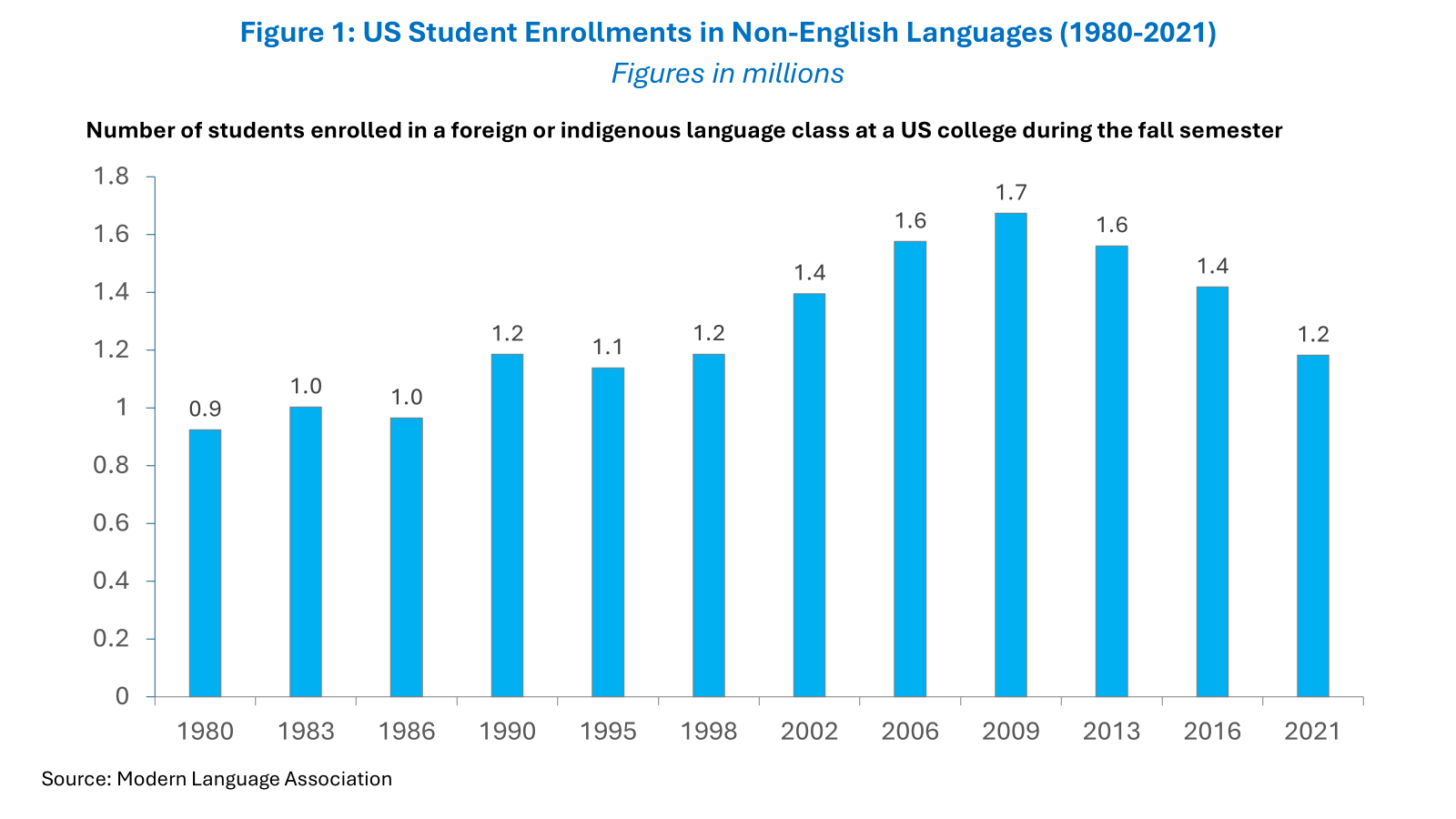
The contraction is visible in the numbers. Between 2009 and 2021, nearly 30 percent fewer college students in the US enrolled in a foreign language course. Russian language programs in American universities have fallen sharply since 2010. Chinese language enrollment briefly surged but then declined since 2018, driven by political suspicion and bureaucratic scrutiny of Confucius Institutes. Hindi, Persian and Turkish studies survive only at a handful of institutions. Most undergraduate programs in “International Studies” now emphasize global governance, human rights and climate change rather than deep area expertise. Students are encouraged to think in universal categories, not to grapple with foreign particularities.
From Pipeline to Flagships: How Incentives Rewired the Hubs

The decline in language training and the reorientation of funding streams do not remain abstract trends. They cascade upward into the very institutions built to convert linguistic and regional mastery into strategic understanding. Centers recalibrate to surrounding incentives such as grant cycles, media salience and Washington’s messaging, thereby substituting high-tempo programming and advocacy for long-horizon scholarship.

This deterioration is most tragically symbolized by the transformation of once-prestigious centers like the Harriman Institute at Columbia University and the Davis Center for Russian and Eurasian Studies at Harvard. During the Cold War, these were the beating hearts of serious scholarship on the Soviet Union and then Russia and Eurasia post-1991. They produced a generation of scholars and diplomats fluent in Russian history, culture and language.

Today, both have become almost unrecognizable and are entirely aligned with the prevailing anti-Russia line in Washington. Rather than fostering nuanced scholarship, they have drifted into ideological activism. The Harriman Institute’s programming, research priorities and guest speakers overwhelmingly echo the US government’s Ukraine narratives. Its intellectual atmosphere, once defined by debate between liberals, conservatives and realists, is now defined by conformity. Russia is no longer studied as a civilization or as a complex historical entity but as a political problem to be solved.

The tragedy is that these institutions once represented America’s intellectual pluralism at its finest. These were places where a young scholar could argue that Russia’s worldview, though different, was legitimate in its own right. Today, that space for intellectual independence has drastically reduced.

The “Ideologization” of Expertise and the Neoconservative Turn

The replacement of real scholarship by ideological conformity has resulted in a chorus of predictable talking points. Russia is “aggressive,” China is “expansionist,” India must “align with the West.” Complex realities are flattened into slogans and the very idea of understanding the “other” becomes suspect. Scholars who advocate dialogue or mutual respect are derided as “apologists”. The late Stephen Cohen faced such treatment in the years following the 2014 Maidan coup in Ukraine.

The political economy of the think-tank world reinforces this dynamic. Funding flows from defense contractors, technology companies and government grants aligned with national security priorities. A young researcher quickly learns that advancing a career requires writing in the idiom of confrontation. Russia is to be condemned, China is to be contained, Iran is to be punished. Nuance is penalized, empathy is suspect. “Understanding Russia” or “engaging China” becomes synonymous with “appeasing authoritarianism.” The very intellectual virtues of objectivity, curiosity and historical imagination that once defined scholarship are now liabilities.

Within this environment, figures such as Fiona Hill and Anne Applebaum have become canonical voices on Russia and Eastern Europe. Both have influence in Washington far disproportionate to their scholarly depth, largely because they reinforce the neoconservative worldview that frames Russia as the perpetual aggressor and the West as the moral custodian of liberal order. Their writings, while rhetorically forceful, are less the products of comparative history, archival or linguistic research than of ideological conviction. They exemplify the shift from scholarship to sermon, diagnosing not to comprehend but to condemn.

By contrast, scholars like Stephen Cohen approached Russia through historical empathy, recognizing its civilizational continuity and its cyclical struggles between centralization and reform. Cohen’s methodology was comparative, historical and dialectical. It sought to understand Russia within its own logic rather than through moralistic templates.

Methods Over Terrain: How US Doctoral Training Crowds Out Deep Regional Expertise

If Washington now rewards slogan over study, a contributing cause is that universities have retooled scholarly formation, prioritizing methods and tempo over languages, archives and long immersion. Since the 1990s, many US Area Studies centers were consolidated into broader ‘global’ units, while leading International Relations (IR) departments increasingly emphasized formal and statistical methods.

The result in many programs has been looser language expectations, thinner country-specific coursework, shorter (often unfunded) fieldwork and greater reliance on English-language secondary sources or datasets when archives or vernacular materials are harder to access. Career incentives also favor rapid publication in high-prestige IR outlets over the slow, cumulative craft of philology, history and ethnography. What often remains is area-adjacent analytics focusing on work about regions rather than scholarship grounded in them.

Contrast this with the Russian model where Area Studies remains a discipline rather than a branding exercise. At the Moscow State Institute of International Relations (MGIMO), the Higher School of Economics and institutes of the Russian Academy of Sciences, multiple foreign languages are compulsory, archival methods and country seminars are core and students are embedded in policy networks that demand granular cultural, legal and historical competence. The pedagogy starts from terrain that includes language, documents and memory. Only then is technique layered on.

By comparison, many US programs privilege technique over terrain, producing excellent modelers who too rarely read the societies they analyze in the original. A system that increasingly prefers technique before terrain produces analysts who model the world better than they read it, thereby creating an imbalance that predictably migrates from dissertations to desks, and from desks to doctrine.

The Consequences: Strategic Blindness and Repeated Failure

The intellectual bankruptcy of American foreign policy has tangible outcomes. The US has repeatedly misread major power transitions of the past three decades. It assumed post-Soviet Russia would become a liberal democracy integrated into the West. Instead, it became a Eurasian power asserting multipolarity. It believed China’s economic rise would lead to political liberalization. Instead, it produced a more confident, centralized and cohesive state. It expected India to align against China. Instead, India pursues its own civilizational destiny.

Each of these miscalculations stems from deficiencies in understanding the civilizational memories of states, their historical traumas, strategic geographies and lived narratives. Washington projects its own categories of liberalism, democracy and deterrence onto societies that operate by different logics. Russian policy is interpreted through the lens of “aggression” rather than security depth. Chinese strategy is seen as “revisionist” rather than civilizational. Indian autonomy is dismissed as “hedging” rather than a coherent tradition of non-alignment rooted in ancient statecraft.

When the intellectual class cannot think beyond its own mirror, policy becomes reactive and moralistic. The US swings between hubris and hysteria, celebrating the “rules-based order” one decade and decrying “authoritarian resurgence” the next. The deeper constants of geography, demography and history vanish from view. This blindness is not inevitable, it is the result of choices made by institutions that abandoned scholarship for ideology.

Toward a Rebirth of Understanding

If America wishes to regain strategic wisdom, it must rebuild the intellectual foundations of global understanding. That means reviving the humanities of geopolitics that embody history, geography, languages and comparative civilizations. Universities should restore Area Studies as a core mission, supported by stable funding rather than episodic grants. Government programs must reward linguistic and cultural fluency, not ideological conformity.

Equally, the policy ecosystem must value independent scholarship. Think tanks should be compelled to disclose funding sources and the media should cultivate voices who actually know the societies they discuss. Exchange programs and long-term residencies abroad, not short study tours, should again become the norm for aspiring diplomats. Most importantly, policymakers must recover the humility to learn before judging.

Understanding does not mean agreement and empathy does not mean endorsement. It means acknowledging that other civilizations think differently and that effective strategy begins with comprehension, not condemnation. Without that, the US will continue to stumble blindly across the world stage, armed with power but bereft of wisdom.

In an age of multipolarity, ignorance is strategic suicide. America needs fewer ideologues and more scholars, fewer “Russia hawks” and more Russia knowers, fewer “China hands” who tweet in English and more who can read Sun Tzu in the original. The restoration of understanding will not come from the think tanks of Washington but from the libraries, classrooms and archives where genuine curiosity still flickers. Only by reviving the disciplines of deep thinking can America hope to recover the lost art of seeing the world as it is, not as it wishes it to be.

  1. US Department of Education, Notice of Non-Continuation of Grant Award, September 10, 2025.
  2. Deborah Cohn, Fewer U.S. college students are studying a foreign language − and that spells trouble for national security, The Conversation, November 16, 2023.

Brian McDonald: China, Russia, peace: the three incompatible visions tearing the West apart

By Brian McDonald, Substack, 11/28/25

The Washington Post gets the symptoms right, but fumbles the diagnosis in Thursday’s piece by Ellen Francis , headlined “Europe strains to speak with one voice as US, Russia decide Ukraine’s fate.” The noise inside the Western camp isn’t really about “values” or virtue, rather it’s concerned with cold hard strategy and geography; and old, stubborn, priorities that won’t go away.

Different blocs want different futures, and they’re all tugging in directions no amount of Atlanticist sermonising can reconcile. That’s the real truth behind every row over Ukraine, Russia, China or military spending. They’re not actually arguing about principle, that’s for irrelevant fanatics in think tanks and over in the hothouse of X.

For Washington the hierarchy is clear and cold: China is the existential problem, the only rival capable of closing the distance. Russia is an irritant… armed, considered volatile, but ultimately regional in its reach. Previous administrations used Ukraine as a tool, a way of punching Moscow hard enough to free America’s hands for Beijing. The trouble is, that trick has been played, and everyone knows it.

Across the water, the current (deeply unpopular) leadership of the Germany–France–UK axis sees things through the harsher lens of proximity and history. Russia is the threat that sits across the fence, whereas China is a profitable abstraction (Poland and the Baltics disagree with this, but they have no real say). Meanwhile, the United States is the security blanket they all clutch at night, praying it won’t be snatched away after the next electoral mood swing in Iowa.

But even this loose alliance buckles under its own contradictions. The Baltics and Poland want Russia ground into the clay. France and Germany want it bruised but still breathing; they will need its resources and huge market again when this is all over. The UK, now reduced to being a freelance actor, wants whatever preserves the illusion that it still matters in the grand game after Brexit.

This is sold as a “united front.” But it isn’t, it’s a choir where every singer insists they’re singing lead.

Then there are the southern Europeans (Italy, Spain, Portugal, Greece, plus the Hungarian and Slovak outliers). They are not closet Russophiles. They are simply grown weary of the endless crusades. What they want is cheaper energy, fewer embargoes, and a foreign policy that doesn’t behave like an unpaid internship for Washington. And above all, no spiritual sequel to the Cold War, this time with China because they’ve all experienced enough imperial hangovers to know how those usually end.

Meanwhile, across the Atlantic, the Americans still harbour the fading hope that Russia might pivot against China. Moscow won’t do this, especially not while the West insists it must get down on its knees first, so the most Washington can realistically hope for is a neutral Russia. That’s not a fantasy because the Kremlin has recently been shown more than a few glimpses of what dependency on Beijing actually means. And it doesn’t like what it’s seen.

So yes, “Europe” strains to speak with one voice because it’s a mishmash of regional interests and no underlying unity of vision or purpose.

In short: Washington wants a China-first strategy, Northern Europe wants a Russia-first strategy and Southern Europe wants peace, cheap gas, and the return of Russian tourists who spend without looking too closely at the bill.

Once you see the map for what it is, a collection of competing anxieties stitched together, the discord starts making sense. Then, of course, there is the final conundrum: Russia itself is just as European as France or Britain (if not even more so the way demographics are headed) and that reality will eventually have to be confronted and accommodated.

Paul Robinson: Homo Postsovieticus

By Paul Robinson, Website, 11/27/25

In my book Russian Liberalism, I noted the tendencies of modern Russian liberals to believe in a version of the ‘Two Russia’s Theory’. In its contemporary manifestation, this theory maintains that there are two Russias – the dark, barbaric masses on the one hand, and the enlightened intelligentsia on the other. The first is conservative, imperialistic, pro-regime, and Asiatic. The second is liberal, peaceful, anti-regime, and European. As Boris Nemtsov put it, “The Russian people, for the most part, are divided into two uneven groups. On part is the descendants of serfs, people with a slavish consciousness. There are very many of them and their leader is V. V. Putin. The other (smaller) part is born free, proud, and independent. It does not have a leader but needs one.”

An associated concept is that of Homo Sovieticus (or homosos for short) – the Soviet Man. According to those who believe in his existence, Homo Sovieticus is a product of the repressive nature of the Soviet system, which created a people replete with negative characteristics, such as subservience, deceitfulness, and national chauvinism. Adherents to the Two Russias Theory see the root of Russia’s problems as lying in the prevalence of Homo Sovieticus, and Russia’s salvation as lying in the replacement of Homo Sovieticus with a new national character, something that requires a thorough process of decommunization. A very similar logic lay behind the Maidan Revolution in Ukraine, many of whose supporters saw it as leading to the elimination of the Sovok (another prejorative word for the Soviet-style person) and his replacement with the European.

With this in mind, it has been interesting of late to read several books which directly impinge on the issue of the Post-Soviet person – Homo Postsovieticus. Is the Post-Soviet Person Homo Sovieticus reincarnated? Or is he/she something completely different?

First off are two books by exiled Russian liberal intellectuals – Sergei Medvedev and Mikhail Shishkin. Unsurprisingly, they are passionate believers in the Two Russias Theory and in the idea that the root of Russia’s problems is the continued dominance of the Soviet personality with all its negative traits. In short, the fundamental cause of Russia’s autocratic political system and aggressive foreign policy is the mentality of the Russian people .

Version 1.0.0

Medvedev reveals his worldview early on his book with the kind of statement that nowadays would probably be considered rather offensive in polite Western liberal circles. He writes: “Russia was the only one of the early empires of the modern era that survived a clash with the West, while all of the others [Aztecs, Incas, Persians, Indians, Chinese, and Japanese] … succumbed to the pressure of a superior civilization.” Russia, in other words, is an archaic non-Western civilization, and its problems derive from its failure to submit to “superior” civilization, i.e. the West.

Thus Medvedev remarks that “Russia is archaic.” The “practice of violence … runs through the whole of Russian society,” he writes, “the people are submissive, inert, fatalistic, and prepared for any sacrifices.” According to Medvedev, Russia suffers from “the immunodeficiency of society and low social capital. … a lack of trust … social atomization and a fragmented and  embittered society. … This is a paternalistic, dependent society. … As a result the individual has developed a disdainful attitude to life.” Medvedev concludes that “Throughout the centuries, Russia has hung over Europe as the heir to the Asiatic hordes from the East,” and that the need to resist the Russian threat is what has created a common European identity. In 1945, he claims, the Allies failed to finish the job – defeating only the Germans, but leaving Russia alone. “It is time for the West to finish the work of 1945,” he concludes.

Mikhail Shishkin similarly desires Russia’s military defeat, and similarly believes in the Two Russia’s Theory and the psychological deficiencies of the Russian masses. He writes:

Russia has been in the unique situation of having its territory shared by two spiritually and culturally disparate nations. Both are Russian, both speak the same language – but mentally they are opposites. One head is furnished with a European education, a love of freedom and the idea that Russia is part of a global human civilization; it believes that the whole of Russian history is a bloody slough from which the country needs to be extricated, before being transformed into a liberal European society. This head refuses to live in a patriarchal dictatorship, and demands freedom, rights, and a constitution. The other head has a traditional view of the world; it believes that Holy Rus is an island surrounded by a hostile ocean, and that only the father in the Kremlin and his iron fist can save this island and its people, and maintain order in Russia.

A few pages later, Shishkin takes up the theme again:

The two “Russian nations” live cheek by jowl on the same streets, but in parallel realities. The majority of Russians are mentally still in the Middle Ages, and believe the zombie box that is television when it is tells them that the fatherland is surrounded by enemies. The rest, however, are too well travelled, too well read, and have surfed the internet. … These Russians take to the street and believe that Putin and his henchmen belong in prison; for the other Russians, the state is sacred and untouchable. The former believe that the country has to be led out of the bloody swamp that is Russian history, and towards a liberal European system. For the latter, only a tsar with an iron fist can guarantee order.

According to Shishkin, “In Russia, reason, knowledge, culture, intelligence and discernment make people unhappy.” There is only one way of out of this mess – Russia must suffer a defeat similar to that suffered by Germany in 1945. The people, of course, may object, “But any historical process is always preceded by an avant-garde. Progressives are ready to fight for democracy, and will take the masses with them.”

But are all these claims about Homo Sovieticus and the psychological failings of the Russian masses true? According to several recent academic studies, no.

A good starting point for a rebuttal comes with Gulnaz Sharafutdinova’s short book The Afterlife of the “Soviet Man”: Rethinking Homo Sovieticus. In this Sharaftudinova charts the development of the idea that communism had created a particular mentality in the people under it, starting with Polish writer Czeslaw Milosz and Bulgarian dissident Georgy Markov. She then examines the originator of the term Homo Sovieticus  – Alexander Zinoviev – before moving onto to perestroika-era Soviet sociologist Yuri Levada, who claimed to have identified the characteristics of Homo Sovieticus by means of a large-scale survey of Soviet citizens.

Levada’s survey work gave the concept of Homo Sovieticus the gloss of scientific legitimacy and proved to be enormously influential. But Sharafutdinova criticizes Levada for relying on discredited theories such as Talcott Parson’s “structural functionalism” and the concept of totalitarianism. She complains that Levada’s work shifts blame for Russia’s problems from the government to the people, and that it is so wrapped up with moralizing language of good and bad that criticizing it has become almost impossible.

Sharaftudinova prefers the work of Soviet sociologist Natalia Kozlova. Whereas Levada relied on the quantitative analysis of survey data, Kozlova engaged in qualitative research, analyzing letters, diaries, letters, and other private documents written by Soviet citizens, in order to gain an understanding of what really made them tick. She came to entirely different conclusions. As Sharaftudinova notes, Kozlova concluded that “Soviet citizens could not be atomized or passive. Instead, they were active participants in making and remaking Soviet society.” From this, Sharaftudinova argues that we must rethink the theory of Homo Sovieticus and recognize “the constancy of human agency” in all human societies.

Another admirer of Kozlova and critic of Levada is British academic Jeremy Morris. In his blog Post-Socialism, Morris has argued that quantitative data can be extremely misleading as a means of judging popular attitudes. Instead, he advocates for an anthropological approach. It is only by living among people and careful observation of them that you can determine what it is they really think. Surveys just tell you how it is that they decided to answer the questions posed, not how they understood the questions, what they meant by their answers, and whether they were even answering honestly.

Morris takes up this theme in his book Everyday Politics in Russia: From Resentment to Resistance. It contains a lot of academic theory, which as a historian not trained in theory, tends to go right over my head. I hope that Morris will excuse me if I have gotten this wrong, but one of the key takeaways seems to be that things in Russia are more complex than simple models of an all-powerful, repressive state and a submissive, inert population would suggest. In his conclusion he comments that people seek out places where they can act autonomously. Because these actions can only be observed “using micro-level methods of ethnographic engagement, the automatic assumption is to dismiss them as irrelevant.” But they are not. Politics at the macro level may have been suppressed, but “the micropolitical struggle continues,” even if only in the form of crafts such as woodworking or knitting. Crochet and painting may not be high politics but they do bring people together and push them “towards actualizing a life of community and autonomy, and a productivist one at that.” This is a community with ethics and sociality, revealing a people who are not quite the passive, unethical creatures of Homo Sovieticus imagination.

Another critic of Levada and the concept of Homo Sovieticus is New York University professor Eliot Borenstein, author of our final book: Soviet Self-Hatred: The Secret Identities of Postsocialism in Contemporary Russia.

In his book, Borenstein, uses contemporary Russian culture – films, TV, novels, poetry, internet fan fiction, and the like – to study several different negative Russian stereotypes – the Sovok, the Vatnik, the New Russian (the nouveaux riches who made their fortunes in the 1990s), and the Orc. These stereotypes reflect a deep post-Soviet identity crisis as well as a sense of shame about what Russia has become. But though the stereotypes reflect a type of self-hatred, they can also be a source of pride. One despises the Vatnik, but nevertheless he (and it is always a he, Borenstein notes) can also be seen as embodying something positive. He may be stupid and drunk, but he is at least patriotic. Thus Borenstein quotes the following poem:

I’m guilty before Europe

Because I’m happy beyond measure at Crimea’s return.

I remember the Crimean Spring,

And am not ashamed of my country.

I’m a vatnik. So those who destroy our monuments

Don’t recognize me.

I’m not ashamed to cry on Victory Day.

I have not forgotten!

I remember!

I am proud!

There is a sort of process of inversion here, in which Russians take the characteristics that Medveded, Shishkin, and those like them despise, and then make them out to be something good. This is particularly well portrayed in Borenstein’s chapter about the Orc. In this, Borenstein makes an interesting argument that Tolkein’s Lord of the Rings is racist. The book features a bunch of “good guys”, who happen to be pale skinned, decidedly Anglo-Saxon, and live in the western part of Middle Earth. And it pits them against a bunch of dark-skinned “bad guys,” who happen to live in the east. Borenstein records that some Russians have interpreted this as being directed against Russia. And indeed, it is true that during the war in Ukraine, the Ukrainians have taken to referring to Russia as “Mordor” and Russians as “Orcs.” And so Russians have inverted it, and in some cases adopted the Orcish label as their own – “Orknash” as Borenstein puts it (echoing the phrase “Krym nash” – Crimea is ours).

Thus, in Russian fan fiction The Lord of the Rings has been portrayed as “Elvish propaganda,” falsely tarnishing the name of Mordor and the Orcs to justify Western Middle Earthish aggression. But as Borenstein points out, taking pride in the Orc is rather different than taking pride in the vatnik or sovok, for the Orc is a lot more violent. Or as Borenstein puts it, “The Orc is the sovok weaponized.”

There is a connection here with my most recent book, about Russian civilizationism. There, I note that liberalism generally rejects civilizationism, and insists on the universal validity of liberal values. Claims to be a distinct civilization are viewed as an excuse used by repressive rulers to justify why they behave contrary to what we consider moral norms of behaviour. But the talk of “Two Russias” and of the Russian masses as paradigms of Homo Sovieticus, and as fundamentally non-European, actually confirms the claims of Russian civilizationists that they are in fact distinct. And this is potentially deeply dangerous. For, if you keep telling Russians that they are an archaic, dark, non-European people, they may turn around and say, “In that case to hell with Europe and everything it stands for.” And if you insist that they are Orcs, and also insist on treating them as such, well, they may decide that Orcs is what they will be.

Strana: Zelensky Losing Control: The Consequences of Yermak’s Resignation

Strana.UA, 11/29/25 (Translation by Geoffrey Roberts)

The head of the Presidential Office, Andriy Yermak, was a key figure in Zelensky’s inner circle, and his resignation will undoubtedly have enormous consequences.

Although Yermak will likely try to maintain his control over the Office of the President by appointing a close associate as the new head of the Office, his resignation ultimately sets in motion Zelensky’s loss of control over the vertical of power.

It turns out that Yermak was actually fired not by his boss (Zelensky), but by the NABU; even before he was charged, the President dismissed his closest associate, following only a search, public outcry, and pressure from opposition politicians. This sends a powerful signal to the entire state apparatus that Zelensky is no longer the “source of power” in the country and cannot guarantee anything even to his closest associates.

Moreover, few believe that Yermak (like Mindych and other figures in high-ranking corruption cases) could have carried out their schemes without the knowledge, consent, or even direct participation of the President.

In other words, a blow to Yermak is automatically a blow to Zelensky, a signal that he too could be accused of corruption at any moment. Especially if lesser figures speak out (and after today’s events, the likelihood of this has increased).

Immediately after the outbreak of the Mindych corruption scandal, Bankova began to lose its levers of political control within the government. Even [Prime Minister] Svyrydenko began to increasingly rely on the opinions of the Servant of the People faction rather than the Office of the Prosecutor General. The SBU and the Prosecutor General’s Office also began to sabotage various “political” instructions from the President’s Office.

Now, all these processes will accelerate dramatically. And the only question is how Zelensky will lose his remaining power.

It could be implemented in a softer form, by shifting the centre of decision-making from Bankova to parliament and the government, but maintaining the dominant position of Servant of the People. This project is being promoted by faction leader Arakhamia and several other people in the presidential team who were negatively disposed toward Yermak.

A source close to Arakhamia in the Servant of the People faction described the group’s vision for the future in a comment to Strana: “After Yermak’s resignation, the Rada will stabilise and calm down. There will be no defections from the faction, which have been much discussed in parliamentary corridors. Everyone will remain in their positions. We will pass the budget with dignity and responsibility.”

Zelensky will also lose political control over the Prosecutor General’s Office, the Security Service of Ukraine (SBU), and the State Bureau of Investigation (SBI) (Yermak coordinated the political work of these agencies, including against the National Anti-Corruption Bureau of Ukraine (NABU)).

But a far more severe scenario is also possible, in which, through a split in Servant of the People, the parliamentary majority is reformed and comes under the control of the “anti-Zelensky coalition” (Poroshenko and MPs close to grant structures, with the NABU on their side). In this case, a vote of no confidence in the government would be passed, and pressure would be exerted on Zelensky to approve the formation of a new Cabinet of Ministers of “national unity,” effectively independent of the president. Such a scenario would essentially lead to Zelensky’s own imminent departure.

But far more important is the potential impact of these events on the war and on the peace negotiations.

Yermak’s resignation and the resulting upheavals within the government will in any case have a significant impact on the country’s governance during the war: budget adoption, energy, defense procurement, and the mood of the military and society.

Zelensky’s own political prospects would also be largely nullified. First, a corruption scandal involving those closest to him. Now, the resignation of a key figure in the vertical of power. All of this significantly reduces the incumbent president’s chances of winning the election.

This means that ratings are gradually becoming a secondary concern for Zelensky. This could, theoretically, make him more susceptible to American pressure regarding key points of the peace agreement, which he has so far refused to agree to (although much depends on the degree of pressure and the bonuses offered).

This also increases the likelihood of a scenario in which, under increasing pressure to make concessions in the negotiations to end the war, Zelensky may decide to resign altogether, and the final negotiations for signing the agreement will be led by the acting president, the speaker of parliament.

Finally, it cannot be ruled out that the system of power will completely collapse and become unmanageable, leaving no one to negotiate peace terms with. But this could have catastrophic consequences for the military situation, and therefore the Ukrainian elite and the West will try to prevent this.