Moon of Alabama, 1/30/26
To read the Quincy Institute Policy Note referenced below, click here.
Anatol Lieven and Mark Episkopos are historians with expertise on Russia who work for the Quincy Institute for Responsible Statecraft. They just published a Policy Note which attempts to answer:
Frequently Asked Questions About the Russia–Ukraine Negotiations.
Unfortunately the answers given miss the mark. They are not founded in reality and do not reflect the positions of the negotiating parties.
The first question the policy note tries to answer is:
“Has Russia made concessions in the negotiation process?”
Its answer:
“Yes. Russia has made significant concessions.
“Russia has agreed to lift all objections to Ukraine’s accession to the European Union, marking a major shift from its position before and after the 2014 Euromaidan revolution.”
Before the Euromaidan putsch the EU was offering an association agreement, not accession or membership, to Ukraine. This would have opened Ukrainian markets to tariff free EU products. At the same time Ukraine had a Free Trade agreement with the Commonwealth of Independent States, i.e. nine former Soviet republics including Russia. At that time some 60% of Ukraine’s foreign trade was with Russia and other CIS countries.
Russia opposed the EU Association Agreement for Ukraine because it would have exposed Russia to EU products without any tariff or custom barrier. It stated that it would have to close the open border with Ukraine if the agreement with the EU were signed. In consequence President Yanukovich of Ukraine had to reject the agreement:
[A] Ukrainian government decree suspended preparations for signing of the association agreement; instead it proposed the creation of a three-way trade commission between Ukraine, the European Union and Russia that would resolve trade issues between the sides. Prime Minister Mykola Azarov issued the decree in order to “ensure the national security of Ukraine” and in consideration of the possible ramifications of trade with Russia (and other CIS countries) if the agreement was signed on a 28–29 November summit in Vilnius. According to Ukrainian Deputy Prime Minister Yuriy Boyko Ukraine will resume preparing the agreement “when the drop in industrial production and our relations with CIS countries are compensated by the European market, otherwise our country’s economy will sustain serious damage”.
After the Ukraine government had paused the Association Agreement, the U.S. and EU activated their proxy forces to launch the Maidan coup to then impose the trade agreement. The violent putsch was successful. Russia closed its open border to Ukraine, the Ukrainian economy, especially its heavy industry, suffered immensely, but the association agreement was signed.
Russia thus did not make a “major shift from its position before and after the 2014 Euromaidan revolution.”
The circumstances on which the position was based have changed. Russia has adopted accordingly. A membership of Ukraine in the EU is by the way still not on offer. It will take a decade or longer after the war for Ukraine to even be marginally qualified.
Lieven and Episkopos continue:
“[Russia] has accepted the principle that Ukraine is entitled to a robust postwar domestic military deterrent. This includes very few qualitative restrictions on the types of weapons Ukraine can possess and a far larger peacetime standing army than Russia demanded during the 2022 Istanbul peace talks. Specifically, in 2022, Russia demanded that the Ukrainian military be limited to 85,000 troops, while current proposals would allow Ukraine to maintain a peacetime military of at least 600,000 and up to 800,000 troops, which would be by far the largest army in Europe.”
The ‘current proposals’ in question are those discussed between the U.S. and Ukraine. Russia is not at all involved in these nor has it agreed on any of the points made in them.
Specifically nowhere has Russia agreed to troop limit of 600,000 or 800,000 for Ukraine. A limit that is by the way higher than the current number of active soldiers in Armed Forces of Ukraine and neither financially nor demographically sustainable.
“During the August 2025 Alaska summit, Russian President Vladimir Putin agreed with President Trump that Ukraine is entitled to substantial, binding security guarantees from Western states, the scope and content of which are currently being negotiated.”
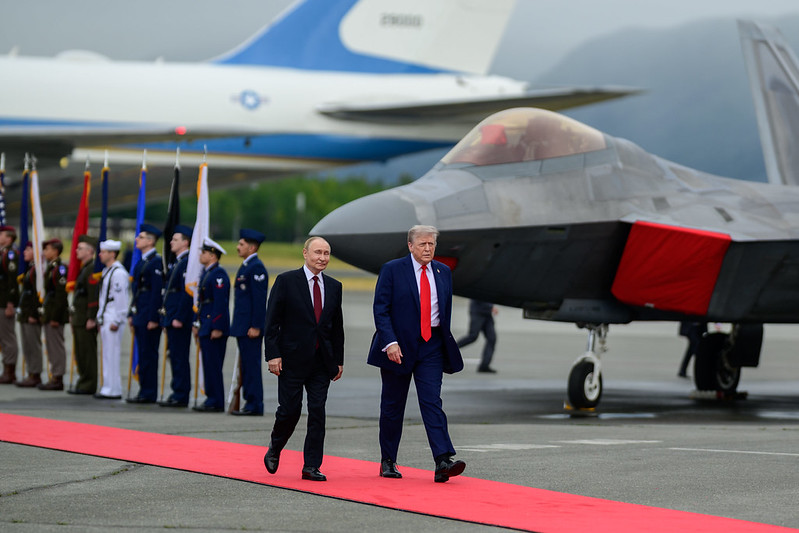
That statement as such is wrong. The link provided leads to the transcript of the press conference held on August 16 2025 after the Alaska summit between President Putin and President Trump. In that statement Putin did not mention any ‘guarantees’. He subordinated Ukraine’s security to a new security balance in Europe:
“[W]e are convinced that, for the conflict resolution in Ukraine to be long-term and lasting, all the root causes of the crisis, which have been repeatedly explained, must be eliminated; all of Russia’s legitimate concerns must be taken into account, and a fair security balance must be restored in Europe and the rest of the world.
“I agree with President Trump. He said today that Ukraine’s security must be ensured by all means. Of course, we are ready to work on this.”
Ukraine’s security must be ensured only after the implementation of a European security balance that satisfies Russia.
Moscow has pared down its September 2022 territorial demands by expressing a willingness to indefinitely freeze the front in Zaporizhzhia and Kherson, abandoning its original goal of conquering these regions.
“Combined, these Russian concessions would permit the establishment of a secure, sovereign, Western–aligned Ukrainian state on approximately 80 percent of its pre-2014 territory.”
I diligently follow the official Russian remarks about the territory in question. Nowhere has Russia or any of its officials said that it had ‘pared down’ its territorial demands. The territories in questions are in their full extend constitutional parts of the Russian Federation.
Lieven and Episkopos ask and answer further questions:
Has Ukraine made concessions in the negotiation process?
…
What are the key outstanding areas of disagreement?
…
Should it be possible to resolve these issues and reach an agreement?
…
… and so on.
On all points that follow the answers given by Lieven and Episkopos are based on unfounded wishful thinking.
Contrary to their fantasies:
-There will be no demilitarized part of Donbas. All of Donbas will be a part of Russia.
-The Zaporizhzhia Nuclear Power Plant is and will continue to be under full Russian control.
-The only country that can give real security guarantees to Ukraine is Russia. They require for Ukraine to be Finlandized.
I am wondering what the Quincy Institute is trying to do with this policy paper.
It gives the impression to those who are not aware of the details that a peace agreement between Russia and Ukraine requires only a little more compromise to be finished and signed.
That is as far from real world reality. There still are fundamental disagreements between Ukraine and Russia. The flim-flam theater of peace talks between the U.S., Ukraine and Europe have yet to involve core Russian demands.
Currently Ukraine is even rejecting (in Russian) to negotiate or sign a peace agreement with Russia. It wants two bilateral treaties but none between itself and the Russian Federation (machine translation):
Ukrainian Foreign Minister Andriy Sibiga said that the construction of a peaceful settlement involves two separate documents: Ukraine will sign a 20-point agreement with the United States (USA), and the United States will sign a separate document with Russia.
He said this in an interview with Evropeyskaya Pravda.
Sibiga stressed that the 20-point document, which is now at the center of the peace process, is a bilateral document of Kiev and Washington.
According to him, according to the same logic, the document with Russia should be signed by the United States.
“If we talk exclusively about this 20-point framework, it is still a bilateral document that will be signed by the United States and Ukraine. Well, with Russia-the United States should sign it. At the moment, such a design is being discussed, but negotiations are still ongoing, this is a process,” he said.
The government of Ukraine also wants a specific sequencing of those bilateral treaties. It demands a treaty with the U.S. about security guarantees before agreeing to any territorial ‘concessions’. This while the U.S. is pressing Ukraine to first make concessions and to only then receive whatever weak assurance the U.S. is willing to offer:
The Trump administration has indicated to Ukraine that US security guarantees are contingent on Kyiv first agreeing a peace deal that would likely involve ceding the Donbas region to Russia, according to eight people familiar with talks.
…
Volodymyr Zelenskyy, Ukraine’s president, had hoped to sign documents on security guarantees and a postwar “prosperity plan” with the US as early as this month, giving Kyiv leverage in future talks with Moscow.
But Washington is now signalling the US security commitments depend on reaching an accommodation with Russia. Ukrainian and European officials described the US stance as an attempt to strong-arm Kyiv into making painful territorial concessions Moscow has demanded in any deal.
If even the U.S. and Ukraine have such fundamental disagreement about basic items how can one expect that there will be any negotiated peace agreement between Russia and Ukraine anytime soon?
We can’t.
This war, as realist John Mearsheimer has asserted for some time, will be decided on the battlefield to eventually end with Ukraine’s capitulation:
“[W]ith regard to working out some sort of peace deal, Trump can’t do it. And the reason Trump can’t do it is because the Ukrainians and the Europeans, on one side, and the Russians, on the other side, are miles apart. There’s no basis for compromise here. And Trump can’t create a basis for compromise. And furthermore, he can’t coerce the Russians into agreeing to Ukraine’s terms, and he can’t coerce the Ukrainians and the Europeans, on the other side, to agree to Russia’s terms.
“So, this one is going to be settled on the battlefield. And what Trump wants to do is he wants to back away, and he wants to turn responsibility for this war mainly over to the Europeans and the Ukrainians. Let them see what happens on the battlefield, and then they could work out an arrangement with Putin. This is the direction that we’re headed in.”
The Policy Paper by the Quincy Institute tries to answer question around a purported peace agreement which is simply not on offer as neither side of the conflict agrees to it. The paper mangles the facts to give the impression that peace is nearly at hand.
It obscures the real disagreements which still need to be laid out and tackled to finally end the conflict.
Like this:
Like Loading...