…Throughout the devastating war and resulting chaos, Ukrainians living along both sides of the frontline have organized communities of informal services to help maintain relative order across the battle-scarred regions. A number of Ukrainians agreed to speak with Responsible Statecraft to share their thoughts on and hopes for a peaceful settlement and the opportunities for Ukraine to secure its future and achieve lasting peace. Pseudonyms have been used to protect the safety of those who agreed to talk with us.
For many Ukrainians who have lost relatives and loved ones, “war is not news headlines—it is everyday life,” says Maria, who lives in frontline northeastern Ukraine, part of which is currently under Russian control.
“The recent change in the U.S. administration and President Trump has sparked hope for a possible resolution of the conflict with Russia and the signing of a peace agreement. The recently published 28-point U.S. peace plan has once again made people talk about the possibility of ending the war,” says Maria who describes herself as an “ordinary woman” living in a frontline region where security is a “key issue.” Facing the daily consequences of war, she hopes for “a ceasefire, silence, and the chance to simply live without constant fear. We want a sustainable, long-term peace — not on paper, but in reality: a peace that saves lives, allows destroyed cities to be rebuilt, and restores a sense of security, dignity, and a future.”
According to a Gallup poll from this past summer, 69% of Ukrainians favored “a negotiated end to the war as soon as possible,” whereas 24% say they “support continuing to fight until victory.” This is a significant shift from 2022, when 73% supported fighting until victory and 22% favored a negotiated resolution as soon as possible.
The most sensitive, unresolved issues concern demands by Ukraine for security guarantees and Russia for Kyiv to cede the remaining territory of the Donbas region under its control. Threading this needle has consumed much of the negotiators’ time and attention over the last several weeks, as ultimately both Moscow and Kyiv need to accept the terms of the agreement.
A December survey by the Kyiv International Institute of Sociology showed that 72% of Ukrainians supported freezing the current front line and providing security guarantees for Ukraine. At the same time, 75% of Ukrainians oppose a proposal to cede the remainder of Donbas to Russia without solid security guarantees.
“Russia should be legally bound to pursue a policy of non-aggression toward Ukraine and Europe, while the United States and Russia should extend their agreements on nuclear non-proliferation and arms control. Ukraine, in turn, reaffirms its status as a non-nuclear state,” says Maria.
Ukrainians’ shared fears are the risk of further escalation of the conflict and the possible unleashing of nuclear weapons. “This prospect is not abstract, it’s a real and deeply personal anxiety for our children, our land, our people, and frightening in a very concrete way—the fear of losing our loved ones, our country dear to our hearts, with its rivers, forests and fields, cities and villages,” Maria says how Ukrainian mothers’ shared common goal is preserving “Ukraine for future generations.”
According to Ivan, who lives in eastern Ukraine under Moscow’s control, the proposals concerning halting further NATO enlargement “are key, as it was the expansion of NATO to the East that became the main trigger for our conflict. Without resolving this issue, it is impossible to resolve others.”
Ivan underscores the importance of the provisions from the original agreement for “promoting understanding and tolerance of different cultures and eliminating racism and prejudice.” He believes the “eliminating racism” phrase must be replaced with “eliminating hatred”, as this “more reflects the situation in the society on both sides of the front line.” He offers the metaphor that “issues of language and religion in Ukraine are abscessing boils, without careful ‘treatment’ of which it is impossible to heal the entire ‘body’ of the state.”
While acknowledging that such a sensitive issue of territorial control will be resolved at the negotiating table, Ivan’s sincere wish is for the voices of those living in territories not controlled by Kyiv to be heard. “Ask them if they want to be ‘liberated’, if they want to return to Ukraine. Most people will answer these questions with an unequivocal ‘no.’ And most of the time, there is no politics in this. People are very tired and brave. And they want peace.”
The proposal that Ukraine hold elections within 100 days of signing the peace agreement, Maria believes, is “necessary,” since trust in the current authorities “remains sensitive.” And holding elections could become “an important step toward renewing public trust.”
For Tatiana, “Ukrainian political elites see that they are being made to pay with Ukrainian lives for a compromise between major powers, yet they do not resist this process.” She offers a grim but accurate assessment of the realities facing ordinary Ukrainians, for whom “this is not true peace but rather a partial transformation into a permanent buffer zone. Still, it represents a halt to the conveyor belt of death, in which people on both sides are killed, and cities are destroyed into lunar landscapes — all for goals that are unclear to anyone and far removed from the daily lives of most Ukrainians.”
“In the end, every side speaks of peace, but means something different by it: the United States seeks a managed exit, the European Union seeks its own security, and Ukraine seeks survival and the right not to be cannon fodder in someone else’s game,” says Tatiana.
For Ivan, the involvement of “representatives of civil society from both sides and experts on specific issues” is critical in addressing the concerns of citizens.
Maxim, who fully supports the 28 points of the Peace Agreement, is deeply committed to peace on his land. He underscores his support for “not only a ceasefire, but also humanitarian issues aimed at protecting and supporting the civilian population on both sides of the conflict.”
Maria agrees with the establishing of “a humanitarian committee to address unresolved issues, including the exchange of prisoners of war and the return of detained civilians.” The underlying concern among all Ukrainians is how the war has divided families; from those living in territories not controlled by the Ukrainian government, to those relocated to western regions where there’s less shelling, and still others who have fled to neighboring countries.
“We need to reunite our families, to have physical access to our loved ones, and to see our husbands, brothers, and fathers return from the frontlines alive and unharmed. We want to focus on rebuilding cities and villages — the restoration of human ties is essential for societal healing,” Maria says.
Newly declassified documents show George W. Bush and Vladimir Putin sought to avert a New Cold War.
Vladimir Putin:…Of course certain differences exist between us. We know about them, but it’s important to cement the positive achievements. This is the way to go…
It is clear that withdrawing from any kind of controls on nuclear warheads is a dangerous thing to do.
George W. Bush: We need to work on that. I’m concerned about transparency on what looks like a nuclear launch and everyone panics. We need to work this out. Let me just say I understand your concerns.
Putin:…A missile launch from a submarine in Northern Europe will only take six minutes to reach Moscow
Bush: I understand.
Putin: And we have established a set of response measures—there’s nothing good about it. Within a few minutes our entire nuclear response capability will be in the sky.
Bush: I know.
Thus began the final meeting between Presidents George W. Bush and Vladimir Putin in Sochi, Russia on April 6, 2008.
Last week, the National Security Archive at George Washington University published newly declassified verbatim transcripts of three conversations between Presidents George W. Bush, Vladimir Putin and their top national security advisers in 2001, 2005, and 2008. The transcripts contain a number of surprises and have significant historical implications, particularly for the rather tarnished reputation of George W. Bush, who emerges as both surprisingly well-informed and well-intentioned (Bush also seemed keenly aware of the danger a John McCain or Hillary Clinton administration would have posed to US-Russia relations, remarking in April 2008, that, “What I’m concerned about is US-Russia relations won’t get any better than what you and I have. History will show it’s very good. I’m not sure about the next group—not Medvedev, but who follows me.”)
For his part, Putin repeatedly expressed his willingness to cooperate with Bush on issues ranging from nuclear weapons, China, North Korea and Iran. It is clear that the current shape of world politics, in which Russia is now strongly aligned with both China and Iran, was in no way inevitable. One example: In order to pressure the hardline Iranian government of Mahmoud Ahmadinejad from pursuing a nuclear weapons program, Putin put on hold a sale of S-300 missiles to Tehran. Bush expressed his appreciation, and Putin went on to note that with regard to the sale, “We have a contract with them signed four years ago but not being implemented.”
Bush: I appreciate that. They’re nutty.
Putin: They’re quite nuts.
Bush: Hopefully rational people will start showing up. You talk to them, we don’t. We hope to have more rational people show up; we’d like to have a better relationship.
Putin: What surprised me when I was there, they may be crazy in their ideology but they’re intellectuals. They are educated in university, come from an academic environment- including Amadinejad, his entourage, the Speaker of the parliament. They are not primitive people. It was quite a surprise to me.
***
The latest round of Ukraine peace talks took place over the final weekend of 2025 in Miami. Despite claims by Trump and Zelensky of great progress, there is little evidence of it. The calculus of the Kremlin has likely hardened in light of the assassination attempt on Putin the day after the Zelensky jetted off from Florida.
The failed negotiations ought to remind of us of two things. First, that President Joe Biden, Secretary of State Antony Blinken, and National Security Adviser Jake Sullivan never seriously considered pursuing a diplomatic off-ramp with the Russians—instead, the record now amply shows they quite consciously provoked the February 24, 2022 full-scale invasion of Ukraine. (The recent inadvertent acknowledgement by former NSC and State Department staffer Amanda Sloat provides more evidence for this conclusion.) Secondly, the newly declassified Memorandums of Conversation between Bush and Putin provide more evidence for what a number of informed analysts have been saying (without much effect) for years: That the New Cold War between Russia and the United States is both dangerous and unnecessary. It was brought about by specific policy choices made by neoconservatives in Congress and their fellow travelers among liberal hawks in the Obama and Biden administrations. Things didn’t have to be this way.
It has become an article of faith among the most rabid American advocates (Michael McFaul, Timothy Snyder, Anne Applebaum, et al.) of the Ukrainian cause that Putin’s decision to invade had nothing whatever to do with NATO expansion. Putin, so the framing goes, is a dyed-in-the-wool Russian imperialist—a génocidaire even, who wishes to extinguish the Ukrainian population once and for all. The new Bush-Putin documents should (but of course will not) put an end to that line of thinking.
In their final meeting, Putin went on at length as to the reasons he was opposed to Ukraine’s membership in NATO.
Putin: Okay. Now I’d like to repeat to you what I said to Condi and Gates in Moscow on NATO enlargement…I’d like to emphasize accession to NATO of a country like Ukraine will create for the long-term a field of conflict for you and us, long-term confrontation.
Bush: Why?
Putin: Seventeen million Russians live in Ukraine, a third of the population . Ukraine is a very complex state. This is not a nation built in a natural manner. It’s an artificial country created back in Soviet times . Following World War II Ukraine obtained territory from Poland, Romania and Hungary – that’s pretty much all of western Ukraine. In the 1920s and 1930s Ukraine obtained territory from Russia — that’s the eastern part of the country. In 1956 [sic – correct year = 1954], the Crimean peninsula was transferred to Ukraine. It’s a rather large European country built with a population of 45 million. It’s populated by people with very different mindsets. If you go to western Ukraine you’ll see villages where the only spoken language is Hungarian and people wear those bonnets. In the east, people are wearing suits, ties and big hats. NATO is perceived by a large part of the Ukrainian population as a hostile organization.
This creates the following problems for Russia. This creates the threat of military bases and new military systems being deployed in the proximity of Russia. It created uncertainties and threats for us. And relying on the anti-NATO forces in Ukraine, Russia would be working on stripping NATO of the possibility of enlarging. Russia would be creating problems there all the time. What for? What is the meaning of Ukrainian membership in NATO? What benefit is there for NATO and the US? There can be only one reason for it and that would be to cement Ukraine’s status as in the Western world and that would be the logic.
I don’t think it’s the right logic; I’m trying to comprehend. And given the divergent views of areas of the population on NATO membership, the country could just split apart. I always said there’s a certain pro-Western part, and a certain pro-Russia part. Now the power there is held by the pro-Western leaders. As soon as they came to power they split within themselves. The political activity there fully reflects the attitudes of the population. The issue there is not accession to NATO, but to ensure the self-sufficiency of Ukraine , Also, their economy should be strengthened.
Seventy percent of the population is against NATO. Condi told me in Slovakia and Croatia the population was opposed at first and they’re now in favor. What we are against is Ukraine’s accession to NATO, but in any case we should wait until a majority of the population is in favor, then let them accede, not vice versa.
Bush: One of the things I admire about you is you weren’t afraid to say it to NATO. People listened carefully and had no doubt about your position…
Putin: I would add another thing now. I do not rule out that Russia-NATO relations could improve in the future, along with US-Russia relations.
I had the same exact reaction when I read Hersh’s piece that came out yesterday. I wanted to write something about it but didn’t have time and Ritter covered it all better than I could have. – Natylie
Seymour Hersh, or Sy to those who know him, is a legendary Pulitzer Prize winning investigative journalist who happens to have a very influential Substack page that has attracted some 233,000 subscribers since he published his first article, “How America Took Out The Nord Stream Pipeline”, back in February 2023.
I’m a big fan of Sy, and for the past 26 years I have been privileged to call him friend.
And it is as Sy’s friend that I am compelled to address his most recent Substack article, “Putin’s Long War.”
Allow me to set the stage.
I’ve had the honor and privilege of interviewing retired Lieutenant General Andrei Ilnitsky, a former senior advisor to Russian Defense Minister Sergei Shoigu. Andrei is a very calm, rational man possessing razor sharp intelligence and deep insights into the reality of the modern world. Andrei is the proponent of a form of informational warfare he calls “Mental War”, which he first publicly detailed in an interview to the Russian military journal Arsenal of the Fatherland in March 2023.
Mental War, Andrei postulates, has its own strategic goals and objectives. “If in classical wars the goal is to destroy the enemy’s manpower [and] in modern cyber wars [it is] to destroy the enemy’s infrastructure,” Andrei says, “then the goal of the new war is to destroy self-consciousness, to change the civilizational basis of the enemy’s society. I would call this type of war ‘mental.’”
Importantly, Andrei notes, “while manpower and infrastructure can be restored, the evolution of consciousness cannot be reversed, especially since the consequences of this ‘mental’ war do not appear immediately but only after at least a generation, when it will be impossible to fix something.”
It is important to point out that the United States has been waging “mental war” against Russia in a concerted fashion since 2009, when President Obama and Michael McFaul colluded on the fiction of a “Russian reset”, which was little more than a policy of regime change disguised as diplomacy.
The “Russian reset” gambit failed because of the crude manner in which it was implemented, will little effort being made to disguise the true objectives of the policy—no one believed that the Russian political opposition was little more than the proxy of the United States, trying to take down the government of Vladimir Putin from within by promulgating a falsified narrative of systemic corruption that even the most cynical Russians failed to embrace. And by dispatching Joe Biden to Moscow in March 2011, the Obama administration ended up exposing its sordid plans for all of Russia to see.
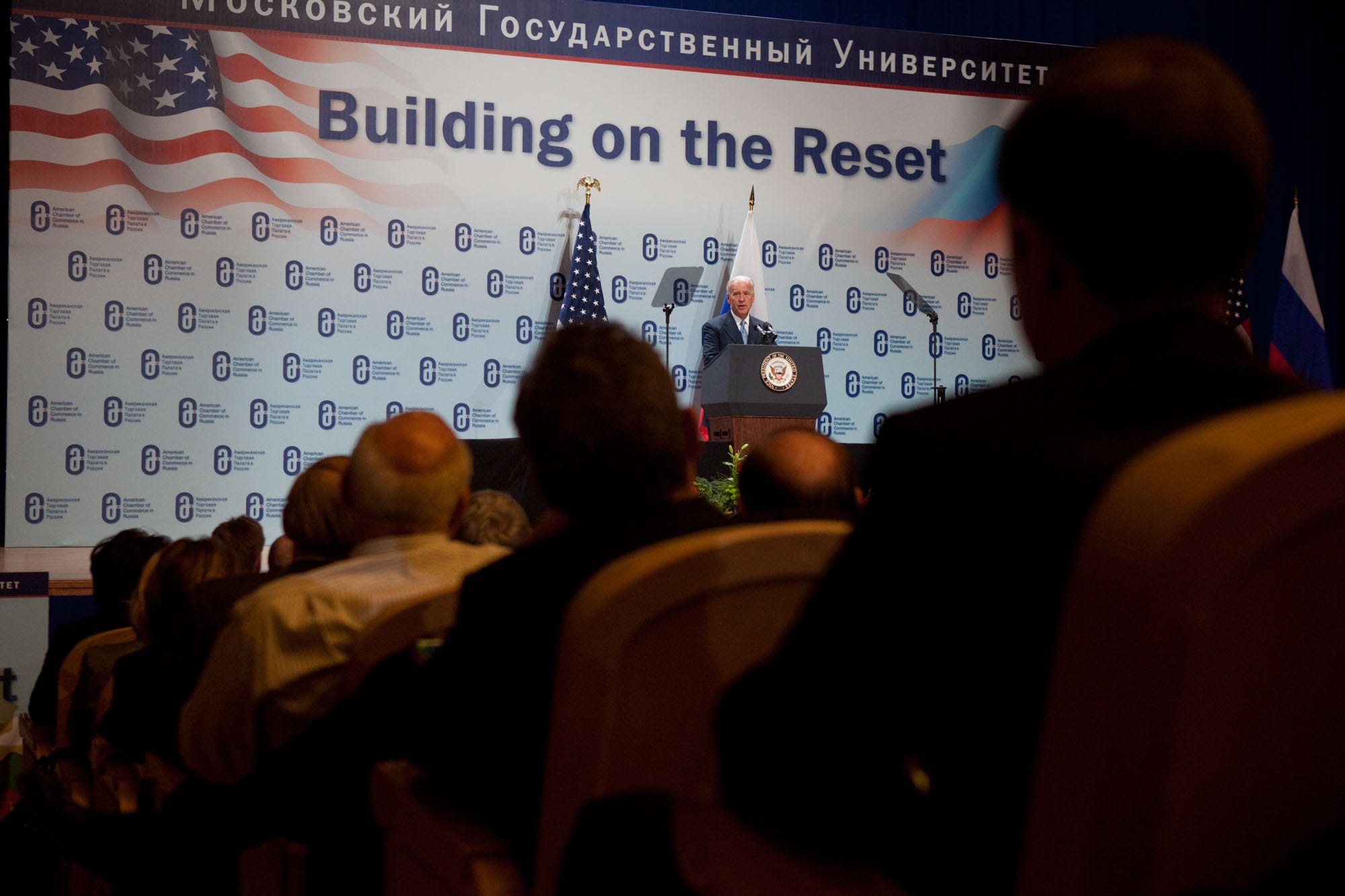
Joe Biden addresses an audience at the Moscow State University, March 10, 2011
On March 10, 2011, Biden addressed an audience at Moscow State University, where he touched on this very reset, framing it as a necessary and natural course correction needed by both countries. “President Obama and I proposed forging a fresh new start by, as I said in the initial speech on our foreign policy, by pressing a restart button, reset button. We wanted to literally reset this relationship, reset it in a way that reflected our mutual interests, so that our countries could move forward together.”
Keeping in mind that the goal of “mental war” is to destroy self-consciousness and change the civilizational basis of the targeted society, then Biden’s speech begins to take on a whole new character. “Consider the following statistics, or polling,” Biden told the assembled students. “In December of 2008, one month before we were sworn in as President and Vice President, polling showed that only 17 percent of all Russians had a positive opinion of the United States—17 percent! This year, that number has jumped to over 60 percent. Our goal is to have it continue to climb.”
In short, Biden was manufacturing Russian consent for the goals and objectives of the Obama administration, planting the notion that a majority of Russians were in favor of the changes he was promoting.
Biden echoed the past focus on market economics that drove US policy in the decade of the 1990’s, following the collapse of the Soviet Union. “American venture capitalists and other foreign investment is flowing into the Russia’s economy to allow it to diversify beyond your abundant natural resources—metals, oil and gas—and help Russian start-ups get their ideas to market,” Biden said. “Those of you who are studying business know that it’s one thing to have an idea, it’s another thing to get to market. It takes people willing to make a gamble, make an investment, make a bet.”
Biden was clearly insinuating that America was ready to take a gamble of Russia.
But there was a catch. “This is one of the reasons the President and I so strongly support Russians accession to the World Trade Organization,” Biden declared. “Accession will enable Russia to deepen its trade relations not only with the United States, but the rest of the world. And it will give American companies a greater and more predictable—important word, predictable—access to Russia’s growing markets, expanding both US exports and employment.”
Then the other shoe dropped.
“I think that’s why so many Russians now call on their country to strengthen their democratic institutions,” Biden said, before listing a series of conditions.
“Courts must be empowered to uphold the rule of law and protect those playing by the rules.”
“Non-governmental watchdogs should be applauded as patriots, not traitors.”
“And viable opposition—and public parties that are able to compete is also essential to good governance,” Biden added. “Political competition means better candidates, better politics and most importantly, governments that better represent the will of their people.”
There was more. “Polls shows that most Russians want to choose their national and local leaders in competitive elections.” Once again Biden referred to polls, as if these ideas he was espousing came from the Russians themselves, and not CIA overlords who manipulated the polls Biden was quoting to create just this perception. “They want to be able to assemble freely, and they want a media to be independent of the state. And they want to live in a country that fights corruption.”
Mental War.
“That’s democracy,” Biden declared. “They’re the ingredients of democracy. So I urge all of you students here: Don’t compromise on the basic elements of democracy. You need not make that Faustian bargain.”
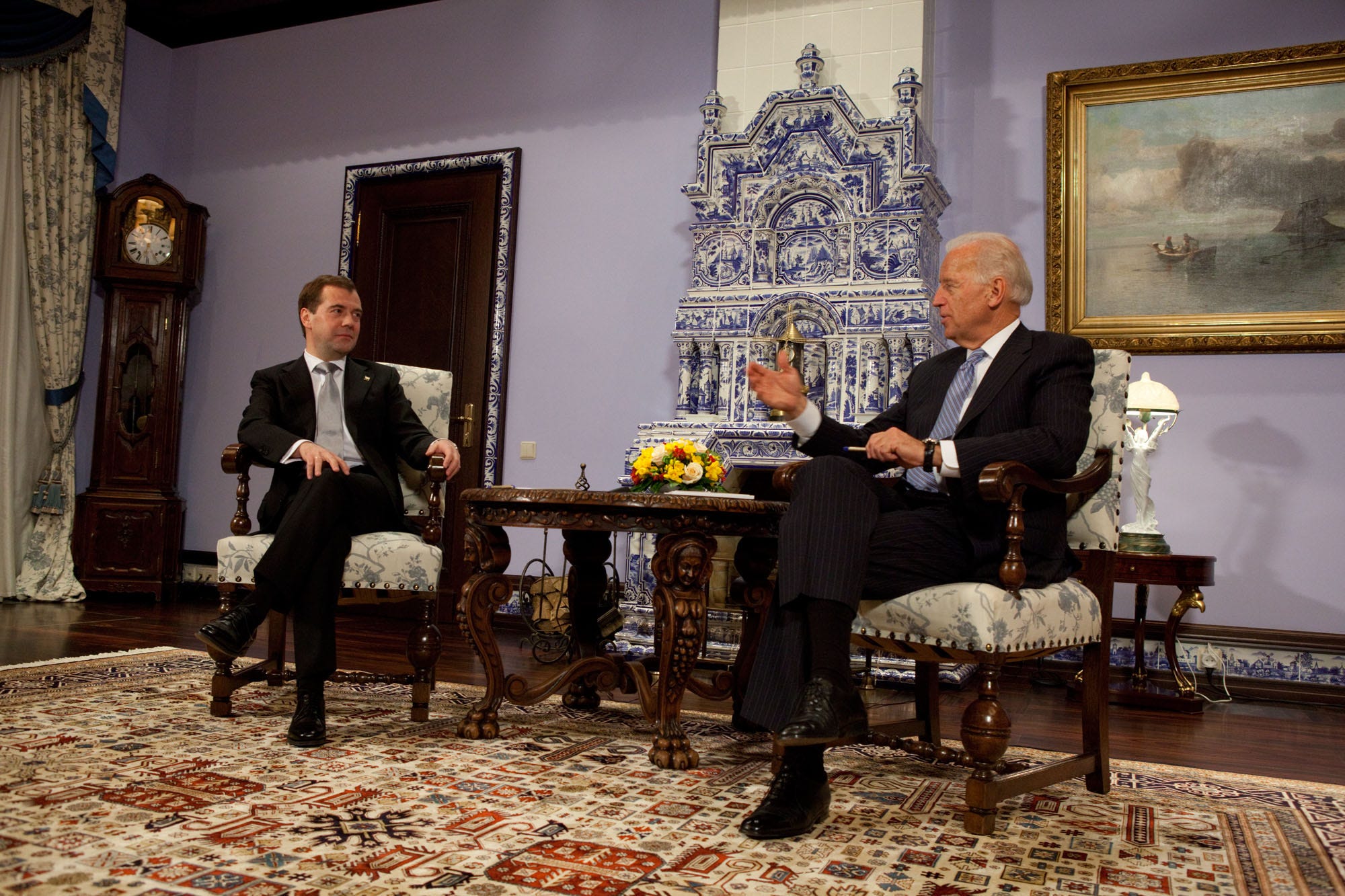
Joe Biden meets with Dmitri Medvedev, March 9, 2011
And again, the audience was told that these were Russian ideas. “And it’s also the message I heard recently when President Medvedev said last week—and I quote him—“freedom cannot be postponed.” Joe Biden didn’t say that. The President of Russia said that.”
And again. “And when Deputy Premier and Finance Minister Kudrin said that ‘only fair elections can give the authorities the mandate of trust we need to help implement economic reforms.’ That’s a Russian leader, not an American leader.”
“Russia and America both have a lot to gain if these sentiments are turned into actions,” Biden concluded, “which I am hopeful they will be.”
The curious thing about Biden’s speech is that it was almost immediately able to be compared and contrasted with remarks he made later the same day to Russian opposition leaders in a private meeting at the US Ambassador’s Spaso House residence.
Forget the Russian people forging their own way forward on their path to democracy—the Obama White House openly opposed a third presidential term for Vladimir Putin, with Biden telling the assembled political opposition that it would be better for Russia if Putin did not run for re-election in elections scheduled for March 2012.
According to Boris Nemtsov, one of the main political oppositionists whom Biden was seeking to empower through his visit , “Biden said that in Putin’s place he would not stand for president in 2012 because this would be bad for the country and for himself.” A report in Nezavisimaya Gazeta, a Moscow daily newspaper openly sympathetic with Russia’s political opposition, published a week before Biden’s visit, stated that the American Vice President’s main goal for visiting Moscow was to press Russian President Medvedev into seeking re-election, thereby squeezing out Vladimir Putin, whom the report said would be offered as consolation the presidency of the International Olympic Committee.
This was the essence of Biden’s mission—regime change disguised as American diplomacy.
Biden’s mission ultimately failed—Vladimir Putin was elected to a third term in elections held in March 2012 where he received 64% of the vote with 65% turnout (by way of comparison, Barack Obama won the 2008 US Presidential race with 53% of the vote, and just under 62% turnout.)
But it has been the goal of the United States since that time to bring down Vladimir Putin, to collapse Russian society, and to return Russia to the status it held in the 1990’s as a defeated nation completely subordinated to the will and direction of the United States.
The messaging that is attached to these goals is consistent with those articulated by Joe Biden in March 2011—that the key to Russian prosperity is its absorption into a market economy controlled by the United States, and that the necessary precondition to gaining access to the venture capital and market expertise offered by the United States is the removal of Vladimir Putin from power.
Which brings us to the issue at hand—Sy Hersh’s latest piece, “Putin’s Long War.”
Sy has long been critical of Russia’s actions in Ukraine.
This, of course, is his prerogative.
And Sy is no Russophobe—I have known him for more than quarter century, and I have always found him to be balanced in his approach to covering matters pertaining to Russia, including those that address Russia’s leader, Vladmir Putin.
But Sy is a reporter, which means he is in many ways a prisoner of his sources. His journalistic instincts have proven him right many more times than they have failed him. In the Netflix documentary Coverup, which came out last year, Sy is asked about his reporting style, which relies heavily on unnamed sources. “People, for a lot of reasons,” Sy said, “they talk. They talk to me.” The key, Hersh noted, “was get out of the way of the story.”
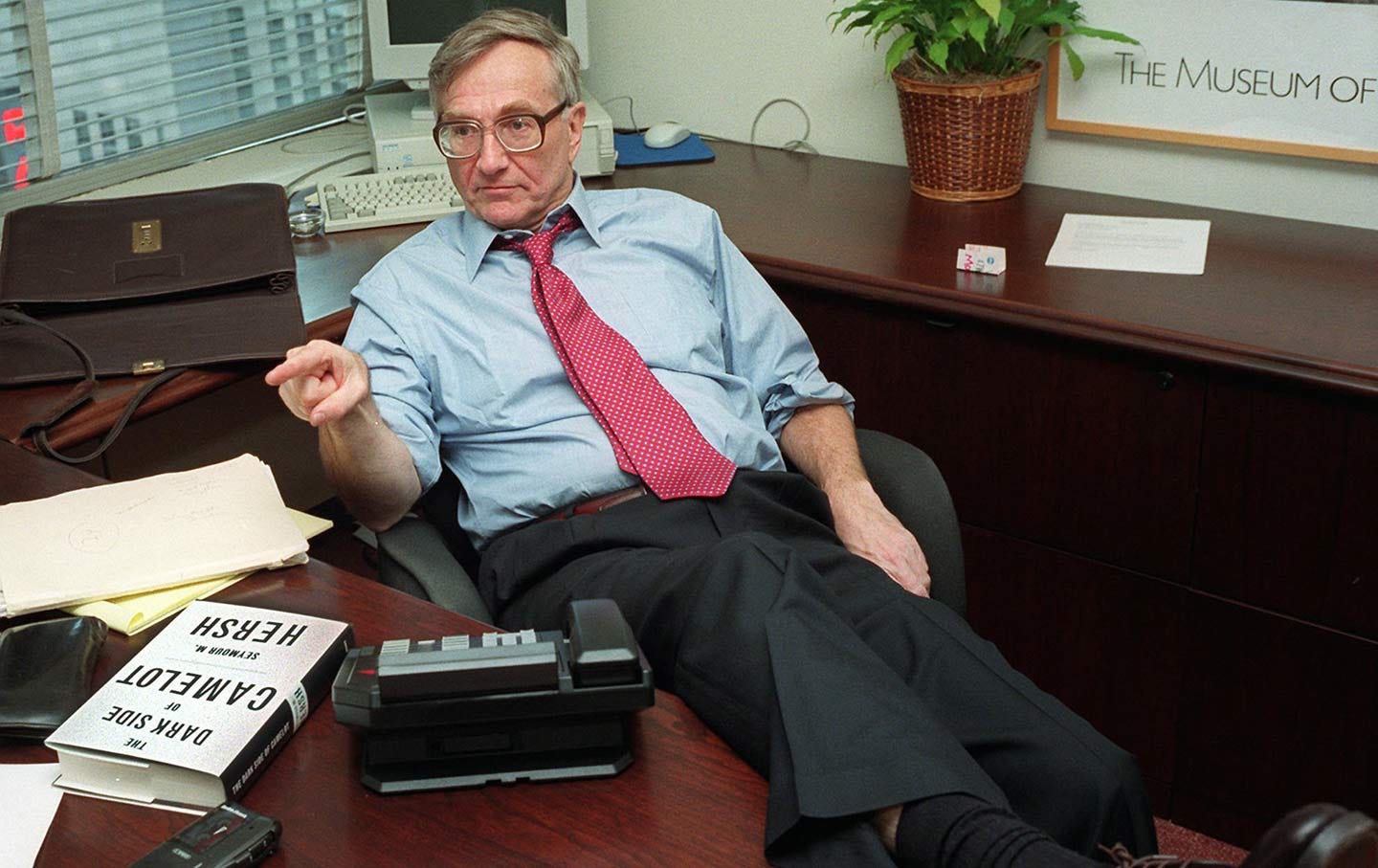
Seymour Hersh and his book, The Dark Side of Camelot
But there were times when a reporter needs to jump in front of a story, or else it will get away from him like a runaway train. This was the case of a sensational book Sy wrote about John F. Kennedy titled The Dark Side of Camelot. Sy had incorporated material into the initial draft of the book which was derived exclusively from documents he received from Lawrence X. Cusack Jr. These documents turned out to be forgeries, forcing Sy to remove a complete chapter from his manuscript, as well as making additional changes to the rest of the manuscript. Cusack was later convicted of fraud, and sentenced to nine years in prison.
It should be noted that Cusack’s fraud was detected because of the due diligence Sy Hersh conducted in an effort to confirm the information contained in the documents—outstanding journalistic practice of the sort one would expect from a winner of the Pulitzer Prize.
In his most recent article, “Putin’s Long War,” Sy could have benefited by getting in the way of the story, and conducting some rudimentary due diligence.
This is because, in my opinion, Sy’s sources—”US intelligence officials” who have “been involved in Russian issues for decades”—are spoon feeding Sy information about Russia that is as fraudulent as anything contained in Cusack’s documents.
First and foremost, if your source is an intelligence official focused on Russia for “decades”, then their entire career has been centered on the issue of discrediting and undermining Russian President Vladimir Putin, who has been in power now more than a quarter century.
It also means that they were more than likely involved in the “Russian reset” regime change operation orchestrated by the Obama administration, and spearheaded by Joe Biden.
This alone mandates that a heavy bit of skepticism be maintained when dealing with any information such a source may provide about Russia.
But then there is the “smell test.” There was a time when Sy would call me up and bounce ideas off me, some of which tested information that was provided by his sources. I remember one time, early in the Afghanistan War, when Sy called about some Special Operations missions being conducted in Afghanistan. He described the actions of Delta Force, an elite Army commando unit, but used the terms “Company”, “Platoon” and “Squad” when describing them.
“Are these direct quotes?” I asked.
Yes, Sy said.
“And your source claims he is with that community?”
Again, Sy responded in the affirmative.
“He’s not Delta”, I said of the source.
Delta operators, I explained, operate as part of a Squadron, Troop, and Team, and any discussion of their operations would make use of such terminology.
Sy pressed the source, and discovered the truth—he was not who he claimed he was.
I just wish Sy had called me about his Russia story.
Not only is the provenance of the claims set forth in article questionable—the US intelligence community is composed almost entirely of Russophobes dedicated to spreading misinformation about Russia and its leader—but the actual data defies belief.
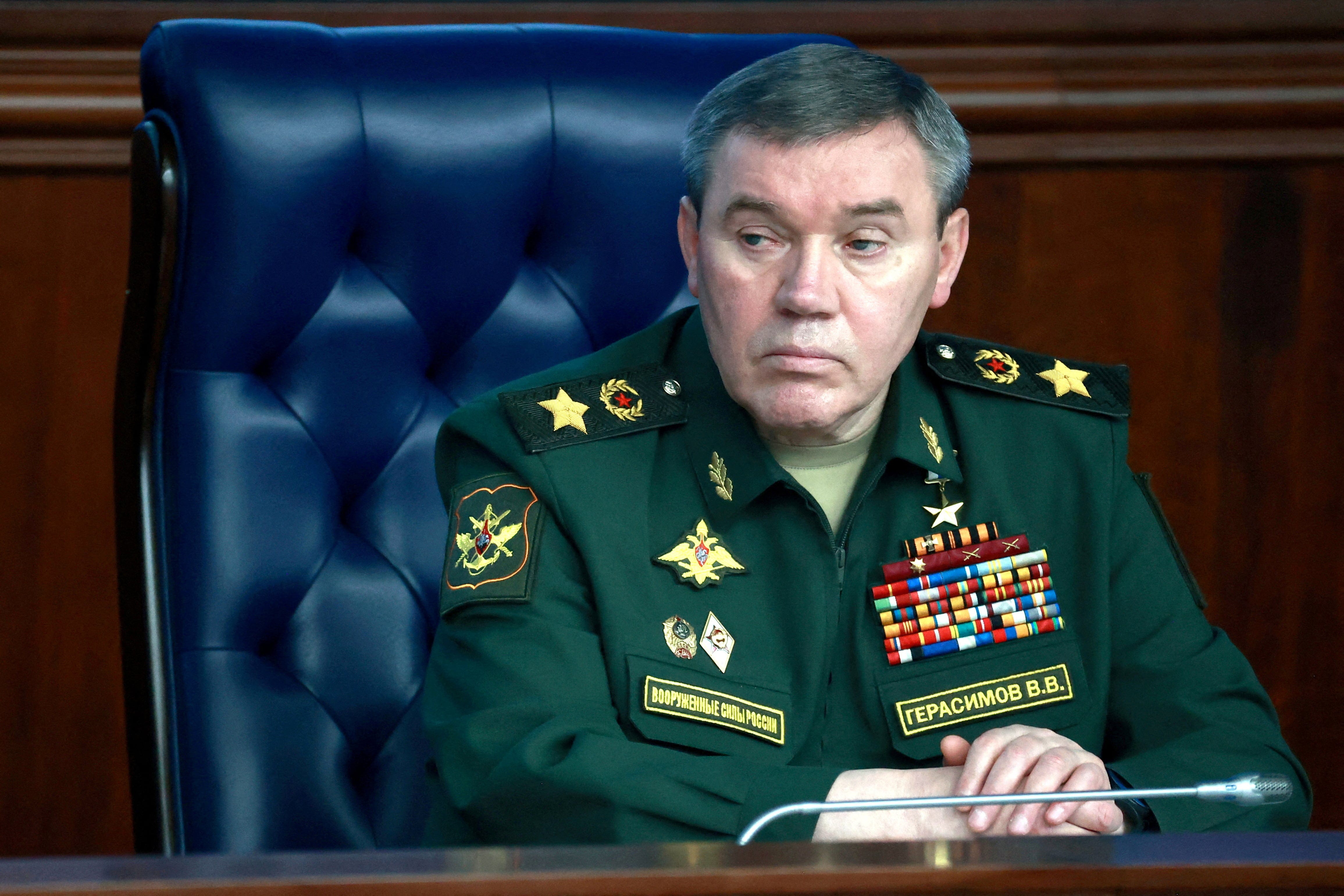
General Valery Gerasimov
At one point in the article Sy, quoting this “official”, quotes Russian General Valery Gerasimov, the Chief of the Russian General Staff, as lamenting “I no longer have an army. My tanks and armored vehicles are junk, my artillery barrels worn out. My supplies intermittent. My sergeants and mid-grade officers dead, and my rank and file ex-convicts.”
It is highly unlikely—indeed, nigh on impossible—that Gerasimov ever said such a thing. This is the highest ranking officer in the Russian military, and a close and personal confidant of the Russian President. Such a statement from a man in his position, even if true, would be tantamount to treason.
The main problem, however, is that the points ostensibly being made by Gerasimov are not only contradicted by reality, but—which is something Sy should have picked up on—match trope for trope the propaganda points being put out by the Ukrainian government and its supporters in the West—including the US intelligence community, which helps write most of them on behalf of the Ukrainians.
The Russian army is widely recognized as the most lethal combat force on the planet today.
Russian tanks and armored vehicles have been shown to be far more survivable than their western counterparts.
While Russia once had a minor supply issue regarding artillery barrels, this is no longer the case—Russia has sufficient production capacity and, moreover, the nature of the war today, where drones have not only taken over a significant part of the front-line fire support duties and responsibilities, but also locate and provide direct observation of Ukrainian targets which are destroyed using precision fires, obviate the need for the kind of massed fires that wore out Russian artillery barrels in the early phases of the conflict.
The Russian army is one of the best supplied combat forces in the world, and the practice of rotating troops out of the front lines, resting them, refurbishing them, and training them on the latest techniques ensures Russia maintains a qualitative edge over their Ukrainian counterparts.
Russian casualties are but a fraction of those inflicted on the Ukrainian military, and the Russian NCO’s and mid-grade officers are thriving, not dying.
Yes, the Russian army makes use of convicts, but they are a tiny fraction of the tens of thousands of volunteers who fill the ranks of the Russian army every month.
I don’t know how many times Sy’s source has been to Russia, or whether or not the source has been to Russia since the Special Military Operation began.
I’ve been five times, including travel to Crimea, Kherson, Zaporozhia, Donetsk, and Lugansk.
Men who have served, and are currently serving, on the front lines.
The Author (left) interviewing Lt. Gen. Apti Alaudinov (right), August 2025
I’ve travelled Russia extensively.
I’ve spoken with people intimately involved in the Russian economy.
Literally nothing Sy’s source says rings true.
The idea of their being a viable political opposition to Vladimir Putin that seeks to promote his downfall is as absurd as the day is long.
And the fact that Sy drew upon the reporting of two vehemently anti-Putin activists who are in self-imposed exile from Russia only underscores the fundamental weakness of his reporting in this regard.
Alexandra Prokopenko was a minor official in the Russian banking industry who fled Russia after the Special Military Operation began, taking refuge in the Carnegie Russia Eurasia Center in Berlin. The Carnegie Russia Eurasia Center is headed by Alexander Gabuev, who leads a team of analysts who were formerly part of the Carnegie Moscow Center, which was forced to close by the Kremlin in early 2022, after nearly three decades of operation, because of its status as an “undesirable” activity funded by foreign sources of money derived from entities hostile to Russia.
Prokopenko and the others continue their openly anti-Russian activities in Berlin today.
Alexander Kolyandr is a Senior Fellow with the Democratic Resilience Program at the Center for European Policy Analysis, an openly Russophobic public policy institution headquartered in Washington, DC that promotes a trans-Atlantic (i.e., NATO) agenda.
Both Prokopenko and Kolyandr are Ukrainian.
They co-author a weekly report, Inside the Russian Economy, where they consistently promote a narrative that is negative on Russian economic health. Their most recent column, published on January 17 and to which Sy apparently references, is titled “Russia’s hidden economic weak points: What to watch in 2026.”
Inside the Russian Economy is a feature in the online Russian independent economic news outlet, The Bell, founded by a trio of anti-establishment Russian journalists, Irina Malkova, Petr Mironenko, and Elizaveta Osetinskaya, who today operate in exile from the San Francisco Bay area.
Sy reports that Prokopenko and Kolyandr’s January 17 article was “circulating in some government offices in Washington.”
This is a meaningless observation, which seeks to give credibility to a source that has zero credibility when it comes to the reality of Russia and its economic performance. Long-range sniping done by people physically disconnected from Russia, and intellectually programed to find anything negative about Russian economic performance, is not the standard that one is normally looking for when seeking fact-based analysis about complex issues. This past November I spend 19 days in Russia meeting and interviewing experts on the Russian economy. Sy would have benefited from the insights these experts had on what is really going on economically in Russia, instead of breathing life into Russophobic tropes designed to promote a larger picture of a Russia in trouble, where “disillusionment and resentment are increasing” and Vladimir Putin is facing “increased domestic unrest.”
Sy has been writing on Russia and the Ukraine conflict for some time now, and I have had similarly negative reactions to those articles and their over reliance upon unnamed sources who claim to have special access to Russian policy questions, but exhibit absolute ignorance about Russian reality. So why have I chosen to bring attention to this article at this time?
To be honest, this is not something I wanted to do. Sy is a very good and close friend, and this will always be the case. But the fact is Sy is being played by forces within the US government who are waging “Mental War” against Russia. Normally, such an argument would be mooted by the fact that Russia is not normally responsive to western propaganda published in western outlets, if for no other reason that pushing Russophobic nonsense on an inherently Russophobic audience serves the same function as a self-licking ice cream cone, “analysis” that exists primarily to justify its own existence.
Kirill Dmitriev
But since the Alaska Summit of August 2025, there is a new dynamic that alters how this western propaganda is viewed by Russians inside Russia. The so-called “Spirit of Alaska” has taken on a life of its own, with the prospect of economic prosperity linked to the negotiated end of the Russian-Ukrainian conflict increasingly resonating within certain circles of Russian economic and political elites. A critical aspect of this “Spirit of Alaska” is the ongoing dialogue between Kirill Dmitriev, President Putin’s designated interlocutor with Trump’s point man on Russia, Steve Witkoff. This dialogue, extensively promoted by Dmitriev, focuses on the economic benefits that will accrue for Russia once the war with Ukraine ends and economic relations with the US begin.
Perhaps unwittingly, Dmitriev has helped create the very psychological impressions on the Russian people that Joe Biden attempted back in March 2011, when he extolled the benefits of American venture capitalists investing in the diversification of the Russian economy from being focused simply on how to extract its natural resources, to bringing these resources to market.
But the “Spirit of Alaska” economic boom is predicated on the same thing Biden’s promise of a better Russian future hinged on—the removal of Vladimir Putin from office.
The “Spirit of Alaska” is simply the Biden regime change policy reimagined under Donald Trump.
The goal isn’t to convince those who already hate Russia to hate Russia more, but rather to impress upon a critical segment of Russian society that all is not well, and that the solution lies in deep and meaningful political change at the top.
This is where Sy Hersh comes in.
He is a Pulitzer Prize winning investigative journalist held in high regard by the Russians, especially after his reporting on the destruction of the Nord Stream Pipeline.
Sy has credibility within Russia, and as such, his reporting is read by many in Russia inclined to view his writing in a positive fashion. If a journalist like Sy Hersh commits to a given narrative, the American practitioners of “Mental War” believe, then that narrative has a chance of taking hold inside Russia, creating societal tensions that could potentially be exploited by foreign intelligence services hostile to Russia, including the CIA.
Sy’s reporting is being hijacked by sources whose real purpose is to seed ideas and information into the public discussion, creating an echo chamber in the West that reaches back into Russia, where it is used to fuel resentment, dissent, and opposition.
Sy has become a tool of regime change in Russia, a role I believe he neither sought out, or believes he is playing.
But as an old Russian hand myself, who has been watching the games played by the US intelligence services inside Russia for some time now, this is precisely the role Sy is playing, something his sources and their handlers intended when the decision was made to put the sources and Sy together for this reporting.
I have been approached by several old Russian hands about Sy’s most recent article. At least one has reached out to Sy directly about this article, to no avail.
I believe Sy’s new article is harmful to Russia, because what it reports simply is not true.
It is bad for peace because it gives life to the false hope that Russia is teetering on the bring of economic and political collapse, thereby encouraging the Ukrainians and their western supporters to keep dragging the war on, despite the horrific losses (economic and human) being sustained by Ukraine.
It is bad for journalism if for no other reason than it is bad journalism—the sourcing is suspect, and the underlying analytical framework weak.
But most importantly for me personally, it is bad for my good friend, Sy Hersh. The man who broke the story of My Lai and Abu Ghraib, the intrepid investigative journalist who graced the pages of the New York Times and The New Yorker back when both outlets were deemed to be credible journalistic institutions, should not allow his name to be attached to what is clearly a propaganda exercise designed to destroy Russian self-consciousness and change the civilizational basis of Russian society—in short, to wage “Mental War.”
Sy Hersh, long the gold standard for truth in journalism, should not allow his reputation to be tarnished by becoming a weapon in the “Mental War” being waged by intelligence operatives in Washington, DC against Russia.
And yet, by publishing his article, “Putin’s Long War”, this is exactly what has happened.
The Sy Hersh that I know and love, the man I call friend, would never allow himself to be used as a cheap propogandist.
I just want to bring this to the attention of my good friend, and hope that he acts accordingly.
I vividly remember a moment from a graduate seminar in international relations theory that I took at Columbia University in the early 2000s. It was taught by the late Professor Kenneth Waltz, one of the most consequential minds of twentieth-century international politics and the architect of the school of structural realism. I recall the setting. It was late afternoon in March, the light already beginning to fade outside. Eight of us students sat in close proximity around the eminent professor, listening as he spoke without notes, without flourish. There was an unhurried seriousness to the discussion. We moved deliberately through his ideas – structure over intent, power over rhetoric, limits over ambition – and wrestled with the larger questions of an emerging post-September 11 international order and the crises of the time.
It was early 2003. American forces were in Afghanistan, the invasion of Iraq was imminent, and although few yet recognized it, the limits of American power were about to be tested. The United States stood at what many believed was the apex of history – triumphant after the Cold War, unchallenged by any peer rival and convinced it was experiencing what Charles Krauthammer famously called the “unipolar moment”.
Yet, Waltz was unimpressed. With characteristic calm, he warned that empires do not collapse because they are weak, but because they become too powerful. An empire, he argued, is an entity that accumulates such vast power that it must continually seek external venues to project it. Power, once amassed beyond what is necessary for defense, demands use. Over time, this compulsion to project power outward becomes unsustainable. Costs accumulate, resistance hardens, domestic foundations erode and decline begins – not suddenly, but structurally.
Waltz walked us through history – the Mongols, the Romans, the Ottomans, the British Empire, the Soviet Union. Each believed itself exceptional. Each believed its dominance reflected permanence rather than circumstance. Each ultimately faded into history. The United States, he cautioned even then, was not exempt. More than two decades later, that warning reads less like theory and more like diagnosis.
Empire, Overstretch and the Structural Logic of Decline
Empires do not fall overnight. Their decline is a gradual unraveling of the foundational pillars of economic vitality, political coherence, military credibility and moral legitimacy. What realism teaches is that decline is not primarily a moral failure, it is structural.
Paul Kennedy articulated this with devastating clarity in his seminal work The Rise and Fall of Great Powers. His core thesis of “imperial overstretch” holds that when a state’s military commitments expand beyond the capacity of its economic base to sustain them, strategic failure becomes inevitable. Military power cannot indefinitely substitute for economic health at home. Eventually, the imbalance asserts itself.
Waltz’s structural realism complements Kennedy’s materially grounded analysis of imperial power. A system dominated by one state becomes unstable not because others are aggressive, but because power itself invites resistance. As Waltz observed, unbalanced power leaves weaker states little choice but to combine against the dominant one. Hegemony, in this sense, plants the seeds of its own unfolding. From Vietnam to Iraq, from Libya to Afghanistan, the American pattern has been consistent in that overwhelming force is deployed in pursuit of political outcomes it cannot sustain.
From Influence to Possession: Venezuela as a Turning Point
If earlier American excesses could still be framed, however implausibly, as misguided attempts to preserve order, recent developments mark a qualitative shift. The US seizure of Venezuelan President Nicolás Maduro represents not another intervention, but a transition from influence to possession.
This shift was openly acknowledged by President Trump himself. In the press conference that followed Maduro’s abduction, he stated bluntly that the United States would “run” Venezuela. The language is striking not merely for its aggression, but for its candor. There is no pretense of multilateralism, no invocation of international law, no claim of humanitarian necessity. This is empire speaking plainly.
Trump’s threats have not been confined to Venezuela. He has openly floated or threatened coercive action against multiple sovereign states: Colombia, Mexico, Cuba, Iran, Nigeria, Denmark (via Greenland) and Venezuela itself. This is not rhetorical excess but doctrinal candor, treating sovereignty as conditional and force as routine.
The “Donroe Doctrine” and Hemispheric Enclosure
Trump went further still by explicitly renaming the Monroe Doctrine the “Donroe Doctrine”. The original Monroe Doctrine, for all its imperial implications, was framed defensively as a warning against European recolonization of the Americas. The “Donroe Doctrine” strips away even that fig leaf. It asserts that the Western Hemisphere is not merely a sphere of influence, but an exclusive American domain in which Washington will deny extra-hemispheric competitors, explicitly framed by the administration in terms of China and Russia, the ability to base forces or control strategic assets.
Facing declining leverage globally, the United States is attempting to lock down what it still believes it can dominate absolutely – its near abroad. That is not the behavior of a confident hegemon, but one fortifying imperial red lines as its outer perimeter weakens.
Crucially, hemispheric consolidation does not imply a reduction in American ambitions toward Russia and China. Quite the opposite. Even as Europe is rhetorically de-prioritized, the United States remains committed to containing both powers simultaneously, despite the structural contradiction it entails.
Russia and China possess overwhelming military power in regions that are existential to their security – the post-Soviet space for Russia, the Western Pacific for China. Structural realism predicts that great powers will fight hardest, and most successfully, in precisely such theaters. This logic was anticipated by George F. Kennan, the architect of America’s Cold War containment strategy, who warned in 1997 that NATO expansion would be
“the most fateful error of American policy in the entire post-Cold War era”1,
precisely because it ignored how great powers respond when their core security interests are challenged. Russia’s imminent victory in the US-led proxy war in Ukraine is a clear illustration of this principle. Yet, US strategy continues to challenge both states in their core zones while asserting absolute dominance in the Western Hemisphere. This is not balance-of-power logic. It is imperial denial.
Military Power Without Strategic Victory
The United States still commands unparalleled military resources in the form of hundreds of overseas bases, a defense budget exceeding that of the next ten countries combined, and technological superiority across multiple domains, from precision strike and global surveillance to cyber and space. By any material measure, American military power remains immense. Yet, power measured in hardware increasingly fails to translate into strategic success.
The contradiction between US military capacity and strategic outcomes is no longer theoretical. It is empirical. The United States was defeated in Vietnam, despite overwhelming technological superiority. In Korea, Chinese intervention pushed US forces back to the 38th parallel, imposing a strategic stalemate that endures to this day. In Afghanistan, the Taliban outlasted and defeated the most powerful military coalition of the twenty-first century, emerging victorious after two decades of occupation. Most recently, the Houthis in Yemen, a lightly equipped movement, forced the US Navy into a defensive posture, disrupting global shipping and exposing the limits of American coercive power even at sea.
Iraq and Afghanistan
Nowhere is this failure more comprehensively illustrated than in Iraq and Afghanistan, wars that together consumed over $6 trillion and ended in strategic defeat. In both cases, the United States achieved overwhelming tactical dominance through rapid regime collapse, battlefield supremacy and uncontested control of the air, only to discover that none of this produced durable political outcomes. Firepower could not compensate for political incoherence, cultural ignorance or the absence of attainable strategic objectives. Victory was defined operationally, but never resolved politically. That failure was understood even by the regime the United States had just overthrown in Iraq. According to John Nixon, the CIA analyst who interrogated Saddam Hussein following his capture, the Iraqi leader remarked bluntly:
“You are going to find that it is not so easy to govern Iraq…You are going to fail in Iraq because you do not know the language, the history, and you do not understand the Arab mind.”2
It was a realist observation, not a cultural one. Overwhelming force cannot substitute for political legitimacy, local knowledge or societal coherence.
The chaotic withdrawal from Kabul in August 2021 was also not merely a logistical embarrassment or a failure of execution. It was a symbolic confirmation of imperial exhaustion. After twenty years of occupation, the world’s most powerful military exited a country it had fundamentally failed to remake, leaving behind a political order that collapsed almost instantly once American force was removed. The episode crystallized the deeper reality that coercive capacity without political legitimacy produces only temporary compliance, not lasting control.
In each case, the weaker side fought not for advantage, but for survival – a distinction decisive in history. The lesson here is not that American power is weak. It is that power alone does not determine outcomes when conflict becomes existential for the weaker party. When sovereignty, dignity and survival are at stake, materially inferior peoples have repeatedly demonstrated a willingness to absorb costs that liberal, post-industrial empires are structurally unwilling, and politically unable, to bear. Time, patience and social cohesion often outweigh technology when war becomes a struggle over existence rather than advantage.
History suggests that empires in decline often double down militarily, not because war works, but because alternatives have narrowed. When diplomacy loses credibility and internal reform proves politically unattainable, force becomes the default instrument. As retired US Army Col Andrew Bacevich has argued, the United States has increasingly come to rely on military power as a substitute for strategy, confusing activity with purpose and motion with direction.3 This addiction to force does not preserve empire. It accelerates its collapse by draining resources, hardening resistance and eroding legitimacy at home and abroad.
In this sense, American military dominance today resembles that of other late-stage empires – formidable in appearance, unmatched in scale, yet increasingly ineffective at shaping outcomes that matter. Power remains vast, but its returns are diminishing and its costs are compounding.
Economic Strain and Political Fragmentation Beneath the Imperial Façade
Kennedy’s framework again proves instructive in assessing the economic foundations of American power. The United States retains an enormous and innovative economy, but the alignment between its domestic economic structure and its global military commitments are increasingly strained.
Decades of de-industrialization have reduced the country’s capacity in key sectors critical to sustained great power competition, even as defense obligations have expanded. Infrastructure investment has lagged behind peer competitors. Income and wealth inequality are returning to levels not seen since the Gilded Age. Public debt has surpassed $34 trillion alongside a defense budget approaching $1 trillion annually.
At the same time, the dollar remains dominant but is no longer uncontested. Efforts by other states to conduct trade outside the dollar system reflect not imminent displacement, but structural adaptation aimed at reducing vulnerability to American financial coercion. No empire in history has sustained open-ended global military primacy without eventually confronting such internal economic tensions.
External projection also requires internal cohesion which is eroding. American politics is defined by polarization, institutional paralysis, contested elections and the normalization of political violence. Congress is dysfunctional, the judiciary is politicized and executive power expands without consensus or legitimacy. An empire divided against itself cannot sustain coherent external power. Its adversaries need not defeat it militarily. They can simply wait.
The Collapse of Dignity: Prestige, Language and the Degradation of High Office
Empires do not decline only through material exhaustion or military failure. They also decay symbolically. Prestige – what earlier generations called gravitas – is not ornamental. It is a form of power. When it erodes, coercion increasingly substitutes for authority, and vulgarity replaces legitimacy.
The conduct and language of senior American political figures in recent years are symptomatic of this deeper erosion of US prestige. The casual use of expletives, threats and street vernacular by White House officials and political elites is not merely a stylistic departure from earlier norms. It reflects the loss of confidence in the moral authority of office itself.
Former President Joe Biden’s public description of Russian President Vladimir Putin, the head of a nuclear-armed great power, as a “pure thug”4 and a “crazy SOB”5 marked a striking break with language historically associated with diplomacy and statecraft. Such language may resonate domestically as cathartic or performative, but in international politics it signals something far more consequential: the abandonment of restraint as a governing principle.
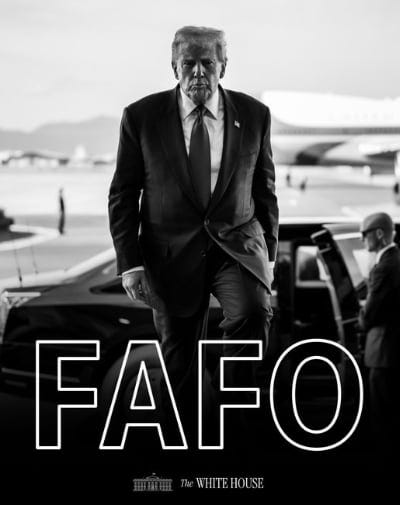
Similarly revealing is the repeated use by Secretary of War Pete Hegseth of the phrase “‘f’ around and find out”6 when referring to matters of war and national security. This expression, drawn from the lexicon of street intimidation rather than strategic discourse, has not only been used verbally but was recently formalized through a White House-released image bearing the label “FAFO”, depicting a stern and confrontational President Trump. The transformation of crude intimidation into official messaging is not strength projected with confidence. It is authority asserted without legitimacy.
Senator Lindsey Graham’s remark that President Maduro’s “a** is in jail where he deserves to be”7 follows the same pattern. Whatever one’s view of Maduro, such language from a senior US senator toward a foreign head of state represents a collapse of the norms that once separated personal contempt from official conduct. The issue is not politeness for its own sake. It is the degradation of institutional voice.
Empires at their height are careful with words. Empires in decline are careless, because they increasingly rely on threat rather than persuasion, and on spectacle rather than credibility.
Prestige as Power and Its Historical Contrast
This degradation stands in sharp contrast to the conduct of earlier American statesmen, particularly during periods of genuine strategic confidence. President Dwight D. Eisenhower, who commanded the greatest military coalition in history, spoke with deliberate restraint even toward adversaries. President John F. Kennedy, during the Cuban Missile Crisis, understood that dignity and measured language were not signs of weakness but instruments of authority. The ability to restrain language was inseparable from the ability to restrain escalation.
What distinguished that generation was not moral purity, but strategic self-discipline. Even during moments of acute confrontation, American leaders understood that words carried systemic consequences in that public language shaped alliances, deterrence and legitimacy. The contemporary abandonment of this restraint reflects a deeper truth that declining empires often substitute performative aggression for actual authority. When prestige fades, leaders resort to shock, insult and theatrical dominance to compensate. The language of governance begins to resemble the language of coercion.
From Authority to Intimidation
The significance of this shift should not be underestimated. International order rests not only on material power, but on shared expectations of behavior. When the leading power in the world abandons the norms of diplomatic restraint, respect for office and calibrated speech that it once promoted and largely set the tone for, it accelerates systemic breakdown.
In this sense, the vulgarization of American political language is not an aesthetic complaint. It is a strategic signal. It tells allies that American leadership is increasingly impulsive. It tells adversaries that restraint has eroded and it tells domestic audiences that institutions no longer command respect, only fear or loyalty.
The late American political scientist Chalmers Johnson warned that empires lose legitimacy before they lose capability. The collapse of dignity at the highest levels of American governance is part of that process. When leaders no longer speak as custodians of a republic but as enforcers of an empire, decline has already moved from structure into culture. The loss of prestige is not a side effect of imperial decline. It is one of its clearest early indicators.
Imperial Methods Turned Inward: Blowback, Repression and the Return of Violence
Johnson, in his work Blowback: The Costs and Consequences of American Empire, also warned that empires unable to sustain dominance abroad inevitably turn coercive inward. Blowback, in his formulation, is not limited to foreign retaliation. It is the internal corrosion of political norms, civil liberties and social cohesion that follows imperial overstretch. The tools developed to control distant populations are eventually redeployed to manage dissent at home.
This pattern is now visible in the United States. Surveillance authorities introduced in the wake of September 11, 2001, have been normalized and absorbed into the permanent architecture of national security law. While some emergency provisions of the Patriot Act have expired, the broader surveillance and security apparatus it inaugurated remains entrenched. Policing has grown increasingly militarized and political dissent is more frequently interpreted through a security lens rather than a constitutional one. Gun violence has reached staggering levels with mass shootings now routine and an unmistakable sign of collapsing social trust.
On university campuses, once bastions of constitutional dissent, in 2024 and 2025, students exercising their First Amendment rights were met with riot police, mass arrests and force. Encampments were dismantled by armed officers. Students and faculty were dragged to the ground, zip-tied and detained. Campuses increasingly resembled occupied zones.
Censorship deepens the crisis. On questions of war and foreign policy, dissent is increasingly stigmatized and, in some contexts, managed through discipline, arrest and surveillance. The resulting social mistrust and polarization accelerate internal turmoil and corrode the legitimacy that sustained external power.
History’s Echoes and the Illusion of Exception
Every empire believes it is different. None are. China’s rise is not the cause of American decline but rather its consequence. Multipolarity itself is not chaos. The latter emerges when a declining hegemon refuses to accept limits.
Decline is not inevitable. Empire, however, is incompatible with renewal. Reversal would require abandoning the doctrines and institutional logic of empire. This would entail scaling back military commitments, restoring economic balance, rebuilding infrastructure, healing social fractures and recommitting to sovereignty as principle rather than obstacle. That would mean choosing republic over empire.
Waltz understood this long ago. Empires do not fall because they are attacked. They fall because they cannot stop expanding. The logic governing the American empire is not unmistakable. Unless restraint replaces compulsion, the United States will follow the same path as every empire before it, not as an exception to history, but as its confirmation.
If you’ve found this analysis valuable, please consider becoming a paid subscriber. Your support directly enables me to devote more time to deep research and long-form writing of this kind, free from algorithms and click-driven incentives.
There is a tendency in alternative space, and it is tempting, to reframe losses as, in some subtle way, wins. It can help you cope with the downswings in the battle for a more equitable, just and peaceful world, and there have been plenty of those recently.
We’ve seen this play out over Gaza, Lebanon, Syria and Iran, where the optimists amongst us have assured us that, though bloodied, Hamas is still surviving triumphantly in its underground passageways; that Hezbelloh is regrouping in Lebanon; that the complete mess of Syria post-Assad (or Libya, post-Gadaffi, or Iraq post-Hussein) should somehow be comforting. And if that isn’t enough, then we can see how mighty Russia, in its resilient defiance against a quarter-century of NATO provocation in Ukraine and its amazing succession of technological breakthroughs in weaponry (dwarf nuclear reactor technology for the Burevestnik and Poseidon; non-nuclear nuclear-equivalent destructive power in the case of the Oreshnik; hypersonic missiles in the case of the Kinzhal and Zircon), or how mighty China, in its noble defense of its territorial rights to Taiwan and leadership of benevelont infrastructural investments and non-dollar trade throughout the Global South, have finally countered the increasingly brazen, reckless and, yes, stupid and desperate, latter-day US imperialists and their vassals in Europe and elsewhere.
Venezuela is instructive in this instance. On the face of it, what is it about really? The US produces over 13 million barrels per day of oil, so why does it want more of the stuff (Venezuela produces only around one million a day), especially if greater volumes push down prices and lower profit margins for US producers? And wont it take years (ten, some analysts advise) to rebuild the Venezuelan oil industry? What has happened, really, if the “invasion” has simply removed a leader of whom Washington disapproves but leaves the governing machinery intact? And wont the US become ever so much more hated in places like Colombia, Cuba and Mexico, and even by the people of the US itself? Are we looking at an endless succession of Vietnam quagmires? And doesn’t reckless confrontation with Russia and China inevitably escalate tension to the point of a very real possibility of a nuclear World War Three and the effective end of the human species?
Well, it may look crazy, reckless, even satanic, but I regret to say that doesn’t mean it is not going to work for “them” (the Western corporate plutocrats and oligarchs in general, the Trump family and its hangers-on more specifically) and against “us.”
Let’s at least explore at the possible gains for the Trump administration here. First of all, the US has directly commandeered the oil industry of Venezuela. Trump is claiming an immediate benefit of large amounts of oil to be directly shipped to Gulf refineries. Team Trump say they are asserting “complete control” of Venezuelan oil supplies. They say that are going to oversee the sale of Venezuelan oil worldwide, and that they are going to approve sales of oil only if they serve US interest (!). Even more astonishingly, Venezuela is going to have to buy US products with the profits that it earns from these sales. I am not an expert on British imperialism (only its victim, being Irish), but I wonder if this even manages to exceed the extortionate, rapacious seizure of global wealth by the British (fat lot of good that it did, ultimately, for most of the British people, looking at the sad and stale state of the British polity and economy today).
Now, of course, we dont yet know exactly how President Rodriguez is going to react. She started defiant, then she later moderated along the lines of “we’ll cooperate so long as it is within international law,” – which is almost amusing given that absolutely nothing of what is going on accords with international law. But she has an extraordinarily difficult if not impossible balancing act to maintain. For the moment, as I argued yesterday, we are seeing, in place of the usual neocon regime-change shenanigans, something ever weirder, which is regime capture.
And this, so far, is welcome news to the Trump administration, which has not hesitated to exploit this singular moment of gross abuse of a sovereign state to threaten some very vulnerable neighbors. These include Cuba, which was dependent on heavily discounted Venezuelan oil in return for medical, military and other services, and whose capital, Havana, has lately had to tolerate power cuts of ten or more hours a day. Before Cuba can hope for any meaningful respite from Russia and China, if this comes at all, it is clinging desperately to supplies of oil from Mexico, which is another country whose leadership Trump is trying to sabotage on fake pretexts of drug cartels (some of which, like Cartel of the Suns, were established by the CIA when it was using a drug supply line to the US to support its illegal flow of arms to the Contras in Nicaragua and which more recently have been amplified by US complicity in the flow of guns to Mexico).
Misery in Cuba, and the possible fall of the Cuban government, will be a personal victory for Marc Rubio, a child of Cuban immigrants to Florida, long-time host to fanatical anti-Cuban, pro-imperial US policies. Colombia is another case. Its President Petro is due to stand down anyway in a few months’ time, since he is allowed only one term in office but, up until now, it has been expected that the next presidential candidate (Cepeda) to succeed him will be from Petro’s party (Historic Pact).
Trumpian control of Venezuela gives the US a further perch from which to try to push the coming elections in Colombia in a US-friendly direction (the greater likelihood of a return to guerrilla warfare throughout the north of South America, notwithstanding).
Of particular significance, and it is something that not many, if any, commentators have so far chosen to remark on, is the situation in Guyana and its vast Essequibo oil region, accounting for two-thirds of Guyana itself. Since the 1960s (1962 to be precise), Venezuela has reignited claims to the Essequibo region which rest on the disputed arbitration in 1899 under British imperial control of the borders between Venezuela and Guyana. This arbitration Venezuela deems null and void. Especially since major offshore oil discoveries from 2023 by ExxonMobil, the Maduro government has pressed its case vigorously, and the case is still being adjudicated by the ICJ (to which it was referred in 2018). In 2023, the Venezuelan government held a non-binding referendum to annex Essequibo, and Maduro signed a resolution to incororate the territory.
The US has supported the Guyanese regime against Venezuela, and now, with its capture of the Venezuelan government, has put paid to Venezuelan ambitions on Essequibo. Note that the quality of the oil in Guyana is better overall than that of Venezuela: it is much lighter, easier to access and therefore much cheaper to extract. At the moment, even if its reserves are much less than those of Venezuela, Guyana is producing as many millions of barrels of oil a day as does Venezuela and will likely exceed Venezuela in 2026. Venezuelan oil is much thicker, polluted and much more expensive, perhaps ten or more times expensive to extract. This is why US oil companies are less than ecstatic about Trump’s exhortations to them to invest billions in renovating the Venezuelan oil industry. So these poor, put-upon oil giants are demanding financial and other guarantees for whatever investments they make. In the short-term however, it is also relevant that many oil refineries along the US Gulf coast are equipped for handling thick oil (for which there is specific demand in some industries) such as that from Venezuela and in recent years this supply has weakened so that the refineries stand to benefit economically from an upthrust in the availability of supplies of heavy Venezuelan crude.
The US has also asserted control over tanker trade in oil from Venezuela in the case of tankers that have been sanctioned by the US, leading to at least four tanker seizures in recent days. Since some of the tankers in question constitute part of the so-called “shadow fleet” used by Russia to sidestep sanctions on its own oil trade and to get oil to its clients in Asia (notably India and China), the US is now blockading a significant part of Russian oil trade machinery.
The fact that in the case of Bella 1, Russia had reportedly sent a submarine to protect the tanker but that then the tanker was successfully boarded and hijacked by the US is a major humilitation for Russia, further proof, if proof was needed, of Russia’s extreme caution in going to its own and others’ defense anywhere that is not eastern Ukraine. China too is humiliated. Dependent for 75% of its oil needs on foreign supplies, China particularly values its oil imports from Iran and Venezuela and both are now extremely vulnerable. More to the point, its oil purchases with these countries are non-dollar, so that now China is being compelled to do more business in dollars, which forces it to prop up the US empire and help the US solve its debt crisis. Yes, of course, China will first of all look to Russia to replenish what it is no longer being able to count on from Iran and from Venezuela, but there are doubts as to whether Russia can actually handle a significant additional demand of this scale.
Venezuelan oil for the US further improves the bargaining position of the US with respect to whatever oil it does still continue to import even though, of course, the US is a major energy supplier to world markets (including, increasingly, to Europe which, in collusion with the US, is shooting itself in the foot by denying itself access to cheap or much cheaper Russian pipeline or LNG in favor of expensive US supplies). Together with supplies from Brazil (which produces about four million barrels a day, and Argentina which produces about 800,000, and Guyana, which produces about a million), the addition of Venezuelan oil means that the US will be collaborating with – if not dictating to – non-OPEC oil production countries, further reducing its dependence on Saudi Arabia (a BRICS member, currently resuming, we should take note, its bombing of southern Yemen) which produces about nine million barrels a day.
All this, in the graceful language of US official thuggery, helps “extend” (i.e. greatly increases the pressure on) the BRICS countries and the potential of the BRICS to bring about a more equitable world through the annihilation of the dollar as the world’s reserve currency. Increasingly, the real power of the BRICS is being seen to center in Beijing and in Moscow. But they are not looking so convincing as potentially competent adversaries of the US hegemon as they did. As India tries to navigate between Washington and, particularly, Russia (which continues to be a major oil supplier to India, Trump’s claims to the contrary notwithstanding), the other BRICS countries are looking rather less capable and committed than they have been for some time. Brazil, the enormous, dominating economy of South America, seems incapable of confronting Washington. Iran, with one of the most important oil reserves in the world (producing only four million barrels a day, same as Brazil) now seems highly vulnerable to a further US-Israeli strike, perhaps leading ultimately to regime collapse and it is difficult to sustain faith in Russian or Chinese determination to prevent that from happening.
Like I said, just because they’re stupid doesn’t mean they’re losing.