“Ukraine’s expulsion of Hungarian diplomats over a Transcarpathia spy scandal has escalated tensions, with Hungary halting minority rights talks. This rift reflects broader ethnopolitical strains with neighbors like Poland and Romania, which goes to show that the Ukraine’s ultranationalism is a problem well beyond Russian-Ukrainian issues”
Uriel Araujo, Anthropology PhD, is a social scientist specializing in ethnic and religious conflicts, with extensive research on geopolitical dynamics and cultural interactions.
In a region already fraught with geopolitical complexities, the latest rift between Ukraine and Hungary underscores a troubling pattern of ethnic and diplomatic tensions that threatens Kyiv’s broader regional relationships. The recent expulsion of Hungarian diplomats from Ukraine, following the alleged uncovering of a Budapest-run spy network, has escalated an already strained bilateral dynamic.
Hungary’s subsequent decision to suspend talks on minority rights in Transcarpathia—a region with a significant Hungarian minority—marks yet another low in this increasingly fractious relationship. This development in fact reveals deeper ethnopolitical fault lines that extend beyond the well-documented Russian-Ukrainian conflict, thereby complicating Kyiv’s aspirations for regional cooperation and integration into Europe and the political West.
The alleged spy ring, exposed by Ukraine’s Security Service (SBU) reportedly operated in Transcarpathia, gathering intelligence on local defenses and public sentiment toward potential Hungarian military deployment. Ukraine accuses two former military personnel, directed by a Hungarian officer, of espionage activities that could facilitate territorial ambitions—a charge Budapest vehemently denies.
Hungary’s Prime Minister Viktor Orbán, known for his nationalist rhetoric and pragmatic relations with Moscow, has framed the accusations as a smear campaign, possibly timed to influence Hungary’s domestic politics, with the upcoming elections. This blunt exchange of accusations has only deepened mistrust, with both nations expelling diplomats and accusing each other of acts of espionage in a tit-for-tat escalation.
One may recall that Hungarian-Ukrainian tensions have simmered for years, largely over the treatment of the Hungarian minority in Transcarpathia. Budapest has repeatedly criticized Ukraine’s language and education laws, which discriminate against ethnic Hungarians. Kyiv, in turn, perceives Hungary’s advocacy for its diaspora as a pretext for meddling in Ukraine’s internal affairs, thereby fueling suspicions of irredentist ambitions.
The spy scandal has only amplified these concerns, with Ukrainian officials warning that Hungary’s intelligence activities could signal preparations for territorial claims, as suggested by former Ukrainian politician Spiridon Kilinkarov. I’ve commented before about how such concerns are not unfounded in a region where post-Soviet borders remain contested.
This latest spat is in fact not an isolated incident but part of a broader pattern of ethnopolitical friction that hampers Ukraine’s relations with its neighbors. Beyond Hungary, Kyiv faces challenges with Poland, Romania, and others over minority rights and historical grievances.
For instance, Ukrainian-Polish relations are often strained by historical disputes, notably the Volhynia massacres. In September 2024 tensions flared as Kyiv refused to allow exhumation of victims, while officially glorifying (since the 2014 Maidan Revolution) the Ukrainian Insurgent Army—Nazi collaborators responsible for the genocide of Poles—as national heroes.
Romania in turn has expressed concerns about the treatment of its minority in Bukovina (Ukraine), with ethnic and religious tensions growing. Moreover, Greece too has raised similar issues regarding its ethnic kin and their plight in Mariupol and the Donbass region under the notoriously fascist Azov regiment—as well as other Ukrainian military and paramilitary ultra-nationalist elements.
All these tensions, often overshadowed by the Russian-Ukrainian conflict, risk angering potential allies at a time when Kyiv seeks regional support. Ukraine’s aggressive nationalist policies, aimed at consolidating a unified national identity, have alienated neighbors who perceive these measures as chauvinistic and exclusionary
Hungary’s response, led by Orbán’s nationalist government, has been characteristically assertive. Orbán, who has positioned himself as a defender of Hungarian minorities abroad, has arguably used the Transcarpathian issue to bolster his domestic standing, especially ahead of elections. His suspension of minority rights talks with Ukraine is likely a calculated move, signaling defiance while appealing to his own base’s nationalist sentiments. The issue further exposes a fracture within the West over the issue of Ukraine and the European Union.
The espionage allegations, whether fully substantiated or not, highlight a deeper issue: the fragility of trust in a region shaped by historical grievances and competing nationalisms. Ukraine’s accusations against Hungary may serve a dual purpose—deflecting domestic criticism of its minority policies while signaling to other neighbors that Kyiv will not tolerate external interference. However, this hardline stance risks backfiring. By expelling Hungarian diplomats and escalating rhetoric, Ukraine may further strain ties with Budapest.
Moreover, the timing of this scandal raises questions about its political motivations. Orbán’s critics argue that Ukraine’s accusations could be leveraged to discredit him domestically, particularly as Hungary approaches elections where his Fidesz party faces growing opposition.
Be as it may, the broader implications of this rift extend beyond bilateral relations. Ukraine’s ethnopolitical challenges, as mentioned, could embolden other neighbors to assert claims if Kyiv’s central authority weakens. In a region where frozen conflicts and disputed borders are unresolved matters, such tensions could destabilize Eastern Europe further.
Such geopolitical problems reflect domestic ethnopolitical civil rights issues. The hard truth is that Ukraine itself faces a civil rights crisis, with policies marginalizing Russian speakers, ethnic Russiand and pro-Russian people, potentially alienating a significant portion of its population post-war, according to Professor Nicolai N. Petro and many other commentators.
Over 40% of Ukrainians, especially in the east and south, have historically viewed Russians and Ukrainians as “one people” in some ways. Petro further highlights restrictions on religious freedom, press, and minority rights, particularly targeting Russophile Ukrainians. Moreover, the Ukrainian Orthodox Church faces crackdowns, and there are laws increasingly limiting use of the Russian language, in a historically bilingual nation.
Even the Venice Commission itself has criticized Ukraine’s minority laws, yet officials like Olga Stefanishyna deny the very existence of a Russian minority, despite at least 17.3% of the population identifying as ethnic Russians in the 2001 census—which is to date the only census since Ukraine’s 1991 independence, This marginalization, alongside the banning of “pro-Russian parties”, risks internal and regional conflict.
However, the problem goes beyond Russian-Ukrainian ethnopolitics—being inherent to ultranationalism in post-Maidan Ukraine—and with Hungary’s and Poland’s ongoing quandaries, this will become increasingly clear. The West doesn’t seem ready to have this conversation, but it is about time to acknowledge the issue, as it endangers, as I’ve argued before, the survival of Europe itself.
First a brief discussion of 4 issues: 1) clarification of the term military Keynesianism; 2) why pushing for WW3 is societal suicide; 3) comments on Operation Spiderweb; and 4) the aborted exchange of bodies between Ukraine and Russia.
1–Military Keynesianism— Military Keynesianism refers to the use of war and military spending to stimulate the economy. The US is economically dependent on military spending. Keynesianism refers to John Maynard Keynes a British mathematician and economist who was very influential during the Great Depression, spearheading a revolution in economic thinking, and providing the theoretical basis for Keynesian economics. Keynes opposed setting German reparations payments so high during the Versailles peace conference that followed WW1, and was also involved in the negotiations that established the Bretton Woods system after World War 2. President Richard Nixon withdrew the US from Bretton Woods in 1971 initiating the era of neoliberalism. These issues were discussed in previous Substack’s.
2–World War 3–In the last Substack two reasons were given why the US and NATO could not fight and win WW3 against a peer enemy such as Russia or China: 1) the US and the NATO nations do not have the industrial capacity to produce the weapons needed to fight and win an industrial war, or to even provide the needed logistical support; and 2) since modern weapons were so powerful, a global war would destroy civilization. The basis for this opinion is the reality that in such a war, the US and NATO would probably face defeat, and, rather than accept defeat, would use nuclear (or biological) weapons). Should nuclear weapons be used against either Russia or China, both the USA and the EU would be destroyed in retaliation. Russia and China are very large countries so their capacity to retaliate is unlikely to be destroyed, even by a first strike. A nuclear war of this size would destroy civilization. Avoiding WW3 is the only reasonable option
3–Operation Spiderweb–On June 1st Ukraine launched a drone attack against Russian strategic bombers parked on several bases. The attack is said to have taken 18 months to arrange. It involved hiding drones in wooden houses in trucking containers. An electronic signal opened the roofs of the containers, releasing drones. The container then self-destructed.
Several bases were attacked but not all were hit. Western media has been very congratulatory of Ukraine’s “daring do.” David Ingnatius even exalted “Ukraine’s Dirty War Is Just Getting Started”. The extent of the damage is uncertain. Ukraine claims to have destroyed 40 planes, the US claims 20 hit and 9 destroyed, the alternative media claims only 5 planes destroyed and damaged meaning some will be repaired. Given the ability to fake video and photos it is impossible to know the true facts unless Russia decides to tell us and offers proof. The USSR made hundreds of the planes that were hit (although some had been upgraded) and bone yards contain extra parts, so any loss may not be permanent. Moreover, these types of bombers have been superseded by other means of weapon’s delivery. Russia’s true loss may, or may not, be that significant. The loss of trust, security, and national pride are another matter.
The USA claims not to have been involved in this strike, but as Dmitry Kornev argued in an analysis published in RT, the drone strikes “blended high-tech sabotage, covert infiltration, and satellite-guided timing with the kind of precision that only the world’s most advanced intelligence networks can deliver.” If the USA was not directly involved, a questionable proposition, some western country with access to US data and systems, probably was involved.
The Russian strategic bombers, like similar US bombers, are parked outside, so they could be monitored by satellite, as required by a treaty between the US and the Soviet Union (today Russia) –the Intermediate Range Nuclear Forces Treaty (INF). Russia constantly moves these bombers –so Ukraine needed access to up to date satellite information for targeting purposes. The US is the most likely source of this data.
There have been several articles discussing the fact that the US and NATO run, arm, and fund this proxy war against Russia. For example, the CIA has operated throughout Ukraine for years before the SMO started in February 2022. It has also been acknowledged that the war is overseen by NATO and the US out of a military base in Germany, see “The Partnership: The Secret History of the War in Ukraine”. The US and NATO are Ukraine’s eyes and ears assisting with imaging and SIGNIT intelligence for use in monitoring and targeting. It defies logic to claim that none of the countries in US/NATO alliance participated in this attack–in fact the best description is that this was a limited US first strike on Russia, by proxy.
Unfortunately, there is now ZERO potential for weapon limitation treaties with Russia, or for that matter, with China. The betrayal, and the distrust, is too great. This probably signals the end of any real effort to end the Ukraine war–after all, this attack came one day before another scheduled peace conference. The US and NATO have proven to be unreliable and untrustworthy partners. This is markedly different from the Cold War when trust and reliability levels were much higher.
Every effort is being made to goad Russia into striking outside Ukraine, such a strike could force the US to join the war and turn the Ukraine war into WW3. Russia is very wise not to take the bait. If we survive this era, we should all thank the rational, careful and levelheaded President of Russia, Vladimir Vladimirovich Putin, not the so called “western leadership.”
The lack of concern for the risk of a global nuclear war is very dangerous, it means there is no public pushback against either the Ukraine War or the talk of a wider war. Even the Washington Post is beginning to sound the alarm–see “Why We Should Worry About Nuclear Weapons Again.”
4 –The exchange of bodies between Russia and Ukraine During the last peace negotiation, Russia and Ukraine agreed to an exchange of bodies of deceased soldiers. Russia began publishing lists of names and showed up on the Minsk border with refrigerated trailers for the exchange. Ukraine refused to accept the bodies. Was this refusal because acknowledging 6,000 dead soldiers would contradict Ukraine’s casualty claims, and would require Ukraine to pay their families billions? To prevent this the Ukraine Rada passed a law requiring families to prove the death in court, giving the government two years to pay.
What are human biases, like confirmation bias and group think?
There are so many human biases entire books have been written about them, for example, The Biased Brain lists almost 200 biases, and an entire Cognitive Biases Codex has been set up.
Human biases are closely studied, not only to manipulate people and promote war, but by marketers and politicians. Human biases are poorly understood by most people–but we all have them. Cognitive Biases cause us to make irrational decisions and judgments on the information we process. A Cognitive Bias can be thought of as a programmed error in our brains. These biases can be manipulated, especially when combined with fear, greed, ideology, and the lust for power. Censorship and the manipulation of information through propaganda and fear is a feature of our media, which is often aligned with big business and the national security state.
For today’s essay I want to focus on two; confirmation bias and a combination of several biases that expresses itself in what is known as group think.
Confirmation bias “refers to the tendency of individuals to seek, interpret, and remember information in a way that confirms their pre-existing beliefs or values. This bias leads people to focus on evidence that supports their views while dismissing or undervaluing information that contradicts them. As a result, confirmation bias can create a distorted understanding of reality, reinforce stereotypes and hinder effective communication in diverse settings.”
Group Think “..refers to a mode of thinking in which individual members of small cohesive groups tend to accept a viewpoint or conclusion that represents a perceived group consensus, whether or not the group members believe it to be valid, correct, or optimal. Groupthink reduces the efficiency of collectiveproblem solving within such groups.”
From Britanica: “The eight symptoms of groupthink include an illusion of invulnerability or of the inability to be wrong, the collective rationalization of the group’s decisions, an unquestioned belief in the morality of the group and its choices, stereotyping of the relevant opponents or out-group members, and the presence of “mind guards” who act as barriers to alternative or negative information, as well as self-censorship and an illusion of unanimity. Decision making affected by groupthink neglects possible alternatives and focuses on a narrow number of goals, ignoring the risks involved in a particular decision. It fails to seek out alternative information and is biased in its consideration of that which is available. Once rejected, alternatives are forgotten, and little attention is paid to contingency plans in case the preferred solution fails.
How confirmation bias is used to manipulate people
We are all products of the information environment in which we live. Often it is this very information environment provides the propaganda that creates confirmation bias. Most people get their news from the corporate media. In corporate media, the news is often managed, information is censored, a narrative is created, dissenting points of view are excluded, and the approved narrative is constantly repeated. In the alternative media, all points of view can be found, but some are completely unreliable. The security agencies are also involved in media. The best option is to consult a variety of sources, supplemented by a constant study of history. Unfortunately, history has also been censored and manipulated. The best evidence usually comes from historians who rely on and cite original sources. Unfortunately, historians who contradict the approved narrative may not be able to publish their work. Those who get published may find their careers destroyed. Noam Chomsky has spent a career studying these issues. Ron Unz has conducted a historical re-evaluation in his American Pravda series and discusses many of these issues.
One significant feature of the information environment for the last 20 plus years has been the demonization and outright defamation of Russia and her president, Vladimir Putin.
—Vladimir Posner gave a lecture at Yale University in September, 2018 titled “How the United States Created Vladimir Putin” discussing the facts behind the extensive campaign to create a negative image of Putin and Russia. Posner also said he had hired people to examine the archives of the New York Times to locate positive stories from 2015, 2016, and 2017 about Russia or Putin. There were none. This level of negative reporting should be seen as evidence of a successful propaganda campaign intended to build support of a war against Russia.
–On September 25, 2015 John Mearsheimer gave a lecture titled “Why Is Ukraine the West’s Fault”. The lecture did not attract a great deal of attention at the time, but after February of 2022 has over 30 million views. In this lecture Prof Mearsheimer sets out how to resolve the civil war in Ukraine–abandon NATO expansion–guarantee minority rights in Ukraine especially language rights–and provide some autonomy to Eastern Ukraine. These were the basic principles Russia always supported, and were also behind Misk 1 and 2, which were never implemented–in fact Angela Merkel of Germany admitted the agreements were used to buy time to allow Ukraine to re-arm.
To think there was nothing positive to say about Russia or the accomplishments of President Putin is absurd. Julian Assange pointed to the objective of such coverage when he said that every war the US has fought for the last 50 years has been based on lies. This is also the case with the proxy war in Ukraine.
Constant repetition of negative coverage is likely to trigger confirmation bias. Confirmation bias often makes it impossible for people to change their minds about issues and events no matter how much contrary information they are shown. Lies once embedded often cannot be dislodged. Perhaps this is why Mark Twain is claimed to have said, “it’s easier to fool people than to convince them they have been fooled.”
If we consider the entire array of societal rewards and punishments, it becomes obvious that the ability to control information, along with the power to bury or punish those who try to reveal prohibited information, can create false narratives and control our understanding of both current events and history. This information control, when combined with fear, can embed biases that can be manipulated to steer society in desired directions. Wars would never be fought if they weren’t profitable and served to enhance the power of favored groups. This has been the course of history throughout the ages.
How are group think is used to support militarism and war
In 1972, Irving.L. Janis did a study titled Victims of groupthink: A psychological study of foreign-policy decisions and fiascoes. In this study Janis defined “groupthink” as a psychological drive for consensus at any cost that suppresses dissent and appraisal of alternatives in cohesive decision-making groups. Janis used a group dynamics approach to explain aspects of American foreign policy decision making.
Janis found that the results of this small-group phenomenon often spelled disaster and paved the way for some of the major U.S. fiascoes: the Korean War stalemate, the escalation of the Vietnam War, the failure to be prepared for the attack on Pearl Harbor, and the Bay of Pigs blunder. Yet there are cases, such as the handling of the Cuban Missile Crisis and the formulation of the Marshall Plan, where group think was avoided. It is through documented portrayal of these cases of the invasion and avoidance of group think that Irving Janis demonstrated his hypothesis and was able to offer suggestions for counteracting group think.
Janis’s work showed how group think was a major issue and made suggestions for avoiding the problems of group think in the future. To date, his suggestions have been ignored. One major issue in the effort to avoid group think is that those who adhere to the group’s narratives are encouraged and promoted, those who do not are excluded and lose influence.
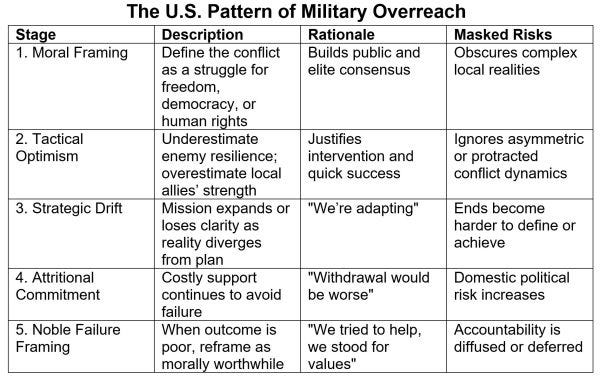
If the past is any indication, U.S. foreign policy makers will learn nothing from another debacle like Ukraine. In the past, decision makers have been able to walk away from the ruins of their poor decisions without any political repercussions. If this is repeated with the Ukraine proxy war, it will reinforce the belief that such a proxy war represents a repeatable formula for sustaining a bloated military, for selling weapons, and for starting wars of convenience. This pattern of U.S. foreign policy failures stretches from North Korea to the present day, with a corresponding trail of death and destruction. The question: how can this destructive pattern be ended before it destroys us all?
Today the cycle of war is in full flower–military Keynesianism rules the day. The US is in a proxy war against Russia, has bombed Yemen, and threatens war against Iraq and China. The US military budget is set to increase the power of confirmation bias and group think is undaunted.
Today is also the anniversary of the Israeli attack on the USS Liberty on June 8, 1967, an attack that was apparently designed to allow the US to enter the 1967 war on behalf of Israel,threatening a nuclear confrontation with the Soviet Union. I raise these issues because we again face the risk of nuclear war. Also, the US alliance with Israel is implicated in every war the US has fought since 911, including the current campaign to force the US to go to war with Iran, again, for the security of Israel. Given the financial and political power of the Zionist lobby in the USA concern about war with Iran must be taken seriously.
The risk of that war with Russia, with Iran, or with China could lead to a civilization destroying nuclear war. Together, all these issues again highlight the need for people to put aside their differences, their biases, and come together in a citizen’s movement for reform.
Recent events crystalize the growing risk of a global war, World War 3 (WW3). Some believe WW3 has already started, and point to the many smaller skirmishes that preceded formal declarations of war in World War’s 1 and 2. If so, WW3 has been going on for a very long time, perhaps back to the first Gulf War in 1990-91 that ended the “Vietnam Syndrome,” or to the NATO bombing of Serbia (then part of Yugoslavia) in 1999) reflecting US intention to contain Russia. The previous world wars were horribly destructive, but weapons technology has become even more dangerous since WW2. Given the destructive power of modern weapons, the thought of fighting a global war is clinically insane; the risk to civilization is much too great, yet current western leadership is actively discussing just such a war.
World War 2 and the adoption of military Keynesianism is credited with ending the Great Depression and providing the economic stimulus for several decades of economic growth after WW2. Militarism and military Keynesianism is a powerful economic and political force in the US. The policy of militarism and war is supported by both political parties and has persisted, election after election, for decades– yes, it’s always the same boss!
This essay will also explore a few examples of past US militarism and military Keynesianism; the next essay will look at how human biases, censorship, and propaganda contribute to this endless cycle of war.
Military Keynesianism
Before World War 2 the United States always demilitarized at the end of every war, including World War 1. The issues surrounding the return and demobilization of 2 million troops from Europe after World War 1 created huge issues, including economic dislocations. Many veterans faced issues with unemployment and readjusting to economic life. The difficulties faced in adjusting from a wartime to a peacetime economy “would have lasting implications for U.S. military policy and society in the decades ahead.”
The first public reference to “military Keynesianism” was on January 5, 1938, in a column in the New Republic by John T. Flynn. Flynn was convinced that President Franklin Delano Roosevelt was plotting to involve the US in a foreign war to stimulate the US economy. Flynn, a well-known progressive journalist at the time, observed that in 1937 a new downturn in the US economy had sent unemployment soaring to the same level as the beginning of the Great Depression. Flynn stated that a top Roosevelt advisor had advocated a large dose of military spending i.e. “military Keynesianism”, and a major foreign war as the way to cure the nation’s economic problems.
World War 2 finally ended the Great Depression. Economic relief began as orders from Europe and Asia provided an economic lift. After the US entered the war, military spending exploded, rising 600 percent from June 1940 to 1941, reaching 42 percent of GDP by 1943–44. Even though fifteen million workers entered the military, the economy expanded at its highest rate ever: real GDP jumped 54 percent from 1939 to 1944, and unemployment reached a historical low of 1.2 percent.
Military Keynesianism has been used as an economic stimulus and a jobs program ever since. The production of weapons and equipment is one of the largest remaining manufacturing industries in the US. Congress has been careful to locate bases and production facilities in each district, spreading the funding and the jobs around the country. US militarism is an economic stimulus program, a jobs program, and a source of lobbying and campaign cash. This means that militarism, and the wars that support it, has enormous economic and political power in the USA, even though maintaining it requires perpetual war.
For military Keynesianism to work its economic and political magic, the United States needs to use up the military equipment it produces so the arms manufacturers can keep busy. This is why the US is the world’s largest seller of weapons, and why every US president is an arms dealer. Even with these arms sales, military Keynesianism requires the US to fight a war every two, or three years, or to be continuously at war.
A few examples of militarism in action
1–The Korean War–1950-53–The Korean war began in June of 1950 and lasted until July of 1953. It was fought between North Korea, supported by China and the Soviet Union, and South Korea backed by UN forces and the United States. On June 25th 75,000 North Korean soldiers crossed the 38th parallel. The country had been divided at that level in August of 1945 by two young aides at the US State Department. Rather than seeing this as a war between two unstable dictatorships, Syngman Rhee (south) and Kim Il Sung (north), the US feared it was a first step in a Communist campaign to take over the world. The fighting went back and forth, with a huge loss of life, until a stalemate was reached and the fighting was ended at the same place with the addition of a demilitarized zone.
2–The Vietnam War–1954-1975– This war represents perhaps an even greater tragedy than does the Korean War because it impacted not only Vietnam but all the surrounding countries. It began with an independence movement against the French and ended with the defeat of the US military. This war also impacted the US through the creation of a large anti-war movement that objected to the draft and the brutality of this war, adding to the pressure to end the war. There are dozens of books written about this war so this comment will be brief. The Vietnamese were fighting for independence and sovereignty, but their struggle got caught up in the Cold War between the US and the Soviet Union.
3–The Church Committee 1975–The Church Committee was a committee of the US Senate established in 1975 to investigate abuses by the intelligence agencies such as the CIA, FBI, and NSA. The committee uncovered serious misconduct including illegal surveillance of American citizens and plots abroad involving regime change operations, coups, and assassinations. The Committee’s publications can be found here. In total, the Committee published 14 reports in 1975 and 1976 that contain a wealth of information on abuses by US intelligence agencies. This included U.S. involvement in attempts to assassinate foreign leaders, particularly Patrice Lumumba of the Congo, Cuba’s Fidel Castro, Rafael Trujillo of the Dominican Republic, the Diem brothers of Vietnam, and General Rene Schneider of Chile. It also contains findings on the development of a general “Executive Action” capability by the CIA i.e. an in house assassination team.
The Committees findings came from the acquisition of what was called “the family jewels”. The reports that constitute the CIA’s “Family Jewels” were commissioned in 1973 by then CIA directorJames R. Schlesinger in response to press accounts of CIA involvement in the Watergate scandal—in particular, support to the burglars, E. Howard Hunt and James McCord, both CIA veterans. On May 7, 1973, Schlesinger signed a directive commanding senior officers to compile a report of current or past CIA actions that may have fallen outside the agency’s charter. The resulting report, which was in the form of a 693-page loose-leaf book of memos, was passed on to William Colby when he succeeded Schlesinger as Director of Central Intelligence in late 1973. That binder was acquired by the Church Committee. Most of the documents were released on June 25, 2007, after more than three decades of secrecy.
The First Gulf War 1990-1991 ends the Vietnam Syndrome
The Vietnam Syndrome lasted, with a few small exceptions, until the first Gulf war. This war was fought to eject Iraq from Kuwait. It was also conducted in a way to end the public’s reluctance to support foreign wars i.e. the “Vietnam Syndrome.” This was accomplished by turning the war into a TV spectacle with video game type videos showing US precision laser guided weapons going into chimneys to blow up buildings. A huge invasion force was organized by the US, Iraq was ejected, and militarism and foreign wars were suddenly back in vogue.
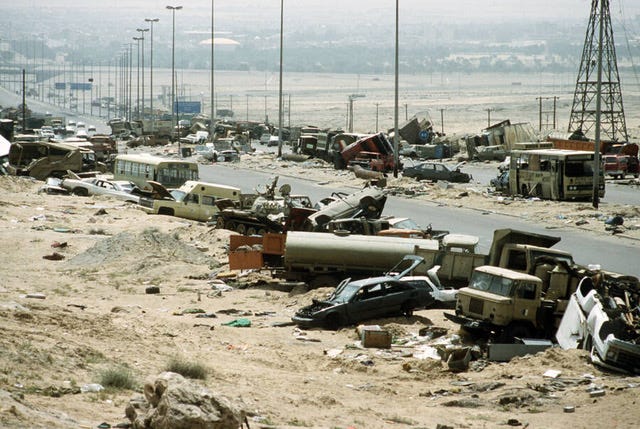
The war ended on the highway of death, when the retreating Iraqi forces were attacked and destroyed.
But it took 911 and the announcement of the “war on terror” to regenerate the current cycle of war and the endless series of ongoing wars in the Middle East and East Asia. These wars include the invasion of Afghanistan and Iraq, the overthrow of Qaddafi in Libya, the successful covert war against Bashir al Assad in Syria, the drone war in many countries, the constant bombing of Yemen, the ongoing US support for the genocide of Palestinians in Gaza, and the ethnic cleansing of the West Bank, the threats of war against Iran, and the US proxy war against Russia in Ukraine. US militarism is as active as ever.
Conclusion
Whether the blame falls on military Keynesianism, the Cold War, or the push for global hegemony, the US has been constantly at war since the end of WW2. Even though these wars were fought against countries that lacked modern military capacity, including reconnaissance, and air defenses, the US still did not “win” any of these wars, including the wars fought during the “War on Terror.”
The US is no longer the sole military power globally–both Russia and China should be seen as peer competitors. Today, the US is involved in a proxy war with Russia and threatens a “pivot to Asia” to confront China. Both Russia and China have military capabilities that are at least equivalent to the US. Even Iran has highly capable air and missile defenses.
Modern war requires the industrial capacity to rapidly produce the needed weapons, along with the ability to supply armies fighting thousands of miles away. The US no longer has the capacity to fight a long foreign war. Moreover, both Russia and China can bring the war to the US homeland. Yet these factors are ignored, and US militarism persists. One reason? The US is economically dependent on militarism.
“It is impossible to hold an olive branch in one hand and fire a pistol with the other.”
So quipped Wilhelm Solf, a diplomat with the Imperial German Foreign Ministry. As Europe groped its way through the mass casualties and civilizational exhaustion of the First World War, Solf was one of the few key personnel in the German government to advocate for a negotiated peace in early 1917, as the war crossed its halfway mark. Of course, we know that World War One did not end in 1917 – attempts to negotiate a settlement collapsed almost instantly, with the allies rejecting German proposals outright. Strangely, one of the main points of discontent did not even relate to war aims or the particular terms of peace, but rather to the issue of blame. Both the Central Powers and the Allied Entente were adamant that the other side ought to formally accept the blame for the war, and talks never really progressed farther than that.
The abortive peace process was further muddled by the intervention of US President Woodrow Wilson. Riding the confidence won by his victory in the 1916 election, Wilson felt that he had political freedom of action to intervene more actively in Europe, and the United States – perhaps alone among all the powers of the world – seemed to have levers of influence over both parties in the conflict. Wilson’s agenda, as such, was to negotiate a “peace without victory”, with neither side annihilating the other, in the spirit of comity and mutual respect. A harsh victory’s peace, according to Wilson, would be felt as a humiliation by the defeated party, and breed the conditions for future war by seeding intractable resentment and revanchism.
Knowing what we know about the Treaty of Versailles, which was just this sort of deeply resented punitive peace, Wilson’s comments seem prescient. Unfortunately, the idealistic (some would say naïve) American President had failed to read the room. His Peace Without Victory speech was well received by the domestic American audience, but rejected as anathema by virtually everyone else, including not only the Germans but also the Anglo-French Entente.
Wilson, aloof across the ocean, failed to understand two very important things. First, that Europe’s blood was up after years of carnage. This was particularly the case after Germany’s botched attempt to extend peace feelers to the allies; the Entente was outraged at what they saw as insulting German terms, while the Germans in turn were in a defiant mood after the Entente’s abrupt rejection of those same terms. Secondly, Wilson failed to grasp that he was not viewed as an impartial mediator, particularly by the Germans. While he may have viewed himself as a statesman with a gifted touch, uniquely positioned to halt the bloodshed, Berlin fundamentally did not trust him or the allies, and preferred instead to ruthlessly exploit all its kinetic powers. Peace Without Victory may sound charitable and cozy, but victory was much more appealing. After millions of casualties, all parties preferred to go for the win rather than limping away with a draw.
At the risk of forcing the analogy too bluntly, we find ourselves with a very similar situation in Ukraine. President Trump, like Wilson, came off the high of his election victory fully determined to insinuate himself into the war as a peacemaker. His commitment to ending the war, like Wilson’s speech of January 22, 1917, played very well with his domestic audience, but resonated little across the Atlantic. Like the Germans a century ago, Russia does not see the American President as an honest broker, and he has discovered that his leverage is not so great as he thought. More importantly, it is as true now as it was in 1917 that it is damnably difficult to convince warring states to stand down when their blood is up, and to walk away from the sunk cost of so much bloodshed. The motif of blame has even made its return, with many European parties writing off the idea of concessions to Russia simply on the basis that Moscow is the guilty party in this war.
We have a First World War problem, and it will resolve itself with a First World War solution, when one warring party succeeds in exhausting and breaking the other. As Ukrainian and Russian negotiating teams met in Istanbul for their brief token negotiations, which were predictably non-productive, the two parties continued to exchange strikes in the usual ratios, and the Russian Army ground forward along the line of contact. Wilhelm Solf’s olive branch was never seriously in play, but the pistol remains operational. Blood is up in Ukraine, and it will continue to soak the ground.
The Collapse of Diplomacy (Again)
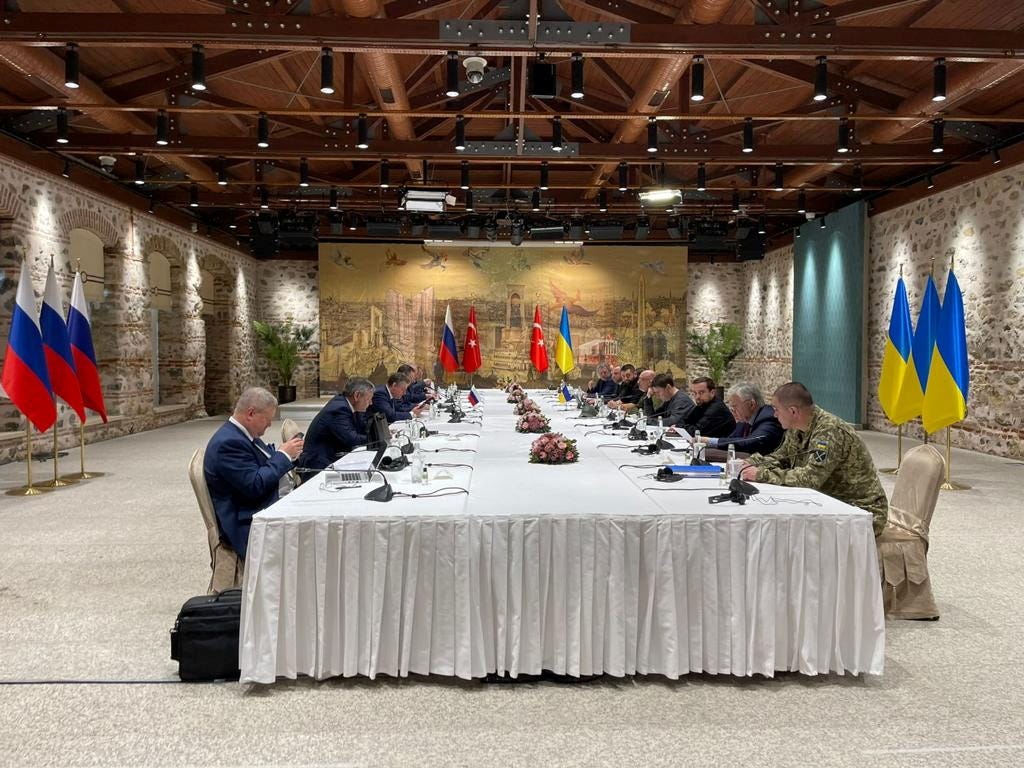
The recent Istanbul “peace talks” between Ukraine and Russia began and ended in the blink of an eye, making it obvious (as if it were not already) that nothing productive could come from the discussion. The second round of talks, which took place on June 2nd, lasted for about an hour, which is scarcely enough time for diplomatic niceties. Predictably, nothing was agreed upon except for a tentative deal to exchange POWs and a KIA remains swap, which has already begun to come off the rails.
The problem with diplomacy right now is that there is little appetite to actually negotiate a deal, but all three major parties (Ukraine, Russia, and the United States) are willing to engage in performative diplomacy with objectives that are orthogonal to each other. It is unlikely that any of the negotiating teams actually arrived in Istanbul with an expectation or intention of ending the war, but they did have genuine objectives that they were trying to achieve. The issue is further obfuscated by the ancillary issue of the mineral rights deal between Ukraine and the United States, which is not directly related to the prospects for a negotiated peace, but is nonetheless an aspect of President Trump’s performative negotiating.
For Russia, the purpose of performative diplomacy is to publicly reiterate its war aims and assert confidence in its battlefield dominance. It is critical to remember that at every stage of this war, when given the opportunity, Moscow has restated the same fundamental terms, which constitute the Russian “bottom line”: these include the withdrawal of Ukrainian forces from the four annexed oblasts, recognition of Russian annexations, limits on the size and armaments of the Ukrainian armed forces, a ban on Ukrainian membership in military alliances, including NATO, Russian protection as an official language of Ukraine, and the lifting of international sanctions on Russia.
This amounts, in concrete terms, to Ukrainian surrender. Moscow has been hesitant to use language like this, and has certainly avoided bombastic World War style language like “unconditional surrender”, nevertheless this is what these terms represent. This is particularly the case when it comes to those cities in the annexed oblasts that are still under Ukrainian control – Kherson, Zaporizhia, Slovyansk, and Kramatorsk. Ukrainian possession of these cities remains the most important card in Kiev’s hand, and indeed the only real leverage that they have vis a vis Russia is their ability (for the time being) to force the Russian Army to sustain additional casualties to take these cities. Once Russia has those cities, Ukraine has nothing to offer in negotiations. Russian reiteration of these war aims, then, amounts to a demand that Ukraine hand over its most important negotiating assets, which is equivalent to surrender.
We should therefore understand Russia’s actions in Istanbul as an ostentatious display of force, making a thinly veiled demand for Ukrainian surrender in an act of performative diplomacy. This performance is directed squarely at Kiev and Washington.
Ukraine, however, is engaged in its own form of performative diplomacy, but the Russians are not Kiev’s intended audience. Rather, Ukraine “negotiates” as a form of signaling towards Washington (and to a lesser extent Europe). This is seen in the fact that, while Russia is demanding de facto Ukrainian surrender, Kiev is asking for stopgap measures like limited ceasefires. The goal, for Ukraine, is not to end the war, but to paint the Russians as the intransigent party, unwilling to even agree on a temporary ceasefire. As the Ukrainians see it, this creates a win-win scenario: if Russia does agree to a ceasefire, this blunts Russian momentum on the battlefield and provides an opportunity for the AFU to recalibrate; if Russia does not agree, this can be presented to the west as proof of Russian bloodthirstiness.
Performative Diplomacy in Istanbul
The result, then is, that Moscow and Kiev are approaching the question of negotiations with incompatible paradigms. Kiev, ideally, would like a ceasefire without any negotiated obligations; Moscow wants negotiations without a ceasefire. Russia has demonstrated that it is perfectly comfortable negotiating while military operations are ongoing. If the discussion collapses, it can always be resumed later, and in any case the Russian Army can continue advancing. This flexibility comes from Russian confidence that it will achieve the same strategic objectives in either case. For Ukraine, on the other hand, negotiating against a backdrop of ongoing combat is bad math, because it is the AFU that is steadily being rolled back and seeing its strategic position weaken.
Taking this to its paradigmatic conclusion, Russia and Ukraine have fundamentally different views of the relationship between military operations and negotiation. Ukraine seeks to negotiate to improve its military position: using performative diplomacy to leverage additional support from its western backers, and seeking a ceasefire to reconstitute its forces. Russia, on the other hand, uses military operations to improve its position in negotiations. The particular war aims and demands of the two parties are almost inconsequential, as the two sides do not even agree on what negotiations are for.
Trump is no doubt eager to avoid turning Ukraine into his own Afghanistan, and he has the benefit of a junior partner (Europe) which is perfectly willing, if not fully able, to hold the bag for him. All in all, Trump has managed Ukraine fairly well, if one understands that his chief objective has been to gain political flexibility, rather than ending the war at all costs or achieving some sort of Ukrainian victory. Simply by getting Ukrainian and Russian negotiators into the same room (no matter how performative the proceedings), he’s gained the leeway to tell the American public that he gave it his best shot; when the negotiations collapse, he can begin washing his hands of Ukraine and hand the flaming bag to the Europeans.
With the rapid and predictably unfruitful talks in Istanbul now over, it looks like we are finally ready to move past the charade – particularly given the latest news that the US is cancelling unrelated bilateral discussions with Moscow. The thing that stands out the most from all of this, of course, is that virtually nothing has changed in the relative negotiatory stances. Notwithstanding Vice President Vance’s assertion that Russia is “asking too much”, Moscow is making exactly the same demands that it has been making for years, and it is running into the same brick wall.
Neither Trump’s election, nor the failure of Ukraine’s offensives on the Zaporizhian steppe and Kursk, nor the ongoing Russian progress clearing the Donbas has had any material effect on the negotiating calculus. These things all mattered in their own right, but curiously none of them have moved the needle on diplomatic prospects in Ukraine. The negotiations are a strangely static, sterile, performative enterprise, serving mainly as forums to allow Ukraine and Russia to publicly reiterate their aims and complaints. In that respect, they are mostly harmless. Meanwhile, the war will be fought to its conclusion.
Ukraine’s Blockbuster: The Strike War in Context
By far the biggest headliner moment of the year, at least in western media, was Ukraine’s unexpected attack on Russian strategic aviation assets at dispersed airbases deep within Russia itself. The attack, codenamed Operation Spider’s Web, was certainly notable for three distinct reasons. First, it degraded Russia’s strategic aviation (strategic bombers and Airborne Early Warning and Control), which are assets that had been essentially unscathed to this point. Secondly, the strike affected Russian bases as far afield as the Russian Far East, which damages the sense of Russian geographic standoff and the inviolability of the country’s vast dimensions. Third and finally, the platform for the attack was highly novel, with the Ukrainians launching small drones from truck-carried launchers which were assembled within Russia itself, at a covert Ukrainian base in Chelyabinsk.
This, of course, makes it rather funny that Ukraine has received such widespread acclaim and unqualified praise for Operation Spider’s Web. The complaints levied against Russian and Chinese experiments with Club K type systems are essentially that it is unlawful to disguise strike systems as innocuous civilian cargo. Clearly, the Ukrainian strike is not particularly different, and merely swaps a shipborne cargo container for a truck. Now, those who have been reading my work for some time know that I am not the type to wring my hands about “international law”, which I view as an essentially nonsensical concept. International Law is not really law, but only an institutionalized mechanism for the strong to constrain the weak. Nor, for that matter, does hypocrisy really matter. What matters, and particularly in war time, is not what a state is “allowed” to do by international law, but what it is able to do, and what sort of risk appetite it has. In the case of Club K and the Spider’s Web, we see that their perfidy is our audacious covert operation. The hypocrisy does not really matter, but it is at least a little funny.
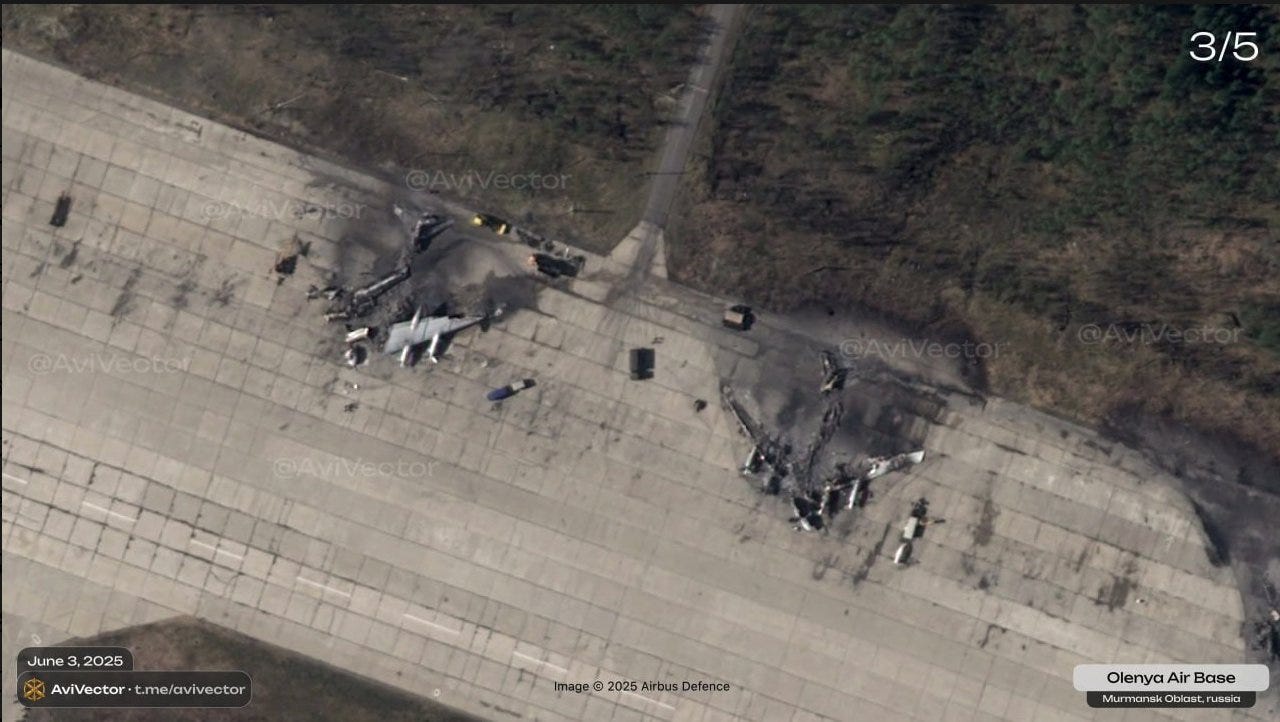
So, on to the damage from Spider’s Web itself. Initially, much of the Ukrainian infosphere was bandying numbers that were patently absurd, claiming that something like 70% of Russia’s strategic bombing fleet had been destroyed. The official claim from the Ukrainian government was that 40 bombers and early warning aircraft had been badly damaged or destroyed, which would amount to perhaps a third of the Russian inventory. A review of the video published by Ukraine, as well as satellite imagery, confirms around a dozen total losses, and western defense officials have landed on the number 20, including six destroyed TU-95s and four TU-22s.
Destroyed TU-95s at Olenya Airbase
Putting this in context, it means that Russia lost approximately 12% of its TU-95 fleet and 7% of its TU-22s, with the inventory of TU-160’s escaping unscathed. All told, that is approximately 8.5% of Russia’s strategic bombers. The issue, which constantly emerges on the Ukrainian side, are absurdly high expectations and a gross misunderstanding of what “success” means. In any realistic paradigm, destroying nearly 10% of Russian strategic bombing assets with relatively cheap drones would be viewed as a considerable success, but the ongoing expectation that Russian capabilities can simply be wiped out prevents such a realistic assessment.
We should acknowledge that the upsides here for Ukraine, lest we fall into the trap of “coping.” It’s manifestly obvious that Spider’s Web was both a schematically ingenious and technically innovative operation on the part of Ukraine. Striking at five widely separated Russian airbases with assets staged deep in the Russian heartland, Spider’s Web was both bold and ambitious, and it did not require risking particularly valuable Ukrainian assets. From a risk-reward calculation, this was clearly a success for Ukraine.
Furthermore, it must be plainly admitted that the destroyed Russian aircraft are, in fact, mostly irreplaceable. The TU-95 has been out of production for years, and the extant fleet was expected to serve a workhorse role for the foreseeable future. Russia has some production of the TU-160, with perhaps four aircraft scheduled for delivery in the near term, but this will obviously not fully replace the recent losses. Still, things could have been much worse. Losses were minimized by the total failure of strikes on two of the five target airfields. At Dyagilevo airfield near Ryazan, Russian air defenses were effective and no aircraft were hit; meanwhile, the attack on Ukrainka airfield in Amur Oblast failed when the launch container blew up. It also appears that the strike on Ivanovo Severny hit a pair of A-50 (AEWAC) aircraft but did destroy them.
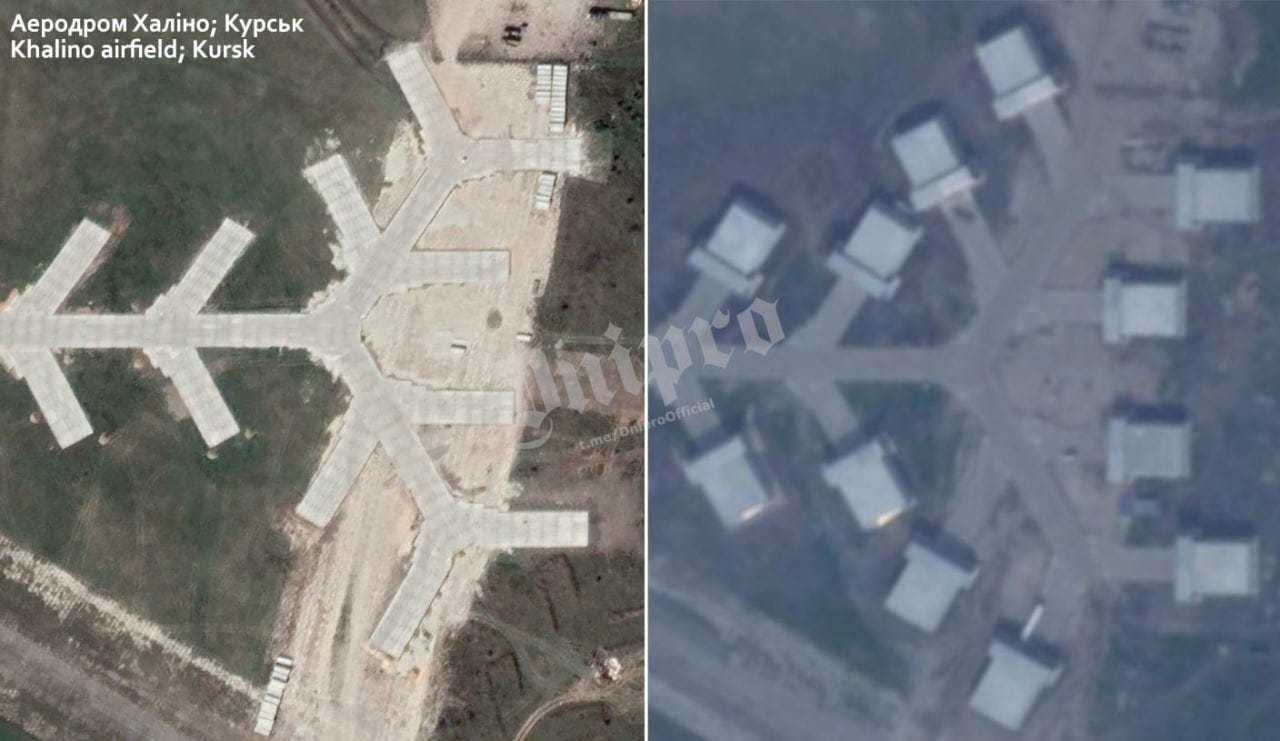
We’re left with something of a mixed bag. Ukraine demonstrated a novel and ambitious ability to strike Russian assets and did destroy several irreplaceable aircraft, but the results were certainly far short of what Kiev was hoping for. The Russians have good reason to feel that they escaped the worst of it. Certainly, this will be an inducement to accelerate the construction of hardened aircraft shelters, which has been underway at a plodding pace, though obviously not at all airfields, since 2023. Thus far, the Russians have mainly prioritized hardening airfields in range of conventional Ukrainian strike systems (in places like Kursk and Crimea). Spider’s Web will likely prompt similar hardening at far flung airfields that were once thought to be relatively safe.
Newly built shelters at Khalino Airfield in Kursk Oblast
Add it all up, and the ledger on Spider’s Web is fairly straightforward: it was a significant success for Ukraine, in that it destroyed a good number of valuable Russian assets while risking very little. However, multiple Russian airfields escaped without losing aircraft, thanks to a mix of successful Russian air defense and Ukrainian malfunction. The Ukrainians are left with a success, but one that was much smaller than they might have hoped for.
More significantly, however, Spider’s Web degrades Russian capabilities in a way that is very unlikely to make a material impact for Ukraine itself. Losing strategic bombers, especially models that are out of production, puts more stress on the remaining airframes and pinches capacity, but these losses are highly unlikely to make anything except the most marginal reductions in Russian strikes against Ukraine.
The first and most basic reason for this, of course, is that the air-launched missiles of the strategic bombing fleet form a relatively small fraction of the munitions that Russia fires into Ukraine. The vast majority have been, and continue to be, drones (like the venerable Geran) and the ground launched Iskander. Gerans, in particular, form the most numerous munition now in use, with hundreds launched per day amid rapidly increasing production. TU-95 participation in airstrikes is a relatively scarce occasion, and no matter how loud and cinematic the Big Bears may be, they are not remotely the primary launch platform in this war.
In fact, Spider’s Web provides an opportunity to pontificate on an ancillary point of considerable importance. Russia’s use of air launched cruise missiles has slackened significantly in 2025, as they stockpile missiles not only for use in Ukraine but also for other contingencies. In fact, mere days before Spider’s Web struck at the strategic bombing force, Ukrainian media was wondering aloud about the relatively scarce Russian use of these systems, noting that air launches by strategic bombers had occurred only a handful of times this year. At the moment, the key factor constraining Russian cruise missile strikes on Ukraine is neither a shortage of missiles nor a lack of airframes, but strategic decisions to stockpile assets.
In the grand scheme of things, the loss of irreplaceable bombers does compress top-line Russian capabilities, but not in a way that changes the calculus for Ukraine right now. Destroying a grouping of TU-95s on the ground is a success for Ukraine, particularly given the cheap assets that they expended for the task, but it does not address the problem, which is that Russia has established the ability to sustainably bombard Ukraine, particularly with Iskanders and Gerans, all while stockpiling strike assets. It is possible that, in the wake of Spider’s Web, Russia is compelled to make more frequent use of the TU-160 (which has been used extremely sparingly to this point), but it is clear that Russia has many strike options and its capabilities vis a vis Ukraine remain more than adequate. This is a war of industrial attrition, and Ukraine’s covert operations are not a substitute for the capacity to wage a persistent air campaign.
Ultimately, this brings us to the broader point. Spider’s Web was an innovative example of an asymmetric operation, but this merely speaks to the presence of a broader asymmetry in this war, as such. Russia is the far richer and more powerful fighter in this conflict, which paradoxically means that it has more assets both to use and to lose. Ukraine managed to destroy nearly a dozen Russian strategic bombers, but Ukraine has no strategic bombers at all. Russia will always be vulnerable to asymmetric losses of this sort, because it possesses assets that Ukraine does not. Losing strategic bombers is not good, but it’s better than not having them at all. In this conflict, there’s still only one party that has a vast and diverse arsenal of indigenously produced strike systems, and one party that has to resort to (admittedly very clever) truck launched drone attacks due to the exhaustion of its conventional strike capabilities.
Hitting the Seam: Donbas Front Update
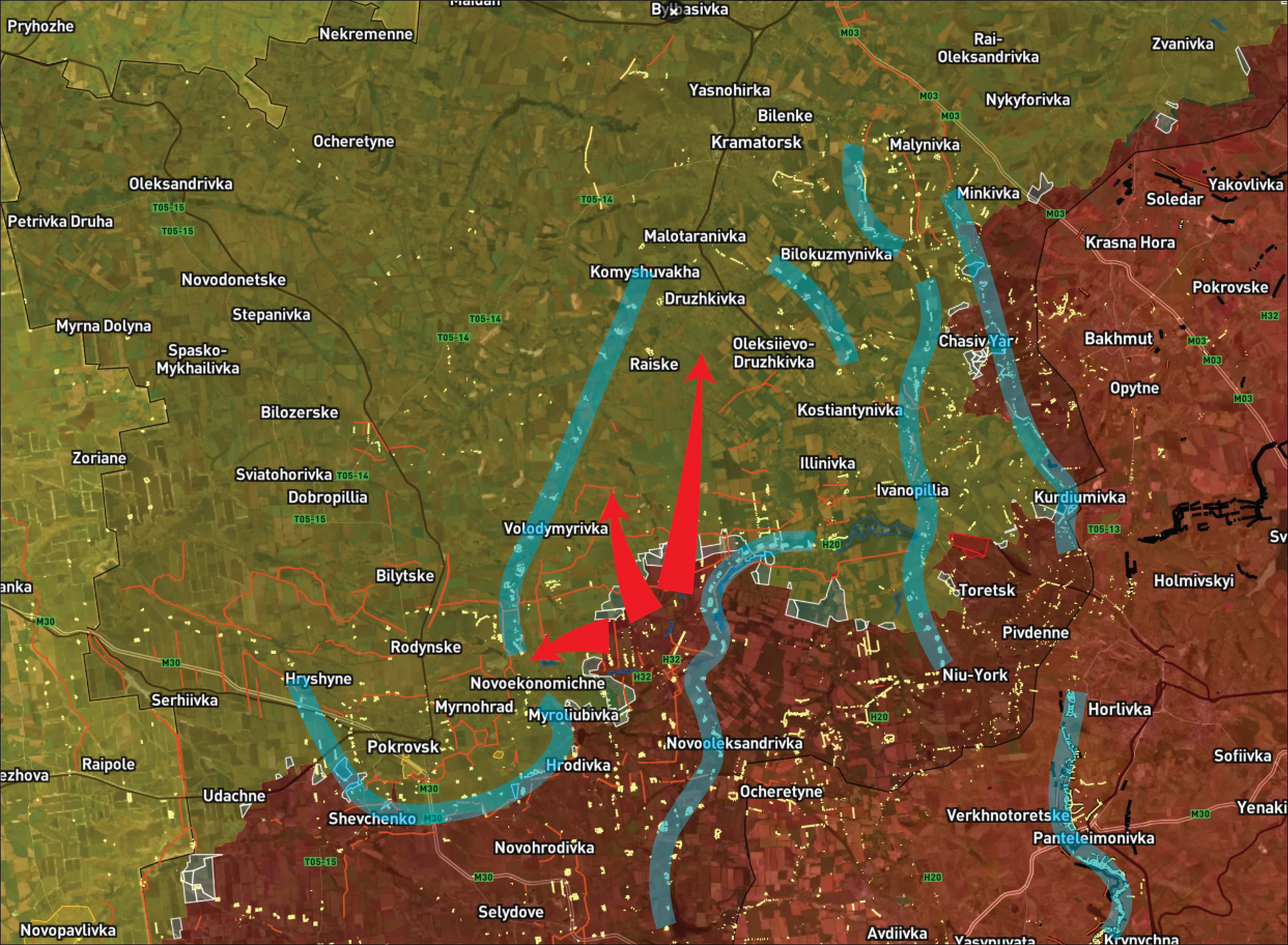
On the ground, the primary axis of effort for the Russian Army continues to be the central Donbas front, around the cities of Kostyantynivka and Pokrovsk. This is particularly the case now that the two axes in South Donetsk and Kursk have been largely scratched off. A brief look at the situation map reveals a swelling Russian offensive in this critical central sector. The past few years ought to have given us a good sense of caution about using words like “breakthrough” and “collapse”, so I will instead simply argue that the Ukrainian Army is in serious trouble in this sector.
The reasons are fairly straightforward, and lie not only in the escalating manpower shortages facing Ukrainian formations, but also in a triple vulnerability that exists in this particular sector of front. In short, the Pokrovsk-Kostyantynivka axis suffers from what we will call a “triple seam” which makes it operationally very vulnerable, and the current Russian offensive is aimed directly at this seam, or operational joint. Let’s elaborate.
The first seam, or vulnerability, is geographic and thus by far the easiest to understand. The basic issue is that the urban belt in western Donetsk (running from Kostyantynivka up to Slovyansk) lies on the floor of a valley. In the Kostyantynivka sector in particular, there are local high points around Chasiv Yar, Toretsk, and Ocheretyne, all of which are now firmly in Russian hands and form the bases of support for advances towards Kostyantynivka. To the west of Kostyantynivka, there is a wedge-shaped plateau which separates the city from Pokrovsk, and it is into this elevated wedge that the Russians are now advancing.
Elevation Map: Central Donbas
The operational problem for Ukraine, however, goes much farther than the elevation map. In fact, the elevation issue dovetails with structural problems with Ukraine’s prepared defenses. To understand this, we must first remember the state of the front in 2023. Two summers ago, the main axis of Russian effort was through Bakhmut – that is, an advance due west across central Donetsk. At that point, the southeastern axis of the front (Avdiivka, Krasnogorivka, Ugledar) was holding steady for the AFU. Facing the prospect of a Russian advance directly from the east, the Ukrainians built up defenses around Kostyantynivka which face eastward, towards Bakhmut.
The collapse of the southern front creates a pivot in the Ukrainian defenses, so that the axis of the Russian advance is now from the southwest of Kostyantynivka, rather than from the east. Although the Ukrainians began building new defenses (oriented towards the south) after the collapse of the southern front, there remains a significant gap west of Kostyantynivka. Furthermore, the “joint” where Ukraine’s defenses intersect is essentially at the southwestern limit of Kostyantynivka itself.
Ukrainian Defensive Belts (Military Summary)
Recent Russian advances have now put them behind the Ukrainian positions guarding the southwestern approach to Kostyantynivka. When the Russians reached Yablunivka (approximately June 4), they were firmly in the rear of the defensive belt southwest of Kostyantynivka, opening up the Ukrainian line here for entry into the city’s western flank and link up with the advance out of Toretsk.
Approximate Situation around Kostyantynivka
Given Ukraine’s lack of manpower, these trench systems threaten to become highways for Russian forces, as we saw along the Ocheretyne axis in 2024. Once Russian forces break into these belts, they are able to roll along the length of the belts deep into Ukrainian space.
In short, a variety of structural weaknesses are all dovetailing in the same sector of front. The Russians are advancing from advantageous high ground into structural seams in the Ukrainian defenses, precisely into the area of front that wedges Pokrovsk and Kostyantynivka apart from each other. The result is an emerging double envelopment, with the Russians plowing through the middle towards the rear areas behind these cities. The terrain and the orientation of the Ukrainian lines have accommodated an enormous Russian splitting wedge which will sever the lines of communication to both cities. This would be a major problem under ideal circumstances, but given Ukraine’s inability to properly man its positions, it has become a crisis.
In the coming weeks, Russian forces will continue their expansion into the interstitial space between Pokrovsk and Kostyantynivka, probing their way into Ukraine’s operational liver. When they reach the space just to the southwest of Druzhivka, they will be positioned to cut the lines of communication into both cities. Simultaneously, they will continue the rollup of the defenses on Kostyantynivka’s southwestern flank. With Russian forces penetrating into the city’s southwestern flank, the city is already in an untenable position,
Of the two cities, Kostyantynivka is likely to fall first, with the Russians beginning to assault the city proper at some point in July. In what I would characterize simply as a command decision, the Russians have been patient about pushing Myrnograd and crumpling the shoulder of the Pokrovsk position. At this point, they seem unlikely to do so until the advance into the seam has compromised the lines of supply from the rear.
At the risk of being somewhat hyperbolic, this remains the only sector worth watching closely. Russian forces are exerting relatively minimal efforts on other axes of the front. There is incremental progress, pregnant with opportunity, around Lyman, and Kupyansk, and the expansion of the Russian “buffer zone” in Sumy oblast bears watching. It seems extremely unlikely, however, that Russia has intentions in the near term of pushing the front towards the city of Sumy itself; rather, the buffer zone is aimed at seizing a forward defensive line along the high ground on Ukraine’s side of the border, keeping an advantageous front open to dissipate Ukraine resources. The center of gravity in this war remains the central Donbas, and the key operational fact, as such, has been the pivot in the Russian strategic axis. After advancing westward through Bakhmut in 2023, they broke open the south in 2024 and are now advancing orthogonally into the Ukrainian defense between Pokrovsk and Kostyantynivka, in the penultimate act of the Donbas campaign before they reach the prize in Kramatorsk and Slovyansk.
Conclusion: Strategic Clarity
I have written frequently about the critical importance of a “theory of victory” when waging a war. This refers, in the simplest sense, to the need for a state to have an overarching concept for leveraging power into its war aims. This is the strategic ligament which connects military operations and diplomacy to the state’s wartime objectives.
As the war moves on into its fourth year, Ukraine and her western backers have cycled through several different theories of victory which were quietly discarded after coming apart at the seams. In the first year of the war, the theory of Ukrainian victory centered on created an unacceptable cost-benefit calculus for Russia. If Ukraine and the west showed unexpected resolve, keeping the AFU fighting fiercely in the field, it was hoped that Russia would back down from fighting a long war, particularly as sanctions gnawed away at the Russian economy. Instead, Russia began mobilizing for a longer fight, and the Russian economy has thus far weathered the sanctions intact.
This theory of victory was then replaced with a model predicated purely on military operations, which supposed that a decisive victory could be won in the south by knifing through Russian defenses in the land bridge. This theory came apart in a much more visible fashion, with western armor burning on the steppe after a botched attempt to breach the Surovikin line. A second attempt to restart decisive operations met a similar end in Kursk.
In contrast, Russia has had an essentially consistent theory of victory since late 2022, when it began mobilization. That theory is very simple: by establishing a basis for sustainable military operations against Ukraine, consistent pressure and ground advances can be maintained until either Ukrainian resistance collapses or Russia controls the Donbas. To this point, Ukraine has not demonstrated capabilities – either to go on the offensive or to halt the Russian advance in the Donbas – that change this basic calculus.
Commentators in the west rarely try to view the conflict from Russia’s perspective, but if they could they would quickly see why Russian confidence remains high. As Russia sees it, they have absorbed and defeated Ukraine’s two best punches on the ground (the 2023 counteroffensive and the Kursk operation), and they have weathered a long and steady infusion of western combat power without the trajectory of either the ground campaign or the strike war fundamentally shifting. Meanwhile, Russia has essentially scratched off the entire southern Donbas, pushing the front across the border into Dnipropetrovsk Oblast, and they are poised to wrap up the central sector of front as the advance around Pokrovsk and Kostyantynivka blooms.
We’re left, then, with a jarring disconnect. On the one hand, the Trump Administration approached Ukraine as if their election fundamentally changed everything and instantly raised the probability of a negotiated peace. Russia, however, rather rightly feels that nothing has changed at all. They have absorbed everything the west has thrown into the conflict, and they continue to both advance on the ground and relentlessly strike Ukraine on a material basis that they clearly view as sustainable, without unduly burdening civilian life in Russia.
If anyone was surprised, then, that Russia came to Istanbul only to reiterate the same terms they’ve been presenting from the beginning, they were clearly not paying attention. Russia has no inducement to soften its stance so long as it feels that the battlefield calculus is unchanged, and nothing that the west (or Ukraine) has done since 2022 has given Moscow a valid reason to revise its views. Russia’s baseline demands ought to be well understood by now, as is Russian willingness to achieve those aims kinetically. If Ukraine will not give up the Donbas at the table in Istanbul, it can be taken by the Russian Army. In the end, there’s very little difference.
We are left with Woodrow Wilson’s formulation. Not, of course, his high minded “peace without victory”, which is a nonstarter today just as it was in 1917. Rather, we’re left with the hardened and embittered Wilson of 1918. With the United States now an active belligerent in the conflict, Wilson’s outlook had darkened immensely, and he now categorically opposed negotiating with an undefeated Germany at all. He had concluded instead that “If Germany was beaten, she would accept any terms. If she was not beaten, he [Wilson] did not wish to make terms with her.”
If the olive branch has wilted, the pistol will do.
By Max Blumenthal & Anya Parampil, The Grayzone, 6/21/25
An official in the administration of President Donald Trump has told The Grayzone that CIA Director John Ratcliffe and US CENTCOM Commander Gen. Michael Kurilla have become vehicles for Israel’s Mossad and military as they seek to manipulate the US into attacking Iran. The official referred to Ratcliffe as “Mossad’s stenographer.”
This Substack is reader-supported. To receive new posts and support my work, consider becoming a free or paid subscriber.Upgrade to paid
According to the official, Ratcliffe and Kurilla have pressured Trump to join Israel’s war more directly by regurgitating overblown briefings they received from the Israeli military and Mossad director David Barnea – but without informing the president they the intelligence derived from a foreign third party.
During the Trump administration’s meetings with Israeli intelligence officials including Barnea, the official said the Israelis have demonstrated a single-minded focus on regime change, clamoring for authorization to assassinate Iran’s leader, Ayatollah Ali Khamenei. The official have emphasized that the moment to take out Khamenei is now.
The issue of Iran’s nuclear enrichment capacity is of secondary concern in the Israelis’ presentations, which the official characterized as tactless, hyper-aggressive exercises in fear-mongering. At one point, the Trump official recalled, an Israeli intelligence briefer declared that Iran could transfer a nuclear weapon to Yemen’s Houthi militia in less than a week.
According to the official, Trump’s lead negotiator with Iran, Steve Witkoff, has been pushing the president to preserve the diplomatic track. However, an Israeli assassination of Khamanei would almost certainly be the nail in the coffin of nuclear negotiations – which is precisely why the Israelis seem so determined to do it.
If the US enters the war by attacking Iran, the official fears that Iran will activate IRGC-backed Popular Mobilization Units to attack US troops and bases in Iraq and Syria, leading to American casualties and triggering escalation well beyond the initial scope of Iran’s nuclear program.
Having launched a damaging war of attrition with Iran, Tel Aviv is deploying every mechanism at its disposal to compel the US to lurch headlong into the conflict it initiated, but which it can not finish on its own.
Inside the Trump administration, the source told The Grayzone that top officials who have questioned the logic of attacking Iran such as Director of Intelligence Tulsi Gabbard and her deputy, former CIA officer and director for the National Counter-Terrorism Center Joe Kent, have been excluded from meetings by White House Chief of Staff Suzie Wiles.
Taking the lead in briefing the president is a highly suggestible CIA director whom Israel has groomed since he first entered Congress.
AIPAC director boasts of influence over Ratcliffe
This April, The Grayzone released exclusive audio of remarks by AIPAC CEO Elliot Brandt to an off-the-record Israel lobby session in Washington DC. Boasting of his organization’s success in recruiting members of Congress, he described CIA Director John Ratcliffe as a “lifeline” inside the administration.
“You know that one of the first candidates I ever met with as an AIPAC professional in my job when he was a candidate for Congress was a guy named John Ratcliffe,” Brandt recalled. “He was challenging a long time member of Congress in Dallas. I said, this guy looks like he could win the race, and, we go talk to him. He had a good understanding of issues, and a couple of weeks ago, he took the oath as the CIA director, for crying out loud. This is a guy that we had a chance to speak to, so there are, there are a lot – I wouldn’t call them lifelines, but there are lifelines in there.”
Besides Ratcliffe, AIPAC CEO Elliott Brandt also named Marco Rubio and Mike Waltz, two former Republican congressmen cultivated by AIPAC in advance of their appointment to key national security positions in the Trump administration.
“They all have relationships with key AIPAC leaders from their communities,” said the AIPAC CEO. “So the lines of communication are good should there be something questionable or curious, and we need access on the conversation.”
This May, Waltz was outed by colleagues for secretly coordinating with Israeli Prime Minister Benjamin Netanyahu to orchestrate a US attack on Iran, costing him his job as National Security Council director. Secretary of State Rubio assumed the role of acting National Security Director, granting him control over more cabinet level positions than any US official since Henry Kissinger. Meanwhile, Ratcliffe quickly emerged as the key channel of Israeli influence in the administration.
The CIA director has come a long way since entering politics as the mayor of a backwater Texas town with a population of 7000.
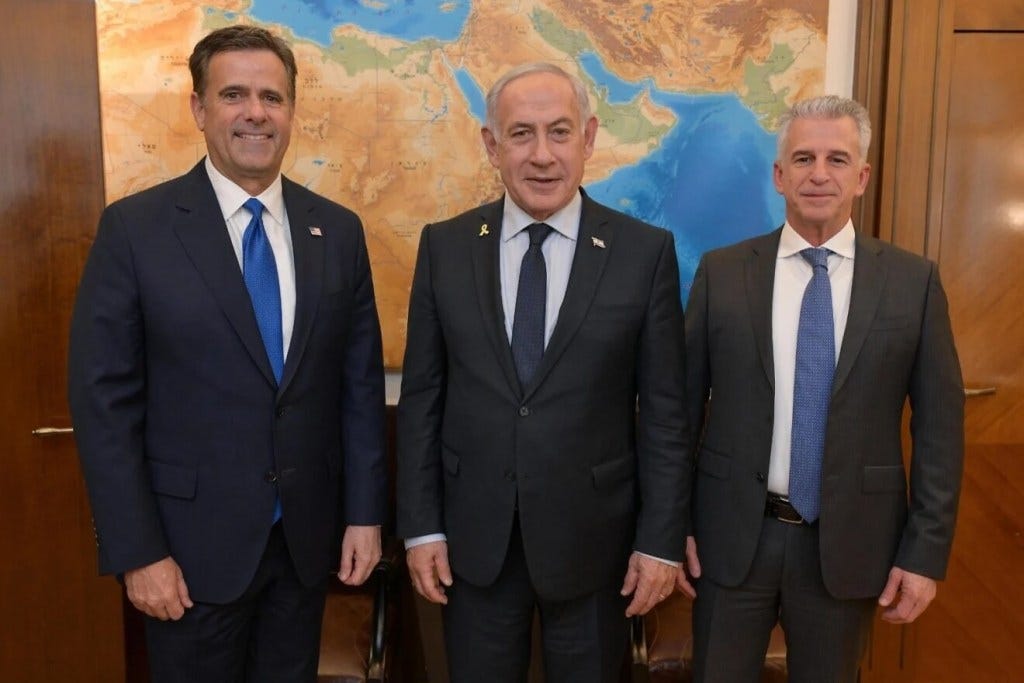
CIA Director John Ratcliffe with Israeli PM Benjamin Netanyahu and Mossad Director David Barnea in Jerusalem, April 2025
A small town Texas mayor becomes big time Israeli asset
With no experience in the US military or intelligence, Ratcliffe spent the early part of his political career as mayor of Heath, a small town outside of Dallas, which was broken by a year-long stint as a US Attorney between 2007-08. He entered Congress in 2014, and emerged two years later as one of Trump’s fiercest attack dogs on the Judiciary Committee. The backbencher also served on the House Intelligence Committee.
Trump rewarded Ratcliffe’s loyalty by nominating him as Director of National Intelligence in 2019, but quickly withdrew the nomination after Ratcliffe was exposed for lying about his role in several federal terrorism cases.
His most absurd embellishment was on the prosecution of the directors of the Dallas-based Holy Land Foundation, in which he boasted that “he convicted individuals who were funneling money to Hamas behind the front of a charitable organization.” In fact, Ratcliffe played no discernible role in the case at all, prompting several Republican senators to withdraw support for his nomination when the lie came to light.
It is notable nonetheless that Ratcliffe sought credit for taking down the Holy Land Foundation, as the case was one of the most politicized and legally dubious prosecutions of the Bush-era “war on terror,” leading to life sentences for Palestinian American defendants whose only crime was sending charitable donations to organizations in the Israeli-occupied Gaza Strip which were not on any government watchlist, and which also received support from the International Committee of the Red Cross and USAID. What’s more, the case was heavily influenced by Israeli intelligence.
Following a mistrial that proved embarrassing for the US government, Israel’s Mossad dispatched an agent to Texas to testify against the Holy Land directors. The judge allowed the agent to testify in secret, with the courtroom cleared, and under an assumed identity as “Avi.” The agent proceeded to brandish a series of questionable documents that supposedly proved the Holy Land Foundation was set up as the nexus of a vast terrorist financing network that had enabled several suicide bombings by Hamas.
While Ratcliffe’s fantastical claims about his role in the case tanked his nomination in 2019, Trump successfully installed him as DNI the following year, paving the way for his nomination as CIA director upon Trump’s re-election.
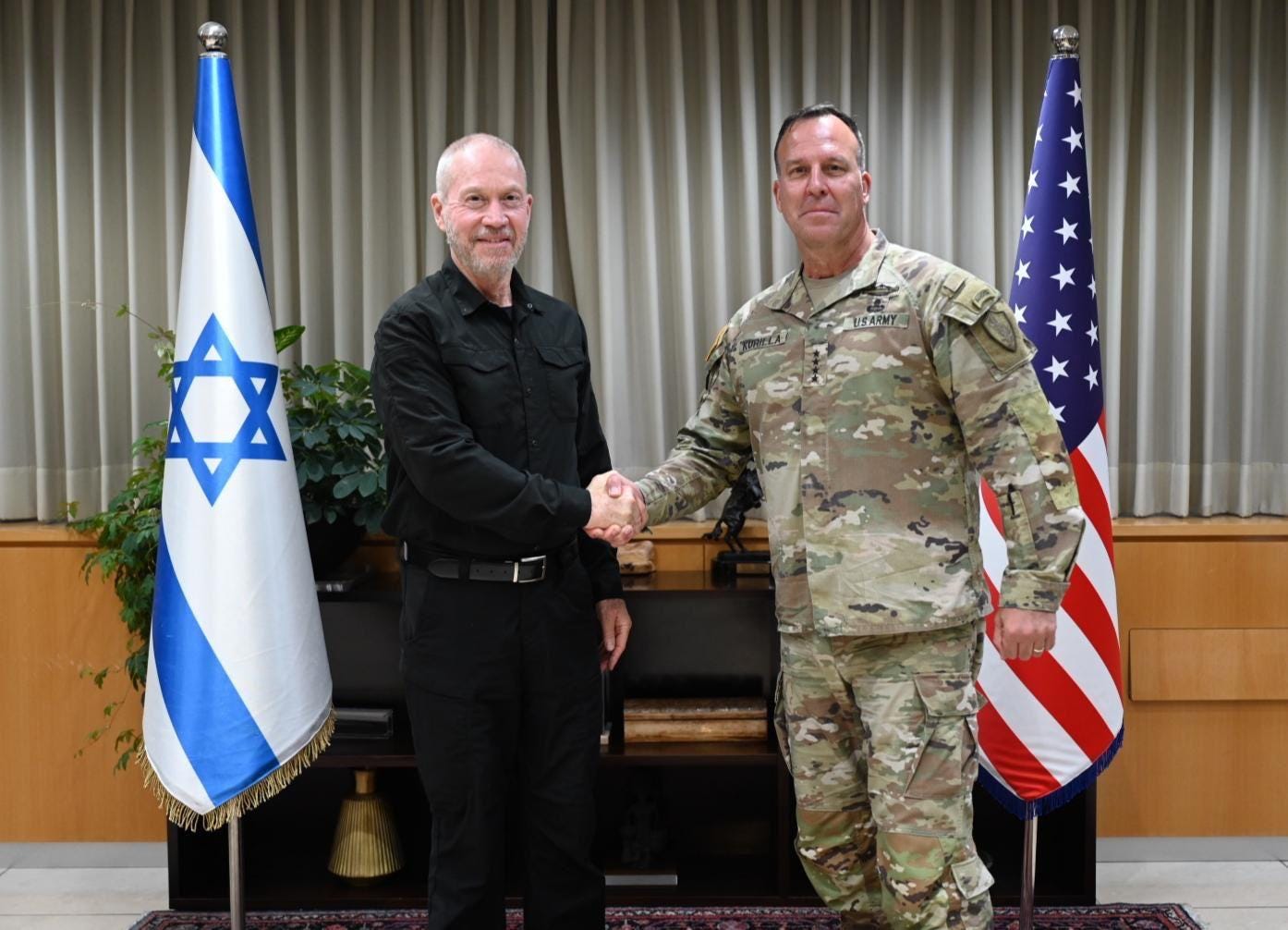
Gen. Michael Kurilla with then-Israeli Defense Minister Yoav Gallant, March 2023
Chief of Staff Suzie Wiles isolates Trump with “Israel’s favorite general”
The Trump official told The Grayzone that White House Chief of Staff Suzie Wiles has ensured that the president remains surrounded by Ratcliffe and Gen. Michael Kurilla in briefings related to Iran.
Ratcliffe is said to take dictation from the Mossad and read the documents they’ve prepared to the president without any sense of critical detachment, or disclose that the assessments came from a foreign liaison rather than US intelligence.
Then there is Gen. Kurilla, who appears singularly focused in meetings with Trump on making the case for a US attack on Iran. In 2024, the pro-Netanyahu Israeli outlet Israel Hayon described Kurilla as “a vital asset to Israel.” The UK’s Telegraph referred to Kurilla this June as “Israel’s favorite general.”
Former Pentagon officials have even speculated that Israel’s decision to launch an unprovoked surprise attack on Iran this June 13 was partially influenced by Kurilla’s looming retirement in July, as Tel Aviv did not want to go to war without him present at CENTCOM.
The Trump official told The Grayzone that Wiles has excluded Trump’s Director of National Intelligence, Tulsi Gabbard, from crucial meetings where US intervention in Iran was discussed. That included a June 8 meeting at Camp David where Ratcliffe used a clumsy sports metaphor to insist that Iran was just days away from producing a nuclear weapon: “It’s like saying a football team marched 99 yards down the field, got to the one yard line and, oh, they don’t have the intention to score,” he argued to Trump.
Two days later, Gabbard released a social media video invoking the American military’s destruction of the Japanese city of Hiroshima with a nuclear bomb in 1945, and warned that a similar horror could soon unfold because “political elite warmongers are carelessly fomenting fear and tensions between nuclear powers.”
Trump was reportedly infuriated by her comments. Asked by a reporter about Gabbard’s testimony this March that Iran had not restarted its nuclear weapons program, Trump grumbled, “I don’t care what she said,” then echoed Ratcliffe’s view – and by extension, that of the Israelis: “I think they were very close to having [a nuclear weapon].”
This may explain why Gabbard released a June 20 statement on Twitter/X insisting that her views on Iran’s nuclear enrichment were faithfully aligned with Trump’s, and had been distorted by a “dishonest media” seeking to “manufacture division.” Though the statement reaffirmed her commitment to President Trump, her assessment of Iran’s nuclear program did not differ from the evaluation she delivered in March, which determined Iran was not currently pursuing a nuclear bomb,
“America has intelligence that Iran is at the point that it can produce a nuclear weapon within weeks to months,” Gabbard claimed on Twitter/X, “if they decide to finalize the assembly.”
According to the Trump official, Chief of Staff Wiles has also excluded Secretary of Defense Pete Hegseth from meetings on Iran, relying instead on Kurilla to represent the US military.
Vice President JD Vance has held a parallel series of meetings on Iran, the official said. In contrast to those controlled by Wiles, Vance has encouraged robust debate and included diverse perspectives. In public, however, Vance is constrained by the obligation to demonstrate loyalty to Trump.
For his part, Trump’s views are said to be shaped by constant exposure to Fox News, which has transformed in the past two weeks into a 24/7 commercial for war on Iran. Fox News’ coverage has become so transparently influenced by Israel’s propaganda mechanism that Steve Bannon, the former White House chief of staff and intellectual architect of the America First movement, called for a Foreign Agents Registration Act investigation of the network.
As Trump heads back to Washington on June 21, Bannon lamented that “the party is on,” suggesting the president had decided to go to war on Israel’s behalf.