Despite U.S. President Donald Trump’s frequent statements that victory in Iran is close, there is no end in sight to the hostilities in the Persian Gulf. On the contrary, new approaches to limited traffic through the Strait of Hormuz are gradually being implemented. The Islamic Revolutionary Guard Corps has started issuing paid transit permits to vessels unaligned with the United States or Israel, and a growing number of countries want to discuss “safe passage of their vessels.”
The consequences of restricted transit for the oil market are already clear and well known. Not as much attention is being paid to the impact on the global fertilizer market. The changes there will be more gradual, but irreversible. Food prices will take six to nine months to react to the supply shock in the fertilizer market resulting from the closure of the Strait of Hormuz. Meanwhile, Russia might enjoy more lasting benefits than temporarily lining its pockets with petrodollars.
The Strait of Hormuz is the most important transit route not just for oil but also for fertilizers. Persian Gulf countries account for about 46 percent of global seaborne urea transit and around 30 percent of ammonia transit. These nitrogen compounds are integral for efficient cultivation of almost every food crop. However, their shipping from the Persian Gulf is almost completely paralyzed.
Disruptions to maritime transit through the strait have already triggered a sharp surge in nitrogen and phosphorus fertilizer prices. According to Platts, as of March 19, the free on board (FOB) price for Middle East granular urea rose to $604–710 per ton, up from $436–494 before the start of the war. The Southeast Asia granular urea was at $750 per ton on March 19, up from $490–498 in late February. While these prices are still below the 2022 record highs, they continue to grow.
Furthermore, unlike with oil, there are no strategic reserves of urea, no alternate pipelines for ammonia, and no military escort programs. Saudi Arabia has created infrastructure to export oil bypassing the Strait of Hormuz, but no such solutions exist for fertilizers.
The lag between disruptions in fertilizer supply and rising food prices is measured in seasons rather than days. A farmer who doesn’t have access to urea at the start of the planting season might use less fertilizer, switch to a different crop, or forgo planting altogether. This decision affects the harvest in three to six months, and takes longer still to impact supermarket prices. Today we are at the very beginning of this cycle.
The UN World Food Program estimates that the number of people experiencing acute food insecurity could rise by 45 million to a record-high 363 million if the war in Iran doesn’t end by mid-2026, and oil prices remain above $100 a barrel.
The geographic distribution of this increase is predictable and politically significant: an additional 17.7 million people in East and Southern Africa, 10.4 million in West and Central Africa, and 9.1 million in Asia. Many in these regions will be happy to buy not just Russian fertilizers, but also the Kremlin’s narrative that Moscow is the best guarantor of food security for the Global South.
Similar dynamics played out in 2022, when Russia’s full-scale invasion of Ukraine had also hit the fertilizer market hard. However, back then, the disruptions in Black Sea shipping had simultaneously driven up grain prices, which partially offset the rising cost of fertilizers for farmers.
Today, the grain prices are only growing a little, because Iran is not a major agricultural producer. Thus, higher expenses for farmers at the start of the planting season aren’t being compensated with higher crop values, and the consequences for the food market will emerge later and last longer.
As with the oil market, Russia is one of the main beneficiaries of the turmoil in the fertilizer market. Russia accounts for about 23 percent of global ammonia exports, 14 percent of global urea exports, and—together with Belarus—40 percent of global potash exports. Furthermore, its export infrastructure is completely independent of the Strait of Hormuz. Moscow doesn’t need a ceasefire, a military escort, or a diplomatic breakthrough to ramp up its deliveries. All it needs is orders, and it is getting more and more of these.
Importers in Nigeria and Ghana are already pre-purchasing Russian fertilizers for the third quarter of 2026. This is a rational market response to the disappearance of competing supply, and once established, these connections will solidify into a dependency that could outlast any ceasefire.
Moscow has already employed this tactic. In 2022–2023, the Kremlin used the Black Sea Grain Initiative as diplomatic leverage in Africa and the Middle East, pushing importer countries for friendlier positions and corresponding votes in the UN as an unofficial precondition for resuming deliveries.
Fertilizers are even more convenient as leverage. They receive less media attention in the West than wheat, and they are more critical for the agricultural sector. The bureaucrats responsible for fertilizer procurement in Ethiopia and Bangladesh don’t think about the Ukraine conflict when they need urea before the monsoon season arrives. They call the Kremlin, and the Kremlin answers.
Moscow is well aware of these new opportunities. In a March 18 interview with Kommersant, presidential aide Nikolai Patrushev said that the U.S. war with Iran is not a temporary crisis, but a structural realignment that should be leveraged. According to Patrushev, the U.S.-Israeli operation is a “catalyst for the redistribution of the global energy market and the disruption of maritime logistics” and has “unpredictable humanitarian and economic consequences.”
Patrushev made no mention of Ukraine in the interview. However, he did propose providing naval convoys to protect merchant ships. In August 2024, Patrushev was appointed chairman of the newly established Russian Maritime Board. Meanwhile, his son Dmitry Patrushev is a deputy prime minister for agriculture and fertilizer production.
The closure of the Strait of Hormuz triggers a chain reaction of three consecutive shocks in the agricultural sector. The first—a surge in fertilizer prices—is already under way. Even farmers in developed nations are feeling it, albeit less acutely due to existing stockpiles and access to financing.
The second—reduced crop yields as a result of high fertilizer prices—will come in the fall. Its impact will be uneven: agricultural producers in the United States and the EU will find it easier to diversify their suppliers than those in many countries of Africa and Asia.
The third—food inflation—will follow in 2027. Food is a commodity with a very low price elasticity of demand, particularly in poorer nations. A supply shock translates almost entirely into higher prices rather than lower consumption, and lower consumption is itself a catastrophe: in poorer nations, lower consumption means famine and not just changes in the composition of the consumer basket.
For Russia, each of these three shocks is important in its own way. Moscow imposed export quotas on fertilizers back in 2025 in order to stabilize the domestic market. A rapid increase in exports would require corresponding government decisions and could run up against infrastructure constraints at the ports.
Historically, Russia was the world’s largest exporter of anhydrous ammonia; however, the Togliatti–Odesa ammonia pipeline is not currently operating due to the war in Ukraine. A new terminal on the Taman Peninsula was supposed to partially resolve this issue, but the details on its full capacity remain unclear. Nevertheless, the Kremlin has already declared that “Russia is one of the few countries that can ensure a growing market supply.”
In the long run, the Kremlin will enjoy geopolitical gains from the turmoil in the Persian Gulf and not just financial benefits. Additional oil revenues are likely, but could run out. Meanwhile, higher prices on fertilizers and food are a victory of a different magnitude. Russia won’t just profit from rising prices; it will have the opportunity to convert its market power into political influence and acquire leverage over countries whose neutrality is vital for the West.
The war in Iran will probably end before most people see its connection with the rise in food prices in 2027. By that point, Russia will be able to position itself as an indispensable supplier that saved the world from starvation. The Kremlin did not sow this harvest, but it will most likely reap it.
The survey has been conducted since 2021 among the same group of respondents—more than 700 sole proprietors and small business owners. The most recent wave of interviews took place from January 20 to February 19, 2026.
According to the study, entrepreneurs’ expectations for the first quarter of 2026 are the worst ever recorded. More than half of respondents (52%) believe their business’s situation will worsen, while only 12% expect an improvement.
For comparison, in the first quarter of 2022, against the backdrop of the widespread introduction of anti-Russian sanctions, the share of pessimistic assessments was 38%, while optimistic ones were at least 20%.
At the same time, the share of companies operating in survival mode is growing. At the end of the fourth quarter of last year, it reached 39%, the highest level in the last five years. However, only 8% of entrepreneurs expect an increase in these indicators.
Small businesses’ financial performance is also deteriorating. Thirty-nine percent of respondents reported a decrease in revenue compared to the previous quarter, and 29% reported insufficient revenue to cover direct expenses.
Last week, the New York Times ran an alarming house editorial called “Politicians Are Trying To Control The News,” outlining how the “shadow of press repression” is now expanding to “onetime bastions of press freedom” like Hong Kong, Israel, and Donald Trump’s United States. Written in the grave tone the paper brought when it published a history-altering essay by Soviet dissident Andrei Sakharov fifty years ago, it was all true, except it left out our country’s strangest and most shameful example, one in which the Times played a regrettable part: the case of Dimitri Simes.
In August, 2024, the FBI raided the Virginia home of Simes, who defected to the United States in 1973 after being expelled for protesting Soviet involvement in the Vietnam War. A huge team of agents swooped into the empty home — both Simes and his wife were away — and took almost everything, including an icon “which my mother got from Andrei Sakharov.” For Simes and his wife Anastasia, it was devastating. “Look, I lived in the United States for fifty years,” he said Monday. “It was all our possessions.”
The FBI left one thing. “My handgun,” Simes said. “They put it on my night table.”
A month later, on September 5, 2024, Simes was indicted on a series of charges that have no precedent. Technically, he was charged with violating the International Emergency Economic Powers Act (“IEEPA”), a sanctions regime that allows the president to take action against any “unusual and extraordinary threat” to national security. The law is intended to allow the U.S. to seize or block assets of foreign powers deemed hostile or belligerent, in this case Russia.
The offense that triggered the Simes indictment was that he “continued … hosting and producing the television program ‘The Great Game’ for Channel One Russia, and received compensation and services from Channel One.” Simply put, he hosted a Russian TV program and was paid to do so. U.S. government sources told the New York Timescharges were filed “to crack down on Russia’s attempts to influence American politics ahead of November’s presidential election.” Times reporters Julian Barnes and Steven Lee Myers added that the Justice Department believed that Russian President Vladimir Putin had “devised a plan to target swing state voters in favor of Mr. Trump and against further support for Ukraine.”
The Great Game is a political debate show broadcast on Russia’s Channel One in Russian, for Russians. No one in America watches it, in swing states or anywhere else, but even if they did, it’s still extraordinary that the Biden government charged an American citizen in criminal court with the overtly political offense of potentially supporting his opponent, or opposing American involvement in the Ukraine war. Anyone reading that September, 2024 New York Times story would assume that Donald Trump by now would have handed Ukraine to Putin, and certainly dropped the charges against Simes.
Neither proved true. Simes remains under indictment, threatened with forty years in prison, for the crime of hosting a Russian TV show. It’s not a partisan problem, as this case (like the Assange case) was brought under Democrats and continues to be prosecuted under Donald Trump. Hundreds if not thousands of people in America work for foreign news organizations, some of them for sanctioned countries, but Simes alone has been criminally charged in this way. Why?
One of the lawyers for Simes is the eminent Michel Paradis, well known for representing Guantanamo detainees and for authoring a number of provocative books, including most recently The Light of Battle, about Dwight Eisenhower’s role in building America’s superpower status. I asked Paradis if there was any precedent for criminally charging someone for working as a journalist. Typically in speech offenses the ostensible offense is different: incitement, discrimination, causing harm, etc. With Simes, it was his employment status alone.
“It is a totally unprecedented use of the sanctions laws,” said Paradis. “The closest analogies over the past 100 years are the prosecutions of John W. Powell for sedition for editing China MonthlyReview during the Red Scare (which ended in a mistrial), and of Tokyo Rose for treason during World War II.”
Simes was pursued relentlessly in the Trump/Russia investigation, but the government never found wrongdoing. The biggest revelation about him in the Mueller report, in fact, disproved two media myths. After Trump was elected in 2016, Alfa Bank Petr Aven attempted to set up a line of communication with the new president by reaching out to former U.S. Ambassador to Germany Richard Burt, who in turn tried to broker a connection to team Trump through Simes.
Simes refused, in an episode that showed that pre-election hysterics about a “secret server” connection between Trump and Alfa-Bank were wrong. Moreover, as the Washington Post put it, “Russians did not appear to have pre-election contacts” with the Trump team.
Simes, long known as the head of the Center for the National Interest think tank, was for decades a go-to quote for journalists from papers like the New York Times and Washington Post, if they needed an insight into Soviet or Russian politics. As a young reporter at the Moscow Times I probably called him a half-dozen times, along with most other staffers. Now the onetime defector is back in exile in Russia, and the American press that asked for favors repeatedly has abandoned him as a politically inconvenient colleague.
Simes is comfortable in Moscow now, but is fighting his case not just for the right to return to his adopted country, but for the sake of the First Amendment and the rule of law itself. “If I were to remain silent, there would be a false impression that things like this are okay, that you can do it with total impunity,” he says. “That’s wrong.”
The rest of my conversation with Dimitri Simes, with whom I spoke for the first time in three decades Monday, is in an audio file below, followed by a transcript:
Matt Taibbi: Dimitri, thank you for joining me. I’m in New Jersey. Where are you right now?
Dimitri Simes: I am in Moscow.
Matt Taibbi: But you are an American citizen?
Dimitri Simes: Yes, but I’m also a Russian citizen.
Matt Taibbi: Can you just share a little bit of your history?
Dimitri Simes: Well, let me say first, I was not a Russian citizen for a very long time. I became a Russian citizen in October 2022, when I moved to Moscow full-time. Before that, since 1980, I was strictly a proud American citizen. I came to the United States with my first wife, in 1973. And we lived, at first in Virginia. Several months after we came to the Washington area, I got a job at the Center for Strategic and International Studies, where I was at first a senior fellow, then became director of Soviet Policy Studies.
I was there until 1980, then moved to the then-created, Foreign Policy Institute, and I also was there for about 10 years, as a research professor of Soviet Studies. And in 1983, I went to the Carnegie Endowment for International Peace, where I was until 1994. In 1994 Richard Nixon asked me to become CEO of his newly created center, so that’s basically my employment history.
Matt Taibbi: And that became the Center for the National Interest?
Dimitri Simes: That became the Center for the National Interest.
Matt Taibbi: One of the ironies of this whole story is that you were one of the most quoted people in the American press, whenever reporters wanted some insight into either Soviet or Russian politics. Is it fair to say you were very frequently called?
Dimitri Simes: I think so. I was frequently quoted. I also had dozens of articles in the New York Times, Washington Post. I certainly cannot complain about being able to share my views.
Matt Taibbi: What is The Great Game, and when did you begin hosting it?
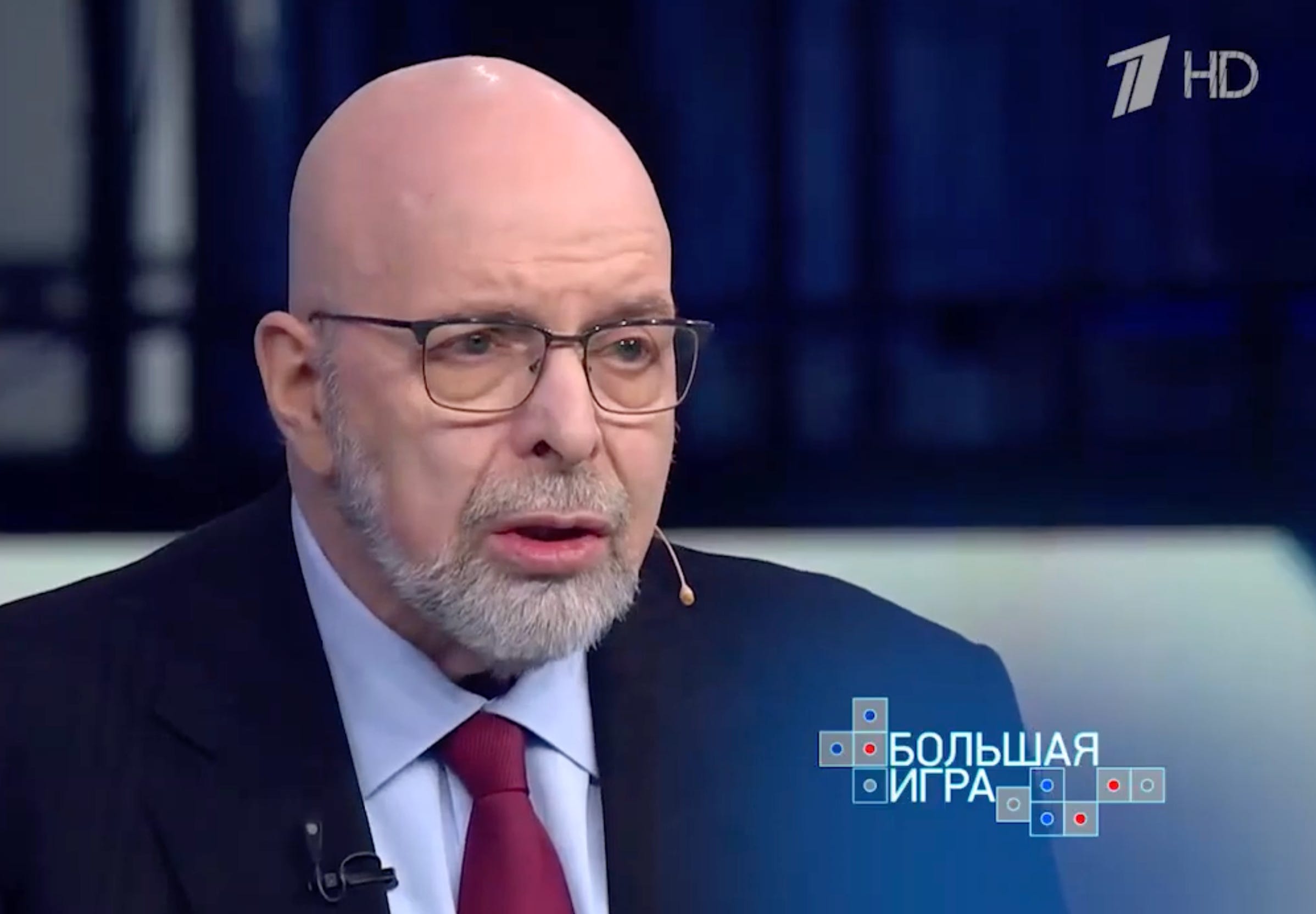
Simes on “The Great Game,” a.k.a. “Большая Игра”
Dimitri Simes: It was in 2018. I was invited by Channel One to become one of two hosts. Initially, they envisioned it as a debate between Russian and American states.
And, on the Russian side, they selected Vyacheslav Nikonov, who is a prominent deputy in the State Duma, and [Soviet statesman Vyacheslav] Molotov’s grandson. As the first channel put it on the channel website, Vyacheslav, he was presenting the Russian position. I said at the outset that I could not present anybody’s position but my own, so it was stated delicately that I was explaining in American position.
Matt Taibbi: But you were there, essentially, to explain what you thought the American position or the Western position might be in the debates.
Dimitri Simes: That is correct, when we originally talked about the program, I shared it, obviously, with the center leadership. And they came to a conclusion, only Chairman Henry Kissinger and then Chairman General Boyd, they came to a conclusion, that, they did not want it to be just my own project.
And, the board voted, and they made it, an official initiative. And I volunteered that I would considerably cut my salary at the center to make sure that it would not look like, you know, I was enriching myself from that endeavor.
Matt Taibbi: Just to back up a moment, so that was in 2018. You were a supporter of Donald Trump in 2016, is that right? Can you explain why that was the case?
Dimitri Simes: Well, first, let me say, I was clearly supportive of his approach. I did not vote for him. I did not vote for a very simple reason. I was, at that time, the publishing CEO of The National Interest. And I thought it would be inappropriate for me to vote in any presidential elections, whatever personal preferences I could have. But I certainly, liked, basically, Trump’s approach.
I was, before that, an informal advisor to Rand Paul. And, I knew Paul fairly well. I did not know Trump at all. It was kind of news to me that he would consider himself a presidential candidate. But I basically liked his foreign policy approach.
I wasn’t sure that he had much of a chance, but I thought it would be helpful to foreign policy debates to have somebody like him presenting his perspective. And then I was at a luncheon at the CNN Time Warner headquarters and, Jeff Bewkes at that time was the chairman, and he was a member of our board. And Richard Plepler was another very active member of our board, and he was CEO of the home box office. So they organized a small fundraiser at the center. Henry Kissinger spoke, and explained how wonderful the center was. And said some kind of words about me, and basically, it was a small, intimate fundraiser.
A young guy came up to me, and said that, his name was, Kushner. And that he was pleased to be acquainted, and could we talk sometime? And, I said, sure. And so when, next time I came, to New York, which was in a couple of weeks, we got together, and then at the end of the conversation, he said, ‘You know, we have a possible project for you. Would you be interested in Trump delivering a foreign policy speech at the center?’
And, I said, of course, as long as it is not a partisan speech, and as long as it would be in the framework of what organizations like ours normally do. And we talked about that, and I thought that we had a good understanding. And then Jared asked me, he said we got a foreign policy team, advisory team. But then he said we had to put it together very quickly, because everybody was asking, who are our advisors?
We brought a small group of advisors, but that was not necessarily the best we could do. And we talked about creating a small and informal advisory group. We actually agreed that we would not even call it an advisory group, because some people in this group were not Trump supporters. And they could say things which would not make a campaign very comfortable. So, it was a group of foreign policy consultants. And Jeff Sessions, he was in charge of the national security kind of group in the campaign.
And it also so happened that he was a member of my Senate Advisory Council, and we were good friends. So he took it, basically under his umbrella. That’s how I became involved with the Trump campaign. It was, a very informal and a very loose involvement.
Matt Taibbi: The only reason I ask that is because of the events of 2024, and what happened to you, the way it was explained later. Before we get to that moment: did you have an inkling in Joe Biden’s first term, that you might have to make a change to the way you did business or changed your schedule as a journalist?
Dimitri Simes: Well, the US-Russian relationship was deteriorating very, very quickly. In addition to that, my ability to express my views in the United States was declining, very, very quickly. I still could publish in The National Interest. But basically, not much more than that.
Matt Taibbi: They weren’t taking your calls if you wanted to submit an editorial or that kind of thing?
Dimitri Simes: You know, it was not like that. It was not like, I was submitting and they were not taking. It was almost everywhere. They got new opinion editors. And it was very clear that they were taking a different direction. I had a couple of pieces with my friend and co-host, Graham Edison, who was a member of our board. I had a couple of pieces in the Wall Street Journal with General Boyd, who was chairman of our board.
But it was very clear that there was no space for somebody with my views. You know, you don’t need to be told we will not accept your pieces. It was pretty clear that I could see that some people who were coming weren’t very enthusiastic to send me to events. We were not doing it anymore. Nobody told me that I was subjected to cancel culture.
But, you know, if you’re subjected to that, you don’t need to be told.
Matt Taibbi: Which views in particular do you think were the most unwelcome?
Dimitri Simes: That it was possible and desirable to have a normal relationship with Russia. The notion that the Russian-Ukrainian relationship was very complex. And, to say who did what to whom at what point. It was not a very easy exercise.
In Moscow, I also discovered that people who were very willing to come as our guests. Including from the Atlantic Council. And I allowed them to say on the program that Putin was a war criminal, to say all kinds of controversial things on Channel One.
But I could see that their willingness to take part in something like that in the Russian TV program was, kind of this ruling this was declining very quickly. Also, I had a very good relationship traditionally with, the assembly in Moscow.
And whenever I would come to Moscow, I always would see, whoever was an ambassador, and they would give the dinners, lunches for me, and etc. And particularly with, Ambassador Huntsman who used to be a member of the Central Board of Directors.
And I spoke at his embassy a couple of times in different formats. And I talked to him, and his Deputy Chief of Mission about my interest in taking part in the program. And initially, Huntsman was very supportive, with an understanding that, obviously, I would not be pretending to express official U.S. opinions.
And I think that, Huntsman thought that my views were pretty mainstream. But then clearly somebody told him something. And they made very clear that, no, they would not support the program in any shape or form. And, basically, said that they hope I would not do it.
And, you know, I was a kind of already planning to do it, and I never was a government official, precisely because I did not like to take guidance from government officials.
And the more I talk to Channel One, the more I was beginning to believe that I would have considerable autonomy.
So, there was a kind of a process of my natural exclusion from the American elite foreign policy mainstream. And I don’t think, you know, it was one step. It was a process.
Matt Taibbi: So I wasn’t planning to ask this, but you obviously, you lived in the United States for a long time, and one of the potential benefits of having your voice in front of the American public, particularly after the war, but even beforehand, would have been to provide some of the history and background of these situations. How would you assess the American public’s knowledge of things like the history of Russian-Ukrainian relations?
Dimitri Simes: Well, I found it almost non-existent, but there was something else, more problematic for me. What was more and more problematic for me, was that the new generation of American foreign policy elite, did not know history, and did not try to understand history.
When I came to the United States I very soon met, Paul Nitze. And, you know, Paul was considered a great headliner. But I could talk to him, because he, he went through the Cuban Missile Crisis, because he remembered World War II.
He understood why it was important to have, at a minimum, a normal relationship with Russia. And he also, he understood, that the Soviet Union, at that time the Soviet Union, to put it mildly, was not a very attractive country.
That’s why I decided to immigrate. But he also understood that this was not black and white. And even somebody like Reagan understood it. And they asked me to help him to prepare for his first meeting with Gorbachev.
And I was very impressed how he tried to understand what makes Gorbachev tick. And, try to understand Russian perspective. I think at a certain point, this perspective became less and less relevant in Washington.
And I don’t mean that they had to accept it, but I thought it would be useful to understand it. So, I do not think that, again, there was one reason for my estrangement from the American foreign policy elite. But I will say that, obviously, it was a kind of, an action-reaction process, on both sides.
Matt Taibbi: In August 2024, and then shortly after, in the first week in September, first, the FBI comes to your home. Can you explain the sequence of events and tell us a little bit about that? Were you surprised? What was your reaction at that time?
Dimitri Simes: Well, I don’t know what term to use. I was shocked… But I also knew that nobody else, and there were plenty of American citizens working for Russian federal channels. I knew that no one else was in any kind of trouble.
I also knew that I was never told by any U.S. government agency, that I was doing something wrong. I had a very good lawyers at that time.
And they did not tell that, that I had, any problem. And basically, the assumption was at first, as the State Department was explaining at that time, including publicly, that those, sanctions, they were not directed against journalists.
Their purpose was to deprive Russian federal channels, which were considered propaganda channels. The purpose, we were told, was to deprive them of American financial support.
And since Channel One did not broadcast in the United States at all at that time, clearly, I in no way was involved in any financial support for Russian official TV.
But second, I thought that what I was doing was pretty objective, that I had disagreements with Russian officials, on there, including with no less than, President Putin.
Matt Taibbi: Whom you interviewed also in 2023?
Dimitri Simes: Yes, but I was on a panel with him considerably earlier, and we had a disagreement.
So, I did not think that I would be a likely target of something like that. I fully understood that I was not a very popular man in Biden’s Washington.
But certainly, the idea is that the FBI, suddenly would come to my home. And it was totally unexpected, and they knew that I was not in the United States. They knew that my wife was not in the United States. You know, if they really wanted to arrest me there was, there was every reason for them to wait a little bit, and that I would come for a visit.
Matt Taibbi: Right.
Dimitri Simes: So, I couldn’t entirely understand what was the purpose of that, unless they had a reason to deprive me of an opportunity to come back to the United States and to make some kind of political point. I don’t know.
Matt Taibbi: So, let’s talk about the charges and what they were alleging. When the FBI came and raided your home first, and then subsequently charged you criminally.
The charge was essentially violating the International Economic Emergency Powers Act, or IEEPA, which is a sanctions regime. But what’s unusual about it is that the overt act here was, if I’m reading correctly, it’s hosting and producing the television program The Great Game. So, you were essentially accused of violating a sanctions regime for hosting a TV program. Is that right? Am I interpreting that correctly?
Dimitri Simes: No, that’s exactly right. There was also a second charge. And that was money laundering.
And I thought it was quite a remarkable charge. Because, they were not alleging that I was involved in any financial transactions. All they have alleged, and that was true, that I was paid my salary in Moscow.
And incidentally, this was one of the banks that had an agreement with the US Treasury, so if there was an American citizen, they were providing full information on their salary, and on all their transactions. So, presumably the FBI could see very easily that I was getting my salary, and that I was using this salary to pay my mortgage in the United States, but most important, to pay my taxes.
I was, paying hundreds of thousands in taxes, in federal taxes. And, I did not have that kind of income… in the United States anymore. So I was, paid by Channel One in Moscow, and I was, transferring the money to my account in Washington, to pay my taxes. It did not occur to me — I guess I didn’t have enough imagination, that it could be considered money laundering.
Matt Taibbi: I’m still confused about this part. How is that money laundering? I vaguely understand what they’re trying to say with the sanctions.
Dimitri Simes: In their view, it was, illegal for me to work for Channel One. Accordingly, my salary was not a legal salary, so if I was using this illegal salary to pay American taxes, which they were dutifully accepting these payments for several years. Without any questions. Without any audit. And then suddenly it became money laundering, you know?
Normally, if there is a problem with your taxes. Normally, IRS would ask you, would raise questions, would warn you. I never had an audit in my life. So you can imagine that I was extremely, extremely surprised. And I also could not imagine what was it that they expected to find there.
What could they conceivably find there? They, confiscated, they said that they were, taking things which they suspected I got illegally, meaning that I used my salary in Moscow to buy these things in Washington.
But the house was bought before U.S. sanctions against Russian radio channels. Most of our cars were bought before that. And practically all our paintings and antiques were bought before then. The most valuable paintings and antiques, actually, I have inherited from my parents. There was a very beautiful and expensive icon, which my mother got from Andrei Sakharov. My mother was a prominent human rights lawyer.
And there were some paintings which my parents got from Moscow avant-garde artists, because again, my parents were considered very supportive of dissidents. And they took all of that.
There was one thing which they did not take.
Matt Taibbi: What did they not take?
Dimitri Simes: My handgun. They put it on my night table.
Matt Taibbi: You think they were trying to send you a message?
Dimitri Simes: Well, nobody would think that if the FBI comes to your home, and they find a weapon … It was a Sig Sauer, a pretty good gun used by U.S. Special Forces. And then they did not take it, and they did not ask any questions about it.
Matt Taibbi: These things must have had an enormous personal meaning for you.
Dimitri Simes: Look, I lived in the United States for 50 years. All my life, my wife for 30 years. This was… this was, all our possessions, and they did damage to the house, they were breaking the floor, they broke the roof.
It’s about 40 people team, to take what in this operation? There were trucks coming, you know, to remove our property.
Matt Taibbi: What’s so fascinating and disturbing after this raid that had so many people take part in it, and after, there were leaks to newspapers, in particular, the New York Times. And then subsequently, when you were charged, you were accused of spreading disinformation and state-sponsored narratives, and the strong implication was that you were part of a Russian attempt to impact the 2024 election, But first of all, your show is in Russian for Russians, yes?
Dimitri Simes: The show is in Russia for Russians. And the second thing is that even now, during the war, when, obviously, there is less freedom to discuss certain things, even under those circumstances, I will assure you that I never am told what I should use on my program. And I will tell you that I’m never told whom I should invite as being guest of my program. What I would not tell you is that there are no restrictions. There are restrictions. There are restrictions during the war.
Some of these restrictions are necessary, or at least sensible. Some restrictions which I would not always agree with, and these are restrictions if I disagree, which actually is a rare case, I discuss with the channel management. But I most certainly do not accept for a second that I engage in propaganda. Propaganda means that somebody directs me to do something.
That is not… that is not the case, at all.
Matt Taibbi: But they specifically charged you with also disinformation, which became a very vogue term in America.
Dimitri Simes: I’m not aware of any specific example, of any specific example. They did mention, they said something, in their press release about Bucha. There’s only one problem; I have never talked about Bucha. Never, never, ever… Never, ever. So they could not find a single instance when they could say that I engaged in this information.
Matt Taibbi: Do you think, though, that your arrest, the charges levied against you, and the search, do you think that was connected to the election?
Dimitri Simes: Well, that certainly was a part of what Trump calls Russian hoax. And I was probably one of the most investigated people in the United States. I was investigated by the FBI the late 1970s.
And my critics who use this without without mentioning that the result of this investigation was the FBI provided information, to the immigration court, that they hear absolutely no reason why I should not be given a US citizenship. And I was getting a US citizenship, through a congressional act.
So, nobody was obliged to give me the citizenship, before a 10-year period, which was established for people who, like me, were members of the Young Communist League Organization.
Matt Taibbi: Komsomol?
Dimitri Simes: Exactly. And there we are, at that point, gave me, a clean bill of health.
Now, then there was a Mueller investigation. And, if you read all these pages about me, about 100 references, what I think is remarkable is that not only they did not charge me with anything, but we very specifically explained, that in each case, they have investigated my actions had a benign and legitimate explanation.
But interestingly, instead of, saying, well perhaps the guy is really innocent, and perhaps we were, actually, unfairly bad-mouthing him. Instead of that, the reaction was, oh, he has to be really sneaky, right?
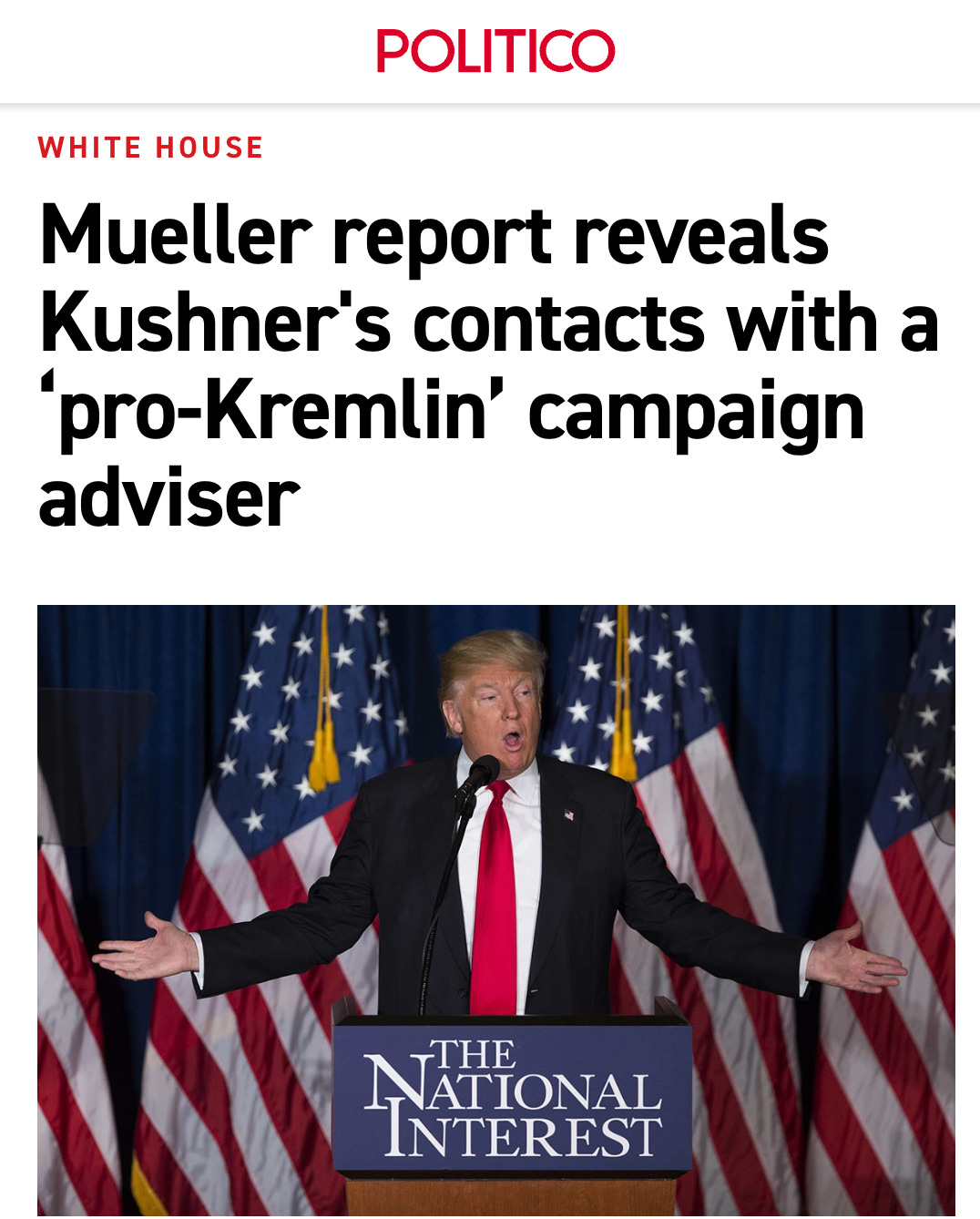
During peak Russiagate mania, the American citizen Simes, who’d advised other presidents, suddenly became a mysterious “pro-Kremlin” figure
This is the [former KGB chief Lavrenty] Beria mindset. If you cannot prove somebody’s guilt, it doesn’t mean that this person is innocent. It means that he is particularly terrible and dangerous.
Matt Taibbi: Show me the person, I’ll show you the crime, basically.
Dimitri Simes: But I understood, that, they were particularly angry with me for one phone call I have received, or at least I was told so, I had very few communications with the United States. Because after I have left, after the work have started, after everything, I did not have too many American contacts.
But there was one specific phone call when, I was told that it would be interesting for me to come to the United States and to share my impressions, of, what was happening in Russia and U.S.-Russian relations.
And, that phone call was, just a couple of weeks, before the FBI would be moved against, my house.
Matt Taibbi: And who invited you?
Dimitri Simes: Well, as you can imagine, I am not at liberty to talk about that. All I can say that this was not a U.S. government official. I actually did not even decide that I would be coming to the United States at that time, because with everything, that was going on between Russia and Ukraine. I was asked by the channel to continue working, throughout August. So, it wasn’t like I had any immediate plans at the time to come to the United States.
But I found it interesting, that when I… when I was thinking what could prompt this indictment. That was the only thing, that, came to my mind. Obviously, if I came to the United States, I would say some pretty critical things, of, the Biden administration conduct at that time.
Matt Taibbi: And you might have been arrested.
Dimitri Simes: So, at that time, it did not occur to me that I would be arrested. Well, it genuinely did not occur to me. There was… the Department of Treasury, if they think that somebody who violated sanctions, they normally would, send them a questionnaire, send them a warning. There was nothing like that. You have, to appreciate, that I was not doing anything secret. I was not hiding anything. Everything I was doing was an open book.
So, if, there were serious concerns about my activities. It was very easy to express these concerns to me directly.
Matt Taibbi: I have just a few more questions. Can you help explain to American audiences why they should pay attention to your case, because it seems you’re being charged with being employed as a media figure for a country that has fallen in disfavor with the United States. You’re not accused of doing anything secret, you’re not accused of having said something libelous…
Dimitri Simes: I am not accused of any contacts with Russian security services. And I have none. Everything I’m doing is pretty public. I do talk to Russian officials; that’s a part of my job. Mostly, it would not be them calling me, but me calling them, because I try to be sure I understand, the official perspective, obviously, before I go on there.
But I do, you know, I was CEO of an influential foreign policy magazine. I know how to ask questions, and how to try to confirm facts, and I’m not doing, in Russia, anything beyond that.
Matt Taibbi: So, but it seems to me your case could impact not only other employees of other state media organizations, but also American employees of other American employees here in the States, of state media?
Dimitri Simes: Well, first of all, let me say, in my view, precisely because there are no charges of espionage against me. There are no serious charges of disinformation against me. I don’t know what are the charges against me, except sanctions for elections.
And in this case, there happens to be the First Amendment, which should be above executive guidance from the Department of Treasury.
That’s not to say that I could violated even that, but still, there is the First Amendment. And I think the casual attitude to the First Amendment and, threatening me with 40 years in jail, I think it’s a very, chilling, message to any American who is expressing his views. And an argument, well, that’s not because of his views, but because he was paid in the process.
The Founding Fathers were very specific about that, that they were trying to cover political activities, and most people who engage in politics and in professional journalism they’re paid. So, I have to say, this is a very chilling a message to anyone who wants to express his views.
But let me say also something. I, tried during all this period. Not to raise my case seriously.
I have a very, comfortable life in Moscow. I, like a lot of people, and, I always wanted to have a TV show. Actually, it was my dream. And, suddenly, when I was well in my mid-70s, this dream, came through. And now, I’m anchoring one of the most, prominent political programs in the country, and they’re doing it 5 days a week. I am also a professor at MGIMO, you know what MGIMO is?
I’m not asking anyone to have pity for me. But I think it’s, not normal. I think it is not just, that I, can, cannot come back to the United States. And that if somebody is interested in my views, that they would be able to ask me questions. And last but not least, they are, constantly complaining in virtually every administration that Russia arrests Americans citizens, that Russia is using these people, as hostages.
And they say that this is unfair and politically motivated. And I will ask you a rhetorical question, if I came to the United States and they arrested me. And they put me in jail. Wouldn’t they think that it contradicts U.S. official notion that things like that should not be politically motivated, and shouldn’t they at least entertain a possibility, that there may be an American who could be in trouble as a result of that? And I’m not even talking about an innocent American, because there are a lot of Americans in Russia, and there are a lot of regulations in Russia, I’m not saying that it should be illegal and selective. I should say that it obviously, is, influenced by perceptions. What kind of relations you have with this particular country, and what, could be the implications of your actions?
And I’m sure that they would say, tell you at the State Department, that if Russia would ask, a prominent American journalist, there would be consequences, right?
Matt Taibbi: One would think.
Dimitri Simes: I would think, and I would not necessarily have issue with that, up to a point.
But they clearly are creating a situation, if they had their way with me, that probably would not, would not be, very fortunate, probably it would be very unfortunate for me.
But I think that it also could be unfortunate for somebody else. And it is surprising how many people in the U.S. government do not think at all about consequences of reactions, and do not think that there is a possibility of a kind of a response they would not find very welcome.
Matt Taibbi: That leads to my last question. You’ve chosen to defend yourself, your court case is proceeding. Obviously, you have your own interests that you want to defend yourself, and your good name, but is it also for the sake of the First Amendment, to show that its importance? I just wanted to ask about your motivations.
Dimitri Simes: But let’s be very clear, for a very long time, I could raise this issue, and I suspect that I would find some enthusiastic audience in Russia. I have never done it, because I saw that there are enough troubles between the two countries, for me to bring my personal case as an unnecessary additional problem, even if it is a very significant problem. But I also thought that what was done to me was done, for, political reasons, that this was a part of the Russia hoax.
And that, I thought that this could be kind of things which would be addressed by the Trump administration, and now, now I see that, President Trump said on many occasions it’s all, Russian hoax, Russian hoax, it’s all Biden, Biden, and that, he would never do things like that.
And, I have an impression that if I would remain silent, there would be a false impression that things like that are okay and that you can do it with total impunity. That’s wrong, and I like to believe, that, what I’m doing is a public service.
Matt Taibbi: Mr. Simes, Dimitri, thank you very much for taking the time to talk.
“An Israeli strike on a naval outpost in the Caspian Sea targeted Russia’s support for Iran in the war, hitting a supply line that the countries have used to move ammunition, drones and other weaponry,” people familiar with the matter were quoted by WSJ on March 24 as saying. The strike, which occurred on March 18 and targeted the Iranian port of Bandar Anzali, damaged Iranian naval headquarters there, according to WSJ. The strike was Israel’s first ever on the world’s largest inland sea, which connects Russian and Iranian ports about 600 miles apart. “The most important goal of this strike was to limit Russian smuggling and show the Iranians that they don’t have sea defenses in the Caspian,” Eliezer Marum, a former commander of the Israeli Navy told WSJ regarding the strike, which was reportedly carried out by the Israeli Air Force. The route hit has become especially important for transferring Iran’s Shahed drones, which are now made in both countries, according to WSJ. Initially designed by Iran and assembled in Russia, these drones are now being modernized by Russian engineers to improve communication, navigation and targeting, and the technology behind the improvements is shared with Iran, according to WSJ. Russia denies either sharing military technology or intelligence with Iran, but these denials have not obscured reports that Iran’s Revolutionary Guard and allied Iraqi militias are now fielding first‑person‑view attack drones guided by fiber‑optic cables, copying tactics Russia pioneered in Ukraine, according to WSJ.
RM’s analysis of ISW data for the past four weeks (Feb. 24–March 24, 2026) indicates that Russian forces lost 4 square miles of Ukraine’s territory (area about three times the size of New York City’s Central Park) during that period. That’s in contrast to the estimated 50 square miles they gained during the previous four-week period (Jan. 27–Feb. 24, 2026), according to the latest issue of the Russia-Ukraine War Report Card. According to ISW data, this past week (March 17–24, 2026), Russia lost 4 square miles of Ukraine’s territory. It follows from daily updates posted by Ukraine’s DeepState OSINT group, that this past week saw Russian forces advance in or near 15 Ukrainian settlements while Ukrainian armed forces pushed back near one Ukrainian settlement.1After rare gains by the Ukrainian army along the southern Zaporizhzhia front in the south—analysts estimate that about 100 square miles were retaken in early 2026—Kyiv now faces a new Russian offensive starting in the spring in the south and in the east, according to NYT.
Russian forces launched nearly 1,000 drones and missiles against Ukraine in a prolonged strike series from the evening of March 23 to the evening of March 24—the “largest Russian strike series against Ukraine of the war thus far,” according to ISW. Between 6:00 p.m. March 23 and 09:00 a.m. March 24, the Russians fired 392 strike drones and 34 missiles, and from 09:00 a.m. to 6:00 p.m. March 24 another 556 drones, for a total of 982 strike assets, according to ISW. Ukraine downed 256 drones and 25 missiles overnight, and 541 of 556 drones during the day.All seven ballistic missiles hit targets near the frontline in Zaporizhzhia and Poltava oblasts, ISW reported.
Ukrainian President Volodymyr Zelenskyy says the Trump administration is conditioning high‑level U.S. security guarantees on Ukraine surrendering the remaining Ukrainian‑held part of Donbas—an area roughly 50 by 40 miles (2,000 square miles) in the Donetsk region, according to Reuters and New York Times.2 This aligns with Russia’s demand that Kyiv withdraw from the heavily fortified zone, home to about 190,000 civilians, as one of the conditions for ending the war, NYT reported. Zelenskyy warns that ceding the area would let Russia avoid years of costly fighting that could cost it 28,000–35,000 soldiers per month and would create a staging ground for future attacks. He also told Reuters that two vital questions remained unresolved regarding security guarantees: Who would help to fund Ukraine’s weapons purchases to sustain its military deterrent, and how exactly would its allies respond in the face of any future Russian aggression?
Ukraine risks running out of money to pay for its defense against Russia within two months as a multitude of factors converge to threaten tens of billions of euros in assistance from the country’s key donors, according to Bloomberg. Kyiv currently has only enough funds to cover spending until June, according to estimates that both domestic and foreign officials shared with this news agency.
U.S. and Russian legislators met in Washington D.C. for talks organized by Rep. Anna Paulina Luna, a conservative Republican from Florida who has advocated rapprochement with Moscow and co‑sponsored a bill to end U.S. military aid to Ukraine. Luna said it was imperative that “the world’s two greatest nuclear superpowers” maintain “open dialogue, ideas and open lines of communication.” Russian accounts say the delegation included senior MPs Vyacheslav Nikonov and Svetlana Zhurova. Zhurova later said Ukraine was the “most prominent” topic, followed by disputes over seized Russian diplomatic properties and visas. The Kremlin said it welcomed “any efforts to revive dialogue with the United States.” Ukrainian outlet Ukrainska Pravda noted the State Department approved the visit in January, with analysts warning it risks feeding Kremlin narratives about U.S. division and “war fatigue” as formal U.S.‑mediated talks on ending Russia’s war remain frozen.3
This past weekend, Trump threatened to escalate the War with Iran by destroying that country’s energy infrastructure starting, as he said, “with the big one”. The ‘big one’ was no doubt a veiled reference to Iran’s civilian nuclear plants.
Iran’s Natanz nuclear plant had been hit with a US missile a few days earlier as a warning. As he announced his plan to destroy all of Iran’s civilian nuclear infrastructure, Trump further declared Iran had 48 hours to capitulate before the US attack. The price of oil jumped and stock market futures began to fall within 24 hours of Trump’s threat.
Before the 48 hours were up, on Monday morning, March 23, an hour before the US stock markets opened, Trump announced Iran had approached him and asked for negotiations. Therefore he, Trump, was now suspending the attack on Iran for five more days, i.e. to the end of the current week.
The five day extension had nothing to do with negotiations, which Iran announced had never taken place. Trump made it up. The five day extension was yet another move by Trump administration officials to stabilize the US stock markets and the price of oil, both of which were set to spike. Within hours of announcing his five day suspension on Monday, US oil prices (WTI) fell $10 a barrel to $90 and stock markets opened higher after a string of declines last week.
Since the war began on February 28, Trump and various administration officials have repeatedly said publicly that negotiations were occurring, were showing progress, or even that the war was about to ‘end soon’, as Trump himself declared.
The pattern shows such false statements were, and remain, mostly about keeping financial markets from falling too fast and to prevent oil prices from rising too fast.
But there’s another explanation for Trump’s about face and his five day suspension of the US attack on Iran’s nuclear energy infrastructure.
That’s Trump’s buying time to get US military forces into the region in order to launch a ground assault into Iran, to coincide with his plan to bomb Iran’s nuclear and civilian energy infrastructure.
Here’s some facts why the five day suspension is really about buying time for much larger US military preparation.
The mainstream US media keeps reporting that a contingent of about 2,000 US marines are en route by sea on the US landing ship, US Tripoli, coming from Asia to the Persian Gulf. If we are to believe the media, the US intends to invade Iran with just a couple battalions of Marines.
The Marines plan to land in the Strait of Hormuz area. The US will somehow seize the strait and allow oil tankers to sail through it again. The media’s is also promoting the view that a second possible landing target is Iran’s Kharg Island, where 90% of Iran’s crude oil is refined and shipped. Kharg is close to the coast of Iran, well into the Persian Gulf’s upper end and closer to Kuwait than to the Hormuz strait. The media refers to Trump’s own social media posts where he mentions Kharg Island as a good target for the Marines. Israel’s number one mouthpiece in the US Senate, Lindsey Graham, gives daily press conferences during which he refers to taking Kharg Island as well.
But it’s all a deception.
In fact, the entire 2000 Marines on the US Tripoli may be a deception.
That raises the question: Is the US actually planning an invasion of Iran; and if so where if not Kharg Island or Hormuz?
Sending 2000 Marines to seize territory around Hormuz or Kharg Island is militarily a stupendous strategic blunder in waiting should it be undertaken. It’s hard to imagine any senior US military advisor recommending that.
First, how would 2000 Marines get through the Hormuz strait and sail up the Persian Gulf to assault Kharg Island? They would be sitting ducks all the way, presuming they could even get through the strait. Furthermore, could a mere 2000 hold Kharg if they were even able to land and seize it? Marine battalions don’t carry radars and anti-missile batteries in their inventories. They would be massively attacked by missiles and extremely difficult to re-supply.
The same applies to the other islands in the Hormuz strait, like Bander Abbas. It takes only one Iranian missile to end the Tripoli and all its 2000 on board.
The fact that US officials, according to Trump and the media, publicly mention Kharg Island and the Hormuz strait as landing targets should be an indicator there’s no intention of occupying Kharg or other Islands in the strait. The US does not discuss in public its military objectives. Therefore they are almost certainly not the targets!
There’s growing evidence, however, that when the US invasion comes—and it is coming—the landing is likely to occur elsewhere the media or Trump is not mentioning. There’s currently a massive US military build up underway, blacked out by the media, involving more than just a Marine battalion. There’s a traditional US military forces mobilization being sent to the region, more like the build up that occurred in early 2003 before the Iraq war.
Two US Airborne divisions, the 82nd and the 101st, have been activated and are reportedly en route to the region. So too are two US Army Ranger battalions. Another US Marine brigade has left the US for the region but will take weeks to arrive. It will likely relieve the first Marine force arriving on Friday. That’s a combined military force of 20,000.
And it’s been reported by some former US military officers that they’ve been informed two traditional US Army divisions are being prepared to go as well. That’s another 50,000. Saudi Arabia and UAE have indicated they will join the coalition for an assault. That’s now a total force of more than 75,000 ground troops! No way they are going to land on Kharg or some other island in the strait.
The US media briefly indicated last week that US forces are leaving the big US base in Baghdad, Iraq and redeploying to northern Iraq’s Kurd region, which borders on northwest Iran. The US air force is redeploying air assets to Turkey’s big Incirlik NATO air base, a mere 40 minute flight from northwest Iran.
When the Iran war first began in late February, there was much talk about the Kurdish forces in northeast Iraq entering Iran. Azerbaijan was also indicated. It is well known Azerbaijan is closely allied with Israel’s Mossad. It was a flight back after visiting Azerbaijan some months ago that the former president of Iran was mysteriously killed as both his helicopters were blown up in the air.
In Iran’s northwest there are large populations of Kurds and Azeris. But after a short reporting by the media on the possibility of getting the Kurds to invade early in the war, all the talk about an invasion by these US-Israel ‘allies’ from the northwest went silent in the media.
The northeast Kurdish region is also where US based military formations formerly in Baghdad until last week are relocating. Is this perhaps where the two US airborne divisions and two Ranger battalions might be sent—i.e. instead of Kharg Island or Hormuz? Is a general ground invasion into Iran from planned from the northwest?
Possibly. Perhaps even likely. Why? Because it is geographically not very far from Teheran, the capital of Iran.
From Kurdish Mosul in northeast Iraq, and from Astara in Azerbaijan’s southernmost tip next to Iran, it is less than 200 miles to Teheran in both cases. The Kurds and Azeris might seize and hold much of the northwest region of Iran where sizable ethnic populations of Kurds and Azeris live. The combined forces of Kurds, Azeris, US Rangers, US airborne could together invade. The two full US Army divisions then might land in Incirlik or Mosul in Kurdish Iraq and cross into Iran to provide heavy armor follow up support for the invasion.
Israel will not likely take part in the coalition invasion. It is too busy invading its near neighbors: Lebanon, Syria, Palestine (west bank), and GAZA.
This is not to say for certain that Northwest region of Iran and Teheran is the actual target for a US invasion. But it makes more sense militarily than sending insufficient US Marine battalions on ships into the Hormuz strait or deep into the Persian Gulf to Kharg Island. Or using US Ranger and Airborne divisions to land either in Hormuz or Kharg. And certainly not to mobilize two full armored Army divisions.
Trump’s war objective is to destroy the current government in Iran. The US objective has always been regime change. He does not want a negotiated compromise. His talk about negotiations is therefore a deception and a lie believed by only the most naïve or who get their information from the mainstream US media. For Trump and the US empire, negotiations are just a tactic and prelude to military action. The Iranians learned that twice, once last June 2025 and on February 27, 2025. So did the Venezuelans. So have the Russians in 2015, 2022, and, I would argue, since last August at Anchorage, Alaska.
So far the Trump goal of regime change in Iran has failed: The CIA engineered popular uprising this past January-February was ill-timed, launched too early, and put down by Iran completely. Nor has limited military action by the US and Israel thus far—i.e. naval blockade, bombings, decapitation strikes, etc. Trump has therefore decided on more massive, direct military invasion.
All indications are Trump has decided to roll the military invasion dice to try to bring the war to a conclusion sooner rather than later. He can’t afford to wait until summer. The deteriorating US and global economy won’t allow it. Nor voters in the coming November elections.
The longer Iran can continue its missile war, the greater the threat to the US and western economies. It doesn’t need to ‘win’. Just not to lose for another three months. The economic impact will take its toll by then. Trump can try to talk down the markets and spot oil prices in order to obfuscate the economic impact of the war for a relatively short time further. But he knows he must escalate, beyond traditional regime change CIA methods and/or limited military action, to a direct military ground war. Or as they say, “boots on the ground.” And it looks increasingly like that’s his plan sometime next weekend, or soon after.
Perhaps he should remember how ‘boots on the ground’ turned out the last time the US resorted to invasion and direct military action in 2001-03 in Afghanistan and Iraq! Someone should remind him the estimated $9 trillion dollars that it cost the US taxpayer, its effect on the US economy and the paltry results produced.
Perhaps he should keep in mind US defense expenditures in 2001 were only $396 billion, US GDP that year 4.1%, and the national debt $5.6 trillion costing $350 billion a year in interest payments?
And that a US land invasion war is happening on a US defense spending of $1.1 trillion (plus another $200 billion requested by Defense Secretary Hegseth and a further $400 billion by Trump himself), a US GDP of only 0.7% last quarter, and a national debt exceeding $39 trillion and costing $1.2 trillion in interest payments! The US Empire can no longer afford costly direct military conflicts and invasions. Those days are over.
Wars are always very expensive affairs. And land invasion wars are especially expensive. The US empire could not afford its last land invasions in 2001-03 that cost $9 trillion. Today it is in a far worse condition economically to afford yet another direct military land invasion in Iran.
The US economy has already entered early stages of recession in 2026. The only forces holding it up from a deeper contraction are Net Exports (mostly falling imports due to tariffs) and an AI investment bubble that cannot continue. Employment is now contracting and Inflation is beginning to surge along multiple fronts. Stagflation is now rearing its ugly head.
But Trump thinks it will all be over quick, as his neocon advisors and Zionist campaign contributors and lobbyist have no doubt assured him. And if it isn’t quick? Well, there’s always his plan to try to overturn the upcoming November elections to save himself.
So Buckle up! It’s 2003 déjà vu. But this time the economic—and political—consequences will prove far more disruptive and difficult to manage.
Fun fact: More money flowed through the prediction market Polymarket on the timing of the U.S. government’s recent attack on Iran than was bet on this year’s Super Bowl with Nevada’s sportsbooks.
Bettors traded more than $529 million in forecasts of when the U.S. would next strike Iran in a market opened last year on Polymarket, the self-described world’s largest prediction market. Bets on Polymarket are made with cryptocurrency, and each trade is countered by another user, so not exactly versus “the house.”
By contrast, $133.8 million was bet on last month’s Super Bowl across Nevada’s 186 sportsbooks, representing a 10-year low, according to data from the Nevada Gaming Control Board.
Prediction markets differ from traditional gambling in other notable ways. A pattern keeps emerging after the fog of war clears battlefields in the Middle East, Latin America, and Europe.
In the final hours before a world leader is killed, kidnapped, or claims territory, bettors swoop in and place anonymous wagers that correctly predict the future.
Hundreds of thousands to millions of dollars change hands, with winners paid in cryptocurrency that’s logged publicly, but mostly obscures the identities behind the accounts.
The world seems on the verge of chaos. And in the warrior casinos of online prediction markets, business is booming, surging past activity in Las Vegas’ physical casinos, and stealing the thunder of popular sportsbooks that have designs on taking over professional entertainment.
While not a perfect apples to apples comparison — Polymarket’s geographic boundaries are far wider than the landlocked Silver State — the prediction markets are where the instantaneous action is.
A surge in bets correctly predicting the late-February Iranian strike flooded Polymarket just before the attack. More than 150 accounts wagered at least $1,000 the day before America took action and got it right, according to a New York Timesanalysis of the platform’s data since June 2025.
The late swell of winning bets was unusual, according to the Times, which found at least 16 accounts made more than $100,000 after placing bets on the eve of the attack and more than 100 accounts cashed out over $10,000.
One lucky gambler spent more than $60,000 in the final moments before the attack and made almost $500,000. The anonymous account was opened in February, potentially within days of the attack.
Polymarket is far from the only prediction market offering bettors the opportunity to wager on world events. Kalshi offered odds on the ouster of Iran’s supreme leader before the recent military strikes, but later suspended trading amid his death and said on X that, “Kalshi does not offer markets that settle on death.”
Photo credit: Getty Images
Certain specialized markets have irked some working in the professional gambling industry.
John Murges, a sports betting professional who got started working with the mob in Chicago, has seen it all in the gambling underworld but did not wager he would see bets on combat in the open.
As a young man, he collected and paid out tens of thousands of dollars to Chicagoans betting on Cubs baseball and Bears football games in the 1980s and 1990s before gambling went mainstream amid legalization.
Murges emphasizes he was not a made man in the Italian mafia — he’s Greek after all — and he has put distance between his old life and his newer efforts as an experienced professional handicapper.
He said the prediction markets offering bettors contracts involving the timing of killings in Iran was “pretty morbid” and questioned whether an insider was involved. The 11th-hour bets do not sit right with him.
“I’ve been in this business a long time,” Murges said. “In the sportsbook industry, they would call that suspicious activity.”
When those who know the Chicago outfit’s work intimately think you have gone perhaps too far, that’s just a sign the prediction markets are ready to double down.
Polymarket defended its willingness to offer trades on the Iran strikes in a note saying it was harnessing “the wisdom of the crowd to create accurate, unbiased forecasts.”
The company said its prediction markets can give people answers in ways “TV news and 𝕏 could not.”
Polymarket’s position echoed a view of the promise of prediction markets from a 2006 edition of the U.S. intelligence community’s professional journal “Studies in Intelligence.” Prediction markets had the potential to “improve analytical outcomes” for the intelligence community, including policy about the Iraq War, according to author Puong Fei Yeh, then identified as a consultant.
Taking bets on strikes that could spark World War III was not an ethical red line for Polymarket, but thermonuclear war might be. Polymarket subsequently permitted a betting market on the timing of a “nuclear weapon detonation” before removing it amid pushback on social media.
Intense scrutiny and pressure is mounting worldwide on those trading information or attempting to manipulate world events for profit on the prediction markets.
Israel indicted a military reservist and a civilian last month for using secret information while placing bets on military operations last year.
Asked if it too was investigating potential insider trading on American military operations, the FBI told Racket it “neither confirms nor denies an investigation and we decline to comment further.”
Policing every individual action on the prediction markets is proving impossible. And some institutions look to prefer handling the matters internally.
The Institute for the Study of War scrubbed the name of one of its geospatial researchers from its website amid reporting suggesting the think tank’s map of disputed territory in the Russia-Ukraine conflict was erroneously edited in a way to spark a payout on Polymarket, according to the Quincy Institute’s Responsible Statecraft.
Some bettors reportedly stood to gain a major profit, as much as 33,000%, on Polymarket if Russian forces took the town Myrnohrad in Ukraine in November 2025.
The betting market relied on the D.C. think tank’s interactive map, which was quietly edited to erroneously show Russian forces advancing in the town, prompting Polymarket to resolve the bet and pay out the winnings, according to 404 Media.
ISW acknowledged an “unauthorized and unapproved edit to the interactive map of Russia’s invasion of Ukraine” in a statement on its website soon thereafter but did not explain the cause of the change nor mention the prediction market effects.
ISW did not respond to request for comment, but Responsible Statecraft said the think tank appeared to have fired an unnamed staffer.
Polymarket is looking to improve upon any reputational damage it may have suffered by partnering with Palantir, the software behemoth born from the CIA’s strategic investment fund In-Q-Tel. Last week, Polymarket announced a new partnership with Palantir and TWG AI to develop a “next-generation sports integrity platform” designed to promote trust, transparency, and reliability.
Palantir’s support of the U.S. military and intelligence community has put a target on its back from Iran, where the war looks to have boosted its stock price. Palantir does not have any hesitation about openly profiting from its enemies’ death.
“Palantir is here to disrupt and make the institutions we partner with the very best in the world and, when it’s necessary, to scare our enemies and, on occasion, kill them,” Palantir CEO Alex Karp enthusiastically told shareholders last year. “We hope you’re in favor of that, we hope you’re enjoying being a partner.”
Fortune favors those wanting to enter the prediction market arena. The sportsbook DraftKings is adjusting its plans to dominate the prediction market industry and President Trump’s Truth Social media platform is preparing its own prediction market for things such as politics, the price of oil, and sports.
Congress, however, is preparing to intervene.
Rep. Ritchie Torres, New York Democrat, introduced legislation last month seeking to prohibit federal officials from buying, selling, or exchanging market contracts tied to government policy, action, and political outcomes.
Torres said in January his Public Integrity in Financial Prediction Markets Act was motivated by a $400,000 payout collected from someone who bet roughly $30,000 on Polymarket to predict Maduro’s capture hours before America’s raid in Venezuela. The bill has attracted more than 40 cosponsors, all Democrats.
Following the prediction market payouts over the Iran strikes, Democratic Sens. Jeff Merkley of Oregon and Amy Klobuchar of Minnesota said last week they were crafting a new bill to block the president, vice president, and other officials from trading event contracts.
Merkley cited bets on Iran and Venezuela as having the “unmistakable stench of corruption” and said the End Prediction Market Corruption Act would crack down on potential insider trading. Merkley also sponsored a congressional stock trading bill last summer.
But betting big on war is not exactly a new phenomenon and the outcomes are far from guaranteed, as America’s enemies found out the hard way 250 years ago.
Over drinks at Brooke’s in London on Christmas Day, 1776, legend has it British Gen. John Burgoyne bet a colleague 50 guineas he would return by the following Christmas having squashed the American patriots’ rebellion.
Instead, Burgoyne became a loser carrying the “stench of failure” upon surrendering his army after the Battles of Saratoga, which the U.S. Department of War has branded the “turning point” in the American Revolutionary War.
The tyrannical redcoats learned a lesson some Americans now wish to maintain: the house always wins except in the warriors’ casino, where Uncle Sam does.
Disclosure: Polymarket has partnered with Substack, providing new tools tailored for writers and publishers. While Racket News accepted the partnership, it declined the money in accordance with our mission that we accept zero dollars in outside financing.