Kyiv International Institute of Sociology: majority of Ukrainians now back peace deal with territorial concessions

Intellinews, 3/17/26

Ukrainians are getting tired of the war. In a change of heart, a majority would now support a peace agreement involving territorial concessions if presented alongside clear incentives such as European Union membership and security guarantees, according to new Kyiv International Institute of Sociology (KIIS) polling data.

Previously, polls found that while support for a ceasefire deal was growing, the majority of Ukrainians would not accept that if it included ceding land not currently occupied by Russia as part of any agreement.

KIIS found that 61% of Ukrainians would vote in favour of a deal that gives up all of the Donbas – the central Kremlin demand – in a referendum if the question were framed positively. Among those who said they were likely to participate in a vote, support rose significantly to 86%, with only 10% opposed.

The public backing for a negotiated settlement with Russia now hinges less on the substance of the agreement itself and more on the political and strategic framing of a potential agreement.

While public support for a compromise deal is rising, the talks themselves are now on hold again, as the US, the central mediator, has become distracted with the conflict in Iran. As bne IntelliNews reported, US President Donald Trump is losing his patience with Ukraine after Ukrainian President Volodymyr Zelenskiy called for the US to tighten sanctions on Russia again, just as the White House eased them to supply India with oil, and criticised Operation Epic Fury. Trump is frustrated with Zelenskiy intransigence on the issue of conceding the Donbas to Russian President Vladimir Putin, which has left the talks in deadlock.

The KIIS poll increases the pressure on Zelenskiy to make a deal and give more away to Russia. The respondents were more inclined to support territorial compromises when these were explicitly linked to tangible outcomes, including prospective European Union membership by 2027, firm security guarantees, and a defined reconstruction programme.

“Depending on wording, Ukrainians planning to vote in a potential referendum would support a peace deal with ‘territorial compromises’,” the polling organisation said, pointing to the sensitivity of public opinion to how proposals are communicated.

Zelenskiy is increasingly finding himself boxed into an impossible position. He welcomed Trump’s suggestion to accelerate Ukraine’s EU accession bid and join in 2027, part of the 27-point peace plan (27PPP) thrashed out in Moscow in December. However, the EU itself has rejected that plan and is insisting on its decade-long vetting process. At the same time, the White House has yet to sign off on the US security deal that was also included in the 27PPP, a key element of Bankova’s prerequisites for conceding land.

Zelenskiy is now facing a growing domestic political crisis as he starts to lose authority with his own Servant of the People (SOTP) party at home, and a funding crisis after the fiasco surrounding the EU’s failure to release the €90bn EU loan agreed in December. If the funding issue is not resolved then Ukraine faces a macroeconomic collapse sometime in the spring. Zelenskiy’s personal popularity has also been falling steadily, albeit slowly.

The poll underscores the challenge facing Ukrainian policymakers as they cope with the growing war fatigue. KIIS stressed that both legitimacy and question design would be decisive in any referendum process, necessary before Ukraine can cede land to Russia. “Legitimacy & question wording matter hugely,” the organisation said.

Strana.UA: Military Strategies of Russia and Ukraine: How Events will Unfold in 2026

Strana.UA, 3/12/26

Translation into English by Prof. Geoffrey Roberts

In the past week, Ukrainian and Russian media and Telegram channels have been full of predictions about the Russian army’s upcoming “spring-summer offensive,” as well as analyses of possible actions by Ukraine’s armed forces.

President Vladimir Zelensky has announced that Russia is preparing a spring offensive, while Alexander Komarenko, the UAF’s Chief of the Main Operations Directorate of the General Staff, has promised to undertake something “the enemy won’t expect” in this year’s military campaign.

Possible directions for Russia’s “main blow” are also being discussed. The Donetsk region is usually cited as such.

At the same time, we have repeatedly written that concepts of “direction of the main blow” and “spring/summer/fall-winter offensive” are inappropriate for the current war.

Drone control over the battlefield, which is total, prevents any surprise strikes with large forces in one direction at a specific, pre-planned time.

Both combatants conduct their offensive operations in a similar manner: constant attacks with small groups of infantry infiltrating the front line while simultaneously attempting to “knock out” enemy UAV pilots (this is currently the primary objective) in order to create breaches in the “kill zone” for further advancement and consolidation.

That is, a constant identification of weak points in defences and attempts to break through as soon as they are discovered. Of the systemic factors that can contribute to the success of this tactic, the only one worth noting is the “hunt” for drone operators. The remaining factors are more or less random — errors by the enemy command, which may “sleep through” the attack and fail to deploy reserves in time, and, crucially, weather conditions.

Fog, for example, allows infantry to penetrate the front line without fear of drones. This is why the Russians made significant advances during the foggy months of October-November-December of last year, when they almost completely captured Pokrovsk, Myrnograd, and Gulyaipole.

Foliage also aids the attackers. While previously, the green cover favoured the defenders, who could easily hide in it, in the era of drone dominance, foliage helps assault groups advance relatively undetected. As recent experience shows, offensive operations do intensify in the spring, and this is likely to happen again.

However, over the past year, drone density has increased even further, meaning any offensive is slow and associated with very heavy losses. This applies to attacks by both the Russian and Ukrainian armies. The only difference is that the Russian army has greater manpower reserves (as well as greater capability to deliver fire damage to identified drone operator locations) and can, albeit with heavy losses, maintain a steady advance on many sections of the front (although this has slowed recently due to the aforementioned factors). Ukrainian counterattacks, due to a shortage of manpower and the more heavily manned Russian defensive lines, are merely localised and deterrent in nature – as happened early last year near Pokrovsk or early this year at the junction of the Dnepropetrovsk and Zaporozhe regions. Over time, these attacks stall and fail to achieve deep penetrations. Even Kupyansk, where the Russian positions were initially very vulnerable, has not yet been fully liberated, and fighting continues there (as confirmed by Ukrainian sources). Though some UAF counterattacks have had a significant impact on the situation on the front; for example, the cutting off of the Dobropol’e salient last year.

But overall, the fighting continues to be waged in a “war of attrition,” where the primary objective is not to plan large-scale offensives in the spirit of World War II, but to exhaust the enemy’s human, moral, and economic resources with the tactic of “a thousand small cuts,” so that at some point, quantity turns into quality and the enemy’s front (or rear) collapses.

This course of events can only change if one side gains a significant military-technical advantage (primarily in the use of robotic systems), which is not yet the case. Any innovation is quickly adopted, and parity is restored.

Nevertheless, as we see, everyone is now once again talking about a Russian offensive, or an offensive by the UAF.

Therefore, let’s consider what the realistic actions of the Russian and Ukrainian Armed Forces may be during the spring-summer campaign.

  1. Russian Army Plans for 2026: Zaporozhe, the Border, and a pincer movement in Donbas

Although the Russians’ primary tactic is constant pressure along the entire front to probe for weak points, there are certainly priority areas where reserves and resources are being directed.

The Donetsk region is constantly cited as a priority for Moscow, but we have repeatedly written that concentrating efforts there from a purely military perspective is pointless for the Russians. Even the loss of Slavyansk and Kramatorsk would not create strategic problems for the Ukrainian Armed Forces, in terms of cutting off logistics routes or making key cities vulnerable. Further down the line, the Russians would run into the Barvenkovo fortified area and other defensive lines.

The higher priority areas for the Russian Federation are obvious, and they are quite different (Kiev, as one of them, is currently being left out, as there are no signs of preparations for a ground attack on it, unless Belarus enters the war, which is also still hypothetical).

The first area is Zaporozhe and Dnipro, two key industrial centres of Ukraine. These are also the logistics centers of the UAF. Even approaching their outskirts by Russian troops (without completely capturing them) paralyses life there, which would be a painful blow to the country’s entire defence system. And capturing these cities and establishing a bridgehead on the right bank of the Dnieper creates a threat of a Russian offensive toward Krivoi Rog and Transnistria. Furthermore, the northward movement of the front line in this area makes logistics along the land corridor to Crimea more secure for Russia and complicates Ukrainian attacks on the peninsula itself (especially on the Crimean Bridge). If we analyse the directions of Russian offensives since 2024, it is here that they have made their greatest advance, moving westward from Donetsk, Kurakhovo, Ugledar, and Velikaya Novoselka, outflanking the well-fortified defense lines of the UAF on the Southern Front from the north.

The second most important area is the border region between Ukraine and Russia. It is important for Moscow both in terms of creating a buffer zone to normalise life in the Bryansk, Kursk, and Belgorod regions, and in terms of facilitating attacks on UAF logistics between the Eastern Front and the rear areas in Central Ukraine. Recently, Russian activity here has increased, with advances in the Sumy region. Last August, Zelensky promised that all Russian footholds in this region would be eliminated “within a few months.”

The third area is Khar’kov. – another major industrial centre, to the south of which are also located Ukraine’s main gas fields. As with Zaporozhe and Dnipro, even the approach of Russian troops to the outskirts of the city paralyses life and economic activity there, given that Russia now has a much larger arsenal of firepower (drones, KABs) than it had in 2022, when the Russian army was already at the former capital. However, Khar’kov differs from Zaporozhe and Dnipro in that a well-thought-out and layered defense has been built to its north in recent years. Meanwhile, in the Zaporozhe Oblast (if we take the direction of Russia’s advance from the east), the situation is very loose, with no serious fortifications in place. It will be difficult for the Russians to break through to Khar’kov, despite the relatively short distance, but attempts will certainly be made, especially if Russia succeeds in advancing in other areas of the border region and gaining fire control of the roads from Khar’kov to the west.

The fourth most important direction is the Donetsk Oblast. The main threat here for the Ukrainian Armed Forces is not a frontal Russian advance from the east toward Slavyansk and Kramatorsk, but rather the creation of a “pincer” by the Russians if they manage to advance in the area of ​​Svyatogorsk and Liman on one side, and capture Dobropol’e on the other and advance north. After this, the large UAF group in Kramatorsk, Slavyansk, Druzhkovka, and Konstantinovka would find itself encircled, with all roads under drone fire. The Ukrainian army would then either be forced to retreat from these cities or suffer heavy losses trying to hold them under unfavourable conditions (as occurred in the final months of the UAF’s Kursk bridgehead). Seemingly, the Ukrainian command understands this, which is why it made every effort last year to cut off the Dobropol’e salient. However, the Russians are now attacking in this direction again.

Another important section of the front lies west of Pokrovsk. An advance here will enable Russia to prepare a broad-front offensive against the Dnipropetrovsk region.

The fifth axis is the frontline section near Oskol, including Kupyansk. It is the least important of all. Essentially, it serves as a subsidiary to the other two Russian axes of action: the second (the buffer zone along the border) and the fourth (the offensive in the northern Donetsk region).

2. UAF Strategy for 2026: Donbas, Counterattacks, and the Iranian “Wild Card”

UAF strategy largely stems from the fundamental threats described above.

That is, to prevent Russia from advancing toward Zaporozhe and Dnipro, to prevent Russian forces from advancing into the borderlands and Khar’kov (and to attempt to enter Russian territory themselves), and to prevent the creation of “pincers” in Donbas. In fact, the UAF’s main activity over the past six months has been in these areas (plus Kupyansk, which, admittedly, is more of informational and political significance).

Hence we should expect a further concentration of efforts in these areas.

However, UAF command has already made it clear that it does not intend to limit itself to defence.

“If we don’t have the initiative and instead simply fight back, sooner or later we’ll be finished off. Therefore, we’re planning different actions that will force the enemy to change their plans and act in ways they didn’t plan. And these won’t necessarily involve direct troop actions; we’re also planning asymmetrical actions. Something they won’t expect,” stated the aforementioned Komarenko.

He didn’t specify what these actions would be, but based on past experience it’s clear that Kiev is combining two approaches.

The first is strikes against Russia. These include attacks on industrial enterprises and infrastructure facilities, as well as strikes in the style of Operation “Spiderweb”: bold and daring actions deep in the Russian rear. In addition to inflicting direct damage on Russia, these are intended to bolster morale among the Ukrainian population.

The second is counterattacks at the front. While they don’t result in major advances, they also help maintain morale and slow down Russian offensive actions. But Ukrainian experts have criticized these constant counterattacks, which achieve only limited success and are associated with significant personnel losses (with drones dominating the skies, casualties during assault operations are many times higher than during defensive operations). Critics believe that such tactics lead to the UAF’s weakening and undermine Ukraine’s chances of surviving a war of attrition.

However, the formula currently promoted by Ukraine’s military-political leadership—”we are not just sitting on the defensive, but liberating territory and seizing the initiative”—has been integrated into Kiev’s overall strategy for this year.

Ukrainian authorities assumed that Russia’s growing financial and economic problems would deplete its resources, necessitating belt-tightening among the population, leading to widespread discontent and, possibly, destabilisation within Russia. Under these circumstances, the Kremlin would be forced to make significant concessions regarding the terms of ending the war or even find itself on the brink of defeat due to destabilisation of the rear.

Constant counterattacks by Ukraine’s armed forces, which, at the very least, slow Russia’s advance and even allow it to liberate some territory, fit seamlessly into this strategy, as they are intended to demonstrate to the Kremlin and Russian society the futility of continuing the war.

However, even in Ukraine, not everyone is ready to validate this strategy and its predictions of “Russia’s imminent collapse”.

Indeed, after the start of the war in Iran and the rise in oil prices (plus the predicted problems with Western arms supplies due to the United States’ own increased needs), the strategy finds itself on the brink of collapse.

True, Kiev is hoping for a quick end to the Gulf War, after which, Bankova calculates, everything will quickly return to normal. But if the war drags on, that strategy will have to be completely altered. Either toward compromise with Russia (including on Donbas) on peace terms that would allow for a ceasefire in the near future. Or toward maximum belt-tightening for the population and the militarisation of the entire country, prepared to wage a protracted war of attrition in worsening conditions. This, among other things, implies limiting personnel losses, and thus a change in tactics on the front lines.

Jack Rasmus: Some Economic Consequences of the Iran War

By Jack Rasmus, Website, 3/19/26

Jack Rasmus is author of the recently published book, ‘The Scourge of Neoliberalism: US Economic Policy from Reagan to Trump’, Clarity Press, 2020 and the forthcoming 2026 book, ‘Twilight of American Imperialism’ also by Clarity Press. He publishes at Predicting the Global Economic Crisis at http://jackrasmus.com and hosts the weekly radio show, Alternative Visions, on the Progressive Radio Network every Friday at 2pm eastern time.

As the US-Israel war on Iran enters its third week, the outlines of the economic consequences and fallout of the war have begun to emerge. As the war continues—and by most indicators it appears it will for months longer—the War’s negative impact on the US and world economies will deepen further.

What are some of the economic dimensions for the War’s negative consequences?

First and most obvious is the current oil price shock’s effect on inflation. Not for just US prices but other countries as well. And not just for goods and services but for asset prices (i.e. stocks, bonds, forex, derivatives, gold, silver, etc.).

Another is the long term disruption of global supply chains and the volume of global trade.

As inflation rises, central banks, led by the US Federal Reserve, will continue to raise interest rates with a corresponding negative impact on the US and other economies, many of which are already nearly stagnant or are beginning to enter recession. Most heavily impacted will be Europe, the Gulf States, and middle east energy dependent countries in east Asia like Japan and South Korea.

Another negative impact will be on global money capital flows—both real investment and financial portfolio asset markets (stocks, bonds, forex, derivatives, etc.).

Then there’s the US budget deficit and national debt. The deficit will now approach $2 trillion a year, for the third straight year. That deficit will drive the national debt to exceed $39 trillion by later this spring and possibly $40 trillion by year end.

The Iran war and its costs converge with a host of other forces driving the deficit and the debt into ever greater crisis: Trump’s escalating war spending (including his plan for $400 billion more for just the Pentagon), the current sharply slowing US real economy (that grew at a mere 0.7% rate in fourth quarter 2025), the present collapse of employment and job creation now underway in the US and Trump’s massive 2025 $5 trillion tax cuts benefiting mostly investors and corporations at the expense of US Treasury tax revenues which is estimated to reduce corporate income tax revenues by $77 billion in 2026.

Not least, the war will accelerate the current fiscal crisis of the American Empire. The costs of Empire now exceed $2.2 trillion a year when all categories of ‘defense’ in the US budget are considered, not just the Pentagon and the US Department of Defense—the latter alone which now exceeds $1.1 trillion a year.

Trump’s war in Iran will exacerbate all these negative economic trends, US and global; and the longer the war continues—which by all indicators it will—the worse the negative economic consequences.

Putting some numbers and facts around the above trends, the picture now beginning to appear in terms of economic consequences of the Iran war is as follows:

Oil Price Shock

Throughout 2025 the price of global crude oil remained at around $60 a barrel. It began to rise in late January 2026 and hit $71 just before the war began Saturday, February 28. Prices initially spiked to $118 the following Monday, March 2, but then settled down below $100 the rest of the first week. On March 9 they were still $98. At the start of the second week Trump tried to talk down the price by saying the war was “over soon”. 

His Energy Secretary then posted on the department’s website that US warships had begun escorting tankers through the Hormuz strait. Oil prices quickly fell to $87. But when the facts revealed the war was not about to end in a week, and that there were no escorts, the Energy Secretary quickly took down the fake claim from the department’s website and oil prices rose again. 

By Thursday, March 12 they were $101. On March 15, $104. On Monday, March 16 the price of benchmark Brent crude oil hit $106. The price of crude oil will fluctuate day to day with events in the war in the short run but steadily rise over time.

At the retail gasoline level in the US, the Trump administration has continued to under report the price of gasoline at the pump, after two weeks of war claiming it has risen only 15 cents a gallon. In fact, the average was closer to 70 cents, according to other official estimates, and in regions like California more than $1.50/gallon.

Strategic Petroleum Reserve Failure

Trump’s major policy response to address the crude oil supply shock during has been to announce the release of 172 million barrels from the US Strategic Petroleum Reserve (SPR). After Biden’s SPR release in 2022, the reserve was never restored. Before Trump’s recent announcement, the SPR held only 412 million barrels or about 60% of its total capacity. 

That’s to be reduced now by another 172 million barrels. Europe, Japan and other countries have also announced inventory releases, for a global total of around 400 million barrels of extra crude supply for the global market. But neither the 172 or 400 million barrels will have much effect on global and US prices. Here’s why:

The shutdown of the Hormuz strait results in a 20.3 million barrels a day reduction in total global oil supply, which is about 30% of all seaborn crude oil.

At 20.3 million barrels a day, 400 million additional barrels from the US SPR and global reserves provides for roughly 20 days additional supply to offset the closure of the straits. But 20 days assumes that 20 million barrels from the SPR and other inventories are released to the market immediately on day one. That cannot occur. There’s a ‘flow rate’ limit of release from the SPR which is no more than 2 million barrels a day. That means it will take 200 days—not 20—for the SPR and other sources to reach global oil markets. 

So global supply is still reduced by 18 million barrels a day due to the Hormuz closure. The SPR release will hardly dent the supply effect of the Hormuz closure and so little to dampen rising global crude prices in coming weeks. Nor will it effect much the price of US gasoline at the pump which will also keep rising—as Biden discovered when he released SPR oil back in 2022.

And there’s countervailing forces why gasoline at the US retail level will continue to rise. Whenever there’s a jump in crude oil supply—due to SPR release or other causes—US oil companies simply reduce their output accordingly and/or US drilling companies take a number of their drilling rigs temporarily offline. The result is not a net increase in supply of gasoline even if there’s an excess of crude oil supply from the SPR.

Moreover, US oil companies control the retail price of gasoline at the pump by manipulating refinery output—not by changes in crude supply. They have purposely not built a new refinery in the US in 50 years! As a result, they can turn off the supply spigot at the pump whenever they want by simply reducing refinery output regardless of crude supply changes. That typically occurs after announcing refinery shutdowns for maintenance, repairs, fires or other such excuses. So forget the politicians’ and media talk about the global price of crude. Oil companies control gasoline prices by controlling the bottleneck of oil refinery operations.

As the war drags on—likely now for weeks if not months—the global price of crude may spike much higher than the current $100 a barrel. The Goldman Sachs bank has forecast the price can potentially rise to $200 a barrel, or more. Not coincidentally, the Iran government has indicated its target is to push the price to $200.

Global Supply Chain Disruption

The closing of the straits is not only disrupting global crude oil supply but other commodities supply as well. 20% of the world’s natural gas supply also ships through the Hormuz strait. A significant supply of fertilizer, petrochemicals, plastic packaging, and some metals also pass through the strait. Their supply will be disrupted as well, with various price impacts. The supply of fertilizer may especially have an impact on crop production and food prices in emerging markets in Asia and Africa.

There’s also the matter of the disruption of the supply of shipping containers. A significant supply of containers are locked up now in the Persian Gulf. That will have repercussions on the availability of shipping containers world wide, creating shortages in places and raising container prices.

US Dollar and Gold

The Iran war and rising oil prices will have a significant impact on the value of the US dollar and in turn on the price of Gold. The war and its effects comes on the wake of the bubble in Gold prices in 2025 which rose from $1900 an ounce to more than $5000 throughout the year. Conversely, 2025 witnessed a 10% devaluation (price decline) of the US dollar. Both assets, the dollar and gold, have surged as the War erupted, as investors seek safety havens. The Gold price surge will now continue. The US dollar recovery will not.

The dollar will resume its decline eventually as Demand for dollars to buy oil declines as 20% of the global supply of oil is taken offline. Investors will shift asset investing more to Gold, continuing to drive up its price. In turn rising gold price will further depress the value of the US dollar. Thus, longer term, the dollar will devalue further by year end while gold will rise further.

To try to accelerate the dollar’s decline, Iran has announced policies to hasten decline in its Demand and thus the value of the dollar. It has announced it will allow tankers to pass through the strait of Hormuz so long as they carry oil that is bought and sold with the Chinese Yuan.

US Inflation

Economists’ estimates are that the US consumer price level will rise by 1.3% points should the price of crude oil remain around $100/ barrel. The US CPI has hovered in the 2.5%-2.9% range. That means the CPI rises to more than 4.0%. But that’s not the full impact of inflation on the consumer. 

The CPI (or its cousin US price index the PCE) does not include interest rates which have already begun to spike, impacting auto loans, mortgages, and credit cards. Nor does it fully reflect prices in other categories of purchases that impact consumer budgets. The 1.3% estimate is for the direct cost on energy expenditures, primarily regular gasoline (note most US car owners buy premium but the media likes to quote regular). 

The CPI won’t fully reflect the coming rise in utilities (gas and electric), transport (airlines, trucking, railroad), and food prices as fertilizer and plastic packaging costs rise with global crude prices. Nor does the estimated 1.3% account for consumers’ inflationary expectations almost certainly to rise as well in coming months.

Financial Asset Price Volatility

Effects on the US dollar and gold have already been noted. But what about other financial assets like stocks, bonds, derivatives, forex, etc.? The disruption of trade, energy, and money capital flows will likely mean a shift by investors out of certain stocks and bonds and a rise in the cost of derivatives insurance.

More instability in US stock and bond markets is already appearing, and it comes on the wake of a significant correction in February in US financial markets. The S&P 500 and Nasdaq markets have contracted 5-7% since February. The economic uncertainty unleashed by the War will dampen financial asset investment further.

And what about that sector that had driven almost all of stock price appreciation in 2025—i.e. the tech and AI boom? What will be the impact of $100 or more oil prices on energy costs on the huge investments now underway in Artificial Intelligence, most of which is targeted for the energy hungry AI data centers being built out at present? The AI bubble was already showing signs of contraction before the war. Will sustained surging energy prices lead to further AI stock related instability?

While some asset prices will accelerate further due to the War, others may deflate due to the same. That includes certain stocks and bonds as interest rates rise, emerging market currencies, and of course the dollar.

Interest Rates

Another direct consequence of the War is the rise of interest rates in the US. Already 10 and 30 year Treasury bonds have begun to rise since the start of the war two weeks ago. They will rise further.

The US Federal Reserve will now be even more reluctant to reduce US short term rates at its next and subsequent meetings, out of concern for rising inflation on the horizon. The Fed cut rates three times last year. Trump opened a war on the Fed to force it to reduce rates again further and faster. He needs big cuts in order to have an effect on a US real economy that is weakening fast. 

He needs lower rates at least six months before the US November 2026 elections. He’s running out of time. Trump just lost a major court case in which he tried to legally force Fed chair, Powell, out of office. Given the inflationary pressures generated by the War, the Fed is now less likely to bow to Trump’s pressure and reduce rates. And the longer the war, the less likely the Fed will reduce rates.

US Real Economy

The US real economy enters the War on particularly shaky ground. As previously noted, real US GDP for fourth quarter 2025 was a mere 0.7% and for all of 2025 barely 2%. US job growth for all of 2025 was only 181,000 when 1.2m are needed just to absorb new entrants to the labor force. February’s latest job numbers showed, moreover, a contraction of 92,000 jobs. The US employment sector is already in recession.

Consumer spending has recently also slowed down. That’s 2/3s of US GDP. And the Net exports category of GDP will again now worsen due to global trade disruptions. That leaves business investment even more dependent on the AI bubble, as US government spending continues to cut social program spending to make way for more war spending.

In short, the war may well push the US economy into a condition of Stagflation—i.e. rising prices amidst declining jobs and slowing GDP.

One should not forget the role that oil price spikes can play in economic recessions. Economists generally overlook the role spiking oil prices played in the 2008-09 great recession. It was in the spring-summer 2008 that global crude oil prices shot up to $147 a barrel—a record level which helped precipitate the great recession that year. The financial crash of 2008 played a major role in causing the recession but the oil price explosion that occurred in parallel with the financial crash contributed as well. One should therefore not overlook the potential of price shocks in precipitating recessions—whether 2026 or 2008.

Europe, Russia, Asia and Emerging Economies

Europe economies are in an even worse condition than the US. Already battered by energy costs of US LNG gas and oil six times higher than former Russian natural gas, Europe’s economies have been hovering around stagnation or mild recession, according to official statistics. Europe political elites have exacerbated the conditions by continuing to divert critical money capital for investment in their own economies to Ukraine instead. Now the Iranian war effects will exacerbate energy cost inflation and slow growth in Europe even further.

Europe gets much of its oil and most of its natural gas from the Gulf states. With that blocked, it will have to buy more from the US—at likely even higher prices. The rising cost of energy may well push the major economies of Europe—Germany, France, UK—over the recession cliff.

The Gulf states economies are in even worse state than Europe’s. Their main money engine of oil and gas is virtually shut down or damaged. It will take months, perhaps years, to restart production and repair damages. Their economies are clearly already contracting sharply.

Asian countries like South Korea and Japan are heavily dependent on middle east oil and gas. Japan had created a significant stored reserve. But South Korea had not. That country will almost certainly have to start rationing energy use soon.

Then there are those emerging economies that are heavily dependent on the dollar, having ‘dollarized’ their economies. As interest rates rise, the price of the bonds they have issued or hold will decline sharply. Their currencies will decline and their reserves for purchasing critical imports will dry up. Some will have to borrow more again from the IMF. Others, cut social spending. They will import less food due to rising prices and their falling currencies. Serious food shortages may occur in these dollarized emerging market economies.

In contrast, Russia is a big winner economically from the Iran war. The surge in the price of crude from $60 to more than $100 a barrel is estimated to result in $150 million a day in additional revenue for Russia.

China benefits as well. While China imports a significant amount of its total oil imports from Iran, it is thus far not significantly impacted. Iran has reported it continues to export a significant volume of its oil to China. China has developed alternative global sources for its oil imports and has amassed a reserve of oil that reportedly can last five months. In addition, it can always import more from Russia. Its net assets will rise appreciably with the rising price of gold, which it has been acquiring and storing for years.

Finally, as the war in Iran drags on, there will be a further drift from the use of the dollar to purchase oil and toward alternative currency arrangements now being prepared by the BRICS. The war and its economic dislocations will benefit the BRICS at the expense of the US dollar.

Exodus from the Gulf States

Reports abound of the growing exodus of investors and wealthy local populations from the Gulf states as the war intensifies and Iran continues to bomb their infrastructure and US military bases, from the UAE in the south of the Gulf to Kuwait in the north. As the wealthier population leaves, they take their wealth with them. 

That means investment projects throughout the region are on hold or even being cancelled. In addition, Western money capital is not entering the region now, and Gulf investors are moving their capital from the region and investing it mostly in Gold and other metals elsewhere. The entire economies of the region are being severely disrupted, in other words, not just the flow of crude oil and natural gas.

US Costs of Empire

A generally overlooked consequence of the Iran war is the effect it will have on an already out of control US defense spending and related costs required to maintain the US empire today in general.

The US mainstream media and politicians like the public to think that Pentagon spending represents the total costs of defense in the US budget. That Pentagon will exceed $1 trillion in 2026. But that’s not all the US defense department spends. Its total expenditure is now $1.2 trillion. 

And that doesn’t include other obvious ‘defense’ or ‘war’ expenditures like funding the CIA and intelligence agencies, costs of past wars in veterans benefits, development of nuclear weapons in the Energy Department budget, military aid and assistance to allies, Homeland Security escalating costs, costs for secret new weapons development not indicated in the US budget, and interest payments on the national debt due to defense/war spending’s share of deficits and national debt interest payments.

Nor does the US budget$1.1 trillion authorization for the Pentagon and Defense Dept. include Trump’s 2026 current spending on what’s called ‘Overseas Contingency Operations’ for direct war actions in Venezuela and now Iran. It is estimated the US has been spending $2 billion a day on the war in Iran. 

And that probably doesn’t include weapons replacement costs. Deploying three aircraft carrier tasks forces is not cheap. Committing one third of US aircraft to the region isn’t either. Nor repairing eventually the damage to the US dozen plus bases in the Gulf and aid for the Gulf states to replace their destroyed air defense systems, the radars of which alone cost $1 billion each.

In short the tab for the Iran war after 20 days is at least $50 billion in OCO. And if Trump sends in the Marines and tries to have the US navy escort ships through the Hormuz straits that tab will rise by tens of billions $US more. Given the anticipated direct costs of the Iran war, the Pentagon on March 19 requested Congress authorize $200 billion in OCO additional spending.

In addition to all that, Trump is calling for an increase of another $400 billion for the Pentagon in the next budget as he obviously plans for more wars.

Conclusions

The longer the war the greater the costs to the US across multiple dimensions. Moreover, the longer the war the more likely Iran will ‘win’.

Iran is approaching the war strategically, while the US is doing so tactically. Trump thinks bombing Iran’s infrastructure will force Iranian capitulation. Iran believes if it an keep the Hormuz straight shut long enough it can create enough damage to the US and western economies that Trump will have to ‘declare victory’ regardless of the facts and discontinue the conflict.

Trump started the war in expectation he could repeat the outcome of Venezuela. His US deep state neocons, US oligarch Zionist campaign contributors, and his friend Netanyahu no doubt convinced him that was possible—even as senior US military advisors forewarned him it wasn’t.

So now he has a wildcat in a bag and he can’t decide whether to let the cat out or drop the bag and run.

Meanwhile, the US and world economies steadily deteriorate and the November 2026 US elections grow closer and with it potential political disaster for his war plans—unless of course his plan to somehow overturn or negate the elections prove successful.

The Grayzone: IDF threatens ‘elimination’ for Russian leaders who ‘wish Israel ill’

By Wyatt Reed, The Grayzone, 3/19/26

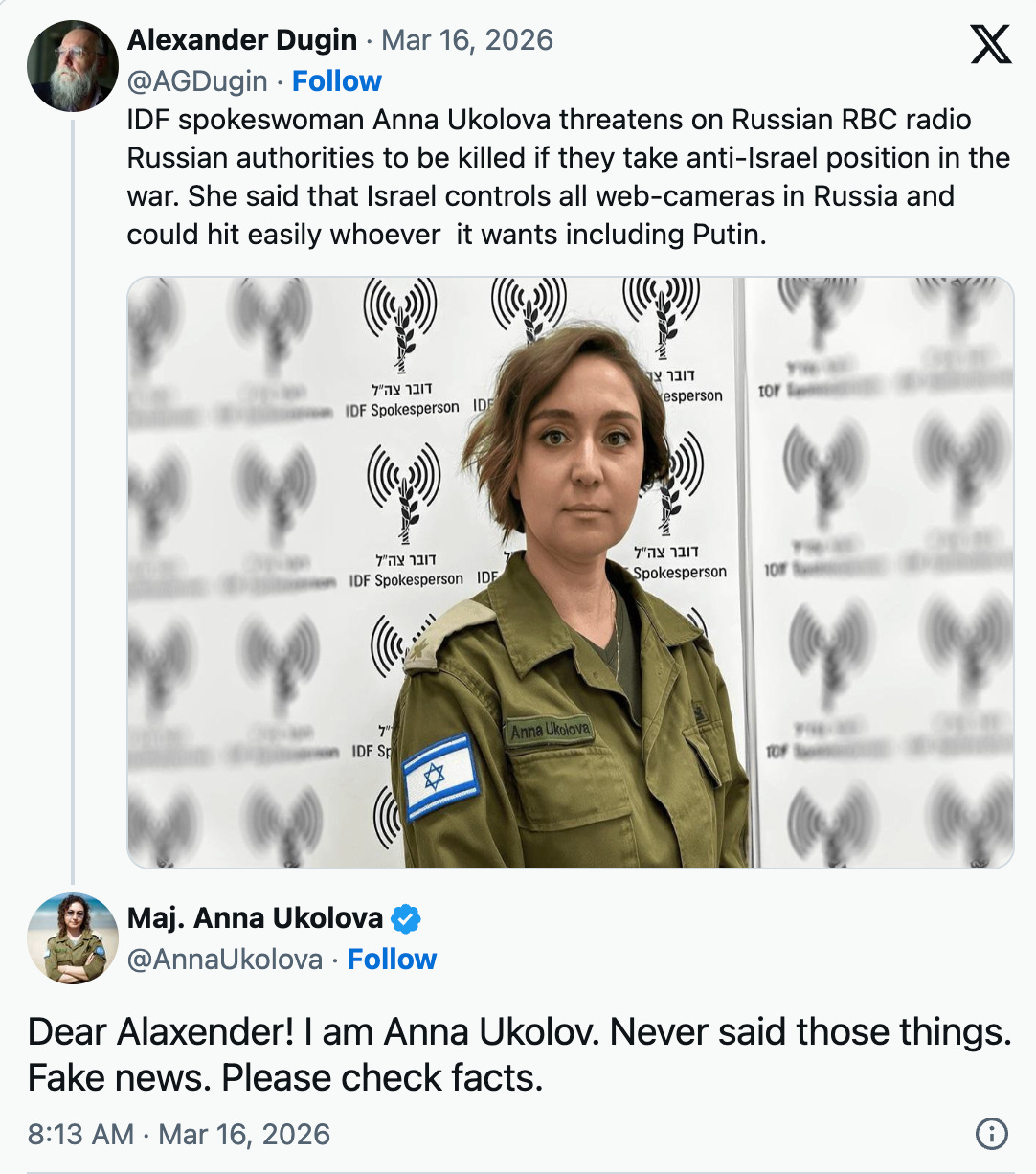
Israeli military spokeswoman Anna Ukolova has drawn outrage in Moscow after threatening that Russian authorities who “wish Israel ill” could be subject to “elimination,” while suggesting Israel could hack into Russian closed-circuit television cameras to identify and track targets.

Asked by a journalist with Russian radio broadcaster RBC whether Israel had access to Russian traffic cameras, Ukolova declined to answer directly but warned that “Khamenei’s elimination shows our capabilities are serious” and that “no one who wishes us harm will be left aside.”

She added, ominously, “I hope Moscow does not wish Israel ill right now – I’d like to believe that.”

In response to a post by Russian philosopher Alexander Dugin, who wrote that the IDF spokeswoman threatened that “Russian authorities [will] be killed if they take [an] anti-Israel position,” Ukolova claimed Dugin was spreading “fake news.” But she declined to clarify how her remarks had been incorrectly interpreted.

Ukolova’s statements came just days after it was revealed that a large number of Russian CCTVs were potentially using BriefCam – an Israeli video analysis software that closely matches the description of a program the Netanyahu regime reportedly deployed to track Iranian movements outside the home of Iran’s Supreme Leader before they assassinated him during their February 28 sneak attack.

On March 12, Russian outlet Mash revealed that the Israeli software BriefCam “has been used in Russia by private providers since the 2010s.” Founded at Israel’s Hebrew University in 2007, BriefCam uses AI to let users “review hours of video in minutes” and “make [their] video searchable, actionable and quantifiable.” In 2024, BriefCam was absorbed by a Dutch subsidiary of the Canon Group named Milestone Systems, which publicly pledges to “amplify what organizations of any size can see, do and achieve with video.”

“Our patented VIDEO SYNOPSIS® technology condenses hours of surveillance into a short summary by overlaying multiple events—each tagged with its original timestamp—onto a single frame, letting you filter them by object type and attributes,” the company’s BriefCam page crows. An analysis by Al Jazeera revealed those attributes include “gender, age group, clothing, movement patterns and time spent in a given location.”

Originally deployed by Israel’s Ministry of Housing and Construction to safeguard illegal settlements in occupied East Jerusalem, BriefCam has been used by governments all over the world, including those in the United Kingdom, New Zealand, Pakistan, Israel, Mexico, United Arab Emirates, Canada, Indonesia, Singapore, Thailand, Brazil, Germany, South Africa, Netherlands, Australia, Japan, India, Spain, Taiwan. It’s also been deployed in the US, with police in Hartford, Connecticut adopting the software in 2022. In 2025, a French court found the government’s use of BriefCam was illegal, citing multiple violations of French and European privacy laws.

As of publication, BriefCam appears to be incorporated into dozens of so-called “video monitoring systems,” including Milestone’s own VMS XProtect surveillance system.

A promotional video shows the numerous surveillance systems that BriefCam operates within.

According to the Russian outlet Mash, a number of prominent Moscow businesses, institutions, and buildings use VMS XProtect surveillance system, including the Institute of Theoretical and Experimental Biophysics of the Russian Academy of Sciences, a 72-story skyscraper named “Eurasia,” and a huge exhibit space known as the Zotov Center. Though Milestone officially ended operations in Russia in 2022 amid the war in Ukraine, Mash reports that some software distributors in Russia “still offer to install the hacked software and hide this in the documents.”

Joe Kent On Israel Lobby, Iran, Charlie Kirk | US-Israeli airstrikes on Iran’s gas fields change the Middle East conflict from “disruption” to “destruction”

YouTube link here.

US-Israeli airstrikes on Iran’s gas fields change the Middle East conflict from “disruption” to “destruction”

By Ben Aris, Intellinews, 3/18/26

A joint attack by Israel and the US on Iran’s Asaluyeh gas plant takes the crisis in the Persian Gulf to a worry crescendo more than three weeks into the war on the Islamic Republic’s structures. 

Asaluyeh and South Pars are the largest gas centres in Iran and the Gulf, and taking them offline transforms the showdown between Tehran, Washington, and Tel Aviv from a geopolitical clash into a full-blown war of total annihilation, likely to sink the global economy.

The attacks targeted at least four major processing units at the Asaluyeh complex in Bushehr province: the third refinery handling phases four and five, the fourth refinery covering phases six, seven and eight, the fifth refinery processing phases nine and 10, and the sixth refinery serving phases 15 and 16.

Further south, South Pars is the backbone of Iran’s domestic gas supply, feeding power generation, petrochemical production and household consumption. Any sustained disruption risks a drop in network pressure and rolling blackouts across the country.

Authorities called on citizens to reduce gas and electricity usage to the minimum necessary. “Otherwise, we will face widespread blackouts,” the statement said.

The extent of physical damage and casualties among technical personnel at the complex had not been verified at the time of the announcement.

Iran’s surviving parliament speaker, Mohammad Bagher Ghalibaf, said following the strike on South Parss, “Attacking the infrastructure means suicide for the enemy, the eye-for-an-eye equation is established, and a new level of conflict has begun.”

The immediate reaction was for Brent crude to jump 10% to $108, while the price of Omani oil, the only Gulf producer outside the Strait of Hormuz, soared to $173 as Iran announced that Gulf energy sites are now “legitimate targets.”

As we write this, Saudi Arabia’s capital Riyadh has already been struck by Iranian missiles, according to videos seen by IntelliNews, while other places have been listed as targets by the Islamic Republic, in its emulation of Israeli Defence Forces (IDF) notifications for Palestinians. 

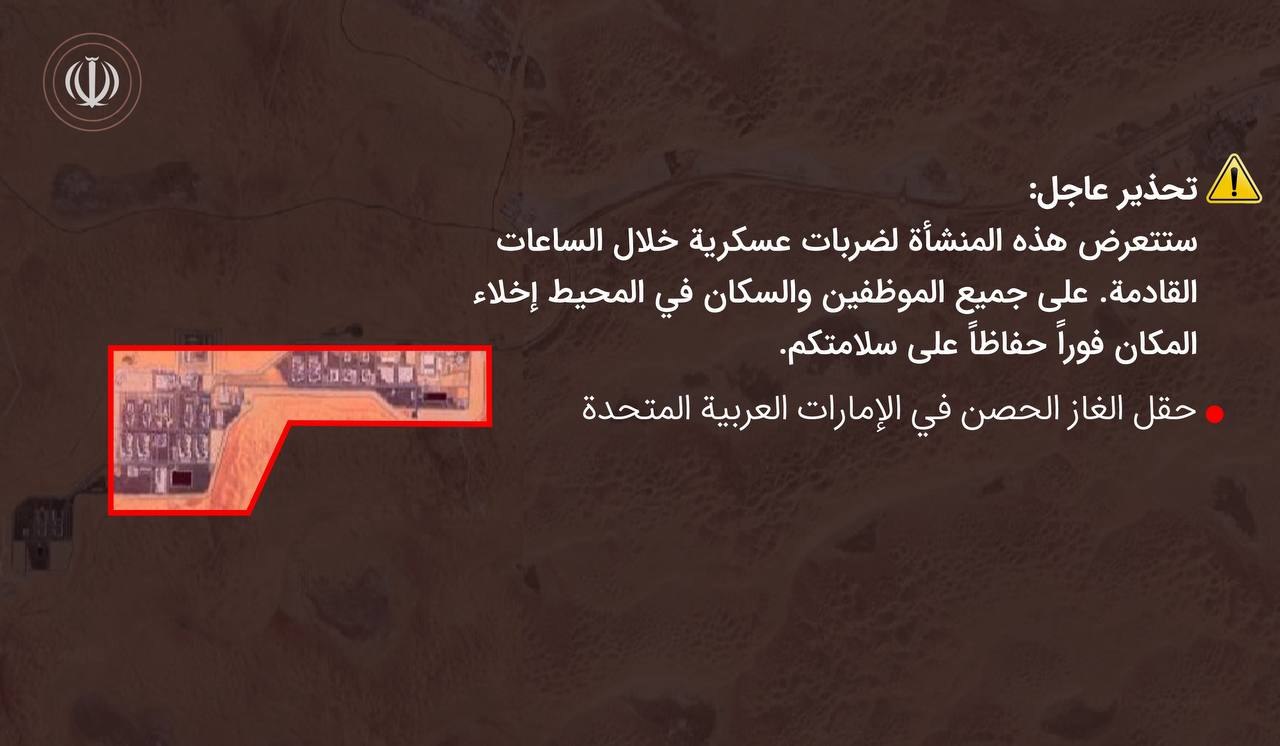
Tehran has already begun striking the Jubail petrochemical complex in Saudi Arabia, as well as expected strikes on the Mesaieed industrial city in Qatar, which is home to the Chevron-linked Q-Chem plant, and the Ras Laffan refinery in Qatar, as well as the Al-Hosn gas processing facility in the UAE – all amongst the biggest energy assets in the Gulf.

That changes the crisis from a “disruption” to the flow of hydrocarbons to the “destruction” of some of the world’s biggest energy production sites.

Even if the war were to end right now with the Islamic Republic’s capitulation, it would take many months to repair the damage, and the dislocation in energy markets would continue to ripple across the world.

Moreover, the “crisis virus” would continue to spread down the supply chains and precipitate a cascade of crises in multiple sectors.

As bne IntelliNews reported, the Persian Gulf has a larger share of the global fertiliser sector than it does of oil and gas, accounting for about a third of global production. Prices have already skyrocketed to the point where the cost is out of reach of many farms, just as they go into the spring planting season.

Unfertilised field yields this autumn can be expected to halve if fertilisers are not delivered, producing another wave to the expanding inflation shock as food prices soar.

Iran is also a major producer of helium, which is very hard to stockpile. Typically, the delivery of helium is limited to 45 days, after which supplies will begin to run low, threatening semiconductor production at chipmakers. With the collapse of helium production, which could lead to a shortage of semiconductors later this year, at a time when there is already a historic shortfall, thanks to the AI boom.

The political consequences have also become unpredictable. By striking their cash cows, the Gulf Cooperation Council (GCC) countries may decide to take matters into their own hands and unite against Iran in order to bring calm back to the region.

Over the last few years, the GCC has been pushing its “vision” strategies, selling itself as an island of stability and prosperity. They have tried to attract foreign investment and tourists to diversify their economies away from dependence on hydrocarbons. The launch of Operation Epic Fury has undone all of that work and shattered the image they have worked so hard to build.

The leading countries in the region, such as the UAE and the Kingdom of Saudi Arabia, will want to reestablish order as fast as they can. With US President Donald Trump frustrated in his efforts to reopen the Strait of Hormuz by the unwillingness of his Nato allies to participate in his open the prospect of a protracted war. The US’s failure to ensure the stability of the region- indeed, it was the US that started this war-GCC may decide to take matters into its own hands with the prospects of a region-wide protracted military conflict.

Commodity prices, starting with oil and gas, will become increasingly unhinged and balloon. Depending on how far the production destruction goes, that will hit global growth and certainly cause recessions in the more exposed countries, largely in Asia, but not only. The gas crisis that has been developing in Europe will metastasise and further compress already lackadaisical growth in the EU. Countries like France and the UK are already overexposed to debt and face possible financial crises.

America’s reputation, which was not good to begin with, has collapsed since Operation Epic Fury began. CNN has reported that support for the US had collapsed by 73% in the last week and it was now the second most unpopular country in the world, beating out only Israel as the world’s most unpopular country.

So far, 2026 is shaping up to be a vintage crisis year and should outstrip the 2022 crisis induced by Russia’s invasion of Ukraine, and probably even the Great Financial Crisis of 2008, when the US subprime mortgage market went into meltdown.

With global resources already weakened by geopolitical tension and the residual effects of the 2020 coronavirus pandemic, united global action will be called for once again.

The G20 came into its own in 2008 as the G7 alone were unable to deal with the aftershocks of the subprime disaster. This time round, the response may have to be truly global, but that will be even harder to organise given the depth and deepening East-West rift.