YouTube link here.
IRAN WILL NOT RELENT: ‘Iranians Unified in Retaliation Against Israel’ –Rachel Blevins Interviews Prof. Mohammad Marandi
YouTube link here.
YouTube link here.
By Sergey Poletaev, RT, 6/13/25
Sergey Poletaev is an information analyst and publicist [journalist]. He specializes in Russian foreign policy and in the Russia-Ukraine conflict. Born in 1980 in Moscow, Poletaev is a graduate of the Faculty of Journalism of Moscow State University. In 2017, together with researchers Oleg Makarov and Dmitry Stefanovich, he founded the information and analytical project Vatfor.
As the spring sun gave way to the heat of early summer, a new phase of the military campaign began to unfold across the front lines – and this time, the initiative clearly belongs to Russia.
After months of grinding attritional warfare, Russian forces have launched a sweeping spring-summer offensive that is already delivering tangible results. From the borderlands of Sumy to the contested hills near Chasov Yar and the approaches to Dnepropetrovsk, the tempo has shifted decisively. Ukraine, battered and overextended, is now struggling to contain simultaneous breakthroughs across multiple sectors.
The silence of Western media around these developments only underscores the magnitude of what is unfolding on the ground. A coordinated advance is in motion – methodical, strategic, and, by all appearances, effective.
Following the liberation of Sudzha in early March 2025, the fighting quickly spilled across the border into Ukraine’s Sumy Region. Moscow officially described its objective as the creation of a buffer zone – meant to safeguard the resumption of peaceful civilian life in Russia’s neighboring Kursk Region.
Motivated by political considerations, the Ukrainian Army has been trying to cling to a narrow foothold just across the border, in the village of Tyotkino in Kursk Region. In fact, Kiev has deployed some of its most experienced and ideologically committed units to this stretch of the front. But rather than showcasing Ukrainian resolve, the situation in Tyotkino has underscored the growing imbalance in offensive capabilities between Ukrainian and Russian forces in 2025.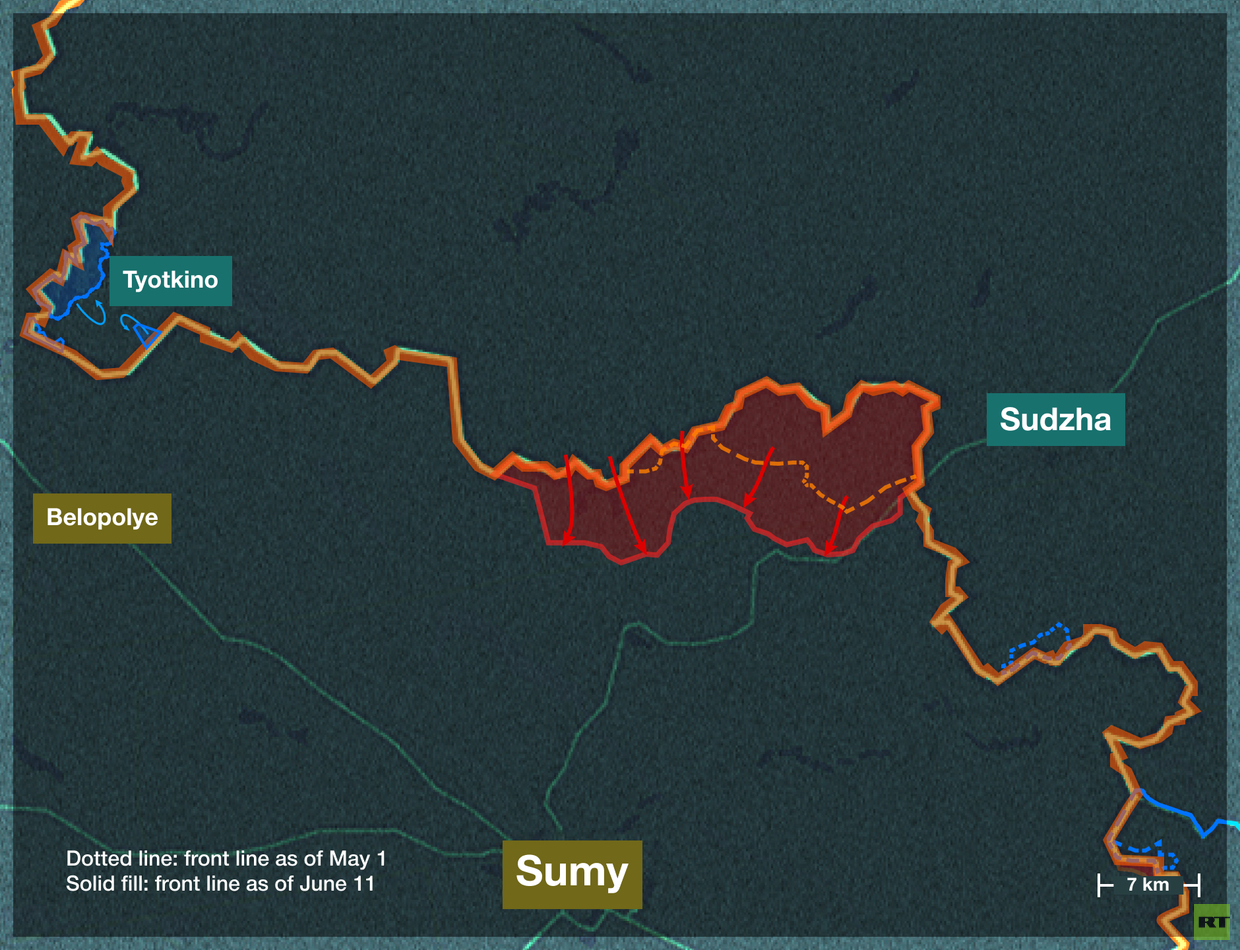
© RT / Sergey Poletaev based on data from Lostarmor.Ru
From the Russian side, Tyotkino is essentially a logistical cul-de-sac. But for Ukraine, the village connects to a critical rear supply hub in Belopolye. Even so, Ukrainian efforts to expand their presence in the area have ended in near catastrophe. In mid-May, the commander of Ukraine’s 47th Brigade came close to staging a mutiny, accusing his superiors of issuing reckless orders that led to needless casualties.
Elsewhere along the Sumy front, Ukrainian forces – many of them retreating from Sumy and the surrounding areas – have taken heavy losses. This remains a strategically vital axis for Ukraine. The authorities have announced mandatory evacuations in another 11 settlements, bringing the total number of evacuated towns and villages in the region to 213.
Notably, this marks the first time Russian forces have entered Sumy Region since spring 2022.
As of now, Russian advances appear to be accelerating. The front line has moved to within roughly 20km of the city of Sumy itself.
Liman (also known as Krasny Liman) is a strategic city in the Donetsk People’s Republic, with a pre-war population of around 20,000. Situated along the Kharkov-Donetsk railway, it serves as a key transportation hub in eastern Ukraine. After brief fighting, the city fell under Russian control in late May 2022 – but was later lost during Ukraine’s Kharkov offensive in October of the same year.
Today, Russian forces appear intent on retaking Liman by cutting off a single critical road that leads northwest toward Izium.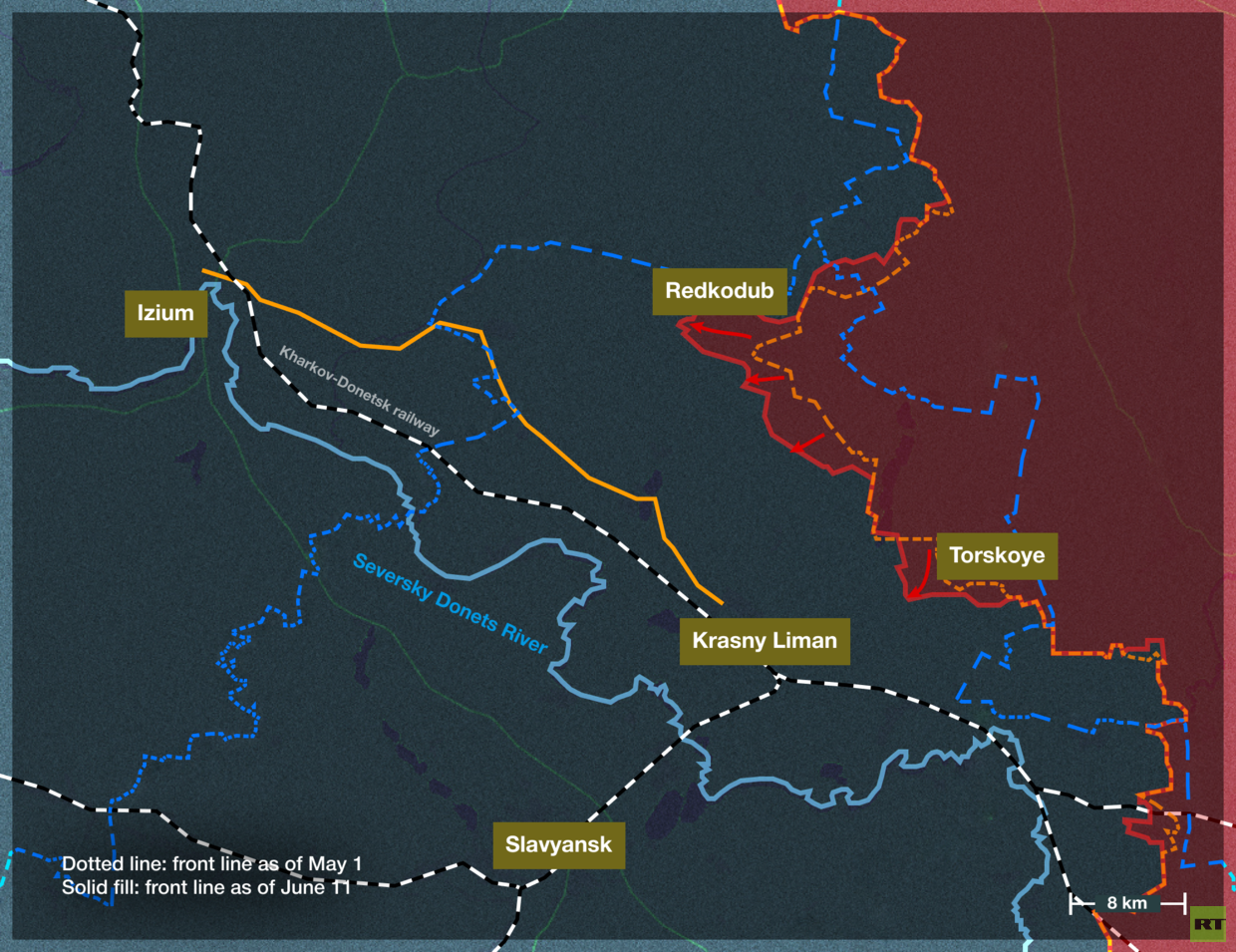
© RT / Sergey Poletaev based on data from Lostarmor.Ru
The current offensive seems focused precisely on this objective. On May 15, Russian troops secured the village of Torskoye, followed by the capture of Redkodub May 29-30. Both settlements are considered vital defensive outposts for the Ukrainian Army along the route to Liman.
From the south, the Liman front is effectively sealed off by the Seversky Donets River. During the brutal fighting in 2022, neither side managed to establish a crossing. With the evolution of drone warfare, any river assault today would be even more difficult to carry out.
Russian forces are now within 10km of Liman and just 7km from the Izium road. The offensive is ongoing.
As of early June, the stretch of the front from Dzerzhinsk (also known as Toretsk) to Mirnograd has become one of the most active battle zones. Russian forces have advanced up to 10km along a 30-kilometer-wide front, capturing 12 settlements and securing more than 15km of a key bypass highway linking Pokrovsk to Konstantinovka.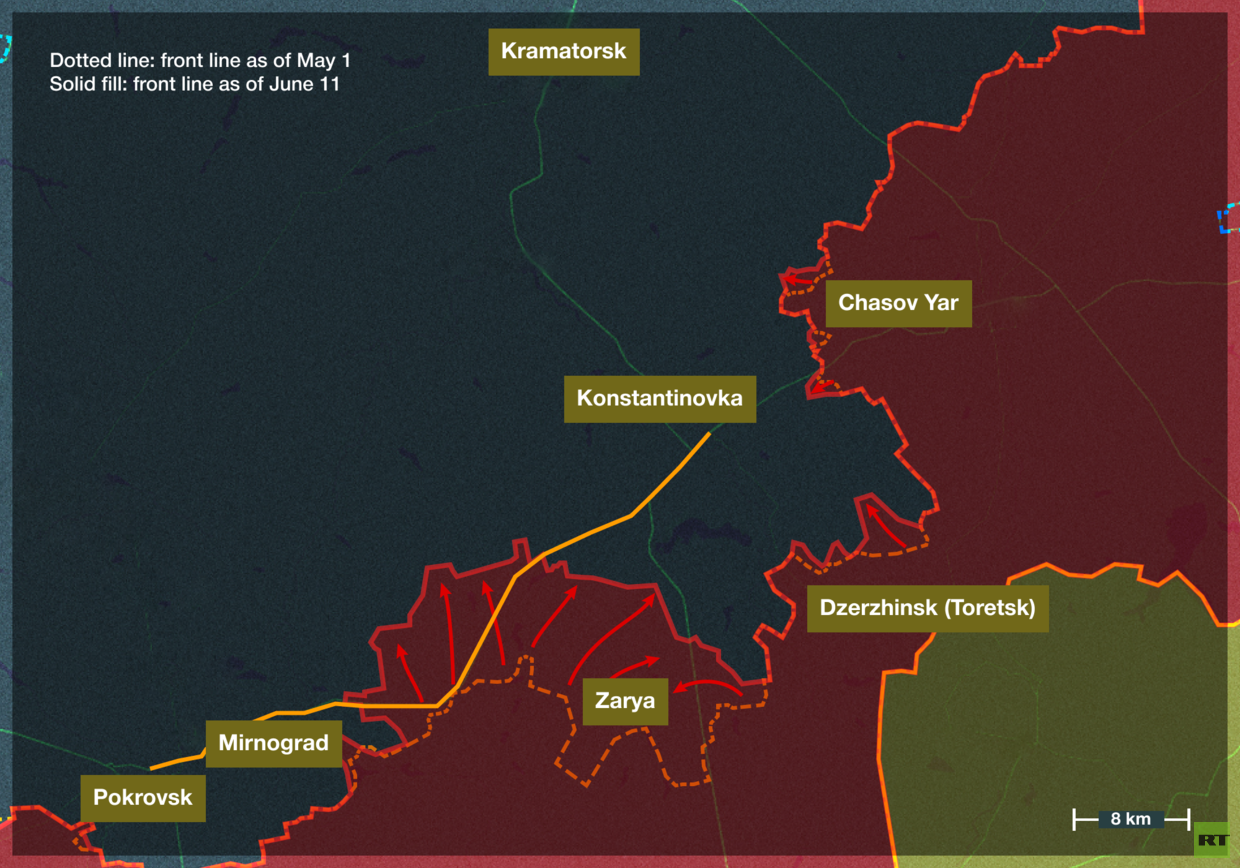
© RT / Sergey Poletaev based on data from Lostarmor.Ru
These gains suggest that a southern encirclement of Konstantinovka – a city with a pre-war population of 67,000 – may now be underway. Simultaneously, fighting has intensified on the northern flank around Chasov Yar. The terrain in this area poses serious tactical challenges: Chasov Yar sits on elevated ground beyond the Seversky Donets–Donbass Canal, complicating efforts to establish supply lines or mount a full-scale offensive from that direction.
Notably, this sector – among the three fronts currently in focus – has received the least media attention. That may soon change. Given its strategic positioning, it could emerge as a central axis of Russia’s summer campaign.
In the past week, Russian forces dismantled a significant Ukrainian stronghold north of the village of Zarya. The terrain here is rugged and uneven, but if fully secured, it would open a path for Russian troops to push toward the southern outskirts of Konstantinovka.
Pokrovsk (Krasnoarmeysk), a city of 65,000 before the war, has been under siege since autumn 2024. After Russia’s swift capture of nearby Novogrodovka and Selidovo, it initially appeared that Pokrovsk would fall just as quickly. But in a surprising pivot, Russian command redirected its main effort toward the Kurakhovo axis. Since the winter, Ukrainian forces have attempted to push Russian troops back from the city’s outskirts, but those efforts have largely failed to yield results.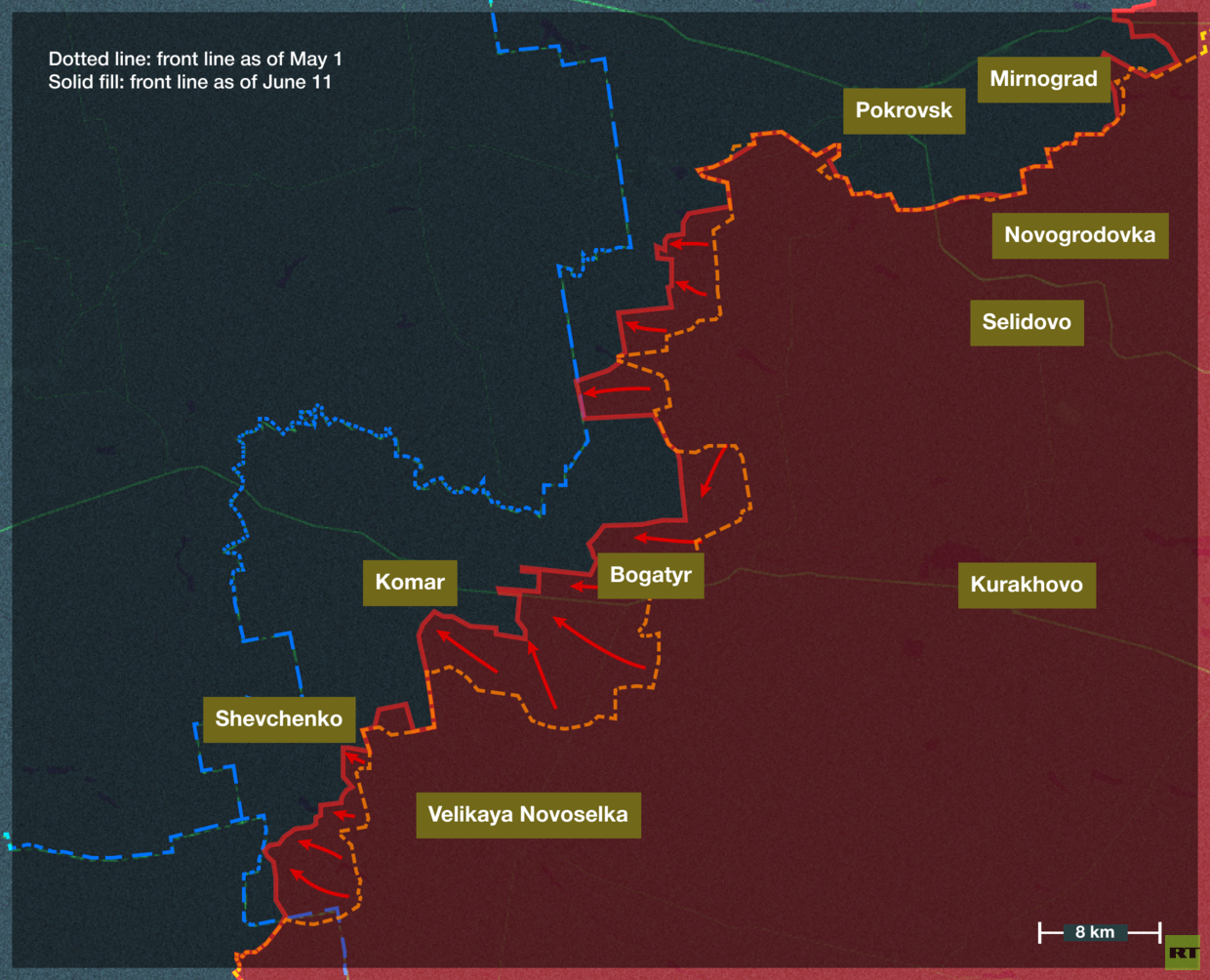
© RT / Sergey Poletaev based on data from Lostarmor.Ru
Further south, across the Volchya River, the offensives launched last year around Kurakhovo and Velikaya Novoselka are still ongoing. Russian troops have taken control of the town of Bogatyr and several surrounding settlements. The front line now lies just 3-15km from the Dnepropetrovsk regional border, depending on the sector.
An interesting development in this sector: Russia’s Central, Eastern, and Southern military groups are coordinating their offensive operations here – a rare show of multi-group integration.
On June 8, the Russian Defense Ministry announced that units from the 90th Tank Division, part of the Center Group of Forces, had reached the western boundary of the Donetsk People’s Republic and were advancing into neighboring Dnepropetrovsk Region.
By Chip Gibbons, The Dissenter, 6/12/25
The following article was made possible by paid subscribers of The Dissenter. Become a subscriber with this discount offer and support journalism that stands up covers whistleblowing, press freedom, and government secrecy.
As United States embassies and military bases across the Middle East braced for a potential Israeli strike against Iran, friends and family of Asif Rahman gathered inside the Albert V. Bryan U.S. Courthouse in Alexandria, Virginia, for his sentencing.
The former CIA analyst had pleaded guilty to disclosing two top secret documents detailing a U.S. ally’s “planned kinetic action,” a thinly veiled reference to Israel’s October 2024 strikes against Iran. While Rahman’s actions did not prevent the strikes, prosecutors said at an earlier detention hearing that he forced Israel to delay its military strikes.
Those seeking to attend the hearing were greeted by a bailiff standing outside the courtroom and a sign announcing the hearing was “under seal.” Around 11:30 a.m. when the hearing was slated to begin, a bailiff indicated that members of the public not only could not be in the courtroom during the classified portion, but also had to wait on an entirely separate floor altogether.
Originally, it was estimated the classified portion would take twenty minutes. It was over two hours later when it was announced the court would adjourn for lunch before finally opening the courtroom doors to the public.
DONATE: Support The Dissenter’s Independent Journalism
At the unclassified portion of the hearing, Judge Patricia Tolliver Giles sentenced Rahman to three years and one month of prison time and two years of supervised release. She also imposed two $25,000 fines.
The sentence was shorter than what the government had requested but longer than the 13-month sentence sought by the defense. It was ultimately a shorter sentence than those imposed on drone whistleblower Daniel Hale and CIA whistleblower Jeffrey Sterling. Like Rahman, both were convicted under §793 of the Espionage Act in the Eastern District of Virginia.
Rahman’s prosecution was the first Espionage Act prosecution during the Gaza genocide, a vicious campaign of extermination waged by the Israeli government and backed by the U.S. government that has repeatedly threatened to spiral into an even wider regional war.
Yet at least during the open part of the hearing, little if any of this context made its way into the proceeding. In fact, as a potential Israeli strike on Iran dominated the headlines, the court proceedings seemed divorced from the outer world.
While §793 of the Espionage Act requires a defendant have reason to believe that their actions will harm the U.S., it leaves little room for motives. There is no public interest defense. As a result, public servants aware of very real wrongdoing by the U.S. government are faced with a dilemma: in order to effectively alert the American people they serve about what their government does in the dark, they often must break the law.
But while motives may not come into play as a defense, they often take center stage during sentencing as the defense tries to show an employee or contractor’s actions were guided by altruism, a desire to inform the public, or prevent some harm.
Rahman’s attorney Amy Jeffress, a former national security prosecutor, stated to the court that it was certainly difficult to understand how a law-abiding individual who gave up a lucrative career in finance to serve in the CIA made the choice that he made. However, Jeffress explained to the court that the defense had consulted a psychologist who produced an evaluation of Rahman that was submitted under seal.
According to Jeffress, Rahman’s actions were the result of traumatic world events and past personal trauma.
In a sentencing memo submitted earlier by Jeffress, the defense mentioned trauma from a threat to his personal safety during his time working with the CIA in Iraq, arguing that “events in the Middle East that began in the fall of 2023 revived his traumatic experiences in Iraq in a profoundly destabilizing and unforeseeable way.”
Jeffress told the court that the former CIA analyst acted out of “misguided compassion” and “in furtherance of peace and saving lives.” But immediately after mentioning Rahman’s attempts to achieve peace and save lives, Jeffress stressed that his actions were “irrational.”
The defense sought to explain Rahman’s solely action in psychological terms, eschewing any descriptions of them as whistleblowing or politically motivated.
After the hearing, The Dissenter asked Jeffress if she wished to expound on how her client viewed his actions as being in furtherance of peace and saving lives, but she declined to do so (though she thanked this reporter for noticing she had made that remark).
Whistleblowers Hale and Chelsea Manning both made statements at their sentencing stressing how the brutal toll of war on civilians inspired their actions. When Rahman spoke, he apologized to his family and stated it was an honor and privilege to serve with the CIA. He said he was sorry for harming the reputation of the CIA and stressed the important work that his former colleagues do, much of which we will never know about due to its secretive nature.
Subscribe To The Free Edition of The Dissenter
Much of Rahman’s arguments for leniency centered on his cooperation with the government.
Although the government took a hardline stance against granting bail to Rahman— arguing to the court that he posed a danger and a flight risk, it has since been revealed that almost immediately Rahman began cooperating with the government.
Such cooperation included giving the government access and passwords to encrypted devices, and in the words of Assistant U.S. Attorney Troy A. Edwards Jr., he told the government “what he had done, who he had done it with, and how he did it.”
Also, according to a government filing, Rahman “provided truthful information related to others,” however, that information was unlikely to result in their prosecution.
This cooperation initially produced a plea deal in which the government and defense agreed on a guidelines range for sentencing. However, on May 6, one week before the original sentencing hearing date, the prosecutors under instruction from the main Justice Department sought a dramatic sentence of 108 months.
Prosecutors also filed a last-minute classified sentencing memo, as well as an unclassified letter from CIA Deputy Director Michael J. Ellis. The defense argued the court should not admit any of this into evidence at sentencing. As a result of the standoff, the judge postponed the sentencing hearing repeatedly.
Incredibly, by the hearing, Jeffress noted that the prosecution no longer stood by the request for a 108-month sentence. Edwards also told Giles that the government did not object to striking the portions of Ellis’s letter dealing with actual harm, as opposed to potential harm.
Giles ultimately refused to allow any part of the high-ranking CIA official’s letter to be considered, stating that the letter alleged actual harm was caused by Rahman’s disclosure when the classified portion made clear there was only evidence of potential harm.
While the prosecution backed away from the 108-month sentence, they continued the bizarre move of seeking both a downward departure and an upwards variance from the sentencing guidelines. (Departures and variances refer to sentences outside the guideline range, but they are based on different statutes. In other words, the government asked for a higher and a lower sentence than the guidelines, which is both weird and nonsensical.)
While Rahman was indicted over two disclosures, the plea agreement revealed for the first time earlier disclosures of classified information, as well as the role of third parties in these disclosures.
The prosecution insisted that this conduct was more egregious than what was described in the initial indictment. Giles agreed stating that the indictment failed to capture the full seriousness of this conduct, which was discussed in the classified session. (To date, those earlier disclosures or who the third parties were remains a complete mystery.)
Giles pushed back on the government for arguing Rahman’s conduct was akin to offenses under §794 of the Espionage Act, which covered in the words of the prosecution “traditional espionage.” A §794 offense carries a potential death sentence.
This move followed a similar bait-and-switch in the sentencing of convicted Vault 7 leaker Joshua Schulte. Like Rahman, Schulte was charged under §793, but the government invoked those convicted under the more severe statute when seeking a harsh prison sentence.
An important distinction between the government’s positions in both cases is that in the Schulte case the government alleged Schulte intended to injure the U.S., whereas in Rahman’s case the government conceded he had no such intent. Giles insisted it was wrong for the government to have someone plead to a lesser charge and then try to sentence them based on a more serious one. She also noted that there were no facts to sustain a charge under §794 against Rahman.
While Giles pushed back against the government at times, she also showed an immense reverence for national security secrecy. She continued to stress the allegedly dangerous nature of what Rahman had done, accusing him of both endangering the American people and breaching their trust. Giles noted that the documents were so secret she could not have them in her chambers, yet they were “floating around in the ethers” and on the internet. She called Rahman’s actions “reckless, yet calculated.”
Ultimately, Giles rejected the government’s request for an upwards variance at sentencing. And she granted an even greater downward departure than the government requested. Rahman’s defense requested that the judge recommend Rahman be placed in Federal Correctional Institution Petersburg, a medium-security facility in Virginia.
While Edwards was unsure if the Justice Department would request Special Administrative Measures (SAMs), if they did that would limit where Rahman could be sent.
One prison was “ADX,” which most likely was a reference to the maximum-security prison in Florence, Colorado. The other was a medium-security prison in Maryland. Edwards stated if SAMs were requested, he would recommend the Maryland prison. Ultimately, the decision of where to house Rahman is entirely up to the federal Bureau of Prisons.
After the sentencing, Rahman’s family was clearly relieved. They were in tears as they hugged Jeffress.
Israel’s genocide has sparked levels of dissent within the U.S. government that have not been seen since the Vietnam War. As Israel’s backers in both the Republican and Democratic Parties lose control of the narrative, they’ve sought to reestablish control by shredding the First Amendment.
It was predictable that the government would wield the Espionage Act as part of this crackdown on freedom of expression. Yet this political context was absent at Rahman’s sentencing.
While there was a smattering of hints that he had a political motive, they were left largely unexplored. Instead, the defense attributed the leaks to his mental state while emphasizing his cooperation with the U.S. government to secure a shorter prison sentence.
YouTube link here.
Here is the link to the 2009 policy paper Berletic refers to by the Brookings Institution, “Which Path to Persia.”
***
Russia Calls Israeli Attack on Iran ‘Unacceptable,’
Russia Matters, 6/13/25
Russia’s Vladimir Putin held phone calls with Israel’s Benjamin Netanyahu and Iran’s Masoud Pezeshkian in the afternoon of June 13, condemning Israel’s overnight attacks on military, nuclear and other targets in Iran, and offering his mediation services to the two arch-enemies. In sync with the Kremlin, Russia’s Foreign Ministry condemned Israel’s strikes as “unacceptable,” while Putin’s deputy in the Russian Security Council Dmitry Medvedev invoked the threat of a nuclear war in his reaction to the attacks. Of the pro-Kremlin Russian commentators whose views on the attacks RM staff managed to find, most criticized Israel, while some worried about the possible disintegration of Iran, which supplies most of the attack drones used by Russia in its war against Ukraine.
***
Live updates at Al Jazeera regarding Israel-Iran strikes
By Jeff Childers, Substack, 6/11/25
Finally, Russia Today ran a controversial story this week headlined, “Ukraine’s shame: Why Kiev refuses to take back its dead and wounded.” I don’t usually cite RT, but the basic facts were confirmed in oleaginous articles from AP and Reuters. Ukraine is making a potentially fatal mistake— but it may have very few options.
Under Ukrainian law, each family of a soldier killed in action is entitled to 15 million Ukrainian hryvnias (about $360,000). In the second-round of Istanbul talks two weeks ago, Ukraine and Russia agreed to swap their war dead. Now, refrigerated Russian semis with 6,000 frozen Ukrainian soldiers sit idling on the border, with Kiev refusing their receipt.
The inglorious motive, which Zelensky adamantly denied, appears clear to everyone else. Accepting this single shipment would instantly obligate Ukraine to pay over $2 billion to grieving Ukrainian families. For context, $2 billion is about 10% of Ukraine’s entire 2025 defense budget.
Kiev’s excuse — that it hasn’t yet confirmed the identities of the soldiers, and doesn’t want to be “tricked” — is laughably absurd. Who exactly do they think Russia is trying to return? Russian soldiers? Are they worried Putin snuck a few Wagner guys in for the ride?
Even more ridiculous: what’s the harm in accepting the bodies of your own fallen comrades and then verifying their identities after? That’s how every other nation on Earth handles the fog of war. If, by some miracle of depravity, Russia did try to sneak in fake corpses, it would be a PR bonanza for Ukraine. Zelensky could’ve dragged the remains into the UN chamber and shamed the Kremlin before the world.
Don’t hold your breath waiting for corporate media to ask any of these questions.

 Ukraine’s stinginess is bad enough, but the 6,000 dead are telling another story, too. Recently, Zelensky claimed that Ukraine has lost only 43,000 KIA since the start of the war. Russia identified this initial batch of 6,000 as the first shipment just from one operation— Kiev’s ill-fated foray into the Kursk salient.
If they are Ukrainian war dead, which seems almost certain, it finally puts the lie to an outrageous claim about bottom-barrel numbers of Ukrainian KIAs long suspected to be a Pinocchio-level fib. More Ukrainian lies.
Kiev’s ugly foot-dragging on taking back its own war dead could conceivably cost it the war. Ukrainian soldiers — especially new conscripts — are watching. Many already suspect their government is minimizing casualty reports and sending them into meat grinders with little transparency. If they now believe their own state won’t even bring their bodies home, or worse, is intentionally stalling to dodge benefits owed to their families?
Not too good for military morale. “Why die for a country that won’t even admit I’m dead?”
Ukrainians on the home front —mothers, widows, and siblings — already feel the absence of official clarity. What happens if they begin to believe that trucks of their own sons are sitting at the border while the government offers bureaucratic excuses and financial foot-dragging? Public grief could quickly curdle into public rage.
For Russia, this is a propaganda jackpot. They get to crow, “We’re returning the dead with dignity. Ukraine doesn’t even want them back.”
Meanwhile, in the West, taxpayers funding Ukraine wonder why billions are being sent to a regime that refuses to bury its own dead. Even a brief delay constitutes a moral failure that crosses civilizational boundaries and vexes all historical precedent.

Zelensky has survived this long on a purely moral narrative: that Ukraine is the underdog, the noble defender, the modern Sparta holding the line for civilization. But this ugly episode —thousands of fallen soldiers rotting in refrigerated limbo while Kiev dithers— punctures that PR spin like an overfilled balloon. But what can Kiev do? If it takes the 6,000, then its budget will be blasted into smithereens. No money for graft. And if it takes this 6,000, what will it do when the next 6,000 show up?
Russia is watching Kiev’s every move like a starving grizzly eying a fattened deer. Zelensky’s dithering in the headlights shows cowardice and weakness, and reveals right where the pressure point lies.
It’s not a logistical crisis. It’s not even a brief PR crisis. It’s a narrative death spiral with no way out. Critical decisions must be made soon— but what to do?