Vladimir Putin met with students, graduates, and teachers of the Sirius Educational Centre in Sochi

Kremlin website, 5/19/25

Later, following the meeting of the Talent and Success Foundation Board of Trustees, the President viewed information stands about the Sirius Secondary Special Music School. Head of the Talent and Success Educational Foundation Yelena Shmeleva gave him a tour around.

The Sirius Secondary Special Music School for students from form 1 to form 11 opened on September 1, 2024. It has become the twelfth institution among secondary special music schools that provide students with both musical and secondary education. Upon completion of studies, graduates may enrol in higher musical educational institutions of the country.

The building, erected on the coastline, houses over 60 academic and music classrooms, alongside dressing rooms, an audio library, a sound recording studio, and a concert hall. Up to 250 young musicians can study here simultaneously. Instruction is conducted in three specialised fields: piano, orchestral string instruments, and orchestral wind and percussion instruments. At all stages of education, significant attention is devoted to regular concert practice, the establishment of a creative environment, and collaboration with the nation’s leading musicians.

* * *

Mikhail Pirozhenko: Hello, Mr President. My name is Mikhail Pirozhenko. I am 15 years old and have come from St Petersburg.

President of Russia Vladimir Putin: Me too.

Mikhail Pirozhenko: I am a pianist, as is my entire family. I learned about Sirius from my elder brother: I have already been here twice and would love to come here for a third time this year. What I have always enjoyed here is the opportunity to interact not only with musicians like me but also with peers from other disciplines.

It is very interesting why Sirius specifically focuses on these three fields – sports, science, and the arts. How did the idea of creating Sirius originate? Was there something that inspired you? Perhaps, places similar to this?

Vladimir Putin: No. It was far more pragmatic: after the Olympic Games concluded, the question arose of what to do with the facilities and how to utilise them. There were many proposals, but ultimately, the idea emerged from the Soviet Union’s – and later Russia’s – tradition of prioritising specialised training for young talents from an early age. These include specialised physics and mathematics schools, chemistry schools, and later biology schools. This is where the concept began – gathering children from across the country here for a set period, then we decided it would be for just over 20 days – 21 days, right?

Head of the Talent and Success Educational Foundation Yelena Shmeleva: 24.

Vladimir Putin: Then I thought: why limit this to the sciences? We have specialised music schools affiliated with conservatoires and world-class – perhaps even surpassing world-class – dance schools training ballet artists. Thus, from the very beginning, we expanded Sirius’ scope of activities. That is how it came about, organically.

I have spoken before about how the name came to be. I simply asked my team: What is the brightest star in the sky? They said, “Sirius.” Since this place was meant for talented young people, children and teenagers, the name felt natural: Sirius.

What we see here today and what I am about to visit, is a continuation of that original idea, evolution of the Sirius concept: the creation of this school and the nearby concert hall. I believe both have been built to meet the highest global standards, and perhaps even exceed them in some respects.

This was the very idea behind preserving the Olympic legacy: it should serve the country and its people in the best way possible. I believe that goal has been fully achieved. But we must progress and continue developing Sirius. The opening of this music school, where we are now, is a significant step in that direction.

I hope everything will work out well for you here, that you will enjoy your time, and that this place will help you unlock and develop your talents. The environment is excellent, the teachers are outstanding, and I also hope so is the acoustics: it was Toyota that worked on that as well. As [Artistic director of the St Petersburg House of Music, Chairman of the Board of the Talent and Success Foundation] Sergei Roldugin keeps saying, sound in a space like this is as important as a musical instrument itself. He keeps telling me what other important things I can say about this place. The sound in the hall is like a musical instrument. It must resonate with the performances here. I believe that will be the case, just as in the concert hall. We are going to visit the concert hall, aren’t we?

Yelena Shmeleva: Not this time, but it’s almost ready. We are officially inviting you to its grand opening in October. We’re looking forward to it.

Vladimir Putin: It is beautiful on the outside. I hope the inside will fully meet the tasks and goals we have set.

Yelena Shmeleva: If I may say, musicians are our priority. This is a music school, though students in all disciplines are gathered here.

So, fellow musicians, who else wanted to ask a question?

Vladimir Putin: Please, go ahead.

Yelena Shmeleva: Dasha Malakhova, please.

Darya Malakhova: Good afternoon, Mr President. My name is Darya Malakhova. I am 16, and I am from Arkhangelsk. This is the second time I have come to the Music and Performing Arts section at Sirius.

I have been drawn to the arts and surrounded by music since I was a child. I went to a music school at three and to an arts school at six. I continue to develop in this direction, and Sirius has certainly been a great help in this.

I would like to ask you the following, since I know that you practised on the piano and learned to play as a child: Do you have time to play the piano now if you have the opportunity to do so? What role does music play in your everyday life despite your busy schedule? Do you think that music is really important, and how has it influenced your development as an individual?

Vladimir Putin: To begin with, unfortunately, I never played the piano, which I regret because music truly enriches your life. Music and painting, if they become part of our lives in childhood, help shape your personality, world outlook, and your attitude towards the world and yourself. Music is harmony, and harmony, if you found it, is what makes every human being happy.

You know, I lived in a very simple family that was not connected with music or art in any way. It was a worker’s family.

However, I started attending concerts and going to the philharmonic when I was in high school. There are many places in St Petersburg where you can listen to good music. Gradually, I started doing that more and more often. Having an appreciation for the arts and music, understanding it and tuning yourself to it is an art in itself. It happens at the level of the unconscious; it is not something very rational, maybe even not rational at all.

However, the ability to enjoy what you see and hear, that is, painting and music, must be part of education. I did not have the kind of education you are receiving, including a music school and so on. But St Petersburg offered an opportunity [to learn to love music and the arts], and thankfully, I took advantage of it. Gradually, I [learned to love it]. Later, I became friends with Sergei Roldugin, who invited me to various events, such as concerts and the like, and then I started going to concerts on my own.

I believe that this appreciation of music, ballet and painting very gradually helped me develop what I have always relied on later in life, supporting me and helping me formulate an attitude towards events and people. I believe that this is an extremely important element of education for everyone. We will support this in every way, just as we are doing it here and now.

Darya Malakhova: Thank you for your answer.

Anna Tsukanova: Good afternoon, Mr President.

My name is Anna Tsukanova. I am 17, and I have come from Barnaul. I study at the Music and Performing Arts section.

I have been playing the piano for 12 years, and my ambition is to become a professional musician. I understand that this takes a great deal of hard work and improvement, and Sirius is a great help in this. This is my fourth and last time here, and every time I get an extremely powerful boost in my professional advancement, as well as energy and inspiration.

However, I also understand that a musician needs not only professional skills but also personal qualities. One of these is probably the ability to take the lead, to conduct an orchestra and to play as part of a team.

I believe that you, as president, have outstanding leadership qualities. I would like to ask you if there are methods for developing them. Do you think that people are born leaders, or can leadership qualities be developed while growing up and acquiring experience? Did you specifically develop these qualities, or have you always had them? Thank you.

Vladimir Putin: It is difficult to say if this is a born quality or not. That is for the geneticists to determine. But I think that it is a talent which you can inherit. But some qualities do not blossom without hard work and effort, even when you have a natural talent, like Mozart did. We know what happened in his family, where he was virtually tortured with music lessons. There are many other examples of this kind, when children fainted or even when mothers thought that their children had died, but they came to and continued with their music lessons. This incredible diligence is part of success, even for very talented people or even geniuses.

So, how can we determine what is important – diligence and self-improvement or inherited qualities? It probably takes both to achieve the highest results and maximum effect. It does take hard work, of course, and it cannot be any other way. Success is not a blessing but something you must strive for.

Vera Chichilenko: Good afternoon, Mr President.

Vladimir Putin: Good afternoon.

Vera Chichilenko: I am a sixth-form student at the Sirius Special Secondary Music School. My name is Vera Chichilenko, and I am 13 years old.

As a child, I loved flying on aeroplanes and dreamt of becoming a flight attendant. However, sports then came into my life, and I aspired to become a master of sports in rhythmic gymnastics. At the age of seven, I enrolled in a music school to study the cello, and now my dream is to become a professional musician.

What did you dream of as a child when you were five, ten, or 15 years old? And what do you dream of now?

Vladimir Putin: At five or ten years old – what I was passionate about, what I dreamt of: I do not want to invent anything for you now; it is rather difficult for me to recall what it was at five, just vaguely. Yet, oddly enough, I do remember certain things. What did I dream of? Everything depends on circumstances, on our level of development, our perception of the world around us, and the people who surround us. It is from there – from art, incidentally, from music, from the opportunity to visit museums – that images emerge, certain goals take shape, and preferences form.

The more positive external influence there is, the brighter and more concrete our plans and dreams become. I surely had my own. But as I grew older and chose a profession, things unfolded differently – I have spoken about this many times. Boys often make such choices: at one point, I wanted to be a pilot, then a sailor – heroic professions like that.

But gradually, gradually, I developed as a person. I was, of course, deeply drawn to how people act, how they live when dedicating their lives to their country. That is where the desire to work in foreign intelligence came from, and then, step by step, it led to what I do today.

I very much hope that your life, and the lives of your peers, will unfold in the same way – that in the end, you will choose a vocation to which you are ready to dedicate your life. Then life will be interesting, and you will achieve the greatest possible results in the field to which you devote your life.

Pyotr Bregadze: Good afternoon, Mr President.

My name is Pyotr Bregadze. I am 12. I play the flute and I study at this special secondary music school. I came here last year, and I live here without my parents. I miss them, of course, and talk to them every day.

What did your family mean to you when you were a schoolboy? Were there events in your childhood that were connected with your parents and that you never forgot? Can you tell us about them, if you don’t mind my asking?

Vladimir Putin: I have spoken about that on many occasions, and frankly, I would not like to repeat myself. But it is true that I remember some events that happened when I was about your age or a little older, as if they happened just now.

You know, the most important and interesting thing for me, which probably influenced my personality and development as a human being, is that my parents always – I would like to stress this – opted for what was best for me when they discussed everyday matters or issues related to my future.

I remember it to this day, and I am extremely grateful to my parents for their attitude towards me and for their love. That is how love is expressed; love is not only cuddling, hugs and kisses, although they are important too.

Overall, I saw that even when I was thinking about where to study, which university to enrol at and so on, my parents wanted something that was simpler to achieve, considering that I engaged in sports and some universities were ready to admit me practically without entrance exams. My coach encouraged them to make that decision, for my own good, and this would have been simpler for me. But I made my own choice, which seemed quite difficult at that time. I remember very well that when my parents saw that it was my choice, they accepted it respectfully and after that never interfered in any way. On the contrary, they did their best to support me.

And it has always been like that, with regard to all issues. They always supported my choices. I will never forget that, and I will always be grateful to them for it.

Asel Kuzbekova: Good afternoon, Mr President.

My name is Asel Kuzbekova. I am 12 years old, a sixth-form student at this special secondary music school, and I play the violin. My most cherished wish is to play the violin as well as my favourite violinist, Pavel Milyukov.

If you caught the golden fish, what wish would you make?

Vladimir Putin: Out of ecological considerations, I would simply release the fish back into the wild and not burden it with fulfilling my wishes. I would strive to formulate my own goals and work to achieve them.

Is that all? Perhaps the children could play something now?

Yelena Shmeleva: Yes, but I believe we still have some questions.

Daniil Sakharov: Good afternoon, Mr President.

My name is Daniil Sakharov, and I have come from Yekaterinburg. I am 17 years old. In my hometown, I am completing my second year at the Sverdlovsk Art College.

Since childhood, I have been drawn to nature and everything it creates in this world. In the future, I would like to become an artist who shows people their true, authentic essence – something innate that cannot be taken away from any person. I believe this could improve the lives and worldviews of future generations. For me, as for all aspiring artists, it is important that our work resonates with the viewer’s soul and conveys ideas that could help improve the lives and perspectives of future generations.

And so my question to you, Mr President: In your opinion, what values should contemporary artists convey? What qualities must a modern artist possess to ensure society hears them? Thank you.

Vladimir Putin: There is one biblical value that stands above all: the most important thing is love. Love for what you do, love for the world around you, and love for the people who surround you.

I do not know – you would understand this better, as you are a future professional artist, as I gather. Therefore, you should already feel what drives you and what you wish to convey to your audience. This is extremely important. After all, it is not just about depicting something beautifully – though that matters – but about conveying to people your perspective on what you portray: nature, humanity, or anything else.

Even photography, incidentally, is a form of creativity, yet it captures something real, an actual subject. An artist, however, seeks above all to communicate their own vision to the viewer, to another person. What matters is not so much the subject being depicted but the attitude of the person portraying it – whether it is nature or even a still life. This, too, reflects the artist’s relationship with their work. The artist themselves, their worldview, is what is important. That, I believe, is the essence – and it is not easy to achieve, as I understand.

It is important to have the talent to depict, but even more crucial is the ability to convey – to be capable of communicating to the viewer your own perspective on what you portray. That is the most important, the most challenging, and the most precious thing.
Kit Klarenberg: How Russia Quietly Revolutionised Warfare

By Kit Klarenberg, Substack, 5/25/25

All my investigations are free to read, thanks to the generosity of my readers. Independent journalism nonetheless requires investment, so if you value this article or any others, please consider sharing, or even becoming a paid subscriber. Your support is always gratefully received, and will never be forgotten. To buy me a coffee or two, please click this link.

On May 23rd, The Times published an extraordinarily candid probe into how militarised drones have irrevocably revolutionised warfare in the 21st century, with Russia far at the forefront of this radical shakeup of how conflicts are waged. Meanwhile, there is little indication NATO members even vaguely comprehend this battlefield reality, let alone a single one of them is undertaking any serious measures whatsoever to prepare for conflict such as that currently unfolding and evolving daily throughout Ukraine’s eastern steppe.

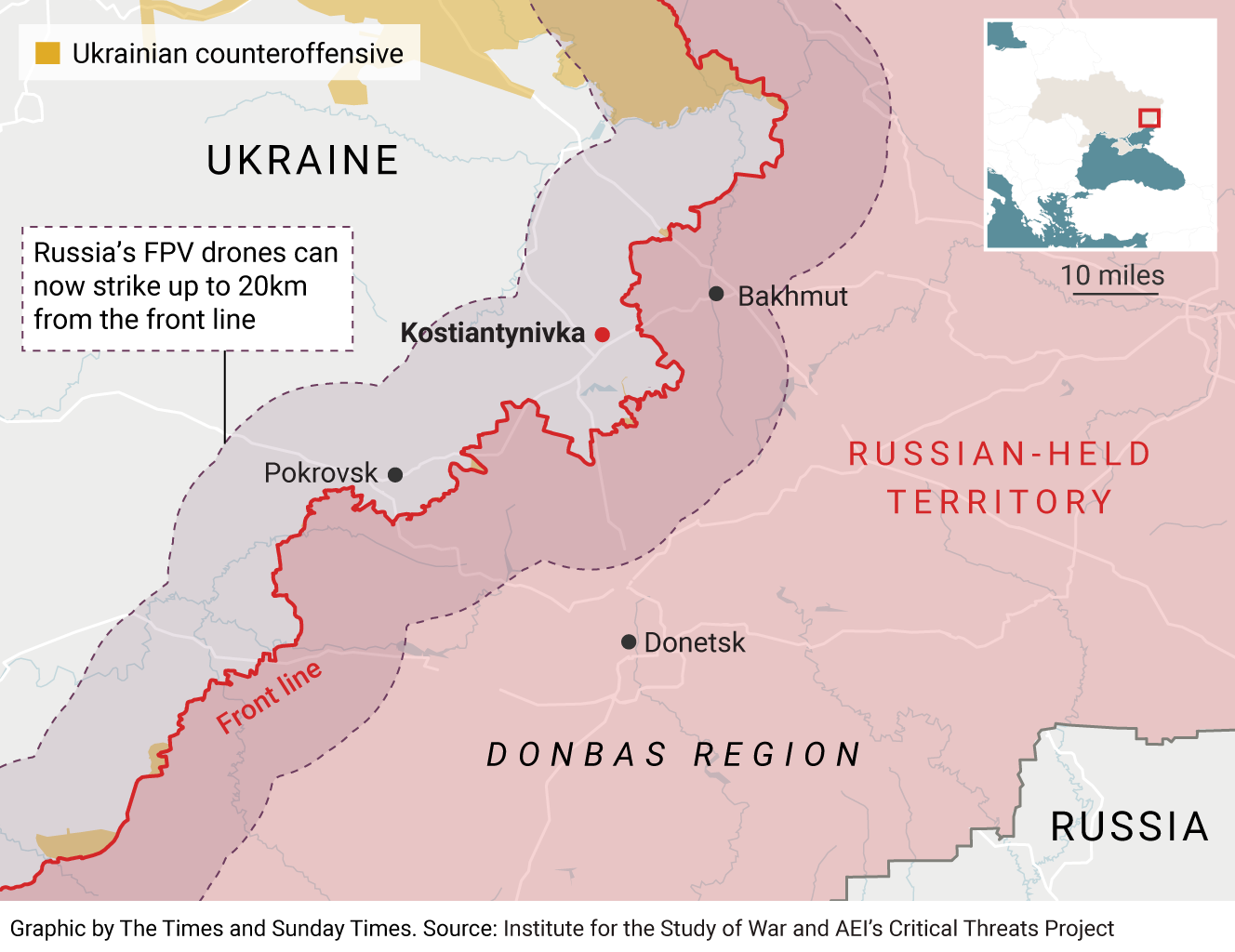
The Times piece is a first-person report of a visit to the assorted headquarters of Kiev’s 93rd Mechanised Brigade, in basements of abandoned buildings and homes throughout the Donetsk city of Kostiantynivka. It’s a devastating picture of the realities of war in the era of drones, which has “[altered] the physical make-up of the front line, the tactics of the war and the psychology of the soldiers fighting it,” while “having a devastating impact on Ukraine’s logistical ability.”

At one stage, The Times reporter was warned they were standing nine kilometres – 5.5 miles – from the nearest Russian position, and thus “well inside the kill range.” A Ukrainian soldier told them with a shrug, this was “now an easy range in which to die”:

“No other weapon type has changed the face of the war here so much or so fast as the FPV drone. Almost any vehicle within five kilometres of the front is as good as finished. Anything moving out to ten kilometres is in danger. Drone strikes at 15 or 20 km are not that unusual.”

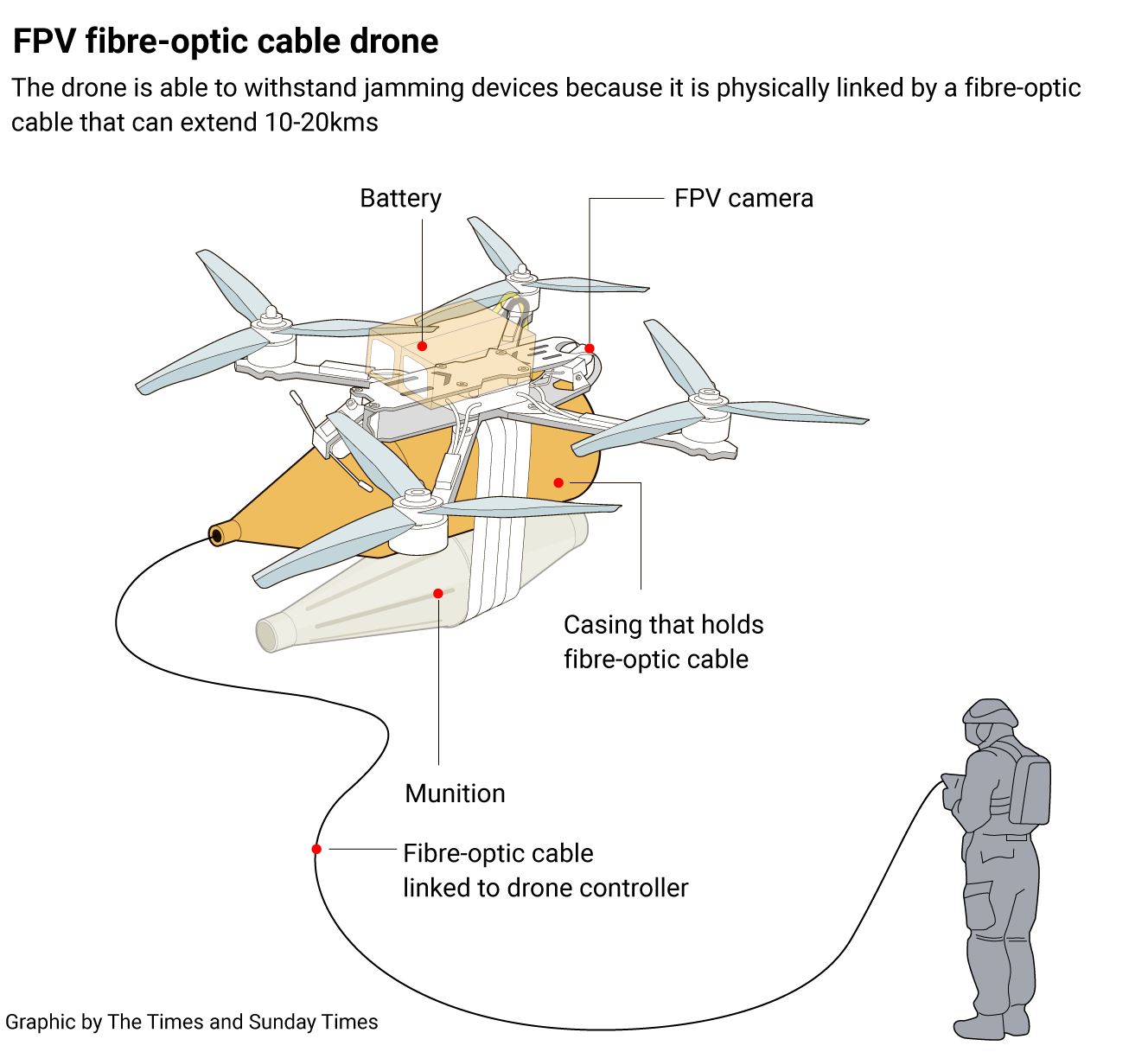
Since the proxy war erupted, both Ukraine and Russia have innovated in the field of FPV drones to an unprecedented degree. Kiev has become so reliant on drones, they are her “weapon of choice.” Yet, as The Times records, Russia has now decisively “taken the lead in the drone race, outproducing Kyiv in the manufacture and use of medium-range FPV drones and fibre optic variants that have changed the shape of the entire 1,200 km front line.”

Not only are FPVs “dramatically” striking ever-deeper into Ukrainian territory, but fibre optic FPV drones have gained “dark prominence over the killing fields.” While emulating the quadcopters equipped with munitions typically deployed by both sides previously, this “highly manoeuvrable killer drone” is connected directly to pilots by “a gossamer thin fibre optic thread.” This makes the contraptions difficult to track, and impervious to electronic jamming. A local infantry battalion commander told The Times:

“The changes posed by drones are so fast that concepts we implemented just a month ago no longer work now. We live in a space of perpetual fast adaptation. In the past week alone, Russian drone strike ranges have increased by four kilometres.”

These developments have sent Ukrainian forces scurrying en masse to regroup at regular, abrupt intervals ever-further away from the front line (also known as “zero point”), while logistical convoys to Kramatorsk – “long considered the bastion of Ukraine’s defence of the Donbas region” – have been repeatedly struck. One lieutenant recorded how Russian drones “swarm our armoured vehicles whenever they get near the zero point,” obliterating them and their crews. He believes drones represent such a world-changing military hazard, “the days of the tank are truly over.”

‘Danger Estimate’

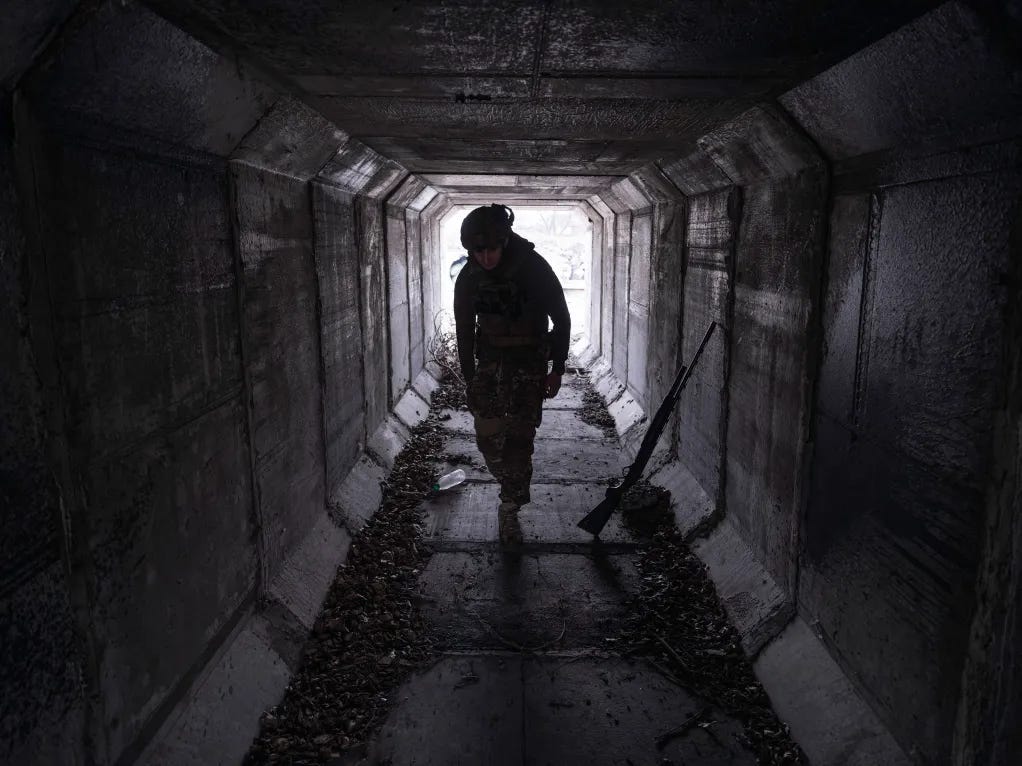
The “drone-filled skies” of Donbass are so deadly, getting soldiers and equipment to the ever-expanding frontline and back is not only a logistical and practical horror, but also a frequently suicidal task. The Times reports that until late 2023, Ukrainian infantrymen “were usually carried to a position near the front in armoured personnel carriers, walking the last few hundred metres on foot.” Today, they are dropped off up to eight kilometres away at night, walking “meandering routes through trees to avoid detection, just to take up their positions.”

Deployments to the frontline have also vastly extended in length. While at the start of 2024 Ukrainian soldiers spent “a week or two” at zero point, now they’re routinely trapped there for months at a time, “often devoid of almost any other human contact, resupplied with water, rations and ammunition by agricultural drones.” Resultantly too, “casualty evacuation has become a nightmare.” Wounded fighters are “commonly” rescued at night, and “even then the operation is fraught.” A senior logistician for the 93rd Brigade’s drone crews lamented:

“As a word ‘stressful’ doesn’t even come close to describing it. Every mission I think, ‘God forbid we get a casualty and have to work out how to get them back’.”

Ukrainian soldiers always keep shotguns close by, to attempt to blast attacking drones out of the sky

Each night too, the Brigade’s frontline drone crews are resupplied with batteries, drone frames and munitions. Logistics teams are dropped off up to seven kilometres from the frontline, then carry up to 36 kilograms of equipment forward on foot. The risk to these crews is “enormous”. One driver was quoted as saying he conducted three missions nightly, “and I never know if each one will be my last, if I’m going to make it there and back in one piece.”

The Times records how a logistics vehicle was recently struck by a Russian drone while returning from a resupply mission. The driver lost an arm, but there were so many drones buzzing nearby, he couldn’t be evacuated from the position for five hours, so bled to death. Five Ukrainian armoured vehicles were destroyed by drones in the same sector the next day. However, none of this is seeping out to the world via the mainstream media, which once published videos of Ukrainian strikes on Russia daily.

As The Times notes, drones have adversely affected a core component of Kiev’s war effort – “media communications”. The 93rd Brigade was once “renowned for allowing reporters good access to…the war from the front.” Now though, “access for journalists has been dramatically reduced,” with “many media organisations…reluctant to commit reporters into areas within 15 km of the front.” Ukrainian brigades are likewise “wary” of the risks “they expose their own troops to in taking journalists by vehicle to the front.”

The Times reports that in 2023, the 93rd Brigade’s press officer “organised hundreds of visits to the front by reporters.” The number of visitors has now “dwindled to a trickle”. Since the proxy war’s eruption, the psychological field of battle has been where Ukraine has performed most effectively, eagerly assisted in its propaganda efforts by a media apparatus reflexively reporting the fantastical claims of officials in Kiev and their Western proxy backers as fact. Now, those days are long over. The press officer complained:

“The risks get bigger and bigger, and the coverage gets less and less. We get a journalist’s request to go to the front now and we wonder how rational is it? What is the danger estimate? What is the benefit?”

‘Technological Adaptations’

The Times report is a vanishingly rare mainstream acknowledgement of how the conflict raging in Donbass is a war unlike any other in history, and its key spheres of battle are wholly uncharted territory for Western militaries. Despite this media omertà, the proxy conflict’s unparalleled operating environment, and obvious lessons, have not gone entirely unheeded in certain elite quarters. Nonetheless, despite alarm bells ringing accordingly, they are evidently falling on deaf ears in American and European centres of power.

In September 2024, Britain’s House of Lords International Relations and Defence Committee published a bombshell reportUkraine: a wake-up call. It found the proxy war had “exposed fundamental weaknesses” in the “military strength” of both Britain and NATO, concluding London was effectively defenceless, with its “small” military reliant on unaffordable “status symbols” such as non-functional aircraft carriers. The country lacks the ammunition, armour, equipment, industrial capacity, personnel and vehicles to withstand a Donbass-style conflict for more than a few weeks at absolute most.

Amidst relentless condemnation of the state of Britain’s armed forces, the report contained a dedicated section on how “the use of drones in Ukraine” had “exposed the sheer variety of possible drone threats in a conflict scenario, ranging from disposable and commercially available drones to high-end, sophisticated ones.” It noted the development has “inserted an extra layer of weaponry between the land and air domains”, while augmenting “existing capabilities that both sides have, particularly offering new defensive options in the absence of air superiority.”

https://www.youtube-nocookie.com/embed/lAgkXO6CI_c?rel=0&autoplay=0&showinfo=0&enablejsapi=0

As such, the House of Lords Committee called for London to “invest in research and development to maintain a strategic edge in drone technology (including amphibious drones), and support the rapid development of new technologies that can compete in contested environments.” It implored decisionmakers to constantly consider and monitor “the pace of technological adaptations on and off the battlefield,” and the Ministry of Defence “to support continuous adaptation,” such as “[incorporating] learning on the use of drones in Ukraine across all domains.”

The report went entirely unremarked upon by the media contemporaneously, and today there is no sign of its multiple urgent calls to action having produced any meaningful results in any tangible regard in Britain’s armed forces. Similarly, despite NATO officials openly warning the alliance is wholly dependent on US electronic warfare capabilities, which in any event are woefully inferior to Russia’s own, public indications of Western leaders or militaries taking the drone warfare revolution seriously are unforthcoming. Should they end up in direct conflict with Russia, they’ll be in for quite a shock.

Matt Stoller: Steve Bannon Calls for Nationalizing SpaceX

By Matt Stoller, Substack (BIG), 6/6/25

Welcome to BIG, a newsletter on the politics of monopoly power. If you’d like to sign up to receive issues over email, you can do so here.

I had planned to write something on the possible Google remedy, but the political world is riveted by the bitter feud that has broken out between the richest man in the world, Elon Musk, and the President, Donald Trump. Though the fight feels a bit like pro-wrestling and may not last long, the insults back and forth are mean-spirited and bitter, and were accompanied with threats.

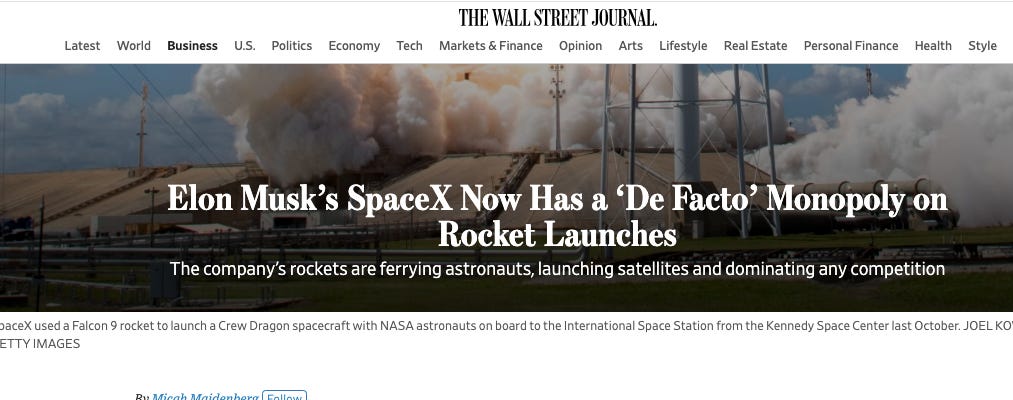
From a market power perspective, there is potential policy fallout, and that’s what interests me. Trump said he might cut Elon Musk’s government contracts, which are largely centered in his rocket company, SpaceX. That’s a big deal, because the company runs much of our space program. In the last quarter of 2023, SpaceX lifted up 90% of all pounds sent into orbit, which makes it a monopolist in launching satellites. It provides the only vehicle that astronauts have to get to and from the International Space Station.

There’s more. A big part of SpaceX is the communications satellite company Starlink, which has around two thirds of all satellites in space and has a dominant lead in its market, allowing people to get broadband internet with a small dish anywhere on the planet. Starlink is so important that it is a key geopolitical weapon. Musk has made the call to allow or disallow Ukraine from using Starlink terminals for different warfighting purposes, giving this individual sovereign-level powers.

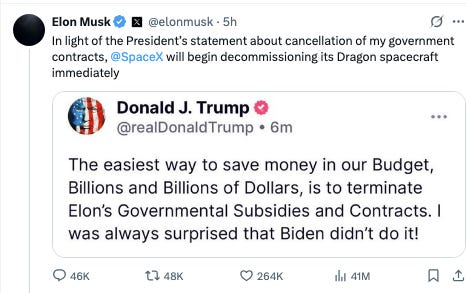
After Trump threatened Musk today, Musk responded by saying he would use his power to jeopardize U.S. interests.

It’s not clear if he was joking, but even a joke threat makes the point. Decommissioning the Dragon spacecraft would harm the International Space Station and hinder U.S. encrypted communications, some of which flow over Musk’s network.

One result of this fight is that Steve Bannon, a close advisor to Trump, has suggested that Trump use the Defense Production Act – a legacy law from mid-century that allows the government to use civilian industrial capacity for national security purposes – to take over SpaceX. Here’s the clip.

Bannon is correct in his argument. Something like launch capacity to space, especially when it’s a monopoly, or a vital communications network like Starlink, are too important to be controlled by one guy. And it’s government funded anyway, having received $22 billion in direct Federal monies, and more every year, with immense public support in the form of permissions to launch and knowledge built on top of the public space program.

Bannon’s argument isn’t just about seizing private power. It’s true that SpaceX’s rockets that bring satellites into space are reusable and efficient, and his company has won because its technology is better than rivals such as Blue Origin and Boeing. But there’s also a real monopolization problem. Here’s the New York Times discussing the company’s tactics a year ago:

The new generation of space entrepreneurs trying to emulate Mr. Musk is sufficiently concerned about what they see as his anticompetitive tactics that some of them are now willing to take him on publicly.

Tim Ellis started Relativity Space after being inspired by Mr. Musk’s pursuit of a rocket that could carry humans to Mars. Then he heard from other industry executives that individuals with ties to SpaceX were trying to block his efforts to raise money for his own Mars project.

Jim Cantrell worked with Mr. Musk at the founding of SpaceX in 2002. When he started to build his own launch company, Phantom Space, two potential customers told his sales team they could not sign deals because SpaceX inserts provisions in its contracts to discourage customers from using rivals.

Peter Beck, an aerospace engineer from New Zealand, met in 2019 with Mr. Musk to talk about Mr. Beck’s own launch company, called Rocket Lab. Several months later, SpaceX moved to start carrying small payloads at a discounted price that Mr. Beck and other industry executives said was intended to undercut their chances of success.

“I don’t think this is an accidental monopoly,” Mr. Beck said in an interview about SpaceX and Mr. Musk. “These are business decisions that are being made.”

Rivals allege two main tactics for the launch part of the monopoly. First, SpaceX allegedly charges below cost in certain contexts to prevent competitors from getting into the market. Second, the company inserts “right of first refusal” provisions with customers, meaning that it has the right to match competitors if they make a better offer. Both of these are classic moves of an aspiring monopolist. There are likely others tactics of course, rumors that Starlink gets better pricing from SpaceX launches than other rival satellites, which is self-preferencing. And there’s the sabotaging of funding rounds, plus the need for large amounts of capital and regulatory barriers to entry.

So there is a legitimate reason that the government has to use the Defense Production Act to take over SpaceX, since Musk is threatening to sabotage vital interests over a political spat. Normally, I’d support Bannon’s argument, and also call for an antitrust investigation and action, as that should have happened long ago. But this is the Trump era, and there’s a reason that didn’t happen

Talking about key national infrastructure in the context of two enormously powerful men calling each other pedophiles on Twitter is extremely weird. We’re in an oligarchy, and nothing screams that as much as this fight. And I will make an observation about how miserable it must be to work in this administration in a political capacity, because keeping your job and/or advancing means expressing zeal for cults of personality that can change at any moment.

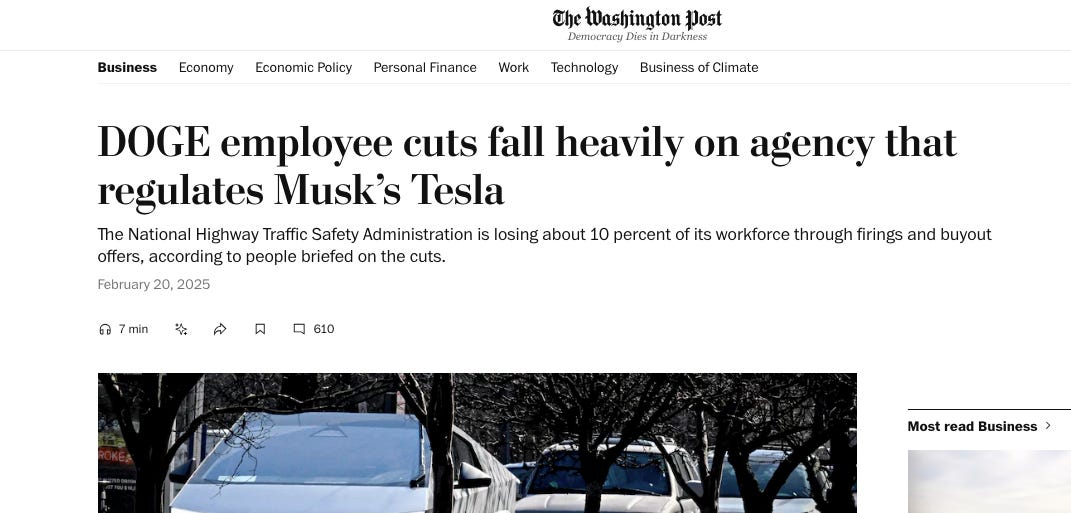
Musk’s politics are those of a standard Reagan libertarian – low corporate taxes, free trade with China, bad labor standards, lots of immigration – and he fits in well with the Republican establishment. But he’s both immensely wealthy, and he has a cult of personality almost as big as Trump. Before this fight, the cringe adoration for Musk among GOP officials was overwhelming. For instance, the FBI set up a task force to look at anti-Tesla vandalism, every agency investigating parts of Musk’s empire was dismantled, the FCC and Commerce Department redirected broadband subsidies to Starlink, and trade reps helped Musk’s broadband company get contracts in India, Somalia, the Democratic Republic of Congo, Bangladesh, Pakistan, Vietnam, and Lesotho, using the threat of tariffs as a lever. The State Department even tried to order $400 million of electric armored cars from Tesla, before being exposed and embarrassed.

I’m not making a corruption argument, though obviously the conflicts of interest here are insane. I’m making a slightly different point. For the last three years, and then increasingly since Trump took office, every Republican official with less than a billion dollar net worth has been bending over backwards to be as obsequious as possible to Musk. When told to jump they ask how high, they self-righteously attack and ferret out anyone who had anything to do with anything that might slightly annoy Musk. It’s little stuff, like this, which I’m guessing Musk didn’t ask for but some random Trump staffer thought might get him a promotion or a positive word from the boss.

Since they don’t know what they want in terms of a governing agenda, and they aren’t getting clear direction, Trump officials are just trying to please the most powerful cult of personality they see. They are acting out of feara constant sense of exhaustive social climbing.

And now, everything that these people have done, all the worshipping of DOGE and Musk, all the extra subsidies they’ve tried to slip Musk’s way, is that for nothing? Have the rules changed? Will they now be criticized for what they thought they were supposed to be doing?

That’s one of the problems with oligarchy. It really is arbitrary, and it sucks for everyone, not just those victimized by the vagaries, but even for those working for the oligarchs. That is one reason the rule of law matters and why institutional integrity is useful. Being at the utter whim of powerful men who can change their mind whenever, without consequence, well, it’s a terrible way to run a country. It took us a thousand years to develop democratic systems and get us away from this kind of arbitrary and capricious behavior. Hopefully we’ll start to remember what we have before we lose it.

In the meantime, yeah, we should treat SpaceX and Starlink like the public utilities they are. And if Trump really wanted to go after Musk, he’d send the Federal Trade Commission after SpaceX to look at some of its contracts and pricing choices. But we’re a ways from that, even if an enterprising state official might be able to do it.


Matt Taibbi: “The Quiet American” Has Never Been More Relevant

By Matt Taibbi, Substack, 5/26/25

In Chapter Two of The Quiet American narrator Thomas Fowler, like author Graham Greene a war-weary British journalist, watches in horror as young CIA agent Thomas Pyle orchestrates a disaster. Pyle has just arrived in Vietnam from Harvard and follows an anticommunist playbook in backing the dubious General Thé, who blows up a street full of women and children instead of soldiers:

“He said, ‘Thé wouldn’t have done this. I’m sure he wouldn’t. Somebody deceived him. The Communists…’

He was impregnably armoured by his good intentions and his ignorance. I left him standing in the square and went on up the rue Catinat to where the hideous pink Cathedral blocked the way.

The Quiet American, Graham Greene’s fifteenth novel, was published in 1955. The novel is equal parts epitaph for Britain’s empire, love story, battlefield diary, and spy thriller (a real-life MI6 agent, Greene wrote four or five of the best spy novels ever). What makes it so uncannily relevant to the present is his merciless dissection of Pyle and his “good intentions.” Perhaps without even intending it, Greene with his seething description of the meddling American “Economic Aid Mission” adviser published one of the first portraits of a figure destined to rule the world, the managerial expert.

A brilliant prose stylist whose extensive travels gave us exotic locales for novels set everywhere from the Caribbean to Africa to Asia to Central and South America, Greene in the first part of The Quiet American spends more time on sour grapes than politics. Fowler, Greene’s aging, opium-smoking English narrator, is in love with a 20-year-old Vietnamese beauty named Phuong (which, he says, “means Phoenix, but nothing nowadays… rises from its ashes”). With the prescience of all inadequate lovers, Fowler knew the virile-if-moronic, sober, hygiene-obsessed Pyle would spot Phuong and take Fowler’s place with her the way America was then taking Britain’s place everywhere. True, Pyle had no game at all, romancing Phuong with lectures on America and the promise of Democracy while his ideas about sex seemed to come from a book called The Physiology of Marriage. Still, Pyle had the one thing Fowler never would again: power, of both the political and sexual kind.

Fowler urges Phuong to get Pyle on the opium pipe to help even the odds, but probably knowing that will fail, tries to console himself with a truism. “A man’s sexual capacity might be injured by smoking,” Fowler writes, “but [the Vietnamese] would always prefer a faithful to a potent lover.” Of course it doesn’t turn out that way, especially once Pyle promises to marry Phuong, elevating Fowler’s resentment and desperation to new levels. Will he have to kill for love in the end?

Fowler’s portrait of Pyle starts out as a humdrum compound of jealousy and Oxonian snobbery — he hates Pyle because he’s a winner and his idea of a good book is The Advance of Red China — but in his callow Euro resentment discovers the real danger of America. Pyle is an overgrown schoolboy whose belief in American know-how and can-do spirit runs deeper and is more full of absurd religious certitude than the British royalists who circled the world murdering for King and country. Greene knew the executors of European colonialism were raised from university age to be rakes and buggerers who knew more poetry than policy, which created its own set of problems but at least immunized them from the most dangerous disease of all: moral confidence. “God save us always,” Fowler says, “from the innocent and good.”

Greene reportedly spent two years in Vietnam beginning in 1951 and parts of several others before publishing in the mid-fifties. The Quiet American predicted twenty years of mayhem, death, and cultural upheaval and in 1975, when it was “all over but the writing,” American Herbert Mitgang went looking for Greene’s inspiration in what was still Saigon. He spoke to retired General Edward Lansdale, a longtime intelligence presence and “adviser on matters of pacification” who was rumored to be Greene’s model for Pyle. “I used to see Greene sitting around the Rue Catinat,” Lansdale said. “I had the feeling that Greene was anti‐American.”

He was right about that. Americans in Greene’s novels are universally savaged as blundering nitwits, from The Presidential Candidate in The Comedians who thinks he can end Haitian violence through vegetarianism to the CIA man in Travels With My Aunt who records how much time he spends urinating per day in a journal. Greene served in MI6 as a deputy under infamous double-agent Kim Philby, and like Philby, flirted with Communism in youth, and repeatedly rationalized Philby’s treason late in life. “Who among us has not committed treason to something or someone more important than a country?” he wrote, in an introduction to Philby’s memoir. Greene even wrote an unnervingly convincing novel (The Human Factor) about a British official so repulsed by America’s alliance with South African apartheid that he spied for the Russians.

In hindsight, even if Greene hated Americans for other reasons, he may have been giving the USAID-style managerial expert too much credit for “good intentions.” Nonetheless, The Quiet American nailed a new kind of world conqueror, one bursting with what Iggy Pop called “plans for everyone,” while simultaneously being too ignorant of everything outside of his American head — language, customs, local personalities — to competently run anything. Because this new character also lacked any capacity for self-doubt, he never knew when to withdraw and doubled down until he found himself blowing up women and children for the “greater good.” Maybe it’s coincidence, but we’ve never had more to fear from the Pyles of the world.

Scott Ritter: Announcing a US-Russia Citizen’s Summit

By Scott Ritter, Substack, 6/6/25

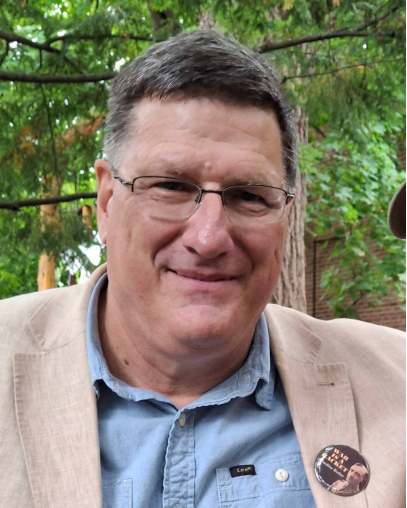
Scott Ritter is a a Writer, Historian, Geopolitical analyst, Arms control specialist, and Military expert.

We live in dangerous times. Now is the time for the people of the United States and Russia to set the example of how civil discourse and dialogue can pave the way for peace between our two nations.

On June 18, 2025, Americans and Russians from all walks of life will come together to engage in an act of “people’s diplomacy.” Whether seated in a theater in beautiful Saint Petersburg, or in the historic Mohican Hotel in downtown Kingston, New York, the participants will be doing what we collectively can only hope our respective leadership will do—engage their citizen counterparts in constructive dialogue which seeks to better relations between their two nations.

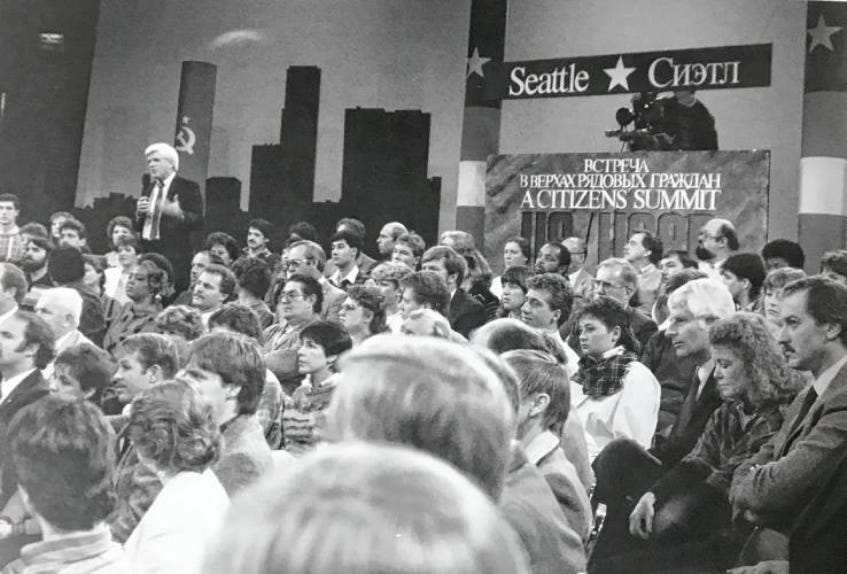
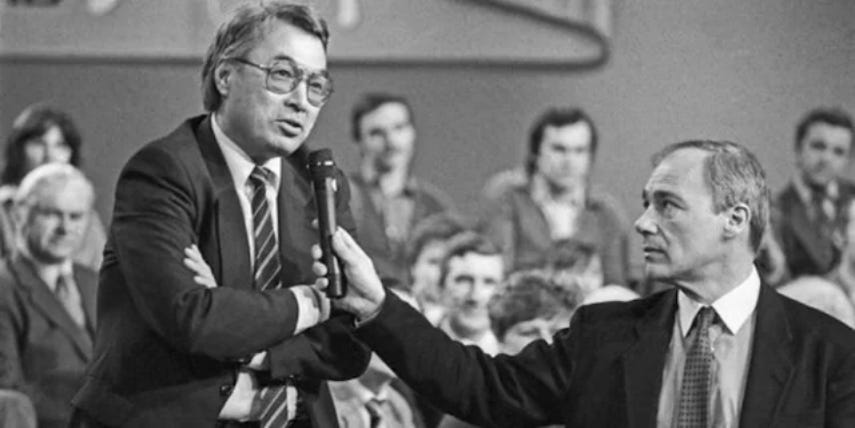
The 2025 Space Bridge/Citizen’s Summit takes place on the 40th anniversary of the historic, groundbreaking 1985 “Leningrad-Seattle” Citizen’s Summit organized by two legendary journalists, Phil Donahue of the United States and Vladimir Pozner of the Soviet Union. The 1985 Space Bridge became the gold standard for citizen-to-citizen diplomacy, setting in motion numerous follow-on Citizen’s Summits that helped both nations navigate the troubled waters of the Cold War toward a path that led toward peaceful coexistence.

Scott will discuss this article and answer audience questions on Ep. 269 of Ask the Inspector.

Like its 1985 predecessor, the 2025 Citizen’s Summit seeks to strengthen the dialogue between the civil society of our two countries and promote the idea of “people’s diplomacy” – open dialogue, exchange of experience and establishment of cultural ties.

The Space Bridge aims to serve as a bridge between cultures, generations, and nations. The program will combine live discussions, cultural exchanges, historical reflection, and a forward-looking perspective. The main goal is to demonstrate that, despite differences, people can find common ground and understand each other.

Phil Donahue moderates the Seattle end of the 1985 Citizen’s Summit

The goals of the 2025 US-Russia Citizen’s Summit for Peace are as follows:

• Strengthen mutual understanding between Russian and American citizens.

• Demonstrate that, despite disagreements, people can find common language.

• Create a positive news story amid tense international relations.

By creating a space for an open dialogue where participants can discuss any topical and pressing issues, including those related to social, economic and cultural interaction, we can deepen understanding between Americans and Russians.

The Citizen’s Summit provides participants with the opportunity to share successful practices in democracy, civic participation and the protection of human rights, while assisting in the dissemination of cultural and educational initiatives that contribute to the strengthening of friendship between peoples.

Vladimir Posner moderates the Leningrad end of the 1985 Citizen’s Summit

The summit will also assist in the dissemination of cultural and educational initiatives that contribute to the strengthening of friendship between peoples, and in the process, help identify possible follow-on joint initiatives and projects involving the participants that can have a positive impact on the lives of citizens of both countries. The Citizen’s Summit will be more than just a dialogue between Americans and Russians—it will be a shared experience, one that hopefully expands beyond the respective forums in Saint Petersburg and Kingston, and resonates to every corner of both the United States and Russia, empowering all who witness it to join in on this joint venture to prove to ourselves and our leaders that, if given the chance, our two peoples can choose peace over war, prosperity over sanctions, and cooperation over confrontation.

The Hosts of the 2025 Spacebridge/Russia-USA Citizens Summit

Pavel Balobanov (Saint Petersburg)

My civic mission is to show the world the real Russia—not the version portrayed by Western media, but a nation defined by innovation and hospitality.

I am proud to be a Russian citizen, to drive innovation within our country by developing and bringing to market Russian products and services sought after both domestically and internationally, and of course, to lead this project.

I hope for a sincere dialogue between Russian and American citizens—essential for true progress—that unfolds not through the lens of media, but face to face. Like my fellow Russians, I have many questions for U.S. citizens, and I’m deeply curious to hear their responses.

Scott Ritter (Kingston)

In 1985, when the first Space Bridge took place, I was serving in the US Marines, preparing for a possible war with the Soviet Union. I viewed the dialogue between Americans and Russians with some interest, since it humanized people I had only previously viewed as my enemy.

Three years later I was able to participate in my own personal Space Bridge. I had been assigned to the Russian city of Votkinsk, where I served as an inspector implementing the INF Treaty. Over the course of two years, I had many conversations with the citizens of Votkinsk, after which I vowed never again to view the Russian people as my enemy.

I have traveled to Russia twice in the past two years, continuing the conversations I began more than 37 years ago. I watch as my country once again seeks to view Russia and its people as enemies of America and Americans. I am struck by the importance of simple dialogue among people as the key to building friendship between nations. I am proud to be able to help facilitate such dialogue today, as part of this project.

The Venue

The Mohican Market, Kingston, New York

The Mohican was originally a market and bakery located in Uptown Kingston’s historic Stockade District. Established in 1880, the Mohican moved to its current address in 1930. For decades it was a popular place for the citizens of Kingston to do their shopping.

The Mohican is surrounded by American history—across the street is the courthouse where John Jay, the first Supreme Court Justice of the United States, wrote the Constitution of New York State—a document which went on to comprise some 70% of the US Constitution. The New York Constitution was written in the summer of 1777, when the Uptown Stockade District served as the first capital of New York State. British troops occupied Kingston on October 3, 1777, and burned the city to the ground as punishment for providing succor and haven for the revolutionaries.

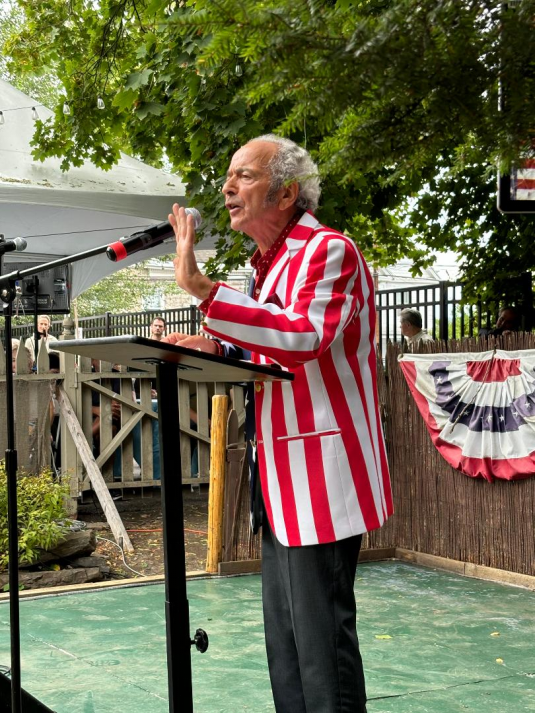
As Kingston fell into hard times in the 1980’s, businesses in the Uptown Stockade District shuttered their windows. The Mohican was not immune to these economic difficulties and was abandoned like many other old establishments. In 2002 the Mohican property was purchased by Gerald Celente, the Founder/Director of the Trends Research Institute and Publisher of the Trends Journal. Today the Mohican serves as the headquarters of the Trends Research Institute, and the home of Gerald’s annual “Occupy Peace and Freedom” rally.

Gerald Celente speaking at the 2024 Occupy Peace and Freedom Rally

The Mohican serves as the perfect venue for introducing a Russian audience to the real America—the country that exists in the vast space that separates Los Angeles, California and New York City. For the purposes of the 2025 Citizen’s Summit, the Mohican will be transformed into an idyllic slice of Americana, a café where the participants can enjoy some food and drinks while being entertained with live music in the lead-up to the event.

The interior of the Mohican Market

The Event

The 2025 Citizen’s Summit will be streamed live in both Russia and the United States. For the American audience, the event will be broadcast using Gerald Celente’s YouTube channel (@gcelente). We are planning to link in audiences from the so-called “Family of Podcasts” that have collaborated in the past on events such as this; more information about how one can watch the 2025 Citizen’s Summit will be published in the days leading up to the event.

The number of people who will be in the live audience is, because of the intimate nature of the Mohican venue, capped at 50 participants. We are looking for a diverse mix of participants who would be interested in asking questions to their Russian counterparts about life in Russia and answering questions from their Russian counterparts about life in the United States.

If you live in the vicinity of Kingston, and would like to attend, please send an email to Scott Ritter.

Include your name, age, gender, background/experience, and a brief paragraph on what you hope to accomplish by participating in the Citizen’s Summit. If you are selected, you will be sent a ticket to the email address from which you submitted your request.

You will need this ticket to get into the venue.

The doors will open at 12 noon, and there will be a buffet for food and a bar for refreshments. A band will be playing in the background. Take the opportunity to mingle and get to know your fellow attendees—you’ll be making history together!

Everyone should be seated and ready to go at 2 pm sharp, when the event begins. The Citizen’s Summit will last three hours and will include several cultural interludes where Russian and American musicians and singers will perform.

And for the next three hours your hosts will guide you through an interactive experience that hasn’t been seen in 40 years—a genuine Citizen’s Summit where Americans and Russians can get to know each other through dialogue and conversation.

The event is free of charge, including the buffet and non-alcoholic drinks.

However, nothing in this life is free, and donations are welcome to help offset the costs associated with pulling off an event of this scope and scale (a donation button is located at the bottom of this page.)

To those of you who will watch the 2025 Citizen’s Summit via the live stream, know you will be joining a community of millions who will be sharing this experience.

And for those of you who will be participating as audience members in this interactive adventure, soak in every minute, because you will be making history.

In any event, I look forward to seeing you all in Kingston, either in person or online, on June 18 for this historic event—the 2025 US-Russian Citizen’s Summit!