Kit Klarenberg: Ukraine’s Corporate Carve-Up Collapses?

By Kit Klarenberg, Substack, 7/14/25

All my investigations are free to read, thanks to the enormous generosity of my readers. Independent journalism nonetheless requires investment, so if you value this article or any others, please consider sharing, or even becoming a paid subscriber. Your support is always gratefully received, and will never be forgotten. To buy me a coffee or two, please click this link.

On July 5thBloomberg reported that a BlackRock-administered multibillion-dollar fund for Kiev’s reconstruction, due to be unveiled at a dedicated Ukraine Recovery Conference in Rome July 10th/11th, had been placed on hold at the start of 2025 “due to a lack of interest” among institutional, private, and state financiers. The summit is over, lack of investor enthusiasm persists, and “the project’s future is now uncertain.” It’s just the latest confirmation the West’s long-running mission to carve up Ukraine for profit verges on total disintegration.

BlackRock’s Ukraine Development Fund has been in the works since May 2023. It was originally envisaged as one of the most ambitious public-private finance collaborations in history, which would rival Washington’s Marshall Plan that rebuilt – and heavily indebted – Western Europe in World War II’s wake. With vast returns promised, initially investors were reportedly “ready to plow funds” into the endeavour, due to widespread optimism Kiev’s much-hyped “counteroffensive” later that year “might end the war quickly.”

In the event, the counteroffensive was an unmitigated disaster. Ukraine suffered up to 100,000 casualties, with much of its arsenal of Western-supplied armour, vehicles and weapons obliterated, in return for recapturing just 0.25% of the territory occupied by Russia in the proxy war’s initial phases. As BlackRock vice chair Philipp Hildebrand explained, the results killed off investor exuberance, as they required “the cessation of hostilities, or at the very least a perspective for peace.” Concerns about Ukraine’s ever-reducing skilled workforce were also widespread.

Fast forward to today, and there is no indication of any peace deal on the horizon, Russia is rapidly advancing across multiple fronts, and the Ukrainian government estimates the country has lost around 40% of its working-age population due to the proxy war. No wonder BlackRock’s Development Fund has failed to attract a single dollar. Quite what will remain of Ukraine when the conflict is over, and whether any financial returns can be gleaned from its ruins, are open, grave questions.
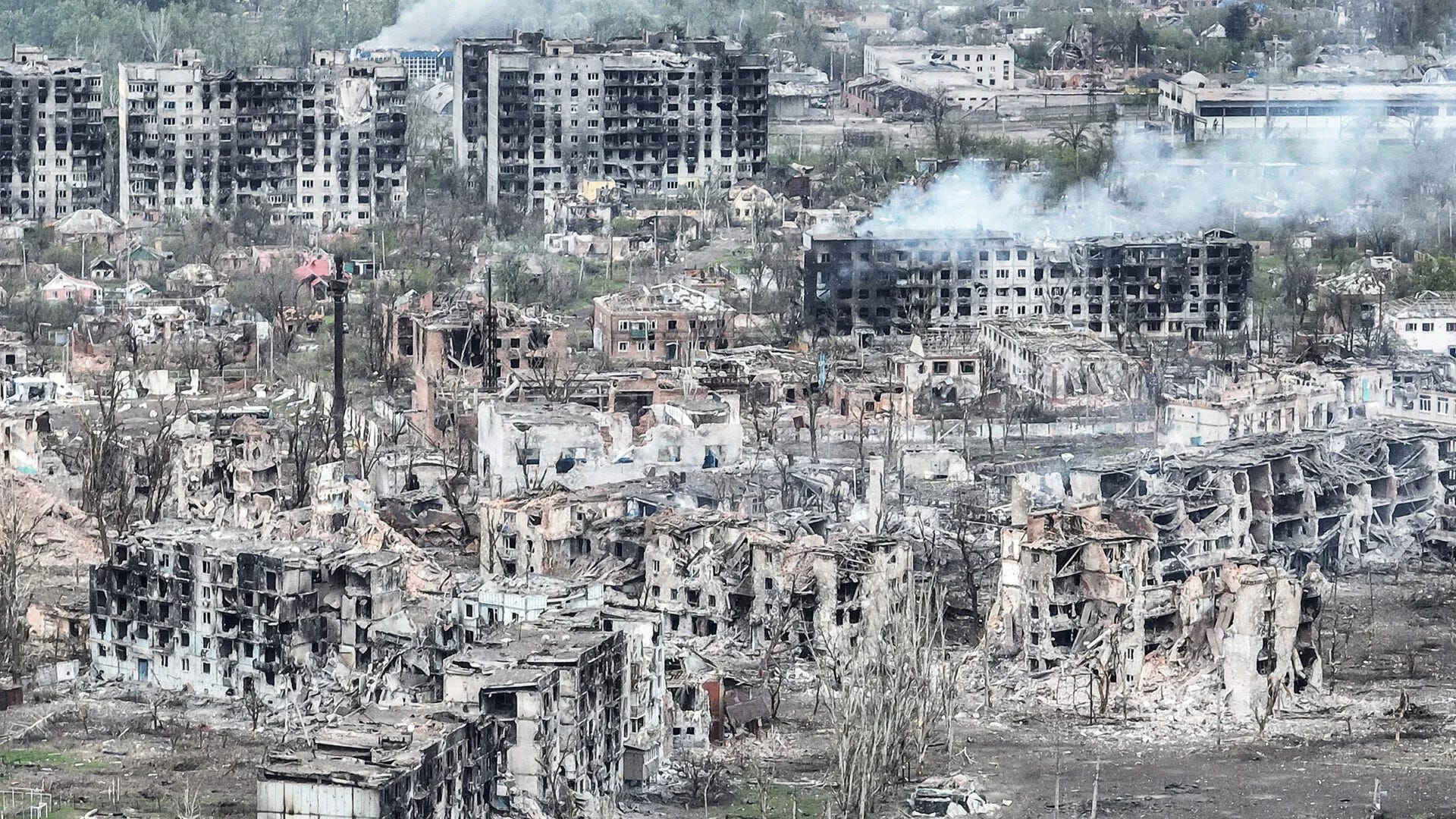
The remnants of Bakhmut

The collapse of BlackRock’s Ukraine Development Fund is not only a microcosm of the impending, inevitable defeat of Kiev and its overseas puppetmasters in Donbass. It also reflects the death of the dream of breaking apart Ukraine’s industries and resources to untrammelled rape and pillage, long-held by Western corporations, oligarchs, and governments. Planning for this eventuality dates back to the country’s 1991 independence, producing concrete results following the 2014 Western-orchestrated Maidan coup, and becoming turbocharged once all-out proxy war erupted in February 2022.

‘Investment Climate’

From the start of 2013, Western corporations began moving en masse to buy up Ukraine wholesale. It was widely expected Kiev would that year enter into an “association agreement” with the EU, facilitating privatisation, and tearing up of longstanding laws restricting foreign purchase and ownership of the country’s untold agricultural riches. The former “breadbasket of the Soviet Union” is home to the equivalent of one third of the EU’s total arable land, and projected profits were voluminous.

That January, Anglo-Dutch MI6-linked energy giant Shell signed a 50-year deal with the Ukrainian government to explore and drill for natural gas via fracking in areas of Donetsk and Kharkov “believed to hold substantial natural gas.” Then, in May, notorious, now-defunct chemical giant Monsanto announced plans to invest $140 million in constructing a corn seed plant in the country’s agricultural heartlands. The company was a founding member of the US-Ukraine Business Council, established in October 1995 to “improve” Kiev’s “investment climate.”

USUBC’s treasurer was and remains David Kramer, who during Maidan also served as president of Freedom House, a National Endowment for Democracy division. NED was avowedly founded by the CIA to do publicly what the Agency historically did publicly. The Endowment and Freedom House were responsible for Ukraine’s 2004 “Orange Revolution”, which brought pro-Western puppet Viktor Yushchenko to power. He immediately implemented deeply unpopular neoliberal economic reforms, including slashing regulations and social spending. Yushchenko was voted out in 2010, securing just 5% of the vote. 

Following Ukrainian President Viktor Yanukovych’s rejection of the EU association agreement in favour of a more advantageous deal offered by Russia in November 2013, the mass Maidan protests in Kiev were ignited by NED-affiliated actors, and fascist agitators. They raged until late February 2014, when Yanukovych fled the country. In the intervening time, Ukraine was plunged into total chaos – yet, firms associated with USUBC weren’t deterred. Many, including major companies with representatives on the organisation’s executive committee, continued making sizeable investments in Ukraine throughout.

Their undimmed enthusiasm may be explained by David Kramer being an alumni of Project for the New American Century, a neoconservative think tank widely credited with masterminding the Bush administration’s “War on Terror”. The organisation’s cofounder Robert Kagan is married to Victoria Nuland, at this time the State Department’s point person on Ukraine. She visited Kiev repeatedly during the Maidan “revolution”, and hand-picked Yanukovych’s replacement interim government. Nuland was thus well-placed to know USUBC member investments in Ukraine would be safe long-term.

‘Trade Opportunities’

Nuland’s fascist interim government was replaced in June 2014 by an administration led by far-right Petro Poroshenko, who stood on an explicit platform of privatising state industries. The President passed legislation enabling this in March 2016. Two years later, his government adopted sweeping laws to further facilitate the auctioning off of Kiev’s public assets and industry to foreign actors. However, a moratorium on private sale of arable land, imposed in 2001, remained in place. No matter – in August 2018, the European Court of Human Rights ruled this was illegal.

There was still one problem, though. Opinion polls consistently showed Ukrainian citizens overwhelmingly rejected privatisation, and the sale of their country’s agricultural land to overseas buyers. As luck would have it, the proxy war’s eruption, and imposition of martial law, allowed for industrial scale trampling by Volodomyr Zelensky’s government over public opinion, and political opposition. Throughout 2022, a series of controversial laws intended to “make privatization as easy as possible for foreign investors” were passed without hindrance.

In the process, close to 1,000 nationalised enterprises were offered up for overseas sale, and auctions for purchase of these entities “under simplified terms” convened. The next year, these efforts intensified, with further legislation enacted enabling “large-scale privatisation of state assets and state companies.” This was reportedly motivated by “the attractiveness” of Ukraine’s “large state assets to institutional investors.” They included an Odessa-based ammonia factory, major mining and chemical firms, one of the country’s leading power generators, and a producer of high-quality titanium products.

Encouraged by the West’s reception to these moves, in July 2024 Kiev announced a dedicated “Large-Scale Privatisation” plan, with yet more prize assets under the hammer. Little wonder two months later, a British Foreign Office briefing document openly acknowledged it viewed “the invasion not only as a crisis, but also as an opportunity.” London’s primary economic aid project in Ukraine is explicitly concerned with ensuring the country “adopts and implements economic reforms that create a more inclusive economy, enhancing trade opportunities with the UK.”

The objectives of Britain’s “Good Governance Fund” in Ukraine

The previous January, the World Economic Forum’s annual congress was convened in Davos, Switzerland. The proxy war, and Kiev’s economic future, loomed large on the event’s agenda. Its centrepiece was a breakout breakfast attended by political leaders and business bigwigs, where Zelensky appeared via videolink. The President thanked “giants of the international financial and investment world,” including BlackRock, Goldman Sachs, and JP Morgan, for buying up his country’s assets during wartime. He boldly promised, “everyone can become a big business by working with Ukraine.”

Subsequently, BlackRock CEO Larry Fink pledged to coordinate billions of dollars in reconstruction financing for Kiev, forecasting the country would become a “beacon of capitalism” resultantly. Meanwhile, Goldman Sachs chief David Solomon spoke with intense optimism about Kiev’s post-war future, and the gains his firm and other major Western financial institutions would reap. “There is no question that as you rebuild, there will be good economic incentives for real return and real investment,” he crowed.

Zelensky spoke at multiple events held in Davos over the five-day-long conference’s course, where pro-Kiev sentiment was reportedly “overwhelming”. The President spoke of recapturing Crimea, and demanded attendees “give us your weapons.” His audiences were invariably highly receptive. On one panel, Boris Johnson, who personally sabotaged fruitful peace talks between Kiev and Moscow in April 2022, urged Zelensky be provided “the tools he needs to finish the job.” The disgraced former British Prime Minister boomed, “Give them the tanks! There’s absolutely nothing to be lost!”
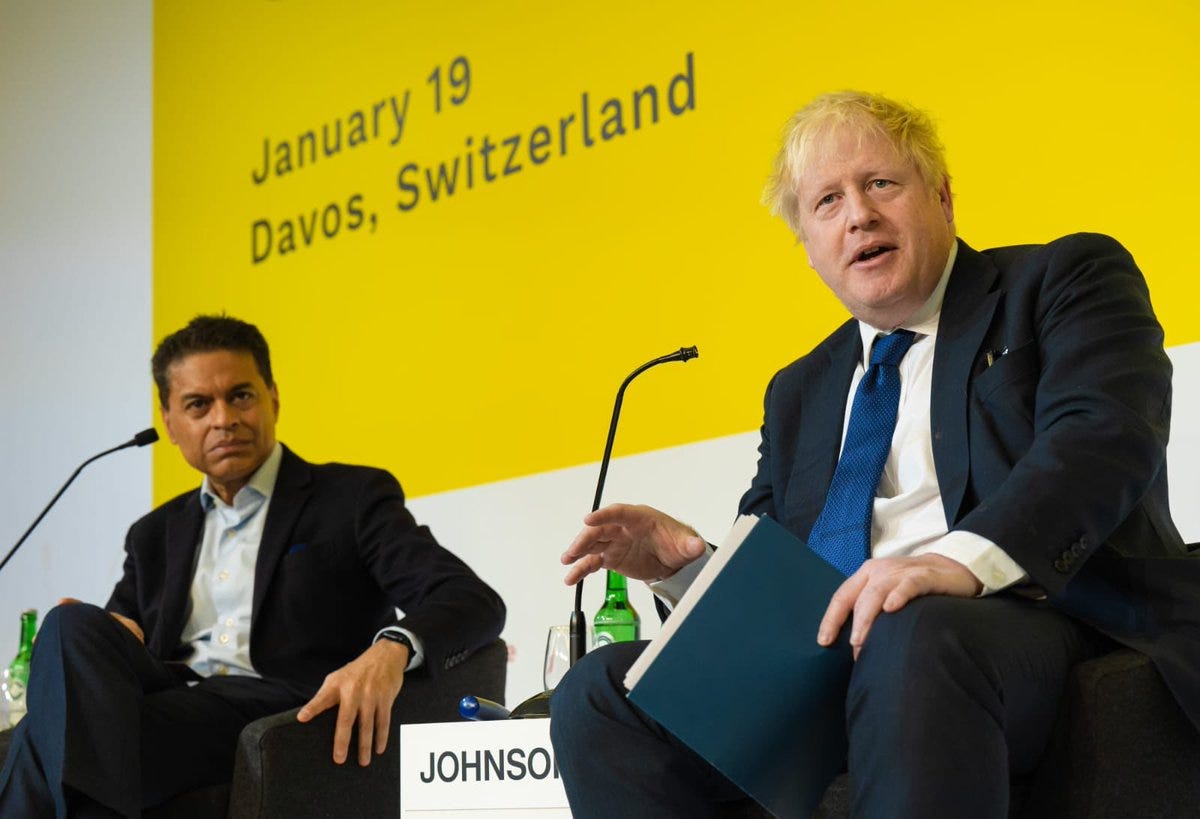
In years to come, the January 2023 Davos summit may be viewed both as the high point of Ukraine’s proxy war effort, and roughly when everything began to spectacularly unravel. The desired weapons arrived in huge quantities, to no effect. Kiev’s three biggest military efforts since, all British-planned – that year’s counteroffensive, the Krynky incursion, and Kursk “counterinvasion” – were deeply costly cataclysms, leaving Ukraine undermanned and ill-equipped to fend off Russian advances. Countries that supplied munitions borderline disarmed themselves in the process.

The Ukraine Recovery Conference passed without much media interest, despite a literal red carpet being rolled out for Zelensky, and multiple senior EU officials – including Ursula von der Leyen – and European state leaders attending. It ended with vague commitments to drum up €10 billion in private sector investments for Ukraine. Evidently, Western ambitions of making a mint out of Kiev haven’t been fully jettisoned – even if the World Bank calculates the total cost of rebuilding the country to be $524 billion.

In a speech, von der Leyen pledged to support Ukraine “militarily, financially, and politically” for “as long as it takes.” Meanwhile, there is little indication that Britain has given up on making Kiev safe for neoliberalism and its own profit, despite London’s covert commitment to “keeping Ukraine fighting at all costs.” Of course, the longer the lost proxy war grinds on, the less Ukraine there will be to rebuild, and reap returns from. But apparently, this unambiguous reality is lost on the proxy war’s sponsors. God help us all.


The Dissenter: FBI Spied On Journalists And Activists Who Organized ‘Russiagate And WikiLeaks’ Panel

By Chip Gibbons, The Dissenter, 7/22/25

The following article was originally published by Defending Rights and Dissent.

On the weekend of June 1, 2018, activists, academics, and writers gathered at John Jay College of Criminal Justice for the annual Left Forum conference. With roots in the Socialists Scholars Conference, Left Forum was regularly one of the largest gatherings of the U.S. left. The crowd of over a thousand people ranged from members of small, socialist sects hawking newspapers to academics presenting their latest scholarship. That year, Defending Rights & Dissent convened a panel on “Defending Dissent in the Age of Trump.” Also attending Left Forum that year, we can now report, were multiple Special Agents with the Federal Bureau of Investigation, including FBI Unit Chief Andrew Thomas Mitchell.

The agents were there to attend a panel entitled “Russiagate and WikiLeaks.” The panel was organized by Randy Credico, a comedian and activist who hosted the radio programs “Live on the Fly” and “Assange Countdown to Freedom.” Other panelists included Dennis Bernstein, host of KPFK’s Flashpoints; Max Blumenthal, founder of the Grayzone; Anya Parampil, at the time with RT; and Ray McGovern, a former CIA analyst turned peace activist. According to the copy of the Left Forum program retained by the FBI, Mark Crispin Miller, a professor of Media, Culture, and Communication at New York University, was supposed to speak as well. Defending Rights & Dissent reviewed a recording of the panel and Miller did not participate. 

The revelation that FBI agents surveilled the panel of journalists and activists stem from documents the FBI turned over to Defending Rights & Dissent as part of ongoing litigation under the Freedom of Information Act. The two-page document is an “FD-302,” a report used by FBI agents to document investigatory activity. These reports are most typically used to memorialize interviews.https://embed.documentcloud.org/documents/26018095-fbi-fd-302-left-forum-russiagate-and-wikileaks/?embed=1

Since September 2024, Defending Rights & Dissent has been suing the FBI in order to compel them to turn over their files on WikiLeaks and its founder Julian Assange. Although the FD-302 is not labeled by investigation, all other files in the document set are part of the investigation titled “Roger J. Stone, Jr.; Foreign Agents Registration Act; Sensitive Investigative Matter.” 

Although the caption of the investigation mentions the Foreign Agent Registration Act, the opening communication makes clear that Stone was being investigated “in connection with his activities related to the unauthorized access of computer data belonging to the Democratic National Committee (DNC) and the unauthorized transmittal and disclosure of the data to persons not entitled to see it.” The FBI was investigating Stone’s prior knowledge of publications internal DNC emails by WikiLeaks and whether he had been in contact with Guccifier 2.0, a hacking group the U.S. government claims was a front for Russian intelligence.  

Other documents make clear Stone is being investigated under the Computer Fraud and Abuse Act, as well as conspiracy and aiding and abetting statutes. There is no mention of Stone being an unregistered foreign agent. Ultimately, Stone was not charged under any of these statutes but instead was charged with obstruction of justice, making false statements to the FBI, and witness tampering. He was convicted in November 2019 but pardoned by Donald Trump the following year. The investigation was opened as a counterintelligence matter on July 25, 2017. Files obtained by Defending Rights & Dissent show that Peter Strzok, then Deputy Assistant Director of the FBI’s Counterintelligence Division, approved the investigation.https://embed.documentcloud.org/documents/26018100-roger-stone-investigation-opening-communication/?embed=1&title=1

Credico, who hosted the Left Forum panel, was accused of being Stone’s “back channel” to WikiLeaks. Credio was subpoenaed both by the House Intelligence Committee and by Special Counsel Robert Mueller. Under oath during Stone’s trial, Credico denied being a back channel. The comedian and radio host referenced the subpoena from the House Intelligence Committee during the panel discussion. He also said, “Stop giving [Roger Stone] any credibility. Just leave him out. Stop. He loves it. He’s eating it up. He had nothing to do with it at all. He insinuated himself into the story because he’s an egomaniac and Trump had dumped him and he wanted to get back in. So he went fishing. He came to me and I blew him off a bunch of times.”

Assuming this connection was what led FBI agents to attend the Left Forum panel, it is difficult to see any legitimate investigatory value to their actions. The two-page investigative report is mostly redacted, including what the agents made of the discussion. Unredacted text in the second paragraph reads, “The small classroom was packed with observers including people standing in the back, sitting on the floor, and peering in through the door. The panel lasted approximately 1 hour and 50 minutes. At the conclusion of the panel, [redacted].” The second page of the report appears to indicate that an unspecified individual was interviewed. It is unclear if the redacted text deals with the interview, a report of the panelists’ remarks, something else, or some combination thereof.

Defending Rights & Dissent reached out to panel organizer Randy Credico. He informed us that on that same day at Left Forum, he also performed a comedy set. After the set, “a young man and woman, who were dressed like Disney tourists, came up to me as I was walking alone and told me how much they loved the show.” As Credico was walking away, they revealed themselves to be FBI agents. After speaking with the agents for “a minute,” Credico put them on the phone with his attorney who made arrangements to speak with them at another date. It is likely this is the “interview” referenced in the FD-302.  

If the FBI’s goal was to interview Credico, why the FBI felt the need to attend both a panel of journalists and activists and comedy show before approaching him is unclear. The FBI’s actions in this case are chilling from the standpoint of First Amendment rights. Left Forum was a political conference, held at a college campus. By attending the panel, the FBI learned no information of utility to a criminal investigation into violations of the Computer Fraud and Abuse Act. But they did observe political speech. 

Although there are serious First Amendment implications to allowing the FBI to secretly attend a political panel, the Attorney General guidelines for FBI investigations considers information learned from observing an event open to the public to be “public information.” For decades, Defending Rights & Dissent and other civil libertarians warned the loose rules for attending public events opens the door to allowing the FBI to spy on First Amendment-protected activity. The files received in response to the Defending Rights & Dissent lawsuit are yet another documentation of their abusive nature.

Although the FBI spoke with Credico for about a minute before making arrangements with his lawyer, they sat through an entire panel during which speakers shared their dissenting views on U.S.-Russia relations and the Russiagate investigations. Panelists rejected the official explanation that the Democratic National Committee had been hacked by Russians or that there was collusion between the Trump campaign and Russia. Many of their remarks were openly critical of the FBI, with McGovern criticizing Strzok by name. McGovern also stated that his criticism of Russiagate led people to believe he was pro-Trump, but he wasn’t. “Trump is the worst president of the United States ever had,” the former CIA analyst said. “But if you don’t have enough reason to get rid of him on all these other things, including the fact that my grandchildren, nine of them will not have clean air to breathe or clean water to drink when they’re my age, if you can’t get rid of this guy without a phony set up here like Russiagate then you know there’s no hope for you.” Other panelists echoed concerns that by focusing on Russiagate as opposed to other issues like the economy, Democrats were ineffective at resisting Trump. Bernstein criticized the disparate coverage between Russigate and the U.S.-backed Saudi war in Yemen, noting the country was on the brink of famine. 

Bernstein also criticized Rachel Maddow, noting that when it came to Russigate, “no minutiae escapes her.” “She loves Russiagate right. And she loves the collusion story. She loves that word collusion. Collusion and the Trump administration. Well, there was collusion,” the Flashpoints host said. “The collusion was between the emerging Trump administration and the Israelis to suppress a pro-Palestinian vote at the United Nations. That’s what we miss with this kind of horrific reporting.”

Ironically, Blumenthal warned that Russiagate would become a form of McCarthyism used against the left – a remark later confirmed by the presence of the FBI at the panel. At the end of the discussion, Credico asked each panelist to explain why WikiLeaks and Julian Assange are important. 

On top of the panelists’ remarks, audience members also made political comments during the question and answer session, unaware the FBI was quite literally watching and listening to them. All of this First Amendment-protected speech is unrelated to any legitimate law enforcement purpose. But it is precisely the type of speech the FBI has surveilled in the past. Having any government agent present and listening in on a political discussion has a chilling impact. That the FBI is a joint law enforcement and national security agency with a long history of spying on the First Amendment only compounds the chilling impact. 

Defending Rights & Dissent’s lawsuit against the FBI for their files on WikiLeaks and Julian Assange is ongoing.

Your taxes, their bombs

The Lever, 7/22/25

Funding the forever wars. Congressional Republicans have, as usual, turned must-pass legislation that will fund annual military policy into a defense industry bonanza. The latest version of the National Defense Authorization Act that advanced in the House last week authorizes $848 billion in spending for the U.S. military, much of which will be funneled (with additional revenue from Trump’s megabill) straight to private defense contractors. Other beneficiaries also include the business and foreign interests represented by the pro-Israel lobbying powerhouse AIPAC, which issued a wishlist of legislative items earlier this year, nearly all of which are now included in the defense bill.

The Israel lobby cashes in. AIPAC spent more than $100 million on the 2024 federal elections, setting a campaign spending record. Nearly two-thirds of Congress have accepted AIPAC money, ensuring a united bipartisan front in support of Israel even as the country wages what many experts have definitively concluded is a genocide in Gaza. Now, AIPAC-funded lawmakers appear to be happily rubber-stamping the organization’s defense requests, which will funnel more money to the Israel Defense Forces.

Investing in genocide tech. Lawmakers, with AIPAC’s backing, introduced the “United States-Israel Defense Partnership Act of 2025,” legislation in February to authorize hundreds of millions in spending on various partnerships between the Israeli and U.S. militaries. That includes $150 million for a new joint technology program between the U.S. and Israel to counter drone weapons; it also entails extending the so-called “Future of Warfare” program for another five years, at $50 million annually, to develop “emerging technologies” like artificial intelligence. 

  • Last year, an investigation by the Israeli magazine +972 revealed that the Israeli military was using AI to generate bombing targets, contributing to the immense civilian death toll of the Gaza war.

Money talks. Most of the key defense provisions that AIPAC supported in a policy brief this year and lobbied for throughout the spring are now included in both the House and Senate draft versions of the new defense bill, having survived committee markups. AIPAC has spent nearly $1 million lobbying on the bill, among other legislative priorities, in the first quarter of 2025. 

  • The lead sponsors of the U.S.-Israel Defense Partnership Act have received millions from AIPAC and its affiliated network of pro-Israel donors: Rep. Josh Gottheimer (D-N.J.), has accepted more than $1.5 million from AIPAC and its network of donors over his congressional career, while Rep. Donald Norcross (D-N.J.), counts AIPAC as his top campaign donor.

Reporting contributed by Katya Schwenk and Luke Goldstein.

BREAKING – Trump “Fed Up” w/Putin: NEW DEADLINE 10-12 Days – Col. Daniel Davis

YouTube link here.

One point Davis makes in his analysis is to speculate on why Trump is saying things that don’t make any sense. He wonders if it might be the product of a cognitive problem with Trump. Personally, I don’t think it’s necessarily a product of a cognitive problem, I think it’s a product of Trump’s compulsive bullshitting, especially to cover up his incompetence. – Natylie