Moscow Times: So You Want to Travel to Russia. Here’s What You Should Know.

Moscow Times, 7/16/25

Tourism from the West to Russia took a major hit after the 2022 invasion of Ukraine. Flight bans, banking restrictions and a range of logistical hurdles, as well as overall geopolitical tensions, have made travel more complicated and less appealing for many Western visitors. Even so, thousands of people from countries in Europe and North America still visit Russia each year, alongside growing numbers of tourists from Asia and the Middle East.

If you’re thinking about making the trip, The Moscow Times has put together a list of things you should know before you go.

Is it safe to go?

Whether or not it’s advisable to travel to Russia depends largely on whom you ask. Since the start of the full-scale invasion, most Western governments have strongly advised their citizens against traveling to Russia and have urged those already there to leave immediately. 

The U.S. State Department, for example, cites a range of safety concerns, including “arbitrary enforcement of local laws” and “the risk of harassment or wrongful detention by Russian security officials,” in its guidance for Americans. Similar advisories have been issued by countries including Canada, Britain, France and Germany.

In contrast, countries like China, Brazil and India do not issue comparable warnings. However, even countries generally seen as Russia-friendly, such as Serbia and Hungary, advise their citizens to exercise increased caution when visiting. Their foreign ministries stop short of recommending against all travel to Russia but do caution against visiting areas deemed to pose “high security risks,” likely referring to regions near the Ukrainian border that are regularly targeted by drone attacks.

If you’re considering travel to Russia, it’s essential to first consult your own government’s travel advisories so you can make an informed decision about whether a trip is right for you. While Russia is by and large not an active warzone, parts of the country, particularly in the south and west, experience regular drone and missile strikes that have killed or injured people even far from the front lines. The overall risk in places like Moscow and St. Petersburg remains relatively low, but it is not completely absent.

Getting a visa

Visa requirements for travel to Russia vary depending on your citizenship. The most reliable source of information is your local Russian consulate or embassy, where you can find the most up-to-date guidance on how to apply. 

Citizens of some countries, including many in the European Union, are eligible for a short-term electronic visa for tourism. Others may not require a visa at all. For U.S. citizens, the application process remains largely unchanged, according to recent travelers who spoke to The Moscow Times. In some cases, wait times may even be shorter due to reduced demand for Russian visas in Western countries.

Traveling to Russia

The easiest and most commonly recommended way to travel to Russia today is by flying through countries such as Turkey or the United Arab Emirates, with onward connections to other major cities from Moscow or St. Petersburg. Due to airport closures that have been in place since early 2022, most airports in southern Russia remain inaccessible.

Traveling by land, such as taking a bus from Estonia or Lithuania to the Kaliningrad region and flying to mainland Russia from there, is possible and often cheaper. However, this option comes with additional challenges, including more extensive security screenings at the border as well as restrictions on bringing euro banknotes into Russia.

Among Moscow’s airports, Sheremetyevo is generally considered the most straightforward for international travelers compared to Domodedovo. Pulkovo Airport in St. Petersburg is also widely recommended. Travelers who spoke to The Moscow Times said security checks at Sheremetyevo and Pulkovo are usually less intensive than at Domodedovo, where longer waits and more frequent questioning have been reported. That said, security checks at Sheremetyevo can still take a few hours.

Interviews by border officers can appear random. Some travelers report being questioned nearly every time they cross the border, while others say they have never been questioned. Questions may include the purpose of your visit, your place of stay, your occupation and whether you have traveled to Ukraine.

Border officials also have the authority to request access to your mobile phone. While only a few travelers reported this happening, it is strongly advised not to carry sensitive information or any content related to Ukraine on your phone. Though you have the right to refuse access to your device, doing so could result in being denied entry into the country.

Bringing money into Russia

Since spring 2022, Visa and Mastercard bank cards issued outside of Russia no longer function within the country. Chinese UnionPay cards issued by foreign banks, meanwhile, are still accepted in Russia. For short-term stays, the simplest and most reliable way to bring money into Russia is by carrying cash.

However, travelers should be aware of several important restrictions. The European Union has banned the transportation of euro banknotes into Russia via EU borders as part of sanctions introduced after the invasion of Ukraine. This means that if you’re entering Russia from an EU country, you cannot carry euro cash across the border. That restriction does not apply if you’re entering from a non-EU country, such as Turkey or the United Arab Emirates, as Russia itself does not prohibit the import of euros. Regardless of currency, travelers are allowed to bring up to $10,000 (or equivalent) in cash without having to declare it.

For those planning a longer stay, opening a local bank account is recommended. Depositing your cash into a Russian account can make everyday transactions easier, as card and electronic payments are becoming more ubiquitous.

Exchanging foreign currency in major cities is generally straightforward, and some exchange offices offer competitive rates, travelers told The Moscow Times. However, it is crucial to bring only clean, undamaged banknotes, they said. Russian banks and exchange offices often refuse old, marked or torn bills. 

Mobile phone service

Accessing mobile phone service in Russia has become significantly more complicated for foreign nationals. As of July 2025, new regulations require foreigners who wish to sign mobile phone contracts to register with the Unified Biometric System (UBS), a government-run database that collects biometric data.

To do so, foreign citizens must visit a Sberbank branch to submit their biometrics, which include a facial photo and a voice recording. They are also required to obtain a SNILS (the Russian equivalent of a U.S. Social Security number), register on the Gosuslugi public services portal and provide the IMEI number of their mobile device.

To apply for a SNILS, foreigners must visit a branch of the Moi Dokumenti government services office (also known as a “Multifunctional Center”). After submitting the necessary documents and biometrics, and once the SNILS is issued — a process that typically takes several days — foreigners can then visit a mobile service provider to buy a SIM card and phone plan.

This process is lengthy and impractical for short-term visitors. As an alternative, travelers can purchase eSIMs from international providers such as eSIM.sm, although it’s possible that Russian authorities may restrict some of these services in the future. Another option is to check whether your existing mobile provider offers roaming in Russia, though this is often expensive. One Italian traveler told The Moscow Times that his provider recently offered 15GB of data and limited calling in Russia for 30 euros per month.

Accommodation and registration

Western platforms like Airbnb and Booking.com are no longer available in Russia. Russia has its own alternatives for short-term hotel and apartment bookings, with Ostrovok.ru and Sutochno.ru being the most widely used. Travelers can also book directly through hotels, hostels or other types of accommodations. Some hotels allow you to pay in cash on arrival.

As before, if you are staying at a hotel, the staff will handle your mandatory registration with the authorities, so no additional steps are needed. However, if you are staying at a private address for several days, you will need to register yourself at a local branch of Moi Dokumenti. 

VPNs

The Russian government has blocked scores of websites and online platforms in recent years, including Instagram and Facebook, making it impossible to access them without a VPN. While many VPN services do still work in Russia, major providers have been blocked, so lesser-known VPNs can often be more reliable. However, the availability of VPNs is constantly changing, so it’s important to consult up-to-date sources online before choosing one.

Travelers are advised to download and set up their VPN before entering Russia, as access to VPN websites may also be restricted once inside the country.
Kit Klarenberg: Case closed after ‘Russian disinfo’ claims led to persecution of NZ journalist

By Kit Klarenberg, The Grayzone, 7/13/25

Journalist Mick Hall was accused of slipping “Russian disinformation” into copy at New Zealand’s state broadcaster, sparking an international furor about Kremlin infiltration. Following an intel agency investigation, his name was cleared.

Now, Hall tells The Grayzone how a simple copy editing dispute brought him into Five Eyes’ crosshairs.

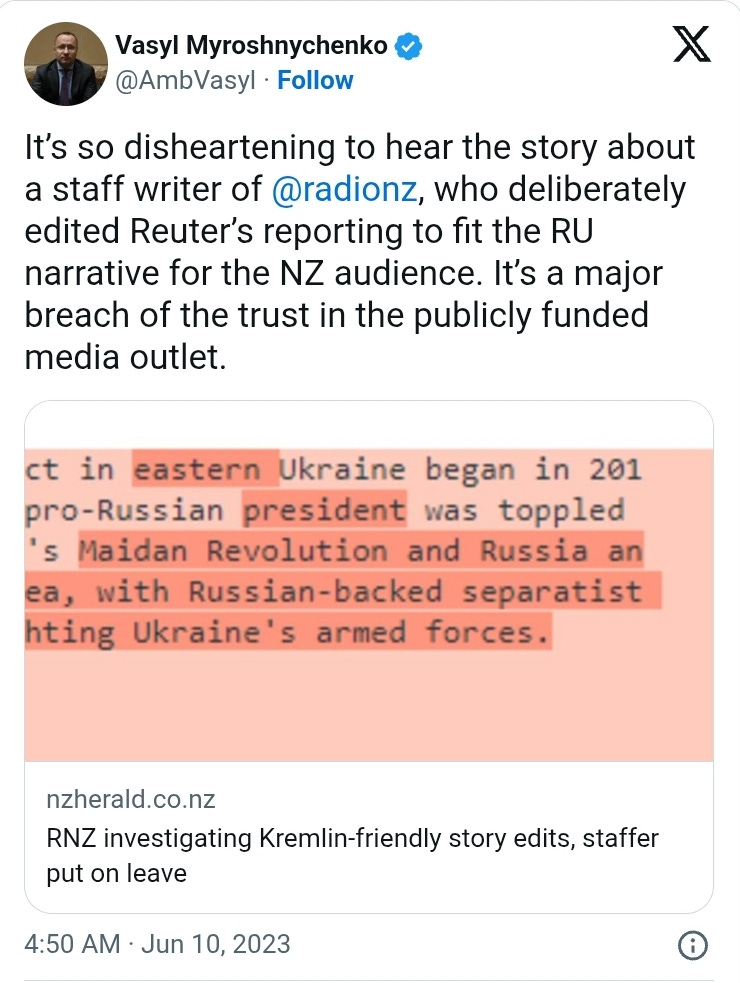
Until two years ago, Mick Hall was a fairly obscure journalist publishing wire copy for Radio New Zealand (RNZ), far-removed from media capitals like Washington and London where international opinions are shaped. But in June 2023, Hall suddenly became the target of Five Eyes intelligence agencies when he was accused by Western sources – including his own employer – of inserting “Russian disinformation” into wire stories.

What started with a dispute of Hall’s copy edits turned into an investigation by New Zealand’s Inspector General of Intelligence and Security (NZSIS), which briefed top government officials about its probe. For months afterward, major Western media outlets fretted that Kremlin agents had infiltrated New Zealand’s national broadcaster.

But Hall insisted he had been unfairly accused and defamed by a pro-war element driven into the throes of paranoia by the Ukraine proxy war. In November 2024, he lodged a formal complaint against the NZSIS, demanding to know whether Wellington’s primary intelligence service “acted lawfully and properly” and followed “correct procedure” in its investigation, and if any information gathered about him “was shared appropriately, including with overseas partners.”

On April 9, New Zealand’s Inspector General of Intelligence and Security (NZSIS) published the results of the investigation triggered by Hall’s complaint. The Inspector General report noted its investigation lasted between June 10 and August 11 2023, and was closed due to “no concerns of foreign interference” being identified.

The Inspector General acknowledged the intelligence services’ probe was initiated purely due to public “allegations [emphasis added] of foreign interference,” rather than substantive evidence of any kind, and expressed sympathy that Hall found it “disconcerting to discover” he had “come to the attention of an intelligence agency…particularly as a journalist reporting on conflicts where different views can validly be expressed.” However, it concluded NZSIS’ actions were “necessary and proportionate”, and the agency acted “lawful [sic] and properly.”

Hall’s name had been cleared, but he had been denied any recompense for being smeared as a Kremlin agent, and having his career in national media effectively destroyed.

An ounce of truth

The manufactured scandal surrounding Mick Hall’s copy edits trace back to New York City, where a lawyer and Democratic party hack named Luppe B. Luppen erupted in outrage at something he happened across on RNZ’s website.

In a Twitter/X post, Luppen complained that RNZ had republished a Reuters article authored by the news agency’s Moscow bureau chief Guy Faulconbridge, with “utterly false, Russian propaganda” inserted. Namely, that the February 2014 Maidan “revolution” was in fact a “violent” US-sponsored “colour revolution,” provoking a civil war in eastern and southern Ukraine, during which local “ethnic Russians” were “suppressed.”

Mick Hall was responsible for inserting this wording.

He told The Grayzone, “it always seemed odd to me a New York-based lawyer would come across a republished Reuters story on a small national broadcaster’s website in the South Pacific – I’ve not read too much into it, but it felt strange at the time, and still does.” Nonetheless, Hall believed his changes were legitimate given the story’s content, and stands by his decision to this day.

Since joining RNZ in September 2018 as a “digital journalist” and subeditor, he was responsible for selecting and processing news stories from international news agencies and wire services for republication on the broadcaster’s website. Hall frequently found that copy by the BBC, Reuters, and other prominent Western news services contained extraordinary bias and distortions. He felt compelled to balance the coverage by adding context, or amending and deleting passages which seemed overtly ideological.

When the Ukraine proxy war erupted in February 2022, Hall sensed that Western news agencies were not even attempting to conceal their biases any longer.

Manufactured crisis boomerangs on RNZ

On June 9th 2023, RNZ placed Hall on leave and announced an urgent investigation into his supposedly Kremlin-influenced editing. By this point, the foundations of an international scandal had been laid. For months afterwards, “disinformation experts”, think tank hawks, mainstream ‘journalists’ and politicians whipped up a paranoid, conspiratorial frenzy over Hall’s edits. The BBC, IndependentNew York Times and Reuters cranked up the controversy with blanket coverage. The Guardian’s obsessively anti-Russian Luke Harding took a particularly keen interest.

Olga Lautman, a Ukrainian nationalist from arms industry-funded think tank CEPA, strongly suggested that Hall was taking orders from the Russian state to insert “disinformation” into RNZ’s output. This libelous conjecture was not helped by RNZ chief Paul Thompson offering a servile public apology, in which he begged for forgiveness for “pro-Kremlin garbage…[ending] up in our stories.” An internal audit identified “inappropriate” edits made by Hall in 49 stories, out of 1,319 he worked on for RNZ in total – exactly 3.71%.

At his lawyer’s suggestion, Hall produced a detailed document listing every story he edited that had been flagged by RNZ for supposedly “inappropriate” tampering. He included personal explanations for why changes were made and passages inserted, along with expert supporting commentary from figures such as economist Jeffrey Sachs and political scientist John Mearsheimer. However, Hall gave up after just 39 stories. “The reasons RNZ flagged the remaining 10 – such as referring to Julian Assange a journalist – were so ridiculous, it seemed a waste of time,” he explained.

RNZ subsequently appointed an independent panel to assess the fiasco. In a bitter irony, the report they published on July 28 2023 was a rebuke to Hall’s accusers. It declared that “not all of the examples of inappropriate editing identified by RNZ were found by the panel to be inappropriate.” Moreover, the panel accepted Hall “genuinely believed he was acting appropriately,” and “was not motivated by any desire to introduce misinformation, disinformation or propaganda.”

While the report accused Hall of several cases of “inappropriate editing,” breaching both RNZ’s editorial policy and its contractual agreement with Reuters, the panel did not conclude this was deliberate, but a well-intentioned effort to add “balance and accuracy into the stories.” Moreover, the edits flagged by the panel as “inappropriate” were usually factual, and contained valuable historical context. For example, Hall amended a May 2022 story about the attempted evacuation of Mariupol to note that Azov Battalion “was widely regarded before the Russian invasion by Western media as a Neo-Nazi military unit.”

That Azov’s extremist background, history and ideology has been obfuscated and whitewashed since the proxy war began is a basic statement of fact. The panel even acknowledged the group’s neo-Nazi links had “been noted, reported on and debated” previously, but bizarrely found Hall’s “uncritical and unexplained inclusion” of this inconvenient truth “had the effect of unbalancing the story.” This was despite the panel admitting, “experienced people operating in good faith can and do disagree” on editorial standards, which are in any event “matters for judgment”.

Conversely, the review was extremely scathing of how Hall’s “errors were framed” by RNZ’s leadership. Their conduct was found to have “contributed to public alarm and reputational damage which the panel believes was not helpful in maintaining public trust.” It furthermore concluded “the wider structure, culture, systems and processes that facilitated what occurred” were the state broadcaster’s responsibility. Grave “gaps” in supervision and training of RNZ’s “busy, poorly resourced digital news team” were identified. For example, “limitations on changing content” from newswires weren’t clearly communicated to staff.

An “intense Western-wide witch hunt over a single person amending newswire copy”

For Hall, many questions about the affair linger today – not least how the Inspector General reached his conclusions. The report states, “much of the information my inquiry has considered is highly classified, which limits the information I can provide you to explain my findings.” It is difficult to conceive what “highly classified” information NZSIS “considered” given the public nature of the allegations against Hall. What’s more, both the independent review panel and NZSIS cleared him of any wrongdoing within two months of the first accusations.

Similarly curious was the vague language which filled the three-page report. For example, it claimed that NZSIS had taken “relatively limited steps” in investigating Hall. Yet it failed to clarify which steps were taken. Confusing matters even further, the Inspector General admitted “NZSIS shared information about the conclusion of its enquiries with interested parties… to allay concerns of foreign interference.” The identity of those “interested parties,” and why it was NZSIS’ responsibility to ameliorate their baseless anxieties, was also unclear.

“We’ll likely never know the answer to any of these mysteries. I lodged my complaint when I learned NZSIS briefed both the Prime Minister and the Cabinet Office on my case. I also have grounds to believe at least one of Wellington’s Western intelligence partners was given information on me,” Hall tells The Grayzone.

“This was a simple matter of minor procedural errors on my part, and disagreement over editorial standards with RNZ’s management, which could’ve been quietly and professionally resolved internally. Instead, I was thrust into the glare of the international media and the Five Eyes global spying network. The intense Western-wide witch hunt over a single person amending newswire copy at a tiny news outlet could indicate there was some kind of deeper, darker coordination at play. Again though, we’ll probably never know.”

William Hartung: The Military-Industrial Complex Is Riding High

By William Hartung, Antiwar.com, 7/2/25

Originally published at TomDispatch.

The Senate is on the verge of passing the distinctly misnamed “big beautiful bill.” It is, in fact, one of the ugliest pieces of legislation to come out of Congress in living memory. The version that passed the House recently would cut $1.7 trillion, mostly in domestic spending, while providing the top 5% of taxpayers with roughly $1.5 trillion in tax breaks.

Over the next few years, the same bill will add another $150 billion to a Pentagon budget already soaring towards a record $1 trillion. In short, as of now, in the battle between welfare and warfare, the militarists are carrying the day.

Pentagon Pork and the People It Harms

The bill, passed by the House of Representatives and at present under consideration in the Senate, would allocate tens of billions of dollars to pursue President Trump’s cherished but hopeless Golden Dome project, which Laura Grego of the Union of Concerned Scientists has described as “a fantasy.” She explained exactly why the Golden Dome, which would supposedly protect the United States against nuclear attack, is a pipe dream:

“Over the last 60 years, the United States has spent more than $350 billion on efforts to develop a defense against nuclear-armed ICBMs [intercontinental ballistic missiles]. This effort has been plagued by false starts and failures, and none have yet been demonstrated to be effective against a real-world threat… Missile defenses are not a useful or long-term strategy for keeping the U.S. safe from nuclear weapons.”

The bill also includes billions more for shipbuilding, heavy new investments in artillery and ammunition, and funding for next-generation combat aircraft like the F-47.

Oh, and after all of those weapons programs get their staggering cut of that future Pentagon budget, somewhere way down at the bottom of that list is a line item for improving the quality of life for active-duty military personnel. But the share aimed at the well-being of soldiers, sailors, and airmen (and women) is less than 6% of the $150 billion that Congress is now poised to add to that department’s already humongous budget. And that’s true despite the way Pentagon budget hawks invariably claim that the enormous sums they routinely plan on shoveling into it — and the overflowing coffers of the contractors it funds — are “for the troops.”

Much of the funding in the bill will flow into the districts of key members of Congress (to their considerable political benefit). For example, the Golden Dome project will send billions of dollars to companies based in Huntsville, Alabama, which calls itself “Rocket City” because of the dense network of outfits there working on both offensive missiles and missile defense systems. And that, of course, is music to the ears of Representative Mike Rogers (R-AL), the current chair of the House Armed Services Committee, who just happens to come from Alabama.

The shipbuilding funds will help prop up arms makers like HII Corporation (formerly Huntington Ingalls), which runs a shipyard in Pascagoula, Mississippi, the home state of Senate Armed Services Committee chair Roger Wicker (R-Miss).  The funds will also find their way to shipyards in MaineConnecticut, and Virginia.

Those funds will benefit the co-chairs of the House Shipbuilding Caucus, Representative Joe Courtney (D-CT) and Representative Rob Wittman (R-VA). Connecticut hosts General Dynamics’ Electric Boat plant, which makes submarines that carry ballistic missiles, while Virginia is home to HII Corporation’s Newport News Shipbuilding facility, which makes both aircraft carriers and attack submarines.

The Golden Dome missile defense project, on which President Trump has promised to spend $175 billion over the next three years, will benefit contractors big and small. Those include companies like Boeing, Lockheed Martin, and Raytheon (now RTX) that build current generation missile defense systems, as well as emerging military tech firms like Elon Musk’s Space X and Palmer Luckey’s Anduril, both of which are rumored to have a shot at playing a leading role in the development of the new anti-missile system.

And just in case you thought this country was only planning to invest in defense against a nuclear strike, a sharp upsurge in spending on new nuclear warheads under the auspices of the Department of Energy’s National Nuclear Security Agency (NNSA) has been proposed for fiscal year 2026. Thirty billion dollars, to be exact, which would represent a 58% hike from the prior year’s budget. Meanwhile, within that agency, nonproliferation, cleanup, and renewable energy programs are set to face significant cuts, leaving 80% of NNSA’s proposed funding to be spent on — yes! — nuclear weapons alone. Those funds will flow to companies like Honeywell, Bechtel, Jacobs Engineering, and Fluor that help run nuclear labs and nuclear production sites, as well as educational institutions like the University of Tennessee, Texas A&M, and the University of California at Berkeley, which help manage nuclear weapons labs or nuclear production sites.

Weakening the Social Safety Net — and America

And while weapons contractors will gorge on a huge new infusion of cash, military personnel, past and present, are clearly going to be neglected. As a start, the Veterans Administration is on the block for deep cuts, including possible layoffs of up to 80,000 employees — a move that would undoubtedly slow down the processing of benefits for those who have served in America’s past wars. Research on ailments that disproportionately impact veterans will also be cut, which should be considered an outrage.

Meanwhile, hundreds of thousands of veterans from this country’s disastrous wars in Afghanistan and Iraq will continue to suffer from physical and psychological wounds, including traumatic brain injuries (TBI) and post-traumatic stress disorder (PTSD). Cutting research that might find more effective solutions to such problems should be considered a national disgrace. In the meantime, active-duty personnel who are getting a tiny fraction of the potential Pentagon add-on of $150 billion are similarly in need.

Worse yet, turn away from the Pentagon for a moment, and the cuts in the rest of that “big beautiful bill” will likely have an impact on a majority of Americans — Democrats, independents, and MAGA Republicans alike.  Their full effects may not be felt for months until the spending reductions contained in it start hitting home. However, enacting policies that take food off people’s tables and deny them medical care will not only cause unnecessary suffering but cost lives.

As President (and former general) Dwight D. Eisenhower, a very different kind of Republican, said more than 70 years ago, the ultimate security of a nation lies not in how many weapons it can pile up, but in the health, education, and resilience of its people. The big beautiful bill and the divisive politics surrounding it threaten those foundations of our national strength.

Clash of the Contractors?

As budget cuts threaten to make the population weaker, distorted spending priorities are making arms producers stronger. The Big Five — Lockheed Martin, RTX, Boeing, General Dynamics, and Northrop Grumman — produce most of the current big-ticket weapon systems, from submarines and intercontinental ballistic missiles to tanks, combat aircraft, and missile-defense systems. Meanwhile, emerging tech firms like Palantir, Anduril, and Space X are cashing in on contracts for unpiloted vehicles, advanced communications systems, new-age goggles for the Army, anti-drone systems, and so much more.

But even as weapons spending hits near-record or record levels, there may still be a fight between the Big Five and the emerging tech firms over who gets the biggest share of that budget. One front in the coming battle between the Big Five and the Silicon Valley militarists could be the Army Transformation Initiative (ATI).  According to Secretary of the Army Dan Driscoll, one of the goals of ATI is to “eliminate obsolete systems.”

Driscoll is a harsh critic of the way members of Congress put money in the budget — a process known as “pork barrel politics” — for items the military services haven’t even asked for (and they ask for plenty), simply because those systems might bring more jobs and revenue to their states or districts. He has, in fact, committed himself to an approach that’s incompatible with the current, parochial process of putting together the Pentagon budget. “Lobbyists and bureaucrats have overtaken the army’s ability to prioritize soldiers and war fighting,” he insisted.

Driscoll is talking a tough game when it comes to taking on the existing big contractors.  He’s evidently ready to push for “reform,” even if it means that some of them go out of business. In fact, he seems to welcome it: “I will measure it as success if, in the next two years, one of the primes is no longer in business.” (“Primes” are the big contractors like Lockheed Martin and General Dynamics that take the lead on major programs and get the bulk of the funding, a significant portion of which they dole out to subcontractors all over the country and the world.)

Ending pork-barrel politics in favor of an approach in which the Pentagon only buys systems that align with the country’s actual defense strategy, as Driscoll is suggesting, might seem like a significant step forward. But be careful what you wish for. Any funds freed up by stopping congressional representatives from treating the Pentagon budget as a piggy bank to buy loyalty from their constituents will almost certainly go to emerging tech firms ready to build next-generation systems like swarms of drones, weapons that can take out a hypersonic missile, or pilotless land vehicles, aircraft, and ships. Driscoll is a major tech enthusiast, as is his friend and Yale law school classmate J.D. Vance, who was first employed by Palantir co-founder Peter Thiel, who then backed his successful run for the Senate from Ohio.

Since the tech firms don’t have the equivalent of the Big Five’s extensive production networks in key congressional districts, they need to find other ways to persuade Congress to fund their weapons programs. Fortunately, the Silicon Valley militarists have a significant number of former employees or financial backers in the Trump administration who can plead their case.

In addition, military-tech-focused venture capital firms have hired at least 50 former Pentagon and military officials, all of whom can help them exert influence over both the Trump administration and Congress. The biggest “catch” was Palantir’s hiring of former Wisconsin Congressman Mike Gallagher, who had run the hawkish Congressional special committee on Communist China.

Some journalists and policy analysts have wondered whether the feud between Donald Trump and Elon Musk will hurt the military tech sector. Well, stop fretting. Even if Trump were to follow through on his threat to cut the government funding of Musk’s firms, the tasks they’re carrying out — from launching military satellites to developing more secure Internet access for deployed military personnel — would still proceed, just under the auspices of different companies. There would be some friction involved, simply because it’s hard to shift suppliers on a dime without slowing down production.  And the transition, should it occur, would also add cost to already exceedingly expensive programs.

But Trump’s threat to cancel Space X’s contracts may just be more grist for his verbal combat with Musk rather than anything his administration plans to follow through on. Even if Musk and his president never reconcile, the DOGE cuts to international diplomacy and domestic social services that Musk spearheaded will still do serious damage for years to come.

Money Can’t Buy Security

A shift toward emerging military tech firms and away from the Big Five will be about more than money and technology.  Key figures among the growing cohort of Silicon Valley militarists like Alex Karp, the CEO of Palantir, see building weapons as more than just a necessary pillar of national defense. They see it as a measure of national character.

Karp’s new bookThe Technological Republic: Hard Power, Soft Belief, and the Future of the West, mixes the Cold War ideology of the 1950s with the emerging technology of the twenty-first century. He decries the lack of unifying concepts like “the West” and sees too many Americans as slackers with no sense of national pride or patriotism. His solution, a supposedly unifying national mission, is — wait for it! — a modern Manhattan project for the development of the military applications of artificial intelligence.  To say that this is an impoverished version of what this country’s mission should be is putting it mildly. Many other possibilities come to mind, from addressing climate change to preventing pandemics to upgrading our educational system to building a society where everyone’s basic needs are met, leaving room for creative pursuits of all kinds.

The techno-optimists are also obsessed with preparing for a war with China, which Palmer Luckey, the 32-year-old founder of the military tech firm Anduril, believes will happen by 2027. And many in his circle, including Marc Andreessen of the venture capital firm Andreessen Horowitz, are convinced that any potential risks from the development of AI pale in comparison to the need to “beat China,” not just in getting to sophisticated military applications first, but in winning a future war with Beijing, if it comes to that. Talk of diplomacy to head off a war over Taiwan or cooperation on global issues like climate change, outbreaks of disease, and building a more inclusive, less unequal global economy rarely come up in discussions among the hardcore militarist faction in Silicon Valley.  Instead, that group is spending inordinate amounts of time and money seeking to influence the future of U.S. foreign and military policy, a dangerous development indeed.

Whether the emerging tech firms can build cheaper weapons with superior capabilities will be irrelevant if such developments are tied to an aggressive strategy that makes a devastating conflict with China more likely. While the fight between the Big Five and the tech leaders may prove interesting to observe, it is also ominous in terms of this country’s future economic and foreign policies, not to speak of the shape and size of our national budget.

The rest of us, who aren’t billionaires and don’t draw $20 million in annual compensation packages like the CEOs of the big weapons firms (directly or indirectly funded by our tax dollars), should play a leading role in rethinking and revising this country’s global role and our policies at home. If we don’t rise to that challenge, this country could end up swapping one form of militarism, led by the Big Five, for another, spearheaded by hawkish, self-important tech leaders who care more about making money and spawning devastating new technologies than they do about democracy or the quality of life of the average American.

Follow TomDispatch on Twitter and join us on Facebook. Check out the newest Dispatch Books, John Feffer’s new dystopian novel, Songlands (the final one in his Splinterlands series), Beverly Gologorsky’s novel Every Body Has a Story, and Tom Engelhardt’s A Nation Unmade by War, as well as Alfred McCoy’s In the Shadows of the American Century: The Rise and Decline of U.S. Global Power, John Dower’s The Violent American Century: War and Terror Since World War IIand Ann Jones’s They Were Soldiers: How the Wounded Return from America’s Wars: The Untold Story.

William D. Hartung, a TomDispatch regular, is a senior research fellow at the Quincy Institute for Responsible Statecraft, and the author, with Ben Freeman, of The Trillion Dollar War Machine: How Runaway Military Spending Drives America into Foreign Wars and Bankrupts Us at Home (forthcoming from Bold Type Books).

Copyright 2025 William D. Hartung

NYT: Numerical Advantages in Troops, Air Power Are Behind Russia’s Gains

Russia Matters, 7/21/25

  1. For a number of reasons, including Russia’s numerical advantages in troops and air power,1 “Russia’s summer offensive in Ukraine is gaining ground as its forces attack on multiple fronts,” according to The New York Times’ Ivan Nechepurenko and Constant Méheut. Russia gained more than 214 square miles of Ukrainian territory in June compared to 173 square miles in May, according to the data collected by Ukraine’s OSINT group Deep State and analyzed by the two NYT journalists.2 And Russia is not just seeking to capture more territory. “Its goal is to destroy Ukraine’s military potential, its army,” Valery Shiryaev, an independent Russian military analyst, was quoted as saying in the NYT article. According to the data collected by the Institute for Study of War and analyzed by RM staff, Russia’s net territorial control in Ukraine, if only including gains made after the launch of the full-blown invasion in February 2022, increased from 44,229 square miles in May 2025 to 44,463 in June 2025. If one compares the monthly rate of change in Russia’s control of Ukraine’s territory in June 2025 (234 square miles) with the average monthly rates of change in such control in the five preceding months of this year (Period I, 130 square miles) and in the 18 months that had preceded June 2025 (Period II, 153 square miles), then one sees that the June 2025 rate is considerably higher than the average rate during either of these two periods.*
  2. “Mass attacks of Shaheds, an Iranian-designed drone now manufactured in Russia, appear to be overwhelming Ukraine’s beleaguered air defenses, with the drone hit rate reaching its highest levels since Moscow’s invasion,” Charles Clover and Christopher Miller report in the Financial Times. “Ukrainian air force data suggests about 15% of the drones penetrated defenses on average between April and June—rising from just 5% in the previous three months,” these FT journalists report. “The success of the drones in recent months demonstrates how cheap mass can overwhelm even sophisticated and layered air defenses,” especially if the drones are modernized to enable them to fly higher, faster and further, according to the duo.
  3. “The Ukrainian system of power has transformed so much that the name of the prime minister is no longer as important as it once wasIn the current system, only the president and his chief of staff really matter,” Konstantin Skorkin writes in reference to the recent cabinet reshuffle in Ukraine. “The latest reboot is generally being explained as a move by the head of the presidential administration, Andriy Yermak, to strengthen his position even further… As his relationship with Washington deteriorated, Yermak felt it was necessary to shore up his influence on domestic policy,” Skorkin explains in his commentary for Carnegie Politika. That Ukraine’s new prime minister, Yulia Svyrydenko, is a protégé of Yermak is something that Financial Times’ Miller also mentions in his analysis of the latest political developments in Ukraine. Miller focuses his analytical take on “anti-corruption raids on prominent Ukrainian figures and moves to favor loyalists in senior positions.” These actions “have led to accusations that President Volodymyr Zelenskyy’s government is sliding into authoritarianism,” Miller writes. “If the institutions meant to enforce checks and balances are turned into political tools, Ukraine risks losing the democratic core it fought to build after 2014,” Miller warns.