Mark Episkopos: Good, bad and ugly: Impact of US Iran strikes on Russia war talks

By Mark Episkopos, Responsible Statecraft, 7/7/25

To a considerable degree, President Donald Trump won the presidency in 2024 because voters embraced his message of keeping America out of protracted conflicts and his promise to end the war in Ukraine.

The administration has made substantial operational headway, particularly in reopening stable channels for dialogue with Russia, but it has proven difficult to arrive at a framework for a negotiated settlement that enjoys buy-in from all the stakeholders — Ukraine, Russia, and Europe.

A sharp diversion of American resources and attention to the Middle-East threatens to make the goal of facilitating a peace deal between Russia and Ukraine more evasive still.

The Israel-Iran war stimulated an effusion of speculation, most of it unfounded, around Russia’s supposed interests in aiding its “ally” Iran. In point of fact, there is no tangible sense in which Russia is militarily allied to Iran. One has merely to read the text of the Russia-Iran Comprehensive Strategic Partnership, signed in January 2025, to discover that the parties’ only concrete security obligation toward one another if either one comes under attack is to “not provide any military or other assistance to the aggressor which would contribute to the continued aggression.”

Moscow’s relationship with Tehran, though it is more than simply friendly and does reach quite far in the fields of economic and political cooperation, is part of a larger portfolio of Middle-Eastern interests that includes maintaining constructive relations with Israel and the Arab states. The idea that Russia had the slightest intention of allowing itself to be drawn into a military confrontation with Israel over Iran was based purely on the ideological framing, popular among certain subsets of the transatlantic foreign policy community but with little connection to reality, that Moscow is duty-bound to support Tehran by dint of shared autocratic affiliation.

No less wrongheaded is the notion that U.S. strikes against three Iranian nuclear facilities sent a “message” to Russia about American resolve, as it’s unclear what that message was supposed to be.

When it comes to potential aggression against NATO countries, there is no indication that the Kremlin doubted or wanted to test the deterrent credibility of American commitment to the alliance’s Article 5 collective defense provisions prior to the American bombing runs. On the issue of Ukraine, the U.S. has repeatedly demonstrated even under a previous administration which was vastly more invested in Kyiv’s victory that it will not fight Russia over Ukraine. It is neither credible nor advisable, considering White House officials’ consistent skepticism of the idea that core U.S. interests are on the line in Ukraine and their desire to deescalate tensions with Russia, to maintain any degree of strategic ambiguity on the prospect of entering direct hostilities with Russia.

Moreover,, the Iranian strikes were conducted in the context of American and Israeli escalation dominance, which made it possible for the U.S. to seize the diplomatic initiative and steer the conflict to its termination with a ceasefire between Israel and Iran after twelve days.

No such conditions exist between Russia and Ukraine, where it is Moscow that maintains the battlefield initiative and holds the capacity to intensify or de-escalate the war as it sees fit.

Yet the linkage between Russia and Iran is significant in other ways. One can easily see how Kremlin officials would fall upon the belief that the White House knew about Israel’s decision to attack Iran and used previous rounds of nuclear talks with Tehran to lull Iranian leadership into a false sense of security. This perception, if left unaddressed, can run a red pen through the work the administration has done to build bilateral trust with Russia and present itself as a good faith negotiator.

The best way to dispel this lingering sense of unease is to make an effort to reengage Iran in substantive negotiations. To the extent that Russia shares and is in a position to contribute to the U.S. goal of achieving a peaceful framework for an Iran without nuclear weapons, the administration should consider taking Putin up on his offer to support the Iran talks.

Russia is already deeply engaged in the region, reportedly including through secret negotiations with Israel over Iran and Syria. Leveraging the Moscow-Tehran-Jerusalem triangle as a vector for reviving the Iran nuclear talks not only advances American interests in the Middle-East but, insofar it establishes larger U.S.-Russia linkages, can generate positive diplomatic momentum toward a negotiated settlement over Ukraine.

The Iran-Israel war has also accentuated the hard limits of U.S. ability to sustain, whether directly or indirectly, multiple high-intensity conflicts.

Previously apportioned U.S. aid packages to Ukraine were slated to run their course by the end of summer. The Pentagon’s reported decision to terminate them prematurely evinces the stark tradeoffs, all too often lost on neoconservative observers, that the U.S. faces in funding foreign war efforts across the world while maintaining its own domestic stockpiles and defense posture.

As Elbridge Colby, Under Secretary of Defense for Policy, keenly understands, there is not a bottomless reserve of interceptors and other munitions to sustain an attrition war that Ukraine is slowly losing in a theatre that is not vital to core U.S. security interests. Yet resource constraints, though no doubt real and deeply felt by this administration, are only one piece of this puzzle.

Administration officials repeatedly warned that the U.S. would “walk away” unless progress is made toward a negotiated settlement between Russia and Ukraine. It was always the case that the likeliest, most readily available path to walking away runs not through explosive proclamations of the kind that followed the disastrous February Oval Office confrontation between President Trump and Ukrainian President Volodymyr Zelenskyy, but rather through a slow, deliberate, and initially subtle diversion of resources and attention away from Ukraine that becomes more pronounced as its cumulative effects compound over time.

The U.S. effort to help Ukraine since 2022, with all its multifarious security, diplomatic, and economic prongs, is the most ambitious aid program ever to be undertaken by a non-belligerent on behalf of a third country to which it has no formal commitments. Observers presciently warned that the all hands on deck strategy taken by the Biden administration was unsustainable given the challenges faced by the U.S. in other parts of the world, but anything less than singleminded focus on Ukraine was always bound to lead to the unraveling of the West’s maximum-pressure program against Russia and, with it, Kyiv’s ability to prosecute the war.

The aid decision is yet the latest reminder, as if any more were needed, that time is not on Ukraine’s side. Ukrainian and European efforts to get the White House to recommit to the Biden-era “as long as it takes” approach to this war will only expedite the administration’s divestment from it.

Still, American engagement in the peace process remains critical for both Ukraine and broader challenges surrounding European security. Kyiv and its European partners need, now more than ever, to repair to a viable set of initial war termination proposals that can secure U.S. buy-in and serve as a point of departure for getting U.S.-brokered peace talks between Russia and Ukraine back on track.
Kit Klarenberg: NSC advisors urged ‘ISIS’-style drone attacks on Russian rail, leaked files show

By Kit Klarenberg, The Grayzone, 6/23/25

A coterie of British and American academics advising the US National Security Council explicitly urged Ukraine adopt the tactics of ISIS in a detailed proposal for “anti-rail drone operations,” according to leaked documents reviewed by The Grayzone.

The aggressive war plans recommended in the files eerily foreshadowed Ukraine’s Operation Spider Web, which consisted of a series of brazen drone attacks waged inside Russia between May 24 and June 1 – the eve of scheduled negotiations between Russia and Ukraine. A pair of Ukrainian bombings of Russian trains in Bryansk on May 31 and Kursk and the following day left seven dead, and injured more than 30 people, including two children.

The attacks on Russian rail infrastructure have continued since the launch of Operation Spiderweb, suggesting the British-born strategy has heavily influenced the thinking of Kiev’s increasingly desperate military.

The leaked plans reviewed by The Grayzone explore the use of “inexpensive drones” as “a low-cost means for disrupting Russian logistics,” but also include blueprints for terror attacks composed by three “drone experts” before being passed to the Biden administration’s then-Director for Russia at the National Council, Col. Tim Wright.

Those experts belonged to a secret academic-intelligence cell called Project Alchemy, whose existence was first exposed by The Grayzone, and which was founded with a mission to “to keep Ukraine fighting” by imposing “strategic dilemmas, costs and frictions upon Russia.”

As previously reported here, Project Alchemy researchers called “to take a page from ISIS’ playbook,” presenting the jihadist group’s psychological operations as a model for Ukrainian attacks on Russian civilians. The Grayzone can now reveal that Alchemy’s team also urged US war planners to look to the Islamic State for inspiration in using commercial drones for attacks on Russian civilian targets.

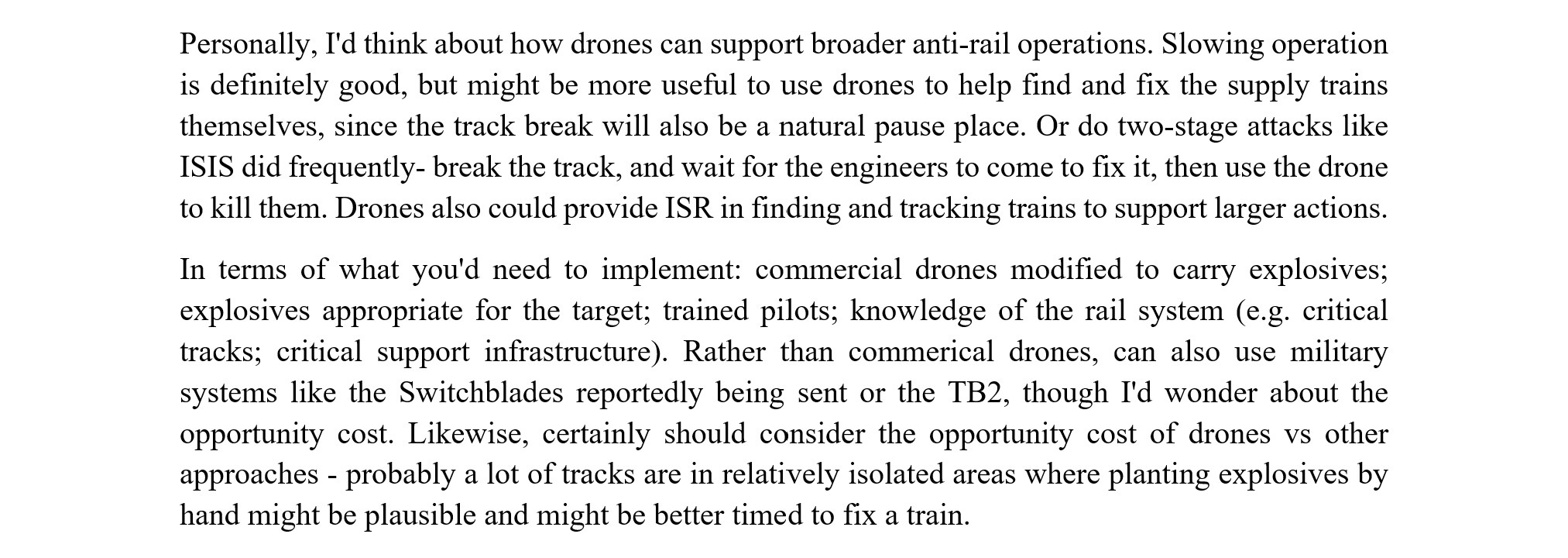
One academic advising the Alchemy cell, Zachary Kallenborn of George Mason University, recommended Ukraine carry out “two-stage attacks like ISIS did frequently” on Russian-held railways, suggesting that Kiev first “break the track, and wait for the engineers to come to fix it, then use the drone to kill them.” In other words: double tap kamikaze drone strikes.

“Drones also could provide ISR [intelligence, surveillance, and reconnaissance] in finding and tracking trains to support larger actions,” with satellite imagery exploited for targeting purposes, Kallenborn added.

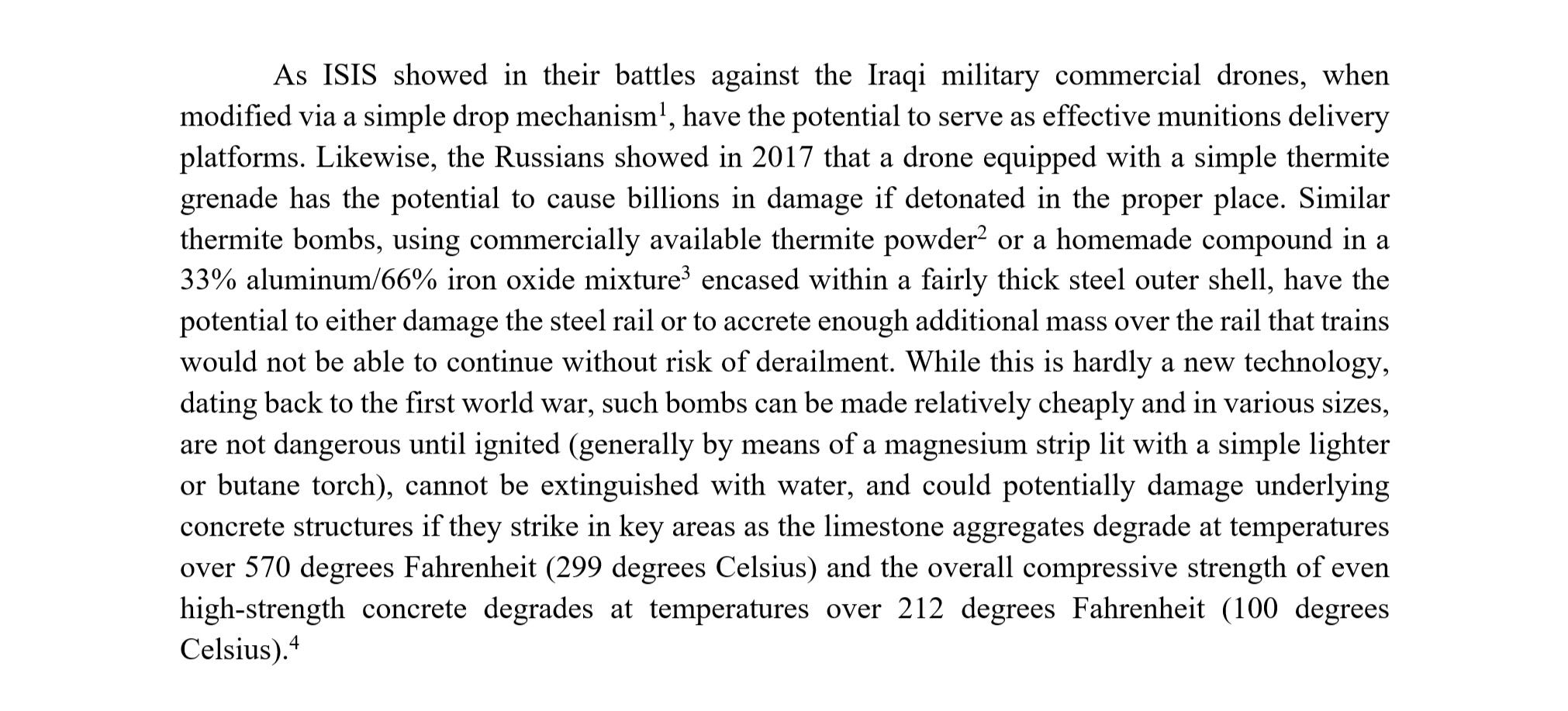
An unnamed Durham University researcher consulted by the NSC declared that “ISIS showed in their battles against the Iraqi military” that drones could be “modified via a simple drop mechanism… to serve as effective munitions delivery platforms.” The conversion of everyday commercial drones into munitions-bearing killing machines would prove one of the most deadly tactics of the war for both sides.

The origin of Kiev’s ‘drone swarm’ offensives?

During a meeting between military historians from Kansas State University and faculty from the Command and General Staff School at Ft. Leavenworth, academic war planners discussed “the idea of using inexpensive drones to prevent Russia from using captured Ukrainian railroads to resupply their combat units.” The academics then delivered the proposal to “three drone experts in the Ukraine Working Group who each provided their analysis for how to achieve this.”

A separate leaked document describes the Working Group as a vast collection of “strategic studies, military technology and Eastern Europe regional studies experts” who “came together to analyze the Russian invasion of Ukraine and to think deeply about policy options” which could “assist Ukraine’s defense (short of deploying combat forces).” The Working Group was composed of “approximately 60 experts hailing from states throughout NATO.”

The operations file begins by noting that, “when operating in its own territory,” the Russian army “relies on its well-developed rail system which is integrated with Ukraine’s domestic rail network.” As Russian forces moved deeper into Ukraine, the Working Group forecasted that they would “increasingly need to rely on Ukraine’s rail system or face logistic-induced paralysis as their lines of supply lengthen and their road-based logistical become increasingly inefficient.”

“The question should therefore be posed as to whether inexpensive drones can be used to hinder Russian efforts to use those portions of Ukraine’s railway network they have captured,” the document stated. An academic using the initials “M.E.D.” who hailed from Britain’s prestigious Durham University declared, “if Ukrainian forces could sustain attacks on occupied railroads, they could hamper Russian forces’ ability to operate deeper inside of Ukraine.”

While believing it “unlikely that drone attacks, even kamikaze attacks, could bring down bridges” – although this “would be ideal” – they suggested “commercial drones could be modified with a sufficient explosive to inflict meaningful damage of railroads, it would greatly complicate Russian efforts.” After all, “even a small amount of damage would force rail traffic to stop until repairs could be made to the line.”

These attacks “could be carried out away from major stations likely to have active air defenses,” and “augment attacks by stay-behind guerrilla forces.” M.E.D. cited a July 2018 paper on Islamic State’s “innovative” use of drones published by the West Point military academy’s “combating terrorism center” as a reference point for such tactics. It discussed “creative ways” ISIS had deployed “simple, low-cost, and replaceable devices” to devastating effect against its adversaries, which could be replicated by the US and its allies.

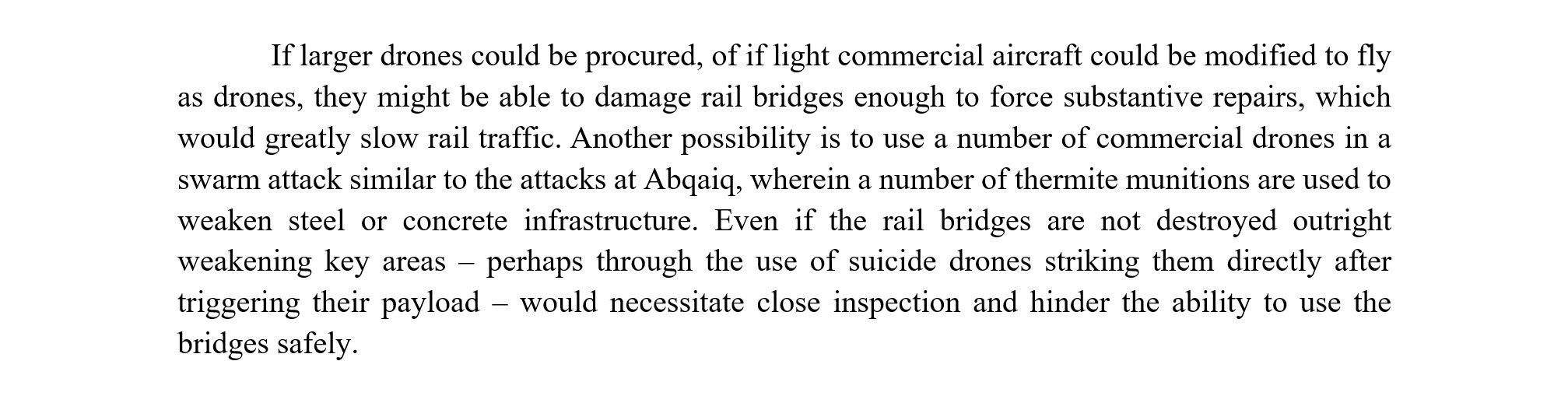
M.E.D. postulated that “if larger drones could be procured, of if light commercial aircraft could be modified to fly as drones, they might be able to damage rail bridges enough to force substantive repairs, which would greatly slow rail traffic” – a proposal which closely resembles the June 1 attacks on rail bridges in Russia’s Bryansk and Kursk regions. “Another possibility” was “to use a number of commercial drones in a swarm attack” comparable to Ansar Allah’s September 2019 strikes on Aramco sites in Saudi Arabia, “wherein a number of thermite munitions are used to weaken steel or concrete infrastructure.”

“Even if the rail bridges are not destroyed outright weakening key areas – perhaps through the use of suicide drones striking them directly after triggering their payload – would necessitate close inspection and hinder the ability to use the bridges safely,” M.E.D. concluded. Throughout the proxy war, Ukraine has regularly deployed drone swarms against Russian targets, in some cases inflicting significant damage.

“Track switches would probably be good targets too”

Another “drone expert” consulted by the St. Andrews cabal was Dominika Kunertove, formerly of Swiss university ETH Zurich’s Center for Security Studies. Kunertove currently serves as director of “a research project on future drone warfare and technology” at the Atlantic Council, the semi-official, arms-industry funded think tank of NATO in Washington DC.

Kunertove suggested using drones to strike “anything that uses” railroads, rather than railways themselves, as this would mean “neither side would be able to use railroads for some time (in case [Ukraine] recaptures…territory previously held by Russians.” This June, Kiev destroyed a military supply train carrying heavy armor, including tanks and artillery systems in an effort dubbed Operation Spiderweb 2.0.

Meanwhile, Zachary Kallenborn, a self-described “war doctor in training” from George Mason University’s Schar School, noted the “limited payloads” offered by commercial drones, with “only a few pounds” of explosive able to be attached to them, meant “the best bet would be to hit sensitive, difficult to repair targets to maximize harm.” While admitting to “not know too much about rail infrastructure,” he suggested “switching yards, engine houses, or the equipment to load and unload trains” as prospective targets.

“Track switches would probably be good targets too,” Kallenborn said, as “a hit would disrupt multiple lines and…would be tougher to repair.” He went on to advocate “[thinking] about how drones can support broader anti-rail operations.” While “slowing” operations intended were “definitely good,” Kallenborn believed it would be “be more useful to use drones” to target “supply trains themselves,” echoing Dominika Kunertove’s suggestions.

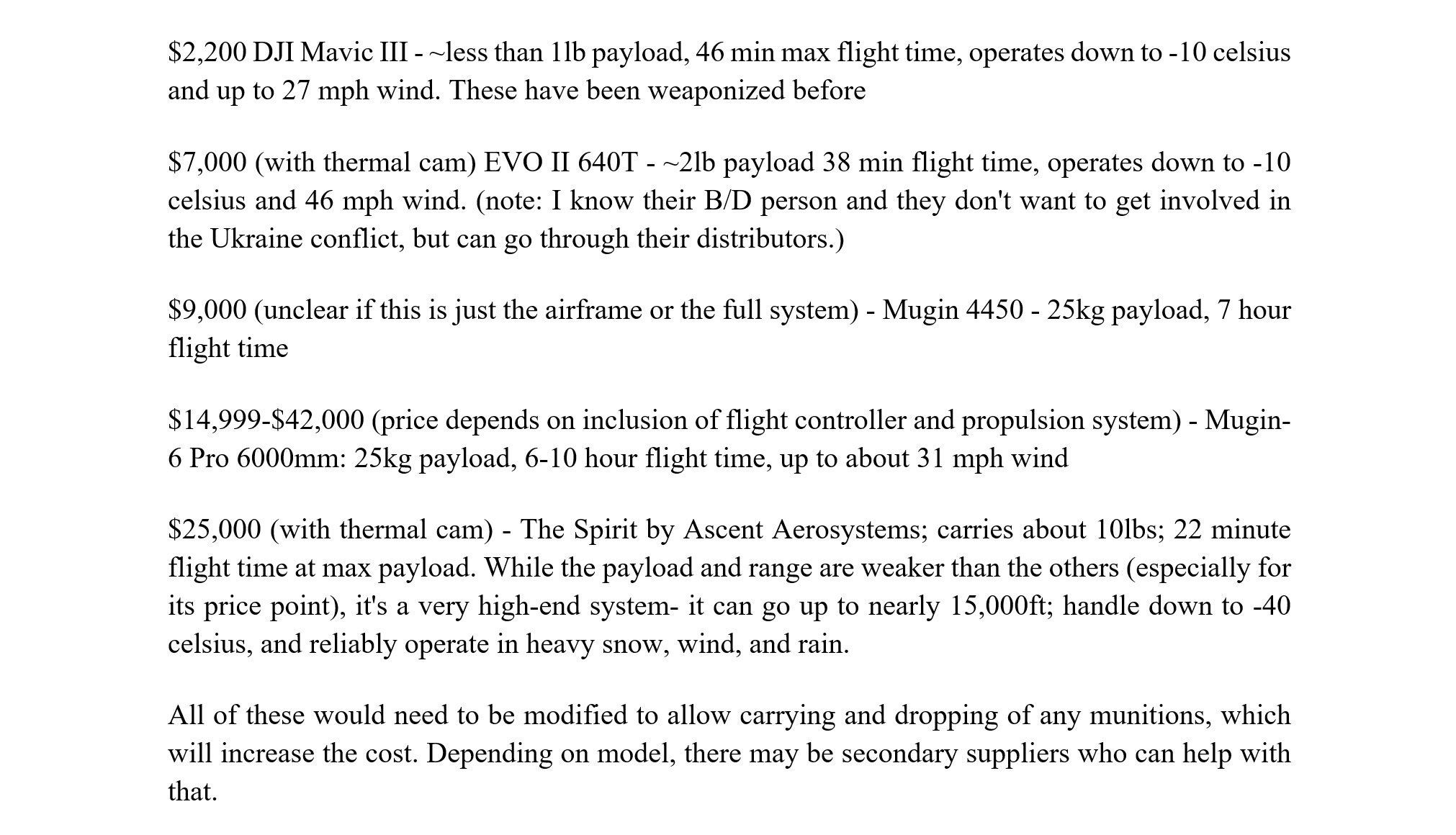
Kallenborn specifically highlighted five commercial drone models which could be outfitted with explosives and sent to disrupt rail operations, including the $2,200 DJI Mavic III, which Ukrainian forces used in their attack on a Russian fuel train this May 24.

“All of these would need to be modified to allow carrying and dropping of any munitions, which will increase the cost,” Kallenborn wrote. But “depending on model, there may be secondary suppliers who can help with that,” he noted.

Still, Kallenborn appeared to express some cynicism about the utility of drones. He urged the National Security Council to “consider the opportunity cost of drones vs other approaches.” He speculated there were “probably a lot of tracks… in relatively isolated areas where planting explosives by hand might be plausible and might be better timed to fix a train.”

That task that could be handily carried out by secret Operation Gladio-style “stay-behind guerrilla forces” which other British academics proposed standing up as part of a proposal to strike “sensitive, difficult to repair targets to maximize harm” in Russian territory.

In the face of constant Russian battlefield gains and a looming reduction in Washington’s military aid to Ukraine, the British government remains committed to spending vast sums on ensuring Kiev has a vast supply of drones at its disposal at all times.

As Ukraine places drone attacks on Russian infrastructure at the heart of its increasingly desperate strategy, Project Alchemy’s ISIS-inspired plans are more relevant than ever.

Why Does Seymour Hersh Never Question His Government Sources?

In the past, I’ve criticized Seymour Hersh’s reporting relating to Russia and the Russia-Ukraine war as I’ve noticed that his understanding of Russia seems to be reliant upon his government sources and establishment writers who are the intellectual fellow travelers of Fiona Hill.

I have to say I don’t understand why such a respected and seasoned investigative journalist who covered the worst of the Vietnam and Iraq wars shows no discernment or inclination to question some of the nonsense he’s being fed by his sources.

As a recent cross-post by Simplicius made clear, the high numbers of Russian casualties being bandied about by US/Western government officials and establishment media are not credible when subjected to a modicum of scrutiny. But this shouldn’t be a surprise to those who remember that it was admitted at the beginning of the Russia-Ukraine war that they considered this an information war and that US government officials would be promulgating stories and information that made Ukraine and the west look good and Russia bad – with the implication that the information would not always be accurate or truthful. Did Hersh forget that admission from 2022?

I don’t deny that there are analysts and commentators who are clearly sympathetic to Russia and put out stories and commentary about how Russia is 20 feet tall and is going to defeat Ukraine next week. I won’t mention any names. I’m interested in those who are attempting to report a reasonable approximation of the truth to the extent that is possible during a proxy war between superpowers who both have motivations and purveyors of biased narratives.

On to some relevant excerpts from Hersh’s article from this past week:

…Zaluzhnyi is now seen as the most credible successor to Zelensky. I have been told by knowledgeable officials in Washington that that job could be his within a few months. Zelensky is on a short list for exile, if President Donald Trump decides to make the call. If Zelensky refuses to leave his office, as is most likely, an involved US official told me: “He’s going to go by force. The ball is in his court.” There are many in Washington and in Ukraine who believe that the escalating air war with Russia must end soon, while there’s still a chance to make a settlement with its president, Vladimir Putin….

…I have been provided with new Russian casualty numbers, from carefully evaluated US and British intelligence estimates, that show that Russia has suffered two million casualties—nearly double the current public numbers—since Putin started the war in early 2022. “Putin is not afraid of losing power, but he is losing popularity,” the US official said, “and Donald Trump is Zelensky’s supplier and the only one who can keep the Ukraine war going. Who’s got real power? It isn’t Zelensky. His only lifeline is the US. Trump is asking, ‘How do we get the pissants to stop? He thinks he’s the only one who can make the deal.

“The message to Putin is you can still say you won” if Zelensky is replaced.

The Russian combat losses are seen in Washington, I was told, as key to a renewed urge to get new leadership in Ukraine in order to begin serious negotiations to end the war, given Putin’s contempt for Zelensky and the possibility of escalation. The losses were at an all-time low of twenty per month last fall, as Putin waited for the results of the US election. “When Trump won,” I was told, the Russian leadership organized a spring offensive “to capture as much territory as possible” before another round of expected peace talks with Ukraine started.

The results were dismal. The offensive has only progressed 120 miles beyond the areas Russia already controlled in Ukraine. That gain, amid high casualties, was of minimal importance, I was told: “all farmland, no fortified towns or critical communication sites. The monthly casualties have been 380 a month through May. The total now is two million. Most importantly,” the official stressed, “was how this number was described. All the best trained regular Army troops, to be replaced by ignorant peasants. All the best mid-grade officers and NCOs dead. All modern armor and fighting vehicles. Junk. This is unsustainable.”

For more comparative context, here is what Russia Matters – a project that relies on western establishment media and commentators – had to say about Russia’s recent advances in Ukraine:

“In the battle for Ukraine, the front line is increasingly at a standstill,” The Wall Street Journal reported on July 13.1 Four days later this newspaper described the situation on the frontline as a “slowdown.” But is it? According to RM’s latest Russia-Ukraine War Report Card, the week preceding July 16 saw Russian forces gain 61 square miles of Ukrainian land, which is triple the rate of the previous week.Moreover, if one compares the monthly rate of change in territorial control in June 2025 (the latest month for which full monthly data is available) with the average monthly rate of change in such control in the five preceding months of this year (Period 1) and in the 18 months (year and a half) that had preceded June 2025 (Period 2), then one sees that the June 2025 rate was considerably higher than the average rate during either of these two periods, regardless of which organization’s data was used to make the calculations (U.S.-based Institute for the Study of War or an online resource that reportedly relies on data from Ukraine-based DeepState, which is affiliated with the Ukrainian MoD). Moreover, the June 2025 rate of advance was higher than that of May 2025 (see Table 2). Thus, it is perhaps not accurate to portray the situation on the Russian-Ukrainian front as “increasingly at a standstill.” [much less a dismal result as Hersh states – Natylie]

Center for Citizen Initiatives: Is Ressentiment Inevitable?

By Paula Day, Center for Citizen Initiatives, 7/11/25

In the article below, Patrick Lawrence presents his rather bleak assessment of the future when the war in Ukraine ends.  After what he refers to as the ‘dead end’ of supposed negotiations between Russia and the US (which, on the American side, have frequently consisted of “social media messages demanding a ceasefire, replete with capital letters and exclamations points, (which) do not count and do not work as statecraft”) Lawrence anticipates a time – a very long time – of Ressentiment.

Ressentiment is a concept that was of great interest to a number of heavy thinkers of the 19th century. What it boils down to is what we at CCI have been anticipating for the aftermath of the bloodiest war in Europe since WWII since the day it commenced:  bone marrow-deep bitterness, rancor, frustration and blame among the citizens of Ukraine and Russia – and many in the West as well.  These toxic feelings have the potential to poison relations between the countries involved in this war, whether directly or peripherally, for generations to come. 

Please read Lawrence’s article, “Trump Dead-Ends Putin,” and let us know what you think.  And in the next few weeks we will tell you of our plan to put citizen-to-citizen diplomacy to work, in some small way, to counter this inevitability.

PATRICK LAWRENCE: Trump Dead-Ends Putin – Consortium News

On a far more positive note, please see the video below from the CCI archives titled, “Present! – Charles Heberle: You the People.”  Charles joined the CCI Board of Directors in February, but he was involved with the organization and in work in Russia long before.  In 2015 he was in the first citizens’ delegation to return to Russia with Sharon Tennison following the Maidan coup.  The videoed interview by Mel Van Dusen, also a 2015 CCI delegate, covers his remarkable involvement in ‘teaching democracy’ in Russia in the decade before that.  If you have not seen the interview already, please take a look.  After the first Cold War ended, the relationship between the former ‘enemies’ could comfortably be called the opposite of Ressentiment.  Let’s hope we haven’t lost that connection forever.

Present! – Charles Heberle: You the People

Sylvia Demarest: DNI head Tulsi Gabbard has referred former president Barack Obama to the Justice Department for investigation

By Sylvia Demarest, Substack, 7/19/25

Sylvia Demarest is a retired trial lawyer.

On Friday, Director of National Intelligence Tulsi Gabbard declassified documents revealing “overwhelming evidence” demonstrating how, before and after President Donald Trump won the 2016 election against Hillary Clinton, then-President Barack Obama and his national security team laid the groundwork for what would be the years-long Trump–Russia collusion probe. In a series of posts on X, DNI head Tulsi Gabbard explains the investigation and the declassification of 114 pages of previously top-secret documents revealing that Russiagate was essentially an intelligence created hoax. Gabbard said, “There was a treasonous conspiracy at the highest levels of government”.

Director Gabbard’s release of these documents is related to an intelligence community operation that took place during and after the 2016 presidential election. This operation was designed to accuse Donald Trump of being a Russian agent and created the Trump-Russia hysteria that occupied the country’s attention for years. The operation was spread by anonymous intelligence community leaks to the corporate media which saturated the the country with what has now been revealed to have been completely “fake news”. We have yet to hear from this media, which includes the New York Times, the Washington Post, MSNBC, NBC, and CNN. The coverage of this fake story by this media, resulted in the media, and their reporters, being awarded Pulitzer Prizes.

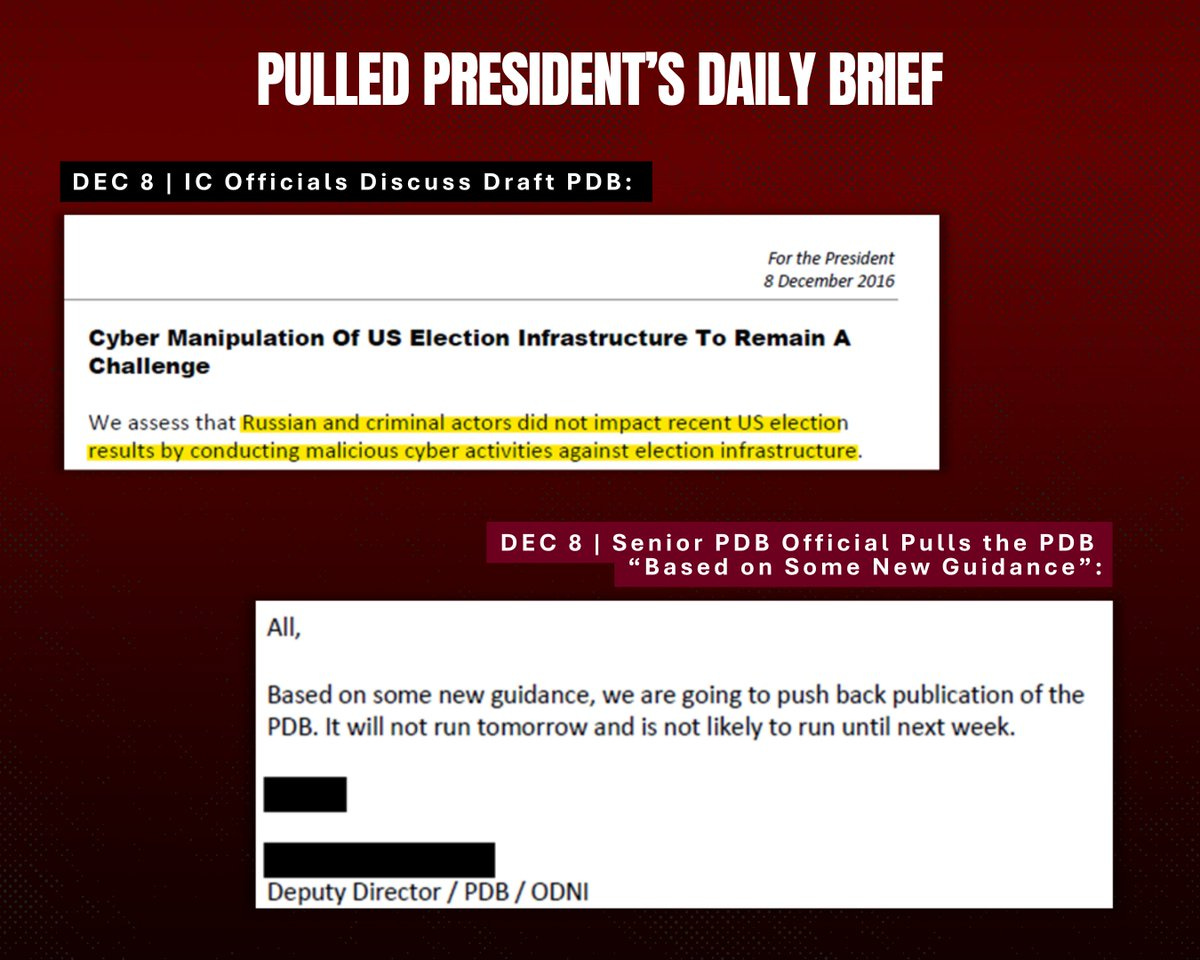
Here’s one example from the DNI disclosures. On December 8, 2016, intelligence officials were prepared to release the President’s Daily Briefing which concluded that “Russian and criminal actors did not impact recent US election results by conducting malicious cyber activities against election infrastructure”:

This “did not impact” memo was never issued due to the intervention of James Clapper and what was contained in these IC memos was the exact opposite of what the Obama White House would claim a month later.

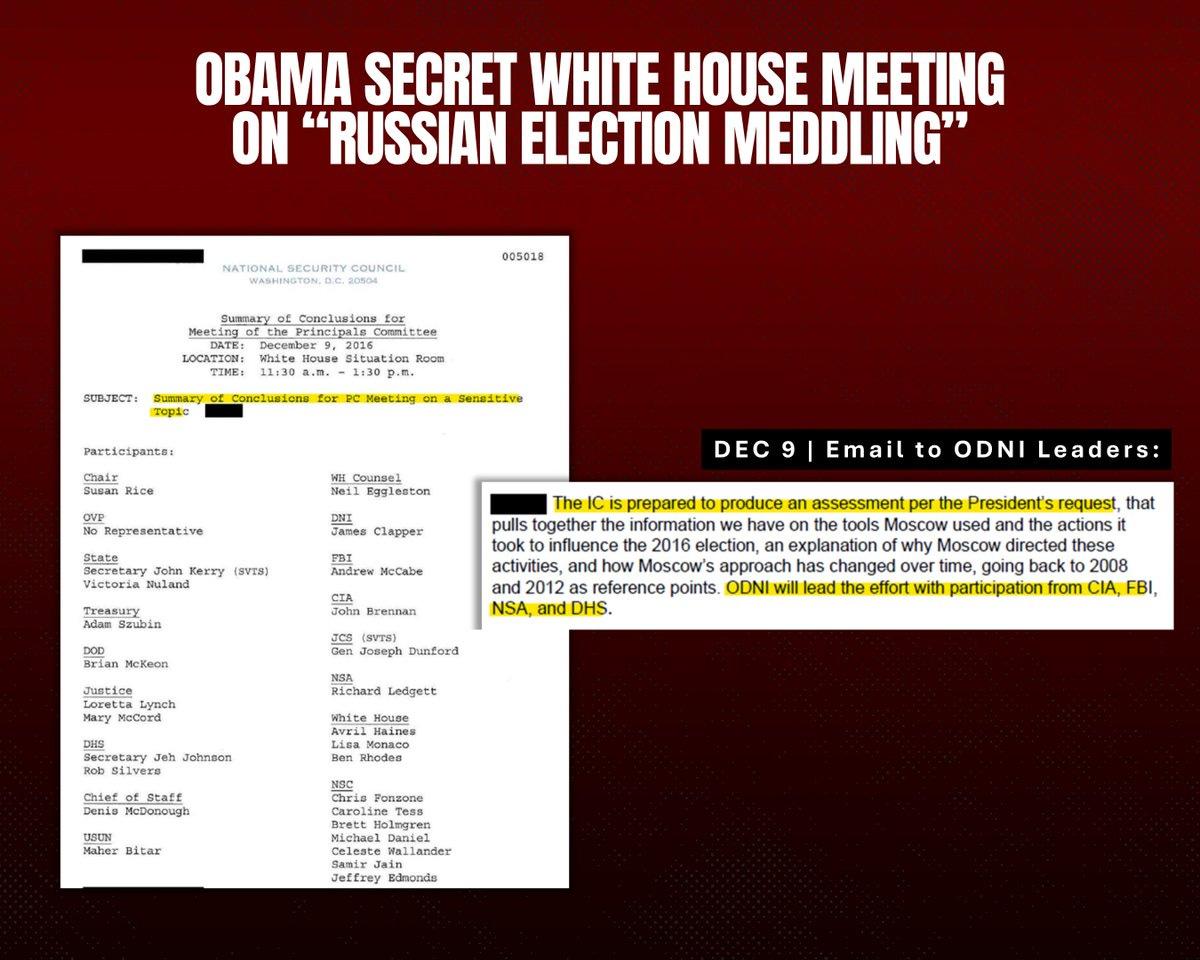
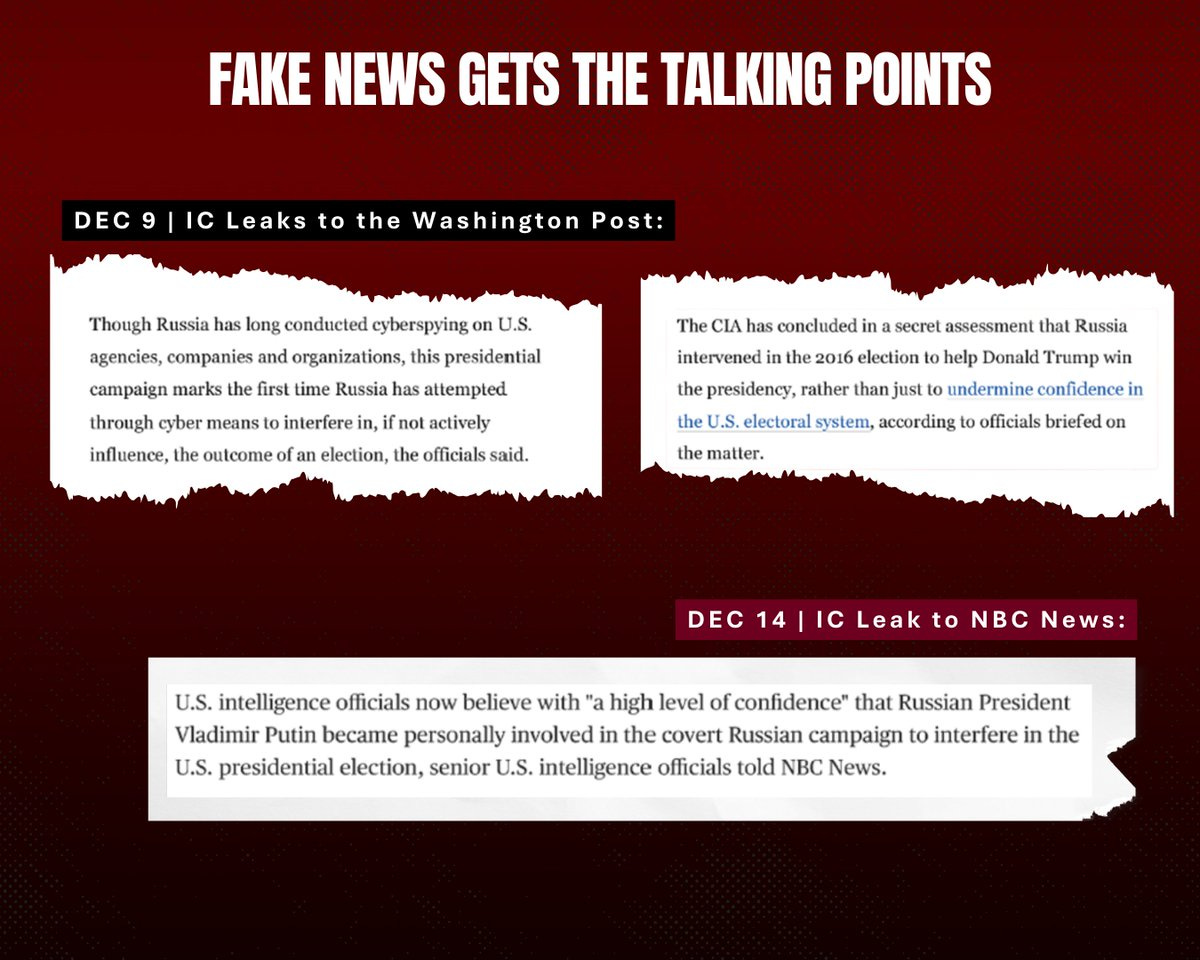
On December 9th Obama’s National Security Principals Committee met and after this meeting each team member received an email tasking them with creating a new “assessment per the President’s request.” This is when the anonymous leaks to the media began, leaks now labeled by the DNI as “blatantly false”. The leaks were about a non-existent “secret assessment” that Russia had intervened to influence “the outcome of the election”. The leaks continued until Brennan could organize and release a Intelligence Community Assessment. These actions put in motion a series of developments that led to the publication of the Steele Dossier and a barrage of media stories linking Trump to Russia, and to an unprecedented scandal that essentially accused Trump of being a traitor.

The materials were bolstered by a whistleblower from then DNI head James Clapper’s office. The documents implicate a wide range of White House officials including President Obama himself, all designed to create a false narrative that Russia had meddled in the election to help Donald Trump.

The release was preceded by an “urgent meeting” of Trump’s Presidential Intelligence Advisory Board, at a secure facility which included officials from the Department of Justice.

The Russiagate hoax seriously impaired US, Russia relations, which appears to have been the ultimate objective.

Here’s Russia Today: “Former President Barack Obama’s administration deliberately manipulated intelligence to frame Russia for interfering in the 2016 presidential election, according to newly declassified documents released on Friday by America’s Director of National Intelligence Tulsi Gabbard. Gabbard unveiled more than 100 pages of emails, memos, and internal communications, which she described as “overwhelming evidence” of a coordinated effort by senior Obama-era officials to politicize intelligence and launch the multi-year Trump–Russia collusion investigation. She dubbed it “a treasonous conspiracy to subvert the will of the American people.” The scandal severely damaged relations between Moscow and Washington, leading to sanctions, asset seizures, and a breakdown in normal diplomacy.”

Catherine Herridge, who had covered the story stated the following: “The newly declassified records are additional, compelling evidence that the 2016 Russia Collision narrative was not rooted in credible intelligence reporting but manufactured to fit a preferred political narrative.”

The significance of this action by DNI cannot be overstated.

This is the first time an intelligence domestic operation has been exposed by its own leadership. It also exposed the abuse of the “classified top secret” label to hide illegal, potentially treasonous activities, which could and should lead to serious reforms in classification procedures. The release of such highly classified documents to the public is also unprecedented and avoids claims that there is “no supporting evidence”.

The criminal referral of former president Barack Obama would have never happened had the Biden DOJ not spent 4 years prosecuting Donald Trump. The Supreme Court case resulting from one of the prosecutions, lays out the circumstances under which a former president can be criminally prosecuted. The Supreme Court said there was “no immunity” for “illegal acts”. The acts revealed by DNI Gabbard, are alleged to be part of a domestic counterinsurgency designed to remove or impair a duly elected president from carrying out his duties under the US Constitution. They were also designed to worsen relations with a foreign country and promote a path to war. If proven, this would constitute an illegal act.

Here is what DNI head Tulsi Gabbard released on Friday:

@DNIGabbard

“Americans will finally learn the truth about how in 2016, intelligence was politicized and weaponized by the most powerful people in the Obama Administration to lay the groundwork for what was essentially a years-long coup against President @realDonaldTrump, subverting the will of the American people and undermining or democratic republic. Here’s how:”

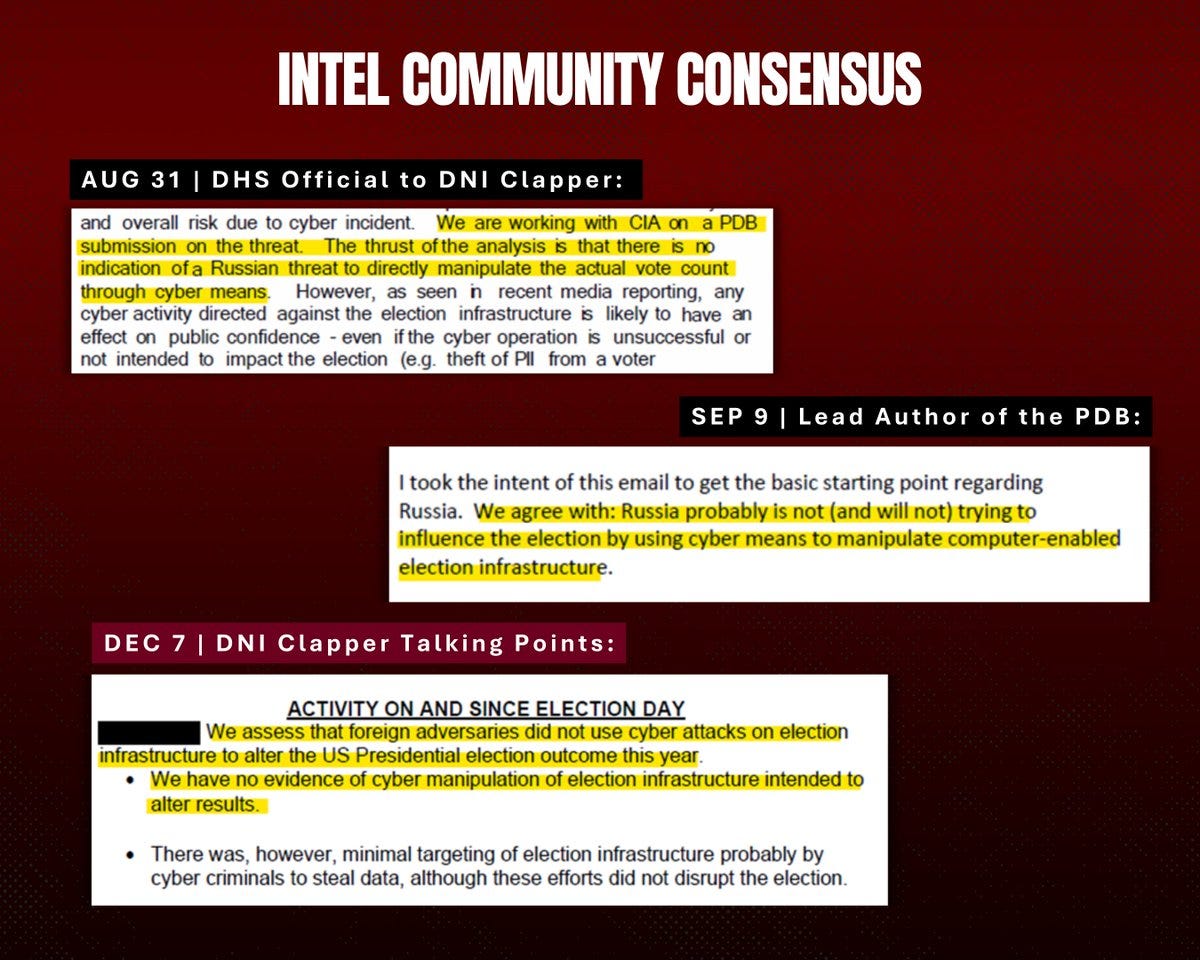
For months preceding the 2016 election, the Intelligence Community shared a consensus view: Russia lacked the intent and capability to hack U.S. elections.

But weeks after President Trump’s historic 2016 victory defeating Hillary Clinton, everything changed.

Image.jpeg

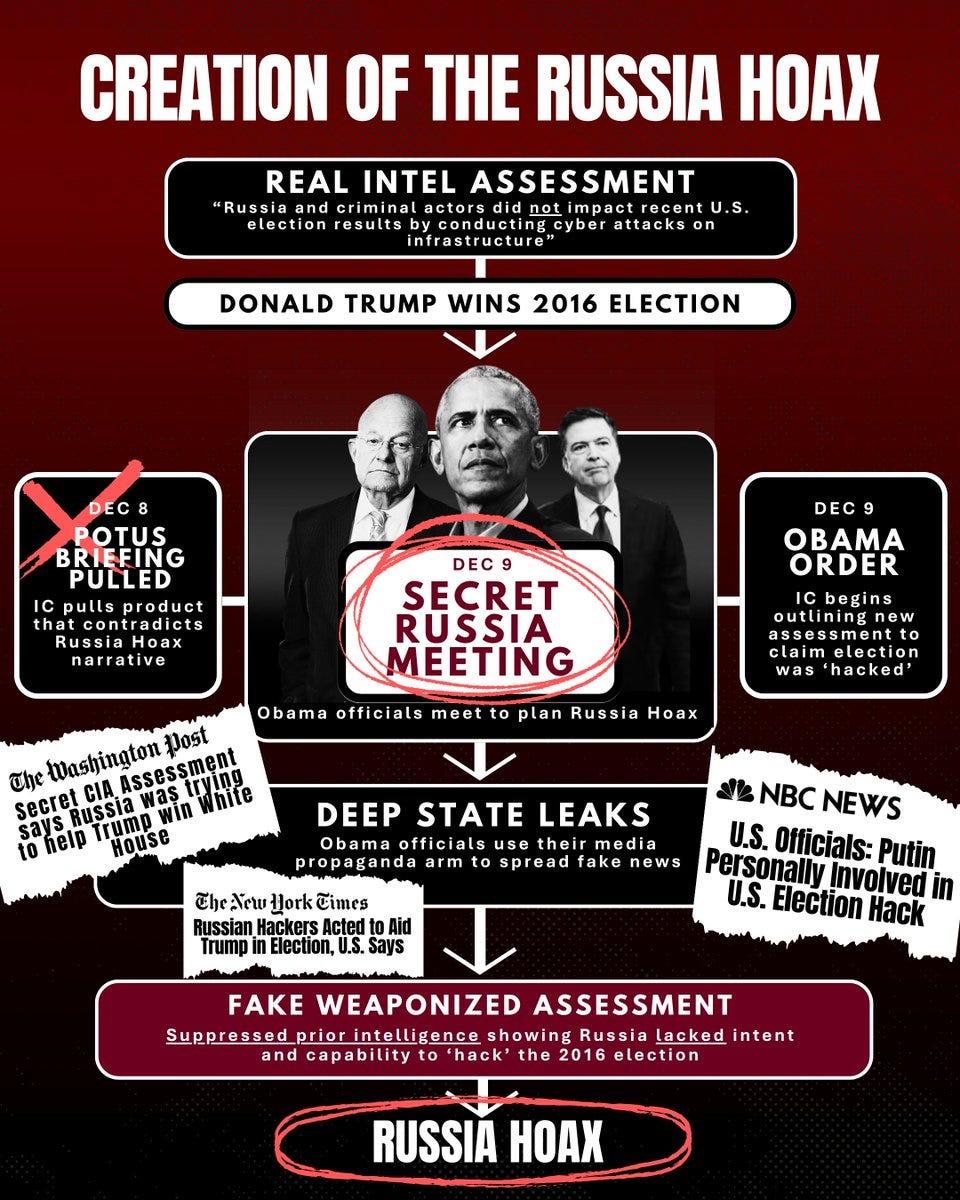
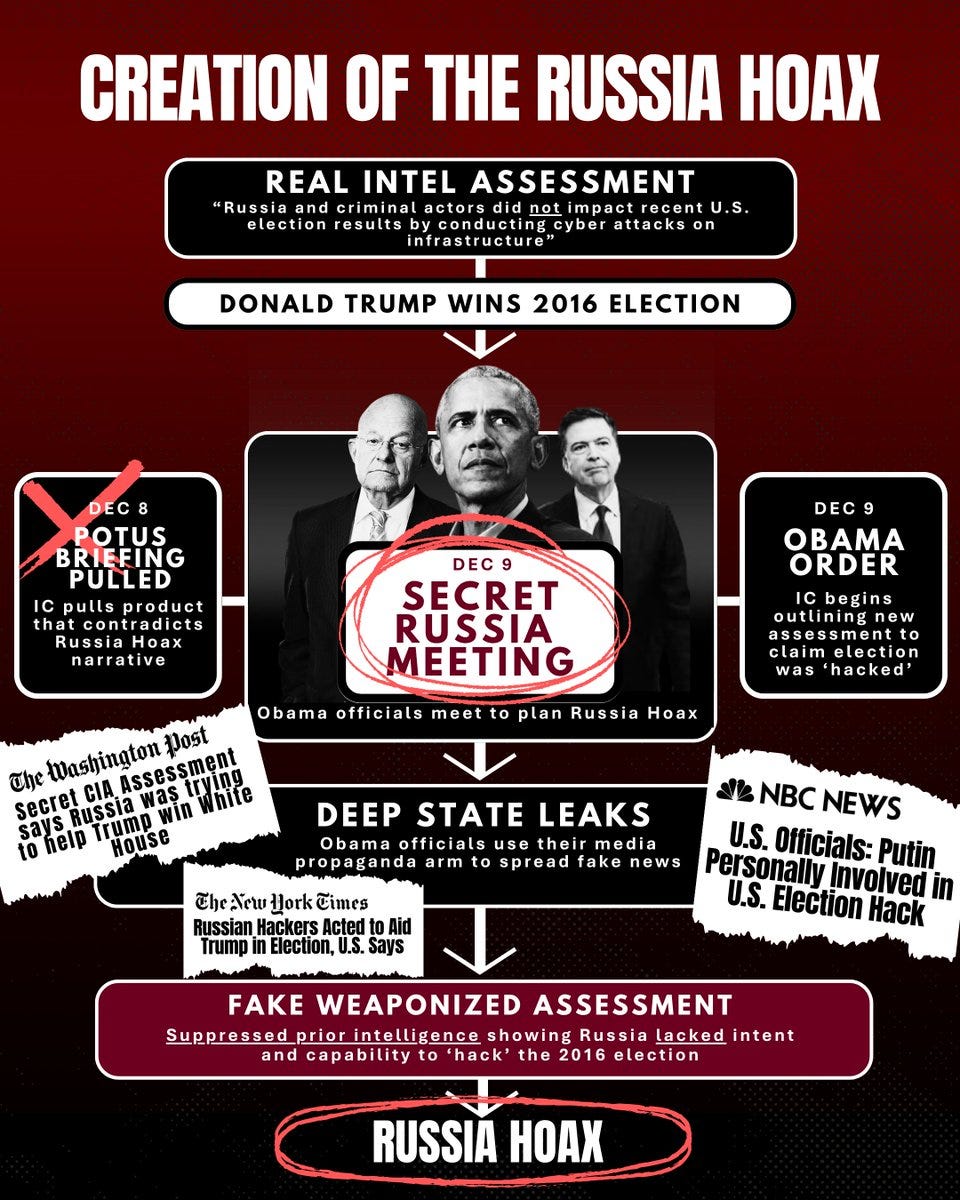
On Dec 8, 2016, IC officials prepared an assessment for the President’s Daily Brief, finding that Russia “did not impact recent U.S. election results” by conducting cyber attacks on infrastructure.

Before it could reach the President, it was abruptly pulled “based on new guidance.” This key intelligence assessment was never published.

Image.jpeg

The next day, top national security officials including FBI Dir James Comey, CIA Dir John Brennan and DNI James Clapper gathered at the Obama White House to discuss Russia. Obama directed the IC to create a new intelligence assessment that detailed Russian election meddling, even though it would contradict multiple intelligence assessments released over the previous several months.

Image.jpeg

Obama officials immediately leaned on their allies in the media to advance their falsehoods. Anonymous IC sources leaked classified information to the Washington Post and others that Russia had intervened to hack the election in Trump’s favor.

Image.jpeg

On January 6, 2017, just days before President Trump took office, DNI Clapper unveiled the Obama-directed politicized assessment, a gross weaponization of intelligence that laid the groundwork for a years-long coup intended to subvert President Trump’s entire presidency.

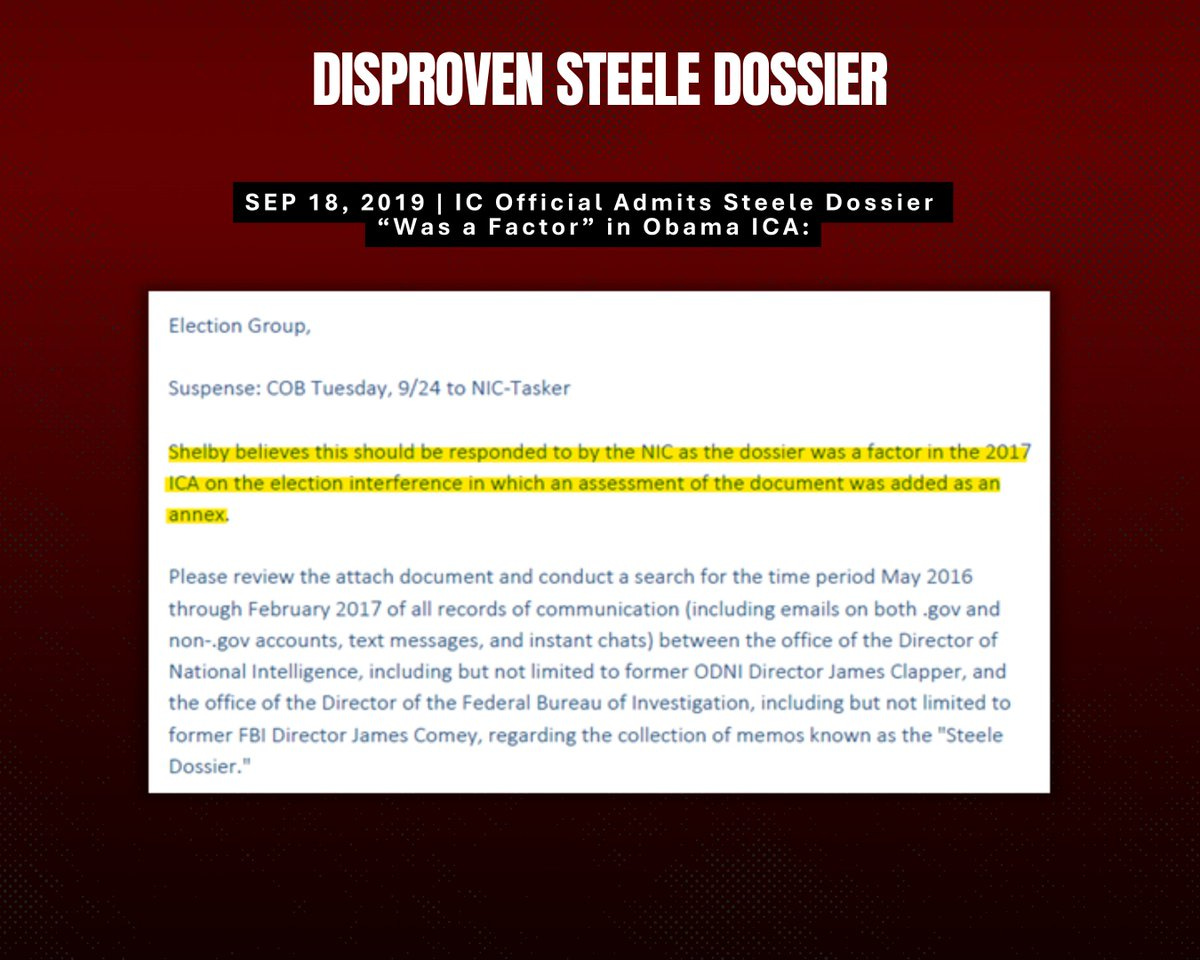
According to whistleblower emails shared with us today, we know Clapper and Brennan used the baseless discredited Steele Dossier as a source to push this false narrative in the intelligence assessment.

Image.jpeg

These documents detail a treasonous conspiracy by officials at the highest levels of the Obama White House to subvert the will of the American people and try to usurp the President from fulfilling his mandate.

This betrayal concerns every American. The integrity of our democratic republic demands that every person involved be investigated and brought to justice to prevent this from ever happening again.

I am providing all documents to the Department of Justice to deliver the accountability that President Trump, his family, and the American people deserve.

Conclusion:

In all there were 17 different investigations which Wired Magazine outlined in an article in 2018. These investigations included a Special Prosecutor, two impeachments, and lawsuits against Russian companies that never went anywhere. These investigations resulted in criminal indictments of several people who worked in the Trump campaign. As a result of these investigations, many people were bankrupted and their families threatened, forcing them to plead to charges; others were tried and convicted, and at least 2 were imprisoned. I followed the entire saga at the time, put together a timeline, read Indictments, court transcripts, and depositions. I concluded it was an anti-Russia intelligence operation designed demonize Russia and to keep President Trump from trying to improve US, Russia relations i.e. that it was a likely intelligence operation bordering on treason. Now DNI has reached the same conclusion.

I have not had the opportunity to review all the documents that were released. There are several Substack’s that are following this issue, including Matt Taibbi’s Racket News, which I highly recommend.