Russia-West clash not about ideology – Putin

YouTube link to excerpt of Putin interview here.

RT, 7/13/25

Western nations’ hegemonic aspirations and dismissal of Russia’s security concerns have led to the ongoing standoff between Moscow and the West, President Vladimir Putin said in an interview released on Sunday. Ideological differences are only a pretext to advance the West’s geopolitical interests, he claimed.

Putin added that he expected the collapse of the USSR to alleviate tensions between Russia and the West.

“I also thought that key disagreements [between us] were ideological in nature,” he stated. “Yet, when the Soviet Union was gone… the dismissive approach to Russia’s strategic interests persisted.”

The president went on to say that his attempts to raise Russia’s concerns with Western leaders were in vain. “The West decided… they do not need to follow the rules when it comes to Russia, which does not have the same power as the USSR.”

All of Moscow’s proposals regarding mutual security, strengthening international stability, and reaching agreements on offensive weapons and missile defense were rejected, Putin said. “It was not just negligence. It was based on a clear desire to reach some geopolitical goals.”

“It has become clear that, unless Russia positions itself as an independent sovereign nation… we will not be reckoned with,” he added.

The Russian president has accused Western nations of betraying Russia and not fulfilling their promises. Last month, he said Moscow was “blatantly lied to” about NATO expansion for decades as the US-led military bloc approached Russia’s borders.

“Everything was good as long as it was against Russia,” he said at the time, adding that Western nations have supported separatism and even terrorism directed against the country.

Moscow has listed Kiev’s NATO ambitions and Western military assistance to Ukraine key reasons behind the Ukraine conflict. Prior to the escalation in early 2022, Russia sought to address its security concerns by seeking guarantees from US and NATO, as well as non-aligned status for Ukraine, which were rejected by the West.

Simplicius: Rubio Claims Russia Suffered 100k KIA in Six Months, Ukrainian Casualties Remain ‘Vague’

By Simplicius, Substack, 7/11/25

The topic of casualties is one we periodically revisit when necessary. Now is such a time, as Marco Rubio has made the absurd claim—coordinated with MSM outlets—that the Russian Army has suffered a whopping 100,000 deaths just since January of this year alone; purely deaths, not even total casualties:

This was immediately backed up by new articles, like the following from the Economist, which likewise claims Russia is experiencing its deadliest year on the front yet, with 30,000+ deaths just in the past couple months alone:

https://www.economist.com/interactive/graphic-detail/2025/07/09/russias-summer-ukraine-offensive-looks-like-its-deadliest-so-far

The above article is a particularly egregious example. Just take a look at their methodology, or lack thereof. This small extract constitutes the entirety of their ‘scientific’ premise for Russian losses:

There is no official tally of losses on either side. But our daily war tracker offers some clues. Our satellite data and shifts to areas of control suggest when the fighting is intensifying. This lines up well with more than 200 credible estimates of casualties from Western governments and independent researchers. By combining this data we can, for the first time, provide a credible daily death toll—or an estimate of estimates.

In short, they claim their satellite data alerts them to where fighting happens to ‘intensify’, and from that they—by some incredible leap of logic—infer that Russian forces are experiencing massive losses. The baffling part is that this facile methodology should apply to the AFU in parallel as well, yet when it comes to Ukraine’s losses, the Economist’s staff are without even a hint of curiosity:

Read that again: satellite data showing “intense fighting” inherently points to Russian losses merely on the assumption that any fighting, as a general rule, results in Russian but not Ukrainian losses. This is an astoundingly juvenile, biased, and to be frank, fraudulent, level of analysis.

Recall this previous revelation, which tells us everything about the West’s info-hygiene:

These publications claim to have such ‘sensitive’ attunements to the battlefield fluctuations as to give exact Russian figures, but when it comes to Ukraine, they are suddenly lacking data.

The fact is, there’s a reason why MediaZona very abruptly changed up their methodology to include “projected” deaths rather than real counted ones, as done previously—because contrary to this coordinated propaganda campaign, Russian losses have actually been at the lowest in a long time. This is precisely the reason such an orchestrated campaign was necessary: Ukraine is badly losing, and the only remaining aspect of the war the propagandists could feasibly utilize to try and spin the narrative are the casualty figures, because they are typically the most ‘subjective’ and ambiguous in nature—which makes them perfect fodder for devious manipulation.

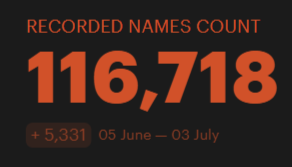
Presently, MediaZona has the total Russian death toll at ~117k as of early July:

If you highlight only January 1st to present, you get 9,849 confirmed deaths:

https://en.zona.media/article/2025/07/04/casualties_eng-trl

You can do this yourself at the official site to confirm.

That means through the first six months of this year, they have registered a mere 9,849 Russian deaths, which amounts to 1,641 per month. Western and Ukrainian publications, on the other hand, claim Russia is suffering that many deaths per day. The discrepancy shows an unprecedented detachment from reality.

We do know MediaZona has a ‘lag’ because it takes time to confirm most recent deaths, and so the number will likely rise, but probably not by an inordinate amount. There is no evidence whatsoever that Russia is taking anywhere near the kinds of losses the West claims. In fact, someone made a good point: since it is Ukraine that purports that 70-90% of their kills on Russian soldiers come by way of drones, they should be able to show all these vast amounts of losses via drone camera recordings; yet there is nothing—and we know the AFU loves nothing more than showing off its ‘successes’.

In an article two months ago, I had highlighted the timeline of the Russian Army’s growth from Ukraine’s own sources. It went as follows:

  • 2023: Bloomberg announces Russian troop count at 420,000.
  • 2024: Head of Ukraine’s military intelligence tells Economist the number had swelled to 514,000.
  • Early 2025: It was 600,000.

And what do we have now, at the midpoint of 2025? Straight from Zelensky’s own mouth:

So, to reiterate and simplify:

400k troops in 2023, 500k in 2024, 600k in early 2025, and already 700k in mid-2025.

This is all from Ukrainian sources, the originals of which you can find in my previous article here.

How can Russia possibly be suffering a claimed 100,000 dead in just six months—as per Rubio—when it is literally gaining over 100,000 per year?

In order for Russia to suffer 100k deaths in six months—annualized to 200k per year—and still gain 100k+ men per year, Russian recruitment would have to be staggering, given the contract churn we outlined previously. Hard to imagine people willingly signing up under the dark cloud of such losses, while in Ukraine—suffering “far fewer casualties”—people have to be forcibly kidnapped from the streets and herded into vans like cattle.

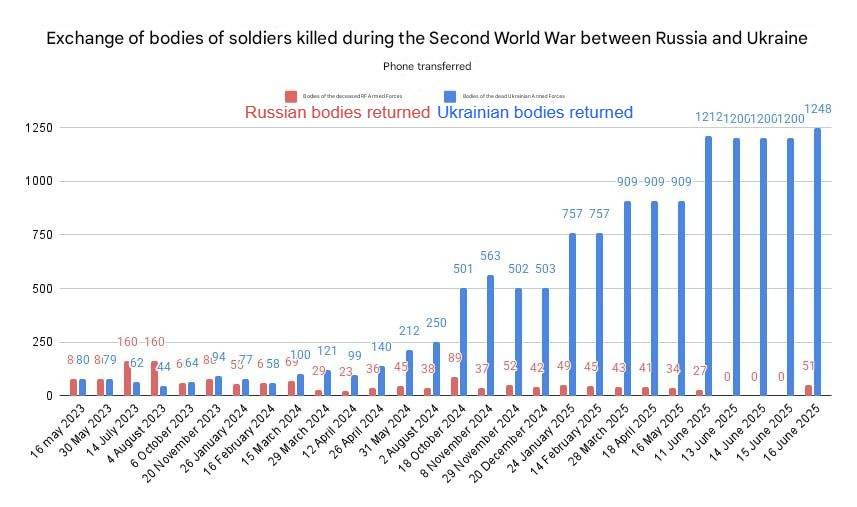
Strange how it’s Ukrainian cemeteries that continue to infamously fill up, rather than Russian ones, and how the past year’s ratio of dead body exchanges has jumped to such an astronomical disparity as to be off the charts:

Any honest journalist would pucker at such incongruities in the data—but alas, that species is about as common as a three-legged emu.

As a recent glimpse into Russian losses during active assaults, here is one honest post from Russian military sources about a settlement that was captured. They write that they suffered four “200s” during the operation:

There are many such assaults per day, so you can multiply the four by the daily amount to get a reasonable count—but it certainly isn’t hundreds, much less thousands.

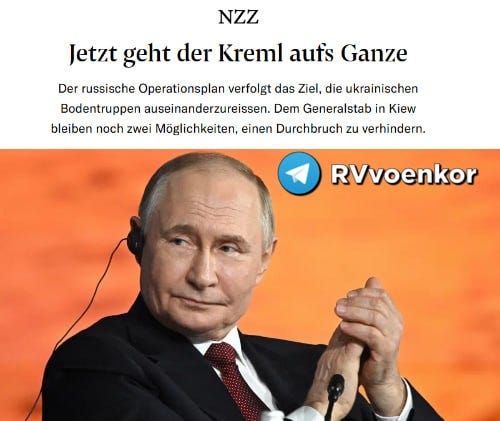
Neue Zürcher Zeitung has a new piece which spells out that Ukraine only has two options to prevent collapse:

https://www.nzz.ch/pro/jetzt-geht-der-kreml-aufs-ganze-ld.1892551

Now the Kremlin is going all out.

The Russian operational plan aims to tear apart the Ukrainian ground forces. The general staff in Kiev still has two options to prevent a breakthrough.

They begin by aptly noting that Putin spelled out the strategy himself at a recent forum:

“They already have too few personnel,” Putin went on to analyze, “and they are withdrawing their forces there, which are already lacking in the decisive theaters of armed conflict.” Putin is making little effort to conceal his operational intentions: the Russian General Staff wants to tear the Ukrainian army apart – and then attempt a breakthrough at a suitable point.

Then they reveal the two options Ukraine faces, which I’ll annotate:

Sirski, on the other hand, still has two basic options for saving Ukraine from a military defeat in the current situation:

1.Delay: The aim is to lose as little ground as possible during the Russian summer offensive and to avoid encirclement of larger troop units. In the fall, the front could then be consolidated and a starting point for negotiations created. At present, Kiev appears to be pursuing this course – in the hope that the USA will resume its military aid.

Here, they admit that Ukraine’s best chance is merely to stall until “negotiations” can be effected; but we know Russia has zero incentive for such a thing, unless you kowtow to the fake figures of Russian losses and believe Russia is “on its last leg”, as per Strelkov and the rest of the doomer clan.

Their second option is to withdraw to the new defensive line reportedly being constructed a few dozen kilometers behind the current LOC:

2. operational withdrawal: The Ukrainian ground forces could gradually withdraw from the front and take up new positions protected by natural and artificial obstacles. The aim is to prevent a capitulation and to maintain the army to protect sovereignty even in the event of an unfavorable outcome to the negotiations. One indication that this option is being examined is the construction of a Ukrainian fortification line 20 kilometers behind the front from the Kharkiv area to Zaporizhia in the southwest of Ukraine.

There are not enough forces for a surprise anywhere along the front, and the pinpricks in the depths of the Russian area will hardly have any effect except in the information area. The Ukrainians lack fighter aircraft such as the F-35 to gain at least partial air superiority. In addition, ammunition for the Himars missile artillery, the Taurus guided missiles, supplies for air defense – the list is well known in Western capitals.

Europe has gone on summer vacation and Trump is at least considering sending defensive weapons to Ukraine again. But the risk of a Russian breakthrough is growing. If a gap opens up somewhere, the occupying forces can suddenly maneuver and use the bridgeheads at Sumi and Kharkiv for large-scale operations. Sirski then gradually ran out of options.

However, the decision to switch from delay to operational withdrawal in good time does not lie with the head of the army, but with President Volodimir Zelensky in Kiev and his dilemma: between military necessity and the political principle of hoping that the Western allies will stand by their big words after all. Meanwhile, the Kremlin is going all out – politically and militarily.

But what would that do? Just like the inherent nonsensical nature of the first option, the second would hardly give Russia pause. We know Ukraine relies on PR to maintain continuity and casualty figures are one facet of this which can be deftly hidden, while territorial changes cannot. This means the organ grinder-in-chief Zelensky would prefer to quietly keep composting thousands of his men while feigning ‘strong resistance’ and pretending that Russia is ‘making no gains’. If a sudden large-scale breakthrough swallowed up a chunk of Ukrainian territory, Western support would likely collapse over night as Ukraine would be deemed a dead case.

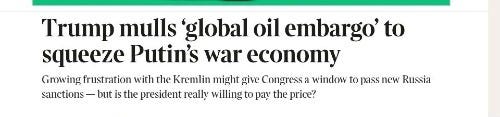
Lastly, in anticipation of Trump’s supposed “big announcement” on Monday, several MSM publications are reporting that Trump is preparing to launch an unprecedented global oil embargo against Russia:

https://www.thetimes.com/world/russia-ukraine-war/article/trump-global-oil-embargo-russia-r2pg8kw6t

It describes a fancifully unrealistic plan to shackle any country in the world that buys oil or uranium from Russia with a massive 500% tariff. The chances of this passing are laughable, as it would destroy the economies of the US and its allies, rather than harming Russia.

The squabbles over ‘control’ discussed last time rear their head again:

Senators have said they would be willing to grant Trump the power to waive the tariff for up to 180 days, provided there was congressional oversight. The White House is, however, insisting that Congress should have no power to intervene if the president decided to end the sanctions.

Maximilian Hess, a fellow in the Foreign Policy Research Institute, predicted Trump would baulk at the 500 per cent tariff in the bill, which would be equivalent to a global embargo on Russian oil.

Hess elaborates:

“As it’s written, in my view it’s just too strong to ever be used, unless Trump gets out there and says, ‘We need to face the risk that Russia poses to Europe and the globe and we have to accept oil prices of closer to $100 or maybe even higher’,” he said. “Which I just cannot see Trump doing.”

The reason Trump wants such control is because he’s merely using the threat of these laughable ‘sanctions’ to try and frighten Putin into concessions, and wants the ability to immediately pull out, TACO-style, as soon as it backfires. The neocon segment of Congress—Graham, Blumenthal, and co.—want to deviously ‘bake in’ the sanctions by having power over them, so that Trump is forced into a major confrontation with Russia; obviously, the freewheeling deep state moles in Congress cannot allow a US-Russian rapprochement and need to create fissures at all costs.

It is also why they recently ‘leaked’ the audio of his threats to bomb Moscow at an opportune time: they’re doing everything in their power to stir the pot and fan the flames of the narrative of confrontation to browbeat Trump into escalation against Moscow.

The big question is, does Trump have the backbone to stay the course?

Lastly:

Ukraine reports Russia has accumulated a record number of missiles—2,000 total:

Even as we speak, another major strike on Ukraine reportedly featuring hundreds of drones and a few dozen missiles is ongoing—all unopposed, as usual:

How are those Patriots coming along?


Russia Matters: Trump Threatens Putin With Tariffs, Arms Supplies to Kyiv, But How Serious Are His Threats?

Russia Matters, 7/14/25

  1. While hosting NATO’s SG Mark Rutte on July 14, President Donald Trump unveiled a deal with this alliance that would send weapons to Ukraine within days while also threating Russia with stiff penalties in his renewed effort to end hostilities between Russia and Ukraine. “We’ve made a deal today where we are going to be sending them [Ukraine] weapons and they [NATO countries] [are] going to be paying for them,” Trump was quoted by Wall Street Journal as saying in Rutte’s presence. During the same event the U.S. president also threatened Russia with “secondary tariffs” unless a deal to end the hostilities in Ukraine is reached by early September. “We’re going to be doing very severe tariffs if we don’t have a deal in 50 days, tariffs at about 100%, you’d call them secondary tariffs,” Trump was quoted by Financial Times as saying. Commerce Secretary Howard Lutnick later said Trump could choose to impose either tariffs or sanctions on countries that do business with Russia, according to Wall Street Journal. Last week saw Trump repeatedly state his unhappiness with Putin’s unwillingness to agree to an unconditional end of hostilities in Ukraine, promising a “major statement” on Russia on July 14. Thus, his July 14 threats came as no surprise, but they were also met with some skepticism. “It is unclear if… Putin will take Trump’s threat seriously,” Alexander Ward and his co-authors wrote in Wall Street Journal on July 14.“For a frequent flip-flopper like him [Trump], can anyone ever tell which flip or flop is for real?” Susan Glasser wondered in the New Yorker. “The president is a late and very reluctant convert to the approach of trying to confront and isolate Mr. Putin” and the approach he is taking “seems designed to keep him at least one arm’s length away from the conflict,” David Sanger and Maggie Haberman explained in New York Times. That Trump is “coming around on Ukraine” represents a decision that “isn’t isolationist or internationalist but realistic,” according to Peggy Noonan.
  2. “Russia’s factories have begun churning out vast quantities of attack drones over the past year, producing a deadly fleet that is now taking to Ukrainian skies in record numbers almost daily,” Matthew Luxmoore and Jane Lytvynenko reported in a July 10 article for Wall Street Journal. Writing for the same newspaper Jillian Kay Melchior also noted the surge in Russian drone production, as did Andrew Kramer of The New York Times. “As Russia’s defense industry continues to ramp up, military analysts expect Russia to routinely launch more than 1,000 drones per volley by autumn,” Kramer warned. These articles indicate that the mainstream U.S. media outlets are catching up with the recent changes in correlation of drone production in Ukraine and Russia in the latter’s favor. In the first and second year of Russia’s full-fledged invasion into Ukraine, such outlets as Wall Street Journal were reporting how use of drones by Ukraine helped to turn the tide in Kyiv’s favor while New York Times reported how “Ukraine has stayed ahead in the drones arm race.” In the third year of the war Forbes declared that “For the first time, Ukraine is launching more long-range drone attacks than Russia.” The coverage of the drone race began to change, however, in 2025. For instance, in January of this year, ECFR’s Ulrike Franke published an article on the web site of this think-tank that estimated that Russia was matching Ukraine’s pace of drone production. Five months later, the press was also noticing this change. For instance, The Times of London’s Anthony Loyd reported from Donbas: “Russia has taken the lead in the drone race, outproducing Kyiv in the manufacture and use of medium-range FPV drones and fiber optic variants that have changed the shape of the entire 1,200 km front line.” Loyd’s May 2025 article was echoed by Politico’s Veronika Melkozerova, who reported in June 2025, citing Zelensky himself, that “Ukraine produces about 100 long-range drones a day, while Russia has managed to scale up production to 300 a day and is aiming for 500.” Russian drone producers managed to boost long-range drone production from 15,000 in 2024 to more than 30,000 this year, as well as up to 2 million small tactical drones, according to Melkozerova.
  3. Volodymyr Zelenskyy’s decision to nominate first deputy prime minister Yulia Svyrydenko as his next PM is a victory for his powerful chief of staff Andriy Yermak for whom there appears to be little love lost in Washington. “Svyrydenko is considered a close ally” of Yermak, according to July 14 article in Financial Times. Apart from the new prime minister, changes are expected at education, health, culture, social policy and possibly finance, according to the Economist. The Economist reported on July 6 that a cabinet reshuffle is “imminent” and that is being driven by Yermak whose lecturing approach to diplomacy Americans despair at. While being allied with Yermak, Svyrydenko is also seen as having “strong ties with Donald Trump’s team after leading the minerals talks alongside U.S. Treasury secretary Scott Bessent,” according to Financial Times.

The War in Ukraine Has Shattered the West’s Digital-Age Delusions

by David Betz and Michael Rainsborough, The Daily Sceptic, 6/15/25

David Betz is Professor of War in the Modern World at King’s College London. Michael Rainsborough is Professor of Strategic Theory at the Centre for Future Defence and National Security.

For all the breathless commentary, one awkward truth has loitered beneath the surface of the Russia-Ukraine war, which is that most people beyond the immediate theatre of conflict don’t have any clear sense of what’s happening on the ground. The fog of war has been thickened not only by competing narratives along with fragmentary info-snacking YouTube clips of drone strikes, but by something more persistent — Western wishful thinking.

For nearly three years, a chorus of commentary penned by pundits whose proximity to the war — geographically or intellectually — is open to question have served up a diet long on optimism but short on evidence. A rotating cast of Atlanticists from Anne Applebaum to Timothy Snyder, along with just about every op-ed in the Daily Telegraph, have reliably assured readers that Ukrainian victory is in sight, or that Putin’s regime has been humiliated or teeters on the edge of collapse. These forecasts, rarely tethered to battlefield realities, have functioned less as analysis and more as morale management — designed to reassure rather than inform.

This faith-based commentary sits uneasily alongside the equally confident illusions that once animated post-Cold War Western military thinking. Western politicians and strategists imagined war in the digital age would be light, precise and swift — waged by lean expeditionary forces wielding smart weapons and networked command systems. The result, they hoped, would be relatively bloodless victories achieved from a polite distance, preferably before lunchtime.

Instead, they got Bakhmut.

As this short essay will seek to disclose, the war in Ukraine has shattered a generation of digital-age delusions. It has exposed the brittle realities beneath Western military thinking and underscored the extent to which the strategic balance has shifted—less due to enemy cunning than to Western self-delusion.

The End of History did not arrive. The Return of Artillery did.

The Digital Mirage

In short, digitalisation — once regarded as the West’s ultimate strategic advantage — has failed to deliver the political returns its proponents anticipated. The concept was deceptively simple: combine precision weaponry with real-time data and operational mobility to achieve swift, efficient and low-cost victories. In the words of one tract in the mid-1990s, the aim is to apply massive shock with minimal force, such that the enemy is stunned into compliance.

Yet war, as the Prussian philosopher of war Carl von Clausewitz long ago observed, remains a clash of wills — reciprocal, unpredictable and fundamentally political. It is not a frictionless exercise in systems management, nor a technological showcase. It is organised violence pursued for political ends. Always messy and brutal. And always resistant to tidy solutions.

What Western strategists often overlooked was a basic fact: adversaries adapt. And many of them have invested not in apps or digital platforms, but in mass, resilience and industrial depth.

The assumption that digital superiority would render conventional war obsolete, where the future of war belongs not to mass armies and tanks, but to decentralised networks and precision strikes’, has not merely proven false — it has been inverted. Russia and other actors have appropriated these same tools, stripped them of their idealistic framing and employed them pragmatically — effectively, economically and at scale.

The West, by contrast, became increasingly enamoured with the imagined virtues of the digital society: a realm where information moves at light speed and liberal pieties hitch a ride on the algorithm. Nowhere was this more evident than in the enthusiasm for cyberwarfare — an area long hyped, but whose strategic effects have often fallen short. Figures such as then-Prime Minister Boris Johnson notably proclaimed that such high tech was transforming the nature of conflict.

The practical outcome of actual warfare, however, has not been the digitalisation or dematerialisation of war, but rather its real-time mediation — live streamed, framed and packaged for distant audiences. In a hyper-connected world, conflict is increasingly staged for global spectatorship. But if the medium has changed, the consequences have not: war remains bloody, destructive and — for all the intrusion of high-tech drones and AI onto the battlefield — still deeply human. “Technology may change how we kill, but not why we kill or what killing does to us.”

The Return of Walls: Fortresses in the Age of Fibre Optics

We should recall the broader intellectual mirage in which Western military thinking once basked—a time of post-Cold War euphoria when history had allegedly ended and borders were passé. Remember when Francis Fukuyama serenely informed us that ideological conflict was over? When Zygmunt Bauman waxed lyrical about ‘liquid modernity’, Michael Mandelbaum speculated about the obsolescence of major wars and Kenichi Ohmae proclaimed the borderless world, flattened by markets and lubricated by technology?

Yes, well: these ideas have not aged like fine wine.

Far from dismantling fences and ushering in a frictionless utopia, the digital age has made fortification fashionable again. Border walls, missile shields and fortified strongholds are proliferating. Bunkers are booming — economically, if not always structurally.

And on the battlefield — from Gaza to Donbas — it isn’t data packets, viral hashtags, networks or narratives that are seizing territory. It’s bulldozers, concrete and men in trenches or ankle-deep artillery shell casings.

The war of the future, we were told, would be weightless, networked, almost antiseptic. While it is true that drone warfare has made a dramatic appearance as highly advanced form of surveillance and precision guided artillery, these new technologies have serviced very traditional modes of warfare. Instead of some new conception of war in the digital age, what we got instead was a flashback: steel, trenches and the long, grinding calculus of attrition.

War hasn’t dematerialised. It has reindustrialised — only now with high-definition targeting and better graphic design.

Ukraine: A Cautionary Tale in Three Acts and No Exit Plan

The Ukraine conflict was supposed to be a masterclass in Western strategic superiority — a proxy war in which Ukraine would draw upon NATO’s high-end technologysoft powereconomic leverage and moral confidence to reduce Russia’s ambitions to rubble. Instead, it’s begun to resemble a doomed product launch — overpromised, underdelivered and still limping along on the exhaust fumes of its own marketing, too costly to cancel outright and too awkward to acknowledge as a failure.

Let’s count the miscalculations:

  • Soft PowerMeant to win hearts and minds. But hearts, as it turns out, aren’t for sale — and minds are busy doomscrolling through drone footage on TikTok, or more often tuning out altogether. Influence, it seems, doesn’t flow so easily from Pride-flag waving embassies and finger-wagging hashtags.
  • Economic Warfare: The so-called ‘sanctions from hell’ were supposed to crush the Russian economy in record time. Instead, Russia’s GDP has outpaced much of the Eurozone, while Germany’s once-vaunted industrial base has gone into self-induced hibernation — collateral damage in a moral crusade that forgot to run the numbers.
  • Strategic Credibility: Once burnished by Cold War mystique, NATO’s reputation now wobbles somewhere between ceremonial relic and crisis PR firm. The alliance increasingly resembles a séance for departed strategic purpose — hands clasped around the table, muttering slogans, hoping the ghost of 1991 will manifest and tell them what to do. It lurches between virtue-signalling and threat inflation, unsure whether it’s meant to deter adversaries or simply reassure itself that it still matters.

The unspoken truth in all this is bleak but not especially complicated: strategically, Ukraine has already lost. So too — albeit less dramatically and more expensively — has Europe. And for anyone paying attention, this wasn’t an unpredictable ending. It was the opening scene, played out exactly as the script always hinted it would. Viewed alongside the other glittering triumphs of Western statecraft — Afghanistan, Iraq, Somalia, Libya, Syria — it raises the uncomfortable question: why does strategic failure keep happening and who keeps hiring these people? At this point, a moderately alert housecat could have produced a more coherent grand strategy — if only by knocking the relevant documents off the table before they reached Cabinet.

BRICS and Mortar: Realignments in a Shattered Order

One of the most egregious strategic miscalculations — and one that yet again should have been foreseen by anyone not still mainlining end-of-history optimism — was the West’s attempt to isolate Russia. In practice, this bold stand for ‘rules-based order’ only served to hasten the very multipolarity it once dismissed as a paranoid fantasy. China and Russia are now closer than at any point since the Brezhnev era. BRICS, once dismissed as a loose acronym in search of a purpose, is gaining unexpected traction — with countries like Turkey and Indonesia now eyeing membership as a potentially better seat at the global table. De-dollarisation, once confined to fringe economists and survivalist blogs, is edging into the mainstream.

Meanwhile, the West’s effort to turn the ruble into rubble instead left it suspiciously intact — at times more stable than a few G7 currencies. Meanwhile, the grand strategy to ‘cancel’ Russia economically has largely backfired, inflicting more damage on Western industry than even the most vodka-marinated of Kremlin plotters might have dared to dream. German manufacturing sends its regards — from behind a padlocked factory gate.

Geopolitically, the unintended consequence is a slowly forming Eurasian compact: one increasingly convinced that the West — at least in its EU-NATO incarnation — is decadent, distracted and no longer capable of setting the global agenda. It’s not quite the overturning of the world order, but it’s one where states feel they have greater options than merely to choose between Western modernity and pariahdom. One thing is for certain, it is not the world order that Washington or Brussels believe they are still running.

Mass Isn’t Dead. It Just Moved East

For years, Western military doctrine enshrined speed, agility and precision as the hallmarks of modern war. Mass, by contrast, was treated as a dusty artefact — something best left in museums next to the flintlock and the bayonet. According to one set of commentators: “Mass is no longer a requirement for victory. Information superiority and speed of command will displace attritional warfare.” Large-scale mobilisation, in other words, was seen as a clunky relic of industrial wars: too slow, too costly, and too reminiscent of the bad old days when wars actually lasted longer than a news cycle.

Then came Ukraine. And Gaza. And with them, the blunt truth reasserted itself: mass matters. Industrial capacity — measured not in white papers but in shells, drones and replacement parts — still wins wars.

The hard numbers from Ukraine are telling:

By contrast, the West struggles to supply even its own forces — let alone those of its Ukrainian proxy. The US production rate of SM-3 interceptor missiles, for example, is a grand total of 12 per year. That’s not a misprint. It’s barely enough to protect a single aircraft carrier, let alone a continent.

What we’re witnessing is not just a clash between Russia and Ukraine. It’s a collision between two theories of war: the Western model of information-age finesse, and the industrial-age brute force its strategists once declared obsolete. The former looks increasingly like a TED Talk. The latter, like it’s winning.

Manoeuvre vs Attrition: When Theory Meets Mud

Western military theory has long exalted manoeuvre warfare — rapid, fluid operations designed to outpace the enemy, strike weak points and collapse morale before a proper defence can even form. It’s a vision of war as ballet: swift and elegant, and preferably done by last orders at the wine bar. Attrition, by contrast, is treated as a kind of doctrinal embarrassment — too crude, too slow, too First World War.

But the battlefield, tells a different story.

Ukraine’s much-vaunted counter-offensives have bogged down in kilometre-deep minefields and trench networks that look like they were lifted from 1916. Russia’s static defences — dismissed early on as archaic — have proven not only resilient but maddeningly effective. Gaza, too, offers little comfort to the manoeuvrists: less lightning war, more bloodied crawl.

The promised revolution in precision warfare — guided missiles, smart bombs and real-time targeting — hasn’t rewritten the rules so much as underlined the old ones. ‘Smart’ weapons may hit what they aim at, but they don’t change the fact that the other side is still dug in, still shooting back, and often still there after the smoke clears.

What has emerged isn’t the war of tomorrow, but the war we thought we had left behind — less networked lethality and more Verdun with drones. And despite the glossy brochures, war, it turns out, still favours the side that can take a punch, not just throw one.

Operational Tempo: Fast, Dumb and Going Nowhere

Speed, we were assured, kills the enemy. Victory belongs to the swift. Wars must be fought fast, finished faster and ideally wrapped up in time for the next election cycle. The longer they drag on, the more politically toxic and strategically incoherent they become. But once again, theory has collided with reality — and reality, as usual, has no interest in being tidy, televised or tactically convenient.

From Iraq to Afghanistan to Ukraine, the West’s ‘fast’ wars have displayed an unfortunate tendency to turn into drawn-out strategic purgatories. Initial momentum gives way to mission creep, political drift and tactical improvisation dressed up as doctrine. Tempo without purpose quickly devolves into noise. Being able to react faster doesn’t help much if you have no idea what you’re reacting to — or why.

What we’re left with is movement masquerading as progress. Digital velocity, for all its dashboards and situational awareness apps, is no match for old-fashioned things like strategic patience, industrial resilience or political staying power. The West has become excellent at starting wars quickly. It has rather less to show when it comes to finishing them.

Information Wars and the Hollow Victory

Few phrases have received more adoration in recent years than ‘information war’: the idea of gaining advantage by protecting access to information flows, while destroying and disrupting those of the adversary. Think tanks, officials and consultants alike have extolled the virtues of strategic communicationsnarrative shaping and viral content as if policy papers and social media posting could substitute for tanks.

Ukraine, by almost every Western measure, has won the information war hands-down: cinematic footage, clever memes and Zelensky’s branded defiance — all flawlessly packaged for global consumption. Most recently, this spectacle was crowned in early June by the daring drone strike against Russia’s strategic bomber fleet deep inside its own territory.

Launched from modified civilian lorry containers, the operation thrilled the op-ed writers but carried rather less charm for anyone concerned with nuclear stability, risking as it does, the Strategic Arms Limitation Treaty and practically inviting Russian reprisals against Western targets. One can only hope Moscow — or any other future adversary — isn’t tempted to return the favour in kind. After all, there is a certain irony in Western commentators applauding such actions as bold and justified while assuming, quite serenely, that their own military bases will be sacrosanct.

But the point is though, that none of this moves the needle in Ukraine’s favour. It is Russia that occupies territory, fires more shells and steadily dictates the tempo of the war.

The paradox is hard to ignore: while Western commentators celebrated Kyiv’s narrative dominance and drone-delivered showmanship, Moscow focused on artillery. One side perfected the aesthetics of resistance; the other brought bulldozers and blasting tactics. It turns out that shaping perceptions doesn’t stop projectiles — and that going viral is no defence against shrapnel.

Winning the narrative, in other words, is not the same as winning the war. It may not even be relevant once the shells start falling.

The West’s Strategic Malaise: ‘Something Must Be Doneism’

Since the Cold War, Western wars have rarely been existential. They’ve been gestures — emotional reactions to tragedy, terrorism or televised horror. The political logic has been consistent, if not exactly strategic: be seen to act. It’s foreign policy as theatre — enough engagement to look principled, but not enough to get seriously hurt or to seriously imperil the national homeland.

The results speak for themselves. Libya, Syria, Afghanistan, Iraq — all launched with moral fanfare and media buzz, all ending in fatigue, withdrawal or the polite burying of lessons left unlearned.

Ukraine, however, is different. The stakes are higher. The adversary is stronger. And yet the habits remain the same. The West’s response has been a familiar mix: morally emphatic, logistically improvisational and industrially unsustainable. It’s as if NATO is attempting to wage a 20th-century land war on 21st-century terms — with 1990s stockpiles and attention spans measured in quarterly press briefings rather than prolonged campaigns.

In truth, many of these interventions seem designed less for the battlefield than for the curated stage of liberal respectability — crafted to win plaudits in opinion pages, panel discussions and policy forums where moral posturing always trumps material constraint. They are calibrated for the approval of the right-thinking, not the requirements of strategic success. Here, victory is optional, while virtue-signalling is mandatory.

Conclusion: Welcome to the Post-Post-Cold War

We were told the digital age would flatten borders, replace firepower with fibre optics and swap armies for narratives. Instead, we got trenches, mass mobilisation and a resurgent Eurasian bloc. It’s not quite the holographic future imagined by the PowerPoint prophets.

The West’s military models aren’t failing for lack of virtue, but because they’re built on expired assumptions. The future didn’t arrive on schedule — and the past, rather rudely, refused to stay buried.

What lessons emerge?

  1. Industrial capacity matters: You can’t tweet your way to artillery shells.
  2. Mass still wins wars: Precision is nice, but only if you have a lot of it.
  3. Soft power is not eternal: A civilisation unsure of itself can’t expect others to follow its lead.
  4. Digital illusions are just that: Cyberspace didn’t transcend the battlefield; it just added lag, disinformation and another excuse for inaction.

In the end, strategic success depends not on who reacts fastest or trends hardest, but on the dull, unglamorous verities that underlies modern war: production, patience and purpose.

And right now, those are in short supply west of the Dnieper.

Sylvia Demarest: How Corporations became people, money became speech, usury was legalized, and the civil rights movement was used to advance neoliberalism

By Sylvia Demarest, Substack, 7/6/25

Sylvia Demarest is a retired trial lawyer.

On May 7th this Substack published an essay titled: The Chicago School, law and economics, and the monopolization of the American economy. The essay discussed how the counter-revolution against the New Deal began at the University of Chicago with the organization of a Free-Market Study Group, how it progressed through the Mont Pelerin society, the Chicago School of Law and Economics, and various organizations, leading to the creation of neoliberalism and its takeover of our economy and legal system. This essay will further this discussion by reviewing the history that led to the judicial decisions creating corporate personhood, equating money with speech, dismantling the protections against usury, and allowing money to dominate our elections.

The end of “the great leveling” and the civil rights movement

The era between the New Deal and the rise of neoliberalism became known as “the great leveling”. This period was characterized by the historically low disparity between the wealthiest and the poorest people in our society. It was also a time of historically high economic growth, leading to the rise of a huge middle class in the USA.

Left out of this economic prosperity was a huge underclass of Black citizens burdened by economic and racial discrimination. The civil rights laws of the 1960’s were designed to address this discrimination, but the political backlash to these laws ended up undermining the political majorities that had voted for and benefited from the New Deal’s mixed economy.

This era was also characterized by anti-war fervor, race-baiting, and the rise of a segment of society labeled the “Silent majority”. After the passage of civil rights legislation in the 1960’s, Nixon’s “Southern Strategy” used the backlash to these laws to separate southern whites from the Democratic Party. Sadly, it was racial fear, resentment, and the militarism of the Vietnam War, that killed the political consensus behind the New Deal. Americans did not realize they were voting for laissez-faire economics, because Nixon was not campaigning on free market ideology, but on grievance and fear. The policy was bought and sold politically as a promise to stop the protests, stop the riots, and stop a civil rights movement the white majority believed had gone haywire, by opening public accommodations, and using bussing to integrate all white schools.

Economists in the emerging school of neoliberalism such as Alan Greenspan, Gary Becker, George Stigler, and Milton Freedman were suspicious of civil rights laws, despite finding discrimination distasteful. Economists, such as Gary Becker and Geroge Stigler argued that the answer to discrimination was the free market. In other words, government intervention in the economy had created discrimination. In a free market, they assumed, discrimination would die out because it created excess costs for the discriminatory white employer. These theories were wrong.

These economists were dreaming, there was no theoretical society where markets were efficient, opportunity was equal, and trade was based on price. Under Jim Crow, discrimination was not a cost, especially to whites who had long benefited from racial discrimination. Discrimination had created its own market forces. But, unfortunately, the damage to the New Deal consensus was done.

Neoliberalism re-defines corporate social obligations

Corporations are legal constructs created by social agreements and enforced by state law. The Constitution gives states the ultimate power over chartering and regulating the corporations they create. Corporations were historically seen as having public duties, not only because most had benefited from public investments, government contracts, and trade protections, but because state charters mandated these duties. In 1969 the chairman of the Securities Exchange Commission noted the power and influence of corporations in society urging them to “meet the needs of the nation as a whole.”

The civil rights crisis led to discussions about corporate civic obligations. These discussions were influenced by the publication of popular business books in the 1950’s and 1970’s. The outside Counsel of General Motors at the time, Donald Schwartz a partner at Williams & Connolly, noted that “social concerns should not be an afterthought but central to the corporate mission. “

Neoliberals such as Milton Freedman disagreed declaring that such statements were preaching nothing “but unadulterated socialism” that was “undermining free enterprise”. Freedman issued one insult after another; the idea of corporate responsibility was “faddish and unscientific”, “lacking in rigor”, and undermining the “foundations of a free society.” Friedman concluded that “corporations have no higher purpose than maximizing profits for their shareholders.”

Lewis Powell, the Powell Memo, and Powell’s tenure on the US Supreme Court

In February of 1971 one of the most significant documents in the neoliberal transformation of America was written by Lewis Powell. Powell, a well-respected corporate lawyer, issued a memorandum titled: “Attack On American Free Enterprise System”. The memo was addressed to Eugene Sydnor, Chairman of the US Chamber of Commerce. Powell claimed that the American economic system was “under attack”. The victim of the attack was the “American business executive”. Attacking consumer advocate, Ralph Nadar, directly Powell claimed that “economics” had to be protected from Nadar’s “economic illiteracy” about “tax loopholes” and other anti-corporate rhetoric. Putting the words rich and poor in quotations, Powell warned that setting “business against the people” was “the cheapest and most dangerous kind of politics.”

Powell advocated two approaches to countering democratic demands on corporations. First, he advocated a long-term plan to change hearts and minds through propaganda via education and the media. Second, Powell advocated the quiet accumulation of legal and political power through legal changes hidden from public view. The first was addressed by the Chicago School of Law and Economics, and other organizations, including textbooks, publications, seminars, and training like-minded people to serve as scholars and jurists, The second was to change law itself through changes in judicial jurisprudence.

The US Chamber of Commerce organized a task force of 40 executives, funding was raised, and plans were set in motion to implement Powell’s recommendations. For example, in 1972 the Business Roundtable was organized and in 1973 the Heritage Foundation was founded. Other organizations founded as the result of the Powell Memo include, the American Legislative Exchange Council (ALEC) in 1973, the Cato Institute in 1977, and the Manhattan Institute in 1978. Money from Coors, John Olin, the Bradelys, the Koch Brothers, and other wealthy businessmen provided long-term financial support for these efforts and the scholars and functionaries who carried out the resulting plans. A permanent structure supporting neoliberal policy and reforms was organized. This structure is still active today–all funded by tax deductible charitable contributions under 501 c 3 of the Internal Revenue Code.

Lewis Powell on the US Supreme Court

Two months after issuing his memo, Powell was nominated by President Richard Nixon to become an associate justice of the US Supreme Court. Powell was 65 years old when he was nominated, too old to really take advantage of life tenure, but such tenure was not the reason for his appointment. Powell was appointed to inject changes in the law in specific areas, banking, corporate power, corporate personhood, money in politics, and interest rates. Powell proved to be extraordinarily effective.

Once Powell was confirmed in1972 he began to quietly transform the law. Over time Powell planted neoliberal principles into the law, empowering corporations while curtailing state power. Powell planted ideas into court jurisprudence that did not manifest for years. This was despite being considered a moderate. For example, the Burger Court decided Roe v. Wade, in 1973, with Powell voting with the majority.

Commercial Speech: One of the first cases providing Powell the opportunity to direct the law, was a case brought by Ralph Nader’s organization challenging a Virginia law prohibiting pharmacies from advertising drug prices. The case was Virginia State Pharmacy v. Virginia Citizens Consumer Council Inc. The argument was that unlisted prices were harmful to consumers who could not seek better alternatives. The fatal error was to argue the case on First Amendment grounds, that prices were information the public wanted to hear. This allowed the First Amendment to be applied to commercial speech. While the consumer group did not ask the court to determine that prices (corporate speech) was protected by the First Amendment, they handed the Court the opportunity to make that distinction. The majority opinion, written by Justice Blackmon, opened the door through which Powell would maneuver the First Amendment toward the elimination of any distinction between corporate and individual speech.

Rehnquist was not fooled and dissented lamenting the elevation the advertisement of products to the ideological market place of ideas, seeing this as an over-extension of the First Amendment. Rehnquist concluded by arguing that the majority had not only failed to accord proper weight to the judgment of the legislature but that the protection of the First Amendment ought to be limited to political and social issues.

Campaign limits: The next significant case in 1976 was Buckley v. Valeo. The issue before the court was how much Congress could regulate campaign contributions without running afoul of the First Amendment. The case did not deal with “corporate speech” but with limits on spending by wealthy people on political campaigns. A complex 150-page opinion by the 5-person majority (including Powell) upheld many of the mandates but struck down the limits on individual spending. This meant that a person or group, including the candidate, could spend as much money as they wanted on a campaign. The majority waived away any government interest in protecting elections from “the corrosive influence of money” or in “equalizing” democratic participation, holding that the idea that the government could restrict the speech of some elements of society to enhance the voice of others was “wholly foreign to the First Amendment”.

The dissent was not fooled. Justices Marshall and White argued that the majority had evaded the law’s purpose and had enabled endless spending. Marshall argued that even the appearance that the political arena was the exclusive province of the wealthy was a valid governmental concern. Unfortunately, after Buckley the government’s hands were tied.

Corporate Free Speech: In 1977 the case of First National Bank of Boston v. Bellotti came before the court. The issue was a long-standing Massachusetts law that prohibited corporate spending on ballot initiatives unrelated to the company’s business. The case divided the court. Some justices felt that since corporations were creatures of state law, the state had the right to regulate them. Rehnquist again raised the same red flags he had raised in Virginia Pharmacy and quoted Chief Justice John Marshall who had clearly distinguished the First Amendment rights of corporations from those of natural persons.

Powell sprung the trap, pointing out in a memo to the court that it was “too late” to hold that persons who elect to do business in the corporate form could not express opinions through the corporation, and for the court to turn its back on this now would be a serious infringement of corporate First Amendment rights. Powell wrote the opinion stating that there was “no question” that corporations had First Amendment rights, but how far those rights extended. Powell’s response was they extend very far.

In the case of Central Hudson Gas and Electric v. Public Service Commission of New York in 1980, Powell took the opportunity to carry the court further along in interpreting the First Amendment as a shield for corporations against state regulatory laws.

The progression of cases: Each of these decisions can be seen as a step-by-step process leading to the 5-4 decision in 2010 in Citizen’s United v. Federal Election Commission, eviscerating federal laws on campaign spending and endorsing corporate personhood and First Amendment rights for money as majority jurisprudence. In doing so the court relied heavily on Buckley.

The progression is as follows: Buckley cleared away all constraints on political spending by wealthy donors and groups; while Virginia Pharmacy, Bellotti, Central Hudson Gas, and Citizen’s United extended free speech protections to corporations. Citizen’s United cleared the last remaining barriers protecting democracy from the corrupting influence of money. Now we have “dark money” and “soft money” as well as protection for commercial speech and for money, in effect, using the First Amendment to achieve deregulatory goals amounting to theft, waste, and graft. This is also known as empowering “rent seeking”. This kind of corruption increasingly crowds out productive activity.

Neoliberalism has succeeded, and in the process, has corrupted the First Amendment and the Constitution.

The impact on campaign spending: After the Buckley case the amounts spent on presidential campaigns rose from $20 million in 1960–to $107 million in 1980–to $186 million in 1992–to $300 million in 2000–to $696 million in 2004–to $1 billion in 2008, to $2 billion in 2016–to $14.4 billion in 2020–to who knows how much in 2024. These amounts do not include “dark money” nor the cost of other campaigns at the local, state, and federal level.

State laws on corporate campaign donations: Many states, including Montana, had laws on their books banning corporations from contributing to political campaigns. Montana’s law was passed in 1912. In the case of American Tradition Partnership Inc v. Bullock, the Montana Supreme Court upheld the constitutionality of that law. In 2012 a 5-4 decision the United States Supreme Court reversed that decision citing United Citizens as precedent. The Brennan Center had submitted an Amicus supporting the law, to no avail. There are no longer any state laws restricting corporations from spending money on political campaigns.

Usury and interest rates: For decades many states had limits on the interest that could be charged on debt. The case of “Marquette National Bank of Minneapolis v. First of Omaha Service Corp.” decided in 1978 established that state anti-usury laws cannot be enforced against nationally chartered banks based in other states. This allowed banks and other business to charge higher interest rates. This ruling enabled banks to offer credit cards with interest rates that exceed state limits. One state that allowed unlimited interest to be charged was South Dakota, where most of the credit card companies are now domiciled. This means credit card customers who cannot pay their balances in full every month, are charged as much as 35% interest on their balances.

The centrality of Alan Greenspan, and the Fed, to the survival of neoliberalism

It is difficult to express the dichotomy between what economists like Alan Greenspan, Milton Freedman, George Steigler were preaching about the “free market” and the actual results of these policies. The example of Greenspan’s economic legacy clearly demonstrates this dichotomy.

Before the outbreak of the Watergate Scandal, President Nixon asked Alan Greenspan to head up the President’s Council of Economic Advisors. By the time Greenspan took the job in 1972, Nixon had resigned. Greenspan remained part of the inner circle of presidential advisors for every subsequent president except for Jimmy Carter (1976-1980). Perhaps no other individual left more of a mark on the US and the global economy than Alan Greenspan.

Greenspan was made Chairman of the Federal Reserve by President Ronald Reagan in 1987–he served until 2006. By the time he left office, Greenspan held more power over global markets than any president he had served.

Here’s Mehrsa Baradaran:

“Greenspan’s legacy as Fed chairman was a financial system so reliant on Fed support that it is near impossible today to delineate where government economic policy ends and financial markets begin. In crisis after crisis, Greenspan’s policy “stabilized” the market, which led banks to take risks with confidence that the Fed would step in to save them, if necessary. The libertarian economist who once convinced Nixon that the only solution to America’s apartheid regime was “to help the Negro help themselves” took a much more helpful stance towards the market. Each time a crisis loomed, Greenspan plied banks with loans, bought distressed assets to place on the Fed’s balance sheets, lowered interest rates, purchased Treasury bonds to boost bank profits, and promised any“backstops” necessary to return banks to profitability. The measures were so common that they came to be called “the Greenspan put”.

The policies followed by Alan Greenspan were completely different from the free-market rhetoric employed by the neoliberals. The result of Greenspan’s policies? Wall Street profits are guaranteed by the public, and wealth is transferred from the bottom to the top of the economy. Meanwhile, the risk of loss is transferred from the wealthy to public. This is the exact opposite of what neoliberalism promised.

Neoliberalism should be seen not as a reaction to socialism abroad or Keynesianism at home, or even as a backlash against the Civil Rights movement, but as a clever way for entrenched power to gain and keep wealth and power.

Conclusion

The contribution of people like Alan Greenspan and Lewis Powell to our current political and economic reality has been enormous. Lewis Powell contributed to the creation of an infrastructure supporting neoliberalism that endures to this day, making political and economic reforms more difficult. Justice Powell contributed to a jurisprudence that gives corporations the same constitutional protections as people and deems the spending of money equivalent to speech. This jurisprudence has turned our democracy into an auction were politicians and policies are sold to the highest bidder. Yet, many of these decisions was by a bare majority of the court, 5 to 4, and could be reversed by a similar majority.

There is dwindling public support for neoliberal policies or for the corrupting influence of money in politics. Unfortunately, the public is uninformed about the history of how these policies and opinions came about. If properly informed, there is little doubt the vast majority would support serious reforms in every area discussed in the Substack. This is why education and discussion are so important. Please, help spread the word by encouraging your friends to sign up for a free subscription to this Substack so we can continue to explore where we are, how we got here, and what can be done to reform our politics and economics.

***

On a related note, The Lever reported on July 8th the following:

Citizens United 2.0, here we come. While corporate interests spent a whopping $2 billion secretly influencing the 2024 election, the dark money problem is poised to get even worse. That’s because the Supreme Court has agreed to hear a case this fall that could abolish some of the last barriers separating political candidates and wealthy donors’ unlimited buckets of cash. National Republican Senatorial Committee v. Federal Election Commission, which originated from a lawsuit by now-Vice President JD Vance, is a corruption bomb designed to allow SCOTUS to permit more unfettered, untraceable corporate election influence than it did in its landmark 2010 Citizens United decision. 

Friends in high places. While Vance has since exited the case, he and his colleagues filed suit in 2022 against federal restrictions limiting coordination between national party committees and candidates. If those rules are abolished, corporate interests could spend freely on these committees as an end-run around limits on how much they can directly give candidates. While the suit lost in the Sixth Circuit Court of Appeals, several of the judges agreed with its argument and urged SCOTUS to take up the case — including one who formerly employed Vance’s wife, Usha Vance, when she worked as a law clerk.

The gang’s all here. Before SCOTUS took up the case, a who’s who of conservative heavyweights filed amicus briefs urging it to do so. That included not just the Republican Governors Association and Sen. Mitch McConnell (R.-Ky.), but also the U.S. Chamber of Commerce, D.C.’s most powerful business lobbying group, and the Institute for Free Speech, a nonprofit funded by the Leonard Leo-helmed dark money network that helped install five of the six current conservative justices. Even the Trump Justice Department joined in, admitting in its brief that while it “has a longstanding policy of defending challenged federal statutes,” the campaign finance law in question “violates core First Amendment rights.”

Get ready to rumble. SCOTUS also allowed three major Democratic groups — the Democratic National Committee, the Democratic Congressional Campaign Committee, and the Democratic Senatorial Campaign Committee — to intervene in the high-stakes case. Depending on the results, the decision could further corporate power’s decades-long master plan to legalize corruption. As one Sixth Circuit judge warned, the case has the potential to allow “the Supreme Court to rework campaign finance, First Amendment, and constitutional law in new and audacious ways.”

Reporting contributed by Joel Warner