Intellinews: Why Russia’s economic model no longer delivers

I’m sure the Russian economy has its problems, but I can’t help but note that every time western analysts predict doom and gloom it doesn’t really materialize. – Natylie

By BNE Intellinews, 7/25/25

At this year’s St. Petersburg Economic Forum—a once-prestigious event that has grown increasingly insular—Russian economic officials faced uncomfortable questions about the country’s future. In a rare moment of candour, Economy Minister Maxim Reshetnikov acknowledged that Russia may be heading into a recession. The moment captured the tension within a system forced to sustain a militarised economy under global isolation and increasingly constrained resources.

“This recession is not a flaw—it’s a feature of Russia’s policy of militarisation,” said Elina Ribakova, senior fellow at the Peterson Institute for International Economics in a recent paper. “It reflects the trade-offs of prioritising defence, not just of national interests, but of the regime itself, over long-term development.”

Russia’s economy has shifted dramatically since its full-scale invasion of Ukraine in February 2022. An initial contraction in 2022, softened by high commodity prices and support from third countries, was followed by a rebound in 2023 and 2024 driven by state spending, credit expansion and the defence sector. But as Benjamin Hilgenstock of the Kyiv School of Economics Institute, a co-author of the same paper, noted, “this was never sustainable growth—it was overheating masked as recovery.”

Signs of strain began to emerge by mid-2023, with inflation soaring from historic lows, interest rates peaking at 21%, and growth narrowing to just 1.4% y/y in early 2025 after two years of strong 4.1% growth. “This actually meant a 0.6% contraction from the previous quarter,” said Hilgenstock. “It’s the first quarterly drop since 2022—and likely not the last.”

It now looks like the military spending stimulus has been exhausted and the economy has hit a hard ceiling. Labour markets are drum tight (at just 2.3%it is alarmingly low for any emerging market); productivity is faltering, and the budget is under increasing stress. By the end of 2024 and in early 2025, signs of economic deceleration were clear and even the military-industrial sector began to stagnate.

“Despite much talk at the June St. Petersburg Economic Forum, neither monetary nor fiscal policy can deliver the deep structural transformation that genuine reforms and investment-driven growth can achieve. However, Russia neither can, nor appears to want, to rejoin the global economy as an open, market-based system. Without a strategic pivot, the space for sustainable growth narrows,” the authors say.

Rosstat reports the contraction has been driven by falling activity in mining, trade, real estate and leisure, which growth in agriculture, manufacturing and public administration were not able to offset.

The Ministry of Finance (MinFin) has already tripled its forecast for this year’s federal budget, albeit to a relatively modest 1.7% of GDP, but the federal deficit had already reached RUB3.4tn ($38.5bn) by May—nearly 90% of the full-year target.

And finances have been hit by falling oil prices after OPEC+ decided to put in a series of production hikes, largely to punish Kazakhstan that has been cheating on its quotas this year. Oil and gas revenues, which still account for about a quarter of revenues and remain crucial to the budget, dropped 14% in the first five months of 2025. The MinFin had based its revised budget on an oil price of $56 per barrel, but average prices in May were closer to $51.

“If oil prices remain moderate and sanctions enforcement tightens, the fiscal outlook worsens,” Ribakova said. “Russia is not just fighting a war—it’s trying to finance it with shrinking room for manoeuvre.”

Liquid assets in the National Wealth Fund were down to RUB2.8tn ($31.7bn) in June —less than the projected deficit— but have recently been replenished to bring the total up to around RUB4 trillion – a little more than projected deficit. Still, MinFin is increasingly reliant on the domestic bond markets to fund its spending. With foreign investors gone and banks strained by lending demands, the central bank has had to prop up demand via repo operations.

“The military sector is protected, but the rest of the economy is bearing the cost,” said Hilgenstock. “Rising rates hurt consumer spending and investment outside the defence sphere.”

Meanwhile, promised reforms remain elusive. Russian President Vladimir Putin called for structural transformation in his 2023 address, but “where is it?” asked Andrey Makarov, chair of the Duma’s Budget and Tax Committee, at the SPIEF forum. “Fewer goods, rising prices and declining quality—that’s what we see.” Moreover, there is an ongoing debate on whether the official inflation figures may be understated, raising concerns about the true scale of economic imbalances, the authors point out.

Ribakova argued that this outcome is by design, not accident. “The redistribution of wealth to regime loyalists and waves of nationalisation have crushed the investment climate. No one sees profit here anymore—not foreign companies, not even the domestic firms shielded from competition.”

Even China has approached economic engagement with caution, providing consumer goods and military inputs rather than capital investment. The defence sector, though heavily subsidised, remains unprofitable, with little benefit for broader productivity.

“Russia is not collapsing—but it is grinding itself down,” Hilgenstock said. “Its ability to continue depends on oil prices, sanctions enforcement, and whether geopolitical developments force a shift in policy.”

Ribakova added: “Sanctions relief won’t guarantee recovery, but it could let banks lend again and businesses invest. Without that, Russia faces a future of stagnation, even as it spends itself deeper into war.”

The Kremlin has been fighting back and CBR governor Elvia Nabiullina’s unorthodox experiment to bring down inflation by non-traditional and non-monetary policy methods seems to be working. From over 10% at the end of last year, inflation is not falling faster than expected to 9.2% in July. The CBR has already cut rates by a surprise 100bp in June and just cut again by 200bp at the July monetary policy meeting. The regulator says, providing inflation continues to fall, it could cut by another 300bp over the next three meetings this year. It seems that the Central bank has changed tactics and is now more worried about the slowing economy than rising prices.

MintPress News: Israel’s Biggest US Donor Now Owns CBS

By Alan McLeod, MintPress News, 8/7/25

After reaching an agreement with President Trump, David Ellison—the son of the second-richest man in the world, Larry Ellison—has acquired Paramount Global, the media giant that owns CBS News.

Larry Ellison, the largest private funder of the Israel Defense Forces, is deeply tied to the Israeli national security state and counts Prime Minister Benjamin Netanyahu among his closest friends.

David has already announced significant changes at CBS, promising “unbiased” news coverage and “varied ideological perspectives,” which are widely understood to signal a shift toward right-wing, pro-Trump coverage. Worse still, Bari Weiss, a journalist with a long history of zealous pro-Israel advocacy, is being considered as the network’s new ombudsman, shaping its political direction, precisely because of her “pro-Israel stance.”

MintPress News examines Ellison’s close ties to both Trump and Israel, Weiss’s extensive career as Israel’s most vocal supporter in the U.S., and what this means for the future of free and diverse speech in America.

Israel’s Man In Silicon Valley

Although Skydance, Ellison’s media empire, is officially headed by David, it is well understood that father Larry holds both the purse strings and the reins of power. With a net worth of $301 billion, placing him second on the Forbes Real-Time Billionaires Rankings, Larry made his fortune by founding tech giant Oracle.

Oracle started as a project for the Central Intelligence Agency. Indeed, it is named after Project Oracle, a 1970s CIA operation on which Ellison worked. For some time, the CIA was Oracle’s only customer, until it began to win contracts with other agencies of the U.S. national security state. Today, although Oracle’s customer base is much wider, it maintains its role as the privatized face of the CIA.

Yet if Oracle is close to Washington and Langley, it is perhaps even more intimately tied to the State of Israel. An avowed Zionist, Ellison has worked tirelessly to advance Israel’s political project. Among his closest personal friends is Benjamin Netanyahu, with whom he vacationed on his private island in Hawaii. Ellison was so impressed and confident in the Israeli prime minister that he offered him a seat on his company’s board, replete with a salary of $450,000.

While Oracle has signed multiple lucrative contracts with the Israeli national security state, Ellison himself has personally bankrolled the Israeli Defense Forces, giving tens of millions of dollars to the Friends of the IDF, an organization that purchases equipment for the Israeli military. This included a $16.6 million pledge (the largest single donation the group has received) to build a new training facility for soldiers defending what he called “our home.” As Ellison explained:

In my mind, there is no greater honor than supporting some of the bravest people in the world, and I thank Friends of the IDF for allowing us to celebrate and support these soldiers year after year. We should do all we can to show these heroic soldiers that they are not alone.”

Oracle sees itself as an activist organization, one whose goal is the advancement of the Israeli colonization project. Safra Catz, the company’s Israeli-American CEO, bluntly explained that any employees uncomfortable with supporting a genocide should simply quit. “We are not flexible regarding our mission, and our commitment to Israel is second to none,” she said, adding:

This is a free world and I love my employees, and if they don’t agree with our mission to support the State of Israel, then maybe we aren’t the right company for them. Larry and I are publicly committed to Israel and devote personal time to the country, and no one should be surprised by that.”

For a deep dive into Oracle and its connections to both U.S. and Israeli power, read the MintPress News investigation, “Openly Pro-Israel Tech Group Now Has Control over UK’s Most Sensitive National Security Data.”

CBS’s New Censor

Thus, the news that the son of the world’s second-richest man – one with such close connections to U.S. and Israeli state power – is purchasing one of America’s most influential news outlets should already worry anyone who cares about a free and independent press.

However, the news that the Ellisons are planning to buy out Bari Weiss’ publication, The Free Press, and give her control over the newsroom at CBS is even more startling. As part of the package to rubber-stamp the deal, Skydance had promised to hire Weiss as an ombudsman to address political bias and stamp out diversity, equity, and inclusion (DEI) practices.

Weiss is a highly controversial figure in the media world, known primarily for her stridently pro-Israel views and for attempts to popularize reactionary, anti-woke thinkers and opinions into the American mainstream. Her positions on the Middle East appear to have landed her the job. As The Financial Times noted, “Weiss has won over Ellison partly by taking a pro-Israel stance, according to people familiar with the matter.”

Weiss will be a “key voice” at CBS News, with one insider source telling The New York Times that she will have “an influential role in shaping the editorial sensibilities” at the outlet.

The news of what some fear will amount to a pro-Israel censor mirrors recent events at TikTok. The social media giant has recently hired former IDF soldier and Israel lobbyist, Erica Mindel, to oversee its online hate speech policy, with particular regard to antisemitism.

Mindel is far from the first former Israeli official parachuted into a position of power at the company, however. A MintPress News investigation revealed that in November 2023, TikTok hired Reut Medalion, a former Israeli intelligence commander, as its global incident manager. Considering what Israel was doing at that time in Gaza, it is fair to wonder what sorts of “global incidents” the ex-spy was working on.

These moves appear to be attempts to placate the Trump administration, which banned TikTok in no small part due to the effect viral videos of Israeli war crimes were having on public support for Palestine. Trump himself tried to force through a sale of TikTok to an American buyer. His close friend, Larry Ellison, was his preferred candidate. “I’d like Larry to buy it,” he said.

Bari Weiss’s Long, Controversial Career

Weiss first came to notoriety while still in college, where she founded an organization that accused Muslim and Arab professors of anti-Jewish racism, attempting to have them fired. Chief among these was renowned Jordanian scholar Joseph Massad, whom Weiss accused of intimidating her and other pro-Israel students during classes. The attempt failed, but it put Weiss’ name on the map. After finishing college, she secured prestigious jobs in Israeli media and managed to parlay those into columnist positions at The Wall Street Journal and, later, The New York Times.

It was at The Times where Weiss introduced reactionary academics to a broader, liberal audience. In an influential article entitled “Meet the Renegades of the Intellectual Dark Web,” she profiled a number of individuals, including Jordan Peterson, Sam Harris, Dave Rubin, Douglas Murray, and Bret Weinstein, all of whom have pushed conservative or even far-right ideas, and nearly all of whom have been passionate supporters of Israel’s actions in Gaza and beyond.

In 2020, however, she spectacularly left her New York Times sinecure, claiming that the organization was an echo chamber of leftist views. The following year, she started a Substack blog that would later be renamed “The Free Press.”

Since its beginnings, journalist Branko Marcetic has noted, The Free Press has been among the loudest supporters of Israeli actions, spreading what he calls “insidious propaganda” and “outright disinformation.”

In 2021, Weiss defended the slaughter of over 50 Palestinian civilians, including children, as “Zionism’s dream turned into the reality of self-determination,” by a state “surrounded by enemies making hard decisions about how to protect its citizens.” She had previously blamed rising antisemitism in Europe on Muslim immigration.

In May 2024, The Free Press falsely reported that the United Nations had “admitted” that Gaza’s civilian death toll was vastly lower than previously claimed. It wrote that mass starvation is “pro-Hamas propaganda,” despite even President Trump acknowledging the reality. And it claimed that an Israeli massacre of Palestinian aid seekers did not happen.

It has also repeatedly attempted to shield Israel from blame over its attacks on health centers, claiming that Hamas itself might have destroyed the al-Ahli Hospital. Yet Weiss herself appeared to justify attacks on other Gaza clinics.

“Every Palestinian knows [the al-Shifa hospital] is full of [armed militants], but nobody can talk,” she wrote on Twitter, referencing a Free Press interview purporting to be with an anonymous Gaza resident.

Targeting Palestinians, Wikipedia

It is even possible that Weiss’s actions resulted in deaths. In October 2023, Weiss singled out a joke from Gazan writer and educator Refaat Alareer made in response to the outlandish (and debunked) claim that Palestinian militants had burned an Israeli baby alive during the October 7 attacks.

“Here is Refaat Alareer joking about whether or not an Israeli baby, burned alive in an oven, was cooked ‘with or without baking powder,’” Weiss wrote.

Alareer was subject to a torrent of abuse and stated that Weiss’s words had put a target on his back. “If I get killed by Israeli bombs or my family is harmed, I blame Bari Weiss,” he said, adding, “Many maniacal Israeli soldiers already bombing Gaza take these lies and smears seriously and act upon them.” Barely one month later, Alareer was assassinated in a deliberate Israeli airstrike.

Another target in Weiss’s sights is Wikipedia. Since the online encyclopedia labeled the pro-Israel pressure group the Anti-Defamation League as an unreliable source, The Free Press has been on a campaign against it. Calling it a “propaganda site,” The Free Press has joined forces with Trump’s Department of Justice to remove Wikipedia’s nonprofit status to pressure it into becoming more pro-Israel.

“Bari could not have chosen a more Orwellian term for her authoritarian news outlet taking a wrecking ball to Western institutions on behalf of Israel,” wrote journalist Ryan Grim.

The Free Press certainly has many powerful backers, having drawn investment from venture capitalists such as Marc Andreessen and David Sacks, as well as from former Starbucks CEO Howard Schultz.

Yet the price being quoted to Skydance for the sale of what remains little more than a Substack blog is remarkable: between $200 million and $250 million. For context, in 2013, Amazon founder Jeff Bezos paid $250 million for The Washington Post, one of the world’s most widely read and most influential news outlets.

Major Changes at CBS

While Weiss’s mission at CBS News appears straightforward, the organization is far from a hotbed of pro-Palestine sentiment. The network repeated highly dubious Anti-Defamation League claims of a supposed wave of antisemitism sweeping across America, and constantly uses Israeli talking points, such as adding the label “Hamas-run” when describing the Gaza Health Ministry.

A MintPress News investigation found that it has also hired a myriad of former Israeli soldiers and lobbyists to produce its news. Gili Malinsky, for example, was a commander in the IDF’s public relations department, leading a unit dedicated to communicating the Israeli military’s story with the outside world. She also worked at the Friends of the IDF before accepting a job as a staff writer at CBS.

Malinsky is not alone. Erica Scott, CBS News’ editorial producer, was formerly the Anti-Defamation League’s media and communications specialist. Betsy Shuller, another CBS News producer, previously worked as a public relations associate at Hillel International, a pro-Israel group.

Nevertheless, it appears that placating Trump by promising a more right-wing editorial line was part of the deal to secure the administration’s approval of the gigantic media acquisition. In addition to Weiss, Skydance has vowed to end all DEI policies at the company. Furthermore, it agreed to pay Trump a $16 million settlement regarding a defamation lawsuit he launched last October against its flagship news and politics show, “60 Minutes.” Many have seen this action as little more than a payoff. Liberal comedian and talk show host Stephen Colbert described the move as a “big fat bribe.” Just days afterward, Paramount announced it was canceling Colbert’s long-running CBS show.

Others have chosen to jump before they were pushed. Citing a loss of journalistic independence, “60 Minutes” editor Bill Owens stepped down in April. More recently, CBS News chief, Wendy McMahon, left, citing an impossible work environment and a changing political outlook.

“Resistance” Media Embrace MAGA

The Ellison CBS acquisition reflects broader developments in a rapidly changing U.S. media ecosystem, as the Trump administration’s hardline tactics prompt the press to bow to its demands. Earlier this year, CNN executives announced they would shift their political outlook from pro-Democrat to more centrist, explicitly instructing their employees not to criticize Trump. In January, the network’s CEO, Mark Thompson, held multiple meetings with editors, instructing them to be “fair-minded” with Trump and not to “pre-judge” his second term in office. Anchors were also told not to “express outrage” during Trump’s inauguration. Several key CNN faces, including anchor Jim Acosta (who lost his White House press credentials after a spat with Trump), left the network.

MSNBC hosts Joe Scarborough and Mika Brzezinski, often seen as the faces of the Democratic “resistance” to Trump during his first term in office, publicly stated that they were changing their editorial stance towards the president. “Joe and I realized it’s time to do something different,” Brzezinski explained to their viewers. “That starts with not only talking about Donald Trump, but also talking with him,” she added, revealing that the pair had traveled to Mar-a-Lago to meet with the incoming president personally.

Other networks that have not adapted have perished. Earlier this week, the Trump administration cut its funding to NPR and PBS, with both networks facing closure in the near future. A similar Trump power play also led to the shutdown of Voice of America, only for it to be reborn in June under different leadership and a new political outlook.

Likewise, social media has gone through a similar transformation. In January, Meta CEO Mark Zuckerberg announced that his platforms (Facebook and Instagram) would be “prioritizing free speech,” and would move their content moderation operations from California to Texas, where there is less concern about “the bias of our teams.”

He also noted that former U.K. Liberal Democrat Deputy Prime Minister Nick Clegg was being replaced as the company’s President of Global Affairs by Trump loyalist and former White House Deputy Chief of Staff Joel Kaplan. Close Trump confidant Dana White, the CEO of the Ultimate Fighting Championship, was appointed to Meta’s board of directors, a move that was almost universally seen as a very public bending of the knee to the MAGA movement.

Facebook’s transformation into a more overtly right-wing platform mirrors that of Twitter, which was acquired in 2022 by Elon Musk, a top Trump supporter and unofficial cabinet member. Musk’s moves, including openly encouraging far-right and other racist sentiment on the platform, led to millions of liberal users leaving it, migrating to smaller sites, such as Bluesky or Mastodon.

TikTok, meanwhile, despite hiring State Department officials and Israeli spies and soldiers to run its internal affairs, continues to be in the Trump administration’s crosshairs.

Ultimately, the news that the son of the world’s second-richest billionaire is hiring such a zealously pro-Israel provocateur – one who has built a career advancing dubious narratives and stoking anti-Muslim sentiment–to help steer one of the country’s most influential newsrooms should raise serious concerns for anyone who values independent journalism.

The CBS News/Bari Weiss saga underscores the twin threats of oligarchic media control and the expanding influence of pro-Israel lobbying on public discourse. It marks a troubling point in the broader decline of journalistic independence in the U.S., as state-aligned interests work to suppress dissent and sustain support for Israel’s actions in Gaza.

Kit Klarenberg: Whistleblower Exposes Real 2016 US Election Meddling

By Kit Klarenberg, Substack, 8/10/25

All my investigations are free to read, thanks to the enormous generosity of my readers. Independent journalism nonetheless requires investment, so if you value this article or any others, please consider sharing, or even becoming a paid subscriber. Your support is always gratefully received, and will never be forgotten. To buy me a coffee or two, please click this link.

On July 30th, the ODNI declassified damning evidence from a US intelligence community whistleblower. They attest to being aggressively – but unsuccessfully – pressured by superiors into signing off on the infamous 2017 Intelligence Community Assessment, which expressed “high confidence” Russia interfered in the previous year’s Presidential election to ensure Donald Trump’s victory. Their testimony indicates senior US spy agency officials not only well-knew the ICA’s findings were bogus, but consciously ignored and suppressed far more compelling evidence of widespread, non-Russian meddling in the vote.

The whistleblower is a US intelligence veteran who 2015 – 2020 served as Deputy National Intelligence Officer, at the ODNI-overseen National Intelligence Council. They specialised in “cyber issues”, including “cyber-enabled information operations”. Prior to the 2016 vote, they led the production of an ICA on “cyber threats” to US elections, at the order of Director of National Intelligence James Clapper, for which they were “commended”. They were then tasked by the outgoing Obama administration to assist in the 2017 ICA’s production.

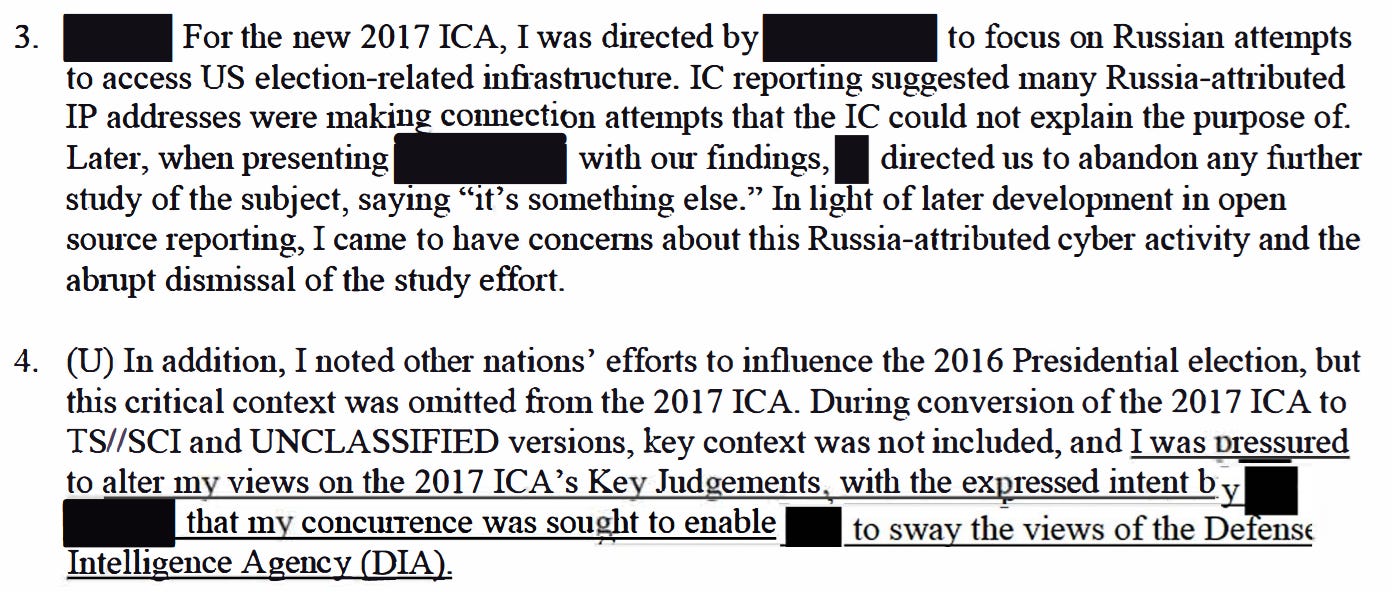
That Assessment purported to expose “Russian activities and intentions” in the Presidential election. The whistleblower’s role was to investigate alleged attempts by Moscow “to access US election-related infrastructure”, as “reporting suggested many Russia-attributed IP addresses were making connection attempts that the [US intelligence community] could not explain the purpose of.” However, an official – name redacted – subsequently “directed us to abandon any further study of the subject,” on the basis it was “something else.”

For the whistleblower, the “abrupt dismissal of the study effort” raised significant concerns about the true nature and source of the “Russia-attributed cyber activity.” They suspected their superiors were attempting to conceal how state or non-state actors closer to home may have been engaged in “Domain Name Service (DNS) record manipulation”, to falsely ascribe cyber meddling efforts to Moscow. Their anxieties only multiplied when superiors rebuffed their attempts to include references to “other nations’ efforts to influence the 2016 Presidential election” in the 2017 ICA.

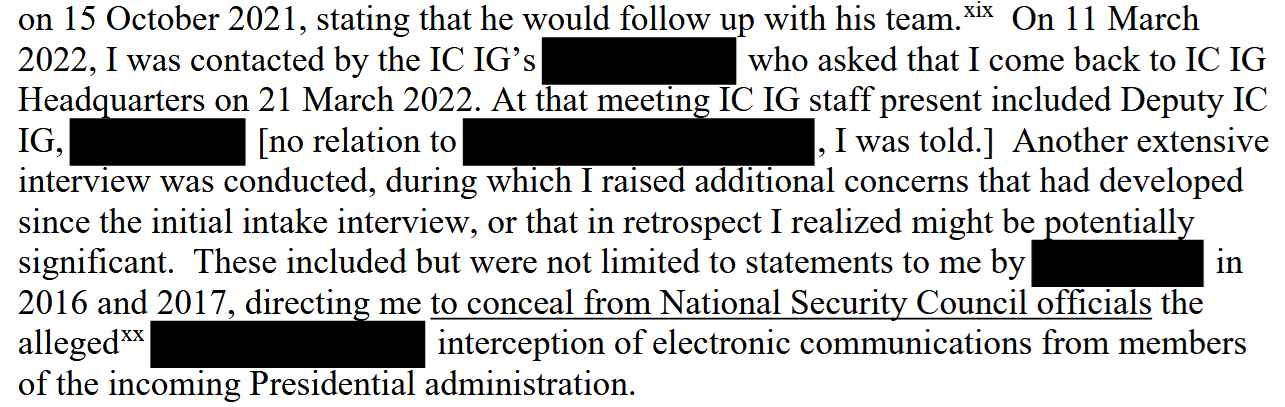
The whistleblower’s “professional judgment…was multiple nations were seeking to shape the views of the US electorate,” and therefore influence their voting preferences. This assessment was based not only on relentless negative media coverage of Trump in allied countries – especially Britain, and other “NATO partners” – but the “interception of electronic communications from members of [Trump’s] incoming Presidential administration.” The source of this interception is redacted. So too is the identity of an official who repeatedly demanded the whistleblower conceal this from the National Security Council.

‘Tradecraft Standards’

The ICA’s release on January 6th 2017, 11 days prior to Trump’s inauguraration, ignited a media frenzy over the President-elect’s potential ties to Russia, and the Kremlin’s purported role in installing him in the White House. The New York Times dubbed the document a “damning and surprisingly detailed account” of Moscow’s “efforts to undermine the American electoral system.” The Washington Post boldly described it as “a remarkably blunt assessment”, and “extraordinary postmortem of a Russian assault on a pillar of American democracy.”

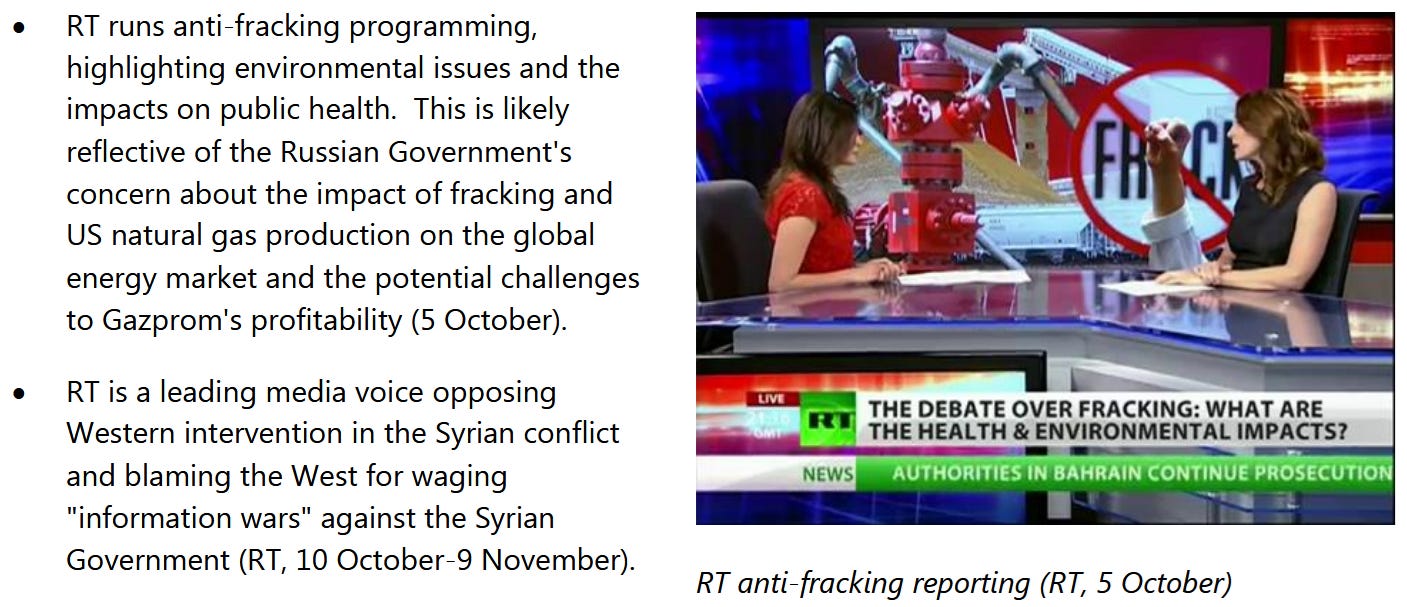
In reality, the ICA offered zero evidence to support any of its bombastic headline conclusions. This glaring deficit was justified on the basis “full supporting information on key elements of [Russia’s] influence campaign” was “highly classified”. Bizarrely, much of the Assessment’s content focused instead on the output of Russian media – both for domestic and international audiences – with no relevance whatsoever to the 2016 election. This included RT America coverage of topics including police brutality, fracking, and “alleged Wall Street greed.”

When the whistleblower learned the ICA was so heavily dependent on a “simplistic treatment” of “English language Russian media articles”, they expressed “substantial concern” over the “legitimacy” of the Assessment’s “analytic tradecraft”. They moreover “could not concur in good conscience based on information available,” and their “professional analytic judgement,” of a “decisive Russian preference” for Trump’s victory, as concluded by the ICA. The whistleblower thus refused to sign off on its findings.

Excerpt from January 2017 ICA

This was not well-received by a senior US intelligence official, name redacted. Leading up to the ICA’s release, they sought to harass and suborn the whistleblower into endorsing the Assessment. After multiple failed attempts to bully the whistleblower to “abandon” their “tradecraft standards” and simply “trust” there was “reporting you are not allowed to see,” which “if you saw it, you would agree,” the official strongly implied the whistleblower’s subsequent promotion was contingent on their agreement.

When this approach didn’t work, the “visibly frustrated” official fulminated, “I need you to agree with these judgments, so that DIA [Defense Intelligence Agency] will go along with them.” This prompted discussion between the pair about the DIA’s “supposed trust” in the whistleblower, and “the necessity” of them proving their “bona fides” as an intelligence community officer “by doing what it took to bring DIA on board as an additional [intelligence] Agency signing on to the 2017 ICA.”

Refusing to compromise on “standards, tradecraft, and ethics”, the whistleblower defied his superior’s direct order “to misrepresent my views to DIA.” While unexplored in the declassified file, the official’s desperation for the DIA to endorse the ICA is understandable. In September 2020, it was revealed the entire US intelligence community had no “confidence” in the Assessment. In fact, then-CIA director John Brennan personally wrote the report’s incendiary conclusions, before selecting a coterie of his close Agency confidantes to sign off.

Many US intelligence analysts conversely assessed Russia favoured Hillary Clinton’s victory, and viewed Trump as a potentially dangerous “wild card”. As such, creating the false impression of US intelligence community unanimity over Brennan’s concocted conclusion was of paramount importance to the CIA chief. In the end, only the Agency, FBI, and NSA publicly endorsed the ICA’s findings. Even then, the NSA – which closely monitors communications of Russian officials, and could therefore detect any high-level discussions about the 2016 election in Moscow – merely expressed “moderate confidence”.

‘Something Else’

The whistleblower was surprised the FBI expressed “high confidence” in the 2017 ICA. They were aware “as recently as September 2016,” the Bureau “pushed back” against suggestions “of Russian intent to influence” the Presidential election, believing “such a judgement would be misleading.” The whistleblower notes the FBI “altered its positions…without any new data other than the election’s unexpected result [emphasis added] and public speculation Russia had ‘hacked’ the vote – a scenario [US intelligence] judged simply did not occur.”

They were furthermore shocked to learn years later disgraced former MI6 spy Christopher Steele’s ‘Trump-Russia’ dossier was a core component of the “highly classified” material, upon which the ICA’s dynamite conclusions heavily relied. It was their understanding the ODNI viewed the dossier at the time “as non-credible sensationalism”, the Office’s chief James Clapper considered it “untrustworthy”, and Steele’s ludicrous claims “had never been taken seriously” by US intelligence more widely.

The whistleblower’s grave, myriad qualms about the Assessment’s construction led them to approach a variety of US government oversight agencies, including the Intelligence Community Inspector General, with what they knew. Despite receiving acknowledgement they “had witnessed malfeasance”, the whistleblower was stonewalled, and their evidence never appears to have reached any relevant authority, let alone been acted upon. Given the explosive nature of the whistleblower’s insider testimony, ominous questions abound over why they encountered such resistance – and where the non-Russian interference they identified truly emanated from.

The whistleblower’s account of being tasked to investigate alleged Russian hacking of “election-related infrastructure” the US intelligence community found inexplicable, only to be told to leave it alone as it was “something else”, is particularly striking. There are several explanations for this activity, all of which point to concerted attempts to falsely concoct the narrative of Russian election interference for malign purposes. For example, in September 2016, Hillary Clinton-connected lawyer Michael Sussmann approached the FBI, claiming to possess explosive evidence of Trump’s collusion with Moscow.

The material comprised DNS logs, supposedly indicating the Trump Organization used a secret server belonging to Russia’s Alfa Bank for back-channel communications with the Kremlin. This was fed to the media, and excitedly reported by certain liberal outlets prior to the election. However, The Intercept rubbished the trove, given the DNS records supplied couldn’t “prove anything at all, and certainly not ‘communication’ between Trump and Alfa.” In sum, “no one…can show that a single message was exchanged between Trump and Alfa.”

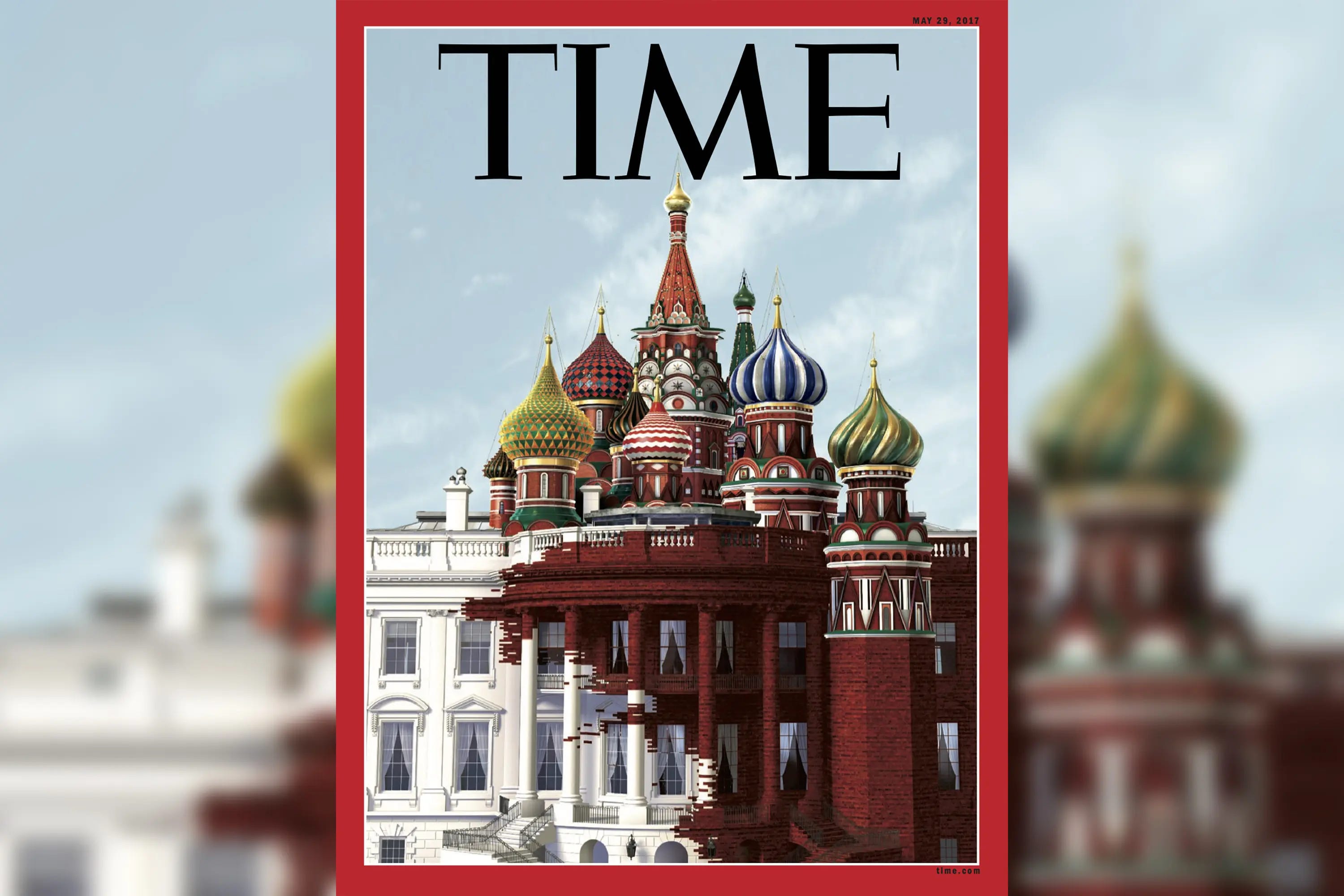
May 2017 TIME magazine cover, depicting the White House being absorbed by the Kremlin

An alternative may be the Department of Homeland Security was responsible for targeting election infrastructure. In December 2016The Wall Street Journal reported an attempted hack into the state of Georgia’s voter registration database traced back to a DHS IP address. The incursion came at a time the Department was lobbying for election systems to be regarded as “critical infrastructure”, therefore making their protection part of the agency’s formal purview.

On January 6th 2017, the same day the ICA dropped, DHS secretary Jeh Johnson jubilantly announced he had designated “election infrastructure” part of the agency’s already vast domestic spying remit. He acknowledged “many state and local election officials…are opposed to this designation.” It was certainly a good day to bury bad news. And assist the CIA and Clinton campaign in furthering nonsense conspiracy theories about Russian attempts to “hack” the 2016 Presidential election, therefore hopefully invalidating its “unexpected result”.


FAIR: Media Largely Ignored Gaza Famine When There Was Time to Avert Mass Starvation

By Julie Hollar, Fairness and Accuracy in Reporting (FAIR), 7/29/25

Media Largely Ignored Gaza Famine When There Was Time to Avert Mass Starvation
  • 226 Shares
  • 225Share
  • Share
  • Toot
  • Share
  • Mail
  • Print
  • Share

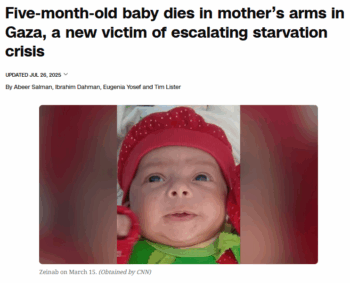
CNN: Five-month-old baby dies in mother’s arms in Gaza, a new victim of escalating starvation crisis

Even as media report more regularly on starvation in Gaza, coverage still tends to obscure responsibility—as with this CNN headline (7/26/25) blaming the baby’s death on the “starvation crisis” rather than on the US-backed Israeli government.

The headlines are increasingly dire.

  • “Child Dies of Malnutrition as Starvation in Gaza Grows” (CNN7/21/25)
  • “More Than 100 Aid Groups Warn of Starvation in Gaza as Israeli Strikes Kill 29, Officials Say” (AP7/23/25)
  • “No Formula, No Food: Mothers and Babies Starve Together in Gaza” (NBC7/25/25)
  • “Five-Month-Old Baby Dies in Mother’s Arms in Gaza, a New Victim of Escalating Starvation Crisis” (CNN7/26/25)
  • “Gaza’s Children Are Looking Through Trash to Avoid Starving” (New York7/28/25)

This media coverage is urgent and necessary—and criminally late.

Devastatingly late to care

Wall Street Journal: Aid Delivered Into Gaza

An informative Wall Street Journal chart (7/27/25) shows the complete cutoff of food into Gaza at the beginning of 2025—a genocidal policy decision by Israel that was not accompanied by increased coverage in US media of famine in the Strip.

Since the October 7 attacks, Israel has severely restricted humanitarian aid to the Gaza Strip, using starvation of civilians as a tool of war, a war crime for which Israeli Prime Minister Benjamin Netanyahu and Foreign Minister Yoav Gallant have been charged by the International Criminal Court. Gallant proclaimed a “complete siege” of Gaza on October 9, 2023: “There will be no electricity, no food, no fuel, everything is closed.”

Aid groups warned of famine conditions in parts of Gaza as early as December 2023. By April 2024, USAID administrator Samantha Power (CNN4/11/24) found it “likely that parts of Gaza, and particularly northern Gaza, are already experiencing famine.”

modest increase in food aid was allowed into the Strip during a ceasefire in early 2025. But on March 2, 2025, Netanyahu announced a complete blockade on the occupied territory. Israeli National Security Minister Itamar Ben-Gvir declared that there was “no reason for a gram of food or aid to enter Gaza.”

After more than two months of a total blockade, Israel on May 19 began allowing in a trickle of aid through US/Israeli “Gaza Humanitarian Foundation” (GHF) centers (FAIR.org6/6/25)—while targeting with snipers those who came for it—but it is not anywhere near enough, and the population in Gaza is now on the brink of mass death, experts warn. According to UNICEF (7/27/25):

The entire population of over 2 million people in Gaza is severely food insecure. One out of every three people has not eaten for days, and 80% of all reported deaths by starvation are children.

According to the Gaza Health Ministry, at least 147 Gazans have died from malnutrition since the start of Israel’s post–October 7 assault. Most have been in the past few weeks.

Mainstream politicians are finally starting to speak out—even Donald Trump has acknowledged “real starvation” in Gaza—but as critical observers have pointed out, it is devastatingly late to begin to profess concern. Jack Mirkinson’s Discourse Blog (7/28/25) quoted Refugees International president Jeremy Konyndyk:

I fear that starvation in Gaza has now passed the tipping point and we are going to see mass-scale starvation mortality…. Once a famine gathers momentum, the effort required to contain it increases exponentially. It would now take an overwhelmingly large aid operation to reverse the coming wave of mortality, and it would take months.

And there are long-term, permanent health consequences to famine, even when lives are saved (NPR7/29/25). Mirkinson lambasted leaders like Cory Booker and Hillary Clinton for failing to speak up before now: “It is too late for them to wash the blood from their hands.”

Barely newsworthy

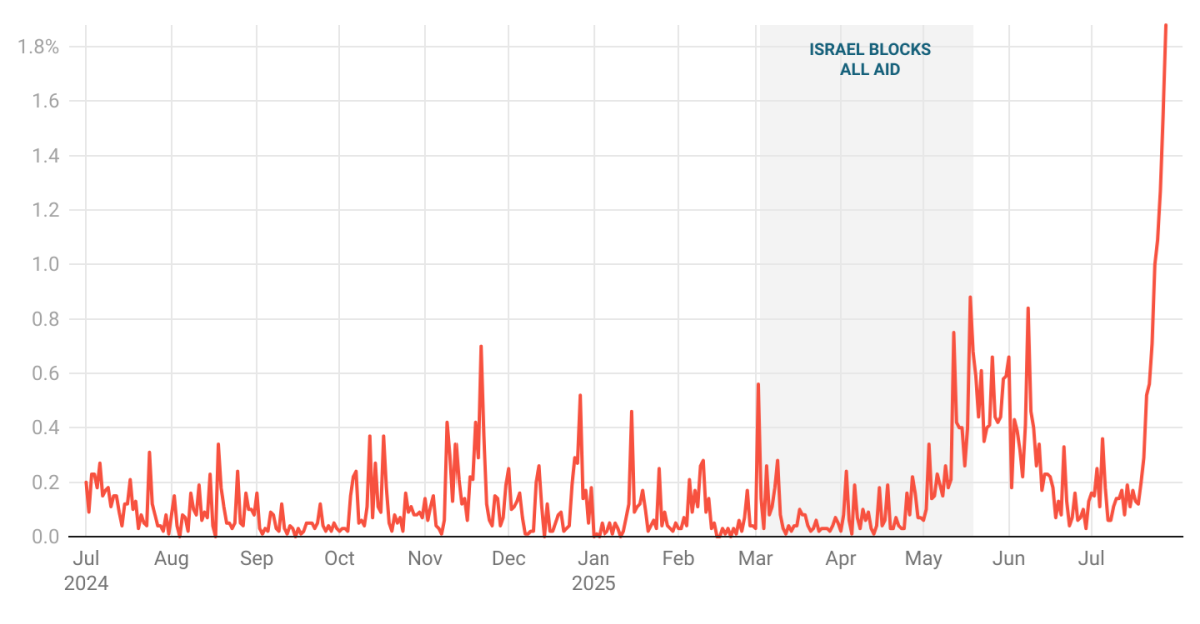
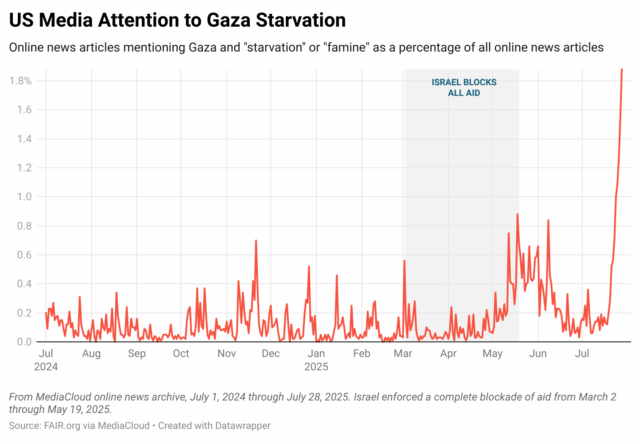
US Media Attention to Gaza Starvation

Major US media, likewise, bear a share of responsibility for the hunger-related deaths in Gaza. The conditions of famine have been out in the open for well over a year, and yet it was considered barely newsworthy in US news media.

A MediaCloud search of online US news reports mentioning “Gaza” and either “famine” or “starvation” shows that since Netanyahu’s March 2 announcement of a total blockade—which could only mean rapidly increasing famine conditions—there was a brief blip of media attention, and then even less news coverage than usual for the rest of March and April. Media attention rose modestly in May, at a time when the world body that classifies famines announced in May that one in five people in Gaza were “likely to face starvation between May 11 and September 30″—in other words, that flooding Gaza with aid was of the highest urgency.

But as aid continued to be held up, and Gazans were shot by Israeli snipers when attempting to retrieve the little offered them, that coverage eventually dwindled, until the current spike that began on July 21.

FAIR (e.g., 3/22/244/25/255/16/255/16/25) has repeatedly criticized US media for  coverage that largely absolves Israel of responsibility for its policy of forced starvation—what Human Rights Watch (5/15/25) called “a tool of extermination”—implemented with the backing of the US government.

The current headlines reveal that the coverage still largely diverts attention from Israeli (let alone US) responsibility, but it’s a positive development that major US news media are beginning to devote serious coverage to the issue. Imagine how different this all could have looked had they given it the attention it has warranted, and the accountability it has demanded, when alarms were first raised.

FAIR’s work is sustained by our generous contributors, who allow us to remain independent. Donate today to be a part of this important mission.

Putin’s Conditions for Peace Deal: Ukraine Gives Up Donbas, No NATO, and No Western Troops

YouTube link here.

By Dave DeCamp, Antiwar.com, 8/22/25

Reuters reported on Thursday that Russia’s demands for a peace deal in Ukraine include Ukrainian forces withdrawing from the Donbas, a guarantee that Ukraine won’t join NATO, and for Ukraine to keep Western troops out of the country.

Russian sources told Reuters that Putin had compromised on his initial conditions, which included the Ukrainian withdrawal from the territory in the southern Kherson and Zaporizhzhia oblasts. Under the current offer, Russia is willing to freeze the lines there and also return small amounts of territory it controls in Kharkiv, Sumy, and Dnipropetrovsk.

For his part, Ukrainian President Volodymyr Zelensky has publicly rejected the idea of ceding the territory Ukrainian forces still control in the Donbas, and European leaders appear to be backing his position.

When it comes to NATO, the Reuters report said that Moscow is seeking a legally binding pledge from the alliance that it wouldn’t move further eastwards. A guarantee that Ukraine wouldn’t join NATO was one of Russia’s main demands to avoid the invasion, but the Biden administration refused to engage on the issue.

While the Trump administration has ruled out the idea of Ukraine joining NATO as part of a potential peace deal, the alliance’s leadership is still insisting on its “open door” policy. NATO Secretary-General Mark Rutte said this week that Ukraine is on an “irreversible path” to NATO membership.

Russia’s other condition is related to the security guarantees for Ukraine that are being discussed by the US and its European allies, who are insisting on some sort of arrangement where European troops are deployed to Ukraine and backed by US air power. But Russia has made clear repeatedly that the idea is completely unacceptable, and the insistence on it could tank the peace process.

Sources speaking to Reuters floated the idea of some kind of three way deal between the US, Russia, and Ukraine on security guarantees or revisiting an idea from short-lived peace talks in 2022 that would have involved the five permanent members of the UN Security Council providing the guarantees, which was also brought up by Russian Foreign Minsiter Sergey Lavrov on Wednesday.

While Russia continues to engage in negotiations, it has also made clear that it’s willing to continue the war if its conditions aren’t met. “There are two choices: war or peace, and if there is no peace, then there is more war,” one of the sources told Reuters.

Dave DeCamp is the news editor of Antiwar.com, follow him on Twitter @decampdave.

***

Hopes Fade on ‘Breakthrough’ in Ukraine Talks, Russia Keeps Gaining Land

Russia Matters, 8/22/25

Despite the past week’s initial hopes that Donald Trump’s subsequent meetings with Vladimir Putin, Volodymyr Zelenskyy and European leaders would advance talks on the Ukraine conflict toward a breakthrough, the negotiations on the subject remained riddled with contradictions and stalled outcomes as of Aug. 22. For instance, Trump’s envoy Steve Witkoff claimed Putin was amenable to “Article 5-like” guarantees for Kyiv, yet Russia’s top diplomat Sergei Lavrov insisted Moscow must hold veto power over any guarantees, suggesting that the P5 should provide them. Lavrov also discouraged Trump’s public hopes for quickly organizing a Zelenskyy-Putin summit, making clear Russia would presently agree to negotiate only at levels lower than heads of states. Meanwhile, European leaders flatly rejected giving Russia the veto on security guarantees, while Zelenskyy also ruled out China as a postwar security guarantor. It remains unclear whether and how these differences1 can be reconciled.

In the period of July 22–Aug. 19, Russian forces gained 237 square miles of Ukrainian territory, which marks a 2% decrease from the 241 square miles these forces gained in the period of July 15–Aug. 12, 2025, according to the latest issue of RM’s The Russia-Ukraine War Report Card. Comparing shorter periods, such as the past week to the preceding week, shows that in the period of Aug. 12–19, 2025, Russia gained 25 square miles of Ukrainian territory (roughly one Manhattan island), which marks a 67% decrease from the 76 square miles Russian forces gained in the period of Aug. 5–12, 2025. One of the reasons Russia has been able to make gains every week2 is that it has more personnel than Ukraine to employ in combat. “Today, Russia recruits about 1,000 soldiers a day,” which is “about twice as high as Ukraine’s” recruitment, according to The New York Times.*

A map that Trump showed to Zelenskyy during their Aug. 18 meeting indicates that Russian forces control 99% of the Luhansk region and 76% of the Donetsk region, which together constitute Donbass. U.S. intelligence estimates on whether and when Russia could take the rest of Donbass vary. “One assessment posits that Putin could seize all of Donetsk by October. Another predicts a far harder and inconclusive slog,“ according to Axios.

Russia has more than doubled the number of missiles and drones it has fired monthly into Ukraine since January, according to the Wall Street Journal. Most recently, the night of Aug. 20 to 21 saw Russia launch the third largest strike of the war, launching 574 drones and 40 missiles against 11 locations in Ukraine, according to ISWThe number of Russian long-distance strikes can be expected to increase further, and it is likely that more of them will reach targets in Ukraine as Russian drone and missile production increases (in fact, Russia may soon fire 2,000 drones a day), further attriting Ukraine’s already strained air defenses.3

India is under increasing pressure from the Trump administration over its continued purchases of Russian oil, with White House trade adviser Peter Navarro expecting punitive tariffs of 50% on imports from the South Asian nation to kick in next weekBut is such pressure justified or are the Indian leaders right to complain about “double standards in Washington, which continues to buy Russian uranium hexafluoride, and in the EU, which remains a key buyer of Russian liquefied natural gas,” as the Wall Street Journal reported? Here are three facts which may help you decide if Indian leaders have a point: First, the U.S. continues to import enriched uranium from Russia. In fact, in 2024, the U.S. imported $624 million worth of Russian HEU, according to Comtrade’s international trade data. Second, the U.S. imported $1.3 billion of fertilizers from Russia, according to the New York Times. Third, Russia was the second largest source of gas imported by the European Union in 2024, with Russian supplies to the EU increasing by 18% that year. The EU also purchased $8.5 billion worth of LNG from Russia that year, according to CREA and The Economic Times.

***

US Approves European-Funded Long-Range Cruise Missile Deal for Ukraine

By Dave DeCamp, Antiwar.com, 8/25/25

The Wall Street Journal reported on Saturday that the US has approved a deal that will arm Ukraine with thousands of Extended Range Attack Munition (ERAM) air-launched missiles, which have a significantly further range than other missiles that the US has sent into the proxy war.

Two US officials told the Journal that the ERAMs can hit targets up to 280 miles away, nearly 100 miles further than the range of the Army Tactical Missile Systems (ATACMS), munitions the US began providing Ukraine in 2023.

The deal will provide Ukraine with 3,350 ERAMs as part of an $850 million weapons package that will mostly be funded by European countries. This year, NATO began a new scheme to provide Ukraine with more US weapons in deals funded by other NATO allies, known as the Prioritized Ukraine Requirements List (PURL) initiative.

The ERAMs are expected to arrive in Ukraine within six weeks, and the US officials said that the Ukrainian military will need Pentagon approval to use them.

The Journal report said that the Trump administration had been quietly blocking ATACMS strikes on Russian territory, which the Biden administration first greenlit toward the end of 2024. At the time, the US-backed ATACMS strikes marked a significant escalation of the proxy war, and Moscow responded by altering its nuclear doctrine to lower the threshold for the use of nuclear weapons.

The Journal report said that the Trump administration hasn’t allowed any Ukrainian ATACMS strikes on Russian territory since late springbut the ERAMs deal signals that the US may be prepared to support missile attacks inside Russia once again. The news comes as there has been little progress toward a peace deal following the summit between President Trump and Russian President Vladimir Putin.