Gilbert Doctorow: Europe capitulates: treacherous leadership kneels before Trump and willingly destroys the prosperity of its citizenry

CCI posted this article in its entirety with the permission of the author.

By Gilbert Doctorow, Center for Citizen Initiatives, 8/7/25

Today’s European media carry the story of the agreement on tariffs that Ursula von der Leyen reached with Donald Trump at their Scotland meeting. In France, we hear that not only Marine Le Pen, on the Right, but Emmanuel Macron’s Centrist prime minister Francois Bayrou denounced the agreement, suggesting that France will oppose ratification. German chancellor Friedrich Merz called it ‘a black day for Europe’ but hinted that he will reluctantly back the agreement as the best that could be achieved under the circumstances.

Today’s leading French-language daily in Belgium Le Soir carried a front page editorial on the subject. It stated openly that this trade deal will greatly damage national economies across Europe which are already experiencing stagnation for more than two years. They predict that large flows of investment will now be directed by European manufacturers to the United States, meaning that jobs will be created there while they are lost here. They place the blame for the unequal relations with the USA which made it possible for Trump to win the tariff war on Europe’s excessive dependence on exports to maintain growth instead of promoting domestic demand. However, the editors willfully ignore the reality that the Chinese economy is also export driven and is doing very nicely, with more than 5% annual GDP growth.

The editorial board makes no mention of the way the trade deal ensures that European goods will be uncompetitive on world markets for years to come by obliging the EU to purchase still greater quantities of American gas and oil. If the deindustrialization of the German economy can be attributed to any single factor today it is precisely the switch from cheap Russian pipeline gas for very expensive LNG gas from the United States, Qatar and other global suppliers.

The Soir editorial notes that part of the logic in agreeing to Trump’s trade terms was to keep the American president engaged with them. Engaged over what? The editorial gives a slight hint at what I see also in other European media: that the engagement is over continued military and financial support to Ukraine in its war with Russia. There, indeed, is the key to understanding how and why European economic sovereignty is being sacrificed with only a few tears shed.

Note the disappearance from European media of their recent gloating over an imagined U.S. brain drain to these shores as American professors seek to immigrate to Europe in protest over Trump’s threats to university independence.

We cannot be certain that von der Leyen will triumph over all the objectors to what she has agreed with Trump. However, the objectors may be bought off by some small corrections to her deal at the margins. France, for example, may get a better tariff on its champagne and Bordeaux wines.

In an essay on these pages a few days ago, I referred to my recommendation to Europe’s leaders 10 years ago when they were first seriously discussing creating a European army: “what Europe needs is not a new army but a new foreign policy.” The same kind of recommendation is in order today: “what Europe needs is not stimulus to domestic consumption to bring back growth but a new foreign policy.”

The new foreign policy must be based first on a glance at the map, at who is Europe’s big neighbor to the East.

Russia happens to be a nuclear super power that is fast becoming a conventional weapons super power while also becoming a major global economic force. Russia in the last year roared past Germany to become Europe’s largest economy and the fourth largest economy in the world. Common sense and a Realist approach to the conduct of international affairs dictate that some accommodation has to be sought with that neighbor rather than the ongoing policy of building barbed wire and 4 meter high concrete barriers against the neighbor with whom you do not deign to talk and allocating hundreds of billions of euros to expanding European production of tanks, armored personnel carriers, missiles, drones and air defense units.

I have been rereading my notes on a very interesting conference in Varna, Bulgaria that I attended ten years ago. The sponsor was the Bulgarian office of the Friedrich Ebert Stiftung, the think tank of the SPD, the Social Democrats of Germany. The keynote address was delivered by a certain Hannes Swoboda, an Austrian Member of the European Parliament who had for 3 years been chaired the bloc of Socialists and Democrats, the second largest group of deputies in the Parliament. Swoboda was no apologist for Putin, but he told us all that Europe had to rethink how it deals with Russia. The values based approach to international dealings is fine within the European Union, he said. Each Member State can and should intervene in the internal affairs of other Member States when they violate shared values. But de facto, Europe practiced Realpolitik in its dealings with many countries around the world, for example the Gulf States. Why, he asked, cannot the same common sense approach be applied to its relations with Russia instead of the hectoring, the attempts to punish and isolate Russia for not living up to Europe’s values?

Why indeed?

The fact of the matter today is that Mr Trump’s USA is showing in every way that it is no friend of Europe, that it sees Europe as a geopolitical and economic competitor and will do anything to trip up European ambitions in both sectors.

Today’s European presidents and prime ministers who do not respond to this threat from the USA and do not respond to the opportunity for advantageous trading relations with Russia to obtain, as in the past, critical raw materials at prices that are affordable, such ‘leaders’ are enemies of their own peoples and should be voted out of office or impeached at the earliest opportunity.

©Gilbert Doctorow, 2025

Brian McDonald: Putin’s no ideologue: His creed is Russia First

By Brian McDonald, Substack, 8/21/25

By the time Michael McFaul gets round to flogging his latest volume (Autocrats vs. Democrats), the title alone has already done the heavy lifting for him. It’s the sort of binary that reads well on a publisher’s spring list, even if it crumbles like a cheap biscuit once it meets reality. And his insistence that Vladimir Putin is some kind of messianic ideologue is a fine example of this; neat for a blurb, but hopeless for a diagnosis.

It also confirms the notion that he’s become a Walmart Anne Applebaum. A cheap tribute act to a veteran master of calculated myopia on Moscow and beyond.

If Putin has a guiding star, it isn’t some grand creed stretching from the Neva to the Urals. Rather it’s much simpler, and tougher to blunt: let’s call it Russia first. The rest (Orthodoxy, talk of “values,” the occasional flirt with tradition) is merely paint on the bonnet. Underneath, the engine is all about survival and jockeying for advantage. Of course, there’s an ideological patina; the essays about the ‘Russian world,’ and the talk of civilisational clashes with the West. But these serve more as instruments than ends, leading a vocabulary of legitimacy rather than a vision to die for.

He picked it up in the wreckage of the Soviet Union, as he watched a superpower bleed out with shelves bare, figures fiddled and whole ministries running on lies. And then the humiliation of its grandees or their families heading west with their bags packed. The truth was hammered home: any faith that leaves your own pensioners hungry while you keep Cuba on the drip is a form of suicide.

And he saw the other imperial capital crack too, with misguided adventures in Iraq, Libya, Afghanistan leaving Washington’s sermons of democracy turned to rubble. Of course, hubris can rot a state faster than any tank battalion.

When Joe Biden decided to hold his grand “Summit for Democracy” in 2021 and pointedly left out allies like Hungary, Putin will have seen it for what it was: an attempt to sort the world into neat ideological blocs, as if Orban in Budapest and Merkel in Berlin were playing the same sport. The Soviet Union long tried that sort of categorisation; and it didn’t end well.

Some Western pundits like to believe that Putin’s sudden turn after 2011, with a choke on the media after Dmitry Medvedev’s relatively freewheeling interlude and the lurch into family-values sermonising, was the blossoming of some long-hidden conviction. In truth, it looked more like a counter-insurgency kit cobbled together on the run, and meant to be a hard break with Vladislav Surkov’s theatre-state. Bolotnaya Square had filled with the largest crowds Moscow had seen since the nineties, and the Kremlin didn’t read them as citizens finding their voice but as Washington dusting off its colour-revolution manual. Hillary Clinton was at State, Obama in the White House, and on the stage were Alexey Navalny, once a nationalist outflanking Putin from the right, and Garry Kasparov, both lifting their lines from the Merkel-Obama hymn book. Even the pampered darlings of state TV, Ksenia Sobchak and Vladimir Pozner among them, drifted into the square for a cameo, as if to remind the Kremlin how thin the loyalty could be once the crowd began to roar.

Two years later came the Kiev Maidan, which followed the Orange Revolution in 2004, and the Rose in Georgia a year earlier. Each one, at least in Moscow’s telling, was carried on the shoulders of Western-funded NGOs and political fixers flown in from abroad and it hardly escaped the Kremlin’s notice that the US media quickly tried to label Bolotnaya the ‘Snow revolution.” For a government paranoid about systemic security, after the turmoil of the 20th century, the signal was blunt enough: liberalism wasn’t just another faction inside the house; it had turned into a breach in the wall. The conservative turn allowed Putin to brand these forces as alien to Russia, even treacherous… people willing to sell the country to the West for a place at someone else’s table.

All the talk of birth rates and “non-traditional propaganda” were just fronts, handy covers for something plainer: bolting the ideological doors before another colour revolution tried to walk through them.

If Putin were the stiff ideologue those playing to the gallery keep sketching, the guest list would be much tidier than the far from smooth reality. What you see is a patchwork quilt pulled from every conceivable ragged corner. You’ve got Belarus the hard dictatorship stitched beside Kyrgyzstan, which is half a democracy and half a shambles. On the friends side of the ledger can be found North Korea and China propped up on one flank, with Israel and Brazil grinning from the other. One week the Kremlin is bowing to Gulf monarchs, the next it’s raising toasts with Latin leftists. And India is nearer now than it’s ever been, regardless of the fact it’s the world’s largest democracy. No gospel binds that mess together and it looks more like the hand of a 19th-century statesman marooned in a nuclear age, playing the cards as they tumble, and not caring a damn if they match.

This is why the “Cold War” frame continues to mislead. Moscow isn’t selling its dogma like the Comintern once did and it doesn’t need converts. All the Kremlin really wants is space to breathe at home and partners it can count on abroad. Some will say this pragmatism is a liturgy in its own right, and you could call it the playbook of survival. Maybe they’re right, but it’s a far cry from the holy mission McFaul tries to hang on Putin.

Of course, you can throw sanctions at Moscow and lock it out of SWIFT, and cut it off from capital markets, but there’s no Warsaw Pact to dismantle and no utopian Soviet dream to unpick.

The trouble with McFaul’s reading, and with much of the Western mind in policy circles, is the hunger to hammer Russia into a single mould. First comes the Cold War script: Moscow cast again as the ideological foe and its principles written off as incompatible with ours. Then, after 1991, it switches to the transition-state tale: Russia as a misfiring liberal project that can be nudged back onto the “right” path. Now, in McFaul’s telling, it’s back to the first version, only painted with 21st-century anxieties about “illiberal nationalism.”

McFaul’s Autocrats vs. Democrats might sell because it flatters liberals’ need for a morality tale. But morality tales are for children and think-tank panels. Putin doesn’t view his mission as being about converting you, nor is he concerned with saving your soul. Instead, he believes he’s here to make sure Russia survives, and even thrives, on terms you may not like. That’s his ideology.

BERTRAND Critiques Hudson Institute Report: China after Communism, preparing for a post-CCP China

By Arnaud Bertrand in Switzerland, Intellinews, July 29, 2025

It may be one of the most insane reports ever produced by a US think-tank, and that’s saying something.

The Hudson Institute has just published a 128-page plan entitled China after Communism: Preparing for a Post-CCP China“, edited by Miles Yu (director of the Institute’s China Centre), which provides detailed operational plans to bring about the collapse of the Chinese regime through systematic information operations, financial warfare and covert influence campaigns, followed by detailed protocols for post-collapse management by the United States, including military occupation, territorial reorganisation, and the installation of a political and cultural system subservient to the United States.

I really don’t know whether to laugh or cry about it.

Cry at the arrogance and casualness with which they write about overthrowing the government of the world’s largest economy, the main economic lifeline for most of the planet and a quarter of the human race.

Laugh at this cartoonish wickedness of believing that a declining empire, which can’t even maintain its own infrastructure and has lost every major conflict it has provoked in the last two decades, could orchestrate and manage the controlled collapse of a country of China’s importance.

Regardless, the report is fascinating to read because it reveals so much about the sick soul of the American empire and some of the main reasons for its decline – a comical detachment from reality, an inability to learn from past failures, a zero-sum worldview, a denial of sovereignty in others, and, more than anything else, the fact that this report screams despair.

There is a common pattern well-known to political sociologists: when groups face existential threats to their status and identity, they often exhibit compensatory extremism – becoming caricatured versions of themselves to defend themselves against irrelevance. This was, for example, the case of the Southern Confederacy before the Civil War, which responded to growing abolitionist pressure by becoming more fanatically committed to slavery and “the honour of the South” than it had ever been before.

This Hudson Institute report reads a little like this: Witnessing the end of American primacy, some members of the imperial establishment are transforming themselves into a grotesque caricature of themselves, taking every toxic aspect of American foreign policy and amplifying it to absurd extremes, becoming more imperially ambitious and delusional than ever before, planning interventions of unprecedented scale and audacity, as if doubling down on their worst impulses might somehow restore their waning dominance.

As such, this report should not be read as a true policy blueprint – its analysis of China is so detached from reality as to be completely worthless. Rather, it should be read as an anthropological specimen, a fascinating window into the fever dreams and neuroses of a dying empire, where compensatory extremism strips away all pretence and reveals what US hegemony has always been – just as the Confederacy’s fanatical focus on slavery exposed the moral rot that had always defined that system.

So let’s examine this artifact piece by piece and see what it reveals about the dying empire that produced it.

Below is a summary of the main points in the rest of the article:

Core criticisms

  • Misreading Chinese History and National Identity
    The report assumes Chinese citizens want US-led “liberation” from the Communist Party, ignoring:
    • China’s “century of humiliation” under Western colonial powers.
    • The Communist Party’s legitimacy stemming from restoring sovereignty, not just economic growth.

“The idea that the Chinese people are secretly dying to see the Communist Party collapse… is beyond absurd: it represents the exact opposite of everything around which the Chinese national psyche is organised.”

  • Advocacy of hyper-colonialism
    The report proposes measures worse than 19th-century colonialism:
    • Support for secessionist regions to fragment China.
    • Nuremberg-style tribunals and rewriting of Chinese history.
    • Military occupation with “20 US Special Operations Forces” in every major city.
    • US restructuring of China’s financial system and constitution.

“In short, the report proposes colonialism on steroids.”

  • Instrumentalising Ethnic Tensions
    The document suggests using separatist movements purely for American gain:
    • Xinjiang independence is encouraged, but Tibetan independence discouraged – because of Indian sensitivities.

“These are mere tools to be exploited for American geopolitical interests.”

  • A Vision of ‘Controlled Fragmentation’
    The plan is to:
    • Break China into manageable units.
    • Keep it economically useful but politically weak.

“They want to create an ‘ideal point’ of permanent subordination for China.”

Hubris of “managing civilisation”

  • The report outlines a technocratic blueprint for rebuilding Chinese society:
    • A 151-201 person convention to write a new constitution for 1.4bn people.
    • Governance suggestions treated as if China were a business merger.

“This is hubris of the highest order… as if one of the youngest nations on the planet can somehow teach governance to a 5,000-year-old civilisation.”

  • The author points to the failures of US nation-building in Iraq, Afghanistan and Libya as evidence of the folly.

Projection and delusion

  • The report accuses China of coercion, corruption, and economic fragility – yet the US exhibits many of these traits more acutely:
    • Declining global trust in US leadership.
    • A weakened domestic economy and crumbling infrastructure.
    • Low public trust: “literally single digit”.

“The somewhat rogue world state they describe as China is just themselves, to a much greater extent than China.”

  • China, by contrast:
    • Has 95.5% central government approval (Harvard study, 2016).
    • Grew 5.4% in Q1 2025, while the US shrank by -0.5%.

Final judgment

The author sees the report as:

  • A reflection of imperial nostalgia and delusion.
  • Evidence that American strategists cannot accept decline.
  • A naked expression of imperial ambition without pretence.

“They may have accidentally produced the most honest document ever written about the American empire.”

Arnaud Bertrand is an entrepreneur and China analyst. Can be found on X @RnaudBertrand. Bertrand founded HouseTrip, a leading European vacation rental marketplace, and is the founder and CEO of Me & Qi, one of the premier English-language platforms for Traditional Chinese Medicine. He is also a graduate and honorary professor of Ecole Hôtelière de Lausanne in Switzerland.

Kit Klarenberg: US backed ethnic cleansing of Serbs, top diplomat secretly told Croat leader

By Kit Klarenberg, The Grayzone, 8/4/25

August 4 marks the 30th anniversary of Operation Storm. Little known outside the former Yugoslavia, the military campaign unleashed a genocidal cataclysm that violently expelled Croatia’s entire Serb population. Dubbed “the most efficient ethnic cleansing we’ve seen in the Balkans” by Swedish politician Carl Bildt, Croat forces rampaged UN-protected areas of the self-declared Serb Republic of Krajina, looting, burning, raping and murdering their way across the province. Up to 350,000 locals fled, many on foot, never to return. Meanwhile, thousands were summarily executed.

As these hideous scenes unfolded, UN peacekeepers charged with protecting Krajina watched without intervening. Meanwhile, US officials strenuously denied the horrifying massacres and mass displacement amounted to ethnic cleansing, let alone war crimes. NATO member state governments were far more interested in the “sophistication” of Zagreb’s military tactics. One British colonel heading a UN observer mission in the area gushed, “whoever wrote that plan of attack could have gone to any NATO staff college in North America or Western Europe and scored an A-plus.”

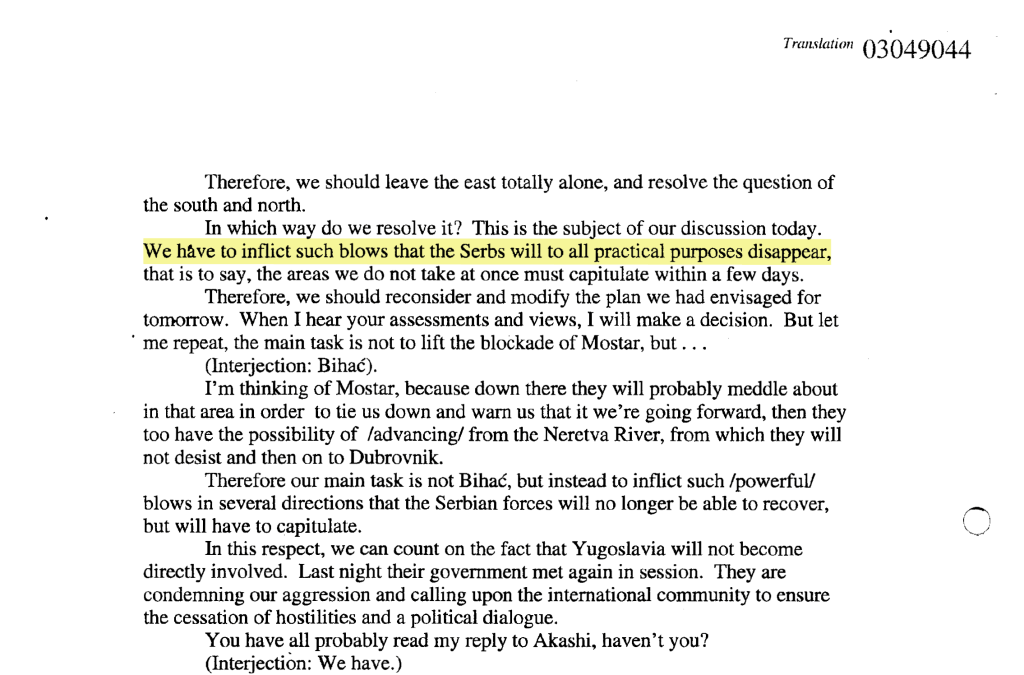
Widely overlooked documents reviewed by The Grayzone help explain why Croatian forces were graded so highly: Operation Storm was for all intents and purposes a NATO attack, carried out by soldiers armed and trained by the US and directly coordinated with other Western powers. Despite publicly endorsing a negotiated peace, Washington privately encouraged Zagreb to employ maximum belligerence, even as their ultranationalist Croat proxies plotted to strike with such ferocity that the country’s entire Serb population would “to all practical purposes disappear.”

In the midst of talks on a political settlement in Geneva, high-ranking Croat officials privately discussed methods to justify their coming blitzkrieg, including false flag attacks. Assured of their Western patrons’ continued backing amid the bloodshed, Croat leaders boasted that they merely needed to inform their NATO backers in advance of their plans. Once the dust settled and Croatia’s Serb population was entirely cleansed, Croat officials met in secret with US officials to celebrate their “triumph.”

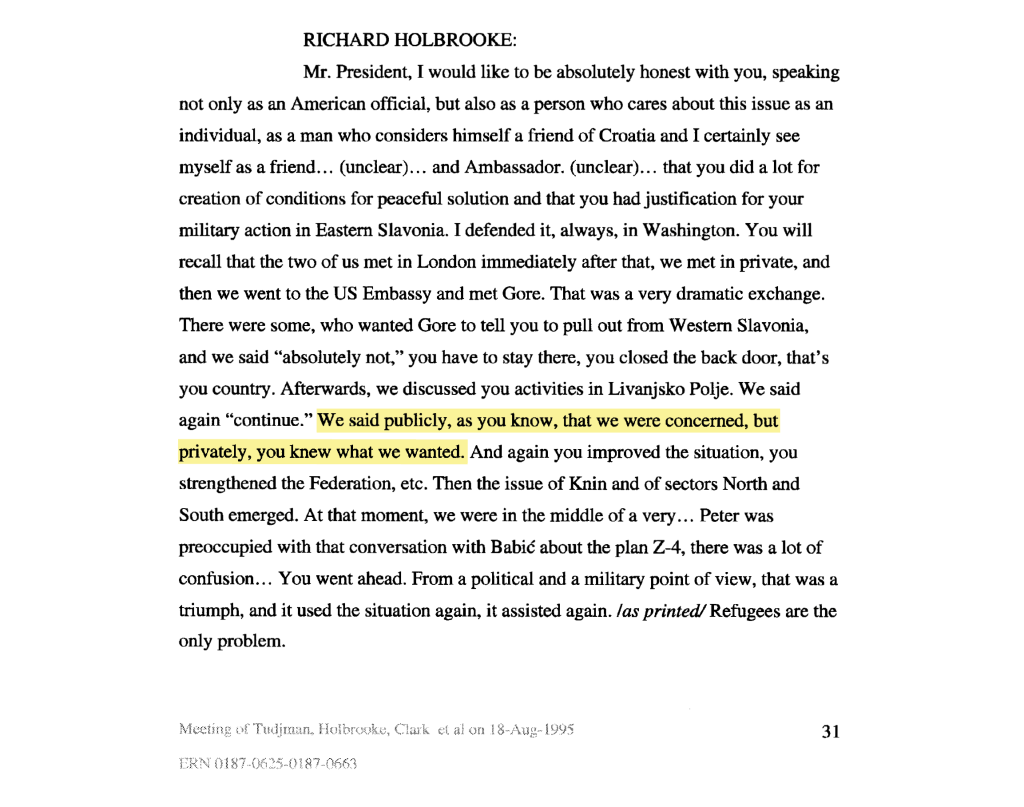
Richard Holbrooke, a veteran US diplomat then serving as Assistant Secretary of State in the Bill Clinton administration, told the president of Croatia that while the US “said publicly… that we were concerned” about the situation, “privately, you knew what we wanted.” As one of Holbrooke’s aides wrote in a note the diplomat later reproduced, Croatian forces had been “hired” as Washington’s “junkyard dogs” to destroy Yugoslavia.

After expelling the newly-independent country’s Serb population, the newly-formed Croat regime could be counted on to exert US dominance not only over the Balkans, but Europe more widely. The ethnic tensions fomented by NATO in the region still simmer, and have been exploited to justify perpetual occupation.

The former Yugoslavia remains horribly scarred by Operation Storm. From NATO’s perspective, however, the military campaign provided a blueprint for subsequent proxy conflicts and military strikes. Washington has recreated the strategy of weaponizing extremist foreign fighters as shock troops in an array of theaters, from Syria to Ukraine.

Western-backed fascists seek ethnically pure Croatia

Throughout the 1980s, Western powers – in particular Britain, Germany, and the US – covertly sponsored the growth of nationalism in Yugoslavia, hoping to encourage the multiethnic federation’s breakup. Their chosen proxy in Croatia, Franjo Tudjman, was a fanatical ethnonationalist, outspoken Holocaust denier, Catholic fundamentalist, and alumni of secessionist extremist groups. These factions embarked on a terrorist rampage throughout the early 1970’s, hijacking and blowing up airliners, attacking Yugoslav diplomatic sites abroad, and in 1971 assassinating Vladimir Rolovic, Belgrade’s ambassador to Sweden.

Following an upsurge of Croatian separatist violence in Yugoslavia, Tudjman was jailed in March 1972 along with his close confederate Stepjan Mesic due to their ultranationalist views. When Zagreb held its first multi-party elections since World War II 18 years later, the pair’s Croatian Democratic Union (HDZ) won a plurality of votes, and a majority of parliamentary seats. In the process, Tudjman became President, and Mesic Prime Minister. As Croatian nationalism soared, Serbs were purged en masse from state agencies.

On the campaign trail, Tudjman eagerly venerated the “Independent State of Croatia,” a Nazi-created puppet entity savagely run by local collaborators from April 1941 to May 1945, describing the fascistic construct as “an expression of the historical aspirations of the Croatian people.” Elsewhere, he openly remarked, “thank God, my wife is neither a Serb nor a Jew.”

These utterances reflected a monstrous strategy Tudjman laid out in February 1990 at a public meeting in Cleveland, Ohio, for when HDZ took power:

“[Our] basic goal… is to separate Croatia from Yugoslavia,” Tudjman explained. “If we come to power, then in the first 48 hours, while there is still euphoria, it is indispensable that we settle scores with all those who are against Croatia.”

“Lists of such persons have already been drawn up,” he continued. “Serbs in Croatia should be declared citizens of Croatia and called Orthodox Croats. The name ‘Orthodox Serb’ will be banned. The Serbian Orthodox Church will be abolished… it will be declared Croatian for those who do not move to Serbia.”

Many of Tudjman’s adherents adulated the Ustase, hardcore fascists who ruled the “Independent State of Croatia” during World War II. Their crimes ranged from executing women and the elderly by the hundred through methods including beheading, drowning. Meanwhile, the Ustase managed a network of death camps across Axis-occupied Yugoslavia, with dedicated units for children. Their ruthless barbarity towards Jews, Roma, and Serbs repulsed even their Nazi patrons. Hundreds of thousands were murdered by the Ustase, whose officer corps included the brother and father of Tudjman’s Defense Minister, Gojko Šušak.

These horrific events remained visceral for residents of the historic Serbian territory of Krajina, which was administratively assigned to the Yugoslav socialist republic of Croatia following World War II. HDZ received funding from Ustase exiles in Western countries, and immediately upon taking office renamed Zagreb’s iconic Square of the Victims of Fascism as Croatian Nobles Square, while Croat paramilitary units proudly touted Ustase chants and symbols. As the Tudjman-led government openly fanned the flames of ethnic hatred, Serbs in the fledgling country began preparing for civil war.

After interethnic fighting broke out in Croatia in March 1991, Yugoslav People’s Army units were deployed to guard Krajina, where residents declared the establishment of an autonomous Serb Republic until an international peacekeeping deal could be brokered. Yugoslavia’s then-President Borislav Jovic testified before his death the objective was “to protect the Serb territories, until a political solution [could be] found.”

Croats covertly scheme to make Serbs ‘disappear’

In August 1995, that “political solution” appeared on the brink of fruition. A dedicated UN Contact Group was conducting peace negotiations in Geneva between Krajina authorities and Zagreb. A proposal intended to bring the Croatian conflict to an end, known as Zagreb 4 or Z-4, was drafted by the EU, Russia, and the US. Washington’s ambassador to Zagreb, Peter Galbraith, played a key role in negotiating terms with Krajina-Serb leaders.

Accepted on August 3rd 1995, Z-4 envisioned Serb-majority areas in Croatia remaining part of the country, albeit with a degree of autonomy. That same day, Galbraith confirmed on local TV that “reintegration of the Serb-held areas in Croatia” had been agreed upon. Meanwhile, US mediators in Geneva declared that due to major Serb concessions, there was “no reason for Croatia to go to war.” At long last, the stage was finally set for a negotiated peace.

Upbeat Krajina-Serb officials announced they’d received assurances from Washington that it would intervene to prevent Croatian military action against Krajina if they complied with Z-4’s terms. Yet, before the day was over, Croatian officials rejected Z-4, walking out of negotiations. Operation Storm began the next morning.

Now, documents reviewed by The Grayzone reveal that Tudjman never had any intention of securing peace at the conference.

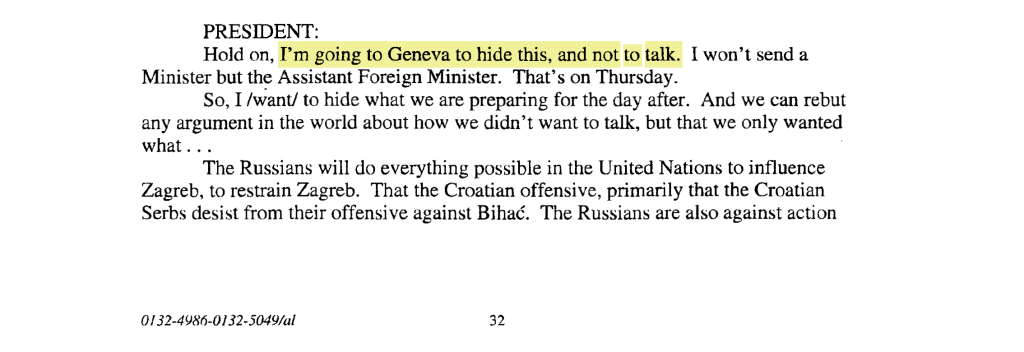
Instead, the files shows that Croatia’s participation in Geneva was a ruse intended to create the illusion Zagreb was seeking a diplomatic settlement, while it secretly crafted plans for “completely [vanquishing] the enemy.” The scheme was revealed in the minutes from a July 31, 1995 meeting between Tudjman and his top military brass at the presidential palace on the Brionian Islands. During the conversation, Tudjman informed those assembled: “We have to inflict such blows that the Serbs will to all practical purposes disappear.”

“I am going to Geneva to hide this and not to talk… I want to hide what we are preparing for the day after. And we can rebut any argument in the world about how we didn’t want to talk.”

Such statements, which constitute clear and unambiguous evidence of genocidal intent, were not limited to the President. The inevitability of ethnic cleansing was admitted by Ante Gotovina, a senior general who returned to Yugoslavia to lead operation Storm after he fleeing in the early 1970s. a decisive and sustained attack on Krajina would mean that afterwards, “there won’t be so many civilians, just those who have to stay, who have no possibility of leaving,” said Gotovina. The former French foreign legion commander, who was once employed as security for France’s far-right Jean-Marie Le Pen and worked as a strikebreaker cracking down on CGT union workers, would later be acquitted for his leading role in Operation Storm by a Western-dominated international tribunal.

For those Serbs who were now trapped in a hostile ethnic enclave, Tudjman suggested a mass propaganda campaign targeting them with leaflets declaring “the victory of the Croatian Army supported by the international community,” and calling on Serbs not to flee – in an apparent attempt to lend an inclusive veneer to their proposal to forcibly displace the civilian population. “This means giving them a way out, while pretending [emphasis added] to guarantee civil rights… Use radio and television, but leaflets as well.”

The generals discussed other propaganda efforts to justify the impending attack, including false flags. Given that “every military operation must have its political justification,” Tudjman said the Serbs “should provide us with a pretext and provoke us” before the strike began. One official proposed, “we accuse them of having launched a sabotage attack against us… that’s why we were forced to intervene.” Another general suggested carrying out “an explosion as if they had struck with their airforce.”

Bill Clinton provided ‘all clearance’ for mass murder

In late 1990, Yugoslav intelligence secretly filmed Croatia’s Defense Minister Martin Spegelj covertly plotting to purge the republic’s Serb population. In one tape, he told a fellow official that anyone opposed to Zagreb’s independence should be murdered “on the spot, in the street, in the compound, in barracks, anywhere” via “[a] pistol…into the stomach.” He forecast “a civil war in which there is no mercy towards anyone, women or children,” and Serb “family homes” were dealt with using “quite simply grenades.”

Spegelj went on to openly advocate “slaughter” to “resolve” the issue of Knin, Krajina’s capital, making the city “disappear.” He boasted, “we have international recognition for that.” The US had already “offered us all possible assistance,” including “thousands of combat vehicles” and “complete arming” of 100,000 Croat soldiers “free of charge.” The desired end result? “Serbs in Croatia will never be there again.” Spegelj concluded, “we are going to create a state at all costs, if necessary, at the cost of shedding blood.”

Western support for the horrors planned and perpetrated during Operation Storm was also writ large during the meeting on July 31, 1995. There, Tudjman told his generals, “we have a friend, Germany, which consistently supports us.” The Croats just had to “inform them ahead of time” of their objectives. “In NATO as well there is also understanding of our views,” he explained, adding, “we enjoy the sympathy of the US.” In 2006, German outlet Der Spiegel confirmed that the massacres bore Washington’s fingerprints, citing Croatian military sources who claimed they’d enjoyed “direct though secret support from both the Pentagon and the Central Intelligence Agency in planning and carrying out the ‘Storm’ offensive.”

“In preparing for the offensive, Croatian soldiers were trained at Fort Irwin in California and the Pentagon aided in planning the operation,” the outlet reported. US support went far beyond what it publicly acknowledged, which was that Croatian forces merely underwent training exercises carried out by US private military contractor MPRI, Spiegel revealed. “Immediately prior to the offensive, then-Deputy CIA Director George Tenet met with Gotovina and Tudjman’s son – then in charge of Croatian intelligence – for last minute consultations. During the operation, US aircraft destroyed Serbian communication and anti-aircraft centers and the Pentagon passed on information gathered by satellite to [Croatian forces].”

At an August 7 1995 cabinet meeting, Tudjman bragged of how Washington “must have been pleased” with how Croatia’s military executed Operation Storm. His premier, Ivo Sanader, then discussed coordinating the effort with US officials, who “worked in the name of” Vice President Al Gore. He assured those gathered that “all clearance… was approved straight” by US President Bill Clinton, and that Croatia could therefore “expect continuous support” from Washington as the massacres unfolded.

US diplomat cheers a genocidal ‘triumph’

On August 18, a high-level summit with senior US diplomat Richard Holbrooke was convened in Zagreb’s Presidential palace. A fixture of the intervention-obsessed Beltway foreign policy establishment, Holbrooke had his eyes on plum appointments under Bill Clinton and beyond – perhaps under a future Hillary Clinton administration. The successful dismantling of Yugoslavia would provide fuel for his ambitions.

In a transcript reviewed by The Grayzone, Holbrooke fawningly described Tudjman as the “father of modern Croatia” and its “liberator” and “creator.” Noting with approval that the strongman had “regained 98 percent of your territory” – without mentioning that it had been purged of Serbs – the American diplomat described himself as “a friend” of the newly-independent state, whose violent conduct he framed as legitimate.

“You had justification for your military action in Eastern Slavonia,” Holbrooke informed Tudjman, “and I defended it, always, in Washington.” When some in the US suggested reining in Zagreb, Holbrooke argued Croats should “continue” anyway, he declared.

Regarding Operation Storm, Holbrooke admitted, “we said publicly, as you know, that we were concerned, but privately, you knew what we wanted.” He dubbed the horrifying blitzkrieg a “triumph” from “a political and military point of view,” which left refugees as “the only problem” from Zagreb’s perspective. Effectively stage-managing the Croatian president, Holbrooke advised Tudjman to “give a speech stating that the war has finished and that [Serbs] should return.” While forecasting “the majority would not return,” Holbrooke apparently felt it important to at least leave the offer open publicly.

Croatian authorities dealt with this “problem” by passing discriminatory laws making it virtually impossible for displaced Serbs to return, while seizing their property. Despite possessing overwhelming evidence of grave war crimes, the NATO-funded International Criminal Tribunal for the former Yugoslavia did not indict anyone responsible for Operation Storm until 2008. Many culpable officials, including Tudjman, died in the intervening time. Three surviving military commanders were eventually prosecuted in 2011. One was acquitted and two convicted, although this was overturned on appeal in 2012.

That ruling reached several other extraordinary conclusions. While accepting “discriminatory and restrictive measures” were employed by Zagreb to prevent displaced Serbs from returning, this did not mean their departure was forced. Although civilians had been murdered in large numbers, including the elderly and infirm who couldn’t flee, Operation Storm somehow didn’t deliberately target non-combatants. And despite the explicitly stated desire of Spegelj and Tudjman to make Serbs “disappear,” neither government nor military officials were found to have specifically intended to expel Croatia’s entire Serb minority.

The anniversary of Operation Storm is now celebrated as ‘Victory Day’ in Croatia. The attack’s success is venerated in Western military circles today, and the effort may have influenced similar operations in other theaters of proxy conflict. In September 2022, the Kyiv Post cheered Ukraine’s unexpectedly successful counteroffensive in Kharkov as “Operation Storm 2.0,” suggesting it was a harbinger of Russia’s impending “capitulation.”

Almost three years later, Kiev’s forces are collapsing throughout the Donbass. Unlike in Croatia, the latest crop of ultranationalist US proxies appear unlikely to prevail.

Commentary & Analysis on Reports from Trump-Putin Meeting and Trump-Zelensky-European Leaders Meeting

​Trump’s security guarantees: key to a Ukraine settlement?

By Stephen Bryen, Asia Times, 8/18/25

Are we in for something like a repeat of Woodrow Wilson’s failure to achieve Senate backing for the Treaty of Versailles?

US President Donald Trump has offered Ukrainian President Volodymyr Zelensky security guarantees that Trump describes as “like Article V” of the NATO Treaty. Zelensky has apparently signed onto the Trump offer and potentially has agreed that some “territorial swaps” will be needed to make a deal with Russia.

Trump has reported to his European interlocutors who came to the White House to back up Zelensky. He told them more or less the same thing, according to reports, and told German Chancellor Friedrich Merz, who pushed for an immediate ceasefire, that a ceasefire ahead of a deal was off the table.

We don’t know what security guarantees mean or how they would be implemented. The Russians will be asking a lot of questions about the idea, if they have not already done so. Trump said he would be calling Russian President Vladimir Putin as soon as today, [August] 18, 2025, where it is already after midnight as this is written.

Here are the likely questions about security guarantees.

(1) Will the US send troops to Ukraine (as the European so-called “coalition of the willing” wants to do) or will the assurances to Kyiv be political in nature?

(2) Will the US set up any kind of infrastructure in Ukraine as part of the assurances to Ukraine?

(3) While Trump has ruled out any NATO membership for Ukraine, will the Europeans, or some of then, be part of the Trump guarantee?

(4) Article 5 of the NATO treaty, which is the effective collective security provision of the Treaty, requires consensus of all NATO members. Is Trump thinking of a quasi-NATO-like arrangement that also will require consensus for activation? One should note that not all European countries plan to support any troop presence in Ukraine even for security assurances. Specifically, Germany, Italy and Poland have said “no” to proposals from the UK and France.

(5) NATO is a treaty organization that was formally approved by its members, meaning the Treaty was signed and ratified by each country’s legislative authority. If Trump’s security guarantees are not under a treaty format, the deal might not be supported by a future President. If Trump wants to sign a treaty with Ukraine, he will need to convince Congress it is in the US national interest. This may not be as easy as it would seem because many will start to question exactly what would oblige the US to take military action if there is a violation of the final deal on Ukraine. It is obvious these are tricky waters, and the Trump administration will have to skip a lot of rope to sell the idea of an actual guarantee that involves the US military in a war with Russia, which is, as I am sure some have noticed, a nuclear-armed power.

In the United States a treaty, for ratification, needs a two thirds vote in the US Senate. There may well be enough isolationists in Congress to block ratification, if Trump goes for a treaty. Down the road, one is reminded of Woodrow Wilson’s failure to achieve Senate backing for the Treaty of Versailles.

There are more recent examples of treaties that ran into trouble. These include the Comprehensive Nuclear Test Ban Treaty, the Convention on Elimination of All Forces of Discrimination Against Women and the Law of the Sea Convention.

(6) The Russians have demanded a smaller Ukrainian military and a neutral Ukraine. Will this demand be honored in any way?

(7) We don’t yet have any idea on the territories Ukraine will yield, or the actual borders (since the Russians do not control all of Donbas). This will be a tough negotiation, and Putin will be under heavy pressure from his army, which, for the most part, is gaining ground in Donbas and elsewhere.

Trump faces an uphill battle selling US guarantees for Ukraine, notwithstanding whether they require US boots on the ground and if others will join the US, such as the UK and France. In one sense, with a smaller group, the Russians will regard the future risk as greater than the NATO risk because the UK and French are aggressively promoting their participation in armed conflict against Russia. A so-called coalition of some-willing looks like a non-starter for Russia.

All of this means that what looks like a success at the White House may devolve into another casualty of the Ukraine war. The offer of guarantees may fail under scrutiny, either by Russia or by the US Congress.

***

Doubts Grow on Ukraine Security Package as Russia Demands a Role (Excerpt)

By Natalia Drozdiak, Bloomberg, 8/21/25

Efforts to establish security guarantees for Ukraine as part of a US-led push to end Russia’s war are running into difficulties almost immediately.

US, Ukrainian and European officials have started hashing out proposals for a post-war plan to protect Ukraine, after White House officials said Russian President Vladimir Putin was open to “Article 5-style” security guarantees for Kyiv, a reference to NATO’s collective defense commitment.

The Kremlin hasn’t confirmed publicly that Putin made such a commitment at his summit with US President Donald Trump in Alaska last week. Russian Foreign Minister Sergei Lavrov said Wednesday that Russia should have a say in security arrangements for Ukraine, which could also involve China. Hours later, Ukrainian President Volodymyr Zelenskiy ruled out Beijing as a potential guarantor of peace.

Lavrov reiterated the demand on Thursday, saying Moscow had supported a Ukrainian proposal at negotiations in Istanbul shortly after the 2022 invasion began that would have involved the five permanent members of the United Nations Security Council, the US, Russia, China, the UK and France, in security guarantees.

Russia supports guarantees based “on the principle of collective security, on the principles of indivisible security,” Lavrov said. “Anything else, anything unilateral is, of course, an absolutely hopeless undertaking.”

Several senior European officials and diplomats, speaking on condition of anonymity, said they viewed Lavrov’s comments as an attempt to stall the process, and expressed doubt that Putin is willing to make a deal. Trump is pressing for Putin and Zelenskiy to meet for direct talks as the next stage of US efforts to reach an end to the war that’s in its fourth year.

Zelenskiy and a delegation of European leaders rushed to the White House on Monday for talks with Trump after the US president rolled out the red carpet for Putin at their summit and appeared to swing toward Russia’s positions on the war. He abandoned demands for Putin to agree to a ceasefire ahead of negotiations and said Ukraine would have to concede territories to Russia as part of a settlement.

***

US will play minimum role in Ukraine’s security guarantees – Politico

By Ben Aris, Intellinews, 8/21/25

The Pentagon’s top policy official Elbridge Colby says the US will play a minimal role in any Ukraine security guarantees, Politico reported on August 21.

US President Donald Trump has shifted position in the last month, promising to contribute to the security guarantees being worked out by Ukraine’s European allies ahead of a meeting between Ukrainian President Volodymyr Zelenskiy and Russian President Vladimir Putin, but has also made it clear that the US role will be limited.

Trump has revealed few details of what the US role will be but has said Washington will not contribute troops to any peacekeeping force Europe appears to be planning. Colby comments add some clarity and underscore the fact that the lion’s share of the security arrangements will fall to Europe.

There also seems to be some dissent amongst EU leaders on what the best sort of security guarantee would be. While the UK and France are tending towards reviving the idea of sending peacekeepers, Italy’s Prime Minister Giorgia Meloni has been a lone voice arguing for a true “Nato Article 5-like” guarantee where EU members sign genuine security guarantees and commit to sending troops to Ukraine within 24 hours if Russia were to re-invade Ukraine, Bloomberg reports. The plan does not include Ukraine’s membership in Nato, but does tally with the bilateral security deals that Zelenskiy was hoping for as part of the 2022 Istanbul peace deal.

Meloni first brought up the idea of “Nato-lite” Article 5-like protections for Kyiv in March 2025, but has not been backed by other Nato members. She brought the idea up again in public comments during the White House summit on August 18.

The Article 5-like proposal is one of many options currently being weighed by European leaders ahead of a mooted meeting between Putin and Zelenskiy that also includes peacekeepers, more sanctions, increased weapons supplies, security agreements, long-term economic aid, and land swaps.

Peacekeepers

A decision to send peacekeepers to Ukraine is controversial. The Kremlin has said repeatedly that it will not accept any Nato-backed troops on Ukrainian soil.

The idea of peacekeepers was first floated by French President Emmanuel Macron earlier this year and backed by the UK, two of the leading members of the coalition of the willing. Germany, however, the third leading member of the coalition, has made it clear that it will not participate. Bloomberg previously reported that about ten European countries are willing to commit troops to Ukraine.

The Kremlin has dismissed the peacekeeping security proposals. Russian Foreign Minister Sergey Lavrov said on August 20 that Russia should be one of the countries that provides Ukraine security guarantees.

“As for reports that the UK, France, and Germany want to develop collective security guarantees, we support making these guarantees truly reliable,” Lavrov said on August 20 and repeated earlier calls that any deal should be based on the terms agreed in Istanbul in 2022.

“Our delegation then agreed to work out security guarantees involving all permanent members of the UN Security Council — Russia, China, the US, France, and the UK,” he said. “Germany and Turkey were mentioned, as well as others that may be interested in joining this group.”

Zelenskiy has demanded that Russia provide Ukraine with “ironclad” security guarantees and Putin signalled during the Alaska summit on August 15 that he was agreeable to the idea.

EU leaders have flip flopped on the idea of peacekeepers, but it appeared the plan was abandoned in March, deemed to be unworkable thanks to Russia’s objections. Now the idea appears to have been revived in lieu of giving Ukraine true security guarantees.

UK Prime Minister Keir Starmer said on August 20 that the UK was willing to send up to 30,000 soldiers to Ukraine as part of the peacekeeper force.

Europe in the driving seat

Colby’s comments came in response to questions from European military leaders in a meeting of the Joint Chiefs chair Gen. Dan Caine on August 20. Defence chiefs from the United Kingdom, France, Germany and Finland pushed the US side to disclose what it would provide in troops and air defences to help Ukraine maintain a peace deal with Russia should an agreement be reached, according to a European official cited by Politico.

“There’s the dawning reality that this will be Europe making this happen on the ground,” a Nato diplomat who was briefed on the talks told Politico. “The US is not fully committed to anything.”

Trump on Monday said he was ready to send US troops to Ukraine. But he backtracked next day, suggesting instead that he was open to providing air support for European troops there.

“I don’t know where that leaves us,” a European official told Politico. “Pretty much back to where we were in the spring with the coalition of the willing.”

Trump has tried to withdraw from supporting Ukraine since taking office. He has cancelled all monetary and military support at least twice since taking office but has been pressured into resuming some level of support by the Ukraine supporters in his entourage.

But what support remains, will be minimal. US Secretary for Defence Pete Hegseth announced in July that the Pentagon had stopped all support for Ukraine, although the White House walked the total halt back a week later. As bne IntelliNews reported, Europe has taken on almost the entire burden of supporting Ukraine since the start of the year.

EU officials are sceptical of Colby, who was the force behind Hegseth’s decision to stop supplying Ukraine, arguing that US stockpiles of weapons had fallen to only 25% of what Pentagon’s strategic planning targets demanded for the US’ own defensive needs. Coby has long lobbied for European allies to do more to defend the continent against Russia.

A poll from The Economist/YouGov found that US citizens are deeply divided on the question of US support for Ukraine. A third (32%) of Americans favour increasing military aid, and a fifth (21%) favour maintaining the current amount. Just over half (54%) of those polled said that Europe should be involved in the talks with Russia while just under half (46%) think the US should also be involved.

The poll also found that the results show that 42% would blame Putin for the failure of the talks, while only one in ten would blame Zelenskiy. An additional 11% would blame President Donald Trump, and 17% would blame all of the leaders equally.

The poll also shows strong opposition to Ukrainian territorial concessions: 68% of Americans said Russia should get “none of it,” although the same poll found that 38% of Americans believe Russia will ultimately control “some of” Ukraine’s territory and 30% of Americans believe Russia is more likely to win the conflict, while only 15% believe Ukraine is more likely to win.

Zelenskiy reports that Ukraine now produces between 40% and 50% of all the weapons it needs, but the progress has been largely in the simpler weapons raising the question: can Ukraine go it alone? For now, Kyiv remains entirely dependent on the West for the sophisticated and long-range offensive and defensive items like Patriot, HIMARS and ATACMS missile systems.

***

Can Putin Legally Stop The Conflict Without First Controlling All The Disputed Territory?

By Andrew Korybko, Substack, 8/19/25

The Constitutional Court would likely have to rule on this hypothetical scenario due to 2020’s constitutional amendment prohibiting the cession of Russian territory except in certain cases.

RT’s report on Steve Witkoff’s claim that Russia has made “some concessions” on territorial issues, which signal a “significant” shift towards “moderation”, prompted talk about whether Putin can legally stop the special operation without first controlling all the disputed territory that Moscow claims as its own. He himself demanded in June 2024 that the Ukrainian Armed Forces “must be withdrawn from the entire territory of these regions within their administrative borders at the time of their being part of Ukraine.”

Moreover, the agreements under which Donetsk, Lugansk, Zaporozhye, and Kherson joined Russia all describe their administrative boundaries as those that existed “on the day of [their] formation”, thus suggesting that the entirety of their regions are indeed legally considered by Russia to be its own. Putin also famously declared during the signing of those treaties in late September 2022 that “the people living [there] have become our citizens, forever” and that “Russia will not betray [their choice to join it]”.

Nevertheless, Putin could still hypothetically “moderate” this demand. Article 67.2.1 of the Russian Constitution, which entered into force after 2020’s constitutional referendum, stipulates that “Actions (except delimitation, demarcation, and re-demarcation of the state border of the Russian Federation with adjacent states) aimed at alienating part of the territory of the Russian Federation, as well as calls for such actions, are not permitted.” “Moderation” could thus hypothetically be an “exception”.

To be absolutely clear, no call is being made within this analysis for Russia to “cede” any territory that it considers to be its own, nor have any Russian officials lent any credence whatsoever to Witkoff’s claim. That said, if Putin concludes for whatever reason that Russia’s national interests are now best served by “moderating” its territorial claims after all that happened since September 2022’s referenda, then any proposed “re-demarcation of the state border” would likely require the Constitutional Court’s approval.

He’s a lawyer by training so it would make sense for him to proactively ask them to rule on the legality of this hypothetical solution to the Ukrainian Conflict. Even if he instead hypothetically proposes retaining his country’s territorial claims but freezing the military phase of the conflict and only advancing those claims through political means, he’d still likely seek their judgement too. They’re the final authority on constitutional issues and these scenarios require their expertise per their connection to Article 67.2.1.

If they hypothetically rule in his favor, the question would then arise about the fate of those living in the Ukrainian-controlled parts of those regions who Putin said “have become our citizens, forever.” They might rule that those who didn’t take part in the referenda, such as the residents of Zaporozhye city, aren’t Russian citizens. Those that did but then fell under Ukrainian control, such as the residents of Kherson city, might be deemed citizens who could move to Russia if Ukraine lets them as part of a deal.

To remind the reader, no Russian officials at the time of this analysis’ publication have lent any credence whatsoever to Witkoff’s claim that Russia made “some concessions” on territorial issues, so it remains solely a hypothetical scenario for now. Even so, Putin might hypothetically conclude that such “moderation” is the best way to advance Russia’s national interests in the current context (such as part of a grand compromise), in which case the Constitutional Court would likely have to rule on its legality.

***

Declassified notes from Putin’s first presidential summit show parallels with Alaska meeting last week

National Security Archive, 8/21/25

Washington, D.C., August 21, 2025 – Newly declassified notes from Vladimir Putin’s first presidential summit with an American leader reveal some of the constants in the Russian leader’s approach: flattery, banter about sports, appearing to agree while saying nyet, and history lectures, according to documents obtained through a Freedom of Information lawsuit and published today by the National Security Archive.

The notes written by Strobe Talbott show Putin in his most cooperative and pro-Western period, hoping for full integration of Russia into the European security system and even NATO. Putin emphasizes cooperation on every point, strategic and economic, even when he intends to disagree. Putin is still inexperienced, yet confident and in full command of his brief, freely moving from subject to subject and trying to impress the American president.

The declassified notes published today include extensive color commentary about Putin’s style, psychological assessments of Putin and his rhetorical flourishes, dramatic quotes from Putin about preferring force to negotiations (“giving them what they deserved”), descriptions of Russian motivations and red lines—all the product of close first-hand observation by Strobe Talbott, then deputy secretary of state and fluent in Russian, during the June 2000 summit between Putin and President Bill Clinton at the Kremlin. Talbott was the U.S. notetaker during the three “one-on-ones” (actually 3-on-3 including translators and notetakers) at the 2000 summit, as he had been for most of Clinton’s previous meetings with Yeltsin.

The publication today also includes the formal memorandum of conversation for one of the two plenary sessions during the summit, declassified by the Clinton Presidential Library as the result of a Mandatory Review request by the National Security Archive. Detailed in this memcon is an extraordinary back-and-forth between Putin and Clinton about the possibility of Russia actually joining NATO, a prospect about which Putin says, “I am pleased.”

While the parallels between last week’s Alaska summit and the Moscow summit 25 years ago are not exact, many of the same issues resonate today, although similar detailed notes are unlikely ever to appear from the meeting last week between Putin and President Trump. Putin’s aggressive approach to the Chechen war back then and his endorsement of force over negotiation no doubt rhymes with his current stance on Ukraine, since he was the invader and could stop the war tomorrow if he wanted. The other major subject of the Putin-Clinton conversations—missile defense—remains a front-burner issue today, with President Trump’s newfound interest in building a “Golden Dome” over the U.S.

Read documents here.