Uriel Araujo: Trump’s Venezuela U-Turn: why Chevron back in Caracas despite neo-Monroeism

By Uriel Araujo, InfoBrics, 7/31/25

In a somewhat striking (and underreported) reversal, the Trump administration has authorized Chevron to resume oil operations in Venezuela, granting a six-month license to extract and export crude to the United States. This comes just months after Trump had revoked the company’s license in February, citing electoral irregularities and failed promises on migrant repatriation. The decision thus marks a notable shift in Washington’s traditionally hostile posture toward Caracas.

US-Venezuela relations have indeed long been defined by sanctions, diplomatic standoffs, and ideological confrontations. Trump’s first term saw the recognition of opposition leader Juan Guaidó and a “maximum pressure” campaign that quite effectively strangled Venezuela’s oil output to some extent. Thus far, the Biden interregnum had offered only temporary respite, and Trump’s return to power brought back neo-Monroeist rhetoric to the Americas — complete with tariff (and even “annexation”) threats against Mexico, Brazil, Colombia, Panama, and, one may recall, even Canada.

Why, then, make an “exception”, so to speak, for Venezuela? Why is Chevron suddenly welcome back in Bolivarian territory, with Washington’s blessings?

Well, oil prices and domestic economic imperatives must be taken into consideration. As I noted, in July 2024, any escalation in the Iran-Israel conflict could send gas prices soaring, thereby undermining Trump’s economic credibility and crashing markets. That escalation, thus far, has not materialized — Iran’s retaliation to US strikes last month was restrained, and Tel Aviv has not pursued overt escalation after taking a heavy blow under Iranian missiles.

Yet even without a Middle Eastern full blow-up, oil remains a pressure point. After the February revocation of Chevron’s license, crude prices rose by nearly 2%. Inflation continues to hover above target, and any relief for US consumers and for “MAGA” — particularly heading into the 2026 midterms — is very welcome.

I’ve noted elsewhere how much the incumbent American President is dealing with domestic turmoil, while now also facing a political crisis amid the Epstein scandal; all of that further intertwines domestic and foreign policy.

In any case, Venezuela’s heavy crude is uniquely suited for US Gulf Coast refineries. Its output to Chevron alone may reach up to 220,000 barrels per day — roughly 3.5% of US imports. No wonder Washington would rather siphon oil from a manageable adversary than allow inflation to erode its domestic standing.

But oil prices alone do not explain the full picture. A more underreported — and arguably more strategic — motivation lies in countering Chinese influence. As I’ve recently written, Venezuela has become a quiet but critical node in Beijing’s energy belt. As oil analyst Antonio de la Cruz puts it, “it’s not about Caracas… it’s about Beijing.”

With over half a million barrels per day flowing to China under opaque contracts, US sanctions have become increasingly toothless. Chevron’s return is thus a surgical maneuver to reassert US presence and try to prevent China from “monopolizing” Venezuela’s reserves — which, suffice to say, are among the largest in the world.

This aligns with what some have called a “tightrope act”: re-engaging Venezuela without legitimizing Maduro, thereby preserving strategic leverage in the Caribbean. In this light, Chevron is less an oil company than a geopolitical instrument.

Not everyone buys the high-strategy explanation, for sure. Some view the decision as a byproduct of corporate lobbying and debt recovery, pure and simple. After all, Chevron spent over $9 million with lobbying in 2024 alone, and still seeks to recover at least $1.7 billion of Venezuela’s unpaid debts. With Washington, it is always a bit of both.

The new license is structured under “external profit control” — ostensibly to “keep Maduro at bay” — but critics contend that this is window dressing. No wonder some suggest that Chevron, not the State Department, is setting the policy tone in Caracas.

In any case, diplomatic gestures have also played a role. A recent prisoner exchange — ten Americans for 252 Venezuelans — softened bilateral tensions somewhat. Though underreported, this development (which was being quietly discussed for some time) arguably created space for economic détente, at least in limited form.

Yet internal contradictions abound. Hardliners like Secretary of State Marco Rubio have reportedly voiced concerns about re-engaging Maduro, fearing that any deal — no matter how conditional — may embolden “Chavismo”. I’ve written before about Trump’s emboldened neo-Monroeism and its focus on Latin America. The administration thus walks a narrow line between realpolitik and ideological consistency.

In conclusion, Trump’s Venezuela manoeuvre is a case study in hyper-pragmatism. It reveals a foreign policy often driven by domestic cost-benefit calculations, corporate influence, and geopolitical hedging — rather than any coherent doctrine. Whether this move stabilizes fuel prices or merely enriches a few players remains to be seen. Be it as it may, Trump’s often unpredictable foreign policy remains erratic, improvisational, and at times strategically opaque.

James Carden: The Carnegie Endowment for the Permanent State: Why should taxpayers subsidize this think tank?

By James Carden, Substack, 7/28/25

Despite the myriad of disasters the permanent state—with the assistance of its allies in the media and its enablers on Capitol Hill—have brought about, it remains as entrenched as ever, Trump’s claims to the contrary.

How is that?

One answer is that, of course, the permanent state is lavishly well funded; it essentially functions as a public-private enterprise, in which Washington think tanks play a critical role. Perhaps it has escaped the administration’s notice, but tax-exempt organizations like the Carnegie Endowment for International Peace (which has assets of over half a billion dollars) are, as we speak, providing an institutional home for a number of men and women who sought to overthrow Trump’s first administration.

Now that DNI Gabbard has revealed the extent to which the Obama administration, acting in concert with former CIA director John Brennan, had to do with fomenting the Russia ‘collusion’ scandal, the administration might do well to turn its attention to a number of Washington tax-exempts that have long protected discredited members of the national security apparatus.

The Brookings Institution’s links to Russiagate, via Fiona Hill, are by now well known. It was Hill who made the connection between Igor Danchenko and Christopher Steele, the mendacious ex-British spy who authored the Steele Dossier. And it was Danchenko whose fantasies fueled the most salacious parts of that report, which went on to serve as a foundational report for Brennan’s fictitious Intelligence Community Assessment (ICA) of January 6, 2017.

As it happens, one of the proud authors (they were all handpicked by Brennan) of the Intelligence Community Assessment, Gavin Wilde, served as a former NSC director for Russia during the first Trump administration and is now nonresident fellow in the Technology and International Affairs Program at the Carnegie Endowment for International Peace.

The ICA claimed, without evidence (or logic), that Putin interfered in the US election to benefit Trump and kicked off what was to be a years-long McCarthyite witch hunt culminating in his first impeachment. The impeachment drive, as readers will recall, was set off by an Ukrainian-American dual national on the staff of the National Security Council who decided that he, not the president, was responsible for the conduct of US foreign policy.

The Ukrainian national, a publicity-hungry Army foreign affairs officer named Alexander Vindman worked with a CIA operative detailed to the Trump NSC, Eric Ciaramella, who, reports indicate, leaked the contents of a phone call Trump had with Ukrainian president Zelensky to the staff of House Permanent Select Committee on Intelligence (HPSCI), Chairman Adam Schiff. As it happens, Ciaramella now works side by side with Wilde at the Carnegie Endowment where he serves as senior fellow in the Russia and Eurasia program.

In addition to these two, Carnegie boasts a slew of former high ranking intelligence and diplomatic officials, including Biden and Obama era national intelligence officers; former CIA operatives; and even a Clinton-era national security council staffer with a sideline in writing comic books.

Trump may think he is hitting the permanent state where it lives with indiscriminate firings across the federal workforce, but until such time as the IRS and Department of Justice turn their sights on the tax exempt status of institutions like Carnegie, the permanent state will not only survive, it will thrive.

Uriel Araujo: Trump, Epstein and politics of child abuse: American intelligence apparatus has a history

By Uriel Araujo, InfoBrics, 7/30/25

Uriel Araujo, Anthropology PhD, is a social scientist specializing in ethnic and religious conflicts, with extensive research on geopolitical dynamics and cultural interactions.

With the recent developments involving Ghislaine Maxwell, the Jeffrey Epstein scandal (involving the trafficking of teenage girls for powerful individuals) is definitely back in the spotlight, and analysts are wondering the extent to which this could undermine Donald Trump’s presidency, given his ties to Epstein.

With reports on Trump’s involvement with the Elite Model teen abuse scandal of the nineties, and the Virginia Giuffre case (who worked at Trump’s Mar-a-Lago resort and then for Epstein), it is fair to say that the American leader is under attack in terms of media coverage. Accusations of pedophilia and cover-ups swirl, but framing all of this as mere “personal indiscretions” or personal wrongdoings, grave as they are, on Trump’s part would be a mistake. It is a US systemic societal and state issue.

Releasing the Epstein files was ironically enough initially promised by Trump’s own task force. One may recall that the Epstein case “backfired” on Trump largely thanks to Elon Musk, who also had his own ties to the billionaire. As I suggested back in February, it’s not far-fetched to see Trump’s task force for releasing classified files, including those on Epstein, as a strategy to weaponize information for leverage. The risk, I argued, was self-incrimination, given Trump’s own ties to Epstein — and to other organized crime figures. The “break-up” with Musk seems to have sparked precisely such backfire.

Consider the fact that the aforementioned Ghislaine Maxwell (Epstein’s girlfriend and “madam”) was granted limited immunity for two days of interviews with Deputy Attorney General Todd Blanche, and now she claims to be ready to testify before the US Congress, if given clemency. Her attorney has confirmed she answered questions about approximately 100 individuals. The timing is quite interesting to say the least — and the implication is clear: Maxwell’s list of names may very well be weaponized to shift the narrative, thereby shielding powerful figures including Trump from further scrutiny. But one needs to look still beyond that.

I wrote before on Epstein links to espionage, including but not limited to an Israeli Mossad angle. The former US Secretary of Labor Alexander Acosta is on the record saying that Epstein “belonged to intelligence”, and thus was “above his pay grade” and should be left “alone”, despite all the serious accusations.

It is a well known fact that the billionaire’s properties were rigged with cameras, making blackmail the most obvious scenario. Sexually exploiting teenage minors is nasty enough but the exploitation of actual prepubescent children would bring far greater “value” in terms of kompromat and weaponizable damage, which leaves one wondering what else could be in the Epstein files (the same ones American officials now claim to have nothing).

American abuse of minors, espionage, blackmail: none of this would be a new phenomenon. The United States’ political machinery has long thrived on kompromat, a tactic refined during the Cold War when intelligence agencies exploited sexual vices to manipulate leaders and recruit operatives. The CIA’s so-called “brothels,” laced with LSD for blackmail, are a well-documented example taken from the infamous MKULTRA program.

This program also involved the torture and sexual abuse of children, among other human rights violations including clandestine scientific experiments with even newborns. In the Cold War years, the US government went so far as to feed radioactive oatmeal to disabled American school children (thus used as guinea pigs) as part of Atomic Energy Commission experiments. The point is that the US national security apparatus has a history of treating children as abusable and dischargeable objects for various purposes.

One may recall also that former US President Barack Obama was going to release information and even photos pertaining to torture conducted by the US regime at the Abu Ghraib and Bagram prison. Obama too changed his mind, as one does and the matter was closed. At the time, General Antonio Taguba confirmed (see page 17) the existence of unreleased images and videos showing sexual torture, including the rape of a boy by a US contractor. No wonder such material has never been released, but one still may wonder: why would authorities film or photograph such state crimes, thereby producing what is by definition child pornography?

It’s long been known that the American intelligence apparatus has engaged in illicit operations for its black budget, including organized crime sectors such as drug trafficking, to the point of creating the crack addiction problem in the US. Historian Alfred W. McCoy’s “The Politics of Heroin in Southeast Asia” and former diplomat Peter Dale Scott’s works — such as “Cocaine Politics” — offer thorough documentation of part of this history.

Well, it just so happens that child pornography is a multi-billionaire industry and is part of the crime landscape. There is no reason to assume that the American “deep state” would have any qualms in taking part in such things. We are talking, after all, about a complex that for the last half century has been promoting “regime-changes”, torture, assassinations, trafficking, death squads, terrorism, and neo-fascism in different parts of the world.

Consider this: in the 1980s, an investigation into the Finders — a cult-like group based in Washington, D.C. — raised alarms over child trafficking and pornography, and a CIA-linked cover-up (the group had CIA ties via front companies such as Future Enterprises). In 1987, police in Tallahassee, Florida, found six filthy, hungry children aged 3 to 10 in a van with Finders members, along with videotapes, a computer, and urine-soaked bedding. Some children showed signs of sexual abuse.

Authorities later uncovered passports to sensitive places like North Korea and North Vietnam, large sums of money, and photos of chained children. Notably, Isabelle Pettie, wife of the group’s leader Marion Pettie, was a confirmed CIA employee, and their son worked for Air America, a CIA front tied to drug trafficking. A 1987 D.C. Police Intelligence report marked “Confidential” stated the case was “treading on the toes” of the CIA and had become a “CIA internal matter.” The suspects were released and the children returned to their guardians — charges were dropped.

Similar cases abound to this day, but are usually dismissed by the American media as “conspiracy theories”, unless it is convenient to weaponize them for electoral or political purposes (as is the case now with Epstein and Trump). To sum it up, releasing the Epstein files would be a good first step, but it’s merely the tip of a deeply disturbing iceberg.

Gordon Hahn: Trump’s Suicidal Nuclear Brinksmanship

By Gordon Hahn, Website, 8/5/25

I noted at the advent of his first term that Mr. Trump would be good for US domestic politics, especially the economy but bad for foreign policy and that is bearing out again in this second term. It is one thing for a political leader to loosely play with language that circles around making a nuclear threat, as Russian Security Council Deputy Head and former Russian President Dmitrii Medvedev has done again recently in a public social net spat with US President Donald Trump. But it is quite another to play global chess with the repositioning of nuclear forces to actually threaten another country, especially another nuclear power of equal if not superior nuclear weapons strength. No matter, that is precisely what President Trump has been doing of late. Not even the clueless, corrupt, and strategically incompetent Biden and Obama administrations made such a foolish move.

Trump responded to Medvedev’s verbal assault by making a material nuclear threat against Russia. He announced he had redeployed to US nuclear submarines closer to Russia – an act of open nuclear threat and intimidation. 

But that is not even the whole story. Trump’s nuclear sabre-rattling relates to much more than ‘merely‘ forward deploying two nuclear submarines a spart of a self-declared threatening of Moscow. 

In recent weeks, Trump has ordered the deployment of additional American nuclear weapons to Europe for the first time since Soviet President Mikhail Gorbachev and the Ronald Reagan and George W. Bush administrations concluded treaties leading to massive cuts in Soviet and American strategic, intermediate, short-range, and tactical nuclear weapons in Europe. In other words, he has negated the results of years of arms control efforts and decades of nuclear arms comity with Moscow. As Larry Johnson has noted, the Trump administration has deployed some 100-150 B61-12 tactical nuclear gravity bombs to six bases in five NATO countries: RAF Lakenheath (United Kingdom); Kleine Brogel Air Base (Belgium); Büchel Air Base (Germany); Aviano and Ghedi Air Bases (Italy); Volkel Air Base (Netherlands), and Incirlik Air Base (Turkey) (https://open.substack.com/pub/larrycjohnson/p/trump-escalates-nuclear-threat-to?r=1qt5jg&utm_medium=ios).

All this comes on the background of a NATO(US)-Russia Ukrainian War and an imminent Russian-American nuclear arms race, given the expiration of the New START nuclear arms treaty coming in seven months, not to mention Trump’s apparent last ditch attempt to revive Russian-Ukrainian negotiations and transition to normal US-Russian relations with his roaming negotiator Steven Witkoff’s visit to Moscow this week. Perhaps this is Trump’s provocative way of opening up discussions on renewing or replacing the expiring New START (https://gordonhahn.com/2025/05/23/a-new-new-start-putin-sees-trump-administration-as-a-window-of-opportunity-for-strategic-arms-control/).

Not surprisingly, except perhaps to Trump and his neocon provocateurs, Moscow responded by removing its self-imposed moratorium on forward deploying forward short and medium-range nuclear missiles. This might be a bit of a ruse for now, since in June 2023 Russia deployed nuclear missiles to Belarus, as NATO persisted in conducting the Ukrainian War it clearly provoked and in April 2022 blocked prevention of. Mr. Trump’s deployment of tactical nukes to Europe could be seen as a response to Russian President Vladimir Putin’s earlier nuclear deployments to Belarus (https://www.reuters.com/world/europe/belarus-has-started-taking-delivery-russian-tactical-nuclear-weapons-president-2023-06-14/). But the nuclear submarine redeployment cannot be so viewed, and the redeployment of tactical nukes to Europe comes too long after the Russian deployment to Belarus to be convincing as such.

The Western imperative of escalation in and around Ukraine after provoking the war by way of battlefield and geostrategic escalations in Ukraine is clear and undeniable. From blocking the April 2022 Istanbul peace agreement to providing offensive rather than just defensive weapons, from first providing Ukraine with tanks and armoured personnel carriers, then artillery systems, then fighter jets, mid-range missiles, and soon perhaps longer-range ones, the West has taken every opportunity to escalate the war rather than negotiate an end to it. 

The endgame of Western persistence in escalating in order to level a ‘strategic defeat against Russia‘. This can be seen in the US, NOT UKRAINIAN, initiative to send HIMARS missiles to Kiev. For it was not Ukraine that requested the supply of HIMARS to Kiev, but rather it was American generals who did. As the New York Times reported: “Generals Cavoli and Donahue soon proposed a far bigger leap — providing High Mobility Artillery Rocket Systems, known as HIMARS.” “When the generals requested HIMARS, one official recalled, the moment felt like ‘standing on that line, wondering, if you take a step forward, is World War III going to break out?’” (https://archive.is/Fdwq3). This also can be seen in the proposal by some Biden-era US officials, according to the New York Times, to ‚return‘ nuclear weapons to Ukraine (www.nytimes.com/2024/11/21/us/politics/trump-russia-ukraine-war.html). This would end either in a pre-emptive Russian nuclear strike or massive conventional one, using the likes of Oreshkin missiles, that would finish off the process of Ukraine‘s Second Great Ruin. This is suicidal brinksmanship and over what? NATO’s expansion to Ukraine.

Mr. Trump is returning to this stupid, futile, and dangerous Biden-era escalation policy, even as he ostensibly pursues a Ukrainian peace process. But Trump’s innovation is to escalate at the nuclear level, threatening a security-vigilant Moscow with a nuclear first strike in eastern Ukraine or the homeland proper. Continuing this petulant foolishness, as I have noted repeatedly in the course of the decade-long Ukrainian crisis, cannot end well.

***

Putin Subtly Puts the US on Notice… Russia is Locked and Loaded

By Larry Johnson, Substack, 8/5/25

Following two months of provocations and threats from the United States, Vladimir Putin announced a major policy change regarding intermediate-range missiles that pushes the world to the brink of nuclear war. While the mainstream media has largely ignored Russia’s announcement that it would no longer abide by the Intermediate-Range Nuclear Forces Treaty (INF), a few podcasters — e.g., Danny Davis and Alexander Mercouris — recognized both the importance and danger inherent in this decision and discussed this at length during their respective shows. This is not Russia going rogue. Putin’s decision was a unambiguous response to a series of foolish and reckless actions by the United States since June 1st of this year.

The Spiderweb attack on Russia’s strategic bomber force on June 1st, using drones deployed from hidden compartments in semi-trucks, was a dangerous provocation, although little damage was inflicted. Twelve days later, Israel launched a decapitation attack on Iran — that too thankfully failed — using the same drove tactic employed in Russia just weeks earlier. In mid-July the Russians listened in shock to General Christopher Donahue, Commander of US European Command (USEUCOM) describe how NATO has tested plans to quickly overrun and capture Kaliningrad, a Russian exclave. At the same time, Trump re-deployed B61-12 nuclear gravity bombs to at least six airfields in Europe, including the UK’s Lakenfield. Lastly, Trump brashly announced the deployment of two nuclear submarines with the specific mission of being in position to strike Russia. [NOTE: This was most likely a symbolic statement because submarines with that mission were already on station.]

The Trump administration also has announced that it will begin deploying intermediate-range ballistic missiles (IRBMs) and other long-range fire capabilities in Europe starting in 2026, with Germany as the initial host country for these systems. This deployment specifically includes advanced missile systems such as the Typhoon and Dark Eagle, which have been referenced in recent official communications and news reports. The Typhon Missile System (Mid-Range Capability) is a mobile, ground-launched system that fires multiple missile types (not a missile itself, but a multi-missile platform). It can fire the Tomahawk Land Attack Missile, which has a range of 1,500–2,500 km, or the SM-6, which has a range of 320 km. The Dark Eagle is a Long-Range Hypersonic Weapon aka LRHW, with a range of 2,775 km. The Dark Eagle hypersonic missile, after several failed attempts from 2021–2023, has been successfully tested. The system achieved its first successful end-to-end flight test in June 2024, followed by a second successful test in December 2024.

It is worth reviewing the INF Treaty that Donald Trump cancelled in 2018:

Major Points of the INF Treaty

1. Elimination of Intermediate- and Shorter-Range Missiles:

-The treaty required the US and Soviet Union to eliminate all ground-launched ballistic and cruise missiles with ranges between 500 and 5,500 kilometers (approximately 300–3,400 miles), including both nuclear and conventional variants.

-Intermediate-range (1,000–5,500 km) and shorter-range (500–1,000 km) missiles were targeted, covering systems like the US Pershing II and Soviet SS-20 Saber.

-By June 1, 1991, both parties were to complete the destruction of these missiles and their launchers, resulting in the elimination of 2,692 missiles (1,846 Soviet, 846 U.S.).

2. Prohibition on Production and Testing:

-The treaty banned the production, flight-testing, or possession of ground-launched intermediate- and shorter-range missiles after the elimination deadline.

-This applied to both nuclear and conventional missiles within the specified range, ensuring no new systems could replace those destroyed.

3. Scope and Exclusions:

-The treaty covered ground-launched missiles only, excluding air-launched and sea-launched systems (e.g., submarine- or ship-based missiles like the US Tomahawk).

-It applied to missiles regardless of warhead type (nuclear or conventional), making it comprehensive within its range category.

-Support structures, such as launchers and associated equipment, were also to be destroyed or rendered unusable.

4. Verification and Inspection:

-The treaty established a robust verification regime, including on-site inspections, data exchanges, and continuous monitoring of missile production facilities to ensure compliance.

-A Special Verification Commission was created to resolve compliance disputes, with inspections continuing for 13 years after 1991 (until 2001).

-Both sides provided detailed inventories of their missile systems and destruction sites.

5. Indefinite Duration:

-The treaty was of unlimited duration, meaning it remained in force until a party withdrew (as the US did in 2019, citing Russian non-compliance with the 9M729 missile).

-Either party could withdraw with six months’ notice if they believed their supreme interests were jeopardized.

6. Global Application:

-The treaty prohibited deploying covered missiles anywhere in the world, not just in Europe, addressing concerns about Soviet SS-20s targeting Asia and US Pershing IIs in Europe.

-It applied to missiles stationed in allied territories (e.g., US missiles in NATO countries, Soviet missiles in Warsaw Pact states).

That treaty has prevented nuclear war in Europe for 37 years. Now, with Trump’s nuclear sabre rattling, Putin has put Trump on notice… Any IRBMs introduced to Europe will be destroyed. When that happens — mind you, I don’t say “if” — we will be at the very threshold of a nuclear nightmare. I don’t think Trump will get a Nobel Peace Prize out of this.

Jeff Childers: AG Orders Grand Jury Probe into Obama Officials Over Russiagate

As to whether arrests will actually occur…I’ll believe it when I see it. – Natylie

By Jeff Childers, Substack, 8/5/25

Jeff Childers is an attorney and conservative commentator.

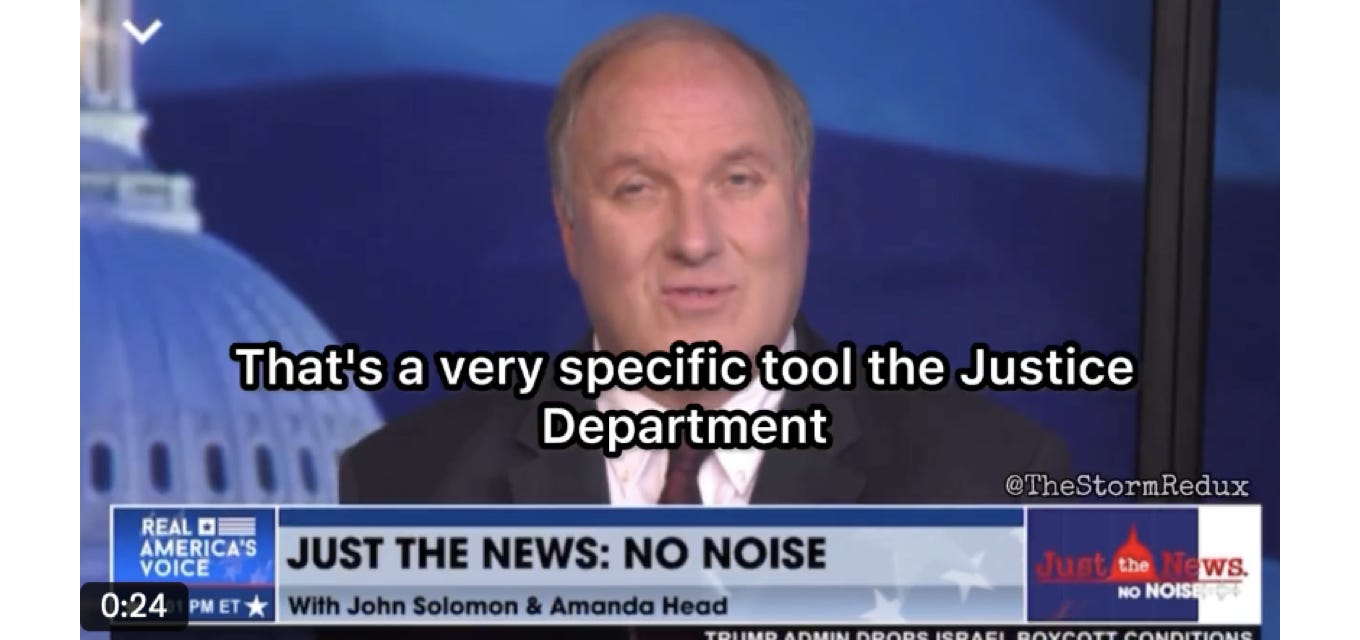
Yesterday (August 4), CNN ran a massively encouraging story headlined, “Attorney General Bondi orders prosecutors to start grand jury probe into Obama officials over Russia investigation.”. Also yesterday, John Solomon’s Just the News ran a similar breaking story headlined, “Bondi orders evidence sent to grand jury for Russia collusion hoax.

image 8.png

CLIP: JTN’s John Solomon says DOJ will empanel grand jury in Florida to begin RussiaGate indictments (0:34).

According to Just The News, “multiple sources” have said Attorney General Pam Bondi has now ordered evidence from the Russia collusion hoax to be sent to a federal grand jury, “probably” in Florida. Where the Mar-a-Lago raid occurred. CNN said, “a source familiar with the matter” had told them.

When the Department of Justice sends evidence to a grand jury, it’s not for show—it’s a formal step toward criminal charges. Grand juries aren’t investigative committees or cable news panels. They’re made up of everyday citizens who review evidence in secret and decide whether there’s enough to indict. And they almost always do, leading to that old saw about ham sandwiches.

The grand jury standard is low. It doesn’t require proving guilt beyond a reasonable doubt; it’s just “probable cause.” So when Bondi sends the RussiaGate evidence to a grand jury, it’s a sign that indictments are not just possible. They are likely. If true, this isn’t just a narrative-management exercise anymore. It’s a real legal proceeding with bloodstained claws.

Indictments precede arrests and prosecution. Once a grand jury returns an indictment, the DOJ typically issues a warrant, and unless the charges are sealed for tactical reasons, the next step is an arrest. In federal cases, this process is usually swift and serious: U.S. Marshals or federal agents either pick the person up or notify them to surrender. An indictment means the government believes it can prove its case in court, and it isn’t just sending a message—it’s preparing to put someone in handcuffs.

Grand juries are sequestered and conducted in secret. It’s entirely possible that this grand jury is already empaneled and hearing evidence, and we wouldn’t know it. If Bondi’s team is leaking about the existence of the grand jury, then it seems more likely the grand jury was empaneled weeks or months ago, quietly receiving documents, hearing testimony, and is getting ready to hand down charges.

It’s worth repeating: you don’t leak the existence of a grand jury unless you’re nearly finished. First, because it alerts the enemy. The moment a grand jury becomes public knowledge, anyone with something to lose starts looking for the jurors, to influence, intimidate, or discredit them. Second, because if the grand jury hears your case and refuses to indict, you look like a moron. In other words, you look both politically motivated and legally incompetent.

Prosecutors never voluntarily take that risk unless they’re confident in what’s coming next. Assuming the leaks came from Bondi’s DOJ —and that seems almost self-evident— they know what they’re doing.

In other words, based on what we can already see —the disclosures, the criminal referrals, the grand jury order, the sudden public confirmation— we could be getting very close to high-profile arrests. Possibly within days. And based on the rapid acceleration of events over the past two weeks, it could conceivably happen this week.

The Hunt for Red August appears to be underway.