Following talks between Donald Trump’s envoy Steve Witkoff and Vladimir Putin this week U.S. and Russian officials are working toward an agreement on Ukrainian territories for a planned summit between the U.S. and Russian leaders that could occur as early as the next week, according to Bloomberg. The agreement aims essentially to freeze the war, cementing Putin’s land gains, and pave the way for a ceasefire and technical talks on a definitive peace settlement, “people familiar with the matter” told this news agency. Under the terms of the deal, Russia would halt its offensive in the Kherson and Zaporizhzhia regions of Ukraine along the current battlelines. In exchange Putin is demanding that Ukraine cede entire Donbas to Russia as well as Crimea in what would require Ukrainian President Volodymyr Zelenskiy to order a withdrawal of troops from parts of the Luhansk and Donetsk regions still held by Kyiv, according to the agency. Speaking in the late afternoon of Aug. 8, Trump confirmed that the deal would involve territorial concessions. Trump said discussions were under way to get “some” land back as well as “some swapping of territories to the betterment of both,” according to Financial Times.He said the conflict could be resolved “very soon.” While having lost 99% of the Luhansk Oblast, with only 103 square miles remaining under their control in that province, Ukrainian forces continued to control some 25% of the Donetsk Oblast (2,509 square miles or 6,500 square kilometers), according to ISW’s latest estimates.1 Forcing Ukrainian armed forces to quickly cede more than 2,600 square miles of territory they still control in Donbas, which comprises the Donetsk and Luhansk regions, without putting up a fight could be a tall order. A voluntary surrender of these territories by Ukrainians would require concessions on other issues by Russia, but, according to the Bloomberg story, it remains unclear if Moscow is prepared to give up any land that it currently occupies.*
In the period of July 8–Aug. 5, 2025, Russian forces gained 226 square miles of Ukrainian territory, which is more than the 190 square miles gained by Russia in the period of June 10–July 8, 2025. However, if one were to compare shorter periods, such as the past week to the preceding week, then such a comparison would reveal that Russia’s weekly gains declined. Russia gained 31 square miles of Ukrainian territory (about 1½ Manhattan islands) over the past week (July 29–Aug. 5, 2025)—slowing to just one third the rate of the previous week’s (July 22–29, 2025) gain of 105 square miles, according to the Aug. 6, 2025, issue of the Russia-Ukraine War Report Card .
Ukrainian Commander-in-Chief Oleksandr Syrskyi is warning that Russia is accelerating troop mobilization, aiming to form 10 new divisions by year’s end and adding about 9,000 troops monthly—despite suffering over 33,200 losses in July, Kyiv Independent reported. Syrskyi said Ukraine has no other option but to ramp up its own mobilization, improve training and strengthen drone capabilities to prevent Russia from achieving its objectives. Meanwhile, the General Staff of the Russian Armed Forces has assured Putin that the Ukrainian front will crumble in two or three months, one source close to Russian government told Reuters.
More than three years into the war, Ukrainians’ support for continuing the fight against Russia until victory is “collapsing,” according to Gallup’s interpretation of its latest poll on the subject. Indeed, the share of those who think Ukraine should continue fighting until it wins plummeted from 73% in 2022 to 24% in 2025, which represents a decline of more than 67%, according to this international pollster. In the meantime, the share of Ukrainians who think Ukraine should seek to negotiate an end to the war as soon as possible went from 22% to 69%, exceeding that of Russians (63%) who would like to see a negotiated end to the fighting.2
The Russian Finance Ministry said this week that the country’s budget deficit has reached 4.88 trillion rubles ($61.1 billion) between January and July, or 2.2% of GDP, according to The Moscow Times. That is well above the 3.8 trillion rubles planned for all of 2025, according to this newspaper. The ministry blamed weaker oil and gas revenues—down nearly 19% year-on-year—and “advance financing” of expenses early in the year, the newspaper reported. Indeed, Russia’s combined oil and gas revenue totaled 787.3 billion rubles in July, down by 27%, according to the Bloomberg. Analysts, however, told MT that the real driver of the budget deficit is runaway spending.
Good grief, were our government officials and military representatives this unprofessional during the Cold War? This sounds like some cringey comedic movie. – Natylie
David Axe is a journalist and filmmaker in South Carolina.
For five days in mid-July 2013, a delegation of the Pentagon’s top nuclear officials led by U.S. Air Force Maj. Gen. Michael Carey traveled to Moscow to meet its counterparts in the Russian nuke force.
It was a make-nice involving the world’s biggest atomic powers, which for decades have possessed, and held back, the power to obliterate each other and the rest of the world in mere minutes.
And it came during what was, in retrospect, the last period of potentially fruitful interactions between the Americans and Russians, as Russia would invade Ukraine just seven months later.
Carey’s meeting was, in other words, a big freaking deal.
But to Carey—at the time the head of the 20th Air Force, America’s main nuclear ICBM strike force, with 9,600 airmen and 450 continent-blasting Minuteman missiles—it was a chance to engage in an epic, ego-fueled, taxpayer-funded bender.
Over the course of the five days, Carey allegedly guzzled around 50 drinks, hit on four different women—including three he later claimed might be Russian agents—and managed to repeatedly offend his Russian military hosts.
After an investigation, Carey was removed from command and assigned as a special assistant to the commander of the Air Force’s Space Command—a position with no real power. He retired in 2014 after doing his damnedest to wreck relations between the world’s top atomic powers while in the pursuit of booze and babes.
Carey’s marathon international insult was documented in a hilarious official report obtained byThe Washington Post. Let’s count the drinks that disarmed the man once in charge of America’s nuclear arsenal.
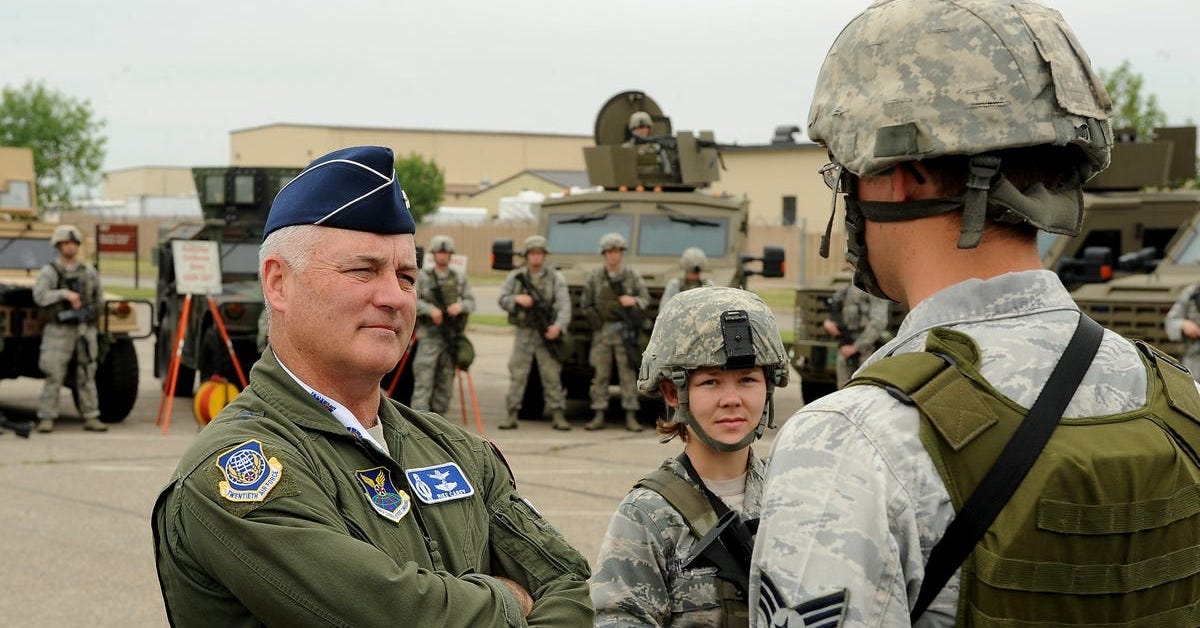
Carey in a more sober time. U.S. Air Force photo
Day 1: 2 glasses of wine, at least 2 beers
Weather delayed Carey’s trip from his headquarters in Wyoming to Washington, D.C. for onward travel to Moscow. He had only a few hours to rest in a local hotel before meeting his five-person delegation at Dulles airport on July 14.
Carey’s crew included representatives from the Pentagon’s joint staff, U.S. Secretary of Defense Chuck Hagel’s office, the U.S. Department of Energy, the U.S. Navy and the U.S. Defense Threat Reduction Agency, the organization in charge of eliminating the world’s weapons of mass destruction.
Despite the esteemed company, Carey—apparently exhausted before even stepping onto the plane—was on his worst behavior. On the first leg of the flight he drank two glasses of wine and, delayed again in Zurich, chased the wine with at least two beers.
According to a witness, the general was “visibly agitated about the long delay at Zurich, he appeared drunk and, in the public area, talked loudly about the importance of his position as commander of the only operational nuclear force in the world and that he saves the world from war every day.”
But Carey was just pre-gaming before the big binge.
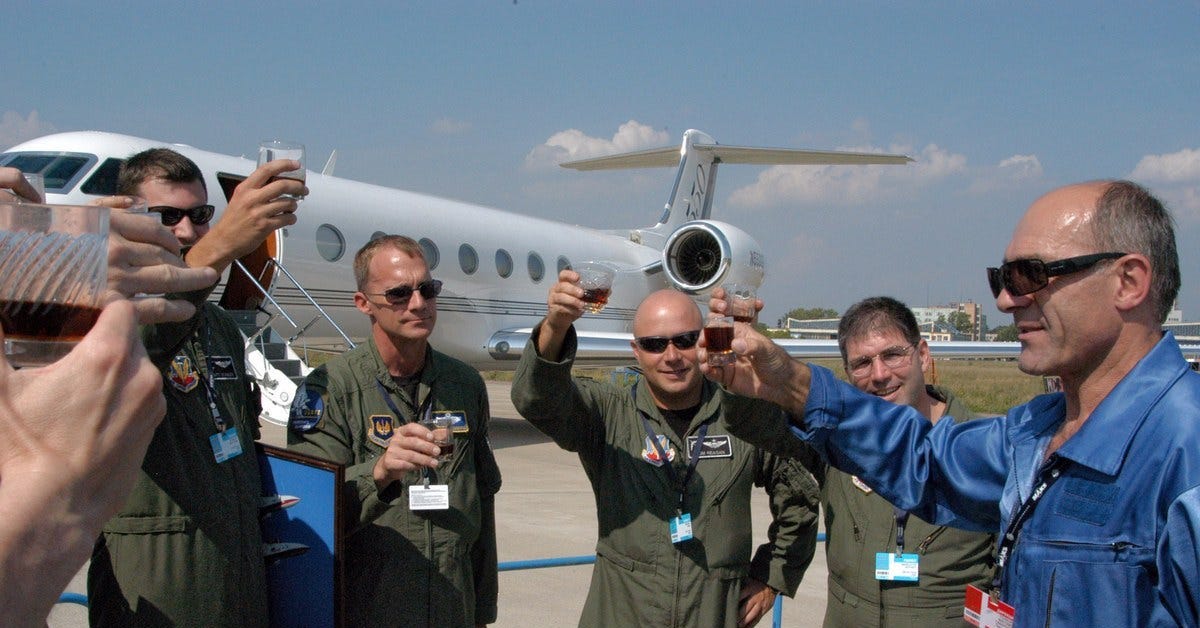
U.S. airmen toast a Russian general at a Moscow air show. U.S. Air Force photo
Day 2: at least 4 beers plus 2 or more other drinks
The delegation checked into a Moscow Marriott the evening of July 15. First order of business was a team meeting to discuss the trip itinerary, including two days of meetings with Russian nuclear troops. At the meeting, Carey drank several beers … and began mouthing off.
“Again, he started in on the very loud discussions about being in charge of the only operationally deployed force and saving the world,” said a delegation member. Carey complained that his airmen had the worst morale in the Air Force—and blamed his superiors for “not helping out.”
The gripe did not include any classified information. But the witness described it as “not really something I was comfortable with you know, being part of in a Russian hotel in the middle of Moscow.”
Carey, who by this point had apparently slept only fitfully for several days running, went to the hotel lobby with one of his teammates, grabbed another beer and bought a cigar from a woman vendor. The male teammate proposed checking out a rooftop bar at the Ritz Carlton—a neighboring hotel—the next day.
But Carey suggested they go that night, and his colleague agreed.
At the rooftop bar, Carey had at least two more drinks. He and the other man met two young women who claimed to be British travel agents. The four revelers closed down the bar then wandered to the La Cantina Mexican restaurant, but it was shuttered for the night. Carey’s teammate mentioned that the Americans might go back to the Mexican joint the next day—and the girls should meet them there.
On return to America, Carey would voluntarily turn in the girls’ business cards to Air Force investigators, along with the cigar vendor’s card. The general would claim that the women’s behavior was fishy, and imply they might have been Russian agents. But Carey’s suspicion did not stop him from continuing to drink with the ladies in Moscow.
La Cantina. Virtualtourist.com photo
Day 3: 9 vodka shots, a bottle of vodka & a bar crawl
July 16 was the first day of meetings with Russian troops. And boy howdy was it a boozy one. Carey was 45 minutes late meeting the rest of the team, plus some Russian military guides, waiting in the Marriott lobby.
The Russians had arranged a demonstration by nuclear-force trainees and were worried the Americans might miss it.
Carey had gotten just few hours of sleep and his eyes were bloodshot. He snoozed on the van ride to the Russian base but was still not at his best during the morning’s briefings. Claiming he could not understand the Russians’ military interpreter—described as an “attractive” young woman—Carey told one of his Russian-speaking teammates to take over the translating.
The Russians “were insulted … they were unhappy,” a witness said.
Some Russian trainees—apparently part of the Kremlin’s nuclear security force—showed off their fighting, first aid and vehicle maintenance skills. Addressing the Americans, Carey derided the demonstration as “sophomoric.”
Lunch was served in a tent near the training range. There were nine vodka toasts. Some of the Russians, including a general, sipped water instead. The Russian general, for one, said he needed to be sober since he was in charge. In an ill-conceived attempt to ape the Russians’ toasting conventions, Carey singled out the woman linguist he had previously insulted, raised his glass to her and called her “beautiful.”
Carey was drunk, according to the other Americans. He ran his mouth about the Syrian war — over which Washington and Moscow have serious disagreements—and also about National Security Agency leaker Edward Snowden, who was granted asylum in Russia.
One witness reported that “at some point he announced that the reason he had been late [that] morning was that he had met two hot women at the bar the night before.” The Russians were less than thrilled about this and “made it very clear we had to be on time the next day.”
That afternoon and evening, the Americans visited a monastery and then Red Square. There was more drinking in the van. At the monastery, Carey insulted the tour guide, a woman. “At one point he tried to give her a fist bump. She had no idea what he was trying to do,” one American said.
Carey wandered away from the main group. That evening, the nearly incapacitated general couldn’t keep up with his teammates in Red Square and sat alone “pouting and sulking.” He told the others he wanted to bail on the second day of meetings.
But that night, he was apparently feeling better. He decided the delegation would go to La Cantina, the Mexican restaurant. There was a Beatles cover band he wanted to see, he said. At La Cantina, he drank more and kept pressuring the band to let him play guitar or sing with them.
The band declined.
The two, ahem, “British” women showed up. One kissed Carey on the cheek and the general joined them at their table, where he told them about his job and the trip. Carey danced with one of the girls. “It was a fast dance,” according to a witness.
The general, two other Americans and the girls closed down the Mexican joint and hit a couple more bars. While stumbling back from the night of drinking, Carey opened up to one of his colleagues, again talking about not wanting to attend the next day’s proceedings.
But his drinking buddy convinced him he had to go, and Carey resolved to do his best. He didn’t get to bed until around 3:00, leaving him just four hours to sleep. By this point, Carey had apparently thrown back between 20 and 30 drinks since leaving his headquarters three days earlier.
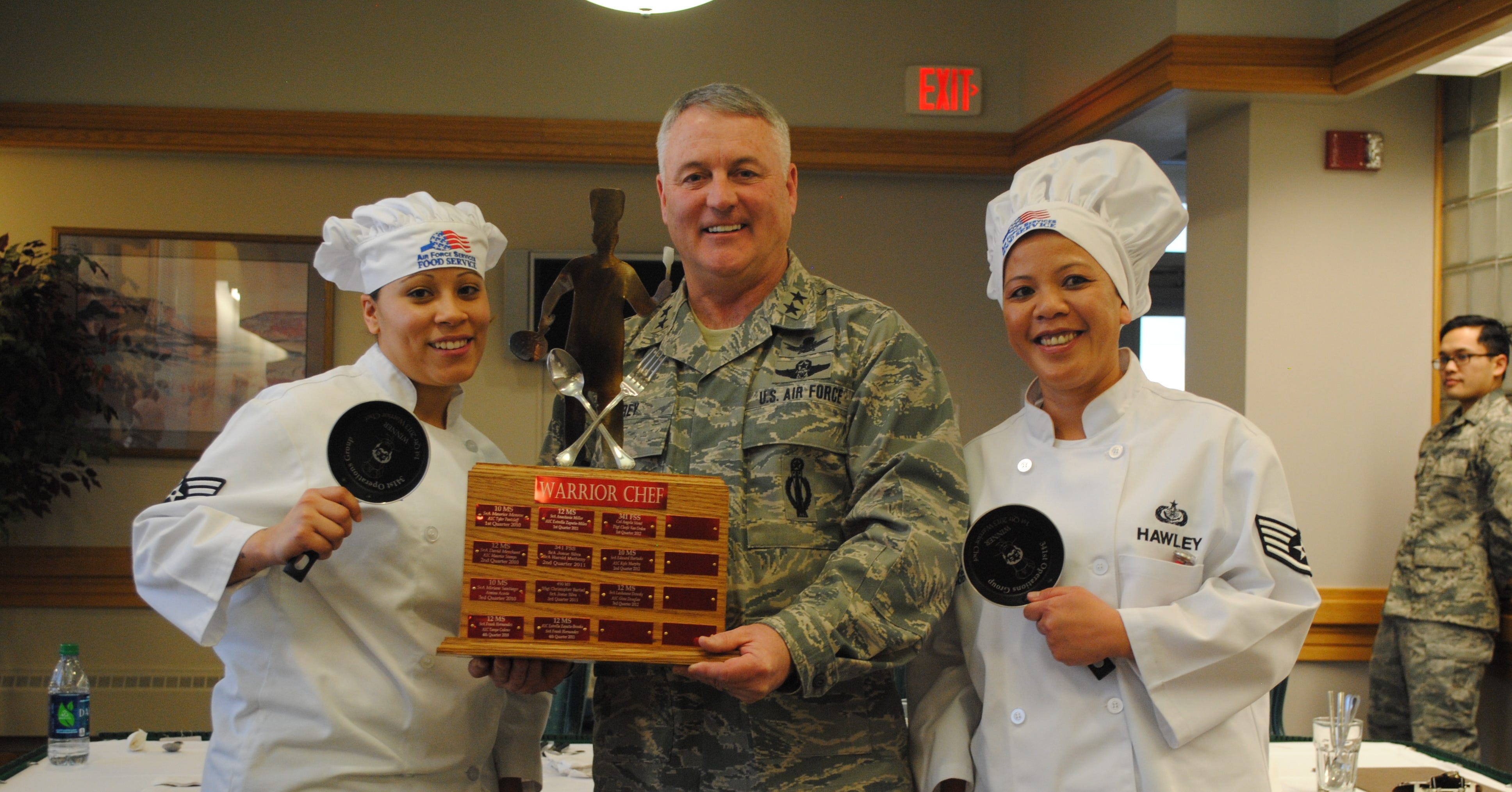
Carey judging a cooking competition. U.S. Air Force photo
Days 4 & 5: 25 vodka shots, cognac & 3 glasses of wine
Despite his late-night booze-inspired resolution to set a good example, on the morning of July 17, Carey appeared to be having a hard time concentrating. He was 15 minutes late to the hotel lobby, looking exhausted, his eyes again bloodshot. As before, he slept through the car ride.
The demonstrations that morning were much like those the previous day. Carey was bored. And again he had problems with the Russian linguist, loudly correcting her translations in a crowded room, insulting her and embarrassing himself. The Russians were upset, but the translator—taking the high road—smoothed it over.
Carey then proceeded to embarrass himself further by attempting a lame joke with another translator. In a misguided attempt at levity, Carey proceeded to ask the man, “Can you hear me now?” Over and over again, invoking the then decade-old Verizon ad campaign.
The translator didn’t get it. Neither did the Russian brass Carey was there to make nice with. “The Russians were looking at him like are you crazy?” one witness said.
Then the drinking began.
At lunch that day, the number of toasts went up from the previous day’s nine to 25. According to witnesses, Carey participated in all of them. He even had a little wine on the side. During the meal, Carey’s face and eyes reddened and his speech slurred. He interrupted some of the toasts, irritating his Russian hosts.
He was wrecked.
“That’s the deal when you go to a Russian toasting event—you’re into the toasts,” Carey told an investigator. “The nice thing is that the toasting glasses are not full ounce glasses.”
But the glasses were full enough to get the general drunk, twice.
On the ride back to the hotel Carey disco-napped in the car but sprang to life once the group reached the front doors. He posted up in the hotel lounge and finished off a bottle of cognac left over from the day’s proceedings. Then he switched to wine.
Carey wanted to pull an all-nighter before flying home, in order to “get his body clock back in sync,” he said. Most of his associates fled. One delegate said he “didn’t want to end up in another situation like the night before.”
Some of the delegation stayed up with him and they chatted all night with the cigar lady about science and technology. In the morning, Carey and his delegation flew home. No further incidents were reported.
When they landed, someone complained. The investigation into Carey’s conduct started on July 30. The general declined to answer many questions and responded vaguely to others. “Carey’s account of events varied greatly at times from those of the other U.S. members on the trip,” an interviewer wrote.
But the rest of the American delegation recalled the five-day bender with total clarity. It’s clear, reading the investigators’ report, that every other person on the trip told the same story.
That Carey acted like a total frat boy.
Worse, the general apparently realized while in Moscow that the supposedly British women he cavorted with two nights in a row posed a security risk—but that didn’t stop him from drinking and flirting.
“It just seemed kind of peculiar that we saw them one night and then saw them again later while we were there and for people who are in business to be kinda conveniently in the same place where we’re at, it seemed odd to me,” Carey told an investigator.
Same thing with the cigar vendor. “She was asking questions about physics and optics and I was like, dude, this doesn’t normally happen. … A tobacco story lady talking about physics in the wee hours of the morning doesn’t make whole lot of sense.”
What also doesn’t make sense is how the man then in charge of some of the deadliest weapons in human history decided that a diplomatic mission to a rival superpower was a fine time to get shitfaced, chase sketchy women and insult the very people he was sent to impress.
“The Japanese were ready to surrender and it wasn’t necessary to hit them with that awful thing.” —Gen. Dwight D. Eisenhower
“In 1945 Secretary of War Stimson, visiting my headquarters in Germany, informed me that our government was preparing to drop an atomic bomb on Japan. I was one of those who felt that there were a number of cogent reasons to question the wisdom of such an act. … The Secretary, upon giving me the news of the successful bomb test in New Mexico, and of the plan for using it, asked for my reaction, apparently expecting a vigorous assent. During his recitation of the relevant facts, I had been conscious of a feeling of depression and so I voiced to him my grave misgivings, first on the basis of my belief that Japan was already defeated and that dropping the bomb was completely unnecessary, and secondly because I thought that our country should avoid shocking world opinion by the use of a weapon whose employment was, I thought, no longer mandatory as a measure to save American lives. It was my belief that Japan was, at that very moment, seeking some way to surrender with a minimum loss of ‘face.’ The Secretary was deeply perturbed by my attitude.” —Gen. Dwight D. Eisenhower
“The use of the atomic bomb, with its indiscriminate killing of women and children, revolts my soul.” —Herbert Hoover
“[T]he Japanese were prepared to negotiate all the way from February 1945 … up to and before the time the atomic bombs were dropped; … [I]f such leads had been followed up, there would have been no occasion to drop the bombs.” —Herber Hoover
“I told [Gen. Douglas] MacArthur of my memorandum of mid-May 1945 to Truman, that peace could be had with Japan by which our major objectives would be accomplished. MacArthur said that was correct and that we would have avoided all of the losses, the Atomic bomb, and the entry of Russia into Manchuria.” —Herbert Hoover
“MacArthur’s views about the decision to drop the atomic bomb on Hiroshima and Nagasaki were starkly different from what the general public supposed. When I asked General MacArthur about the decision to drop the bomb, I was surprised to learn he had not even been consulted. What, I asked, would his advice have been? He replied that he saw no military justification for the dropping of the bomb. The war might have ended weeks earlier, he said, if the United States had agreed, as it later did anyway, to the retention of the institution of the emperor.” —Norman Cousins
“General MacArthur definitely is appalled and depressed by this Frankenstein monster. I had a long talk with him today, necessitated by the impending trip to Okinawa. He wants time to think the thing out, so he has postponed the trip to some future date to be decided later.” —Gen. Douglas MacArthur’s pilot, Weldon E. Rhoades
“[General Douglas] MacArthur once spoke to me very eloquently about it, pacing the floor of his apartment in the Waldorf. He thought it a tragedy that the bomb was ever exploded. MacArthur believed that the same restrictions ought to apply to atomic weapons as to conventional weapons, that the military objective should always be limited damage to noncombatants…MacArthur, you see, was a soldier. He believed in using force only against military targets, and that is why the nuclear thing turned him off…” —Richard Nixon
“The Japanese were ready for peace, and they already had approached the Russians and the Swiss. And that suggestion of giving a warning of the atomic bomb was a face-saving proposition for them, and one that they could have readily accepted. In my opinion, the Japanese war was really won before we ever used the atom bomb.” —Under Secretary of the Navy, Ralph Bird
“The Japanese position was hopeless even before the first atomic bomb fell, because the Japanese had lost control of their own air.” —General “Hap” Arnold
“The Japanese had, in fact, already sued for peace. The atomic bomb played no decisive part, from a purely military point of view, in the defeat of Japan.” — Fleet Admiral Chester W. Nimitz, Commander in Chief of the U.S. Pacific Fleet
“The Japanese had, in fact, already sued for peace before the atomic age was announced to the world with the destruction of Hiroshima and before the Russian entry into the war.” Adm. Nimitz
“The use of this barbarous weapon at Hiroshima and Nagasaki was of no material assistance in our war against Japan. The Japanese were already defeated and ready to surrender because of the effective sea blockade and the successful bombing with conventional weapons … The lethal possibilities of atomic warfare in the future are frightening. My own feeling was that in being the first to use it, we had adopted an ethical standard common to the barbarians of the Dark Ages. I was not taught to make war in that fashion, and wars cannot be won by destroying women and children.” —Fleet Admiral William D. Leahy, Chief of Staff to President Truman
“Truman told me it was agreed they would use it, after military men’s statements that it would save many, many American lives, by shortening the war, only to hit military objectives. Of course, then they went ahead and killed as many women and children as they could, which was just what they wanted all the time.” —Fleet Admiral William D. Leahy, Chief of Staff to President Truman
“The war would have been over in two weeks without the Russians entering and without the atomic bomb. … The atomic bomb had nothing to do with the end of the war at all.” — Major General Curtis LeMay, XXI Bomber Command
“[LeMay said] if we’d lost the war, we’d all have been prosecuted as war criminals. And I think he’s right. He, and I’d say I, were behaving as war criminals. LeMay recognized that what he was doing would be thought immoral if his side had lost. But what makes it immoral if you lose and not immoral if you win?” —Robert MacNamara
“The first atomic bomb was an unnecessary experiment … It was a mistake to ever drop it … [the scientists] had this toy and they wanted to try it out, so they dropped it.” — Fleet Admiral William Halsey Jr.
“I concluded that even without the atomic bomb, Japan was likely to surrender in a matter of months. My own view was that Japan would capitulate by November 1945. Even without the attacks on Hiroshima and Nagasaki, it seemed highly unlikely, given what we found to have been the mood of the Japanese government, that a U.S. invasion of the islands scheduled for 1 November 1945 would have been necessary.” —Paul Nitze, director and then Vice Chairman of the Strategic Bombing Survey
“[E]ven without the atomic bombing attacks, air supremacy over Japan could have exerted sufficient pressure to bring about unconditional surrender and obviate the need for invasion. Based on a detailed investigation of all the facts, and supported by the testimony of the surviving Japanese leaders involved, it is the Survey’s opinion that certainly prior to 31 December 1945, and in all probability prior to 1 November 1945, Japan would have surrendered even if the atomic bombs had not been dropped, even if Russia had not entered the war, and even if no invasion had been planned or contemplated.” —U.S. Strategic Bombing Survey, 1946
“Just when the Japanese were ready to capitulate, we went ahead and introduced to the world the most devastating weapon it had ever seen and, in effect, gave the go-ahead to Russia to swarm over Eastern Asia. Washington decided it was time to use the A-bomb. I submit that it was the wrong decision. It was wrong on strategic grounds. And it was wrong on humanitarian grounds.” —Ellis Zacharias Deputy Director of the Office of Naval Intelligence
“When we didn’t need to do it, and we knew we didn’t need to do it, and they knew that we knew we didn’t need to do it, we used them as an experiment for two atomic bombs. Many other high-level military officers concurred.” —Brigadier General Carter Clarke, the Military Intelligence officer in charge of preparing summaries of intercepted Japanese cables for President Truman and his advisors
“The commander in chief of the U.S. Fleet and Chief of Naval Operations, Ernest J. King, stated that the naval blockade and prior bombing of Japan in March of 1945, had rendered the Japanese helpless and that the use of the atomic bomb was both unnecessary and immoral. —Brigadier General Carter Clarke
“I proposed to Secretary Forrestal that the weapon should be demonstrated before it was used… the war was very nearly over. The Japanese were nearly ready to capitulate… My proposal… was that the weapon should be demonstrated over… a large forest of cryptomeria trees not far from Tokyo… Would lay the trees out in windrows from the center of the explosion in all directions as though they were matchsticks, and, of course, set them afire in the center. It seemed to me that a demonstration of this sort would prove to the Japanese that we could destroy any of their cities at will… Secretary Forrestal agreed wholeheartedly with the recommendation… It seemed to me that such a weapon was not necessary to bring the war to a successful conclusion, that once used it would find its way into the armaments of the world.” —Special Assistant to the Secretary of the Navy Lewis Strauss
“In the light of available evidence I myself and others felt that if such a categorical statement about the retention of the dynasty had been issued in May 1945, the surrender-minded elements in the Japanese government might well have been afforded by such a statement a valid reason and the necessary strength to come to an early clear cut decision. If surrender could have been brought about in May 1945, or even in June, or July, before the entrance of Soviet Russia into the Pacific war and the use of the atomic bomb, the world would have been the gainer.” —Under Secretary of State Joseph Grew
And for what it’s worth, then-Army Chief George Marshall wanted only to hit military facilities with it, not cities.