US President Donald Trump has said he is considering tariffs on BRICS nations, accusing the group of adopting anti-US policies. Earlier, Trump warned that any attempt by the group to challenge the US dollar would be met with harsh economic measures. BRICS members targeted by his latest sanctions, such as India and Brazil, said they would protect their domestic interests.
Speaking at the White House on Wednesday, he claimed the group is working to weaken the dollar and strip it of its role as the world’s reserve currency.
“They have BRICS, which is basically a group of countries which are anti the United States, and India is a member of that if you can believe it,” Trump said. “It’s an attack on the dollar, and we’re not going to let anybody attack the dollar.”
The same day, Trump announced that India will face 25% tariffs and additional penalties starting on Friday over its continued trade with Russia. He said the tariffs were imposed partly because of India’s membership in BRICS, and partly because of what he called a “tremendous” trade deficit with New Delhi.
Trump also imposed a 50% tariff on all goods from Brazil effective August 1, claiming the country poses a threat to “the national security, foreign policy, and economy” of the US.
BRICS was established in 2006 by Brazil, Russia, India, and China, with South Africa joining in 2010. Over the past year, it has extended membership to Iran, Egypt, Ethiopia, the United Arab Emirates, and Indonesia. BRICS partner countries include Belarus, Bolivia, Cuba, Kazakhstan, Malaysia, Nigeria, Thailand, Uganda, and Uzbekistan.
Russian Foreign Minister Sergey Lavrov has said BRICS countries are seeking alternatives to the dollar to shield themselves from Washington’s “arbitrariness,” calling the shift irreversible.
Last year, Russia’s Finance Ministry said national currencies made up 65% of BRICS trade, with the dollar and euro falling below 30%. Deputy Foreign Minister Sergey Ryabkov said BRICS is not a rival to the US, but warned that “the language of threats and manipulation… is not the way to speak to members of this group.”
The following is an interview with Nicolai N. Petro about his book, The Tragedy of Ukraine (De Gruyter, 2023). It was conducted by István Szabó of the Hungarian daily newspaper Magyar Nemzez on July 12, 2025.
What inspired you to approach the Russia–Ukraine conflict through the lens of classical Greek tragedy? Why did you choose this particular cultural reference?
I had been thinking about writing a book about Ukraine ever since our first visit there in 2008. When I won a Fulbright Grant to spend the 2013-2014 academic year in Odessa, I thought of writing about the influence of the Russian Orthodox Church in Ukrainian society. This topic, however, was quickly overtaken by the events that were unfolding around us—the Maidan uprising.
I subsequently spent several more years thinking about how such a seemingly stable society could shatter in just a few short months. I found no suitable approach, until I stumbled upon Professor Richard Ned Lebow’s book The Tragic Vision of Politics.
In it, he looks at modern conflicts through the lens of political realism inspired by Thucydides’ classic history of the Peloponnesian War (431 to 404 BC). Thucydides traced the roots of this conflict among the Greeks to the collapse of the traditions and practices that had sustained their civilization for so long. Simply put, war erupted because the leaders of Athens and Sparta decided that they no longer shared ideas, identity, and values, and so were no longer bound to each other.
I felt that this was a good description of what had taken place in relations between Russians and Ukrainians since the Orange Revolution of 2004.
In your book, the concept of catharsis plays a central role. How do you interpret catharsis in the context of the current geopolitical situation, particularly with regard to Ukraine?
Recurring conflict is a problem of the heart, as much as it is of political institutions. This is as true of nations as it is of individuals. The enduring value of classical Greek tragedy is that it seeks to induce a change of heart—which the Greeks called catharsis—a purging of emotions so powerful that it allowed emotions such as pity and compassion to enter the soul, and to take the place of rage.
By showing the horrors that result from the unyielding pursuit of vengeance, Greek playwrights tried to lead citizens away from anger and vengeance, and toward compassion. By replacing rage with reason, they believed catharsis could liberate both individuals and societies from the tragic cycle of vengeance.
Catharsis is based on the ability to see the enemy, the Other, as a co-sufferer, so that endless conflict can give way to dialogue, and eventually forgiveness. Put another way, no conflict can ever be resolved without a catharsis.
What could such a form of catharsis mean for the future of the Ukrainian state and society? Is it even possible in the midst of an ongoing war?
I believe that Sophocles, Euripides, and Aeschylus would prescribe for Ukrainian society what they prescribed for themselves– a profound shift in social attitudes that would allow people who hate each other to engage in dialogue. Without such a catharsis there can be no dialogue about the future, because there is no shared future.
In my book I suggest that Ukraine would benefit from a Truth and Reconciliation process, which has helped scores of countries to heal conflicts, both domestic and international. This would be an important step in reconciling the antagonistic segments of Ukrainian society, and in restoring trust in government institutions.
In your book, you highlight that many people in eastern and southern Ukraine identify with Russian cultural identity. What are the consequences if this identity is not recognized at the political level?
The persistent divisions within Ukrainian society derive from its history of being a focus of contention between rival empires, including Russia, Austro-Hungary, and the Ottomans. When these empires collapsed in the early 20th century, their frictions were often inherited by the countries that emerged from them.
The largest community within modern Ukraine are those seeking to preserve a cultural, religious, and linguistic tie with Russia. In my book I refer to them not as “Russian speakers,” which oversimplifies their identity, but as Maloross Ukrainians. This older term was commonly used before the Bolshevik Revolution because it highlights that this identity goes far beyond language and religious affiliation, even though these are the most widely discussed points of contention today.
These two Ukrainian identities, which can be thought of as two nations living in one state, have not yet learned how to live together, and this has led to the bloody war that the country is enduring today.
Do you think it is possible for Ukraine to develop an inclusive national narrative in the long term—one that provides a legitimate place for its Russian-speaking population? If so, how?
It is certainly possible. Other countries have done it—Belgium, Switzerland, Canada, India, Indonesia, to name a few. The main obstacle that needs to be overcome is atavistic nationalism, which says that a nation must consist of only one monolithic identity, and which therefore sees all other identities as threats. Such nationalism seeks to redefine and restrict ethnicity, language, religion, and historical memory. Eventually, however, the list expands to include almost any characteristic, which is why nationalism is often seen as a precursor to Fascism and Nazism.
What role has the international community—especially the West—played in either reinforcing or exacerbating Ukraine’s internal tensions?
U.S. Secretary of State Marco Rubio recently stated (Fox News, 5 March 2025) that the West is involved in a proxy war against Russia in Ukraine. This makes it a continuation of what 19th century British rulers commonly referred to as “The Great Game”—a global chess match between rival powers aimed at shifting the overall balance of power in their favor.
The impact on any nation caught up in the “game” has always been devastating, as the competing powers each promote their indigenous supporters. This inflames existing social tensions, and turns every political debate into a choice of good versus evil. That is why Ukrainian nationalists referred to their Maidan coup d’etat against president Viktor Yanukovych, as a “civilizational choice” in favor of the West. This in turn led to the rebellions of Crimea and Donbass, which were supported by Russia.
In your view, would the West ever be willing to accept a Ukrainian national vision that is not exclusively Western-oriented but also culturally multipolar? Are there any historical or international precedents for this?
The West contains many diverse elites, with many diverse agendas. While it is hard to imagine the current political leadership of the EU accepting a neutral Ukraine that had good relations with both Russia and the EU (this was already an obstacle during the EU Association talks in 2013), the political climate in Europe and the United States seems to be shifting away from this group, and toward elites that place their own national interest first. This is causing the once monolithic West to fracture.
It is therefore possible that, when current political leaders are replaced by their national electorates, their successors will seek better relations with Russia, even at the expense of Ukraine, since Russia is a far more important neighbor for Europe.
What do you see as the biggest challenge in conveying your book’s message to the direct actors in the conflict? How might this kind of discourse gain wider societal resonance?
The biggest challenge in the resolution of any conflict, large or small, is getting the parties now immersed in the conflict to recognize the extent to which they themselves helped to bring about this conflict. That is why the Greeks said that true object of dialogue was self-transformation. Classical Greek tragedy is, quintessentially, a series of dialogues in which we are all encouraged to reflect on our own tragic flaws. Only when the participants can grasp how their own actions have stoked the hatred of others, can they choose a different path.
Welsh social critic Raymond Williams captured this perfectly when he said that, “Tragedy rests not in the individual destiny. . . but in the general condition, of a people reducing or destroying itself because it is not conscious of its true condition” (Modern Tragedy, p. 196).
Greek playwrights could convey this message through plays that were mandatory for the entire polis. Today we cannot gather all citizens in one place, but governments could use social media to spread a message of tolerance, dialogue, and forgiveness of our enemies, if they wanted to.
Of course, in a world of rival nation-states it would be naïve to expect political leaders to do so, unless it could be shown to benefit their own political careers, and as being the supreme national interest. Over the past few decades several senior diplomats have tried to steer American foreign policy in this direction, including such luminaries as George F. Kennan, Amb. Jack F. Matlock, Jr., and Amb. Chas W. Freeman, Jr..
On a personal level, how has your perspective on the Ukraine–Russia relationship changed during the course of your research? Was there any insight that particularly surprised you?
I was struck by the consensus that once existed among scholars regarding the totalitarian aspirations of nationalism. Reinhold Niebuhr once commented that nationalism is when “the nation pretends to be God.” The danger of this seems to have been almost entirely forgotten today.
I was impressed by the successes of Truth and Reconciliation Commissions in healing social wounds that have festered for many decades. In my book I look at what they were able to accomplish in South Africa, to prevent violence after the end of the apartheid regime; in Guatemala, to support reconciliation after nearly four decades of civil war and American intervention; and in Spain, to assist the peaceful transition to federalism and democracy after 36 years of dictatorship.
In a similar vein, inside Ukraine we can point to the remarkable peacemaking efforts of Sergei Sivokho, a close friend of Ukrainian President Volodymyr Zelensky who, with the president’s support, set up a National Platform for Reconciliation and Unity. Unfortunately, he was hounded out of his position by Ukrainian nationalists, and died soon afterwards.
On a personal note, I find it amusing that I am sometimes accused of being too naïve about politics. I would counter that if a policy fails to achieve the results it promises (like sanctions on Russia, which were supposed to lead to the rapid collapse of the Russian economy), then expecting success from more of the same is both naïve and irresponsible.
Policies should be judged by their results, and when a policy has persistently failed, governments should consider other approaches. In the case of Ukraine, Western efforts to promote security through escalation have patently failed. Why not, then, see if better results can be achieved by reducing military involvement, rather than expanding it?
There is historical precedent for this—the 1953 Korean Armistice Agreement. After a series of contentious negotiations, a ceasefire was finally achieved not through increasing arms and support for South Korea, but through a total embargo on any new weapons being introduced onto the peninsula. This embargo was monitored by the United Nations. The parties also agreed to hold later talks on a permanent peace treaty, but by 1954 the United States had already moved on to the conflict in Vietnam. As a result, the ceasefire that was meant to be temporary became permanent. While this is certainly not an optimal solution, it has resulted in more than seventy years of peace.
Another criticism that I sometimes hear is that I minimize the role of Russian aggression. Again, I disagree. I have always pointed out that the invasion of Ukraine is a violation of international law, but my study of Ukrainian history leads me to conclude that, while Russia initiated the current level of hostilities, their roots go much, much deeper. Understanding this complex history does not in any way minimize, mitigate, or justify Russia’s attack on Ukraine. It is however, vital for the healing of Ukrainian society, and for achieving a lasting peace after the war.
About Nicolai Petro:
Nicolai N. Petro is Professor of Political Science at the University of Rhode Island, where he previously held the Silvia-Chandley Professorship of Peace Studies and Nonviolence. His scholarly awards include two Fulbright awards (one to Russia and one to Ukraine), a Council on Foreign Relations Fellowship, and research awards from the Foreign Policy Research Institute, the National Council for Eurasian and East European Research, the Kennan Institute for Advanced Russian Studies in Washington, D.C., and the Hoover Institution at Stanford University. In 2021 he was a Visiting Fellow at the Institute of Advanced Studies at the University of Bologna, Italy.
There are questions that sound academic until you realise entire wars have been built on their answers. One of them, heavy with history and the kind of political quicksand that swallows men faster than bullets, is this: Where does Russia belong?
Not in the atlas—that part’s clear. Russia’s right where it’s always been, draped across the continents like a great old beast, spine deep in Siberia, face still turned—half-defiantly—toward Europe. But if you look past the borders and into the bones, the question comes again: what is it now?
Is it still the outlier in the European family—wounded, estranged, but recognisably kin? Or has it thrown in its lot with the Global South, shoulder to shoulder with Brazil and South Africa in that loose alphabet of ambition we call BRICS?
The numbers say one thing. The stories we tell say another. And somewhere between the two lies the truth—stubborn, shifting, and hard to hold.
Take the latest data measured by the IMF. Russia’s PPP-adjusted average (net) salary now sits at $3,340 a month—a not-so-gentle reminder that this is no longer an “emerging market” in any serious sense. That puts it above Italy ($3,307), Czechia ($3,022), and Lithuania ($2,870). It’s knocking at the door of Spain ($3,459) and not far off the UK ($3,597). And the direction of travel matters: incomes in ruble terms rose 16% year-on-year, according to Rosstat. The numbers aren’t just big—they’re getting bigger.
Then we look at BRICS. China stands at around $2,000, a full tier above Brazil ($1,210), India ($900), or South Africa ($965). For all of China’s rise—its bullet trains, high-rises, and sprawling megacities—Russian living standards remain, on average, markedly higher. It doesn’t really swim in the same waters as its BRICS partners. The shelves are fuller, the flats warmer and better air conditioned, the middle class—however bruised—more securely anchored. This isn’t the landscape of unfinished industrial revolutions or sprawling poverty. And yet, BRICS was never really about income. It was about leverage. A counterweight. A refusal to accept the world as arranged in Brussels or Washington. And here, Russia fits like a clenched fist: sanctioned, ringed by rivals, yet impossible to ignore. A battle-scarred heavyweight among rising strivers.
But averages are for economists and liars. Russia remains a country of gulfs, not gradients. The gap between richest and poorest regions has now hit a record ₽182,000 per month—a difference of $2,330. In Chukotka, the average salary’s $2,855. In Ingushetia, it’s $525. In Moscow, Yamalo-Nenets, Magadan—you can clear $1,850. In Chechnya, Dagestan, Ossetia—you’ll be lucky to get past $600.
And those are just the visible figures. The informal economy is vast, anywhere from 30 to 50 percent of GDP by some estimates. Wages are paid in cash, favours, or silence. The real economy—the one people actually live in—moves in ways no spreadsheet can mode
But even through the distortion, a picture emerges. This isn’t India or Brazil. It isn’t South Africa. Not in income, not in infrastructure, not in human capital. Russia is something else—wealthier than it lets on, more developed than many would like to admit, and far harder to categorise than any acronym can allow.
Still, the Kremlin has made its choice. Not just in trade, but in tone.
“European markets, European economies—these are dying economies,” said Maxim Oreshkin, Putin’s top economic aide, standing at a forum outside Moscow, this week, like a man delivering last rites. “Germany has been in stagnation for years.” In his eyes, only India compares to Russia in long-term potential—but even there, he says, “the mentality” stifles initiative.
You may scoff. You might nod along. But you can’t ignore it—this is how the Kremlin sees the world in 2025. And from that vision comes policy. Comes alignment. Comes strategy.
It’s not just rhetoric, either. Russia is rebuilding itself in the image of South Korea’s chaebols—not through design, perhaps, but necessity. The old oligarch model is being nudged aside. In its place: corporate giants like Severstal, Norilsk Nickel, Rosatom, sprawling, vertically integrated, politically aligned.
Billionaire Alexei Mordashov has warned this shift comes with risks—monopolies, stagnation, a strangling of small business. But is it worse than what came before? The era when Roman Abramovich, Mikhail Friedman, Andrey Melnichenko stripped billions out of the country, bought mansions in London, chalets in Switzerland, parked their yachts in the Med, and passed through airports with more passports than principles?
One Moscow tycoon told me last year, without blinking, that over $2 trillion net was “ripped out of Russia” between 1991 and 2021. A staggering sum. A slow bleed, year by year. Maybe now, at last, the arteries are being tied off.
So again we ask—where does Russia belong?
Not in BRICS, if we’re talking economic fundamentals. Its income levels, industrial base, and urban development look more like Warsaw or Milan than Pretoria or São Paulo. It may trade with the Global South, but it doesn’t live like it.
And yet… it doesn’t quite belong in Europe either. Not politically. Not anymore.
It’s been a long while in the cold now. Years of it. Locked out, boxed in, talked about in every room but never let through the door. NATO’s right up at the fence, sufficiently close to hear it breathe. And all the while, Western Europe pulls its collar up and crosses the street. Brussels has been doing its best impression of a fainting duchess, pretending this is all one-way traffic—as if history were a thing that only happens to other people. And every Russian artist, every athlete, every voice with that distinctive accent—brushed with the same shade of guilt.
Some of it, of course, is Russia’s own making. No getting around that. But by no means is all of it. And the effect’s the same either way: a continent turning away from a country that once helped shape its soul.
Because let’s not kid ourselves—Russia is European. Not just on the map, but in the marrow. In its music, its cathedrals, its tragedies. In the long, bleak arc of its novels. It suffers like Europe. It thinks like Europe. It dreams in the same key.
What are Pushkin, Tolstoy, Chekhov, if not European masters? What is Tchaikovsky if not the echo of a continent? Have we forgotten Tarkovsky? Shostakovich and his Lady Macbeth of Mtsensk?
What of Orthodox Christianity, born of Byzantium, rooted in Constantinople, branching into the same soil as Rome and Athens?
That Western Europe has chosen to forget this—out of fear, fury, or fatigue—is a tragedy. That Russia might forget it too would be a far greater one.
So no, Russia doesn’t fit neatly into BRICS. But neither is it fully out of Europe. It’s caught between orbits, spinning under a sky that no longer knows how to name it.
Ricardo Martins is based in Utrecht, the Netherlands, and has a PhD in Sociology specialising in European politics, geopolitics and international relations.
What started off in 2009 as an eclectic coalition of emerging economies seeking greater global influence has crystallised into something far more consequential: a group that US President Donald Trump now considers threatening enough to warrant punitive tariffs. During BRICS’ recent summit in Rio de Janeiro, the irony was not lost on Brazilian President Lula da Silva, who dismissed Trump’s additional 10% tariff threats as signs of “desperation mode,” and on the South African leadership, who saw the threats as validation that “BRICS matters and is relevant.”
But beyond the headlines and diplomatic posturing lies a more complex story, here revealed through conversations with experts across five continents. Their perspectives paint a picture of a world in transition, where traditional alliances are thrown into disarray and new partnerships are being forged – sometimes reluctantly, sometimes with great enthusiasm.
Brazil’s sustainability gambit: leading by example or struggling with contradictions?
Claudya Piazera, CEO of Smart8 LCC and a Circular Economy Ambassador, who has worked with UNDP, UNCTAD, and WIPO, embodies Brazil’s ambitious vision for BRICS leadership. “Brazil stands to gain significantly from BRICS’ infrastructure finance and South-South cooperation – a pathway to more sustainable investment in agroforestry, renewable energy, and circular economy projects,” she explains, her voice carrying the enthusiasm of someone who has long navigated the corridors of international organisations.
However, Piazera’s analysis also lays bare the central paradox of Brazil’s BRICS strategy. While the country positions itself as a bridge between climate ambition and development needs, “persistent governance challenges, particularly corruption,” threaten to undermine its credibility. “Such issues not only stall progress in sustainable development and circular economy innovation but also erode Brazil’s credibility among G7 nations and key international institutions,” she observes.
Brazil’s approach reflects broader BRICS dynamics, characterised by an everlasting tension between aspiration and execution. The country sees the bloc as offering “economic opportunity through trade diversification,” “diplomatic autonomy,” and “soft power gains through collaboration in cultural, technology, and educational initiatives.” Yet internal resistance comes from “fiscal hawks and environmental advocates worried about standards and governance transparency in some partner nations.”
The Latin American ripple effect: Cuba, regional integration, and strategic autonomy
The Rio Summit’s expansion to include partnerships with Cuba, Nicaragua, and other Latin American nations signals a potential transformation of regional dynamics. Chile and Uruguay were invited to participate in the BRICS summit. Venezuela’s accession bid, however, was vetoed by Brazil during last year’s gathering in Kazan over democracy concerns following a disputed election, which saw President Nicolas Maduro secure a third term amid widespread allegations of fraud. Although Lula later signalled that this position may change. While Latin America has been considered the United States’ “backyard” for decades, the BRICS expansion now offers an alternative integration model that bypasses traditional North-South dependencies.
The Rio summit’s final declaration, featuring “the strongest pro-Palestinian language ever in a BRICS document” and condemnation of “illegal attacks on Iran,” firmly places Latin America within broader Global South solidarity networks. This represents a significant shift from the region’s historical tendency to avoid taking sides in global conflicts, driven partly by US pressure and partly by pragmatic considerations.
For countries across the region watching Brazil’s experiment, the stakes are enormous. Success could inspire broader Latin American engagement with BRICS, while failure might reinforce traditional dependencies on Washington. The establishment of the BRICS Multilateral Guarantees and progress towards alternative payment systems offer tangible benefits that extend beyond Brazil’s borders.
Global South voices: from the UAE’s pragmatism to Algeria’s aspirations
Dr. Kristian Alexander, Senior Fellow at the Rabdan Security & Defense Institute (RSDI) in Abu Dhabi, represents a voice of the UAE’s pragmatic approach to BRICS engagement. “For the UAE, participation in BRICS+ represents an opportunity to diversify its global partnerships, reduce dependency on Western-centric institutions, and engage with high-growth economies in the Global South,” he explains.
The UAE’s strategy aligns with the Gulf states’ sophisticated hedging, using BRICS membership to balance “between traditional Western partners and emerging powers.” This approach proves “particularly useful given the shifting dynamics in the Gulf, the Red Sea, and the Indo-Pacific.” Yet Alexander acknowledges challenges: “The divergent national interests among BRICS members (e.g., India-China tensions) may limit the UAE’s ability to gain consensus on regional or international issues it cares about.”
From Algeria, Karim Fess provides insight into a country that applied for BRICS membership but faced rejection. His analysis reveals both the bloc’s appeal and its limitations for aspirant nations. “BRICS represents a powerful global bloc, comprising over 42% of the world’s population and 31.5% of global GDP,” he notes, emphasising the potential for “access to financing from the BRICS New Development Bank” as an alternative to Western institutions.
However, Algeria’s experience highlights BRICS’ implicit membership criteria. The North African country faces “formidable challenges,” including “non-membership in the WTO, limited industrial productivity, and reliance on raw material exports” that “run counter to the implicit BRICS preference for diversified, trade-engaged economies.” This tension between inclusive expansion and institutional effectiveness remains unresolved.
European dilemmas: constrained choices and strategic autonomy
European perspectives reveal the constraints facing traditional Western allies as BRICS gains influence.
The UK’s Senior Analyst at Global Weekly offers a nuanced view of Britain’s position amid BRICS expansion. The country “stands to benefit from diversifying its economic partnerships, particularly with the current administration in the US contributing to general trade instability”. However, the UK faces “significant challenges if BRICS strengthens its economic autonomy, potentially marginalising traditional Western financial and trading institutions,” he adds.
Italian analyst Leonardo Di Piazza reveals the constraints many European countries face in engaging with BRICS. Italy “tried to benefit from BRICS but this hasn’t been allowed,” he notes, citing US pressure that led the right-wing government of Prime Minister Giorgia Meloni to opt out of the Belt and Road Initiative agreements. “Italy has destroyed relations with Russia, signed and then (after US pressure) rejected the memorandum on the Belt and Road Initiative,” illustrating how US influence limits European strategic autonomy.
From Amsterdam, a different European perspective emerges, revealing the complex calculations puzzling traditional Western allies. Dutch political analyst Wouter Timmers argues that BRICS expansion creates both existential threats and unexpected opportunities for Europe. “BRICS will definitely determine the world market in the coming times,” he observes, suggesting a stark choice ahead: “If the EU wants to trade with BRICS countries in a good, healthy way, it will also have to improve its own market. Less USA, more EU.”
Yet Timmers also warns about the Netherlands’ current political climate, describing it as “an ultra-right state where hatred of foreigners is central,” which could hinder any pivot towards BRICS engagement. His perspective reveals Europe’s fundamental dilemma: whether to double down on Atlantic dependence or risk the uncertainties of multipolarity.
The institutional challenge: rhetoric versus reality
Multiple experts point out the gap between BRICS aspirations and weak institutional performance. From India, Soumyajit Gupta provides stark numbers: while the World Bank provides “$300bn in annual lending, the NDB (also known as “BRICS Bank”) has approved fewer than 70 projects totalling around $25bn to date, revealing institutional inertia and conservative risk appetites.”
Russian expert Andrey Kortunov offers a more measured assessment, noting that “over the last ten years, the intra-BRICS trade grew on average by 10.7% annually, while the overall global trade grew by only 3% per year.” Yet he acknowledges that BRICS “cannot become a global economic integration project” due to limited internal trade and investment flows compared to other regional arrangements.
The challenge of de-dollarisation particularly reveals institutional limitations. Moroccan analyst Yassine El Bouchikhi says that “as long as the BRICS does not attack the heart of the problem, which is the international financial system via the hegemony of the dollar and its weaponisation, these efforts will not be of critical importance in tilting the balance of power.”
The China question: dominance or leadership?
Perhaps no issue proves more divisive than Beijing’s role within BRICS. Turkish journalist Celal Çetin notes that “China’s huge economy is larger than the economies of all other BRICS countries combined,” with economic output “approximately fourteen times larger than that of South Africa and five to eight times larger than the economies of India, Russia, and Brazil.”
This asymmetry creates what Iranian expert Amir Maghdoor Mashhood describes as risks that BRICS becomes “a vehicle for Chinese geopolitical and economic expansion, undermining its broader multilateral promise.” The concern extends beyond economics to governance, with multiple analysts worried about “China dependency problems” where countries become “reliant on China, reinforcing a two-tiered structure: China as the anchor, others as dependents.”
Pakistani analyst Naik Wazir offers a different take, describing BRICS as “a modern version of the Non-Aligned Movement” where “members prioritise national sovereignty and multilateral cooperation.” This view suggests BRICS’ inherent diversity prevents any single power from dominating, despite economic asymmetries.
For their turn, Indian analysts express cautious concerns about China’s economic dominance within BRICS, with geopolitical analyst Musharraf Khan noting that “China accounts for over 50% of intra-BRICS trade and is the principal lender and investor for many new applicants,” while highlighting India’s “ballooning trade deficit with China – over $85bn in FY2024.”
Strategic analyst Manu Bhat says that “rather than it being spearheaded by China, there should be some autonomy for each of the members,” reflecting broader Indian sentiment that BRICS should avoid becoming overly China-centric. This tension is further evidenced by India’s strategic balancing act, as experts note the country’s simultaneous engagement in Western-aligned forums like the Quad while remaining committed to BRICS as a platform for “territorial integrity” and resistance to any single power’s agenda-setting dominance.
Multipolarity or new bipolarity? the defining question
The fundamental question facing BRICS involves whether it contributes to genuine multipolarity or evolves into a competing pole resembling Cold War divisions. Moroccan expert El Bouchikhi frames this as requiring “necessary clarity” about BRICS’ strategic direction, particularly regarding India’s position as incoming chair.
“India, the next chairman of the BRICS, must decide on its strategic position: either to be an important vassal of the West or to build independence with the BRICS and overcome its lack of trust in China and Russia,” argues our Moroccan interviewee. Without this clarity, BRICS risks creating “a unipolar or bipolar world” rather than genuine multipolarity.
The UK’s analyst offers a more optimistic assessment, arguing that BRICS “strongly contributes to the emergence of a multipolar world order rather than evolving into a Cold War-style pole.” He believes BRICS lacks “the cohesive ideological unity required for bipolarity” and doesn’t possess the confrontational character of Cold War rivalries.
Looking forward: the decade of decision
Expert insights for BRICS’ future point to both convergence and divergence in expectations. Brazilian expert Piazera envisions BRICS evolving “into a proactive architect of a global green transition, regenerative growth, and Inclusive Finance for all,” focusing on sustainable development priorities while warning against becoming “opaque, inward-looking, or overly politically consolidated around any one power.”
From the UAE, Dr. Alexander advocates for BRICS becoming “a platform for pragmatic multilateralism, rather than an anti-Western alliance,” focusing on development finance, digital cooperation, and South-South diplomacy. He warns against BRICS becoming “an ideologically rigid bloc that mimics Cold War bipolarity.”
Russian expert Kortunov claims that BRICS can become “one of the most efficient mechanisms that the rising Global South has within its reach to make its voice heard in future discussions on the new world order,” but requires enhanced institutionalisation and focus on specific problems rather than broad declarations.
The Trump test and beyond
As Trump has explicitly threatened BRICS, the burgeoning bloc gears up to endure its first major external stress test. The expert consensus suggests that Trump’s confrontational approach and aggressive trade policies may paradoxically strengthen BRICS by validating the need for alternatives to Western-dominated institutions.
Yet success is not guaranteed. As Algerian expert Fess observes, BRICS faces “three key pitfalls: instrumentalisation by dominant powers, ambiguity in purpose, and rhetoric without results.” The next decade will show whether BRICS can overcome internal contradictions to deliver concrete outcomes that justify its members’ strategic investments.
The stakes extend far beyond any single bloc or rivalry. BRICS represents the Global South’s most ambitious attempt to reshape the international order since decolonisation. Whether it builds genuine multipolarity or fractures under internal pressures will determine if the emerging world order enhances human agency or perpetuates domination under new management.
Small wonder that the Deep State tried to keep under lock and key the explosive appendix to Special Counsel John Durham’s anemic May 2023 report on the Russiagate “scandal.” Sen. Charles Grassley, head of the U.S. Senate Judiciary Committee, made it public on Thursday and it became the latest revelation in July to blow open the real scandal behind Russiagate.
It’s small wonder, too, that when Kash Patel won Senate approval to be F.B.I. director, former C.I.A. Director John Brennan, former F.B.I. Director James Comey, and former Director of National Intelligence James Clapper “lawyered up.” Clapper told CNN colleague Caitlin Collins last week he’d been lawyered up with “perpetual attorneys, since I left the government in 2017.”
But the trio will need more than clever lawyers. Grassley has awoken to what his Oversight Committee is supposed to do – such as oversee the Department of Justice. Better late than never. In 2021, Grassley displayed his own anemia when he plaintively called the DOJ “the Department of JUST US”.
Grassley was lamenting that F.B.I. lawyer Kevin Clinesmith got a slap on the wrist after falsifying a FISA Court application to eavesdrop on Trump associate Carter Page, who was supposed to have been the lynchpin of Russia-Trump “collusion.” But Special Counsel Robert Mueller’s $32 million, two-year investigation found no such “collusion.”
Out of the Burn Bag; Onto the Front Burner
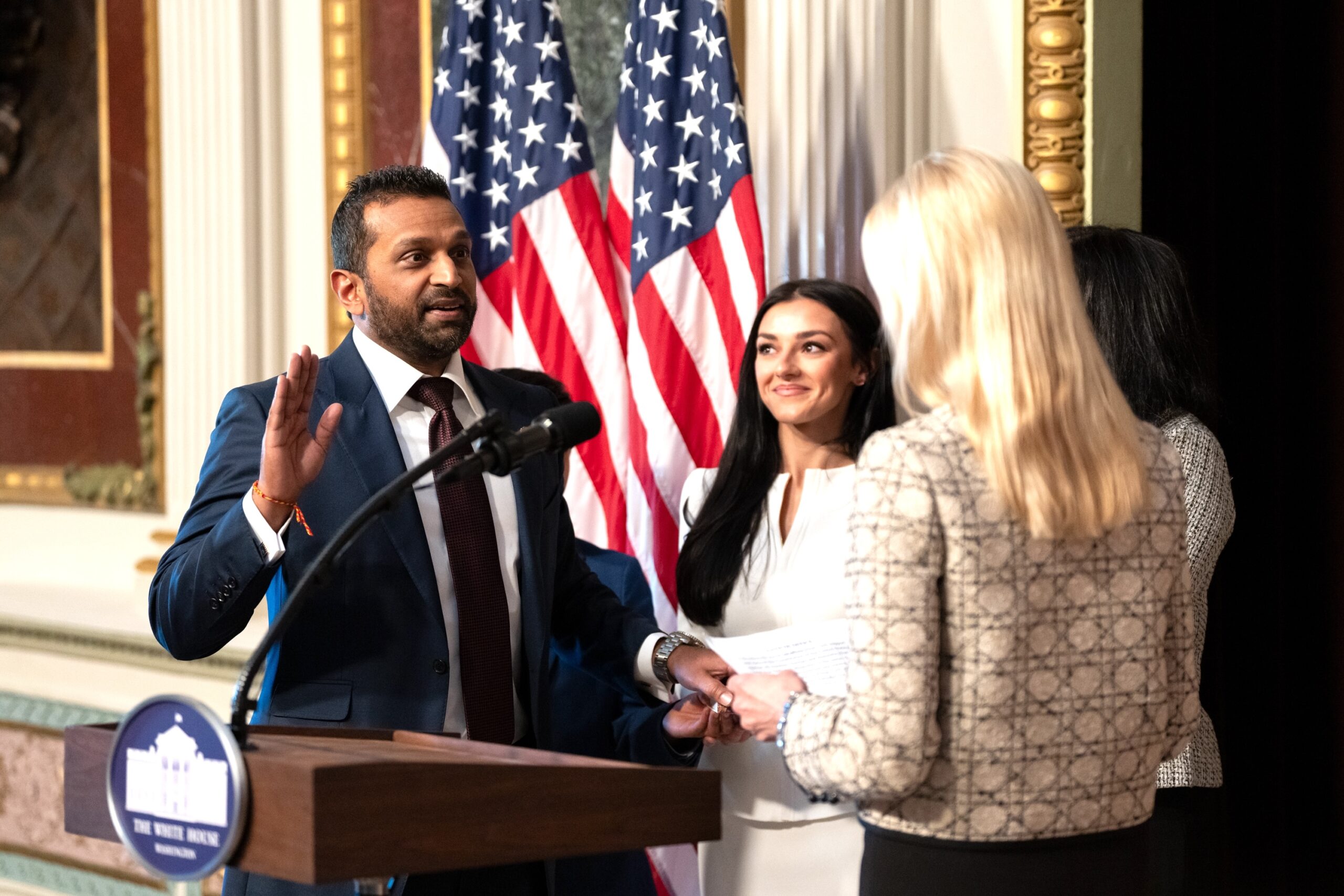
Kash Patel sworn into office as director of the FBI by Attorney General Pamela Bondi in Washington, D.C., on Feb. 21, 2025. (White House)
It had long been clear that Patel, given the breadth of his earlier experience investigating “Russiagate”, knew “where the bodies were buried” – and, not least, could identify the bodies of very senior miscreants still walking around free.
Reportedly, he had some luck in finding a secret room at F.B.I. headquarters that contained burn bags filled with thousands of Russiagate-related documents revealing evidence that incriminated the top gurus of the Deep State. (It’s a wonder why they weren’t burned).
Among these documents was a particularly damning 29-page secret Appendix to the not-so-thorough-yet-four-year-long investigation by Special Counsel Durham, appointed by Trump’s first-term Attorney General William Barr in May 2019 to look into the origins of the Russiagate mess.
(Burn bags commonly are simply paper bags containing classified documents to be burned, shredded, or otherwise destroyed beyond recognition. Deep State miscreants were rather careless. Remember, they were convinced Mrs. Clinton was going to win.)
Durham’s Appendix burst, so to speak, into the media Thursday, the day after the burn-bag story broke on Wednesday. But not before TheNew York Times obliged Clapper and Brennan the same day with a Guest Essay titled “Let’s Set the Record Straight on Russia and 2016” – an apparent attempt to pre-empt the damage from Durham’s Appendix.
It is a hard thing to do. Within a day of the discovery of the Appendix, Grassley on Thursday asked the F.B.I., C.I.A., and others to declassify it, which was done before the ink was dry on the Clapper-Brennan piece.
Among other things, the Appendix reveals that President Barack Obama intended to scuttle any F.B.I. investigation into Mrs. Clinton’s mishandling of classified information. And it is replete with evidence that the Clinton campaign, with the help of “special services” were hatching plots to falsely connect Trump to Russia.
The following three observations are drawn from Sen. Grassley’s Key Findings from the Durham Appendix. (We strongly recommend reading the whole Appendix. We include below salient excerpts from the full text.)
• During the first stage of the campaign, due to lack of direct evidence, it was decided to disseminate the necessary information [about alleged Russian interference] through the F.B.I.-affiliated…technical structures… in particular, the Crowdstrike and ThreatConnect companies, from where the information would then be disseminated through leading U.S. publications.
• Julie [Julianne Smith] says it will be a long-term affair to demonize Putin and Trump. Now it is good for a post-[DNC] convention bounce. [See below for the lurid detail.]
• It is a logical deduction Smith was, at a minimum, playing a role in the Clinton campaign’s efforts to tie Trump to Russia. And the communications Durham reviewed certainly lends some credence that such a plan existed.[NOTE: Yes, the same Julianne Smith whom President Joe Biden appointed U.S. Ambassador to NATO.]
The Full Text (Short Excerpts)
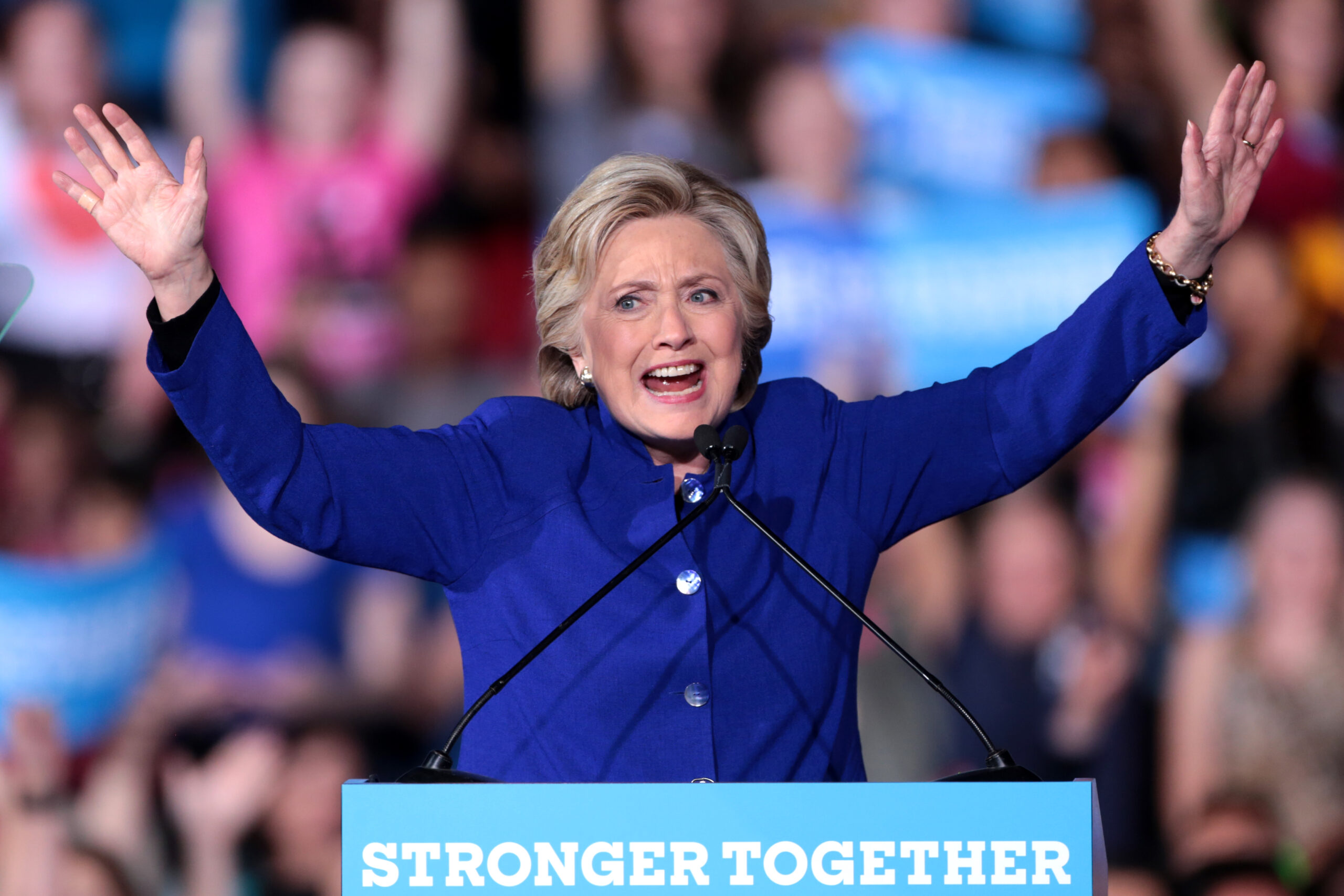
Hillary Clinton at a campaign rally in Tempe, Arizona, November 2016. (Gage Skidmore, Flickr, CC BY-SA 2.0)
The text of the Appendix dwells largely on information coming from memoranda prepared by Russian intelligence. These Russian memoranda analyzed the take from Russian hacking of communications sent by two senior members of the Open Society Foundations (formerly known as the Soros Foundation).
A few appetizing nuggets from the Appendix itself:
• Barack Obama sanctioned the use of all administrative levers to remove possibly negative effects from the F.B.I. investigation of cases related to the Clinton Foundation and the email correspondence in the State Department. [Revealed by WikiLeaks].
• Based on information from [DNC head] Wasserman-Schultz, the F.B.I. does not possess any kind of direct evidence against Clinton, because of their timely deletion from the email servers.
• The political director of the Hillary Clinton staff, Amanda Renteria, regularly receives information from Attorney General Loretta Lynch on the plans and intentions of the F.B.I.
Again, quoting from the Appendix:
“In late July 2016 the F.B.I. received a report that summarized certain hacked emails allegedly sent by Leonardo Bernardo of the Open Society Foundations.
The translated [Russian] draft memorandum stated in relevant part:
According to data from the election campaign headquarters of Hillary Clinton obtained by the U.S. Soros Foundation, on 26 July 2016 Clinton approved a plan of her policy adviser, Juliana (sic) Smith to smear Donald Trump by magnifying the scandal tied to the intrusion by Russian secret services in the pre-election process to benefit the Republican candidate.
As envisioned by Smith, raising the theme of Putin’s support for Trump to the level of an Olympics scandal would divert the constituents’ attention from the investigation of Clinton’s compromised electronic correspondence. …”
A ‘Crimes Report’ Filed
The Durham Appendix notes that the C.I.A. sent the F.B.I. an investigative referral regarding “the purported Clinton campaign plan” to tie Trump to Russia. Investigative referrals are widely known as “Crimes Reports.” U.S. intelligence agencies are required by statute to file a Crimes Report with the Department of Justice, when an unauthorized disclosure of classified information (or another potential federal crime) is believed to have occurred.
Had someone leaked, or was someone about to leak the Russian information on the “purported Clinton anti-Russian campaign plan”? I don’t know. In any case, a Crimes Report was filed – perhaps because more than one intelligence agency was involved; the content was so explosive; and it seemed necessary to work out a common response, just in case; and to brief those with “a need to know”.
Two months later, responding to a Senate Judiciary Committee request, then Director of National Intelligence John Ratcliffe wrote the following:
• In late July 2016, U.S. intelligence agencies obtained insight into Russian intelligence analysis alleging that U. S. presidential candidate Hillary Clinton had approved a campaign plan to stir up a scandal against U.S. presidential candidate Donald Trump by tying him to Putin and the Russians’ hacking of the Democratic National Committee. …
• According to his handwritten notes, former Central Intelligence Agency Director Brennan subsequently briefed President Obama and other senior national security officials on the intelligence, including the ‘alleged approval by Hillary Clinton on July 26, 2016 of a proposal from one of her foreign policy advisors to vilify Donald Trump by stirring up a scandal claiming interference by Russian security services.’
• On 07 September 2016, U.S. intelligence officials forwarded an investigative referral to F.B.I. Director James Comey and Deputy Assistant Director of Counterintelligence Peter Strzok regarding ‘U.S. Presidential candidate Hillary Clinton’s approval of a plan concerning U.S. presidential candidate Donald Trump and Russian hackers hampering U.S. elections as a means of distracting the public from her use of a private mail server.’”
Shocked?
Strzok testifying to U.S. House Judiciary Committee on July 12, 2018 on F.B.I. probe in to 2016 election. (House Judiciary Committee/YouTube)
It hardly needs saying that neither F.B.I. Director Comey nor the equally infamous F.B.I. official Strzok could have been shocked at the information Russia had acquired and the conclusions drawn by Russian intelligence. Comey and Strzok knew chapter and verse – and all the footnotes.
Recall that Strzok, a veteran F.B.I. counterintelligence agent leading the probe into alleged Russian interference, told his F.B.I. lawyer/lover later of his reluctance to join the Mueller investigation: “My concern is that there’s no big there there.” Nor was there any there there then (summer 2016). Few knew more about that than Comey and Strzok.
Nothing to worry about because most Americans had been conditioned to believe the Russians are “almost genetically driven” (as Clapper testified) to do all manner of bad things. So who would believe the Russians that they didn’t interfere? And if someone with access to the truth dared to leak to mainstream media,it would be highly unlikely that the media would give him/her air or ink. In such circumstances who would take such a big risk?
Not surprisingly, there has been no additional information about the investigative referral/Crimes Report.
Coincidence?
July 26, 2016: The timing may be coincidence, but on the same day Mrs. Clinton reportedly endorsed the big push to tie Trump to Russia, David Sanger and Eric Schmitt of The New York Times co-authored an article titled: “Spy Agency Consensus Grows That Russia Hacked D.N.C.”
“WASHINGTON: American intelligence agencies have told the White House they now have ‘high confidence’ that the Russian government was behind the theft of emails and documents from the Democratic National Committee, according to federal officials who have been briefed on the evidence.”
Sanger and Schmitt have won Pulitzers for regurgitating what the C.I.A. and F.B.I. whisper in their ears. I have a bitter, war-of-aggression memory of Sanger one day stating as flat fact seven times that “Weapons of Mass Destruction” were in Iraq. That article, co-authored with Thom Shanker, appeared on July 29, 2002 as Dick Cheney and George Bush Jr. began browbeating Congress to authorize the unprovoked attack on Iraq.
Don’t Fret; We’re Still Here
Some of us got Russiagate right, and we are pledged to stay at it. Actually, one of us got it right on day one. That would be Consortium Newsfavorite, Patrick Lawrence (whom The Nation fired for exposing the lie about “Russian hacking” of those embarrassing DNC emails).
Patrick let it all out in a column at Salon.com after watching some of the chicanery at the 2016 Democratic Convention. Strangely, the day he let loose was the same day that now-Ambassador Julianne Smith got the bright idea to blame the Russians – July 25, 2016 – and sold it to Mrs. Clinton the following day.
Ray McGovern works with Tell the Word, a publishing arm of the ecumenical Church of the Saviour in inner-city Washington. His 27 years as a C.I.A. analyst included leading the Soviet Foreign Policy Branch and conducting the morning briefings of the President’s Daily Brief. In retirement he co-founded Veteran Intelligence Professionals for Sanity (VIPS).
***
The New York Times Can’t Stop Sucking (Coverage of Durham Annex)
Predictably, the New York Times pooh-poohed the release of the classified annex to the Durham report. Charlie Savage wrote:
Kash Patel, the F.B.I. director, and other Trump allies have declared that a newly declassified report on the Russia investigation provides “evidence that the Clinton campaign plotted to frame President Trump and fabricate the Russia collusion hoax.” The reality is almost precisely the opposite… The report shows that a purported email that Trump supporters have long tried to portray as a smoking gun is instead most likely a fake. Russian spies appear to have tried to make it seem authentic by assembling passages lifted from actual emails by different hacking victims…
Mr. Trump and his aides have coupled those releases with wild and inaccurate claims about what they show, spinning the reports as proof of his long-running narrative that the investigation was a hoax instigated by enemies for political reasons.
This whole “assembled by Russian spies” line is based on one assessment about a pair of emails likely pulled by Russians from other real American victims of hacking. Beyond this instance of a “composite,” the paper ignores the gigantic load of material from the same source, which has been described in multiple other reports as real and affecting numerous American “victims” from the Executive and Legislative branches, as well as think-tanks and NGOs.
More irritating is Savage’s diatribe against Patel and the hoax “narrative,” offered without mentioning the roughly ten million instances in which the Times botched its coverage of Patel and Republican investigations into Russiagate. When Patel and then-House Intelligence Committee chair Devin Nunes released the much-denounced “Nunes memo” about FISA abuse in early 2018, Savage personally “annotated” the document, which would be vidicated more or less entirely by an Inspector General investigation nearly two years later. About the accusations of FISA abuse, which included use of the Steele dossier to obtain surveillance authority, Charlie wrote:
The FBI had ““grave concerns about material omissions of fact that fundamentally impact the memo’s accuracy,’” adding, “In accusing the F.B.I. of omitting important information, this memo’s critics say the memo itself omits crucial context: other evidence that did not come from Mr. Steele, much of which remains classified.”This is the much-used initial argument that the Steele material wasn’t important to the FISA warrant.Savage went with this talking point multiple times, also saying in another piece, “Mr. Steele’s information was only one thread in a tapestry of evidence from various sources that the memo ignored, exaggerating its relative importance.” Inspector General Horowitz dashed that, concluding Steele “played a central and essential role”;
Savage went on in the “annotation”: “It makes no note of the fact that [Carter] Page attracted the F.B.I.’s interest in 2013, when agents came to believe that Russian spies were trying to recruit him.” Why didn’t Patel include that detail? Because Page was an informant in good standing with the CIA at the time, a fact an FBI lawyer was criminally convicted for omitting. Savage, who later wrote about Kevin Clinesmith’s conviction, omitted the same critical detail as Clinesmith — perhaps unknowingly, but still;
Savage wrote, “The language used here on Mr. Steele’s relationship with the F.B.I. suggests that it was formal. But he never entered into any formal relationship from which he could be suspended or terminated, according to people familiar…” Steele was terminated as a source by the FBI “for cause” on November 17, 2016, years before the annotation article, showing Savage’s “people familiar” either weren’t “familiar” or were yanking his chain. Colleague Scott Shane would describe the firing as a decision by the FBI to “end the formal relationship” with Steele. Oops.
For what it’s worth, the Times without Savage’s help also swallowed the Hamilton 68 hoax whole and described the #ReleaseTheMemo hashtag as the work of Russian “bots”; ran an editorial called “The Nunes memo is all smoke, no fire”; and ran a full house editorial (one that again cited the phony Hamilton 68 dashboard, by the way) describing the Nunes report as a “fake scandal” designed, like the Clinton email investigation, to distract from the “real conspiracy” investigated by Robert Mueller. This sounds remarkably like today’s story, which described the Durham release as an effort to “change the subject from its broken promise to release Jeffrey Epstein files.” They write the same stories, over and over. It never ends.
The part that really infuriated today, however, was this section:
In reality, the F.B.I. opened its investigation based on a lead it received from the Australian government in late July 2016, after WikiLeaks released Democratic emails stolen by Russian hackers and disrupted the Democratic convention. The tip involved a Trump campaign adviser suggesting, before the hacking had become public, that the campaign had received outreach from Russia and knew what it would do.
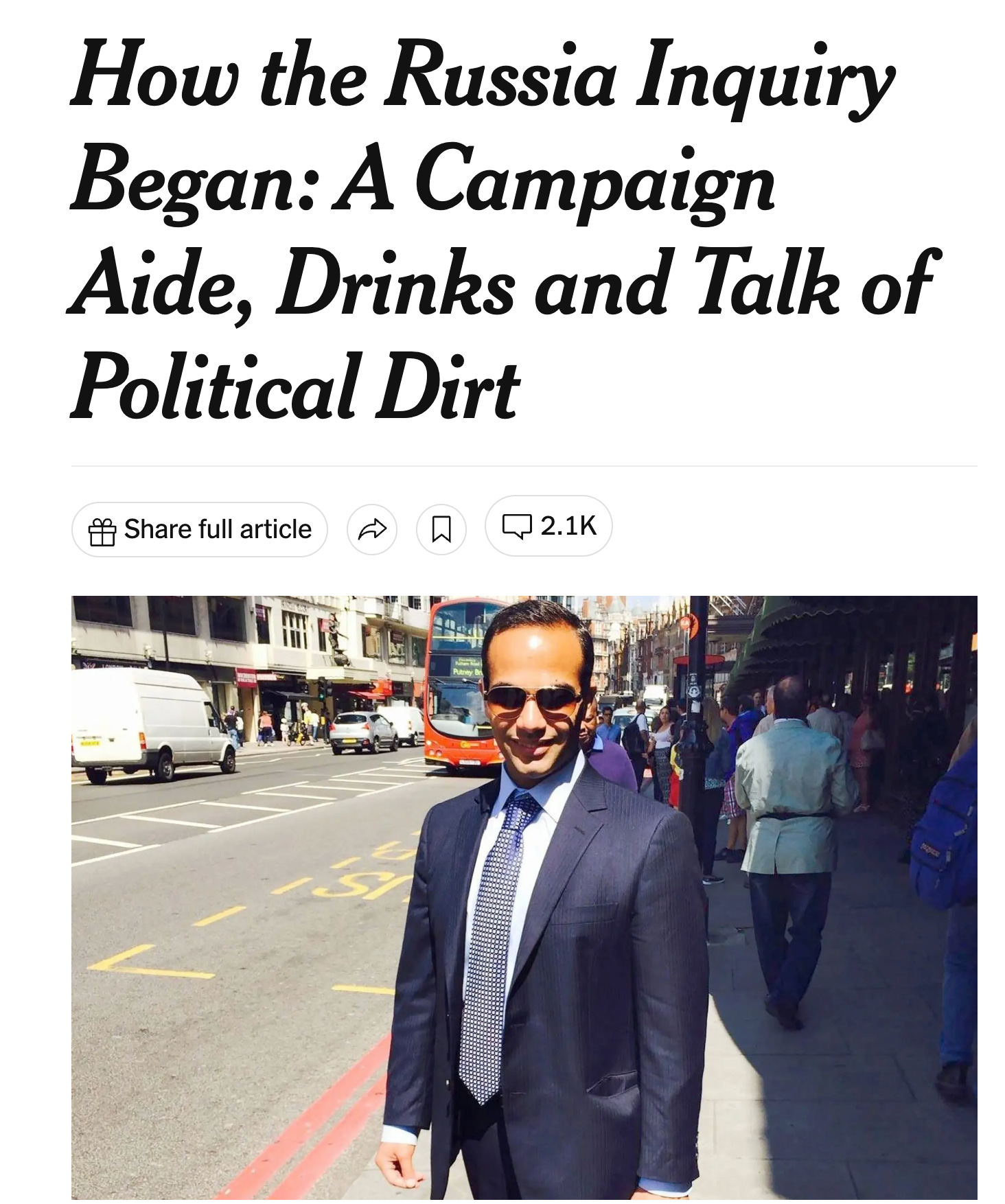
The Times reported that Papadopoulos had been told of “dirt” Russia had, in the form of “thousands of emails that would embarrass Mrs. Clinton,” given to him by a Maltese professor named Josef Mifsud, presented as a cutout for Russia. This was described as a “driving factor” for the FBI opening its “Crossfire Hurricane” investigation into Trump and Russia on July 31, 2016.
Almost everything about this story was wrong. It took a while, but Downer himself eventually admitted there was no “dirt” talk, or email talk. From the public Durham report:
According to Downer, Papadopoulos made no mention of Clinton emails, dirtor any specific approach by the Russian government to the Trump campaign team with an offer or suggestion of providing assistance. Rather, Downer’s recollection was that Papadopoulos simply stated “the Russians have information” and that was all.
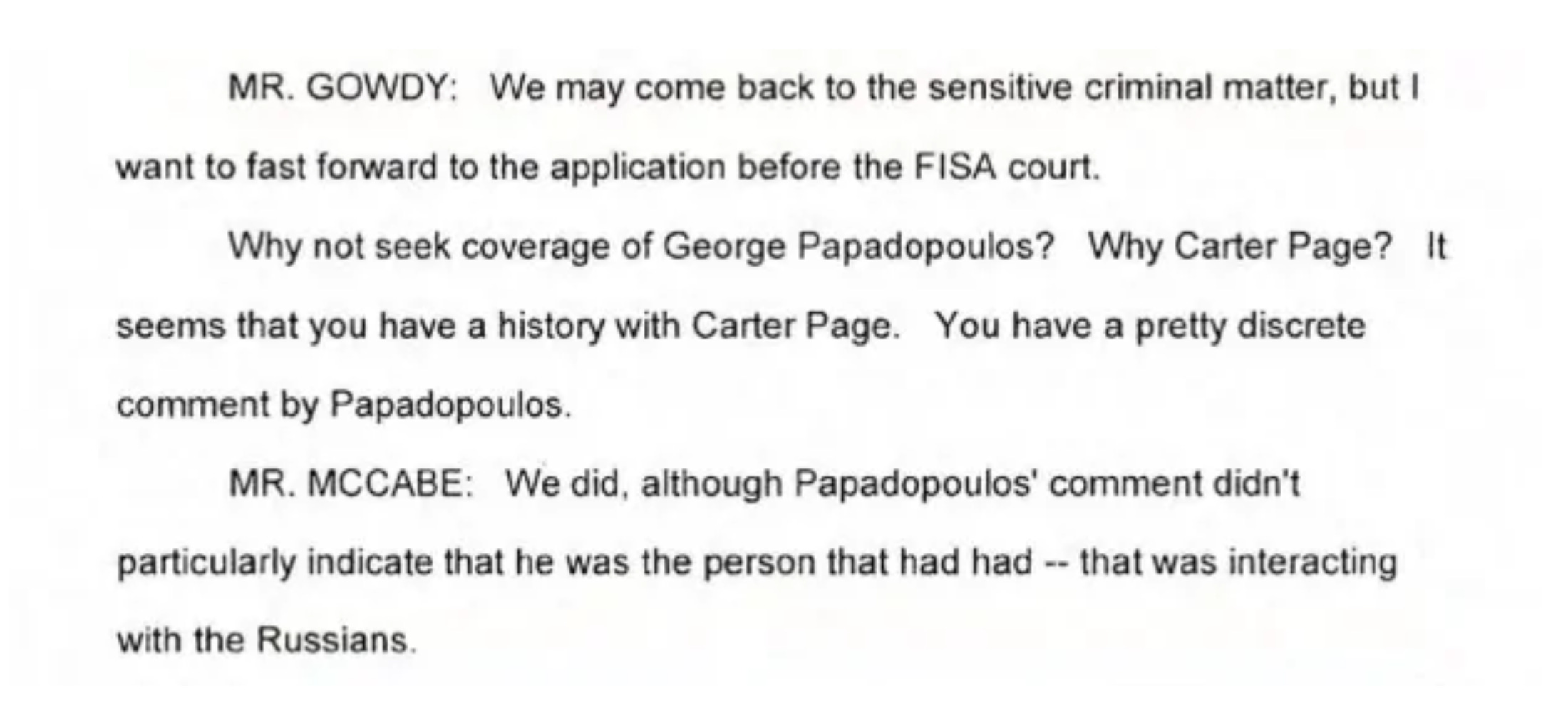
Downer also said he “did not get the sense Papadopoulos was the middle-man to coordinate with the Russians.” More infuriating? The FBI dropped Papadopoulos as a lead weeks into the Crossfire Hurricane inquiry, with Deputy Director Alexander McCabe testifying that his comments “didn’t particularly indicate” contact with Russians:
Screwing up “dirt” and “thousands of emails” is bad, but the McCabe testimony shows the FBI knew in in August of 2016 that Papadopoulos was a dead-end. But “current and former American officials” polished that turd and fed it to the Times a full year and a half later. The paper then used it for its blockbuster tale about how Papadopoulos played a “critical role” in the Russiagate drama.
This will go down as an infamous screw-up and smear. Papadopoulos was totally uninvolved with any intelligence scheme and merely used as a technical pretense to start what proved to be a bogus investigation. Still, the Times plastered his face all over its front page as the scandal’s poster child, in what in hindsight was a proud advertisement for how badly they’d been bent over by their sources.
Now, years later, Savage not only re-writes this passage without the name “Papadopoulos” and without references to “dirt” or “thousands of emails,” but uses sleight-of-hand to suggest what was said between the young Trump aide and the Australian diplomat was meaningful. He describes a “Trump campaign adviser suggesting, before the [Russian] hacking had become public, that the campaign had received outreach from Russia and knew what it would do.” Knew what it would do? Savage leaves out the fact that Papadopoulos had not, in fact, received outreach from Russia, and did not have or claim to have foreknowledge of hacking. He played no meaningful role. It’s part of the Times legendthat he did, however, so Charlie twisted the prose like a pipe cleaner to fit the few remaining usable factoids.
The irony is that while Papadopoulos was not the real beginning of Russiagate, the story Durham told about the U.S. acquiring a large chunk of intelligence from Russia far earlier in 2016 likely was. This was real intelligence concerning Russia that was embarrassing to Clinton, not Trump. Even at this late date, after so many Russiagate stories the paper screwed up, they continue to vomit up this nonsense. Give back your Pulitzer, you clowns!