Trump made a very interesting comment during a press conference yesterday (8/26/25) which entirely summarizes the West’s misguided approach to Russia:
Trump is asked on his opinion regarding Lavrov’s statement that Russia could not sign a deal with an illegitimate leader like Zelensky. Trump responds by saying such statements are irrelevant because “everyone is just posturing”, and “it’s all bullshit”.
Trump could not be more wrong that a civilizational state like Russia is merely “posturing” about its existential interests, and understanding this key divergence is essential for grasping the far larger implications of the ideological rift between West and East.
It also explains why observers have been tearing their hair out trying to comprehend why Russia’s consistently clear elucidations of its demands always seemingly fall on deaf ears. Russia issues the exact bullet point reduction of its demands, and the very next day Trump’s various reps and envoys muddle things by claiming they aren’t sure what Russia wants, or that a meeting is needed to further iron things out.
Trump demystifies things by explaining that these weren’t misunderstandings or a US inability to properly listen to Russia’s demands—even worse, these were outright US dismissals of Russian concerns all along. In Trump’s decadent, reality-TV-inspired world view, every global conflict is just another daytime soap opera production you can throw enough money at, ‘rizz’ up its hosts, and things fall into place.
He cannot seem to grasp the existential implications for the parties involved, a theme I recently alluded to:
The world’s a stage for silver-spooned Donnie, and its ‘inconvenient’ conflicts mere sideshows to be quickly dispensed with for the prize of accolades. That is what being uncultured gets you—the inability to understand rooted histories, barring the odd toss-off like “these people have been fighting for thousands of years” that Riviera Don occasionally rattles off about Gaza in pale imitation of erudition.
This is likely the real reason for Putin’s infamously pedantic exegesis on Russian history for Tucker Carlson, to signal to Western audiences that the conflict has much deeper roots and implications than their leaders are willing to admit.
Another implication of Trump’s crude dismissal of Russian legal objections has to do with the same so-called ‘Rules Based Order’ so often pedestaled as the sacred geometry on which the entire Western system rests. Trump callously pulls at the threads of this Order’s very seams by ignoring clearly legitimate concerns about one of the party’s legal standings, again signifying to the world that the ordurous odor coming from this Order is one of fickle arbitrariness and hypocrisy.
On the occasion of shedding light on this ideological divide between Russia and the West, it is interesting that Putin had just recently again shared his views on the origins of the West’s demonization of Russia. Many have debated this for years, citing Russia’s fraternal involvement with both US and UK in previous centuries and often attributing the ‘fall’ to the pre-WWI, Milner’s Roundtable and Mackinder’s “Heartland” years.
But Putin, for his part, traces the lineage of this schismatic hatred much farther back, to the days of Ivan IV, when he believes Papal representatives sought to convince Russia to shed its Orthodoxy, to no avail. After Ivan IV’s rebukes, Putin says the first inklings of the now-notorious “otherness” began to be applied to Russia, with Ivan deemed to be a mad tyrant and branded ‘the Terrible’.
So, how did we get from Trump’s casual table rants to plumbing historical myths? The underlying continuity can be explained simply: the West does not understand Russia, and does not care to understand it. This comes from an ingrained superiority complex and exceptionalism dating back centuries.
Rhetorical question: How can you resolve a conflict between two parties whose deepest cultural, spiritual, and geopolitical epistemologies you shroud in deliberate obfuscation?….
In 1972, US President Richard Nixon’s trip to China didn’t end the Vietnam War, but it helped offset the political fallout there and put a different turn on the ongoing Cold War. It ultimately worked, although it still took time to materialize into meaningful collaboration against the USSR.
The American strategy of engaging with Russian President Vladimir Putin is a reverse Nixon—an attempt to pull Russia away from China’s embrace. The August 15 meeting between Putin and US President Donald Trump in Alaska failed to achieve the desired result, but at least the effort in this direction was clear.
However, Chinese Foreign Minister Wang Yi’s August 18 trip to India put a very different spin on the whole story. It appears as though Putin and Chinese President Xi Jinping are running circles around Trump.
Not only did Putin not abandon Xi, but the two also managed to woo Indian Prime Minister Narendra Modi, who on August 30 flew to Beijing, effectively ending a tense relationship.
The Nixon paradigm did work in reverse, but not as the US had hoped; that is, this time Moscow outmaneuvered Washington this time.
Modi will certainly be very cautious with China. He visited Japan first, stressing their strong bilateral bond. He also called Ukrainian President Volodymyr Zelensky and pledged to work for peace with Moscow.
But August 31 was a sad moment for America—losing, at least partly, a crucial friend that it had spent nearly 25 years drawing closer. It also represented a setback for Modi, who has tied his political legacy to aligning with the Western camp through the Quad military pact, moving India away from its traditional policy of non-alignment.
Putin is the total winner of the day. He can frame Trump’s erratic behavior as proof of influence, boasting to Xi and Modi: “I control Trump, stick with me, no need to talk with the Americans.”
Whether true or not, the narrative may seem believable, and if so, then anything can spin out of this spiel. Indeed, the next Trump-Xi summit, apparently scheduled for October, could take place under a Russian cloud. Is the US cornered? Trump now needs to prove that Putin is not in control. It could be very tricky.
If the US doesn’t redress its ties with India effectively and quickly, the entire international framework that has held the world together since World War II could begin to unravel. India’s sense of betrayal is felt to varying degrees by many US allies.
What many Asian diplomats find mind-boggling is the reason behind the betrayal. Reportedly, it stemmed from a testy phone call, where Trump insisted Modi nominate him for the Nobel Peace Prize, as the US president had helped resolve the recent India-Pakistan clash (see here). The damage to the US is compounded by how trivial the cause appears, casting a deep shadow over its reliability as a partner.
Russia can now boast a political victory greater than any it has achieved in Ukraine, gaining significant political leverage points from which it can upend the current world order.
China’s position is a mixed bag. Its friction with the US has moved somewhat to the background, but chaos in the world order threatens its trade, its main economic driver, possibly more than Trump’s tariffs. While Russia may have an interest in chaos, China could simply be looking for a distraction.
Nothing is certain or set in stone. “The world’s two most populous countries need to be friends,” Xi told Modi on Sunday (August 31), underscoring there is still a long way to go between China and India to improve their relations.
Meeting on the sidelines of a Shanghai Cooperation Organization summit in Tianjin, Xi reportedly told Modi that the two countries could be good neighbors and play a key role in the Global South.
The Chinese press has emphasized that the visit comes at a pivotal moment, as both countries work to resolve long-standing disputes and seek common ground amid growing strains in their relationship with the United States – the proverbial elephant in Beijing’s room.
Beijing is also using the SCO summit as an opportunity to showcase its leadership and build solidarity among the Global South amid mounting geopolitical challenges. It’s a very different narrative from the one coming out of Washington.
We, the People of the United States of America, are the custodians of our Constitutional Republic. Through our free and democratic processes, we elect officials to represent us in government, and through these very same processes, backed by the rule of law, we hold these same officials accountable for what they do in our name. The processes of good citizenship, however, are not defined by passivity, limited simply to participation in elections, but rather dynamic actions that promote constant engagement across the full spectrum of issues that define our collective daily existence. Good citizenship sets the standards through which we hold elected officials accountable, and good citizens lead by example. This applies to both the domestic and foreign policies being implemented in our name.
The issue of Russophobia in America today should be a concern for us all. Russophobia is designed to exploit the ignorance of the American people by promulgating falsehoods about the reality of Russia that are designed to generate fear, fear which is then exploited by those whom we elect to support policies which postulate Russia as the eternal bogeyman. This mage is then used to justify defense spending and national security postures that have put the United States on a highway to hell that can only end with a nuclear Armageddon. In short, Russophobia represents an existential threat to the security of the United States and the entire world. It is one of the most dangerous threats facing the American people today, and yet it is fostered by mainstream media, academia and the permanent bureaucracy of government, all of which are deeply infected with the intellectual poison produced by Russophobia.
The antidote to this poison is knowledge and information that can only be garnered through direct contact between the American and Russian people.
This is where citizen diplomacy comes in.
I have been actively engaged in citizen diplomacy with Russia since April 2023, when I first travelled to Russia to promote the cause of peace through nuclear disarmament. At that time, I engaged in the practice of repairing trust between the American and Russian people “one handshake at a time.”
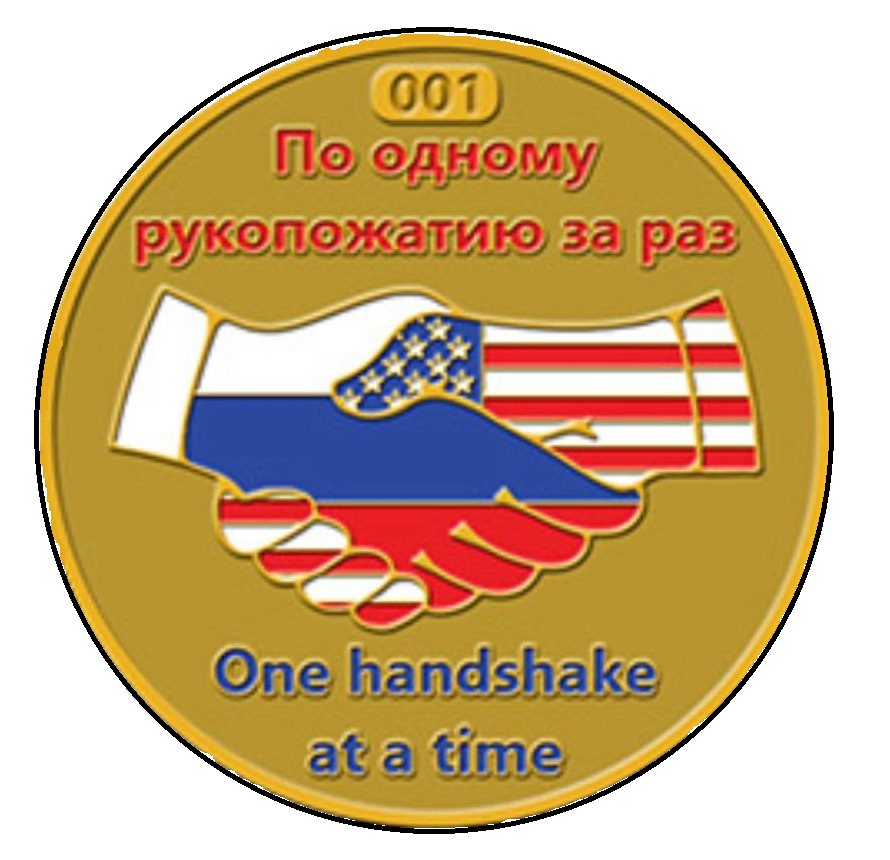
The Challenge Coin I brought with me to Russia in May 2023
I shook many hands during this trip.
I returned to Russia in December 2023 to bring in the New Year, promoting the concept of “Waging Peace” by learning more about the Russian reality, and bringing that reality back with me to the United States, where I sought to share it with anyone and everyone willing to listen and learn.
The poison of Russophobia, however, runs deep in the blood of the United States, and my efforts at conducting citizens diplomacy were deemed a threat by the administration of President Joe Biden, which sought to criminalize my efforts, dispatching the FBI to my home under the false pretext that I was acting as an agent of the Russian government. The Biden State Department revoked my passport, deliberately preventing me from travelling to Russia in the summer of 2024, where I planned on engaging in citizens diplomacy on a scope and scale greater than previously practiced.
I refused to be intimidated by this obvious lawfare being waged against me and the cause of peace I promoted. While I fought to get my passport returned, I continued to engage with the Russian people, attending several functions at the Russian Embassy (including a piano recital, and both Russia Day and Victory Day celebrations).
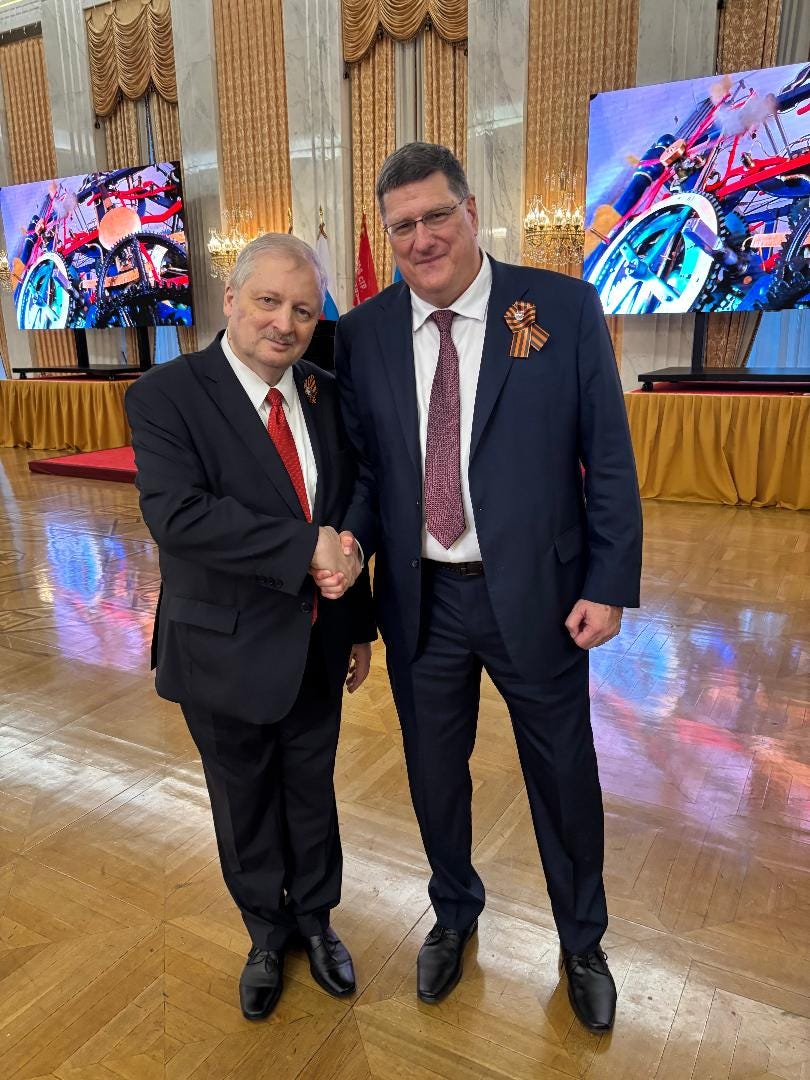
Shaking hands with Russian Ambassador to the United States Alexander Darchiev
I shook many hands during these visits.
I also worked with a Russian counterpart, Pavel Balobanov, to resurrect the landmark 1985 “Spacebridge” organized by the late American journalist, Phil Donahue, and his Soviet counterpart, Vladimir Pozner. One June 18, 2025, Pavel and I conducted a three hour “Citizens Summit” bringing together an American audience in Kingston, New York with a Russian audience in Saint Petersburg, Russia.
The reaction of all involved was overwhelmingly positive.
On July 15, 2025 (my birthday) my passport was finally restored to me. Shortly thereafter, the FBI began returning property they had seized in the raid on my home. Elections matter, and the results of the November 2024 Presidential election saw the Russophobia of the Biden administration replaced by the policies of peace promoted by Donald Trump. These policies were founded in the notion that America was best served by learning to live in peace with Russia. Free speech was once again a concept protected by the government, even when the concepts promoted—such as good relations between Russia and the US—ran afoul of the Russophobic narratives promoted by mainstream media, academia, and the permanent government bureaucracy.
My week in Russia (August 9-18) was one of the most productive examples of citizen diplomacy I have ever been engaged in—and keep in mind I travelled to Iraq in September 2002, where I was the first and only foreigner to address the Iraqi parliament in a valiant but ultimately failed effort to prevent a war by getting the Iraqis to allow UN weapons inspectors to return to work. The timing of this visit was serendipitous—I landed as the Alaska Summit between President Trump and President Putin was announced, and as such I was perfectly located to take the pulse of Russian public reaction, both to the potential of the summit, and its results.
One of the messages I received repeatedly from the scores of interviews I conducted with Russians from every walk of life was how important it was to the Russian people that President Trump understood that, when it came to the issue of peace between Russia and the US, the Russian people were fully supportive of his efforts. I promised that I would do my best to relay this message to President Trump, and today I am making good on this promise.
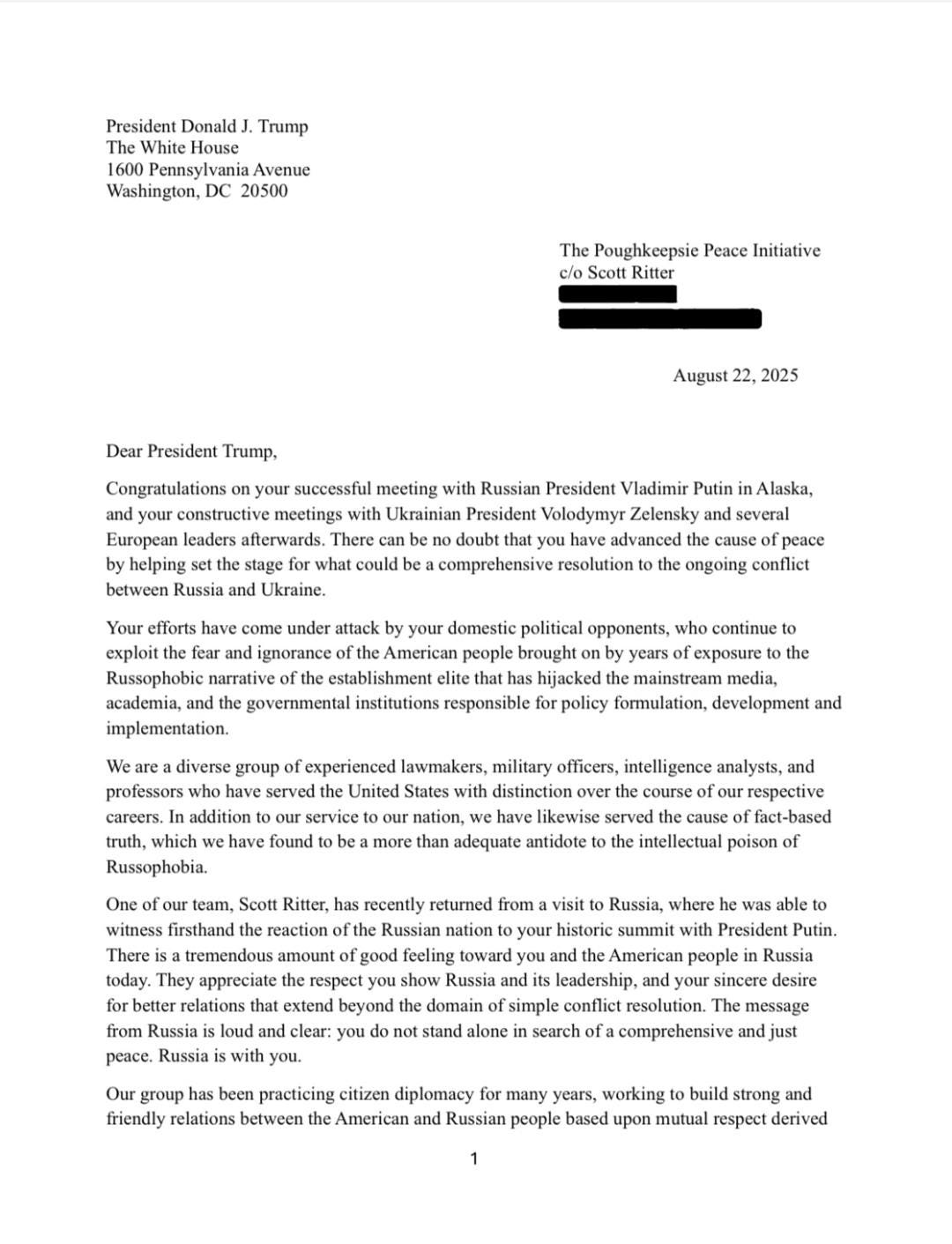
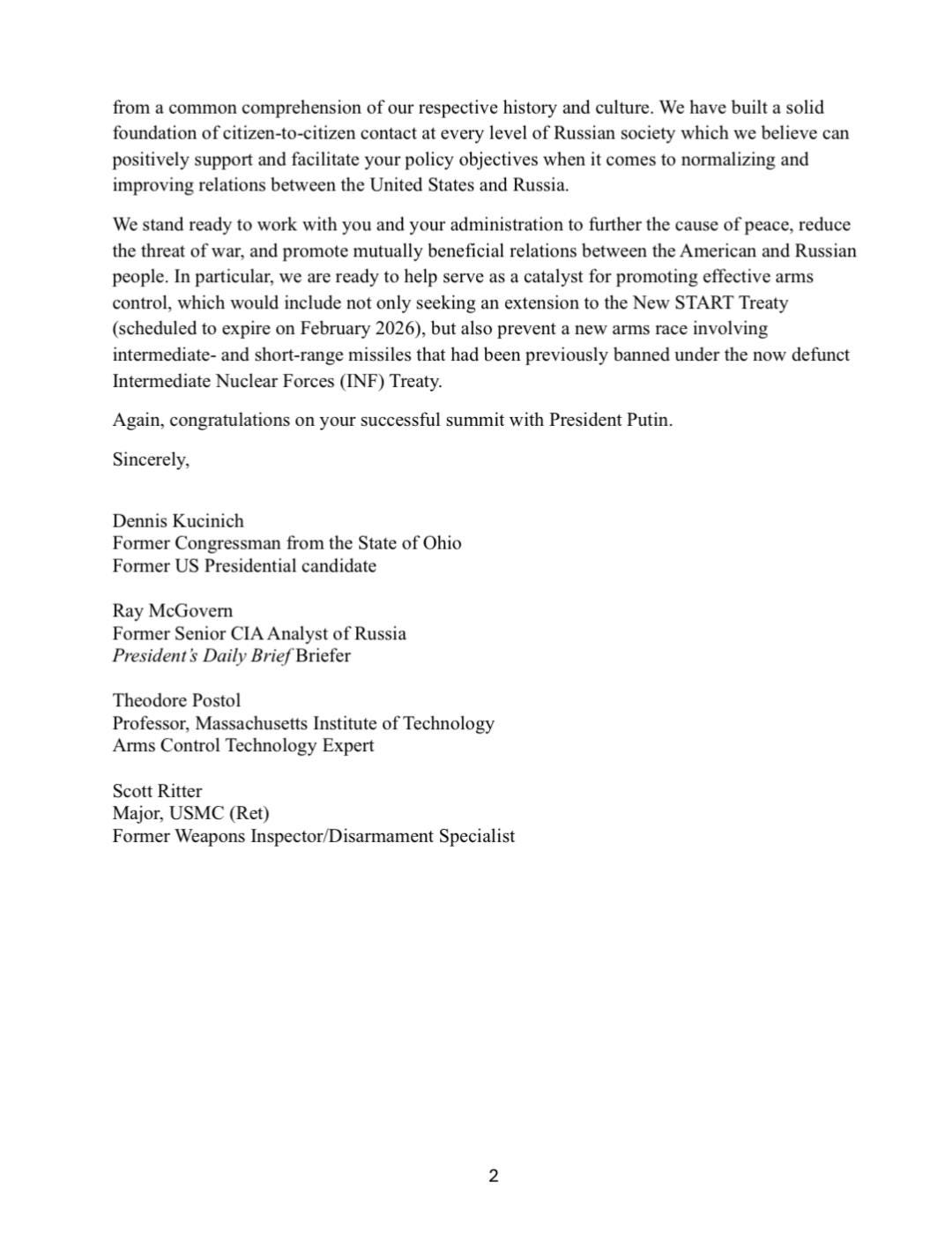
The Poughkeepsie Peace Initiative’s Letter to President Trump
As part of my Project 38 initiative, I have brought together a team of like-minded people, all experts in their respective fields, for the purpose of helping craft a vision for arms control with Russia, built on the premise that the last remaining treaty between the US and Russia which limits the size of our respective nuclear arsenals—the New START treaty—should be extended (it expires on February 4, 2026), and that the need for limits on intermediate range nuclear forces which were lifted with the demise of the INF treaty (President Trump withdrew from this treaty in August 2019) are essential for European and global security and stability. Together with this team—former Ohio Congressman Dennis Kucinich, former CIA analyst Ray McGovern, and MIT Professor Ted Postol—I have written a letter praising President Trump for his courage in agreeing to meet with President Putin, appraising the President of the results of my recent trip to Russia, and informing the President that this team—which we call the Poughkeepsie Peace Initiative—stands ready to support his peace efforts with Russia by engaging in citizens diplomacy for the betterment of relations between the US and Russia.
This is Citizens Diplomacy in action.
If you support the cause of waging peace and the work of citizens diplomacy, please consider donating to the cause. Our work is solely funded by your contributions. Thank you!
Ukrainian law enforcement has detained a suspect in the killing of far-right MP and former parliamentary speaker Andrey Parubiy, Vladimir Zelensky announced on Monday. The arrest comes less than 48 hours after Parubiy was gunned down in broad daylight in the western city of Lviv.
Zelensky said he was informed of the development by Ukraine’s minister of internal affairs, Igor Klimenko, and Security Service (SBU) chief Vasily Malyukon on Sunday night.
“I have instructed that the available information be presented to the public,” Zelensky said in a post on X. “I thank our law enforcement officers for their prompt and coordinated work. All the circumstances of this horrendous murder must be clarified.”
The identity of the suspect remains unknown while “necessary investigative actions are ongoing,” Zelensky added. In a separate statement, he said he had spoken with Prosecutor General Ruslan Kravchenko, who confirmed that the suspect had already given initial testimony.
“Urgent investigative actions are currently underway to establish all the circumstances of this murder,” Zelensky stated, adding that “the entire law enforcement team and the prosecutors are working around the clock.”
Parubiy, 54, was shot eight times by an unknown assailant on Saturday while walking along a sidewalk in Lviv. Surveillance footage shared online appears to show a man posing as a food delivery courier approaching Parubiy from behind before raising a firearm and fleeing the scene.
The motive behind Parubiy’s killing remains unclear. A prominent figure in Ukraine’s far-right political circles, Parubiy co-founded the Social-National Party of Ukraine in 1991 – known for its neo-Nazi symbolism and ideology.
Parubiy played a central role in the 2014 Maidan coup, where he coordinated paramilitary protest groups and served as commandant of the protest camp in central Kiev. After the ousting of President Viktor Yanukovich, he was appointed secretary of Ukraine’s National Security and Defense Council, overseeing early military operations in Donbass and the government crackdown on anti-Maidan protests.
Parubiy’s career was further marred by his alleged role in suppressing protests in Odessa in May 2014, which culminated in a fire at the Trade Unions building that killed more than 40 activists opposed to Kiev’s coup-installed government. In 2018, he drew international criticism for stating in a televised interview that “the greatest man who practiced direct democracy was Adolf Hitler in the 1930s” – a comment he later claimed was misunderstood.
All my investigations are free to access, thanks to the enormous generosity of my readers. Independent journalism nonetheless requires investment, so if you took value from this article or any others, please consider sharing, or even becoming a paid subscriber. Your support is always gratefully received, and will never be forgotten. To buy me a coffee or two, please click this link.
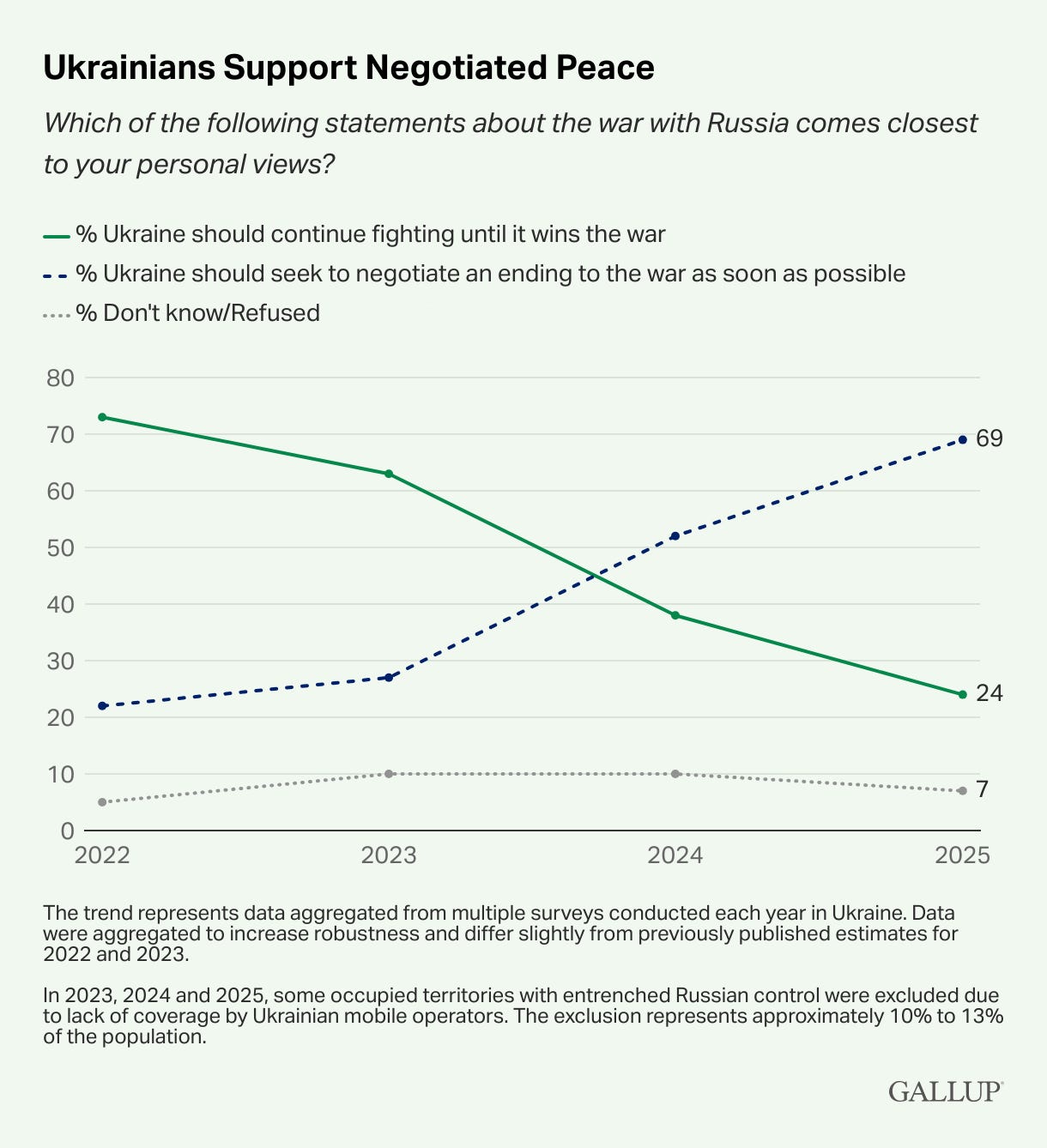
On August 7th, US polling giant Gallup published the remarkable results of a survey of Ukrainians. Public support for Kiev “fighting until victory” has plummeted to a record low “across all segments” of the population, “regardless of region or demographic group.” In a “nearly complete reversal from public opinion in 2022,” 69% of citizens “favor a negotiated end to the war as soon as possible.” Just 24% wish to keep fighting. However, vanishingly few believe the proxy war will end anytime soon.
The reasons for Ukrainian pessimism on this point are unstated, but an obvious explanation is the intransigence of President Volodymyr Zelensky, encouraged by his overseas backers – Britain in particular. London’s reverie of breaking up Russia into readily-exploitable chunks dates back centuries, and became turbocharged in the wake of the February 2014 Maidan coup. In July that year, a precise blueprint for the current proxy conflict was published by the Institute for Statecraft, a NATO/MI6 cutout founded by veteran British military intelligence apparatchik Chris Donnelly.
In response to the Donbass civil war, Statecraft advocated targeting Moscow with a variety of “anti-subversive measures”. This included “economic boycott, breach of diplomatic relations,” as well as “propaganda and counter-propaganda, pressure on neutrals.” The objective was to produce “armed conflict of the old-fashioned sort” with Russia, which “Britain and the West could win.” While we are now witnessing in real-time the brutal unravelling of Donnelly’s monstrous plot, Anglo-American designs of using Ukraine as a beachhead for all-out war with Moscow date back far further.
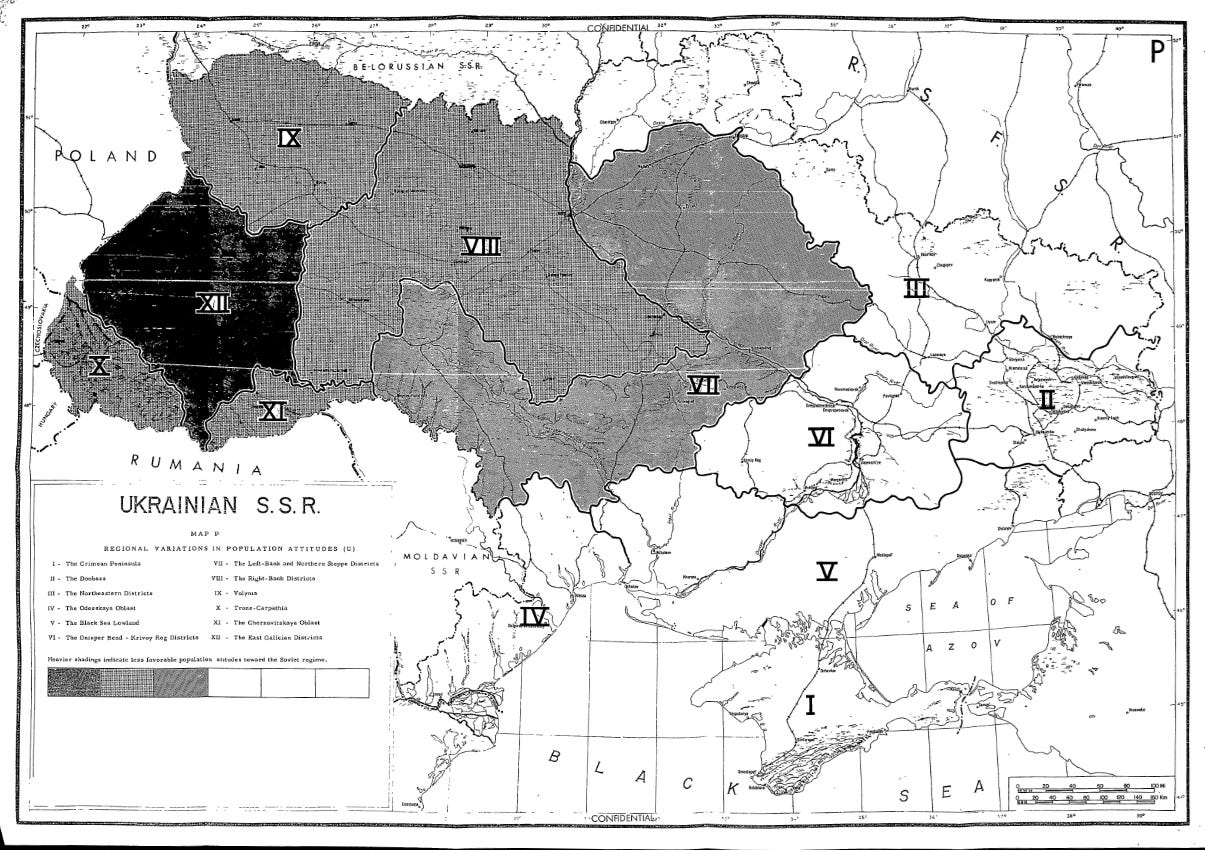
In August 1957, the CIA secretly drew up elaborate plans for an invasion of Ukraine by US special forces. It was hoped neighbourhood anti-Communist agitators would be mobilized as footsoldiers to assist in the effort. A detailed 200-page report, Resistance Factors and Special Forces Areas, set out demographic, economic, geographical, historical and political factors throughout the then-Soviet Socialist Republic that could facilitate, or impede, Washington’s quest to ignite local insurrection, and in turn the USSR’s ultimate collapse.
The mission was forecast to be a delicate and difficult balancing act, as much of Ukraine’s population held “few grievances” against Russians or Communist rule, which could be exploited to foment an armed uprising. Just as problematically, “the long history of union between Russia and Ukraine, which stretches in an almost unbroken line from 1654 to the present day,” resulted in “many Ukrainians” having “adopted the Russian way of life”. Problematically, there was thus a pronounced lack of “resistance to Soviet rule” among the population.
The “great influence” of Russian culture over Ukrainians, “many influential positions” in local government being held “by Russians or Ukrainians sympathetic to [Communist] rule, and “relative similarity” of their “languages, customs, and backgrounds”, meant there were “fewer points of conflict between the Ukrainians and Russians” than in Warsaw Pact nations. Throughout those satellite states, the CIA had to varying success already recruited clandestine networks of “freedom fighters” as anti-Communist Fifth Columnists. Yet, the Agency remained keen to identify potential “resistance” actors in Ukraine:
“Some Ukrainians are apparently only slightly aware of the differences which set them apart from Russians and feel little national antagonism. Nevertheless, important grievances exist, and among other Ukrainians there is opposition to Soviet authority which often has assumed a nationalist form. Under favorable conditions, these people might be expected to assist American Special Forces in fighting against the regime.”
‘Nationalist Activity’
A CIA map split Ukraine into 12 separate zones, ranked on “resistance” potential, and how “favorable population attitudes [are] toward the Soviet regime.” South and eastern regions, particularly Crimea and Donbass, rated poorly. Their populations were judged “strongly loyal” to Moscow, having never “displayed nationalist feelings or indicated any hostility to the regime,” while viewing themselves as “a Russian island in the Ukrainian sea.” In fact, as the study recorded, during and after World War I, when Germany created a fascist puppet state in Ukraine:
“Inhabitants of Donbass strongly resisted Ukrainian nationalists and at one point created a separate republic, independent of the rest of Ukraine. In the following years, they defended Soviet rule and Russian interests, often attacking the Ukrainian nationalists with more zeal than the Russian leaders themselves. During the German occupation in the Second World War, there was not a single recorded case of support for the Ukrainian nationalists or Germans.”
Still, invading and occupying Crimea was considered of paramount importance. On top of its strategic significance, the peninsula’s landscape was forecast as ideal for guerrilla warfare. The terrain offered “excellent opportunities for concealment and evasion,” the CIA report noted. While “troops operating in these sectors must be specially trained and equipped,” it was forecast the local Tatar population, “which fought so fiercely” against the Soviets in World War II, “would probably be willing to help” invading US forces.
Areas of western Ukraine, including former regions of Poland such as Lviv, Rivne, Transcarpathia and Volyn, which were heavily under control of “Ukrainian insurgents” – adherents of MI6-supported Stepan Bandera – during World War II, were judged most fruitful “resistance” launchpads. There, “nationalist activity was extensive” during World War II, with armed militias opposing “pro-Soviet partisans with some success.” Conveniently too, mass extermination of Jews, Poles and Russians by Banderites in these regions meant there was virtually no non-ethnic Ukrainian population left.
Furthermore, in the post-war period, “resistance to Soviet rule” had been “expressed on a great scale” in western Ukraine. Despite “extensive deportations”, “many nationalists” resided in Lviv et al, and “nationalist cells” created by Bandera’s “task forces” were dotted around the Republic. For example, anti-Communist “partisan bands” had taken up residence in the Carpathian Mountains. The review concluded, “it is in this region [US] Special Forces could expect considerable support from the local Ukrainian population, including active participation in measures directed against the Soviet regime.”
It was also determined that “Ukrainian nationalist, anti-Soviet sentiment” in Kiev was “apparently moderately strong,” and elements of the population “might be expected to provide active assistance to Special Forces.” The capital’s “large Ukrainian population” was reportedly “little affected by Russian influence,” and during the Russian Revolution “provided greater support than any other region for Ukrainian, nationalist, anti-Soviet forces.” Resultantly, “uncertainty about the attitudes of the local population” prompted Moscow to designate Kharkov the Ukrainian SSR’s capital, which it remained until 1934.
The CIA document further offered highly detailed assessments of Ukrainian territory, based on their utility for warfare. For example, “generally forbidding” Polesia – near Belarus – was noted to be “almost impossible” to traverse during spring. Conversely, winter provided “most favorable to movement, depending on the depth to which the ground freezes.” Overall, the area had “proved its worth as an excellent refuge and evasion area by supporting large-scale guerilla activities in the past.” Meanwhile, “swampy valleys of the Dnieper and Desna rivers” were of particular interest:
“The area is densely forested in its north-western part, where there are excellent opportunities for concealment and manoeuvre…There are extensive swamps, interspersed with patches of forest, which also provide good hiding places for the Special Forces. Conditions in the Volyno-Podolskaya Highlands are less suitable, although small groups may find temporary shelter in the sparse forests.”
‘Strongly Anti-Nationalist’
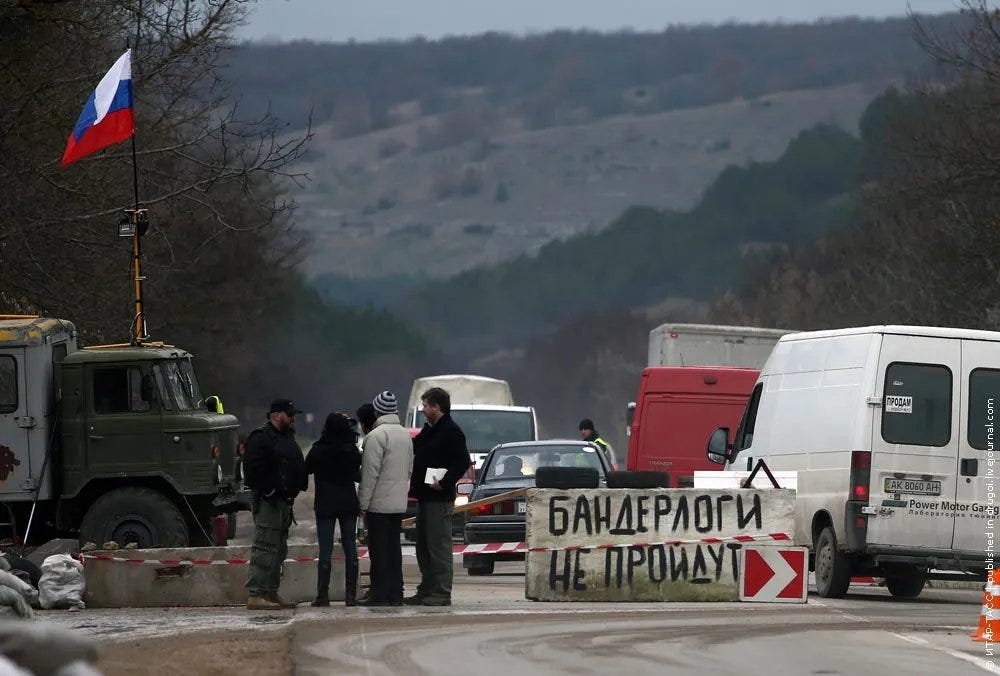
The CIA’s invasion plan never formally came to pass. Yet, areas of Ukraine forecast by the Agency to be most welcoming of US special forces were precisely where support for the Maidan coup was highest. Moreover, in a largely unknown chapter of the Maidan saga, fascist Right Sector militants were bussed en masse to Crimea prior to Moscow’s seizure of the peninsula. Had they succeeded in overrunning the territory, Right Sector would’ve fulfilled the CIA’s objective, as outlined in Resistance Factors and Special Forces Areas.
A civilian defence barricade constructed to prevent Right Sector entering Crimea, February 2014
Given what transpired elsewhere in Ukraine following February 2014, other sections of the CIA report take on a distinctly eerie character. For instance, despite its strategic position facing the Black Sea, the Agency warned against attempting to foment anti-Soviet rebellion in Odessa. The agency noted the city is “the most cosmopolitan area in Ukraine, with a heterogeneous population including significant numbers of Greeks, Moldovans and Bulgarians, as well as Russians and Jews.” As such:
“Odessa…has developed a less nationalistic character. Historically, it has been considered more Russian than Ukrainian territory. There was little evidence of nationalist or anti-Russian sentiment here during the Second World War, and the city…was in fact controlled by a strongly anti-nationalist local administration [during the conflict].”
Odessa became a key battleground between pro- and anti-Maidan elements, from the moment the protests erupted in November 2013. By March the next year, Russophone Ukrainians had occupied the city’s historic Kulykove Pole Square, and were calling for a referendum on the establishment of an “Odessa Autonomous Republic”. Tensions came to a head on May 2nd, when fascist football ultras – who subsequently formed Azov Battalion – stormed Odessa and forced dozens of anti-Maidan activists into Trade Unions House, before setting it ablaze.
In all, 42 people were killed and hundreds injured, while Odessa’s anti-Maidan movement was comprehensively neutralised. In March this year, the European Court of Human Rights issued a damning ruling against Kiev over the massacre. It concluded local police and fire services “deliberately” failed to respond appropriately to the inferno, and authorities insulated culpable officials and perpetrators from prosecution despite possessing incontrovertible evidence. Lethal “negligence” by officials on the day, and ever after, was found to go far “beyond an error of judgment or carelessness.”
The ECHR was apparently unwilling to consider the incineration of anti-Maidan activists was an intentional and premeditated act of mass murder, conceived and directed by Kiev’s US-installed fascist government. However, the findings of a Ukrainian parliamentary commission point ineluctably towards this conclusion. Whether, in turn, the Odessa massacre was intended to trigger Russian intervention in Ukraine, thus precipitating “armed conflict of the old-fashioned sort” with Moscow that “Britain and the West could win” is a matter of speculation – although the Institute for Statecraft was present in the country at the time.