Russia Matters: Russian Strikes Decimate Over Half Ukraine’s Gas Production

Russia Matters, 10/10/25

  1. Russian strikes in recent days have wiped out more than half of Ukraine’s domestic natural gas productionaccording to Bloomberg.Oct. 5 saw Russia launch its largest air attack in weeks on Ukraine, firing 53 missiles—including two Kinzhals—and nearly 500 attack drones across nine regionskilling five and damaging energy facilities nationwide. Five days later, Russia unleashed one of its largest attacks on Ukraine, launching around 465 drones and 32 missiles, according to Ukrainian officials.1 The Oct. 10 attack caused temporary power outages for over one million people nationwide in Ukraine. Also this week, Russia reported a growing number of Ukrainian drone attacks deep inside its territory, with some reaching nearly 2,000 kilometers (1,200 miles) from the Ukrainian border, in the Ural Mountains and the oil-rich region of Tyumen.
  2. In the past week, Sept. 30–Oct. 7, 2025, Russia gained 34 square miles of Ukraine’s territory, up from the previous week’s gain of 13 square miles, which constitutes an increase of 162%In the past four weeks (Sept. 9–Oct. 7, 2025), Russian forces gained 166 square miles of Ukrainian territory, a slight increase from the 160 square miles they gained during the previous four-week period (Aug. 12–Sept. 9, 2025), according to the latest issue of the Russia-Ukraine War Report Card. This week has also seen Vladimir Putin claim that Russian forces had captured almost 1,930 square miles (5,000 square kilometers) of land in Ukraine in 2025. According to data from DeepState, which is associated with Ukraine’s MoD, howeverfrom Jan. 1, 2025, to Oct. 5, 2025, Russia gained approximately 1,217 square miles (3,152 square kilometers) of Ukrainian land.
  3. Donald Trump said Oct. 6 that he has “sort of made a decision” about selling long-range Tomahawk missiles to NATO countries in order for them to be supplied to Ukraine, Axios reported. Trump also said he wants to know what the Ukrainians plan to do with the missiles before he supplies them. Following Trump’s comments, Kremlin spokesman Dmitry Peskov warned that supplying Tomahawks, which he stressed could carry nuclear warheads, would constitute a “serious escalation.” Senior Russian lawmakers broadened the warnings: Andrei Kartapolov promised a “tough, ambiguous, measured and asymmetrical” response. Andrei Zhuravlyov suggested Russia should strike Poland’s Rzeszow air base, a key Western transit hub for arms, if deliveries proceed, while Leonid Slutsky claimed Trump risked a third world war. In his comments on Tomahawks, another senior Russian MP Alexei Zhuravlev referenced Russia’s recent military cooperation agreement with Cuba and implied that Russia can deploy missiles to Cuba close to the United States. Putin weighed in, too, asserting on Oct. 9 that Russia will strengthen air defense.
  4. Trump on Oct. 5 praised Putin’s proposal to extend New START’s limits for one additional year after its planned February 2026 expiration, describing the Russian offer as a “good idea.” Trump did not indicate if the U.S. would attach new conditions or whether it has formally responded to Moscow. Nevertheless, the Kremlin welcomed Trump’s positive remarks, with Putin’s spokesman Peskov calling them grounds for optimism and possible new talks that could sidestep the Ukraine conflict. Speaking on Oct. 10, Putin himself said it would be a shame if the United States declined to extend the warhead limits, but that such a refusal would not be critical for Moscow. Putin has not indicated whether he is open to restoring inspections or data sharing under the treaty, while his Deputy Foreign Minister Sergey Ryabkov emphasized that Moscow’s proposal is not to renew the treaty, but to maintain its quantitative limits for one year post-expiry, provided the U.S. does not take destabilizing actions in offensive or strategic air defense fields.2

Europe and the Myth of the “Russian Nemesis”. The Genesis of Russophobia

By Dr. F. Andrew Wolf, Jr., Global Research, 9/30/25

F. Andrew Wolf, Jr. is director of The Fulcrum Institute, a new organization of current and former scholars, which engages in research and commentary, focusing on political and cultural issues on both sides of the Atlantic. After service in the USAF (Lt.Col.-Intel) Dr. Wolf obtained a PhD-philosophy (Wales), MA-theology (Univ. S. Africa), MTh-philosophical theology (TCU-Brite Div.). He taught philosophy, humanities and theology in the US and S. Africa before retiring from university. He is a regular contributor to Global Research.

The past several weeks has witnessed tensions between EU political elites and the Kremlin escalating, needlessly. A contrived drone incident in Poland, Estonian airspace allegedly being violated by Russian planes, and East European politicians urging NATO to shoot down Russian aircraft — it all points to a deliberate attempt to provoke Moscow and garner Washington’s attention.

But this sudden propensity toward provocation says less about Moscow and more about EU insecurity. With US security guarantees steadily declining, the bloc’s governments are grasping at an old but favorite retreat: the myth of the “Russian threat.”

It is a conjured story that has lingered in European consciousness for more than five centuries, and it speaks clearly to Western Europe’s insecurity – rather than any Russian territorial ambitions.

There are reasons why the EU’s desperate posturing is laced with deceit. Washington’s inclination towards underwriting European security is diminishing. Western media suggests that US officials have told their European counterparts that direct military aid to Eastern Europe may soon be scaled back. Political elites in the Baltics and some former Soviet republics view this as an untenable situation. Hence, the group’s foreign policy initiatives are routinely directed towards provoking a response from Russia, hoping to extract security guarantees and military resources from the US.

Furthermore, and this is the fallacy of the EU position, the latter has no alternative strategy. Without US acquiescence, it cannot conceive of a foreign policy beyond merely provoking the Russian “Bear.” Reintroducing Russia as its “existential” nemesis provides a convenient way to gain Washington’s attention – and money if possible.

The irony is glaring: Russia has no interest in the territory of its smaller neighbors, because it is not in its best interest to do so. The Baltics, Poland, and Finland engaging for decades in anti-Russian rhetoric notwithstanding, Moscow seeks no revenge or a reckoning — again, because it’s not in its interest to so engage. Their relevance in world affairs is negligible. But for the political elites, clinging to the myth of Russian aggression has become the only recourse they, shortsightedly, believe is available to them. 

The Genesis of Russophobia

The roots of this myth lie in neither the Cold War nor the 19th century “Great Game” rivalry between empires; rather, its emergence can be traced to the rather cowardly insecurity of Baltic barons and the opportunism of German knights in Livonia and Prussia.

In the late 15th century, Polish monarchs considered sending German knights to fight the expanding Ottoman Empire. The idea was horrifying to them. For centuries, they had lived comfortably in the Baltics while merely skirmishing with Russian militias. The Ottoman Turks was altogether different. The memory of Nicopolis was still a vivid memory – Ottoman forces executed virtually all captured knights.

Unwilling to face a real threat and a formidable enemy, the Livonian and Prussian knights initiated a propaganda campaign. The goal was to persuade the balance of Europe that Russia was an enemy as dangerous, and perhaps even more so, than the Ottomans. The strategy succeeded: Rome granted indulgences and support, ensuring the knights could remain at home, while still enjoying the prestige of crusaders fighting a “holy war.”

The myth was born: a confluence of fear, opportunism, and financial gain. Eventually, Western Europe (particularly France and Britain) absorbed the deception into a broader scheme of Russophobia – a blend of contempt and anxiety over a vast empire they could neither conquer nor ignore. And in the 20th century England’s academics, especially through its Rhodes Scholar program, indoctrinated generations of America’s best and brightest who became influential in advising presidents and secretaries of state in US foreign policy. Russophobia crossed the Atlantic.

Reflections of the Past

Today, history repeats itself. Once more, Russia’s neighbors (anxious and insecure) seek protection from an Atlantic suzerain preoccupied with larger challenges. Five centuries ago, the Ottomans consumed Europe’s attention; today, it is China – the true strategic rival of the United States.

Little has changed, however, with European elites. They cannot imagine a political identity without playing the role of “victim.” Their economies and influence are far too insignificant, so they inflate the specter of Russian aggression in a futile attempt to remain relevant to Washington and Brussels.

Russia’s foreign minister Sergei Lavrov told the United Nations this week that Moscow has no intention of attacking Europe or NATO countries. Moscow has not the desire and certainly not the need to “invade” the Baltics or Poland. In the 15th century, Ivan III was concerned with issues of trade, economic relations, and Orthodox Christian Church leadership — not with conquest for the sake of territorial gain. Today, Russia’s aims are equally pragmatic: stability, sovereignty, and relations built around trade.

Poland vs the Rest of Europe

The contrast with Poland is instructive. In the 15th century, Poland agitated for war with Russia. In the 21st, it has chosen a more cautious course, focusing on steady economic growth and avoiding reckless entanglements. Unlike the Baltics, Warsaw has built a measure of gravitas in European politics. That success has made it a target of envy in Berlin, Paris, and London, who would prefer Poland to be dragged into open confrontation with Moscow.

But Poland’s refusal to adopt the euro (much like Britain and the northern countries) has made it resilient, mitigating the leverage of German and French economic dominance. And Washington is equally reluctant to risk a “European entanglement” that would distract from its priorities in the Pacific. 

What History Teaches

The myth of the Russian threat was not born of Russian ambition but of broader European insecurity and avarice. European elites in the 21st century perpetuate the deception to distract their own populations from witnessing their own weakness and irrelevance.

What began as propaganda in Cologne in the 16th century still shapes West European discourse, today. But deceit cannot alter reality once it is recognized for what it is – a “lie.” Russia seeks not conflict — only to secure its interests. Europe and Britain understand this – it just doesn’t fit their political agendas.

It is self-defeating for the EU to cling to invented peril; it distracts attention from the real domestic challenges facing it. And in doing so, it risks repeating the same missteps that have dogged its politics for half a millennium – a reticence to deal with actual, rather than virtual, reality.

US Has Been Supporting Long Range Drone Attacks Inside Russia for Months

By Dave DeCamp, Antiwar.com, 10/12/25

The Trump administration has been providing Ukraine with intelligence to carry out long-range drone attacks against Russian energy infrastructure, the Financial Times reported on Sunday, citing multiple US and Ukrainian officials.

The report said that the US intelligence helps Ukraine “shape route planning, altitude, timing and mission decisions, enabling Ukraine’s long-range, one-way attack drones to evade Russian air defenses.”

A US official told the paper that Ukraine selects the target for the strike, then the US provides information on its vulnerabilities. However, other officials said the US has actually been setting out target priorities for the Ukrainian military, meaning the US is choosing what to strike.

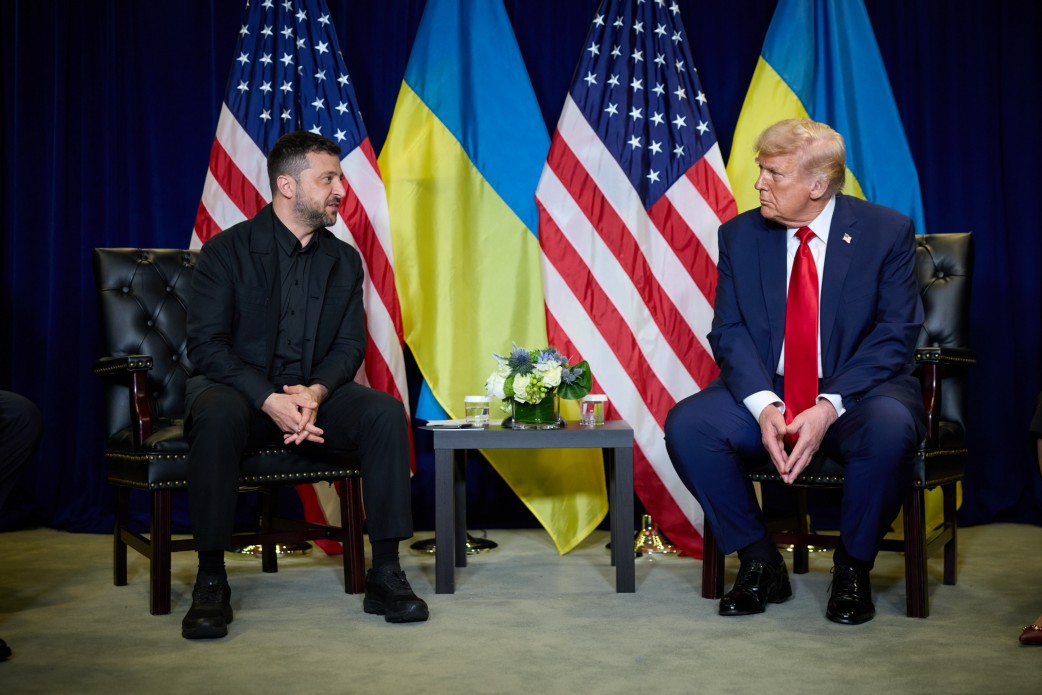
Trump and Zelensky meeting in New York on September 23, 2025 (photo via Zelensky’s office)

One of the FT’s sources described Ukraine’s drone force as the “instrument” the US is using to achieve the goal of undermining the Russian economy and pushing Russian President Vladimir Putin toward a settlement to end the war. The US has spent billions helping build up Ukraine’s drone program, an effort backed by the CIA.

The report said that the US began supplying Ukraine with the intelligence following a July phone call between President Trump and Ukrainian President Volodymyr Zelensky, during which Trump reportedly asked if Ukraine could hit Moscow if the US provided longer-range weapons. In August and September, Ukrainian drone attacks on Russian energy infrastructure significantly escalated.

US-backed attacks on Russian territory always risk a major escalation between Russia and NATO, and the FT report noted that the Biden administration refrained from supporting such strikes on Russian energy infrastructure. President Biden did support Ukrainian strikes on Russian border regions using ATACMS, US-provided missiles that have a range of about 190 miles.

President Trump reportedly halted the ATACMS strikes, but The Wall Street Journal recently reported that he has now signed off on supporting long-range missile strikes inside Russia. His administration is considering supplying Ukraine with Tomahawk missiles, which are nuclear-capable and have a range of over 1,000 miles, though it remains unclear if it’s a realistic option since the Ukrainian military lacks a way to fire them.

If you liked this article, please support Antiwar.com.
We are 100% reader-supported.

Dave DeCamp is the news editor of Antiwar.com, follow him on Twitter @decampdave.

Geoffrey Roberts: Moscow’s 1954 Proposal that the USSR Join NATO

Putin mentioned in his Valdai speech that in 1954 Moscow proposed Soviet membership of NATO – as part of a package of policies to create an inclusive, pan-European system of collective security.

This brought to mind my publication of the key Soviet archival document on this somewhat surprising suggestion – which was part of Moscow’s campaign to radically curtail the cold war:

https://www.wilsoncenter.org/publication/molotovs-proposal-the-ussr-join-nato-march-1954

~Geoffrey Roberts

Molotov’s Proposal that the USSR Join NATO, March 1954
By Geoffrey Roberts, The Wilson Center, November 21, 2011

CWIHP e-Dossier No. 27 

The document below is a translation of V. M. Molotov’s proposal to the Soviet Presidium in March 1954 that the USSR should issue a diplomatic note to the Western powers stating its willingness to consider joining NATO. The background to Molotov’s memorandum was the launch of the Soviet campaign for European collective security at the Berlin Conference of Foreign Ministers in February 1954. At that conference Molotov proposed the Soviet alternative to western plans for a European Defense Community (EDC) involving the participation of a rearmed West Germany—the conclusion of a pan-European collective security treaty. This proposal was linked in tum to a further set of Soviet proposals on the German question, including Germany’s reunification and neutralization in the cold war.

Molotov’s collective security proposal was rejected by western representatives on two grounds. Firstly, because the United States was excluded from the proposed treaty and relegated, together with Communist China, to observer status. Secondly, because the Soviet proposal aimed, it was said, to disrupt NATO as well as halt the formation of the EDC. Molotov responded to these criticisms by saying that the Soviet proposal could be amended and that he was open to persuasion about the value of NATO as a defensive organization.

When Molotov returned to Moscow he tasked Deputy Foreign Minister Andrei Gromyko to formulate proposals on the furtherance of the Soviet collective security campaign. On 10 March Gromyko presented Molotov a draft note for the Presidium proposing that the Soviet position on European collective security should be amended (a) to allow full US participation in the system and (b) the possibility of the USSR joining NATO.[1] Further drafts were presented to Molotov on 20 and 24 March.[2] These drafts were corrected in detail by Molotov. The major change made by Molotov was to delete Gromyko’s statement that the USSR would join NATO on certain conditions and to substitute the formulation that the Soviet Union was prepared to discuss the matter with interested parties. He also added a paragraph stating that the implications of possible Soviet membership of NATO had to be considered even now (see paragraph 9 in the document below). The final version of the note was sent Malenkov and Khrushchev on 26 March, together with the text of the proposed Soviet statement to the Western powers. This text was issued, unaltered, to Britain, France and the United States on 31 March 1954. It announced two amendments to the Soviet draft treaty on European collective security: the United States would not be excluded from formal participation in a system of pan-European collective security and if NATO relinquished its aggressive character the USSR would consider participation in the organization. In those circumstances, concluded the note, NATO “would cease to be a closed military alignment of states and would be open to other European countries which, together with the creation of an effective system of European collective security, would be of cardinal importance for the promotion of universal peace.”[3]

The administrative process through which the Soviet proposal was produced internally was typical of Molotov’s foreign ministry i.e. the production of numerous drafts by his deputies that he personally hand-corrected before they were sent to the Presidium (in the first instance to Khrushchev and Malenkov) for approval. It was unusual, however, for Molotov to present the Presidium with a long, discursive memorandum justifying what was being proposed. Usually, he just sent a short note enclosing the foreign ministry’s proposals which were then discussed in personal conversation at the Presidium level. On this occasion Molotov evidently felt the need for an advance written justification of what was being proposed.

Readers can judge for themselves what the document tells us about the character of the Soviet campaign for European collective security but it seems clear that (a) the reformulation of the Soviet position on 31 March 1954 was designed to further that campaign and (b) that while Molotov thought it unlikely the proposal would succeed (c) he did not rule out the possibility of the USSR joining NATO under certain conditions. It should be noted, too, that while propaganda advantage was an argument the foreign ministry frequently deployed in its submissions to the Presidium that did not mean the proposals were not seriously intended as well.

In May 1954 the Western powers rejected the Soviet proposal to join NATO on grounds that the USSR’s membership of the organization would be incompatible with its democratic and defensive aims. However, Moscow’s extensive and intensive campaign for European collective security continued until the Geneva Foreign Ministers Conference of October-November 1955.[4]

Geoffrey Roberts is Professor and Head of the School of History at University College Cork, Ireland. His latest book is Molotov: Stalin’s Cold Warrior, Potomac Books, 2011.

Footnotes


[1] Foreign Policy Archives of the Russian Federation (Arkhiv Vneshnei Politiki Rossiiskoi Federatsii, or AVP RF), F. 6, Op. l3, Pap. 2, D. 9, Ll. 20-25. I am grateful to Alexei Filitov for bringing the existence of this file to my attention.

[2] Ibid., Ll. 34-37, 44-55.

[3] “Note of the Soviet Government… 31 March 1954,” Supplement to New Times, no. 14, 3 April 1954.

[4] For a more in-depth discussion, see Geoffrey Roberts, “A Chance for Peace? The Soviet Campaign to End the Cold War, 1953-1955,” Working Paper No. 57, Cold War International History Project, December 2008.

Document 

Source:  Foreign Policy Archives of the Russian Federation (Arkhiv Vneshnei Politiki Rossiiskoi Federatsii, or AVP RF)F. 6, Op. 13, Pap. 2, D. 9, L1. 56-59. Translated for CWIHP by Geoffrey Roberts.

[Click to view the document in CWIHP’s online Digital Archive]

 Presidium, CC CPSUTo: Comrade G.M. Malenkov and Comrade N.S. Khrushchev 

According to reports from Soviet embassies and missions and in the foreign press, the Soviet draft of a General European Agreement on Collective Security in Europe has provoked positive responses from quite broad public circles abroad, including such French press organs as Le Monde… At the same time, the Soviet draft has, for understandable reasons, provoked a negative reaction from official circles and from supporters of the “European Defense Community” in France, England and other West European countries. It should be noted that official circles in France have also taken measures to mute the Soviet proposal. Among opponents of the European Defense Community there are also those who don’t support the proposal for a General European Agreement. In this regard the main argument advanced against our proposal is the thesis that the Soviet draft is directed at dislodging the USA from Europe so that the USSR can take its place as the dominating power in Europe. Especially broad use of this thesis is being made in France. Meriting attention in this connection is a conversation between our ambassador in Paris, comrade Vinogradov, and the Gaullist leader [Gaston] Palewski, who said the Soviet proposal is unacceptable in its present form because it excludes the USA from participation in the collective security system in Europe. According to Palewski attitudes to the Soviet proposal would change if the Soviet government declared the USA could take part in the system of collective security in Europe in its capacity as an occupying power in Germany, bearing in mind that the occupation of Germany would not last forever. From this statement of Palewski’s it follows that the USA’s participation in the General European Agreement on a system of collective security would be of a temporary character and limited to the period until the conclusion of a peace treaty with Germany.

The thesis of the dislodgement of the USA from Europe is also being used against the Soviet proposal by supporters of the European Defense Community in England and other countries, by official circles that support the plan for the creation of such a “community” and its so-called European army.

Taking this into account, the Foreign Ministry considers it advisable to limit the possibilities of using this argument against the Soviet draft by sending the governments of the USA, England and France a note which states that on its part the Soviet government sees no obstacle to the positive resolution of the question of the USA’s participation in the General European Agreement on Collective Security in Europe. In the Foreign Ministry’s view it would be inadvisable to declare that the participation of the USA would be of a temporary character. In this regard the Foreign Ministry proceeds from that fact that from the point of view of the interests of the struggle against the European Defense Community it would be inexpedient to indicate the temporary character of the USA’s participation in the General European Agreement.

In introducing a proposal for the participation of the USA in the General European Agreement, the Foreign Ministry considers it advisable not to change the previous proposal that the Chinese People’s Republic would participate in the system of collective security in Europe as an observer

It is necessary to consider another argument deployed against the Soviet proposal, namely that it is directed against the North Atlantic Pact and its liquidation. In order to limit the use of this argument against the Soviet proposal the Foreign Ministry considers it advisable that simultaneously with our proposal about the participation of the USA in the General European Agreement we should, in the same note, pose, in an appropriate form, the question of the possibility of the Soviet Union joining the North Atlantic Pact. Raising this question would make things difficult for the organizers of the North Atlantic bloc and would emphasize its supposedly defensive character, so that it would not be directed against the USSR and the people’s democracies.

The simultaneous posing of the possible participation of the USA in the General European Agreement and possibility of the USSR joining the North Atlantic Pact would be advantageous for us because it would be perceived as demanding a concession in return for the USSR’s agreement on the participation of the USA in the General European Agreement… However, the Foreign Ministry’s view is that our agreement on the admittance of the USA into the General European Agreement should not be conditional on the three western powers agreeing to the USSR joining the North Atlantic Pact.

Most likely, the organizers of the North Atlantic bloc will react negatively to this step of the Soviet government and will advance many different objections. In that event the governments of the three powers will have exposed themselves, once again, as the organizers of a military bloc against other states and it would strengthen the position of social forces conducting a struggle against the formation of the European Defense Community. Such a negative attitude toward the initiative of the Soviet government could, of course, have its negative side for us in so far as it affected the prestige of the Soviet Union. Taking this into account, the Foreign Ministry proposes that the Soviet note should not state directly the readiness of the USSR to join the North Atlantic bloc but limit itself to a declaration of its readiness to examine jointly with other interested parties the question of the participation of the USSR in the North Atlantic bloc.

Of course, if the statement of the Soviet government meets with a positive attitude on the part of the three western powers this would signify a great success for the Soviet Union since the USSR joining the North Atlantic Pact under certain conditions would radically change the character of the pact. The USSR joining the North Atlantic Pact simultaneously with the conclusion of a General European Agreement on Collective Security in Europe would also undermine plans for the creation of the European Defense Community and the remilitarization of West Germany.

The Foreign Ministry considers that raising the question of the USSR joining NATO requires, even now, an examination of the consequences that might arise. Bearing in mind that the North Atlantic Pact is directed against the democratic movement in the capitalist countries, if the question of the USSR joining it became a practical proposition, it would be necessary to raise the issue of all participants in the agreement undertaking a commitment (in the form of a joint declaration, for example) on the inadmissibility of interference in the internal affairs of states and respect for the principles of state independence and sovereignty.

In addition the Soviet Union would, in an appropriate form, have to raise the question of American military bases in Europe and the necessity for states to agree to the reduction of military forces, in accordance with the position that would be created after the USSR’s entry into the North Atlantic Pact.

At the present time, however, it will be sufficient, taking into account the above considerations, to include at the end of the note a statement of a general character: “the Soviet Government keeps in mind that the issues arising in connection with this question must be resolved in the interests of strengthening world peace and the security of peoples.”

The draft resolution for the CC of the CPSU is enclosed

I ask you to examine it.

V.M. Molotov26 March 1954  

[Click to view the document in CWIHP’s online Digital Archive]

Andrew Korybko: Was Scandinavia’s Russian Drone Scare A False Flag To Crack Down On Russia’s Shadow Fleet?

By Andrew Korybko, Substack, 9/30/25

Unknown drones recently flew in close proximity to Danish and Norwegian airports, prompting speculation among some that they were Russia’s delayed hybrid retaliation against NATO for backing Ukraine’s drone flights in proximity to Russia’s own airports over the past few years. No evidence has emerged in support of that hypothesis, but Zelensky still dishonestly passed off such claims as fact during his speech at the latest Warsaw Security Forum.

According to him, “there is growing evidence that Russia may have used tankers in the Baltic Sea to launch drones – the drones that caused major disruption in Northern Europe. If tankers used by Russia are serving as drone platforms, then such tankers should not be free to operate in the Baltic. This is de facto Russia’s military activity against European countries, so Europe has the right to close straits and sea routes to protect itself.”

His proposal for NATO to close the Danish Staits to Russian shipping on this pretext, which would amount to an illegal blockade that could thus legitimize offensive action by Russia in self-defense, was predictable given Ukraine’s and some of its patrons’ interest in escalating the bloc’s tensions with Russia. In fact, it might even be the case that this was the false flag that Russia’s Foreign Intelligence Service twice warned could soon be staged by the UK and Ukraine, albeit ultimately taking a different form.

They assessed that those two might orchestrate potentially forthcoming provocations in the Baltic that would then be blamed on Russia in order to justify cracking down on its sanctioned energy trade that the West dramatically describes as being conducted by a “shadow fleet” transiting through that sea. While no US ship was targeted with Ukrainian-transferred Soviet/Russian torpedoes nor were such mines fished out of the Baltic, Scandinavia’s Russian drone scare still arguably fulfills the same role.

Skeptics might insist that Russia resorted to “plausibly deniable hybrid retaliation” against NATO, yet it’s illogical that Russia would risk anything that could justify the same escalation that Putin’s restraint has thus far avoided, the same goes for the earlier drone incident in Poland. Ditto that for the associated accusation that it violated Estonia’s maritime airspace. All these incidents were spun by the West as deliberate Russian provocations and preceded escalatory proposals misportrayed as “retaliation”.

The Polish and Estonian ones were exploited to get Trump to greenlight NATO downing Russian jets on the basis of them violating the bloc’s airspace, which might embolden some to attempt this on false pretexts, while the Scandinavian ones were exploited to call for closing the Danish Straits to its shipping. Both concern escalations in the Baltic, which could amount to an illegal blockade that obstructs the free movement of Russian planes and ships there, thus also placing unprecedented pressure on Kaliningrad.

This insight strongly suggests that Scandinavia’s Russian drone scare was indeed a false flag to justify cracking down on Russia’s “shadow fleet”, though it’s presently unclear whether any NATO members will cross the Rubicon by seriously making any such move like closing the Danish Straits to its shipping. In any case, Zelensky’s proposal proves that he’s trying to manipulate Trump into a disaster of epic proportions together with some of his like-minded NATO patrons, but hopefully Trump won’t fall for it.