Riley Waggaman: The SMO has achieved everything it was supposed to prevent in Ukraine

Riley Waggaman, Substack, 10/3/25

Riley Waggaman used to be a contributor and editor at RT. He lives in Russia.

On December 17, 2021, Moscow issued a list of security demands to NATO. The document stipulated that:

  • “The Participants [the RF and NATO members] undertake not to create conditions or situations that might represent or be regarded as a threat to the national security of the other Participants.”
  • “The Participants exclude the deployment of medium- and shorter-range ground-based missiles in areas from which they are capable of hitting targets on the territory of other Participants.”
  • “The Participants that are member states of the North Atlantic Treaty Organization shall make commitments that exclude further NATO expansion, including the accession of Ukraine, as well as other states.”
  • “The Participants that are members of the North Atlantic Treaty Organization undertake to not conduct any military activity on the territory of Ukraine, as well as other states of Eastern Europe, Transcaucasia, and Central Asia.”

Four days later, at a meeting with the Defense Ministry, Russian president Vladimir Putin said Moscow was prepared to take action to protect its key security interests and prevent US missile systems, which had been inching closer and closer to Russia’s borders, from being deployed to Ukraine:

If this infrastructure moves further, if US and NATO missiles appear in Ukraine, their flight time to Moscow will be reduced to 7-10 minutes, and for hypersonic weapons no more than five. For us, this represents a most serious challenge to our security.

[…]

We have issued a proposal that would rule out further NATO expansion in an easterly direction, as well as the deployment of offensive weaponry in countries adjacent to us … We need long-term, legally binding guarantees.

[…]

In the case of the continuation of the clearly aggressive line of our Western colleagues, we will take adequate retaliatory military-technical measures, responding to unfriendly steps.

As promised, Russia took military-technical measures after NATO rejected the treaty.

In his February 24, 2022 address announcing the start of the Special Military Operation in Ukraine, Putin explained that “[NATO’s] military presence in territories bordering on Russia, if we permit it to go ahead, will continue for decades to come, or maybe forever, creating an ever-mounting and totally unacceptable threat for Russia.” Military intervention was necessary in order to deter NATO from further eastward expansion, which would represent an existential threat to Moscow:

We cannot stay idle and passively observe these developments. This would be an absolutely irresponsible thing to do for us.

[…]

I reiterate: We are acting to defend ourselves from the threats created for us and from a worse peril than what is happening now.

Putin ended his address by promising that Russia would “respond immediately” to any outside attempts to interfere with the SMO. Any state or foreign actor caught trying to hinder Moscow from protecting its legitimate security interests in Ukraine would “face consequences … such as you have never seen in your entire history.”

In the nearly four years that have passed since Putin made these remarks, NATO has added two new members and turned Ukraine into a base of operations for daily attacks on Russian territory. The weapons used to carry out these attacks have been steadily increasing in range and lethality. Last month, Kiev received authorization from Washington to use US long-range missiles to strike targets deep inside Russia.

Commenting on these developments at the Valdai Discussion Club in Sochi on Thursday, Putin said he was tempted to give Finland a very rude hand gesture for joining NATO, but did not want to offend the women in the audience.
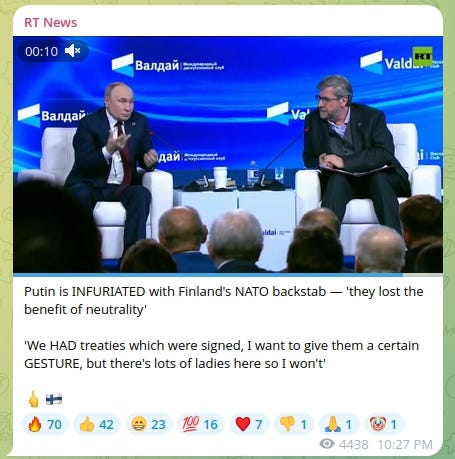
source: RT (https://t.me/rtnews/114292)

He was similarly displeased about Kiev receiving approval from Washington to use US missiles, manned by US specialists, to attack Russia from Ukrainian territory. Such attacks would be perceived by Moscow as “a new stage of escalation” that would harm US-Russia relations.

“Would [US military specialists using long-range missiles deployed to Ukraine to strike targets deep inside Russia] pose damage to our relations, where we see light at the end of the tunnel? Of course,” Putin said.
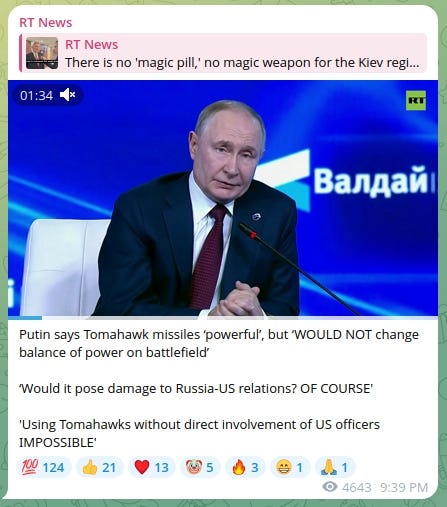
Source: RT (https://t.me/rtnews/114280)

Who could have imagined that Putin would be making such statements more than three and a half years after announcing the start of the SMO, promising historic consequences for anyone who intervened on the side of Ukraine? As it turns out, Russia’s prestigious Valdai Club—the same international forum that Putin spoke at yesterday—predicted this exact scenario.

In an article published in November 2021, three months before the launch of the SMO, Ivan Timofeev, program director for the Valdai Club, explored the probable outcomes of Russian military intervention in Ukraine.
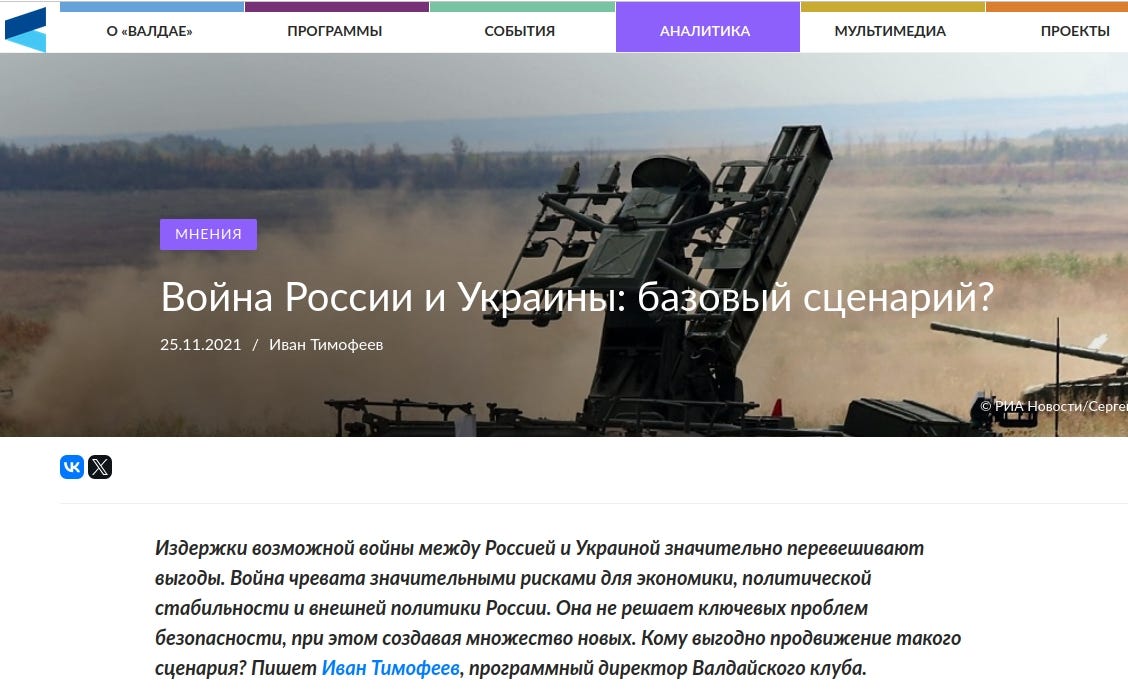
Source: valdaiclub.com

Timofeev imagined a scenario in which Russian forces would strike Ukraine in several directions at once. With the help of uncontested air superiority, the Russian military would either encircle Ukrainian troops in the East, or force them to withdraw to Western Ukraine. Kiev would be declared the capital of a Russia-backed Ukraine, which would include the fully liberated Donbass:

The new state would be recognized by Russia … solving several historical problems at once. An immediate threat to the southwestern borders would be removed. Full control over the Sea of Azov and the land corridor to the Republic of Crimea would be ensured. Two Ukrainian states would appear on the map, one of which is “friendly and fraternal”.

A variation of this scenario involved taking full control of Ukraine, although Timofeev believed this would lead to a prolonged insurgency by Ukrainian nationalists.

Ultimately, Valdai’s program director concluded that military intervention in Ukraine would not resolve Moscow’s core security issues. Instead, a military operation aimed at deterring further NATO aggression would likely exacerbate preexisting problems:

Such a military conflict is unlikely to be ended by any clear agreement. Victory over the Ukrainian military will not lead to a quick peace. The war could develop into a long and sluggish confrontation, especially if part of the territory (for example, Western Ukraine) remains under the control of the Ukrainian military.

[T]he conflict will inevitably lead to a sharp change in the approach to providing Ukraine with modern models of weapons and military equipment. In the United States and in the West as a whole, the new situation will be considered an emergency, and all possible means will be used to equip the Ukrainian military. In this case, all possible conventional weapons will be supplied. Large-scale military aid of the West will drag out the conflict. […]

In other words, the costs of a possible war significantly outweigh the benefits … [A war] would not solve key security problems, while creating many new ones.

Unfortunately, Timofeev’s pessimistic assessment was far too optimistic.

Russia is not battling an insurgency in Lvov. After nearly four years of war, the Russian military is fighting for control of Pokrovsk, a town located in Donetsk Oblast. Assuming Pokrovsk is eventually taken, the Russian military will then have to turn its attention to Ukraine’s major strongholds in Donbass: Kramatorsk, Sloviansk, Druzhkivka, and Kostiantynivka. Then it will be necessary to capture Zaporozhye and Kherson, capitals of Russian regions currently occupied by the Ukrainian Armed Forces. Then there is Kharkov. Then ….

In other words, there’s considerable work to be done if Moscow hopes to achieve, at the bare minimum, the worst case scenario in Ukraine as outlined by the Valdai Club.


Moon of Alabama: Ukrainian Media About Gaps In The Frontline And Other Failures

Moon of Alabama, 10/8/25

The Ukrainian news-outlet Ukrainska Pravda has a new report about the state of the Ukrainian forces at the frontline. The Russian forces are winning the war bit by bit while the Ukrainian army is in constant retreat. The report is discussing several issues which prevent the Ukrainians from holding the line.

While most of UP’s pieces are published in Russian/Ukrainian and English this one has yet to receive a translation. Below   summaries and excerpts of it (edited machine translation):

The holes between the infantry positions are getting bigger and bigger.
What prevents the Ukrainian army from deterring the Russians
 – Ukrainska Pravda, Oct 6 2025

The most urgent need directly on the front line remains infantry. At the current stage of the war, when the work of heavy equipment is maximally complicated, the role of soldiers in the trenches increases significantly. When they are not enough, it is not easy to organize a defense.

Due to the lack of people, many units cannot hold their positions, fully repel Russian attacks, adequately rest and conduct the necessary rotation. As a result, field commanders are forced to choose priority areas, leaving other sectors less protected.

In consequence there is no longer a real frontline. The lack of infantry leads to gaps through which Russian forces can slip into the rear of the Ukrainian forces. Ukrainian mortar troops and drone pilots who are nominally stationed five kilometer behind the frontline suddenly find themselves in direct contact with enemy troops:

A consequence of the problem described above is that infantry positions are increasingly literally deserted. Therefore, the distance between neighboring positions can be 200-300 –, 500-700 –meters, and sometimes even a kilometer.

The formation of a huge number of holes between Ukrainian infantry positions and the penetration of these holes by the Russians deep into our defenses has formed another trend of the current stage of the war – the lack of a stable line of engagement.

Due to the lack of fighters on the first line, drone and mortar operators, who stand 3-5 kilometers from the front edge, are forced to become infantry.

In the worst cases, which UP is also aware of, the Russians even reach artillery positions. These are 10-15 kilometers from the contact line.

Over the last six month the Ukrainian army has changed its structure. Previously various brigades were attached to temporary operational commands (TUS,Tgrs) with each responsible for large parts of the frontline. The new model is based on a corp structure with several brigades assigned to a corp to serve under one permanent command. While the restructuring is officially finished most troops have yet to find their new home:

The key advantage of the transition of the Defense Forces to the corps system was called by supporters of the reform the emergence of stable management bodies. But this is exactly what has not happened so far, because there are still temporary TUS, Tgrs, etc. on the ground in one form or another.

Moreover, there are also questions about the transition to the implementation of tasks by corps exclusively in the designated areas of responsibility. In many sectors of the front, a full-fledged transition did not take place, while the General Staff already has plans to create even new structures, such as assault troops and troops of unmanned air defense systems as part of the air force.

In the context of a general shortage of personnel with the incomplete transition to the corps system, finding resources for new military formations will be quite problematic.

Despite having the just introduced a corp structure the newly created assault battalions were put under direct command of the Ukrainian commander-in-chief,  General Syrski.  Events in Ukraine recently took a look at those:

Undeterred by the total collapse of the Kursk operation in the spring of 2025,  Syrsky remains fixated on the need for new offensives.

Now, the head of the army has created his own personal guard, totally willing to implement all his orders – the assault forces. The western-funded nationalist press has attacked Syrsky’s new project as ‘catastrophic’, claiming that the units involved have taken massive losses in the urge to demonstrate their loyalty to the commander-in-chief.

For whatever reason, these highly critical articles on the assault forces from the likes of BBC Ukraine and texty.org haven’t been translated to English.

Today we’ll take a look at what exactly these new assault forces are. It turns out that they are largely composed of units commanded by the fascist ‘Right Sector’. Syrsky chose these units because they unflinchingly took part in his Kursk adventure – in contrast to other commanders, who criticized Syrsky’s folly and were sacked as a result. …

The best general the Russians have, as Syrski is called by his critics, is also accused of micromanaging the fight at the frontline (edited machine translation):

In June 2025, Ukrayinska Pravda was the first to write about how Commander-in-Chief Alexander Syrsky resorted to manual control of the front. Independently selects, and already removes, the corps commanders, decides which brigade and how much replenishment is being made, sets tasks for battalions, when they should be assigned by the brigade commander, and so on.

During these three months, the situation with the dependence of the front on the instructions of one person, according to the observations of Ukrayinska Pravda and the UP’s interlocutors in the Defense Forces, has only become more complicated.

At first, Syrsky began to regularly visit and “taxi” the actions of units on the Dobropolsky ledge, which is now being “cut off” by the defense forces. According to public references of the commander-in-chief himself, over the past 3.5 months, he went to meetings and meetings with local commanders as many as eight times.

The introduction of long range First-Person-View drones by Russia has cleared the typical rear of the frontline. Command and logistics had to move back further which makes their work more costly and ineffective:

Due to the activity of Russian aircraft and drones from about the end of spring – and early summer of this year, the support units of the Ukrainian army began to move away from the line-of-contact.

According to the decision of the Supreme Chief, all support units had to move 40-50 kilometers away from the contact line.

For logistics commanders, this decision means that with already limited resources – especially fuel-the logistics arm becomes longer and more complex.

I used to spend 40 liters and a couple of hours to get a few tons of fuel. Now – 300 liters and almost a day,” – shares with UP one of the commanders of support.

The UP authors are pessimistic about possible changes:

[T]he military command at various levels turns a blind eye to fairly obvious problems within the Ukrainian army, and the presidential office, without which no solution in this country is complete, does not risk its ratings [..]

Meanwhile, the gaps between the infantry positions are getting bigger.

Ukraine Promotes Neo-Nazi to Brigadier General

By Kyle Anzalone, Libertarian Institute, 10/2/25

Ukrainian President Volodymyr Zelensky promoted Colonel Andriy Biletsky to the rank of Brigadier General. Biletsky has said the purpose of the Ukrainian right is to fight the “Semitic-led untermenschen [subhumans].”

“To confer the military rank of brigadier general on Colonel Andriy Yevhenovych Biletsky, commander of the 3rd Army Corps of the ‘East’ Operational Command of the Ground Forces of the Armed Forces of Ukraine,” the presidential decree signed Wednesday said

Biletsky is the commander of the Third Separate Assault Brigade and the founder of the Azov regiment. He is an outright white supremacist. “Ukrainians are part (and one of the largest and highest quality) of the European White Race. Ras-Creator of great civilization, the highest human achievements. The historical mission of our Nation, in this turning point, to lead and lead the White peoples of the whole world into the last crusade for its existence against the Semitic-led untermenschen,” he said in a 2007 speech

The Third Separate Assadly Brigade webpage says it maintains “the same principles on which the legendary ‘Azov’ and the entire Azov movement are based. The foundation worldview principles of the Azovian units are Ukrainian-centrism, traditionalism, hierarchy and responsibility.”

Additionally, Zelensky awarded the Hero of Ukraine posthumously to Andriy Parubiy. Parubiy was assassinated in August. In 1991, he founded the Social-National Party of Ukraine that used the Nazi Wolfsangel as its logo. 

Neo-Nazis, like Biletsky and Parubiy, gained power in Ukraine following the US-backed coup in 2014. Following the ouster of President Viktor Yanukovych, Parubiy rose to the position of speaker of the Parliament, and Biletsky founded the Azov Battalion.

Debunking the Myth of Russia’s 3 Day Victory in Ukraine

Russia Truth, 10/1/25

The idea that Russia would defeat Ukraine in only three days—the so-called “three-day SMO”—has become a pervasive meme associated with the war. It’s a widespread misconception, but its origin is not in an official Russian statement.

To understand where this notion came from, we can look back to 2014, when an article reported Vladimir Putin boasting he could take Kyiv in two weeks. Considering the poor state of the Ukrainian army then, with mass defections in Crimea and struggles against separatist militias, this claim was perhaps plausible at the time.

The Russian Media and Cyber War Angle

The story picked up again in April 2021 when RT’s editor-in-chief, Margarita Simonyan, stated in an interview that Russia would defeat Ukraine in two days in the event of a “hot war.” Crucially, she said this in the context of a cyber war that would target infrastructure, causing city blackouts and cutting gas supplies, not a conventional ground war. She even expressed skepticism about a conventional war being possible in the modern world.

Western Intelligence and Historical Precedents

When the February 2022 invasion began, many Western officials genuinely expected a swift conclusion. This expectation was informed by the quickness of previous Russian actions, such as the annexation of Crimea in 2014 and the 2008 invasion of Georgia, where the bulk of the fighting lasted only about five days.

The Royal United Services Institute (RUSI) Report

A specific source for the “72 hours” claim appears on the Ukrainian version of the Wikipedia page for the Battle of Kyiv. It cited the Royal United Services Institute (RUSI), which allegedly stated that Russian forces intended to capture and blockade Kyiv within 72 hours. Notably, this refers to blockading Kyiv, not invading the entire country.

However, a closer look at the RUSI report, “Preliminary Lessons in Conventional War Fighting from Russia’s invasion of Ukraine February to July 2022,” presents a different timeline, stating that Russia planned to invade Ukraine over a 10-day period and occupy the country to enable annexation by August 2022. The report based much of its information on captured Russian documents, but stated the underlying source material could not be made public, which raises a significant red flag. Furthermore, those alleged documents from the 810th Russian Naval Infantry Brigade reportedly gave a 15-day timeline for seizing objectives like Melitopol, which was actually captured faster than that supposed expectation. Nowhere in these documents is a 72-hour national takeover mentioned.

The True Origin: US Officials

The reality is that the myth primarily originated from US sources. As Russia’s military buildup became undeniable in early 2022, on February 5, 2022, Fox News reported on a closed-door briefing where General Mark Milley, then Chairman of the Joint Chiefs of Staff, allegedly told US lawmakers that a full-scale Russian invasion could result in the fall of Kyiv within 72 hours. He also predicted substantial casualties. Even Belarusian President Alexander Lukashenko repeated a similar three-to-four-day timeframe for an entire war.

On the day of the invasion, February 24, 2022, Newsweek cited three US officials who expected Kyiv to fall within 96 hours and the Ukrainian leadership to follow in about a week. This is where the myth of the “3-day SMO” was born.

Newsweek itself later admitted that the story provided “ammunition for a decisively misleading meme” and that virtually no prominent Kremlin pundits were predicting the three-day fall. Reddit users have also admitted that the story was a simplification used to ridicule the expectation of a swift Russian victory. While Russia’s high command was almost certainly expecting a rapid victory to force negotiations and concessions, the specific three-day claim was not a Russian one; it was a foreign one that has been widely popularized as a meme.