Uriel Araujo: Nuclear Poland? Between proxy and atomic power

By Uriel Araujo, InfoBrics, 9/26/25

Uriel Araujo is an Anthropology PhD, a social scientist specializing in ethnic and religious conflicts, with extensive research on geopolitical dynamics and cultural interactions.

Polish President Karol Nawrocki has recently stated on French channel LCI that “Poland should be part of the nuclear sharing program, it should have its own nuclear capabilities: energy and military”, as part of “Polish-French partnership.” Nawrocki added that, in the future, Warsaw could be “developing Poland’s own nukes” .

This rather underreported call for NATO’s nuclear-sharing program aligns, in a way, with US assurances to Poland and Estonia for bolstered Baltic defenses. Moreover, this development in fact signals a pivotal shift: Warsaw is no longer content with conventional arms but eyes atomic capabilities as a security cornerstone.

Back in June 2023 then Prime Minister Mateusz Morawiecki was already expressing Warsaw’s interest in hosting NATO’s nuclear weapons under the Alliance’s nuclear sharing policy. And one may recall that early 2025 set the stage for today, with then-President Andrzej Duda urging US nuclear warheads on Polish soil to shift NATO eastward, while Prime Minister Donald Tusk told parliament Warsaw must “reach for opportunities related to nuclear weapons” in a “race for security.”

Amid doubts over transatlantic “friendship” in face of Donald Trump’s presidency in Washington, these statements reveal to what extent Poland seeks a deeper geopolitical play.

For years, Warsaw has chafed under Germany’s shadow, the EU’s economic heavyweight. As a matter of fact, tensions have flared into rivalry, as I’ve written, revealing cracks in Western unity. In 2023, Poland blocked Ukrainian grain imports, undercutting Berlin’s softer stance on Kyiv, while pouring billions into a military buildup to outpace Germany’s spending.

Warsaw’s accusations of German “hypocrisy” on energy and migration cemented its role as Europe’s anti-Russian bulwark. Poland’s elite thus sees nuclear options as a path to autonomy, thereby sidelining Berlin’s influence.

The US, ever the puppeteer, has fueled these ambitions quite skillfully, grooming Poland as a proxy to shoulder containment burdens. This allows Washington to pivot toward Asia (or toward a neo-Monroeist “America First” or what not) while Warsaw plays frontline enforcer. A nuclearized Poland would fit this script, be it through NATO’s sharing program or French deterrent talks.

Suffice to say, such moves skirt the Non-Proliferation Treaty’s spirit but align with America’s selective hypocrisy, as seen time and time again, with Pakistan’s arsenal and elsewhere.

The implications ripple beyond Warsaw. A nuclear-armed Poland would turbocharge its leadership bid, potentially tightening ties with Ukraine. One may recall 2022’s talks of a Ukrainian-Polish confederation amid anti-Russian fervor, a topic on which I also commented at the time.

By 2024, strains had emerged — for one thing, Polish farmers blockaded borders over Ukrainian grain, and far-right voices demanded repatriating draft-age Ukrainians, amid joint calls to end Ukrainian refugee benefits. Yet, 2024 security pacts allow for Poland to intercept Russian missiles and drones over Ukraine, albeit conditionally.

Underreported is how nuclear ambitions could revive such confederation ideas, with Poland eyeing a “Three Seas” bloc to counter Russia (and Germany, by the way), thus enhancing the spectre of EU fractures. The 3SI Warsaw summit has been seen by many as a potential platform to integrate nuclear energy projects, such as small modular reactors, and security pacts, reviving bloc ambitions under the guise of “united Europe” against Moscow.

From a Russian perspective, a nuclear Poland would be an existential red line, akin to Ukraine’s NATO bid. Russia sees Poland as a revanchist threat, with Warsaw’s 2023 moves in Ukraine’s west fueling encirclement concerns.

Polish facilities in such nuclear scenarios could thus be a major source of tension, to put it lightly. Poland’s elite calls this deterrence, but Russia’s arsenal dwarfs NATO’s European holdings, and any “win” invites mutual destruction at best.It is worth noting Moscow already lowered its nuclear threshold, in late 2024.

America’s drive to offload Ukraine’s “burden” onto Europe amplifies these dangers. Even as Trump now claims Ukraine could “regain” disputed territories, the fine print shows European taxpayers footing the arms bill, as I’ve recently noted. Meanwhile, Poland’s RARS agency is under EU scrutiny for 2024’s overpriced procurement.

At this point, Washington’s $283 billion in Kyiv aid arguably pales against EU commitments, yet Trump demands Europe pay more, echoing past “freeloader” gripes. So much for burden-sharing; Poland, the eager proxy, absorbs costs and risks. Tusk’s call for a 500,000-strong army and nuclear options, with only 10,000 US troops as a symbolic shield, lays it bare.

Today, Trump’s backing of Poland (and Estonia, by the way) is classic leverage to “bully” adversaries, using “allies” to prod Moscow — a hallmark of his brinkmanship, so to speak.

Provocative enough to thrill hawks, this courts disaster in many ways, a region primed for escalation. Poland’s nuclear path is no defensive reflex but a bid for great-power revival, egged on by a US keen to “delegate”. The allure — deterrence, German rivalry checked, Ukraine’s orbit tightened — is clear, from a Polish perspective.

Yet the perils — alliance cracks, and fiscal strain; not to mention “cornering” Moscow — make it a dangerous enough gamble. And History rarely forgives such bets. Poland’s “race for security” risks in fact the very war it supposedly aims to avert.
PATRICK LAWRENCE: A Nation of Narcissists

By Patrick Lawrence, Consortium News, 9/9/25

All those malign authoritarians, more than 20 of them, who gathered in Tianjin at the end of August for a summit of the Shanghai Cooperation Organization: This was a festival of anti–Americanism, you need to know.

No other way to understand it. Making it all worse, Xi Jinping then invited more than two dozen heads of state to Beijing to mark the 80th anniversary of the 1945 victory.

How dare the Chinese president organize an elaborate military parade to celebrate China’s role in the historical defeat of the Imperial Japanese Army. How dare he stir pride in the People’s Republic’s determination to defend its sovereignty while refuting the revisionism — nonsensical but prevalent — that airbrushes the Chinese Communist Party out of the Second World War’s history.

The temerity of this man to suggest it was other than the Americans and their corrupt clients, the Chinese Nationalists, who did the fighting and won the war. Let us not, for heaven’s sake, make any mention of the 12 million to 20 million Chinese — there is no precise figure — who died in consequence of Imperial Japan’s aggressions.

No, nothing to honor in any of this. Between the S.C.O. and the festivities in Beijing it was all faintly demonic, a thinly veiled challenge to what the United States and the rest of the West insists is a “rules-based order.”

I keep a file labeled “Sentences to love in The New York Times.” From it: “It shows how Mr. Xi is trying to turn history, diplomacy and military might into tools for reshaping a global order that has been dominated by the United States.”

The mainstream reporting on the S.C.O. and the subsequent gathering in Beijing went on obsessively for days. You would think the Chinese were on the brink of starting another Pacific War and “invading” Taiwan—“invading” in quotation marks because a nation cannot invade territory that historically belongs to it.

As I read through the coverage I marveled at the wall-to-wall West-centricity of it. The Chinese, the Russians, the Indians, various others, even the North Koreans: They think of nothing and do nothing that does not arise from their all-consuming animosity toward the United States and altogether the West. So you read in the reporting of these events.

Then along came Donald Trump, who addressed Xi on his Truth Social platform with this, referencing the Russian and North Korean leaders as he watched the proceedings live: “Please give my warmest regards to Vladimir Putin and Kim Jong Un as you conspire against the United States of America.”

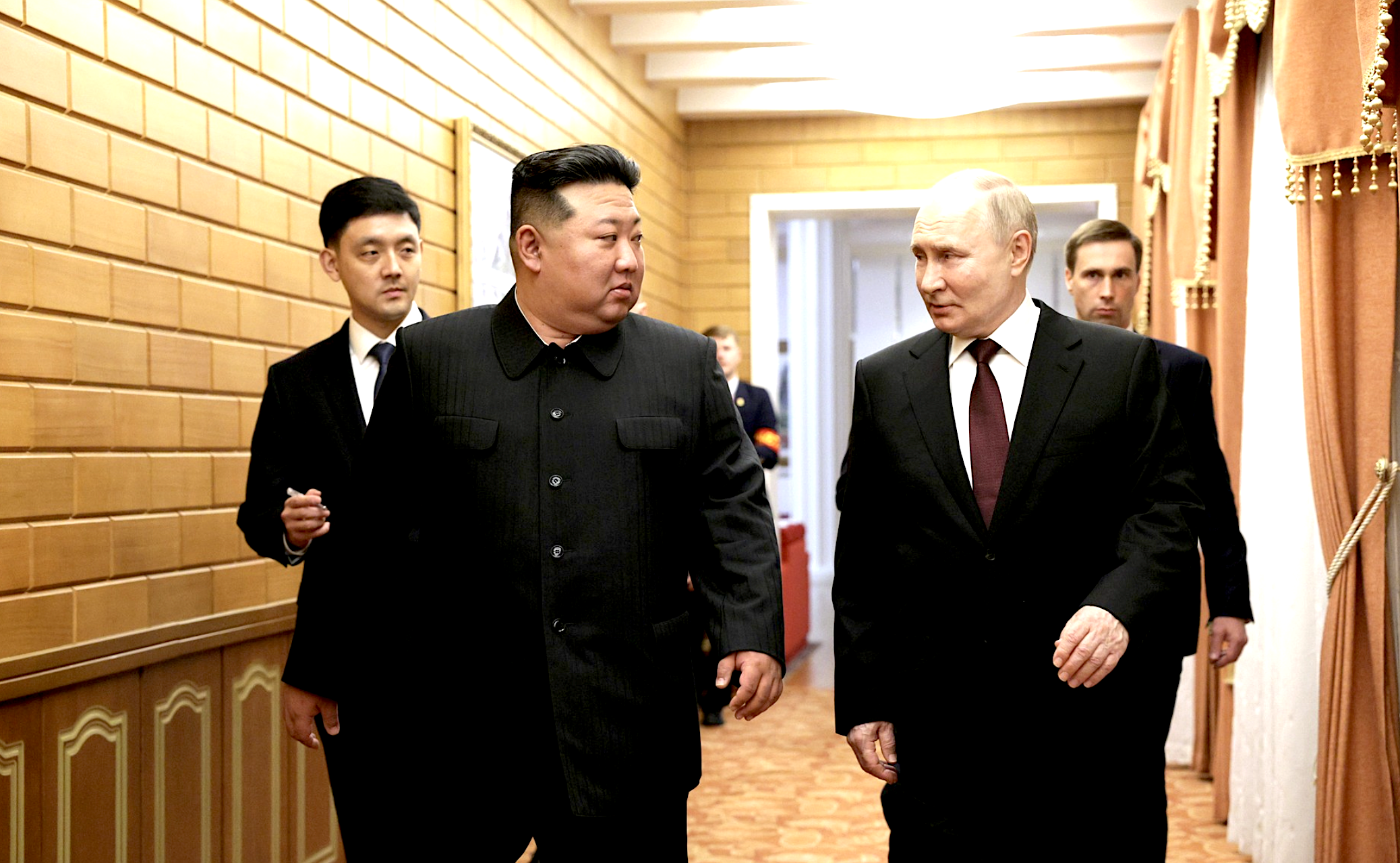
North Korean leader Kim Jong-un and Russian President Vladimir Putin in Pyongyang on June 18, 2024. (President of Russia)

There is no beating the Trumpster when it comes to stating the case forthrightly. The mainstream press can strike the pose of objectivity all it likes, but Trump, the id of the late-phase imperium, comes right out and says it: The non–West is against us. Anti–American animosity is its sole motivation, its very raison d’être.

I write here not of our dissolute press, whose mission these past two dozen years — I take the events of September 11, 2001, as the point of departure — has been to prevent Americans from seeing and understanding the 21st century’s realities. Neither is the blunt instrument now lodged in the White House my topic.

No, the press and the president are merely exhibits, symptoms of a national failing that transcends either of these. This is the problem of America’s self-absorption, the pervasive narcissism that, it now becomes evident, is a primary cause of our troubled republic’s increasingly hostile relations with others and, so, its swift descent into isolation.

In Ovid’s Metamorphosis, Narcissus is a youth of transcendent beauty who spurns Echo, the nymph who loves him, and becomes infatuated with his own reflection in a pool of water. He thereafter takes to rejecting all admirers.

Narcissus is thus blind, but not only to others: He is also blind to himself. This fulfills the prophecy Tiresias made on his, Narcissus’s, birth: He will live long, the mythical seer said, “so long as he never knows himself.”

The Newest Narcissus; or, The Hero of our days, a cartoon by Edward Linley Sambourne, Punch, or the London Charivari, April, 1892. (Project Gutenburg, Public Domain)

Narcissism is the open-and-shut condition of the elites who fashion and execute American foreign policy. They see only themselves when they look abroad at others. And they are utterly incapable of seeing themselves as they are or their country as it is.

It is dangerous to be America’s enemy, Henry Kissinger once remarked in an often-quoted comment, but it is fatal to be America’s friend. This is the United States as run by the narcissistic cliques who set the imperium’s course. Nothing and no one matters beyond their own power.

I think too much of Americans to assign this condition to them out of hand. No, it is the media’s task to impose this condition on Americans. Consider again how the press covered Tianjin and Beijing: We are encouraged in every sentence to see our reflections in those events, for they were all about us.

Read a few of these pieces carefully, I urge. You find correspondents in this or that bureau abroad who rarely quote Chinese or Russian or even European sources in support of the reporting. No, they call reliably conformist scholars or think tank denizens back in the States to tell them how to think about what is going on in China or Russia or wherever it may be.

See what I mean? Journalism this flaccid is a new one on me. If it is not American narcissism as it is in practice I do not know what else to call it. 

Did you read anything in the American press about Xi’s proposal for a “Global Governance Initiative” to assist in the pursuit of a more just and equitable world order?

What about the Chinese leader’s announcement in Tianjin of a new S.C.O. development bank, grants of 2 billion renminbi, $280 million, to S.C.O. members, and an additional 10 billion renminbi, $1.4 billion, in loans?

Or his speech calling for the historical record of the Pacific War — corrupted precisely as the West cravenly erases the Soviet Union’s decisive role in defeating the Reich — to be corrected?

Let me help you out. No, no, and no. The policy cliques are indifferent to these things and you are meant not to see them, blindness to our world the preferred condition. The policy people in Washington have been captivated by their own reflections ever since they set out to achieve global dominance almost immediately after the 1945 victories.

And so long as American power was hegemonic this did not matter. Diplomacy, as Boutros Boutros–Ghali memorably remarked after the United States forced him as out as the U.N.’s sec-gen, is for the weaker nations; the strong have no need of it.

There is need of it now, to state the obvious. And we find America to be self-blinded, stumbling, uncomprehending, and altogether incapable in this, a century of swift and momentous change.

Washington’s prevalent narcissism renders proper statecraft more or less impossible, as there has been, just as Boutros–Ghali astutely observed, no need of it for most of the past eight decades. And we cannot put this down to Donald Trump alone: This has been less obviously but just as true of the administrations that preceded his.

“[W]e find America to be self-blinded, stumbling, uncomprehending, and altogether incapable in this, a century of swift and momentous change.”

At this point the late-phase imperium is more or less entirely dependent on force as its mode of expression in the community of nations.

Parenthetically, this is how I read the Trump regime’s stunning decision to rename the Defense Department the War Department, just as it was called until 1949, when it was judged necessary to veil the arriving era of America’s imperial aggressions.

Military force, increasingly vicious varieties of coercion, sanctions that amount to collective punishment, in the case of Palestinians the refusal of visas: It is all Washington can think of doing as it responds so defensibly to the 21st century. It will, of course, lead nowhere but to further isolation and decline.

At a press conference in Beijing last Tuesday, as the days of diplomacy and celebration drew to a close, a correspondent asked Vladimir Putin what he thought of Trump’s “Say hello as they conspire against us” remark on Truth Social. The Russian president’s reply was a model of statesmanship and clear thinking:

“The president of the United States is not devoid of humor —  everything is clear, everyone knows it well….

I can tell you, and I hope he will hear it as well: It may seem strange, but during these four days of negotiations, both informal and formal, no one has ever expressed any negative opinions about the current American administration…. 

The activities of the SCO and those of our partners, including our strategic partners, are not aimed at fighting anyone, but rather at finding the best ways to develop ourselves, our countries, our peoples, and our economies.” 

It is a point that cannot be made too often, so commonly is it missed. The emergence of the non–West as a bloc of nations has not a shred of anti–Americanism in it. These nations would indeed welcome the United States, with its capital, its technologies, and so on, to participate fulsomely in building the new world order to which they are dedicated.

Only hegemons are unwelcome in this decidedly ecumenical undertaking. Only narcissists. Whether or not America can at last stop staring at its own reflection to see the world around it will determine its fate in our evolving century.

Patrick Lawrence, a correspondent abroad for many years, chiefly for the International Herald Tribune, is a columnist, essayist, lecturer and author, most recently of Journalists and Their Shadows, available from Clarity Press or via Amazon.  Other books include Time No Longer: Americans After the American Century. His Twitter account, @thefloutist, has been restored after years of being permanently censored.

Izvestia: EU split grows over proposal to fund Ukrainian ‘reparations loan’ with frozen Russian assets

TASS, 10/2/25

The division within the European Union is intensifying over a new initiative to establish a reparations loan for Ukraine backed by Russian holdings. German Chancellor Friedrich Merz has urged Brussels to abandon excessive bureaucracy, while French President Emmanuel Macron and Belgian Prime Minister Bart De Wever warn of breaches of international law. Yet, only days earlier, France and Germany, within the framework of the Weimar Triangle, had voiced support for the idea of employing Russian assets. Attempts to seize Russian property will trigger a painful mirror response, the Russian Foreign Ministry told Izvestia.

“Whichever option Brussels ultimately chooses, manipulating frozen sovereign assets without Russia’s consent constitutes a gross violation not only of international law, but also of contractual law. Russia has not authorized any such operations. Actions that involve altering the legal status of Russian assets will no longer mean a freeze, but rather the unauthorized management of foreign property – in other words, essentially theft,” the Russian Foreign Ministry told Izvestia.

“The overwhelming majority of experts argue that the risks of outright confiscation for the dollar and euro systems are far greater than the potential benefits from employing these funds – primarily because of the precedent it would set and the erosion of trust in the financial jurisdiction of Western countries,” Senior Research Fellow at the Institute for International Studies of MGIMO, Russian Ministry of Foreign Affairs, Egor Sergeyev told Izvestia.

“In the short term, no consensus on this matter can be reached, if only because none exists even within the European Union. And in the United States, even under the Biden administration, it has been concluded that from a legal standpoint, this scheme is extremely precarious,” a leading expert at the Russian Institute for Strategic Studies Pavel Zakharov told the newspaper.

According to Vladimir Vasiliev, Chief Research Fellow at the Institute for the US and Canadian Studies, Washington is unlikely to risk its reputation over $5 bln, but may well push Europe in that direction – in which case European capital will begin to flow into the United States.

“The initiators and participants of expropriation measures are guaranteed to face consequences. Moreover, in accordance with the principle of reciprocity, attempts to seize Russian property will provoke a painful retaliatory response. Russia has at its disposal a sufficient arsenal of countermeasures and the ability to deliver an appropriate political and economic answer,” the Russian Foreign Ministry told Izvestia.

First, the measures could be legal in nature, since what is at stake is a violation of international law. Second, the response could be purely economic. Moscow has already developed a system of specific steps, such as temporary management of the property of companies from unfriendly states, or the transfer of such assets to state ownership or to the Central Bank as compensation for any seizures, the newspaper writes.

***

Russia Drafts Plan to Seize Assets If EU Acts on Funds (Excerpt)

Bloomberg, 10/2/25

Russia may nationalize and swiftly sell off foreign-owned assets under a new privatization mechanism in retaliation for any European moves to seize Russian holdings abroad, according to a person close to the government.

President Vladimir Putin on Tuesday signed an order allowing for fast-track sales of state-owned assets under a special procedure.

The decree is intended to speed up the sale of various companies, both Russian and foreign, the person familiar with the matter said, asking not to be identified because the information isn’t public. Should the European Union begin seizing Russian assets, Moscow may respond with symmetrical measures, the person said.

Hundreds of western companies working in sectors from banking to consumer goods still operate in Russia, including UniCredit SpA, Raiffeisen Bank International AG, PepsiCo Inc, and Mondelez International Inc.

Putin acted as EU leaders meeting in Denmark build momentum for a plan to provide Ukraine with €140 billion ($164 billion) in loans from immobilized Russian central bank assets, ahead of a formal summit at the end of this month….

***

Belgium Pours Cold Water on EU Plan to Use Russian Frozen Assets (Excerpt)

Bloomberg, 10/2/25

The European Union’s bid to unlock funding for Ukraine from frozen Russian central bank assets faced resistance as Belgium raised legal questions about the plan to raise financing from up to €185 billion ($217 billion) held on its territory.

Belgian Prime Minister Bart de Wever called the EU proposal to tap interest from the Russian assets a “big gamble” that required ironclad risk-sharing among EU member states. He signaled that the process would be time consuming, suggesting the bloc seek alternative financing for Kyiv.

“Every country will have to guarantee proportionally in the case that this goes wrong,” De Wever told reporters Thursday on the margins of a European Political Community summit in Copenhagen. The EU asset plan entails “huge amounts of money,” requiring guarantees for “a very long time,” he said.

EU leaders who gathered for a meeting Wednesday in the Danish capital offered a more upbeat assessment, saying that the bid to raise billions for war-battered Ukraine is gathering momentum and concerns would be allayed. European Commission President Ursula von der Leyen assured that the risks tied to the plan would land on “broader shoulders.”…

Joe Blank: My Whole Thing with Ukraine

By Joe Blank, Buy Me a Coffee, 9/13/25

As some of you who know me through social media might be aware, I have spent the past 3 1/2 years of the Ukraine war as someone who is extremely against the idea that America (or anyone, for that matter) support Ukraine in the current conflict with Russia. It’s a bit of a story, but I rarely get asked why I feel this way. Rather, most simply prefer to jump to the conclusion I’m MAGA or a Russian agent. I am neither. I’m an American, a Southerner, of Scots/Irish ancestry. I’m politically unaligned, as I value some ideas both traditionally held by the “left” AND the “right”. Heck, prior to 2022, the only Russians I spoke to were a nice married couple I used to work with and a fellow artist I met on Instagram. Definitely not on the Kremlin payroll.

No, I’m just – for this purpose, at least – your average American Joe.

And yet, I find myself coming to a point where I have the names of Azov commanders memorized. Stephan Bandera quotes. Specific amounts of aid provided and the dates the bills were passed by Congress. It’s a bit much. Until the other day, I really had been plunging back into history trying to remember HOW I became so invested in the subject in the first place. And then it hit me.

RT America. Russian news.

Now, before you jump the gun and use this as a “Gotcha, Putin puppet!”, do allow me to explain.

You see, I have always been someone who has deeply cared about our First Amendment rights. In 2013, if you’ll remember, there was a little bit of drama with a guy named Edward Snowden, who released information that I found deeply disturbing to say the least. Not necessarily surprising, but that didn’t matter. The basic premise was out. Your government watches you, sometimes for no specific reason.

It was at this point in my life I think I truly began to appreciate the information sphere that we live in as Americans, honestly. As far as the only two cable television news stations I had access to at the time, only Al-Jazeera and RT News were the ones reporting up-to-date information about his currently known location. They were the only ones actually highlighting the information Snowden had helped bring to light. It really taught me that, when looking for information critical of what your own government is doing, you have to look outside that bubble.

I continued to watch RT then, probably for the next year regularly. So when the Maidan began, initially, I got the Russian perspective. Did that color my initial impression of the Ukrainian state? Not really. Just as I understood that American media isn’t exactly putting out 100% of the story, I assumed the same with Russia and Ukraine. Cynic that I am. But by that time I had already developed a crush on Abby Martin so I kept RT going in the background while i did other things and it was by no means my exclusive venue for news. I have no complaints about it at all as a news organization, personally, but want to emphasize simply that it was one source of many I used to form an opinion.

At that time, too, I was lucky enough to be in a career where – as long as you could multitask on dual monitors and keep off NSFW sites – you could entertain yourself however you pleased. I was a trained researcher in my field. Learning about politics, propaganda, and general skullduggery by “the man” has always been a hobby. Put the two together, I began really looking into the country and the rhetoric coming out of the Obama administration in the aftermath. The “Red Line”, as it were. Why were we so involved and what purpose did it serve America to get involved in, what up until that point, I had considered a civil war in Ukraine?

At that point, I’d already seen the Obama administration doing horrific things abroad and at home. I had been in the brokerage industry during the bailouts and saw the American middle class gutted. And, as I said, was aghast at the privacy and free speech concerns raised by the Snowden leaks. Crimea came and went, thankfully, without escalating to a full blown war between nuclear superpowers. But still, what was driving this?

So, whenever I would come across some news item from Ukraine (wasn’t exactly as if I gave it that much attention) I’d look into it. I wanted to know whose story was more true – the Russian or the American version. And those, I would say, are my formative years becoming the would-be armchair advocate for not supporting this state.

You see, when Biden first admitted that he was withholding a billion dollar grant to Ukraine unless they fired a certain prosecutor, I found that curious as well. Why would our government be dictating who they’d appoint to a specific job like that? Why are we even giving them a billion dollars? It wasn’t hard at the time to verify that Ukraine had, since it left the USSR, been a notoriously underdeveloped and corrupt country. By this time as well, it wasn’t hard to find plenty of Western-sourced articles which would confirm this, among other nasty facts about the country. Azov, ethnic nationalism, and the glorification of WW2 German collaborators. A history of human trafficking. Cheap sex tourism. And for some reason the Vice President, whose unqualified son is working on the board of a Ukrainian energy company, is just handing over that kind of cash, with caveats.

Just seemed all a bit….odd….

There was probably a lull, I’d say, after Trump had his issues with Ukraine, that I really stopped paying attention. Whether Russia had invaded with “little green men” as they’re accused of, or not – it was just the Ukraine. Not exactly a big deal at that point. Sure, we’d thrown them a few weapons – but ultimately it was up to Ukraine and Russia to be sorted out. There were no overt signals from the American government that it would escalate this war further than it need be, and that was enough for me.

Well, that didn’t last long, did it? Biden was elected and, within a year, Russia’s “Special Military Operation” began. If you think America providing Ukraine a billion dollars of our taxpayer’s money in 2016 (when Americans were obviously already struggling and our social safety net was virtually nonexistent) then imagine my utter disgust when the first $13b was passed in Congress, or the $40.1b package passed a couple months later. Couldn’t this money, suddenly found for Ukraine, be used for a better purpose at home?

That’s a question that bothers me, and if you’re any kind of an American, should bother you. We live in a nation with an estimated one million homeless (which I believe is still a lowball number). and have spent over $200 billion combined between federal funding packages and loans financed through the IMF and World Bank (minimum, as no one seems to really know the exact figure). Simple math tells you that COULD have been $200 [billion] put toward housing and mental care, resources for our entire homeless population – every man, woman and child. Why is Ukraine worth that, but the needs of the American people – the least of us – are ignored?

And I think, what has this really gotten us, as a country? Certainly not like every move made should be dependent upon our profiting from a situation, necessarily, but since the war began. it’s done nothing but antagonize other world powers, cost us money, and uprooted any sense of American hegemony left. You look at anything in America today versus 2021, a year prior to the war. Rent costs more. Food costs more. Gas. Electricity. Why should we be consumed with what’s happening in a distant Eastern European former Soviet country that has no substantial cultural ties with us, we have no long-lived allegiance with, nor any major strategic interest in?

I think some things are fairly obvious. Given that the Nordstream pipeline, the pipeline from Russia that fed Slovakia and Poland has been destroyed, and the fact the news was released today that Trump will only increase sanctions on Russia if Europe foregoes all Russian oil and only purchases from America or our approved list of partner states, that this has been a war specifically to increase our gas exports and maintain leverage over Europe. Right now, Trump is making overtures to Russia that our relations could be normalized, potentially playing both sides to his advantage. Either way, our sales to Europe have drastically increased since 2022 and most European nations have spent the past 3 1/2 years doing nothing but threatening and sanctioning Russia. They aren’t likely to return to their supply quickly if the war were to end tomorrow, would they?

But, this is Trump. Whichever way he thinks the wind is blowing at any particular moment – whatever his Mar-a-Lago guests are telling him – it’s a question up in the air. It continues to vex the EU, NATO, Ukraine, everyone involved, because it could go one way or another.

Also, it almost goes without saying, this was used as an upwards transfer of wealth to the weapons manufacturers. Some will use the tired old line of “but it benefits American industry” which no, no it really doesn’t. Not as a whole. Just that one facet of it, and largely the people that receive the most benefit are the already-wealthy shareholders. I argue, wouldn’t it have been more beneficial to Americans and our economy to pay John Deere or an American farm equipment company to provide tractors and the like to struggling American farmers instead of buying tanks and sending them to Ukraine. So much we could’ve done. But, unfortunately, ever since – well – forever – the beast of American defense contractors must be fed. It’s been that way all my life, really, especially since 9/11. They pay our politicians of both parties through lobbyists and campaign contributions, and they expect their back scratched in return.

So that’s my story. That’s how I came to hold the position that I do. Roughly. I could regale you with so many tales of corruption, theft, moral depravity, and the absence of ethics when it comes to this subject, but I am going to [stop] here. I just want to leave you with the understanding of why I am against further aid as a solution to this conflict. Why I feel allowing Russia and Ukraine to sort their own problems out is the most beneficial thing we could do, as Americans and indeed as human beings.

Thanks for reading. If for some crazy reason you enjoy what I write, I do appreciate any tips that you might drop my way. Please do check out my art in the gallery here as well, and feel free to follow or reach out to me on Twitter at @therevjoeblank.

Reuters: US Tomahawk missile shipments to Ukraine unlikely, sources say

By Mike Stone, Reuters, 10/2/25

WASHINGTON, Oct 2 (Reuters) – The Trump Administration’s desire to send long-range Tomahawk missiles to Ukraine may not be viable because current inventories are committed to the U.S. Navy and other uses, a U.S. official and three sources said.

U.S. Vice President JD Vance said on Sunday that Washington was considering a Ukrainian request to obtain long-range Tomahawks that could create havoc deep into Russia, including Moscow. On Wednesday, Reuters reported, the U.S. will provide Ukraine with intelligence on long-range energy infrastructure targets in Russia.

But a U.S. official and sources familiar with Tomahawk missile training and supplies questioned the feasibility of providing the cruise missiles, which have a range of 2,500 kilometers (1,550 miles).

The U.S. official stressed there was no shortage of the workhorse weapon, which is often used by the military for land attack missions, suggesting other shorter-distance options could be supplied to Kyiv.

The official said the U.S. may look into allowing European allies to buy other long-range weapons and supply them to Ukraine, but Tomahawks were unlikely.

SHIFT IN STANCE BY TRUMP

A Tomahawk Land Attack Missile (TLAM) is launched from the guided missile cruiser USS Cape St. Georg..

In recent weeks, U.S. President Donald Trump has sharply shifted how he talks about the war in Ukraine, suggesting Kyiv could retake all the land Russia has seized and calling the Russian military a “paper tiger.” The U.S. decision to help Ukraine target Russian energy infrastructure appears to be one tangible outcome of the new stance.

A new financial mechanism, the Prioritized Ukraine Requirements List (PURL), has been developed by the U.S. and allies to supply Ukraine with new weapons and those from U.S. stocks using funds from NATO countries.

Supplying Tomahawk missiles to Ukraine could significantly expand its strike capabilities, enabling it to hit targets deep inside Russian territory, including military bases, logistics hubs, airfields and command centers that are currently beyond reach.

The Kremlin said on Thursday that if the U.S. provides Tomahawks to Ukraine, it would trigger a new round of dangerous escalation between Russia and the West.

According to Pentagon budget documents, the U.S. Navy, the primary user of the Tomahawk, has thus far purchased 8,959 at an average price of $1.3 million each.

The Tomahawk missile has been in production since the mid-1980s. In recent years, production has ranged from 55 to 90 per year. According to Pentagon budget data, the U.S. plans to buy 57 missiles in 2026.

Russia said on Monday that its military was analyzing whether or not the United States would supply Tomahawk cruise missiles to Ukraine for strikes deep into its territory.