By Sylvia Demarest, Substack, 9/21/25
Introduction: A Short History of Western Colonialism, including in the Middle East
The discovery of the Americas in 1492 ignited what has been called “The Age of Discovery” and the creation of colonial empires across the world. Almost every European country established colonies in the Americas, Africa, and East Asia. These colonies were used to supply resources, raw materials and markets for home-based production. This resulted in the extraction of enormous wealth which flowed back to Europe. Many books have been written about this blood-soaked period of human history.
The most significant colonial empire was the British Empire. Britian used its navy to “rule the waves” for 275 years while small groups of British nationals controlled enormous populations in East Asia and elsewhere. The East Asia Company, at its peak, controlled 50% of global trade and was said to be worth $7 trillion in today’s dollars. How did the Brits manage this empire? By using both violence and strategies that kept the subject population too divided to organize effective opposition. What we call “the west” still depends on extracting wealth from the rest of the world. This means colonial thinking and the technique of divide and conquer continues to drive foreign policy.
How does this apply to today’s Middle East? Again, a short history is required. The Ottoman Empire existed from 1300 to 1923. It was centered on the Anatolia plateau, what is now Turkey, and included parts of Europe, the Middle East and North Africa. At its peak, the empire was noted for its advancement of artistic expression, literary works, and architectural milestones. It oversaw flourishing trade routes until it encountered rivalry from the East and Europe which gave rise to factions within the empire. One important aspect of the empire was its religious tolerance, which was not in the best interests of the western colonial empires that wanted to break up the Ottoman Empire.
The dissolution of the Ottoman Empire after WW1 resulting in the creation of several countries that exist today: Algeria, Tunisia, Libya, Egypt, Sudan, several countries in the Balkans in southeastern Europe, Turkey, Cypris, Saudia Arabia, Iraq, Syria, Lebanon, the Palestinian Mandate, and later, Israel.
The partition of the Ottoman Empire set the stage for today’s controversies in the Middle East. The agreements establishing the partition include The Sykes-Picot Agreement (1916), the Balfor Declaration (November 1917) and the Treaty of Sevres (1920), eventually replaced by the Treaty of Lausanne in 1923. Under these, sometimes secret agreements, the Ottoman Empire was partitioned and the British, and the French, gained control over Iraq, Saudi Arabia, Lebanon, Syria, and Palestine. The Balfour Declaration was incorporated into the British Mandate for Palestine, and the Brits helped to facilitate Jewish immigration into the area–ultimately resulting in the emergence of Israel in 1948.
At the time, the Brits were aware that Iran had oil but did not appreciate how much oil was in Iraq, or that there were enormous deposits of oil in what became Saudi Arabia in 1932. Oil was discovered in Saudi Arabia by expat, Max Steineke, Chief geologist at Casoc and Aramco in 1936.
The big issue, from the very beginning, was how to deal with and control, Arab nationalism. The British worked against the more moderate forms of Arab nationalism by forming alliances with Wahhabi elements represented by the House of Saud and providing them with military and financial support during their conflicts with the Ottoman Empire. Wahhabism emerged on the Arabian Peninsula in the 18th century founded by Mohammad ibn Abd al-Wahhab. The aim of Wahhabism was to reform Islam by denouncing practices seen as idolatrous. The British, seeking to weaken the Ottoman empire, aligned with Wahhabism going all the way back to 1744 because it was seen as a tool to advance British interests. In 1806 the Arabian tribal leader ʿAbd al-ʿAziz ibn Saʿūd seized Mecca. In 1932 of the state ofSaudi Arabia was founded as a modern Islamic state.
The point to be made is that the colonial powers, especially the British and the French but ultimately including the United States, played a major role in the rise of reactionary Arab regimes, which depended on the continued support of colonial and imperialist powers for their survival. The rise of reactionary Arab regimes split Islam by empowering the most radical form of Sunni Islamist fundamentalism, and by disempowering the more moderate forms of Islam, including Sunni Islam. This tactic successfully fractured Arab unity and, to this day, has prevented the consolidation of the Arab population into a world power.
Saudi Arabia, alone, has spent billions supporting the spread of Wahhabism through the construction of mosques around the world and by training and funding Wahhabi Iman to run them. This has resulted in the radicalization of an entire generation of Arabs, unbelievable carnage in the Middle East, and the creation of the image of Islam as a backward violent religion. This represents another successful use of the strategy of “divide and conquer” to control resources, and to protect both Israel and the reactionary Arab regimes.
The empowerment of Wahhabism ultimately led to al Qaeda, ISIS, Au Nusra and dozens of other Sunni Islamist gangs, all of whom have been supported by the Brits, the US, and an alliance of reactionary Arab regimes. The ultimate beneficiary has been western colonialism and Israel. The atrocities committed by these Sunni Islamists led to the “War on Terror”, the Patriot Act, the fall of secular governments in the Middle East, the rise of the Likud party and settler radicalism in Israel, along with our current panopticon of 24-hour total surveillance. The “War on Terror” and the label of “terrorist” or “terrorism” enabled the violation of civil rights at home, US wars for the security of Israel, and atrocities across the Middle East. Once a group or individual is labeled a “terrorist” all human rights are lost, and they can be killed. The labeling of Palestinian organizations, including Hamas as a terrorist group, has been used as an excuse to for the occupation of the West Bank and Gaza. More recently to flatten Gaza, make Gaza unlivable, and murder thousands of Palestinian civilians. An alternative interpretation under international law would be that Hamas is exercising Palestine’s legitimate right to resist the illegal Israeli occupation and theft of Palestinian land. The terrorist designation is by design, and it reinforces decades of propaganda focusing on “Israel’s right to defend herself” and “Israel’s right to exist”, while ignoring the fact that under international law, Palestine also has a right to exist, and Palestinians also have the right to defend themselves.
This centuries old pattern in the Middle East seems to be changing. This essay will discuss how and why.
The Yinon Plan, Clean Break, A New Pearl Harbor, and the dream of Greater Israel
In 1982 an article was published in a Hebrew journal by Oded Yinon, a former advisor to Areil Sharon and a journalist for the Jerusalem Post entitled “A Strategy for Israel in the 1980’s”. This article advocated accelerating the strategy of sectarian division of Islam discussed above. It called for the breakup and fragmentation of the Arab states into small, weak, ethnically and religiously defined states to enhance the security of Israel.
The “Yinon plan’ is claimed to have influenced the drafting of “Clean Break: A New Strategy for Securing the Realm” issued on 1996. The plan called for Israel to renew itself economically by leaving behind it’s socialist foundations and focusing on neoliberalism. It also called for Israel to adopt “preemption” as a military strategy, and to “broaden Israel’s base of support in the US Congress”.
In 2000 a group of neoconservatives surrounding George W. Bush described the need for a “new Pearl Harbor”. Soon after 911 occurred and the wars of the administration of George W. Bush began to take out 7 Middle Eastern countries in 5 years. The countries named were Iraq, Libya, Syria, Lebanon, Somalia, Sudan, and finishing off with Iran. The result has been what Richard Perle described as the beginning of waging “total war”. Over the last 24 years, Zionists and neoconservatives have overthrown several of the countries mentioned, destabilizing the Middle East, but failed to destroy Iran and had to, at least partially, withdraw from Iraq. Presently, Lebanon and Syria are under assault, and Israel is engaged in ethnically cleansing the West Bank and making Gaza unlivable. The UN has now characterized the Israeli attack on Gaza as a genocide.
Support for Zionism and for Israel is falling in the United States. US global military and economic hegemony is in decline. This implies the time frame for Israel to achieve her objectives in the Middle East, including creating a Greater Israel, is narrowing.
Greater Israel and its impact
On September 15, 2025, Prime Minister Benjamin Netanyahu proclaimed that Israel had to become an autarky, a modern Sparta. In August he gave an interview with i24NEWS, anddeclared his commitment to the vision of a “Greater Israel,” encompassing not only the West Bank but also parts of Jordan, Syria, Lebanon, Egypt, Saudi Arabia, Iraq, and Kuwait. The idea goes all the way back to Theodor Herzl and the founding of Zionism in 1896. The establishment of Greater Israel is required if Israel is to become self-sufficient. Here is a map of Greater Israel:
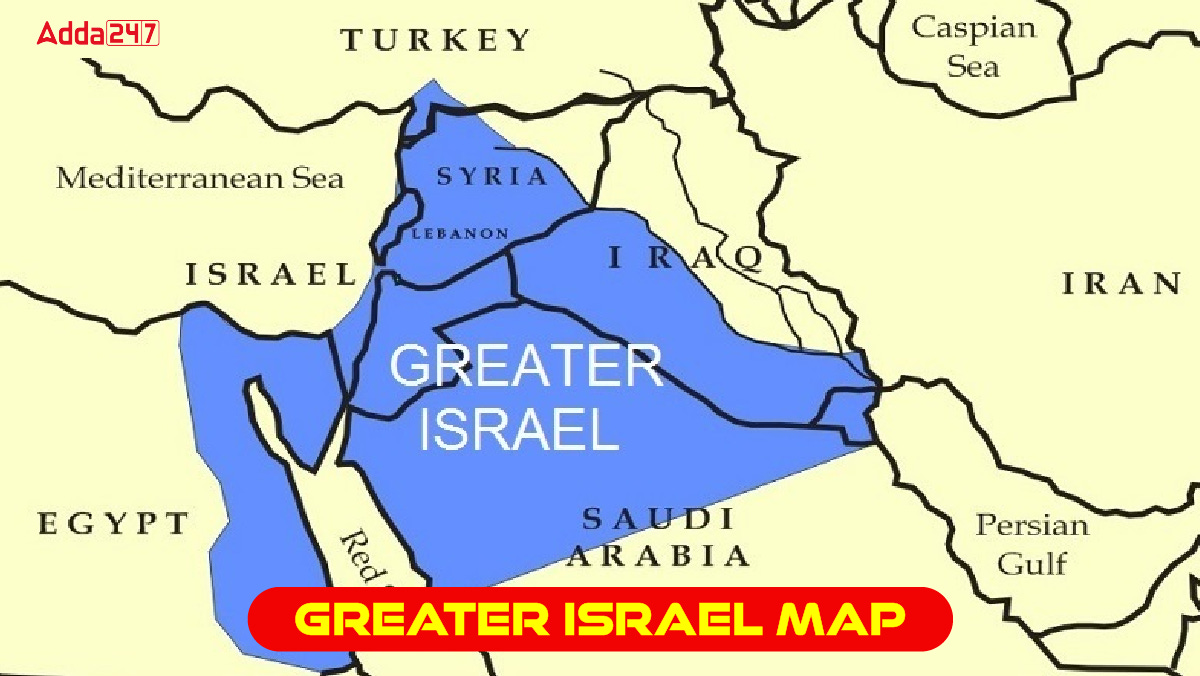
As you can see, Greater Israel includes the following:
–Egypt–the Sinai and everything up to the Nile including substantial resources along the Red Sea. Egypt has a peace treaty with Israel and is the recipient of a large amount of US aid. Egypt has yet to respond.
—All of Jordon. Jordon has been silent.
—All of Syria. Syria has been systematically destabilized. Jolani, the Jihadist who had a $10 million bounty on his head, has allowed Israel free rein to bomb and occupy Syrian territory.
—All of Lebanon including the water resources of the Litani River, the gas resources off the coast, Beirut, the mountains–everything.
—A good part of Saudi Arabia including much of the oil and other resources.
—Northern Iraq including the oil and other resources.
—All of Kuwait including the oil and other resources.
—Part of Turkey.
—Although not shown on the map, there are indications that the Zionists also want Cypris.
Putting aside for a moment whether a Greater Israel is realistic, we must assume that the conquest of Greater Isreal would resemble the conquest of Palestine. If so, terror techniques would be used to expel most of the population in each country, and the property and resources would be confiscated without any compensation. After all, Zionists owned only 7% of Palestine–the rest was seized without compensation. Israel is now attempting to depopulate and confiscate 109 square miles of Gaza, constituting prime Mediterranean property, and off-shore gas resources, again with US support and without compensation.
Obviously, Israel cannot achieve Greater Israel without US help. The US would have to pay for the wars, do the fighting, and the shed the blood and treasure to conquer the targeted countries. Can Israel manipulate the US into creating Greater Israel, as for the wars after 911? Does the US have the financial and military capacity to fight even one more war for Israel or have US militarism and Zionism finally gone too far?
The Israeli strike on the Hamas negotiating team in Doha marks the end of an era
Israel has been conducting “decapitation strikes” with impunity for decades. Here are just a few recent strikes:
—On October 17th and 18th, 2024 thousands of handheld pagers and hundreds of Walkie-talkies, assumed to be used by Hezbollah, suddenly exploded. This represented the use of ordinary commerce to achieve a targeted decapitation. At least 12 people were killed and over 3,000 were injured. Leon Panetta condemned the pager strike as “an act of terrorism.” Which is clearly true.
—On September 27, 2024, Israel killed Hassan Nasrallah, secretary general of Hezbollah, along with many others, as they were meeting under a residential building. The operation involved dropping more than 80 bombs on a residential neighborhood of Beirut, Lebanon. Nasrallah was killed for tying the Hezbollah cause to the Gaza war and seeking to include Gaza in a cease fire. Nasrallah is credited with ending the 18-year Israeli occupation of Lebanon in 2000.
—In the predawn hours of June 13, 2025, even as President Trump was advocating continued dialogue with Iran to resolve the nuclear issue, and another negotiation session had been scheduled, Israel launched a preemptive decapitation strike designed to take out Iranian civilian and military leadership. The strike included a massive attack of perhaps 200 fighter jets dropping 330 precision munitions on over 100 targets. The decapitation strike failed. The result was the 12-day war.
—On August 28, 2025 Israel conducted a decapitation strike that took out the entire Houthi civilian cabinet including the prime minister and 10 senior ministers.
—On September 9, 2025, as a Hamas team was gathering to discuss “the Witkoff Gaza proposal” in Doha, Qatar, Israel attempted a decapitation strike to take out the entire Hamas team. The team survived but again, like with Iran, the Hamas team was meeting in response to a peace proposal being pushed by President Donald Trump. Six people were killed including a Qatar security official. Qatar was not pleased.
Alastair Crooke calls the Doha strike “the end to an entire era–and a ‘new reality’ for Qatar”. This observation could extend to the entire Middle East if not the entire Islamic world.
Crooke points out that for decades Qatar had supported An-Nusra jihadists in Syria, against Iran (divide and conquer), while selling gas and maintaining US military bases and a strategic partnership with Washington. Doha was a mediator with a relationship with the jihadists while acting as a facilitator for Mossad. Now the idea that anywhere in the Middle East is a safe zone from Israeli strikes, or that the US would be a reliable defender, is over.
Israeli channel 11 reported that President Trump approved the attack and applauded any killing of Hamas members. This was yet another US/Israeli sneak attack–one that finally got through to the Arab countries that there are no forbidden territories; no rules of law; no Vienna Convention, and that the US and Israel would act as they pleased in the Middle East.
The unconditional US support “…for Israel’s genocide and ethnic cleansing; the failure to make any serious effort to prepare a political path for a settlement on Ukraine; the reliance instead on making war, whilst proclaiming peace – all these represent the essence of the Trump approach: An exercise of escalatory dominance, both at home and abroad.”
The impact of a US “Israel first” policy is fracturing Trump’s MAGA base as the reaction to the assassination of Charlie Kirk clearly shows. Worse, US policy has negatively impacted US soft power and diplomatic trustworthiness across the world, yet, for some reason, the Trump Administration cannot break free from Zionist domination. Meanwhile, Israel is increasingly out of control, carrying out a second Nakba (ethnic cleaning and genocide) in Gaza and the West Bank. At the same timees, Jewish society itself in Israel is trapped in repression and denial –as it was in 1948 when the reality of the founding of Israel was denied. Israeli filmmaker Neta Shoshani’s controversial documentary about the 1948 war has been banned in Israel because it tried to tell the truth about this history.
“I suddenly realized that in the past two horrible years the whole matter of the Israeli ethos has been totally shattered”:
“I grasped that an ethos has a great deal of power, that it contains society within certain boundaries. And even if those boundaries are breached – and they were certainly breached as early as 1948 – there was still something in society’s moral codes that at least caused it to feel ashamed. So, for decades that ethos safeguarded [Israeli] society and the army, compelling them to preserve certain limits”.
“And when that ethos falls apart, it’s really scary. From this perspective, the film was difficult to watch from the get-go, but after the last two years it’s become unbearable” …
“If 1948 Was a War of Independence, the current war could be the one that ends Israel”.
What does all this mean for the Middle East?
Several of the nations in the Middle East have been aligned with the US; Saudi Arabia, Qatar, UAE, Bahran, and Kuwait. These nations believed that the purchase of US weapons, even with back doors giving the US control, and hosting US military bases would ensure their national security. The Doha attack blew that assumption to smithereens. The US consented to the attack, and the realization finally hit these countries that all the years of cooperating with US/UK/Israel, even as they worked to divide Islam and weaken the Arab world, had been for naught. Plus, the back doors embedded in US weapons meant they could not be used against either the US or Israel. These countries were defenseless, and vulnerable.
The reaction was instantaneous. Qatar organized an Arab-Islamic summit after the Doha attack seeking a collective response to Israel. This follows decades of the systematic destruction of Iraq, Libya, the destabilization of Syria, the ethnic cleansing of the West Bank, the destruction and genocide of the population of Gaza, the destabilization of Lebanon including the US demand that Lebanon disarm Hezbollah.
Leaders from the 57-member Organization of Islamic Cooperation (OIC) and the 22-member Arab League attended along with Iran’s President Masoud Pezeshkian, Pakistan Prime Minister Shehbaz Sharif, and Malaysian Prime Minister Anwar Ibrahim. On September 13th, Iran’s security chief Ali Larijani issued what he called a “warning to Islamic governments” and said they must “form a ‘joint operations room’ against the madness” of Israel instead of resorting to mere statements. The result is unclear, but these nations are talking and the US and Israel are not part of the discussion.
The reaction did not end there. On September 18th Turkey revealed that Israel had sold Greece an air defense system that could further destabilize the Island. It was also reported that Israel thought it was time for Turkey to be forced to leave Cyprus. These events are happening while Israeli’s are buying land and building communities in Cyprus. Turkey is a member of NATO, but this fact could be meaningless in a conflict with Israel.
But the big news is the Saudi Pakistani mutual defense pact which extends the Pakistani nuclear shield over Saudi Arabia. It is truly the US’s Suez moment. The pact represents a NATO type alliance where an attack on one country is an attack on both countries. The symbolism is beyond question. Saudi Arabia could be called the “poster child” of US client states. If the Saudi’s no longer trust US security guarantees, why should anyone else.
There are now two nuclear power blocs in the Middle East–the US/Israeli block and the Pakistani/Saudi Arabia block. More importantly, Pakistan has vowed to nuke Israel should Israel use nuclear weapons.
For Pakistan it addresses a critical flaw, access to energy. From Thomas Kieth: “Pakistan now enjoys an unprecedented warfighting depth: Chinese arms and ammunition on one side, Saudi oil and money on the other. It is an industrial-scale supply chain that neutralizes the constraints India has historically counted on. For Saudi Arabia, the pact is equally revealing. Riyadh has watched the limitations of U.S. security guarantees with growing unease. The recent incident in which Israeli missiles crossed Saudi airspace to strike Qatar without interception exposed the cracks in U.S. air defense systems stationed in the region.”
India has yet to respond and tensions with China and Pakistan still needs to be addressed. Still the pact has created a new strategic corridor where China supplies the arms, Saudi Arabia supplies the energy, and Pakistan provides the pivot.
The US was not informed of this pact until it was announced. For Saudi Arabia, the pact provides a defense against a decapitation strike and the takeover of Saudi assets by Israel as part of creating Greater Israel. By providing a nuclear umbrella over at least part of the Middle East, Pakistan has also defanged Israel’s nuclear threat.
The Saudi/Pakistani pact could result in other client states exploring options leading to the collapse of the US global alliance system. The implications for the petrodollar and US global economic and military dominance should also not be ignored.
The question now is what will happen to Iran. The “snap back” sanctions provisions were adopted by the EU, but their legality has been questioned by Russia, China, and the global south. Apparently, they did not intend to obey the sanctions. Reports say that Israel will initiate another war with Iran before the end of the year.
Conclusion
For the US, the realization may be dawning that it is too late to arrest China’s dominance of the eastern Pacific–or to breakup and loot Russia–that the US should instead pivot to securing the homeland including the entire western hemisphere. The result of this shift is still to be determined. The US now has a flotilla of battle ships threating Venezuela and blowing up small boats. Does this mean the US intends try and seize Venezuelan oil reserves? This would imply the US is trading one series of absurd wars for another. What is needed instead is diplomacy and working to create peaceful exchanges and commerce.
The kind of thrashing around we have witnessed for the last 35 years is not the way a superpower should behave. The dissolution of the Soviet Union should have ended US militarism but instead resulted in the quest for global hegemony and a frantic search for another enemy. Years of domination by militarism, neoliberalism, and the corruption of money has created a catastrophe.
The “brilliant minds” behind US foreign and domestic policy have made an enormous mess both domestically and with foreign policy. Our present circumstance represents a bi-partisan failure of the entire political class over at least 2 generations. A reckoning is coming. This contour of this mess has been discussed in previous Substack’s. The fix has also been discussed; it involves the American people coming together in a new populist movement to reform the system, focused on economic fairness. As for the reckoning–what, how and when is unknown, but it is coming.
“The East Asia Company,” is a typo. It should be “The East India Company” The link is correct.
“…the British, and the French, gained control over Iraq, Saudi Arabia, Lebanon, Syria, and Palestine.”
Five of the six were League of Nations Mandates. I think King Abdulaziz bin Abdul Rahman Al Saud (ibn Saud) of Saudi Arabia would have been surprised to find himself included in that group.
“The British, seeking to weaken the Ottoman empire, aligned with Wahhabism going all the way back to 1744 because it was seen as a tool to advance British interests”
Can I get a citation on this?
The map of Greater Israel does not include North Eastern Iraq which has significant oil reserves.
The Zionists will never be satisfied with merely Greater Israel. Their goal is complete control of all the wealth of the world and with that wealth, power over the entire world.