By Kautilya The Contemplator, Substack, 12/9/25
The recent photograph taken in London of British Prime Minister Keir Starmer, French President Emmanuel Macron, German Chancellor Friedrich Merz and Ukrainian President Volodymyr Zelensky was intended to project unity and resolve. Instead, it has become a quiet indictment and a visual symbol of Europe’s geopolitical exhaustion, moral confusion and strategic irrelevance. Framed as a modern display of allied coordination, the image instead exposes a continent that has lost the power to shape events and must now cling to hollow performances of influence.
The photo stands in stark contrast to another image, separated by eighty years but now inseparable in symbolism – the iconic photograph from the Yalta Conference of February 1945, where Franklin Roosevelt, Winston Churchill and Joseph Stalin, leaders of the victorious wartime coalition, met to determine the contours of the postwar order. Yalta remains one of the most symbolically potent diplomatic images of the twentieth century with three titans of history seated in Crimea, calmly dividing spheres of influence in Europe and shaping the architecture of global politics.
The juxtaposition with the London photo is devastating. Where Yalta showcased the architects of victory determining the fate of continents, London presents four embattled leaders presiding over a failing geopolitical project, excluded from real decision-making, divorced from battlefield realities and increasingly alienated even from their own citizens.
Yalta: The Moment When Power Shaped the World
Yalta is remembered not just for its decisions, but for what it represented – authority grounded in victory. The United States, Britain and most of all, the Soviet Union, had paid in blood, industry and sacrifice to defeat Nazi Germany. Their leaders possessed legitimacy not only from electoral mandates or political structure but from their command of armies, economies and societies mobilized for an existential struggle.
At Yalta, the great powers negotiated Europe’s postwar borders. Roosevelt, Churchill, and Stalin carved out zones of influence and the future of Germany, Eastern Europe and global security institutions was shaped. This was diplomacy anchored in actual power. The Yalta image radiates the confidence of leaders who had earned the right to design the postwar order because they were the ones who had won the war.
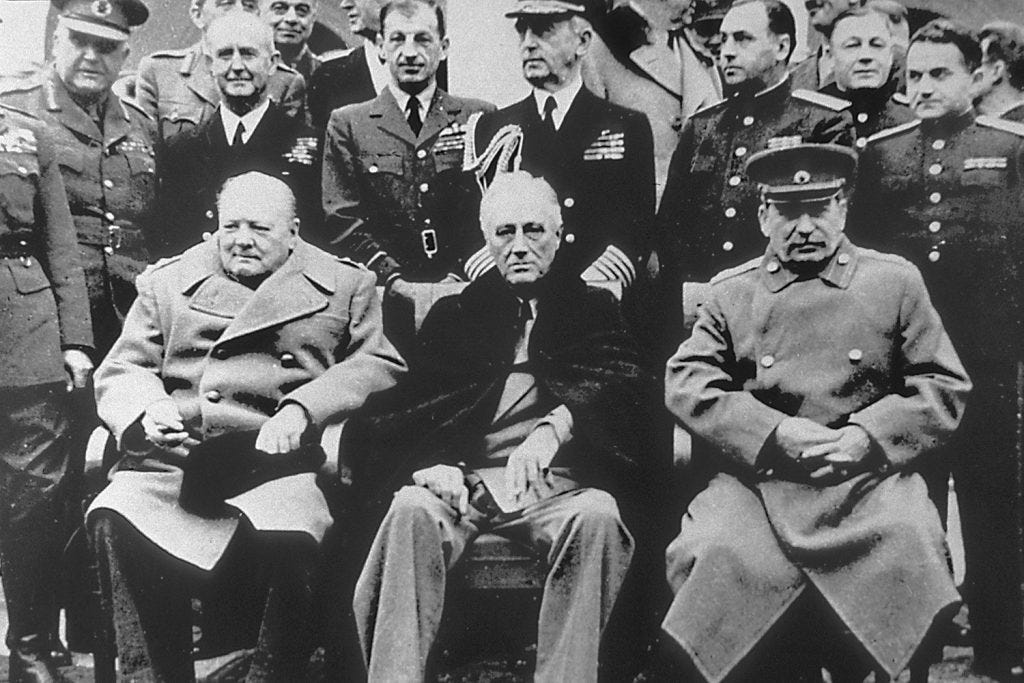
The symbolism is even deeper because Yalta took place in Crimea, the very peninsula that, in today’s conflict, symbolizes the West’s strategic denial. In 1945, Crimea was the serene setting in which the great powers calmly divided Europe. In 2025, Western leaders cannot even accept the reality of Crimea’s status, despite Russia’s irreversible consolidation there. The historical irony is almost poetic. The site where world order was once crafted is now a geographic focal point of Western delusion.
The London Quartet: A Photo of Defeat and Denial
Against this backdrop, the London photo looks painfully small. Starmer, Macron, Merz and Zelensky do not represent victory, legitimacy or stability. Instead, they embody a continent in decline, leaders who cannot influence Washington, cannot deter Moscow and cannot deliver results at home.
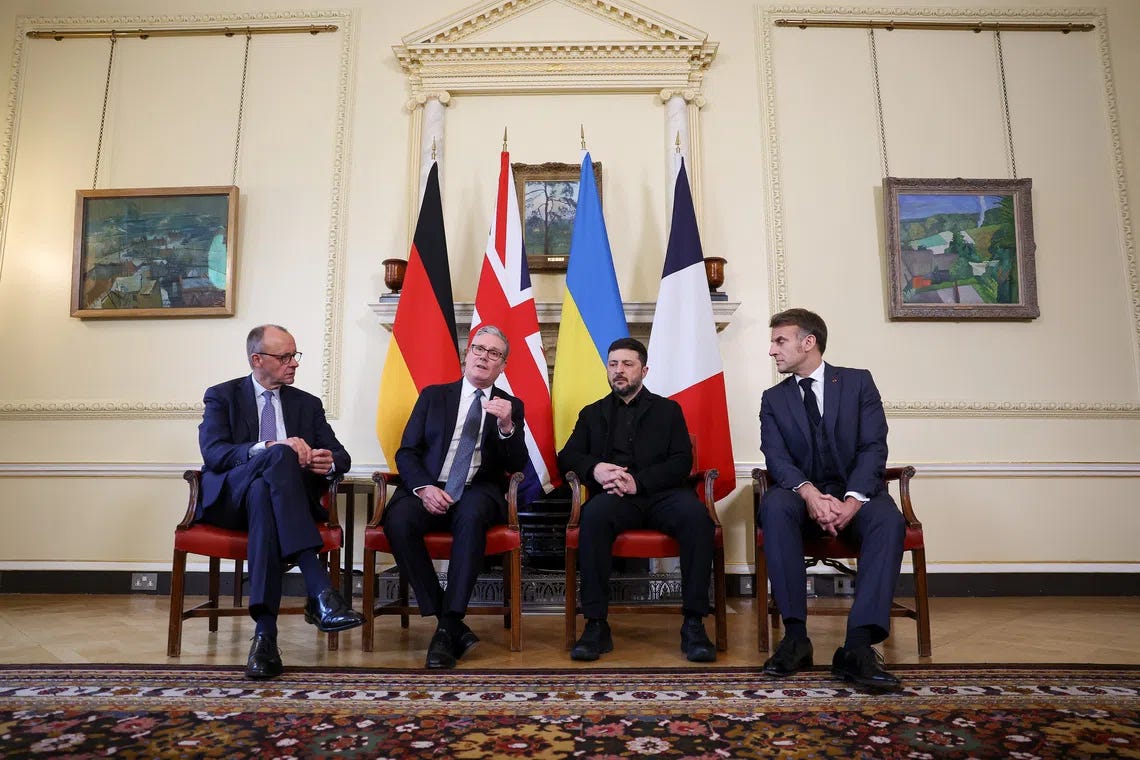
The absence of both the United States and Russia, the only two countries that actually determine the trajectory of the conflict, strips the image of any strategic meaning. Europe is not shaping the conflict. It is reacting to it in an increasingly incoherent manner. The symbolism is unmistakable. At Yalta, the world’s three dominant powers shaped global order. In London, four unpopular leaders pretend to shape a war they are losing. Public relations replaces strategy, performance substitutes for power and denial takes the place of diplomatic realism.
Even more revealing is the timing. As the photo circulates, battlefield reports, including those from The Telegraph, one of the most anti-Russia newspapers in Britain, confirm that Russian forces are accelerating territorial gains in Ukraine.1 Europe’s leaders stand before cameras as though dictating terms, yet on the ground, they have lost the initiative entirely.
A Lineup of Unpopular and Discredited Leaders
If the contrast in power is glaring, the contrast in legitimacy is even more humiliating. Roosevelt, Churchill and Stalin each stood atop national mobilization efforts whose populations accepted enormous sacrifice. Their word reflected the will and power of states united behind them.
The four leaders in the London photo, by contrast, represent profound domestic weakness. Starmer already faces collapsing approval ratings (now at 15%)2 mere months into office, with Labour disillusionment spreading rapidly. Macron is one of the most unpopular leaders in the history of the Fifth Republic with a 13% approval rating, presiding over a fragmented country and years of unrest.3 Merz is highly unpopular with a 23% approval rating, unable to command national confidence or offer a coherent alternative vision.4 Zelensky is an illegitimate head of state, ruling under martial law, postponing elections indefinitely, outlawing opposition parties, censoring media and presiding over deepening corruption.
Europe’s Increasing Strategic Isolation from Both Washington and Moscow
The London photo highlights isolation, not unity. The United States, Europe’s strategic patron, is now openly repositioning itself away from the continent’s conflicts. The newly released US National Security Strategy underscores this shift with striking clarity. While cloaked in the neutral vocabulary of “prioritization,” the document effectively demotes Europe as a strategic theater, placing it behind the Indo-Pacific and America’s competition with China. It signals that Washington will no longer underwrite Europe’s security architecture indefinitely, nor will it finance or sustain Europe’s maximalist ambitions in Ukraine.
Far from guaranteeing long-term support, the NSS demands that Europe assume far more responsibility for its own defense, despite lacking the political cohesion, military capacity or economic strength to do so. In practice, the document foreshadows a United States increasingly unwilling to bankroll Europe’s geopolitical illusions, leaving European leaders stranded with commitments they cannot fulfill.
This shift further isolates a Europe that has alienated Russia entirely and now finds itself subtly but unmistakably deprioritized by Washington. The continent’s leaders cling to maximalist war aims that Washington no longer supports, even as the United States now appears to pursue some semblance of a pragmatic peace plan that tacitly acknowledges Russian territorial gains. The London photo therefore becomes an even more powerful symbol of a Europe acting out the motions of great-power politics at the very moment its patron is quietly stepping away.
Europe Doubles Down: The €210 Billion Loan and the Commission’s Abuse of Emergency Powers
The greatest symbol of Europe’s internal decay, however, comes not from the photo itself but from the European Union’s proposal for a €210 billion ($225 billion) loan to Ukraine.
Not only is this financially reckless, especially for economies already crippled by energy shocks and inflation, it is being pushed through in a profoundly undemocratic way. The European Commission has invoked emergency powers to backstop the loan without the explicit consent of member states, making all EU member states liable for a massive debt they did not approve.
If the plan is implemented, this will represent a constitutional rupture as it overrides national sovereignty, violates the spirit (and arguably the letter) of EU treaties and imposes collective liability for Ukraine’s survival on European citizens who were never asked for their consent.
The Commission’s maneuver reveals a deeper truth in that Europe’s institutions, no longer able to generate unity through consent, have turned to coercion. This is how unions disintegrate, not through external pressure alone, but through internal overreach that delegitimizes the center. When citizens realize they are being forced into underwriting an unwinnable war, led by unpopular leaders in support of an illegitimate government in Kiev, resistance will not be ideological but existential. As such, this €210 billion debt scheme may one day be seen as the moment the EU stepped onto the path toward its own disintegration.
The Image of a Continent’s Exhaustion and Decline
In the end, the most striking difference between Yalta and London is not merely the imbalance of power, but the collapse of political imagination. Yalta’s leaders, despite their flaws, believed they were designing a world that would endure. The leaders in London cannot even shape the world already unfolding around them.
The London photo will be remembered as an image of a continent adrift, led by unpopular leaders, trapped in strategic denial, isolated from global decision-making and crippled by institutions willing to trample democratic norms to sustain an unraveling project. The tragedy is not that Europe has declined, but that its leaders cannot accept the fact. History is seldom kind to those who mistake performance for power.