On Dec. 15th the EU added Swiss military analyst Jacques Baud to its infamous sanctions list.
The move is insane of course and needs to be resisted and challenged by the public.
This is a huge scandal as it directly threatens academic research all over Europe. Baud is famous for using almost exclusively Western media sources and established (state) media from Ukraine. To accuse him of some form of (Russian) propaganda is, sorry for the boastful term, the “mother of all lies”. Spread the word…
In a private email German reporter Patrik Baab stated that he tries to put together a protest note now with Germans General Kujat, Admiral Schönbach, Gen. Vad and Swiss Oberst.Ltnt Bosshardt.
I assume more protest notes will follow but those won´t affect anything.
Eventually this highly illegal, or if you prefer illegitimate, sanctions regime has to be brought down through a court.
The incompetence and malicious conduct of these people is simply insulting.
Here Moon of Alabamas´s blog entry earlier today:
“EU Sanctions Swiss Intelligence Expert Jacques Baud”
From an initial quick comment someone put together EU´s guarantees for human rights:
CHARTER OF FUNDAMENTAL RIGHTS OF THE EUROPEAN UNION:
Article 11
Freedom of expression and information
1. Everyone has the right to freedom of expression. This right shall include freedom to hold opinions and to receive and impart information and ideas without interference by public authority and regardless of frontiers.
2. The freedom and pluralism of the media shall be respected.
and
Article 17
Right to property
1. Everyone has the right to own, use, dispose of and bequeath his or her lawfully acquired possessions. No one may be deprived of his or her possessions, except in the public interest and in the cases and under the conditions provided for by law, subject to fair compensation being paid in good time for their loss. The use of property may be regulated by law in so far as is necessary for the general interest.
and
Article 21
Non-discrimination
1. Any discrimination based on any ground such as sex, race, colour, ethnic or social origin, genetic features, language, religion or belief, political or any other opinion, membership of a national minority, property, birth, disability, age or sexual orientation shall be prohibited.
***
December 15, 2025 tweet from Pascal Lottaz, Associate Professor for Neutrality Studies at Kyoto University’s Faculty of Law & Hakubi Center (we’ve cross-posted some of his YouTube interviews with various academics, journalists and commentators. – Natylie):
“It is now official. The EU IS sanctioning the retired Swiss Army Col. and previous NATO advisor Jacques Baud who was on Neutrality Studies before. One of the most cool-headed and well-informed analysts out there. Reason: Baud is spreading Russian propaganda, the EU says. It is insane. The EUSSR is real.
EU sanctions are not part of the judicial branch. They are punishments coming straight from the executive arm (Kaja Kallas‘ office is responsible for compiling and proposing them). Sanctions against individuals that have never been found guilty by any court of law should not be possible.
Even worse, Baud is living in an EU country and has now all his assets frozen and a travel ban for the entire Union (Switzerland is not part of the EU).
I was in touch with Baud yesterday and he is currently assessing the legal implications on him:
“Yes, I have been sanctioned for ‚Russian propaganda‘. The fact I never use Russian material for my books, but exclusively Ukrainian and Western information and that I consequently refused invitations from Russian media, I am still a “Russian propagandist”!
As stated in my books, my work is not about who is good and who is bad, but about how bad media reflect the realities on the ground. I wanted to show that even without Russian information you can have a better understanding of the conflict. The idea is that the way you understand a crisis defines the way to solve it!
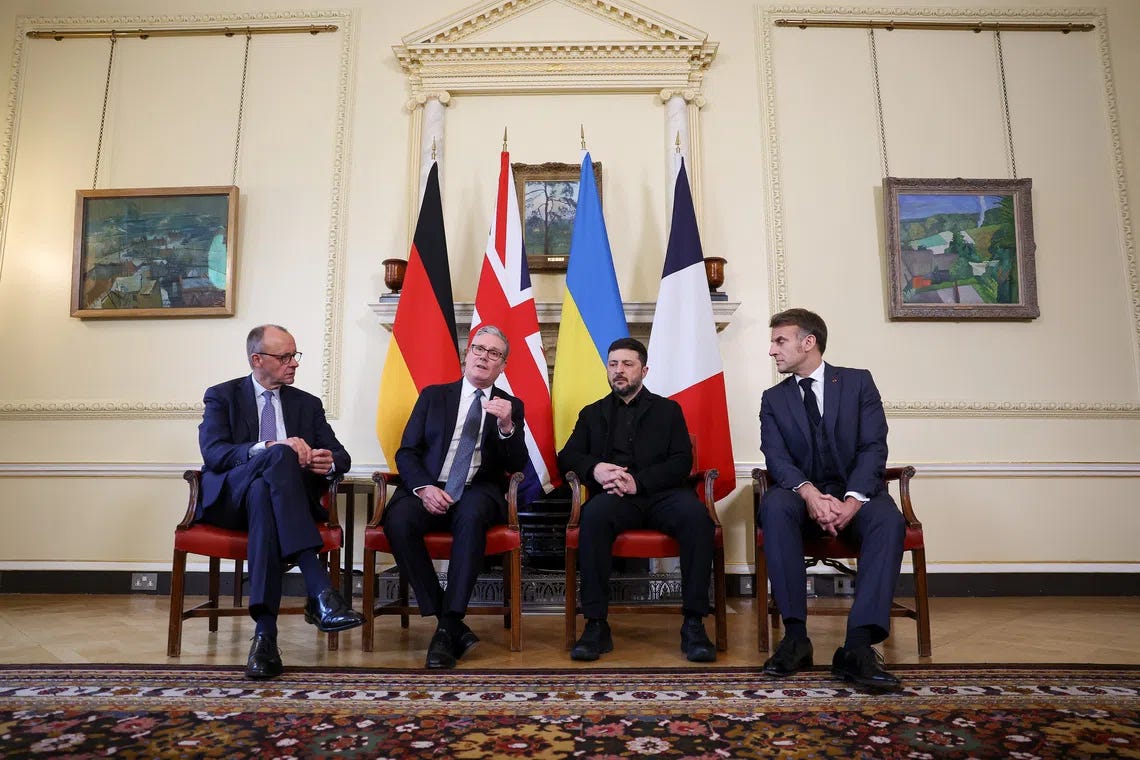
The recent photograph taken in London of British Prime Minister Keir Starmer, French President Emmanuel Macron, German Chancellor Friedrich Merz and Ukrainian President Volodymyr Zelensky was intended to project unity and resolve. Instead, it has become a quiet indictment and a visual symbol of Europe’s geopolitical exhaustion, moral confusion and strategic irrelevance. Framed as a modern display of allied coordination, the image instead exposes a continent that has lost the power to shape events and must now cling to hollow performances of influence.
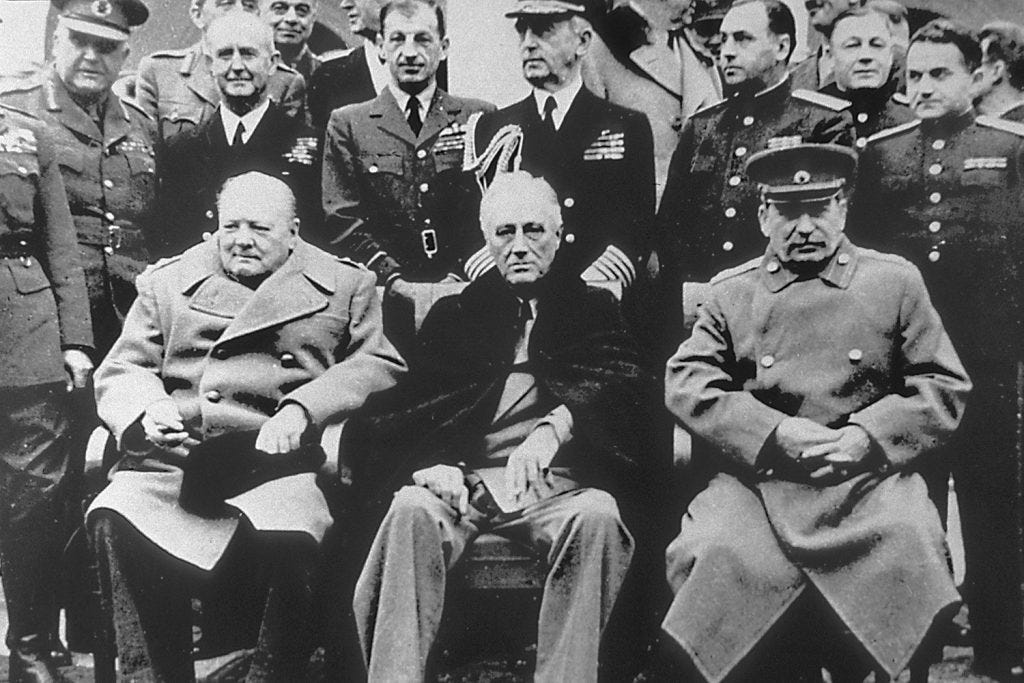
The photo stands in stark contrast to another image, separated by eighty years but now inseparable in symbolism – the iconic photograph from the Yalta Conference of February 1945, where Franklin Roosevelt, Winston Churchill and Joseph Stalin, leaders of the victorious wartime coalition, met to determine the contours of the postwar order. Yalta remains one of the most symbolically potent diplomatic images of the twentieth century with three titans of history seated in Crimea, calmly dividing spheres of influence in Europe and shaping the architecture of global politics.
The juxtaposition with the London photo is devastating. Where Yalta showcased the architects of victory determining the fate of continents, London presents four embattled leaders presiding over a failing geopolitical project, excluded from real decision-making, divorced from battlefield realities and increasingly alienated even from their own citizens.
Yalta: The Moment When Power Shaped the World
Yalta is remembered not just for its decisions, but for what it represented – authority grounded in victory. The United States, Britain and most of all, the Soviet Union, had paid in blood, industry and sacrifice to defeat Nazi Germany. Their leaders possessed legitimacy not only from electoral mandates or political structure but from their command of armies, economies and societies mobilized for an existential struggle.
At Yalta, the great powers negotiated Europe’s postwar borders. Roosevelt, Churchill, and Stalin carved out zones of influence and the future of Germany, Eastern Europe and global security institutions was shaped. This was diplomacy anchored in actual power. The Yalta image radiates the confidence of leaders who had earned the right to design the postwar order because they were the ones who had won the war.
Winston Churchill, Franklin Roosevelt and Joseph Stalin at the Yalta Conference in February 1945 (Source: The Atlantic Council)
The symbolism is even deeper because Yalta took place in Crimea, the very peninsula that, in today’s conflict, symbolizes the West’s strategic denial. In 1945, Crimea was the serene setting in which the great powers calmly divided Europe. In 2025, Western leaders cannot even accept the reality of Crimea’s status, despite Russia’s irreversible consolidation there. The historical irony is almost poetic. The site where world order was once crafted is now a geographic focal point of Western delusion.
The London Quartet: A Photo of Defeat and Denial
Against this backdrop, the London photo looks painfully small. Starmer, Macron, Merz and Zelensky do not represent victory, legitimacy or stability. Instead, they embody a continent in decline, leaders who cannot influence Washington, cannot deter Moscow and cannot deliver results at home.
Left to Right: German Chancellor Friedrich Merz, British Prime Minister Keir Starmer, Ukrainian President Volodymyr Zelensky and French President Emmanuel Macron in London, December 8, 2025 (Source: BBC)
The absence of both the United States and Russia, the only two countries that actually determine the trajectory of the conflict, strips the image of any strategic meaning. Europe is not shaping the conflict. It is reacting to it in an increasingly incoherent manner. The symbolism is unmistakable. At Yalta, the world’s three dominant powers shaped global order. In London, four unpopular leaders pretend to shape a war they are losing. Public relations replaces strategy, performance substitutes for power and denial takes the place of diplomatic realism.
Even more revealing is the timing. As the photo circulates, battlefield reports, including those from The Telegraph, one of the most anti-Russia newspapers in Britain, confirm that Russian forces are accelerating territorial gains in Ukraine.1 Europe’s leaders stand before cameras as though dictating terms, yet on the ground, they have lost the initiative entirely.
A Lineup of Unpopular and Discredited Leaders
If the contrast in power is glaring, the contrast in legitimacy is even more humiliating. Roosevelt, Churchill and Stalin each stood atop national mobilization efforts whose populations accepted enormous sacrifice. Their word reflected the will and power of states united behind them.
The four leaders in the London photo, by contrast, represent profound domestic weakness. Starmer already faces collapsing approval ratings (now at 15%)2 mere months into office, with Labour disillusionment spreading rapidly. Macron is one of the most unpopular leaders in the history of the Fifth Republic with a 13% approval rating, presiding over a fragmented country and years of unrest.3 Merz is highly unpopular with a 23% approval rating, unable to command national confidence or offer a coherent alternative vision.4 Zelensky is an illegitimate head of state, ruling under martial law, postponing elections indefinitely, outlawing opposition parties, censoring media and presiding over deepening corruption.
Europe’s Increasing Strategic Isolation from Both Washington and Moscow
The London photo highlights isolation, not unity. The United States, Europe’s strategic patron, is now openly repositioning itself away from the continent’s conflicts. The newly released US National Security Strategy underscores this shift with striking clarity. While cloaked in the neutral vocabulary of “prioritization,” the document effectively demotes Europe as a strategic theater, placing it behind the Indo-Pacific and America’s competition with China. It signals that Washington will no longer underwrite Europe’s security architecture indefinitely, nor will it finance or sustain Europe’s maximalist ambitions in Ukraine.
Far from guaranteeing long-term support, the NSS demands that Europe assume far more responsibility for its own defense, despite lacking the political cohesion, military capacity or economic strength to do so. In practice, the document foreshadows a United States increasingly unwilling to bankroll Europe’s geopolitical illusions, leaving European leaders stranded with commitments they cannot fulfill.
This shift further isolates a Europe that has alienated Russia entirely and now finds itself subtly but unmistakably deprioritized by Washington. The continent’s leaders cling to maximalist war aims that Washington no longer supports, even as the United States now appears to pursue some semblance of a pragmatic peace plan that tacitly acknowledges Russian territorial gains. The London photo therefore becomes an even more powerful symbol of a Europe acting out the motions of great-power politics at the very moment its patron is quietly stepping away.
Europe Doubles Down: The €210 Billion Loan and the Commission’s Abuse of Emergency Powers
The greatest symbol of Europe’s internal decay, however, comes not from the photo itself but from the European Union’s proposal for a €210 billion ($225 billion) loan to Ukraine.
Not only is this financially reckless, especially for economies already crippled by energy shocks and inflation, it is being pushed through in a profoundly undemocratic way. The European Commission has invoked emergency powers to backstop the loan without the explicit consent of member states, making all EU member states liable for a massive debt they did not approve.
If the plan is implemented, this will represent a constitutional rupture as it overrides national sovereignty, violates the spirit (and arguably the letter) of EU treaties and imposes collective liability for Ukraine’s survival on European citizens who were never asked for their consent.
The Commission’s maneuver reveals a deeper truth in that Europe’s institutions, no longer able to generate unity through consent, have turned to coercion. This is how unions disintegrate, not through external pressure alone, but through internal overreach that delegitimizes the center. When citizens realize they are being forced into underwriting an unwinnable war, led by unpopular leaders in support of an illegitimate government in Kiev, resistance will not be ideological but existential. As such, this €210 billion debt scheme may one day be seen as the moment the EU stepped onto the path toward its own disintegration.
The Image of a Continent’s Exhaustion and Decline
In the end, the most striking difference between Yalta and London is not merely the imbalance of power, but the collapse of political imagination. Yalta’s leaders, despite their flaws, believed they were designing a world that would endure. The leaders in London cannot even shape the world already unfolding around them.
The London photo will be remembered as an image of a continent adrift, led by unpopular leaders, trapped in strategic denial, isolated from global decision-making and crippled by institutions willing to trample democratic norms to sustain an unraveling project. The tragedy is not that Europe has declined, but that its leaders cannot accept the fact. History is seldom kind to those who mistake performance for power.
No other governments are coming to aid Venezuela because the “axis of authoritarianism” is nonsense promoted by lazy Western analysts:
Russia, China, Cuba, Iran and other anti-American powers are offering little more than words of support for Venezuelan leader Nicolás Maduro as he faces a U.S. military buildup that President Trump has said is aimed at forcing his ouster. Like Iran when it came under military attack from Israel and the U.S., Venezuela is finding its authoritarian allies on the sidelines of conflict.
It isn’t surprising that these other states aren’t doing anything to protect Venezuela because none of these countries is allied with any of the others. Hawks have been trying to will an “axis of authoritarianism” into existence for at least twenty years so that they can use it to stoke fear and exaggerate foreign threats. For the most part, the authoritarian states haven’t obliged by creating any alliances among them. The “axis of authoritarianism” isn’t real and it never was.
These states aren’t lifting a finger to help Venezuela because they have no reason and no obligation to do so. The “allies” are on the sidelines because they were never allies. Describing them as allies was a lazy, inaccurate shorthand that many analysts and politicians have been using to make all these states appear more threatening than they are.
Venezuela obviously poses no threat to the U.S. on its own. That is why interventionists have been going out of their way to hype the connections with great power rivals. The trouble for the fearmongers is that the connections are much more tenuous and much less significant than they have claimed.
On Friday, Russia’s central bank announced it is filing a lawsuit in a Moscow Arbitration Court against Belgian-based clearinghouse Euroclear, the custodian of around €185 billion ($220 billion) in frozen Russian assets.
The announcement was made in a brief press release with no commentary. But the timing is no accident. The move comes as the EU’s contentious plan to tap the assets for a massive zero-interest loan to Ukraine is headed for some sort of denouement.
The move by the central bank – a mere legal step with no accompanying fanfare – is typical for Moscow, which tends not to front-run complicated policy endeavors over social media or through provocative public statements. Russian officials have so far also tended to hew to bland statements.
“We [the government], including the central bank, are doing everything to protect our assets,” Deputy Prime Minister Aleksandr Novak told RT. “Illegal confiscations are absolutely unacceptable.”
While Western observers – accustomed to the acrimonious and very public nature of policy implementation in their own countries – may be puzzled by Russian officials’ reluctance to spell out the potential implications, the signal is clear.
Russia has now moved to the realm of action with regard to protecting its interests. The threat of Russian retaliation has hung over the entire EU-led asset-theft episode like the Sword of Damocles, but now an opening salvo has been fired.
At face value, of course, a lawsuit against Euroclear in Moscow means little: the Russian central bank will almost certainly win the suit, and Euroclear will probably not even mount a defense in a Russian jurisdiction. Russia’s legal case is widely seen as strong even disregarding the home-field advantage.
For both Euroclear and the EU, the risk is clearly far greater – but more amorphous – than whatever amount they could be on the hook for in light of a potential Russian court ruling. If Russia’s legal case spills into other jurisdictions, messy and protracted litigation could be extremely damaging for the company, not to mention for the EU’s reputation globally and its investment climate.
Many advocates of the seizure plan rightly point out that Russia could hardly be expected to win a lawsuit in an EU jurisdiction. But the battleground is elsewhere.
If Russia is able to secure an injunction in a neutral country where Euroclear operates, it could create logistical difficulties and tremendous reputational risks for Europe.
Euroclear, by its own admission, still holds client assets amounting to around €16 billion in Russia. These funds are already frozen, but a worse fate could await them if Russia were to retaliate. Friday’s announcement of a lawsuit made no mention of those funds and whether further action could be taken with regard to them. But the announcement didn’t need to: the implication is clear.
Cashing in on war: Why stealing Russia’s assets actually makes things worse for the EUREAD MORE: Cashing in on war: Why stealing Russia’s assets actually makes things worse for the EU
Euroclear CEO Valerie Urbain has also made reference to those funds, admitting that she fears that Russia will move against them. She has generally been outspoken in her opposition to the loan scheme and even warned that her company could face bankruptcy if sanctions against Russia are lifted, but Europe has already allocated the money elsewhere. Of course, given Euroclear’s central role in the financial system, the EU would be forced to step in.
It is true the EU has invoked an emergency clause – Article 122 – which keeps the Russian funds immobilized indefinitely and hedges against a sudden removal of sanctions.
But this hardly alleviates the risk that a broad agreement to end the war won’t facilitate a lifting of the freeze on the Russian assets, even if the funds being returned to their rightful owner may not be straightforward (the US has proposed allowing American companies to tap the funds, for example).
For both Euroclear and the EU, this becomes much more than a question of tallying numbers on spreadsheets. A clearinghouse is not a physical asset that can withstand poor management and remain intact to be passed on to new owners. It lives by the trust investors place in it to be a reliable custodian of their assets. History has shown how quickly financial institutions can find themselves in peril once that trust is broken.
Russia’s lawsuit in Moscow is hardly a decisive move, but it has pushed matters into a very uncomfortable realm for those eyeing Russia’s funds.
A lot of people out there (myself included) have been scratching their heads wondering why European countries are so intent on waging war on Russia — not just through Ukraine on the battlefield but through sanctions and embargoes in the economic realm. Why would Germany point the gun at its own economy in this way, cutting itself off from the cheap Russian gas that underwrote its industrial base? Why would it turn a blind eye while the United States blew up its Nord Stream pipeline — an act of terrorism coming from its own ally — and pretend it didn’t happen? What’s the ideology driving it? What’s the game plan? What’s the thinking? Is there any? What do the technocrats running policy in Germany (the most powerful state in the EU) think they are doing? It seems so irrational and pointless.
Well, I think I have an easy explanation: These technocrats have no choice. They are not really in control. See, the collapse of the USSR didn’t just take out the Soviet block. It also sent Europe and the entire European project into a tailspin. The entire reason for a post-WWII unified, socialism-lite Europe to exist was to counter the Soviet Union — all under protective imperial wing of the United States. When the Soviet Union suddenly collapsed and broke apart and started reverting back to the 19th century, a unified Europe had no reason to exist. There was no external counter-ideology holding it together anymore. No external foe that you could lean your entire structure on. So the more that the unified European project wobbled, the shakier it got, the more cracks developed (I’m thinking here of the Greek austerity crisis of 2009, where a Europe unified to completely fuck the Greek people, their European brothers and sisters), the more that Europe had to turn to the only thing that had unified it in the past: militarism and the Cold War. It had to recreate the enemy and it tried and tried so hard that ultimately it succeeded in actually creating one.
That’s why the seemly baffling attachment to Ukraine. That’s why European technocrats have bet everything on that conflict…why it’s so important to them. They have no positive post-Cold War vision for their beloved European Union anymore beyond a washed [out] neoliberalism that their own people hate. They have nothing. Ukraine is their answer. Their prayer. Their hope. It’s the only that’s keeping them together. But it’s not enough. It can’t stop the collapse. In fact, it’s speeding up the collapse.
PS: This process is similar to something that Evgenia and I talk about all the time with respect to America. The collapse of the Soviet Union also caused a crisis in the United States. As I wrote before, “Americans think they won the Cold War, and that they defeated communism. That’s true. But it’s not clear that Americans have come out as on top of that conflict as they were led to believe. See the truth is that the USA and the USSR were connected — and the USSR and its people propped up America in ways that Americans did not understand. Now that the USSR has been replaced by a pre-revolutionary Russian society, both the former USSR and the USA are going through similar reversions to the 19th century. The processes are linked…they’re mutually reinforcing.”