Benjamin S. Dunham: Making the Case for East Ukraine

By Benjamin S. Dunham, ACURA, 12/5/25

In June 2024 President Putin insisted that Ukrainian troops be completely withdrawn from the territories of the Donetsk, Luhansk, Kherson, and Zaporizhzhia oblasts, which he claimed as Russian territory. 

President Zelensky was firm: “Ukrainians will not gift their land to the occupier. We will not reward Russia for what it has perpetrated.” 

It’s the very definition of a sticking point. After the flurry of negotiations over the Thanksgiving weekend, everyone seemed to agree on only one point: the greatest problem was territorial. But what if the item on the table was the creation of a new country, East Ukraine, which the international community could help shape with the input of both Ukraine and Russia? 

The history of the 20th century itemizes many such splits to solve irreconcilable national divisions—think South Sudan, South Korea, East Timor, Northern Ireland, even India and Pakistan (and Bangladesh from Pakistan). Each of these national bifurcations had its own reasons for coming into being—religion, language, culture, geography, and colonial disruption among them—and some of them have yet to prove themselves as totally successful solutions. But all of them have been useful in calming deadly conflicts, and isn’t that what the current negotiations are trying to achieve?

Throughout its existence, the region of Ukraine has been confronted with left-bank-right-bank issues, using different stretches of the Dniepro River as a dividing line, usually with only temporary success, if even that. At the end of the 19th century, the idea of an autonomous or quasi-independent southeastern region of the Russian Empire was popular among Russian industrialists, and something similar was advocated briefly in 1918 as the Donetsk–Krivoy Rog Soviet Republic, a territorial carve-out whose borders closely follow the possible outline of East Ukraine (see https://tinyurl.com/2mh5zrce).

Another example comes from the history of the Lemkos, a population of Carpatho-Rusyn mountain Slavs in what is now southern Poland who have sometimes been grouped with the greater Ukrainian community. After WWI, one of goals of the short-lived Lemko Republic in 1918-20 was not to be included in the newly established West Ukrainian People’s Republic (see Wikipedia: “The Lemko Republic”). This is of interest for its own sake but also because it suggests that even then there was an awareness of an eastern Ukraine, distinct from the fractious Galician experience. 

If Ukraine is unwilling to cede territory defended by its forces directly to Russia, and Russia is unwilling to give up territory won by its forces from Ukraine, shouldn’t negotiators entertain a settlement calling for the creation of a country to the right of the lower stretch of the Dniepro River, incorporating at least the five oblasts claimed by Russia and perhaps even the whole territory that voted in the majority for ViktorYanukovych in 2010? This was the population arguably disenfranchised by the US-supported Maidan Revolution, which caused the resistance of separatists in the Donbas oblasts and the need for Russia to protect its warm-water port in Crimea. (Of course, there are many other issues that also have to be addressed, and in this both the US 28-point proposal and the revised 19-point proposal would be instructive.)

It is true that President Zelensky along with many Western leaders might initially object, but Russia’s acceptance of East Ukraine’s creation would give the lie to arguments that Russia had its eye on an eventual territorial takeover of Europe. This perceived threat has motivated some European leaders to commit their countries to a built-up defense posture against Russia and been cited as a reason to hold fast to an “as-long-as-it-takes” support for an intact Ukraine. 

At a press conference concluding President Putin’s late-November visit to Kyrgyzstan, he dismissed claims that Russia intends to invade Europe as “complete nonsense…. The truth is: We never intended to do that. But if they want to hear it from us, well, then we’ll document it. No question.”

One step toward proving this would be for President Putin to contribute claimed Russian territory to a new eastern state. And that, of course, is the reason why Russia might agree; it’s a way of confirming Russia’s sincerity as a neighborly and not antagonistic country. Yes, this state would naturally be within Russia’s sphere of influence, but then, a rump western state would naturally be in Europe’s sphere of influence. That is the truth about Ukraine and always has been since the era of the Polish-Lithuanian Commonwealth. We should be prepared to acknowledge it.

And President Zelensky might have his own reasons for warming to the idea of East Ukraine. Unless an ultra-nationalist fills the gap in the Office of the President created by the resignation of Andriy Yermak as its Head, Zelensky might feel free to relax some of  his maximalist goals. Surely, he would prefer not to be administering a potentially unwelcome takeover of the Donbas and enforcing the Verkhovna Rada’s ban on the Russian language in educational and official usage and its ongoing repression of Russian culture and religion. 

Creating East Ukraine would also open up other compromises the government of Ukraine might agree to. For instance, it has never accepted any responsibility for attacking Ukrainian separatists in the Donbas region after the Maidan protests caused the resignation of elected president Yanukovych. But agreeing that Russia’s frozen funds could be contributed to a sovereign wealth fund whose proceeds would be devoted to restoring the damage done in the Donbas in the years before and after Russia’s invasion would be a nod in that direction.

While from a Western point of view the prospect of East Ukraine might seem too accommodating, the idea might at least deflect negotiations from the current irresolvable standoff. This proposal would respond in a positive manner both to Ukraine’s unwillingness to cede territory to Russia and to Russia’s stated goal: a neutral buffer state free of ultra-right Ukrainian nationalism and where Russian language, culture, and religion would be respected. Both Ukraine and Russia would be asked to cede territory, but not to each other. 

Structuring a neutral, non-aligned East Ukraine (without neo-Nazi elements and NATO/CIA involvement, etc.) could take months or even years, but might be the kind of project that Russia would risk a ceasefire to pursue (thereby addressing Ukraine’s unwillingness to proceed further without a ceasefire). Drawing borders, writing a new constitution, working out security issues, nominating leadership—the required tasks are almost innumerable and would require the cooperation of the best experts from all sources. Obviously, in creating a new country out of the scarred and shattered remnants of a multi-year war, there would much to occupy the proposed international committee led by President Trump, with its many transactional commercial and trade concerns, and this would be all to the good. The artillery and bombing would be stopped and the drones defused. Only the arms suppliers could object! But if so, the world would benefit from seeing their self-interested motives fully revealed.

Without some new bone like East Ukraine to chew on, would anyone bet in favor of the parties overcoming their current entrenched positions? If not, all that is left is Prof. John Mearsheimer’s stark conclusion that the conflict will only be settled on the battlefield. That way leads to further dangerous escalation, and nuclear warfare, tactical or total, would be staring us in the face.

Copyright © December 2025 Benjamin S. Dunham. The author is a retired arts administrator and journalist who writes occasionally on subjects of music, history, and politics.

Alan MacLeod: The Richest Men in the World Are Media Moguls

By Alan MacLeod, Consortium News, 12/4/25

Trump loyalist and C.I.A. contractor Larry Ellison’s purchase of CNN appears imminent, and marks the latest venture into media for the world’s second-richest individual.

But Ellison is not alone.

Indeed, the world’s seven richest individuals are all now powerful media barons, controlling what the world sees, reads, and hears, marking a new chapter in oligarchical control over society and striking another blow at a free, independent press and diversity of opinion.

Media Monopoly

Paramount Skydance — an Ellison-owned company — is in pole position to purchase Warner Brothers Discovery, a conglomerate that controls gigantic film and television studios, streaming services like HBO Max and Discovery+, franchises like DC Comics, and TV networks such as HBO, TNT, Discovery Channel, TLC, Food Network, and CNN.

This lead is largely due to Ellison’s proximity to President Donald Trump, who will ultimately have to sign off on such a deal.

Ellison has already spoken to senior White House officials about axing CNN hosts and content that Trump is said to dislike, including anchors, Erin Burnett and Brianna Keilar.

It is this willingness to completely re-orientate the network’s political direction that has made him the White House’s preferred purchaser of Warner Brothers Discovery. He is reportedly so wealthy that he can afford to pay in cash.

Ellison, whose net worth stands at a staggering $278 billion, has been on a media spending spree of late. Earlier this year, he provided the funds for Skydance to purchase Paramount Global, another gigantic conglomerate that controls such products as CBS, BET, MTV, Comedy Central, Nickelodeon, Paramount Streaming and Showtime.

Immediately upon being appointed CEO of CBS News, Larry’s son, David, began drastically re-orientating the network’s political outlook, firing staff, pushing it to become pro-Trump, and appointing self-described “Zionist fanatic” Bari Weiss as its editor-in-chief.

The Ellison family, however, is far from finished. In September, President Trump signed an executive order approving a proposal to force through the sale of social media platform TikTok to an American consortium led by Ellison-owned tech company, Oracle.

Under the planned arrangement, Oracle will oversee the platform’s security and operations, giving the world’s second-richest man effective control over the platform that more than 60 percent of Americans under 30 years of age use for news and entertainment.

Trump himself stated that he was extremely pleased that Oracle would be controlling the platform. “It’s owned by Americans, and very sophisticated Americans,” he said.

The Ellison family’s sudden venture into the realm of media and communications has shocked many, with senior media figures sounding the alarm.

Longtime CBS News anchor, Dan Rather, warned that “we all have to be concerned about the consolidation of huge billionaires getting control of nearly all of the major news outlets.”

“It is a particularly tough time for anybody working at CBS News,” he stated, citing pressure to change coverage to be more pro-Trump. “I think if [the Ellisons] were to buy CNN, it would change CNN forever, and it might be another very serious wound to CBS News,” he concluded.

Billionaire Capture
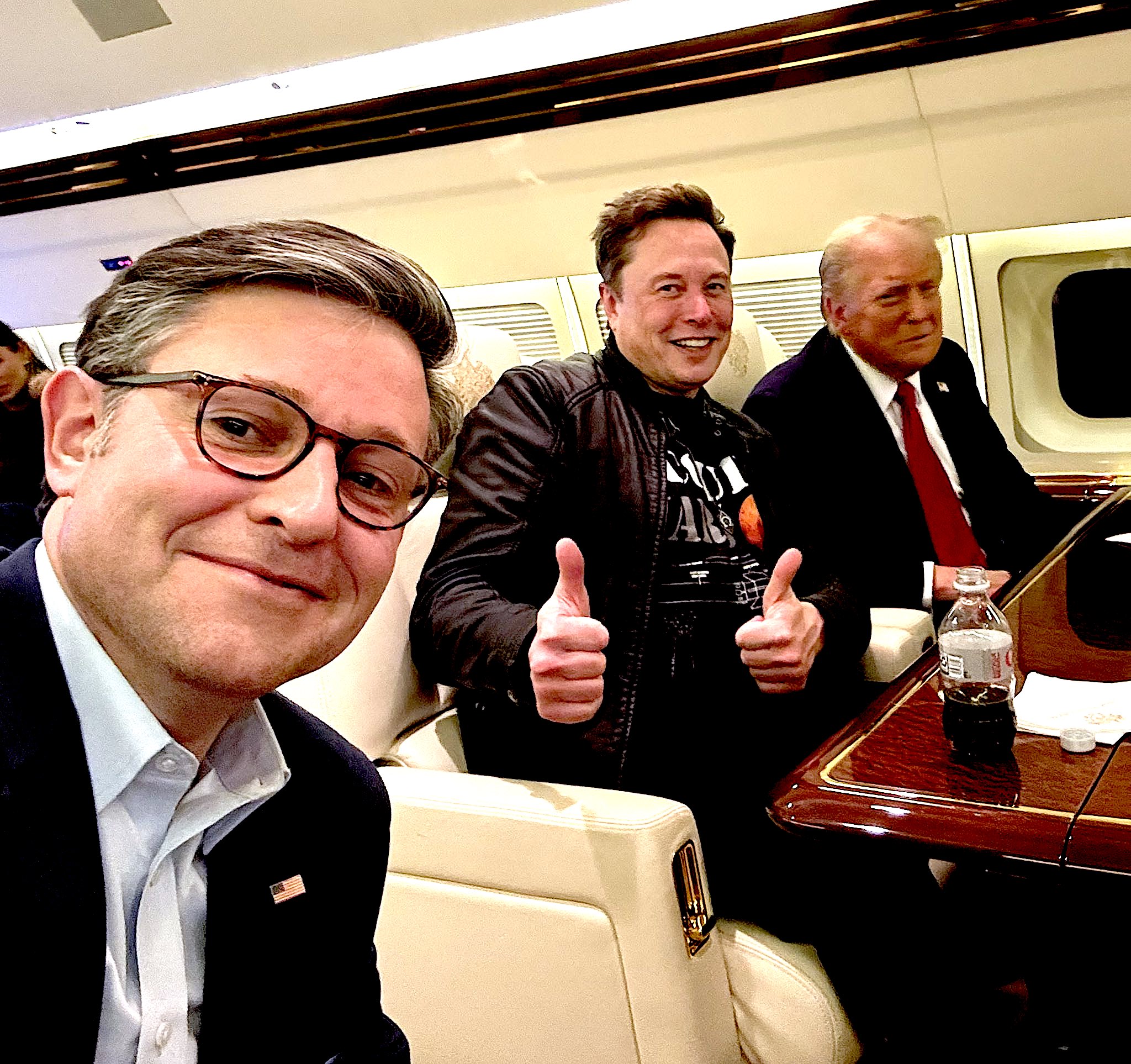
U.S. House Speaker Mike Johnson, Elon Musk and President-elect Donald Trump on Nov. 16, 2024. (Office of Speaker Mike Johnson, Wikimedia Commons, Public Domain)

Rather is correct. No other period in history has seen such a rapid and overwhelming buy up of our means of communications by the billionaire class – a fact that raises tough questions about freedom of speech and diversity of opinion.

Today, the world’s seven richest individuals are all major media barons, giving them extraordinary control over our media and public square, allowing them to set agendas, and suppress forms of speech they do not approve of.

This includes criticisms of them and their holdings, the economic system we live under, and the actions of the United States and Israeli governments.

Sitting on a fortune of over $480 billion, Elon Musk is the wealthiest person in world history, and is projected to, within the next decade, become the planet’s first trillionaire.

In 2022, Musk purchased Twitter, in a deal worth around $44 billion. The South-African born tech magnate quickly set about turning the platform into a vehicle for advancing his own far-right politics.

In 2024, for example, he was a key figure in promoting an attempt to topple Venezuelan President Nicolás Maduro, spreading misinformation about the country’s election and even threatening Maduro with a future in the notorious Guantánamo Bay prison camp.

He has also very publicly rewritten his generative AI chatbot, Grok, on multiple occasions, so it would produce more conservative responses to users’ questions. One result of this was that Grok began to praise Adolf Hitler.

Musk overtook Jeff Bezos last year to become the world’s richest man. And like Musk, the Amazon founder and CEO has made several moves into the world of media.

In 2013, Bezos bought The Washington Post for $250 million, and quickly began exerting his influence on the newspaper, firing anti-establishment writers and hiring pro-war columnists. This came just months after he bought a minority stake in Business Insider (now rebranded to Insider).

One year later, in 2014, Amazon paid nearly a billion dollars to purchase Twitch, a streaming platform which hosts around 7 million monthly broadcasters. Amazon also owns a wide range of other media ventures, including movie studio MGM, audiobook platform, Audible, and movie database website, IMDB.

French billionaire, Bernard Arnault, meanwhile, has been buying up large swaths of his country’s media outlets. The chairman of luxury conglomerate, Louis Vuitton Moët Hennessy (LVMH) and the world’s seventh-richest man now sits on a media empire that includes daily newspapers such as Le Parisien and Les Echoes, magazines such as Paris Match and Challenges, as well as Radio Classique.
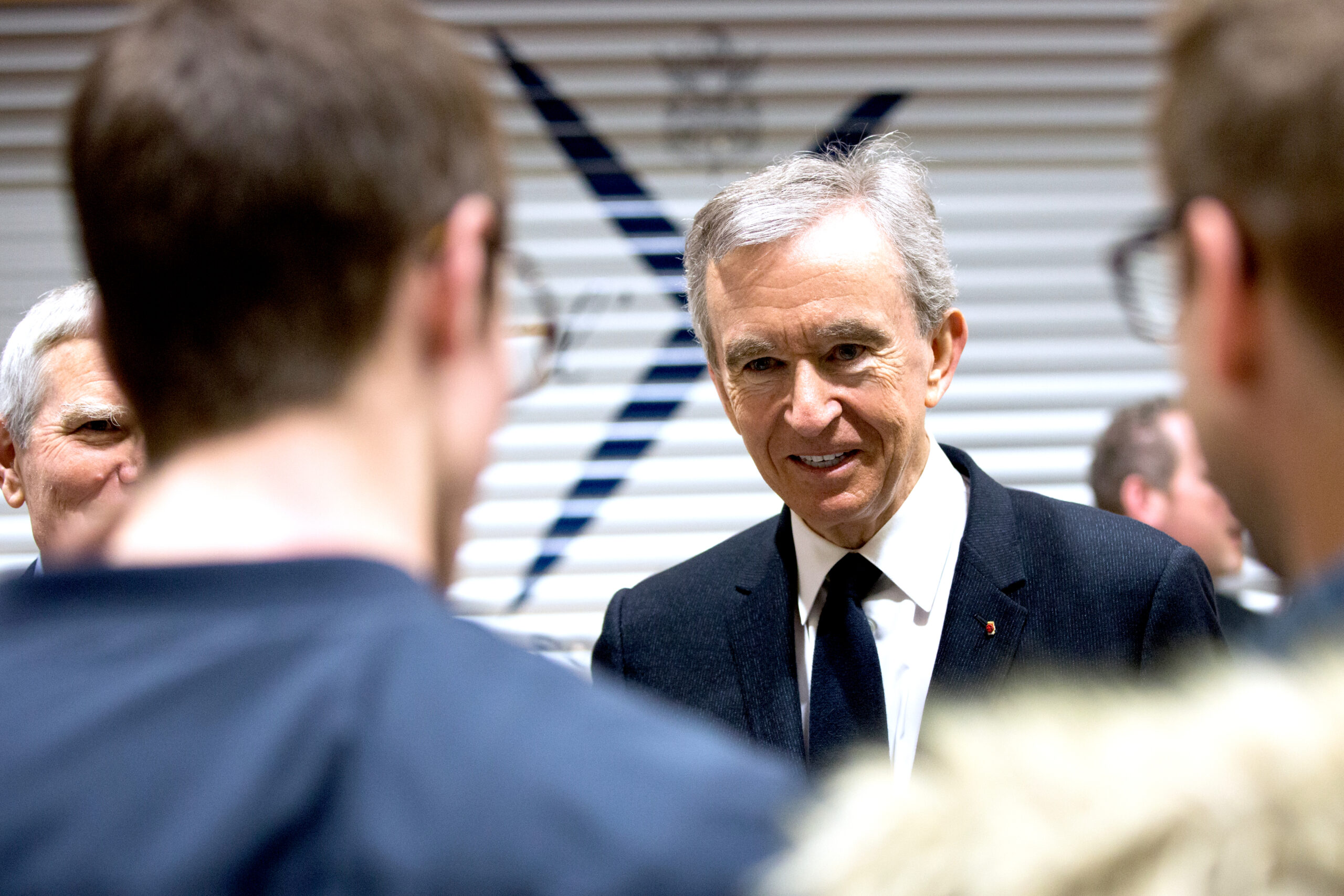
Bernard Arnault in 2017. (Jérémy Barande, CC BY-SA 2.0, Wikimedia Commons)

The remaining three individuals rounding out the top seven list all owe their wealth primarily to their media empires.

Google co-founders Sergey Brin and Larry Page are collectively worth over half a trillion dollars. Google has become the dominant force in today’s hi-tech economy, and is also a major player in social media, having bought YouTube in 2006 for $1.65 billion.

Thirty-five percent of Americans use the video platform as a primary source of news.
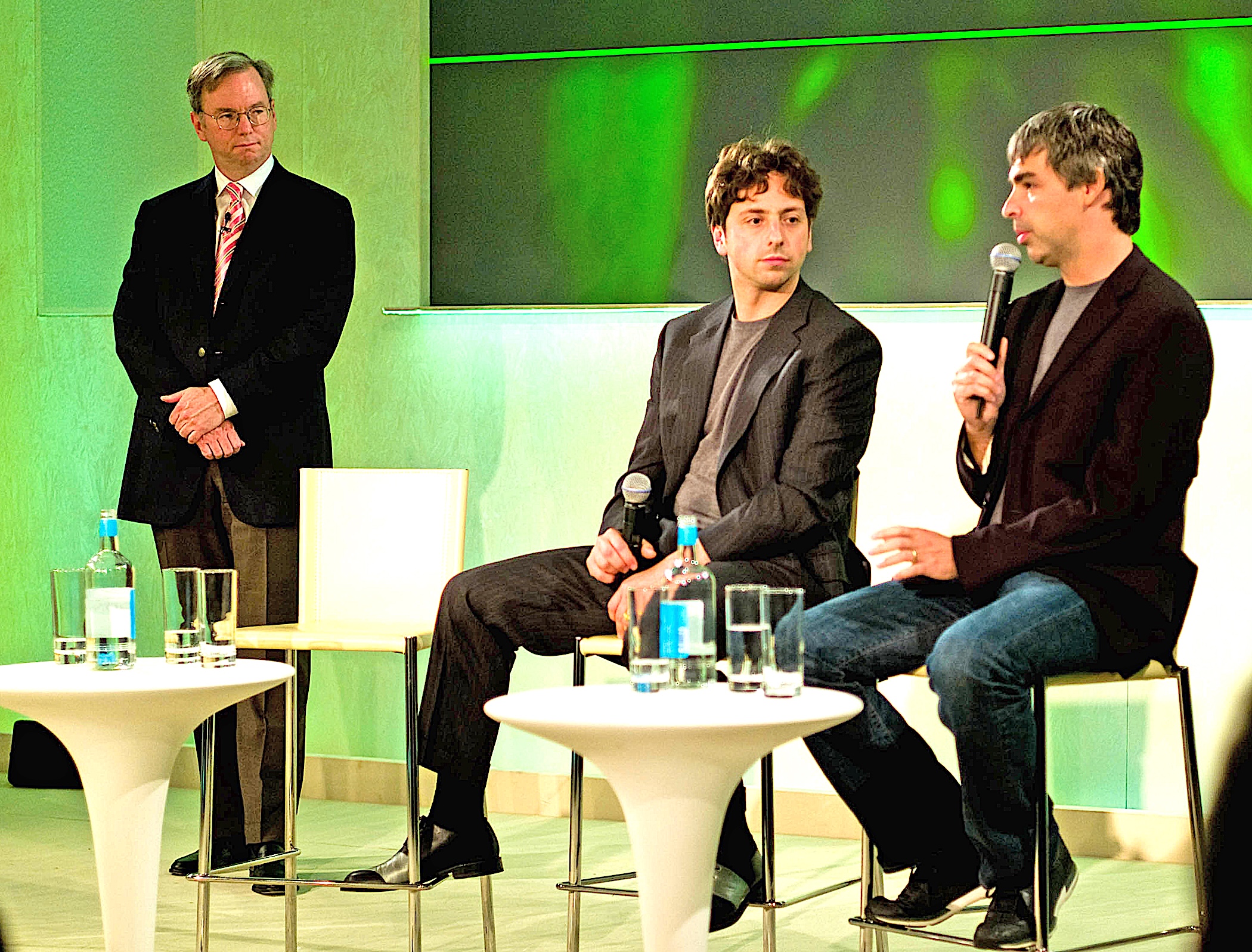
From left, Google’s Eric Schmidt, Sergey Brin and Larry Page, 2008. (Joi Ito /Wikimedia Commons/CC BY 2.0)

Mark Zuckerberg, meanwhile, owes his $203 billion fortune to his social media and tech ventures, including Facebook, Instagram, and WhatsApp. Like YouTube, Zuckerberg’s companies are major players in the modern news landscape, with 38 percent, 20 percent and 5 percent of Americans relying on Facebook, Instagram, and WhatsApp for their news and views.

MAGA Mouthpieces

Many of these wealthy individuals have joined forces with President Trump in an effort to support Republican policies and push a conservative worldview. Chief among these is the Ellison family, who quickly announced significant changes as CBS News, promising “unbiased” coverage and more “varied ideological perspectives” — widely understood as a shift towards right-wing, pro-Trump coverage.

Larry Ellison holds deeply conservative views, and became a top donor and fundraiser for the Republican Party, and a close Trump confident. Indeed, one Trump insider, noting his influence, went so far as to call Ellison the “shadow president of the United States.”

Musk, of course, very publicly turned Twitter into a conservative-dominated platform, and was an unofficial member of Trump’s cabinet, becoming de facto head of the Department of Government Efficiency.

Zuckerberg has also taken a number of steps to align his platforms with the MAGA movement, including firing his fact-checking team (widely associated with liberal politics) and prioritizing what he calls “free speech.” Content moderation teams, the Meta CEO said, would be moved from California to Texas, “where there is less concern about the bias of our teams.”

Zuckerberg replaced Meta’s president of global affairs, the former Liberal Democrat deputy prime minister of the United Kingdom, Nick Clegg, with prominent Republican Joel Kaplan, who was George W. Bush’s chief of staff.

He also appointed Dana White, the chief executive of the Ultimate Fighting Championship and a close Trump ally, to Meta’s board, despite his complete lack of relevant experience.

Many of these moves were likely made in response to Trump’s threat to imprison Zuckerberg “for the rest of his life” if he did anything to “cheat” him out of a 2024 presidential election victory. Zuckerberg subsequently met with Trump at Mar-a-Lago, and, alongside Bezos and other tech moguls, donated $1 million to Trump’s inaugural fund.
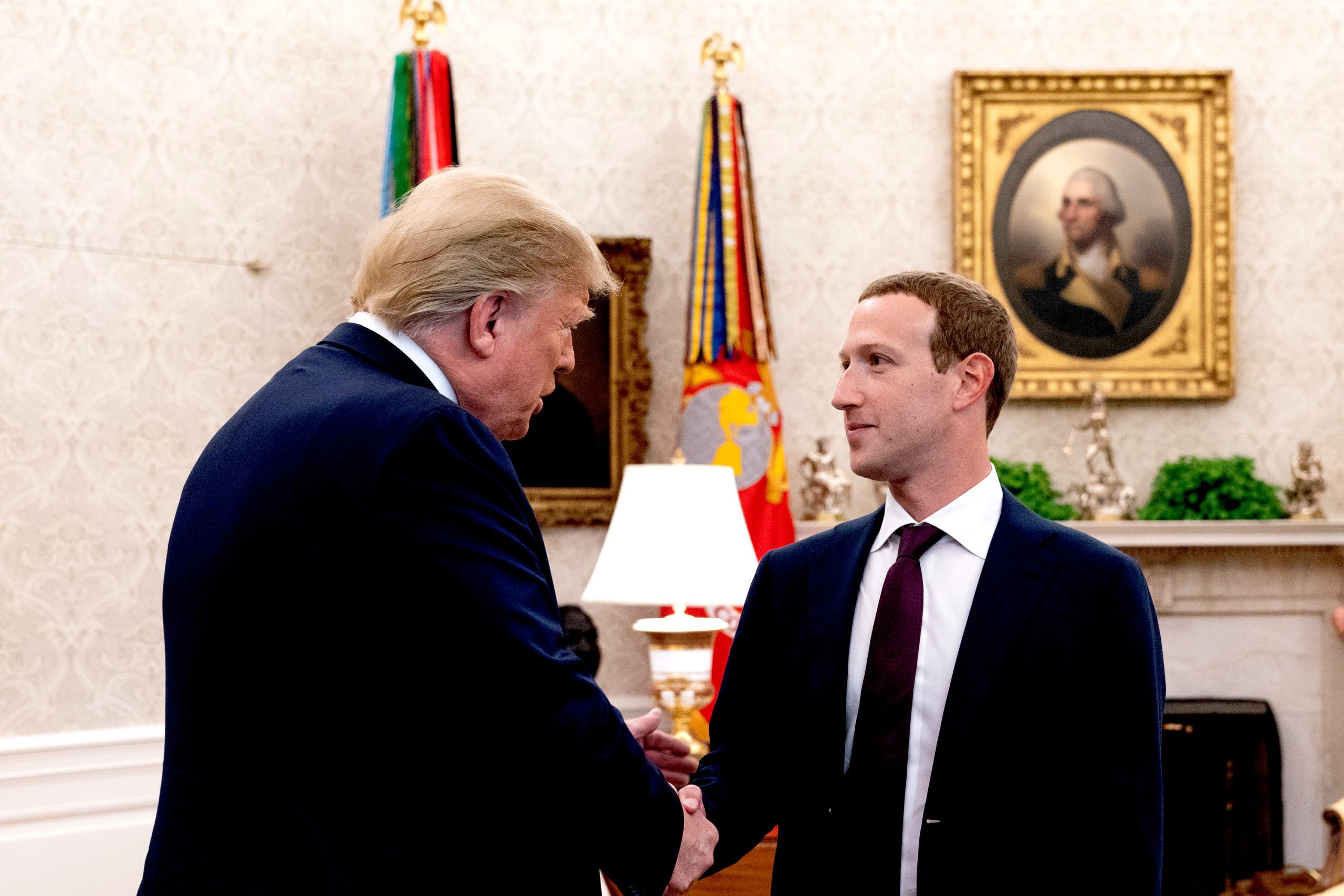
 Trump with Zuckerberg in the White House in September 2019. (White House, Joiyce N. Boghosian)

Bezos, meanwhile, pursued similar measures at The Washington Post, announcing that the newspaper would no longer publish opinions skeptical of capitalism.

“We are going to be writing every day in support of defense of two pillars: personal liberties and free markets,” Bezos wrote, noting that readers wishing to see alternative viewpoints can find them on “the internet.”

The decision was widely seen as a major shakeup, and provoked public opposition from Post employees. “Massive encroachment by Jeff Bezos into The Washington Post’s opinion section today,” said the newspaper’s lead economics journalist Jeff Stein. “[It] makes clear dissenting views will not be published or tolerated there.”

The move was quite the reversal for Bezos, who had once called Trump a “threat to democracy.” Yet, by January 2025, he was sitting with Zuckerberg, Musk and Arnault in prominent positions behind Trump at his inauguration.

Considering his nationality, Arnault has a surprisingly close relationship with Trump. In 2019, the French billionaire opened a new Louis Vuitton factory in Alvarado, Texas, a move that some have suggested was an attempt to please the president.

Trump attended the facility’s opening, calling Arnault an “artist” and a “visionary.”  Due to their relationship with the Trumps, the Arnault family have become unofficial intermediaries between the French and U.S. governments.

They were hosted by the Trumps at Mar-a-Lago in 2023, and, during an escalating trade war earlier this year, Bernard visited the White House to dampen down tensions between the U.S. and France.

Pentagon Contractors

A key factor in the rise of many of the world’s top seven richest individuals is their proximity to the U.S. national security state, with many of their companies growing wealthy in part due to feeding from the trough of Pentagon contracts.

Today’s wars and espionage rely as much on hi-tech computing equipment as tanks and guns, and in 2022, the Department of Defense awarded Amazon, Google, Microsoft, and Oracle a $9 billion cloud computing contract.

Bezos’ Amazon has long enjoyed a close relationship with the C.I.A., having signed a $600 million contract with the agency in 2014. Yet both Google and Musk’s aerospace company, SpaceX, have been intertwined with Langley since their inception.
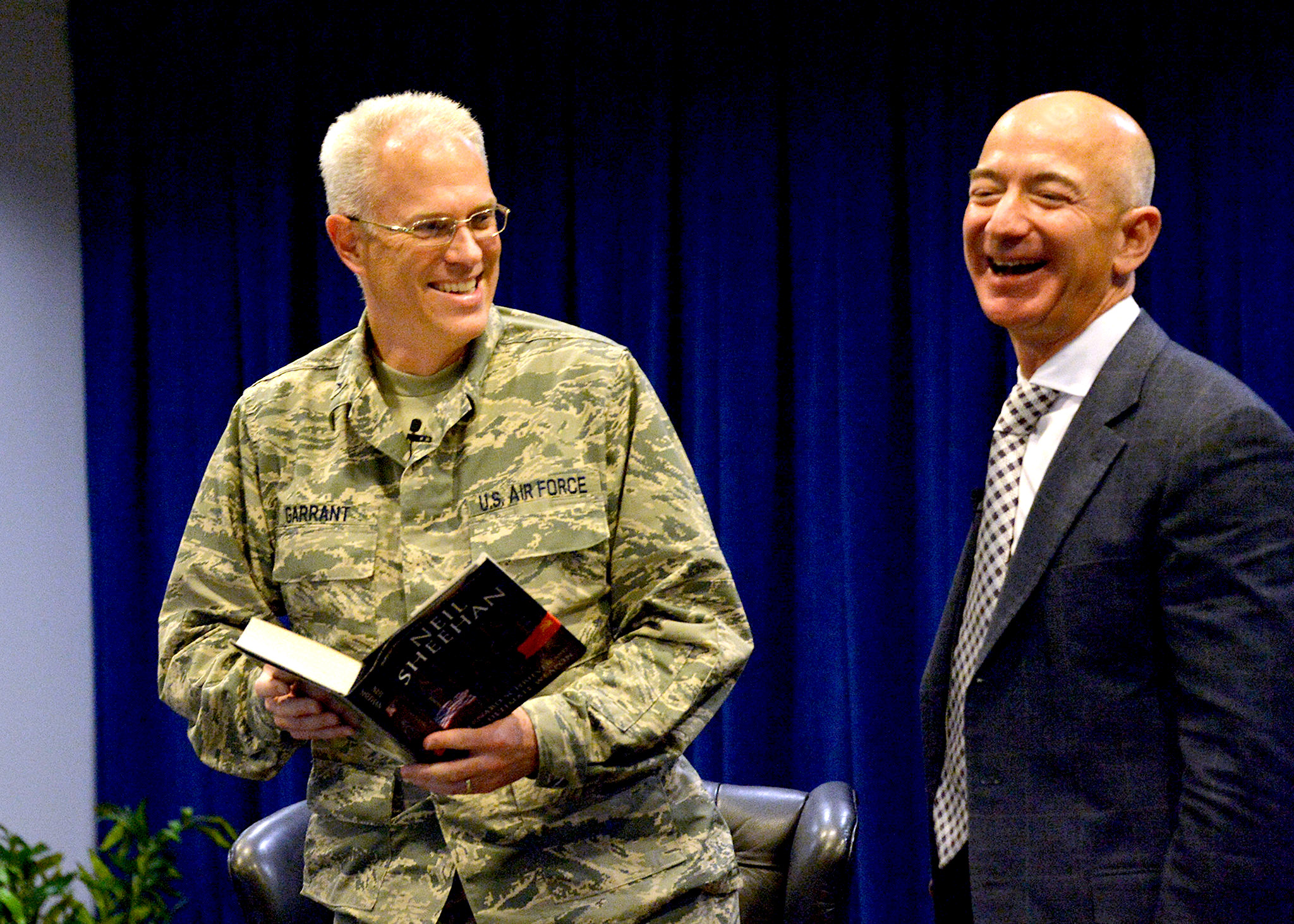
Bezos, on right, visiting the Los Angeles Air Force base, Space and Missile Systems center to speak at Gordon Conference Center, Oct. 25, 2017. (Los Angeles Air Force Base Space and Missile System Center/Flickr/Public Domain)

The C.I.A. bankrolled and oversaw Brin’s PhD research at Stanford University, work which would later form the basis of Google. As one investigation noted, “senior U.S. intelligence representatives including a C.I.A. official oversaw the evolution of Google in this pre-launch phase, all the way until the company was ready to be officially founded.”

As late as 2005, In-Q-Tel, the C.I.A.’s venture capitalist arm, was a major shareholder in Google. These shares were a result of Google’s acquisition of Keyhole, Inc., a C.I.A.-backed surveillance firm whose software eventually became Google Earth.

By 2007, the government was using enhanced versions of Google Earth to surveil and target enemies in Iraq and beyond, according to The Washington Post. By this time, the Post also notes, Google was partnering with Lockheed Martin to produce futuristic technology for the military.

There also exists a revolving door of employment between Google and various branches of federal government.

It would be no stretch, meanwhile, to state that Elon Musk owes his largesse in no small part to his intimate relationship with the C.I.A.

In-Q-Tel chief Mike Griffin helped birth SpaceX, providing support and advice from the beginning, and even accompanied Musk to Russia in 2002, where the pair attempted to purchase cheap intercontinental ballistic missiles to start the company.

Griffin repeatedly championed Musk at the C.I.A., describing him as the “Henry Ford” of the space industry, and worthy of the government’s full support.

Still, by 2008, SpaceX was in dire straits, with Musk unable to make payroll and believing both SpaceX and Tesla Motors would be liquidated. But he was saved by an unexpected $1.6 billion NASA contract that Griffin had helped secure.

Today, SpaceX is a powerhouse. But its primary customers continue to be U.S. government agencies, such as the Air Force, Space Development Agency and the National Reconnaissance Office. And recently, the Pentagon has recruited him to help it win a nuclear war.

A new SpaceX spinoff company, Castelion, is working on building a network of armed satellites circling North America, designed to shoot down enemy nuclear missiles.

A successful operation would give the United States an impervious shield, and allow it to act as it wants around the world, without threat of retaliation, effectively ending the era of mutually assured destruction, and plunging the planet into a dangerous new epoch.

Six of the seven members of Castelion’s leadership team and two of its four senior advisors are ex-Space X employees. The other two advisors are former high officials from the C.I.A., including Griffin himself. Elon named his oldest child Griffin Musk. Another of his sons, X Æ A-12, is named after a C.I.A. spy plane.

No billionaire, however, is more intimately connected to the C.I.A. than Larry Ellison. Ellison began his career by working with the C.I.A. on a database system called Project Oracle. In 1977, he would co-found tech giant Oracle (named after his previous project).

The C.I.A. was Oracle’s only customer for some time, before Ellison branched out and began to win contracts with other branches of the national security state, including Navy Intelligence, Air Force Intelligence and the NSA.

That close partnership continues to this day. In 2020, the company won a 15-year contract with the C.I.A. and 16 other U.S. intelligence agencies worth tens of billions of dollars.

And today, its upper ranks are filled with former C.I.A. executives. One example of this is Leon Panetta, former C.I.A. director and secretary of defense, who sits on its board of directors.

Arming & Supporting Israel

Another key attribute that many of the world’s richest individuals share is their passionate support for Israel and its expansionist project.

Nowhere is this more evident than with Ellison, who has made it his life’s goal to advance the Jewish State’s interests, both at home and abroad. Ellison is an enthusiastic supporter of Prime Minister Benjamin Netanyahu, with whom he vacationed on his private island in Hawaii.

So impressed was he with the embattled prime minister that he offered him a seat on Oracle’s board, replete with a yearly salary of $450,000.

Ellison is the largest single donor to the Israeli Defense Forces (IDF). In 2017 alone, he pledged $16.6 million to build a new training facility for IDF soldiers, whom he described as defending “our home.” At a fundraiser, he explained that:

“Through all of the perilous times since Israel’s founding, we have called on the brave men and women of the IDF to defend our home. In my mind, there is no greater honor than supporting some of the bravest people in the world, and I thank Friends of the IDF for allowing us to celebrate and support these soldiers year after year. We should do all we can to show these heroic soldiers that they are not alone.”

David Ellison is no less ardent a Zionist, and even met with a top Israeli general in order to aid a project spying on American citizens, according to an investigation by The Grayzone.

The scheme was aimed at attacking American citizens participating in pro-Palestine activism in the face of Israel’s attack on Gaza. The documents also mention Brin’s name as a potential collaborator in the plan.

Oracle’s Israeli CEO, Safra Catz, is also a close friend of Netanyahu’s, and describes the corporation as on a “mission” to support Israel. Together, Catz and Ellison have enforced a strict pro-Israel stance across the company.

In the wake of the October 2023 violence, Catz instructed that the words “Oracle stands with Israel” must be printed on company screens across the world in more than 180 countries.

Unsurprisingly, the support and collaboration with Israel has led to significant pushback among employees. Catz’s response to their concerns was blunt. “We are not flexible regarding our mission, and our commitment to Israel is second to none,” she said, adding:

“This is a free world and I love my employees, and if they don’t agree with our mission to support the State of Israel, then maybe we aren’t the right company for them. Larry and I are publicly committed to Israel and devote personal time to the country, and no one should be surprised by that.”

It has been widely reported, even in the corporate media, that the Ellison family’s foray into the world of media was triggered by their desire to help Israel in its public relations battle, something Tel Aviv is keenly aware that they are losing.

As Jonathan Greenblatt, director of the pro-Israel Anti-Defamation League said, “We really have a TikTok problem, a Gen Z problem,” explaining that young people around the world are being exposed daily to videos of Israeli aggression, leading to a PR disaster.

Former congressman Mike Gallagher, a leader in the attempts to ban TikTok, explained how his bill had failed, but, after Oct. 7, 2023, and the worldwide outrage at Israeli actions, it found new life on Capitol Hill, and was passed into law, forcing its imminent sale to a consortium led by Oracle.

This pro-Israel sea change has already occurred at CBS News, with the hiring of Bari Weiss as editor-in-chief. Weiss first came to public attention while still at college, founding an organization that attempted to have Muslim and Arab professors fired for their pro-Palestine views.

As the Financial Times noted, “Weiss has won over Ellison partly by taking a pro-Israel stance, according to people familiar with the matter.”

Last week, at the Jewish Leadership Conference, she stated that she sees her mission at CBS as “redraw[ing] the lines of what falls in the 40 yards of acceptable debate” in America by sidelining voices like Hassan Piker and Tucker Carlson, and elevate “charismatic” leaders like Alan Dershowitz, who represents “the vast majority of Americans.”

Zuckerberg’s platforms – Facebook, Instagram, and WhatsApp – have displayed a no less concerted bias in favor of Israel. As far back as 2016, Facebook was collaborating with the Israeli government on matters of censorship, with Justice Minister Ayelet Shaked revealing that the social media platform complied with 95 percent of her requests for pro-Palestine content to be removed.

The Facebook/Israel partnership was deepened in 2020 when the company appointed Emi Palmor, the former director general of the Ministry of Justice of Israel and an ex-spy with IDF intelligence group Unit 8200, to its oversight board, a 21-person committee ultimately in charge of the political direction of the site.

Zuckerberg’s platforms have long shut down Palestinian voices on dubious “hate speech” grounds. However, the censorship was drastically increased after the Oct. 7 attacks.

Human Rights Watch released a report detailing the “systemic censorship of Palestinian content on Instagram and Facebook,” noting how they reviewed 1050 cases of censorship of Palestinian voices, including those documenting human rights abuses against themselves.

The study concluded that 1049 of them were entirely peaceful utterances of support for Palestine, and did not break any of Meta’s terms of service.

In 2023, Instagram also inserted the word “terrorist” into the bios of thousands of users who mentioned they were Palestinian. When challenged on this, they claimed it was an auto-translation bug.

Internally, Meta staff have complained about systematic suppression of their voices and the creation of a “hostile and unsafe work environment” for Palestinian and Muslim employees.

WhatsApp, meanwhile, is a battleground in more than one sense. The Israeli military is using Palestinians’ WhatsApp data in order to track and target tens of thousands of people in Gaza. It is unclear how or whether Meta is collaborating with the Israeli military in this endeavor.

However, it has been suggested that some of the dozens of former Israeli spies now working in top jobs at Meta could be producing backdoors in the software, or simply passing the data onto their former colleagues.

A 2022 MintPress investigation found hundreds of former Unit 8200 operatives working at Meta, Google, Amazon, and Microsoft.

Zuckerberg himself is known to be a strong supporter of Israel, and has numerous familial connections to the state. After the October 2023 attacks, he released a statement denouncing Hamas and other resistance forces as “pure evil,” an action that earned him an official thank you from the State of Israel.

Musk has also put himself and his vehicles in the service of Israel. In November 2023, he traveled to Israel to meet with both Netanyahu and President Isaac Herzog and offer his unqualified support to their attack on Gaza.

Describing Hamas as “evil” and “revel[ing] in the joy of killing civilians,” Musk attempted to publicly whitewash Israeli violence, stating unequivocally that the IDF goes out of its way “to avoid killing civilians.” At the time of his visit, Israeli strikes had killed at least 20,000 people in four weeks of bombings.

Netanyahu has stated that Twitter is among Israel’s “most important weapons” in the war, and defended Musk from accusations of fascism, after he gave a Nazi salute at the Conservative Political Action Conference.

During his visit, Musk also signed a deal with the government of Israel, giving the latter effective control and oversight over Starlink communications portals operating in Israel and Gaza.

Google and Amazon, too, are key players facilitating the hi-tech genocide in Gaza. In 2021, the pair signed a $1.2 billion contract with the Israeli government to provide cloud computing and AI infrastructure to the IDF — technology that has been used to target the civilian population of the densely-populated strip.

The deal has sparked a rebellion among employees, who organized sit-ins and other protests against their collaboration.

Many other Google employees, however, are intimately linked with the State of Israel. There are at least 99 former Unit 8200 spies working in key positions at the Silicon Valley giant.

One prominent example is Gavriel Goidel, who was a longtime commander and head of learning at Unit 8200, before being hired by Google to become the company’s head of strategy and operations.

Google has also collaborated in disseminating Israeli government propaganda to tens of millions of Europeans, despite the content breaking its own terms of service.

Part of this may be down to the disposition of Brin himself. Normally avoiding the limelight and refraining from making political statements, the Russian-born magnate bitterly condemned the United Nations as “transparently antisemitic” after it released a report detailing his company’s participation in the Gaza genocide.

“Throwing around the term genocide in relation to Gaza is deeply offensive to many Jewish people who have suffered actual genocides,” he added.

Arnault has remained quiet on Gaza. He has, however, invested heavily in Israel. Diamonds and other precious stones are a mainstay of the Israeli economy, and the Frenchman’s luxury brands disseminate the stones globally.

Activists have called for Israeli diamonds to be labeled conflict minerals and boycotted by ethical consumers. He also invested in Israeli tech and security firm, Wiz, a company recently purchased by Google for $32 billion.

Earlier this month, LVMH signed a $55 million deal with Israeli actress and former IDF soldier, Gal Gadot, making her the face of their brand.

We are living in an era of unprecedented global inequality. Together, these seven individuals —  Musk, Ellison, Page, Brin, Bezos, Zuckerberg and Arnault — control more wealth than the bottom 50 percent of humanity (over 4 billion people) combined. Sitting on heretofore unimaginable fortunes, they have begun buying up assets, including media outlets, at record pace.

For billionaires, the utility of capturing the press is threefold: firstly, it shields them and their class from press scrutiny and criticism.

Second, it gives them a mouthpiece to push the public debate towards even more business-friendly laws and regulations. And third, they can use their outlets to champion any causes and promote any other agendas they have.

We have seen all three play out here, as, collectively, our press is rapidly moving towards more conservative, pro-Trump, pro-Israel positions, shutting out any dissenting voices from their ranks.

The effect on democracy, a free society, and the public’s right to a diversity of opinions has been highly deleterious. When it comes to media, we already suffered from an illusion of choice.

However, the supercharged concentration of ownership of American and global media in the hands of just a handful of individuals has only exacerbated this problem.

There once was a time that individuals looking for alternative viewpoints would simply go online to find them. But with censorship of dissenting opinions — particularly on Israel/Palestine — growing, this is becoming increasingly unviable.

In short, then, what the planet’s mega-rich capture of our media system shows is that billionaires are not only a serious drain on resources, but an existential threat to an open society and the free flow of information.

Alan MacLeod is senior staff writer for MintPress News. He completed his PhD in 2017 and has since authored two acclaimed books: Bad News From Venezuela: Twenty Years of Fake News and Misreporting and Propaganda in the Information Age: Still Manufacturing Consent, as well as a number of academic articles. He has also contributed to FAIR.orgThe GuardianSalonThe GrayzoneJacobin Magazine and Common Dreams. Follow Alan on Twitter for more of his work and commentary: @AlanRMacLeod.

This article is from MPN.news is an award winning investigative newsroom.  Sign up for their newsletter.

Views expressed in this article and may or may not reflect those of Consortium News.

A New Strategic Architecture: Putin’s India Visit and the Recasting of a Decades-Old Partnership

By Kautilya The Contemplator, Substack, 12/5/25

Russian President Vladimir Putin’s high-profile visit to India has become one of the most consequential diplomatic moments of the year, not only for the scale of agreements unveiled, but also for the unmistakable symbolism that accompanied it. At a time when New Delhi faces unprecedented tariff pressure from Washington and Moscow remains under expansive Western sanctions, Prime Minister Narendra Modi’s decision to personally receive Putin at Delhi’s Palam airport dominated Indian media. This was not routine protocol. It was a clear geopolitical signal. Traditionally, foreign heads of state are received by a junior minister or, exceptionally, the Minister of External Affairs. Modi’s appearance on the tarmac, accompanied by a warm embrace and a shared car ride, constitutes the highest level of diplomatic courtesy India accords any leader.

Media Optics and the Symbolism of Modi’s Welcome

Indian television channels and newspapers treated the moment as a landmark event. Mainstream outlets like NDTV, India Today, Hindustan Times and DD India ran continuous minute-to-minute coverage, framing the welcome as “rare,” “symbolic,” and an expression of India’s sovereign agency. The visual narrative of Modi breaking protocol, flags lining Rajpath and Putin receiving a tri-services Guard of Honor and a 21-gun salute at Rashtrapati Bhavan, projected a partnership unshaken by Western pressure.

This symbolism carries added significance in 2025. The United States, under the Trump Administration, has imposed a punitive 50% tariff wall on key Indian exports, explicitly linking the additional 25% penalty to India’s continued purchase of discounted Russian oil. Western governments have simultaneously pressured India to scale back its defense and energy ties with Moscow. Against this backdrop, India’s elaborate welcome for Putin was both a reassurance to Moscow and a message to the world that India’s strategic autonomy is not negotiable.

Groundbreaking Economic and Strategic Agreements

In total, the two sides finalized ten inter-governmental agreements and fifteen commercial contracts, inaugurating what both leaders have called a “new economic architecture” for the partnership.

Economic Cooperation Program to 2030

The centerpiece is the Economic Cooperation Program to 2030, which, for the first time, sets explicit, measurable targets, including $100 billion in bilateral trade by 2030. Earlier Modi–Putin summits spoke about expanding trade in general terms. This roadmap introduces hard timelines and structural reforms. Crucially, it aims to rebalance a trade profile skewed by India’s heavy imports of Russian crude. The framework seeks to boost Indian exports across pharmaceuticals, machinery, agriculture, IT services and manufactured goods.

Uralchem Fertilizer Joint Venture

A landmark component is the Uralchem fertilizer joint venture, under which Indian public-sector firms will co-invest in a major gas-based urea plant in Russia dedicated to long-term Indian demand. This moves the partnership beyond a buyer–seller relationship toward shared industrial capacity, a strategic hedge for India, whose food security depends on stable fertilizer supplies. For Russia, it guarantees a secure and long-term downstream market.

Oil Supplies

In energy, Putin publicly pledged “uninterrupted oil supplies” to India, a direct counter to Western attempts to restrict Russian crude flows. This assurance, combined with expanded rupee–rouble settlement systems and mechanisms to channel surplus rupees into Indian assets, marks a major step toward a sanctions-resilient energy and financial corridor.

Pharmaceuticals, Shipbuilding and Arctic Exploration

Beyond fertilizers and oil, the summit significantly advanced cooperation in shipbuilding, pharmaceuticals and Arctic exploration. For India, shipbuilding is strategically crucial. As it becomes a great power and seeks to carry a much larger share of its own trade, it needs a vastly expanded merchant navy. Yet, today Indian yards account for well under 1% of global shipbuilding output, underscoring why access to Russian technology and commercial shipbuilding expertise matters so much. As such, India and Russia agreed to deepen collaboration in civil shipbuilding, including technology transfer, vessel maintenance and greater Indian use of Russian shipyards, an area strategically relevant to India’s Indo-Pacific maritime ambitions.

In pharmaceuticals, Russia committed to supporting Indian companies expanding production and distribution in the Russian market, positioning India as a key supplier at a moment when Western pharmaceutical presence in Russia is shrinking. The leaders also highlighted intensified cooperation in the Russian Arctic and Far East, ranging from hydrocarbon and mineral projects to new shipping routes where India’s investment and manpower are expected to play an increasingly central role in Russia’s pivot to Asia.

Labor Mobility and Tourism Facilitation

The summit also broke new ground in labour mobility. India and Russia are establishing structured pathways for skilled Indian workers, particularly in IT, engineering, construction and healthcare, to take up employment in Russia, while India’s introduction of free e-visas for Russian tourists aims to widen people-to-people ties. This is the first concrete institutional mechanism addressing Russia’s labour shortages and India’s demographic strengths.

Defense Cooperation

Defense cooperation, long the backbone of the partnership, received renewed focus. The leaders accelerated arrangements for S-400 air defense system support, discussed upgrades to legacy platforms and emphasized joint production and localization under India’s “Atmanirbhar Bharat” initiative, a key shift in the defense cooperation framework. This marks a subtle but important development. Rather than diluting defense ties, as many Western analysts had expected, India is converting them into joint industrial capability, thereby strengthening sovereignty in defense manufacturing.

How This Summit Differs from Earlier Modi-Putin Meetings

Compared with earlier bilateral summits, from Delhi 2014 to Moscow 2024, the 2025 summit represents a qualitative shift. Previous meetings largely operated within the established frameworks of arms sales, nuclear power, hydrocarbons and diplomatic coordination. They reinforced the legacy of India–Russia ties but did not fundamentally update the underlying economic or technological architecture.

This summit does precisely that. It transforms the partnership from a collection of sectoral engagements into a strategically diversified, interdependent ecosystem built for today’s era of economic coercion, sanctions warfare and supply-chain vulnerabilities. It also expands cooperation in areas other than defense and energy.

Strategic Autonomy in a Shifting Global Order

The geopolitical context amplifies the significance of these agreements. India today is balancing a complex triad that involves a defense and technology partnership with the United States, a sanctions-stricken but indispensable energy and defense partner in Russia and a Europe aligned with Washington’s sanctions architecture. The 50% US tariff wall, linked explicitly to India’s refusal to reduce Russian oil imports, represents one of the sharpest episodes of economic coercion India has faced from a major partner.

Against this backdrop, Modi’s airport welcome and the sweeping summit outcomes amount to a declaration of strategic autonomy in practice, not rhetoric. India is signaling that it will simultaneously negotiate with the US, deepen cooperation with Russia and maintain its independent geopolitical trajectory.

The 2025 visit thus stands out as a pivotal moment. It reasserts the longevity and adaptability of India–Russia ties, produces a new economic and industrial architecture resilient to external shocks and demonstrates India’s willingness to act as a sovereign pole, not a subordinate, in a rapidly polarizing world.

In short, this was not just another annual summit. It was the unveiling of a new strategic framework for the next decade of India–Russia cooperation, one built to withstand sanctions, tariffs and geopolitical turbulence. India and Russia have responded by tightening, not loosening, their alignment. In doing so, they have reshaped the trajectory of one of the world’s most durable strategic partnerships.

Putin interview with Indian TV on the eve of his trip to India (Excerpt no US, Russia, and Ukraine)

Kremlin website, 12/4/25

Geeta Mohan: Mr President, things have changed a little between the US and Russia. The fact that America is engaging you, we would have loved to be a fly on the wall when you were meeting with Jared Kushner and Steve Witkoff. That was an important meeting. Were there red lines that Russia reiterated? What really happened?

Vladimir Putin: It’s premature to discuss that now. I doubt it would interest you to hear about it, as it lasted five hours. Frankly, even I grew weary of it – five hours is too much. However, it was necessary because…

Anjana Om Kashyap: Five hours! Witkoff and Kushner?

Vladimir Putin: Yes, and I was alone. Can you imagine it?

But speaking seriously, it was a very productive conversation, as what our American colleagues presented was, in one way or another, based on our prior agreements made before my meeting with President Trump in Alaska. We had discussed these very issues, to some extent, at the meeting in Anchorage. However, what the Americans brought us this time was truly new; we hadn’t seen it before. Therefore, we had to go through practically every point, which is why it took so much time. So it was a meaningful, highly specific, and substantive conversation.

Anjana Om Kashyap: Were there certain specific points of disagreement?

Vladimir Putin: Yes, such issues were raised, we discussed them. But this is a complex task and a challenging mission that President Trump took upon himself – fair enough, I say without irony, because achieving consensus among conflicting parties is no easy task. But President Trump, truly, I believe, he sincerely tries to do this.

We went through each point again, let me reiterate this. Sometimes we said, “yes, we can discuss this, but with that one we cannot agree.” That was how the work proceeded. To say now what exactly doesn’t suit us or where we could possibly agree seems premature, since it might disrupt the very mode of operation that President Trump is trying to establish.

But that’s what they do – shuttle diplomacy. They spoke with Ukrainian representatives, then with Europeans, came here, had another meeting with Ukrainians and Europeans. I think we should engage in this effort rather than obstruct it.

Geeta Mohan: You are saying that the 28 points peace proposal is not on the table?

Vladimir Putin: They’re discussing – that’s what they’re discussing right now. They simply broke down those 28 points, then 27, into four packages and proposed discussing these four packages. But essentially, it’s still just the same old 27 points.

Anjana Om Kashyap: We will go back to that and try to understand how it’s going forward.

What happened in Alaska? You met President Trump and it was all about the peace deal, right? What happened? Did you actually have sense of or see a sincere intent?

Vladimir Putin: Yes, there was indeed a sense – no, more than just a sense, I have absolutely no doubt that President Trump had genuine intentions (we won’t discuss here what caused them or why they appeared, but they’re definitely present). Both the United States and President Trump likely have their own understanding of why this needs to be resolved quickly.

Moreover, by the way, on humanitarian grounds too. I truly believe that is one of the motives behind President Trump’s actions regarding this matter because he constantly speaks about his wish to minimise losses, and I’m confident that his sincerity is genuine. He undoubtedly considers these humanitarian concerns when formulating his decisions.

However, other factors also come into play: political considerations and economic interests. Therefore, I believe that the US is actively seeking a solution to this problem.

Geeta Mohan: Yes, he has spoken about intentions, you’re right about. He claimed he would end wars and conflicts – causing consternation in India when he claimed that he had brought peace between India and Pakistan, now he’s looking at Russia and Ukraine. Do you really think he’s a peacemaker?

Vladimir Putin: Regarding the situation in Ukraine – yes, let me repeat once again, I am absolutely certain, with no doubt at all, he sincerely aims for a peaceful resolution.

Let me stress once again: the United States may have various reasons for this – humanitarian ones personally for Trump because he genuinely wants to end hostilities and prevent further loss of life, but there could also be political interests tied to ending the confrontation between Russia and Ukraine, or economic motives too. By the way, they can be in the energy area and in other areas. There are numerous areas where restoring economic relations between the US and Russia would benefit both sides.

I showed you some letters – I won’t go into this now – large US companies sent to us. We should remember this.

Comment: Really?

Vladimir Putin: Of course. About their existence. They’re waiting until all problems are solved, and they’re ready to return to us, they want this, asking us not to forget about them. The letters are there.

Comment: It’s surprising.

Vladimir Putin: What’s so surprising about that? Many want to return. So, of course, the Indian government is saying right: “Why should we leave…?”

Geeta Mohan: They arrived with letters from companies – quite astonishingly unexpected indeed.

Vladimir Putin: No, I believe there has been a misunderstanding. We have letters from American companies – letters they have sent us, where they urge us not to forget about their existence. These are our former partners, who did not leave by choice. They express a clear desire to resume cooperation and are waiting, among other things, for a corresponding political signal.

Anjana Om Kashyap: This conversation is becoming very interesting because there are so many highlights of understanding and it is really pleasant to see you, and your sense of humour, and how you are putting things forth.

But now we are going to go into a very serious matter – and that is the Russia-Ukraine war. So what, in your view, would constitute a victory for Russia in the Russia-Ukraine war? What are the red lines? Because you have, and I quote you, you have said very clearly that Russia will lay down arms only if Kiev’s troops withdraw from the territories claimed by Russia, which parts would that be?

Vladimir Putin: You know, it’s not about victory, like you have said. The point is that Russia is determined – and will certainly do so – to protect its interests. Protect its people living there, protect our traditional values, Russian language, and so on. Protection, by the way, of religion that has been cultivated on these lands for centuries. Yet you know that the Russian Orthodox Church in Ukraine is almost banned: they seize churches, drive people out of temples, etc. – it is a problem. And I’m not even mentioning the ban on the Russian language, etc. It is all part of a big set of issues.

Let me remind you: we were not the ones to start this war. The West egged Ukraine on and supported the events, orchestrating a coup d’état. That was the point that triggered the events in Crimea, followed by developments in southeastern Ukraine, in Donbass.

They don’t even mention it – we’ve tried to resolve these issues peacefully for eight years, signed the Minsk agreements, hoping that they could be resolved through peaceful means. But Western leaders openly admitted later that they never intended to honour those agreements, signing them merely to allow Ukraine to arm itself and continue fighting against us. After eight years of relentless violence against our citizens of Donbass – something the West hasn’t uttered a word about – we were forced to recognise these republics first, and secondly, provide support. Our special military operation isn’t the start of a war, but rather an attempt to end one that the West ignited using Ukrainian nationalists. That’s what is really happening now. That’s the crux of the problem.

We will finish it when we achieve the goals set at the beginning of the special military operation – when we free these territories. That’s all.

Anjana Om Kashyap: What is the end gain for Vladimir Putin in Ukraine?

Vladimir Putin: I have said that already. Listen, we didn’t recognise these self-proclaimed republics for eight years. Eight years. They declared independence, while we were trying to establish relations between the rest of Ukraine and those republics. But when we realised this was impossible, that they were simply being destroyed, we had no choice but to recognise them – and not just their existence on part of the territory, but within administrative boundaries established during Soviet times, then later under independent Ukraine after its independence, still within those administrative borders.

And right away we told Ukraine, the Ukrainian troops: ”People don’t want to live with you anymore. They voted in a referendum for independence. Withdraw your troops from there, and there won’t be any military actions.“ No, they chose to fight instead.

Now they have pretty much fought themselves into a corner, all this boils down to one thing: either we take back these territories by force, or eventually Ukrainian troops withdraw and stop killing people there.

Anjana Om Kashyap: Before we move to the other one, just one last question. On March 8, 2014, during the annexation of Crimea, you were addressing the Federation Council and you said, ”Kiev is the mother of all Russian cities.“ What did you mean?

Vladimir Putin: Here I haven’t made up anything – historically this is how it was said. Originally, the Russian state was formed from several centres. The first capital, according to history, was in Novgorod in the northwest. Later the federal status moved to the city of Veliky Novgorod, and then it moved to Kiev. This was Ancient Rus. And since then, Kiev has been known as the ”mother of all Russian cities.“

Later, historical events unfolded in such a way that the ancient Russian state split into two parts. One part began developing with Moscow as its centre, while another part fell under other countries. For instance, the part with Kiev, along with some other lands, these parts first formed a state with Lithuania, subsequently merged with Poland, forming the Polish-Lithuanian Commonwealth. Thus, this part of the ancient Russian state ended up in Poland, and by the seventeenth century, it sought to return back to Russia.

Geeta Mohan: The fact that you know, you were mentioning the history and it brings me to what I did when the conflict was underway. I had travelled to Donetsk, I had travelled to Lugansk, Zaporozhye, Kherson, and most of the people there are Russian-speaking, they speak Russian language. They were very disappointed that Kiev had banned that language in eastern Ukraine. But they were also a little shocked at how Putin is doing this to us, we are his people. A lot of women I spoke to were in shock. So, what do you have to say to people in eastern Ukraine who actually have families in Russia, who, on a daily basis, move from Ukraine to Russia. What do you have to say to them?

Vladimir Putin: I didn’t understand the question. What exactly shocked them?

Geeta Mohan: They were shocked that there was an operation that happened, and their homes were destroyed, because they lived in eastern Ukraine. And they have love for Russia and the Russian people, and they are Russian-speaking themselves.

Vladimir Putin: The answer is quite straightforward. These individuals presumably resided in those parts of Ukraine – specifically, in the areas of the Lugansk or Donetsk region – that remained under the control of the Kiev authorities at the time. Meanwhile, that part of the Lugansk or Donetsk region outside their control was being subjected to intense military action by the Kiev authorities. We were consequently forced to extend support to those areas that had declared independence. That is the first point.

Secondly, we provided people with an opportunity to express their will in an open referendum. Those who believed it was in their interest to join Russia voted accordingly. Those who did not were free to leave unhindered for other parts of the Ukrainian state. We have never placed any obstacles in the way of that choice.

Geeta Mohan: What do you make of President Zelensky? He was promised NATO, the European Union promised him the EU. But nothing really happened. Was NATO ever on the table for Ukraine?

Vladimir Putin: When this gentleman came to power, he declared that he would pursue peace at all costs, using every means possible, without sparing even his career. But now we see things differently. He follows the same pattern as his predecessors – putting the interests of a narrow nationalist group, particularly radical nationalists, ahead of those of the people. Essentially, he is addressing their concerns rather than those of the nation.

This regime’s mindset truly resembles a neo-Nazi regime because extreme nationalism and neo-Nazism are almost indistinguishable concepts. Today, undeniably, military action dominates their approach. However, they haven’t achieved much success here either.

I have already said before that what matters most for them is realising that the best way to resolve the problems is through peaceful negotiations, and we attempted to negotiate with them back in 2022. What exactly they plan to do remains to be asked from them directly.

Anjana Om Kashyap: That would be interesting to see what they have to say on that, and how this peace process goes forward.

But you have always said that the eastward expansion of NATO is your real concern. Ukraine has not got this NATO membership as of now. My question to you – is NATO expansion a real threat or just a pretext for what you think is a part of Ukraine which is probably you want control over? Or you think that injustice is being done, the Russian language is being banned – these are the real issues?

Vladimir Putin: Listen, NATO is another matter altogether. The Russian language, Russian culture, religion, and even territorial issues – these are very important topics, one subject. NATO is something entirely different. We don’t demand anything exclusive for ourselves here.

First of all, there are general agreements that the security of one state cannot be guaranteed by undermining the security of others. This idea might seem somewhat obscure, but I’ll explain it simply. Each country, including Ukraine, has the right to choose its own means of defence and ensure its own safety. Correct? Absolutely correct. Do we deny Ukraine this? No. But it’s not acceptable if done at Russia’s expense. Ukraine believes it would benefit from joining NATO. And we say: that threatens our security, let’s find a way to secure yours without threatening us.

Secondly, we are not asking for anything unusual or unexpected, nothing falling from the sky. We are just insisting on fulfilling the promises already made to us. These weren’t invented yesterday. They were pledged to Russia back in the ’90s: no expansion eastward—this was stated publicly. Since then, several waves of expansion took place, culminating with Ukraine being drawn into NATO. This completely displeases us and poses a serious threat. Let’s remember that NATO is a military-political alliance, and Article Five of the Washington Treaty establishing NATO hasn’t been repealed. It’s a threat to us. Nobody bothers to take us seriously.

Lastly, when Ukraine became independent, few people recall this: what was the first document ratifying independence? It was the Declaration of State Sovereignty, Independence of Ukraine. That forms the foundation of Ukrainian sovereignty and modern statehood. And it clearly states that Ukraine is a neutral state.

Geeta Mohan: Was that also the basis for what happened when you decided to annex Crimea, you only seized the water port, a very important strategic port for Russia? And then Russia was no longer part of the G8. Today, the West claims, or says, that you actions in the recent past are the reason for, and I quote-unquote, the isolation of Russia.

Vladimir Putin: We didn’t need to seize that important port in Crimea because it was ours already – our Navy had been stationed there under the agreement with Ukraine, which is a fact. After the collapse of the Soviet Union, our fleet remained there regardless. The matter isn’t about that, though it’s significant, but that’s not what we’re talking about here.

And we did not annex Crimea, I want to emphasise this point. We simply came to help people who didn’t want their lives or fate tied to those who staged a coup in Ukraine. They said: “Hey, nationalist extremists took over in Kiev. Did anyone ask us? Ok, we ended up as part of independent Ukraine after the dissolution of the USSR. So be it, history happened like that. Fine, ok, now we’ll live that way. But we believe that we exist in a democratic state. And if coups happen here with unknown consequences, then we won’t accept that, we don’t want to live like that.” There was a threat not just of pressure, but of outright violence against the Crimeans. Russia stepped in to help them. How could we do otherwise? If someone believes differently, thinking that Russia would act differently, they’re deeply mistaken. We’ll always defend our interests and our people…

Ben Aris: NYT details institutional corruption in Zelenskiy’s government

By Ben Aris, Intellinews, 12/7/25

In a damning report, the The New York Times (NYT) detailed institutional corruption in the Zelenskiy administration, where the government has systematically undermined checks and balances to appoint its placemen in charge of key companies and institutions. 

President Volodymyr Zelensky’s government systematically dismantled independent oversight mechanisms in key state-owned enterprises, undermining anti-corruption safeguards even as billions of dollars in Western aid flowed into Ukraine, NYT reported on December 5. [https://www.nytimes.com/2025/12/05/world/europe/ukraine-corruption-zelensky.html]

The investigation, based on interviews with about 20 Ukrainian and Western officials and reviewed documents, found that Kyiv stacked supervisory boards with loyalists, left seats vacant, or delayed their formation altogether. These boards—mandated by international donors to monitor procurement, executive appointments and spending—were often rendered powerless through political interference and revised company charters.

“They understood that as soon as they start the activities of the supervisory board they can lose control,” Oleksii Movchan, a member of parliament from Zelensky’s own party who has supported stronger oversight mechanisms to the NYT. “They didn’t want to lose control.”

The report comes in the midst of the mushrooming Energoatom corruption scandal that has already claimed the heads of two ministers and head of Ukraine’s presidential office, Andriy Yermak, who was forced to resign on November 28 after the National Anti-Corruption Bureau of Ukraine (NABU) raided his office and home.

The scandal centres on Timur Mindich, Zelenskiy former business partner and close personal friend, who ran a $100mn kickback scheme using his influence. He skipped the country only hours before NANU searched his home and offices, where a solid gold toilet was discovered as well as bundles of hundreds of thousands of dollars and euros in cash. He is reportedly sheltering in Israel, which does not extradite its citizens.

Zelenskiy has sanctioned Mindich for three years, but no arrest warrant has been issued. Zelenskiy’s reputation has taken a severe blow as a result of the scandal and comes just as the EU is battling to raise an additional €140bn to fund Ukraine’s war with Russia with the highly controversial Reparation Loan.

The EU is highly displeased and warned Kyiv that it won’t be allowed to join the EU unless it eradicates corruption from the government.

Ukraine’s reputation as a feisty David to Russia’s Goliath is now being dragged in the dirt. The NYT report centres on Energoatom, the state nuclear energy company. The administration has blamed the company’s supervisory board for failing to prevent the corruption, and Zelenskiy has ordered a shake up of the management of the entire energy sector. But NYT found that the board was deliberately hobbled by delayed appointments and unfilled seats, in moves to consolidate Bankova (Ukraine’s equivalent of the Kremlin) control over the company.

A former British financier and incoming board member, said he had planned to scrutinise a controversial $600mn reactor deal but was blocked from taking office. “The whole thing was just a complete rat’s nest,” Dr Stone told the paper.

At Ukrenergo, the state power grid operator, the administration allegedly bypassed the EU-vetted shortlist of board candidates to appoint Roman Pionkowski, a Polish expert deemed unqualified by Western partners. Pionkowski later voted to remove Ukrenergo’s chief executive, Volodymyr Kudrytskyi, despite the remaining foreign board members resigning in protest and calling the move “politically motivated”.

Kudrytskyi is responsible for bringing in $1.5bn of foreign investment into the power sector and used it to build 60 concrete defences to protect Ukraine’s key energy assets from Russian missiles, to great effect. The same defensive constructions were due to be built for Energoatom, but when Kudrytskyi complained to the then Energy Minister Herman Halushchenko, the government opened an corruption investigation Kudrytskyi, who was sacked and the defences were never built. Halushchenko is one of the two ministers implicated by NABU and has since been sacked by Zelenskiy. The hundreds of millions of dollars of foreign aid for the energy sector that Kudrytskyi brought into Ukraine has since dried up to a trickle.

Supervisory boards were just window dressing according to experts interviewed by NYT. And blatant meddling by the state to get its representatives appointed caused many respected foreign independent directors to resign their board seats.

European officials have long been aware of the corruption problem but have shied away from punishing Ukraine. Ukraine was downgraded to B in the last EU accession progress report released in November from A due to the corruption issue. While EU officials went out of their way to scold Kyiv for its lack of progress on making reforms in the “Fundamental cluster” that includes judicial reforms, no concrete actions to limit aid were taken.

A European Commission-commissioned report this year, obtained by NYT, warned of “persistent political interference” in Ukraine’s energy sector and identified the undermining of supervisory boards as a key vulnerability.

A spokeswoman for the European Union said there was no evidence that EU funds were misused but did not comment on the report’s findings regarding corruption.

Eight individuals, including a former deputy prime minister and a business associate of Zelensky, have been accused of charges including embezzlement and money laundering in the Energoatom case. NABU has said that some 40 high government officials may be implicated in the scandal.

Corruption is the system

As bne IntelliNews reported, corruption is not a problem of the Ukrainian system, corruption is the system. Since the 2014 annexation of the Crimea, Ukraine’s supporters have tried to play down the corruption issue, but in the last months, the international coverage has turned increasingly negative as the warts and blemishes of Ukraine’s government have become increasingly hard to ignore. Zelenskiy has been accused of showing increasingly authoritarian traits, but came to a head when he attempted to gut Ukraine’s anti-corruption organs with Law 21414 that sparked the first anti-government protests since the war began. Things have only gotten worse since then, culminating with NABU’s investigation into the Energoatom kickback scheme.

Weak institutions and a dysfunction and venal judicial system means checks and balances do not work. Political power becomes the ability to give underlings lucrative jobs where they can skim off the top. Power is the ability to take those jobs away.

Under the first post-Soviet president Leonid Kuchma, corruption was on an industrial scale with scams coordinated by the original Gazprom management where officials from both Russia and Ukraine skimmed off billions of dollars from the gas transit business between Russia and its EU customers, via vehicles like RosUkrEnergo.

After a brief hiatus under the Orange Revolution government of Viktor Yushchenko, but where no progress in the fight against corruption was made, his replacement Viktor Yanukovych set up what has been dubbed as a “mafia state” who is accused of stealing billions of dollars of state money, leading to this ousting in the 2014 EuroMaidan revolution. He was replaced by oligarch turned politician former President Petro Poroshenko, but even this pro-Western administration was knee-deep in corruption.

Aivaras Abromavičius, a Lithuanian fund manager and naturalised Ukrainian, was appointed Minister of Economic Development and Trade in December 2014 by Poroshenko and also put in charge of cleaning up corruption of Ukroboronexport, the state-owned arms agency. However, he sparked a small political crisis when he gave a press conference and publicly resigned in early 2016, saying corruption in the government made his job impossible. He told bne IntelliNews at the time that Poroshenko tried to force appointments on him in an effort to gain control over revenue streams.