Excerpt from Die Welt (courtesy of Geoffrey Roberts and John Attfield)
Moderators: Good morning from Berlin to Kyiv to Christoph Wanner. Christoph, let’s look at this new attempt to bring peace to Ukraine. What can we take away from Miami? What details are we hearing that could actually influence Moscow’s decision to say yes or no?
Wanner: There is increasing news here in Ukraine that no agreement could be reached in Miami on the really important points. This mainly concerns the possible cession of territory. There is repeated talk of the Russians wanting the Donbas, i.e. the two Ukrainian provinces of Donetsk and Luhansk. And the Ukrainians are said to have stuck to their guns and continued to say: ‘No way. That’s completely contrary to our constitution. We won’t give it up voluntarily, we won’t back down, we won’t vacate the whole thing.’ NATO membership, or possible NATO membership, must be mentioned. The Ukrainians do not want to be deprived of their right to become a NATO member. And the Russians say that this is a taboo subject, completely out of the question. The Ukrainians must renounce this. Security guarantees for the Ukrainians – here, too, no agreement seems to have been reached yet. So, on the really essential points, there is still disagreement between the Americans and the Ukrainians. And now, of course, the Russian war bloggers are quick to comment on this. As is so often the case, they are always the first to break the news, and the tenor is then: ‘If the Ukrainians don’t give in, this war will continue. I often read things like ’dead end”, which is where we still find ourselves. But let’s wait and see what the Americans will discuss with Vladimir Putin. Steve Witkoff and Jared Kushner are flying to Moscow today, and tomorrow there will be a meeting with Vladimir Putin in the Kremlin, and then we will know more. Perhaps the Russians are willing to make compromises that we don’t know about yet. I can’t imagine it. I think the key issues for Putin are territorial issues and the NATO question. If he gets Donbas and assurances that Ukraine will not become a NATO member, he might be willing to talk about many other things.
Moderators: Christoph, you say if he gets the Donbas. The American broadcaster NBC is now reporting that even if the Ukrainians, i.e. Zelensky, were to support this decision, the military would refuse to give up this territory. How likely is a kind of military coup?
Wanner: The news comes from the American media outlet NBC, and their colleagues apparently spoke to Ukrainian military personnel and asked them: What would you do if you received the order to evacuate Donbas? And the answer from many of them was apparently: We will not evacuate, that is out of the question. I asked around among my Ukrainian colleagues this morning because I myself have too little knowledge of how the military would react. And my colleagues assured me that the high-ranking Ukrainian military officers have no political agenda of their own, are not politicians, have no ambitions and will do exactly what Zelensky orders them to do. And so they would probably evacuate the Donbas. Of course, there are always hardliners, there are always hawks, even in the military, ultra-nationalists who do not want to give the Russians a single square centimetre. That’s clear, but there are also many Ukrainian soldiers, and this is what I know from my own experience and hear time and again when we are in the east of the country, who, I have to say it as it is, please forgive me, are simply fed up, who just want this war, this dying, to stop. And these men may be willing to make painful compromises.
The Trump administration’s newly released U.S. National Security Strategy 2025 asserts that an “expeditious cessation of hostilities in Ukraine” is a core U.S. interest—not only to enable Ukraine’s survival as a “viable state,” but also to stabilize the European economy, prevent escalation and reestablish strategic stability with Russia. Managing Europe’s relationship with Russia, the NSS notes, will require vigorous U.S. diplomatic engagement to avoid further conflict and promote Eurasian stability. The document calls for “reestablishing conditions of stability within Europe and strategic stability with Russia,” thus, highlighting nuclear arms control. On nuclear policy, the strategy promises America the “world’s most robust, credible and modern nuclear deterrent,” alongside investment in “next-generation missile defenses.”1
On Dec. 5, Ukraine’s security chief Rustem Umerov and General Staff head Andriy Hnatov met U.S. envoys Steve Witkoff and Jared Kushner—who had previously visited Vladimir Putin to run an evolving peace plan by him with no agreement reached—in Miami to discuss the four-package peace plan. These talks in Miami were adjourned in the afternoon of Dec. 5 without agreement. Despite no deal being reached, further negotiations were reportedly expected with the participation of Umerov and Hnatov in the U.S. in the evening of Dec. 5, after the negotiators were due to brief their respective leaders. U.S. Vice President JD Vance expressed optimism about progress, though he acknowledged talks have been slower and more complex than expected.
During a recent meeting with Ukrainian officials, U.S. Army Secretary Daniel Driscoll warned that Ukraine was facing an imminent defeat on the battlefield. The Russians were ramping up the scale and pace of their aerial attacks, and they had the ability to fight on indefinitely, Driscoll said, two sources with knowledge of the matter told NBC. The situation for Ukraine would only get worse over time, he continued, and it was better to negotiate a peace settlement now rather than end up in an even weaker position in the future. In separate remarks in Kyiv to European diplomats, Driscoll warned that Russia is amassing a growing stockpile of long-range missiles, citing it as a reason to rapidly reach a peace deal before Ukraine’s defenses are overwhelmed, according to New York Times. European officials pressed Driscoll on including accountability for Russian war crimes in the peace deal, but he reportedly deflected, arguing that some disputed Ukrainian cities would inevitably end up under Russian control and warning that the terms for Ukraine would worsen if they delayed making a deal, according to Financial Times.
RM’s analysis of ISW data for the past four weeks (Nov. 4–Dec. 2, 2025) indicates that Russian forces gained 247 square miles of Ukrainian territory in that period, an increase over the 154 square miles it gained over the previous four-week period (Oct. 7–Nov. 4, 2025), according to the Dec. 3, 2025, issue of The Russia-Ukraine War Report Card.2,3 In the past week, Nov. 25–Dec. 2, 2025, Russia gained 23 square miles of Ukraine’s territory in a significant decrease from the previous week’s reported gain of 128 square miles. Since Jan. 1, 2025, Russia has gained an average of 176 square miles per month, according to RM’s war card. Its latest gains include the city of Pokrovsk in the Donetsk region, which is “fully in the hands of the Russian army,” Vladimir Putin claimed in Dec. 2 remarks. According to the map by Ukraine’s OSINT DeepState group, however, most but not all of Pokrovsk was controlled by Russian forces as of Dec. 5 noon, with RF units attacking this key city from the east and west in what looked like an effort to turn AFU’s Pokrovsk-Myrnohrad salient into a cauldron.
Vladimir Putin said on Dec. 2 that Russia was “ready” for war if Europe seeks one, accusing the continent’s leaders of trying to sabotage a deal on the Ukraine war before he met with U.S. envoys, according to MT/AFP. “They have no peaceful agenda, they are on the side of war,” he added, repeating his claim that European leaders were hindering U.S. attempts to broker peace in Ukraine.
The United States wants Europe to take over the majority of NATO’s conventional defense capabilities, from intelligence to missiles, by 2027, Pentagon officials told European diplomats in Washington this week—a tight deadline that struck some European officials as unrealistic, according to Reuters. The U.S. officials told their counterparts that if Europe does not meet the 2027 deadline, the U.S. may stop participating in some NATO defense coordination mechanisms, said the sources, who requested anonymity to discuss private conversations, Reuters reported.
The United States once prided itself on a foreign policy elite that combined intellectual depth with cultural fluency. In the early Cold War, the State Department, intelligence community and leading universities cultivated a generation of scholars fluent in Russian, Chinese, Arabic, Persian and Hindi. These were experts who could not only interpret foreign texts but also civilizations.
Yet, as the 21st century advances, this infrastructure of serious scholarship has deteriorated. The study of comparative civilizations is dying, language training is in decline and “expertise” has become synonymous with partisanship. Few in Washington today possess genuine understanding of how Russia, China, India, Iran or the Arab world actually think and act within their own civilizational frameworks. The consequences of this intellectual vacuum are visible in the hubris, incoherence and repeated strategic failures of US foreign policy.
The End of the Scholar-Statesman Tradition
During the Cold War, the US recognized that to compete with the Soviet Union it needed more than weapons and alliances. It required minds capable of understanding its adversary’s history and worldview. The Ford and Rockefeller Foundations were among several prestigious institutions that poured millions in funding to build Area Studies centers at universities like Harvard, Columbia and Berkeley. These institutes trained generations of scholars who became advisers, analysts and diplomats. Among the most notable were George Kennan, Robert Tucker, Jack Matlock and Stephen Cohen who embodied the “scholar-statesman” ideal – intellectually rigorous, linguistically trained and able to explain Russia to Americans in Russia’s own terms.
That generation has faded away. Today’s policy community is dominated not by historians or linguists but by lawyers, political consultants and think-tank operatives whose expertise lies in managing narratives, not in understanding nations. The passing of Professor Stephen Cohen in 2020 symbolized more than the death of a single scholar. It marked the end of a tradition of empathy-based analysis. Cohen’s deep study of Soviet political evolution and his willingness to challenge prevailing orthodoxies made him one of the few American voices capable of understanding Russia’s post-Cold War trauma. No comparable figure has replaced him. In his absence, debate about Russia has hardened into a binary of demonization versus silence.
The Hollowing of Area Studies and the Language Pipeline
This intellectual decline has institutional roots. The Area Studies system that once underpinned US global understanding has been hollowed out in many centers of higher education. After the Cold War, universities re-directed funding away from regional specialization toward globalized, quantitative and theory-heavy “international studies.” Departments of Slavic, East Asian, South Asian and Middle Eastern studies withered as enrollments fell and budgets were slashed.
The post-1991 “end of history” mentality reinforced the illusion that ideological triumph rendered local knowledge unnecessary. If liberal democracy was destined to be universal, why study the cultural and historical particularities of others? Funding agencies followed suit. The US Department of Education’s Foreign Language and Area Studies (FLAS) program under Title VI, which once supported language training and regional centers, has been repeatedly cut. As recently as September 2025, the Department prematurely terminated funding for FLAS fellowships stating that “international and foreign language education is not in the best interest of the federal government.”1 Meanwhile, defense and intelligence funding has shifted toward technology and cyber-security, not cultural or linguistic intelligence.
When the Soviet Union launched Sputnik 1 on October 4, 1957, the first artificial Earth satellite, not only did it raise concerns about America’s ability to compete technologically but it also sparked an urgency to markedly increase the training of Russian speakers capable of monitoring Soviet military and scientific developments. In 1958, the National Defense Education Act authorized funding to strengthen US education in language instruction creating a pipeline of Soviet specialists.
Today’s landscape echoes that moment. China’s military power is expanding, Russia is fielding next-generation hypersonic weapon systems and Iran has developed a sophisticated drone and missile complex from loitering munitions to solid-fuel medium-range systems that is reshaping regional deterrence. Tracking these developments in real time still demands deep language and technical literacy – to read foreign-language journals, factory disclosures, procurement data and doctrinal debates rather than filtered summaries. Yet, the pipeline has thinned just as the need for rigorous language-based analysis has returned.2
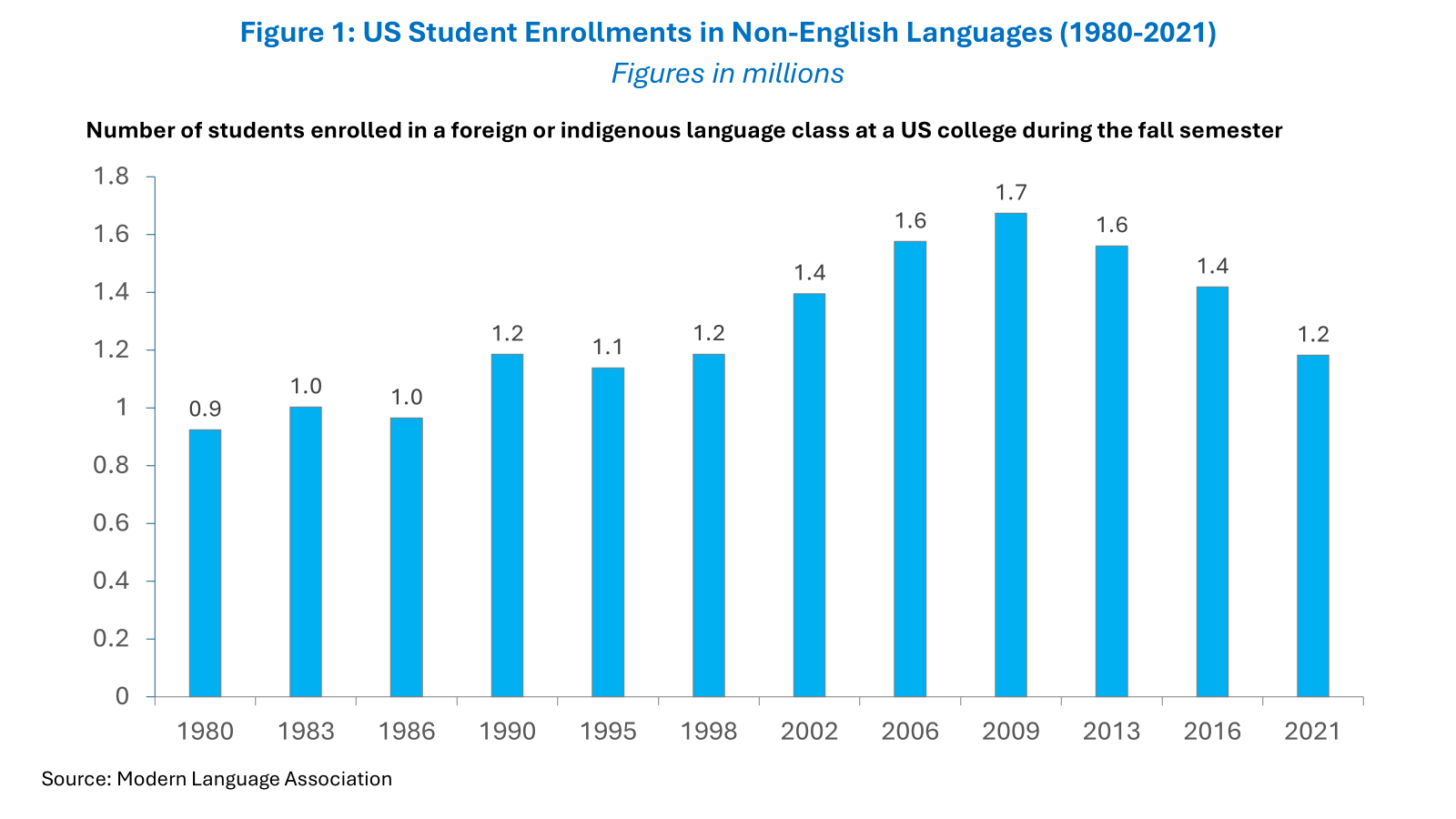
The contraction is visible in the numbers. Between 2009 and 2021, nearly 30 percent fewer college students in the US enrolled in a foreign language course. Russian language programs in American universities have fallen sharply since 2010. Chinese language enrollment briefly surged but then declined since 2018, driven by political suspicion and bureaucratic scrutiny of Confucius Institutes. Hindi, Persian and Turkish studies survive only at a handful of institutions. Most undergraduate programs in “International Studies” now emphasize global governance, human rights and climate change rather than deep area expertise. Students are encouraged to think in universal categories, not to grapple with foreign particularities.
From Pipeline to Flagships: How Incentives Rewired the Hubs
The decline in language training and the reorientation of funding streams do not remain abstract trends. They cascade upward into the very institutions built to convert linguistic and regional mastery into strategic understanding. Centers recalibrate to surrounding incentives such as grant cycles, media salience and Washington’s messaging, thereby substituting high-tempo programming and advocacy for long-horizon scholarship.
This deterioration is most tragically symbolized by the transformation of once-prestigious centers like the Harriman Institute at Columbia University and the Davis Center for Russian and Eurasian Studies at Harvard. During the Cold War, these were the beating hearts of serious scholarship on the Soviet Union and then Russia and Eurasia post-1991. They produced a generation of scholars and diplomats fluent in Russian history, culture and language.
Today, both have become almost unrecognizable and are entirely aligned with the prevailing anti-Russia line in Washington. Rather than fostering nuanced scholarship, they have drifted into ideological activism. The Harriman Institute’s programming, research priorities and guest speakers overwhelmingly echo the US government’s Ukraine narratives. Its intellectual atmosphere, once defined by debate between liberals, conservatives and realists, is now defined by conformity. Russia is no longer studied as a civilization or as a complex historical entity but as a political problem to be solved.
The tragedy is that these institutions once represented America’s intellectual pluralism at its finest. These were places where a young scholar could argue that Russia’s worldview, though different, was legitimate in its own right. Today, that space for intellectual independence has drastically reduced.
The “Ideologization” of Expertise and the Neoconservative Turn
The replacement of real scholarship by ideological conformity has resulted in a chorus of predictable talking points. Russia is “aggressive,” China is “expansionist,” India must “align with the West.” Complex realities are flattened into slogans and the very idea of understanding the “other” becomes suspect. Scholars who advocate dialogue or mutual respect are derided as “apologists”. The late Stephen Cohen faced such treatment in the years following the 2014 Maidan coup in Ukraine.
The political economy of the think-tank world reinforces this dynamic. Funding flows from defense contractors, technology companies and government grants aligned with national security priorities. A young researcher quickly learns that advancing a career requires writing in the idiom of confrontation. Russia is to be condemned, China is to be contained, Iran is to be punished. Nuance is penalized, empathy is suspect. “Understanding Russia” or “engaging China” becomes synonymous with “appeasing authoritarianism.” The very intellectual virtues of objectivity, curiosity and historical imagination that once defined scholarship are now liabilities.
Within this environment, figures such as Fiona Hill and Anne Applebaum have become canonical voices on Russia and Eastern Europe. Both have influence in Washington far disproportionate to their scholarly depth, largely because they reinforce the neoconservative worldview that frames Russia as the perpetual aggressor and the West as the moral custodian of liberal order. Their writings, while rhetorically forceful, are less the products of comparative history, archival or linguistic research than of ideological conviction. They exemplify the shift from scholarship to sermon, diagnosing not to comprehend but to condemn.
By contrast, scholars like Stephen Cohen approached Russia through historical empathy, recognizing its civilizational continuity and its cyclical struggles between centralization and reform. Cohen’s methodology was comparative, historical and dialectical. It sought to understand Russia within its own logic rather than through moralistic templates.
Methods Over Terrain: How US Doctoral Training Crowds Out Deep Regional Expertise
If Washington now rewards slogan over study, a contributing cause is that universities have retooled scholarly formation, prioritizing methods and tempo over languages, archives and long immersion. Since the 1990s, many US Area Studies centers were consolidated into broader ‘global’ units, while leading International Relations (IR) departments increasingly emphasized formal and statistical methods.
The result in many programs has been looser language expectations, thinner country-specific coursework, shorter (often unfunded) fieldwork and greater reliance on English-language secondary sources or datasets when archives or vernacular materials are harder to access. Career incentives also favor rapid publication in high-prestigeIR outlets over the slow, cumulative craft of philology, history and ethnography. What often remains is area-adjacent analytics focusing on work about regions rather than scholarship grounded in them.
Contrast this with the Russian model where Area Studies remains a discipline rather than a branding exercise. At the Moscow State Institute of International Relations (MGIMO), the Higher School of Economics and institutes of the Russian Academy of Sciences, multiple foreign languages are compulsory, archival methods and country seminars are core and students are embedded in policy networks that demand granular cultural, legal and historical competence. The pedagogy starts from terrain that includes language, documents and memory. Only then is technique layered on.
By comparison, many US programs privilege technique over terrain, producing excellent modelers who too rarely read the societies they analyze in the original. A system that increasingly prefers technique before terrain produces analysts who model the world better than they read it, thereby creating an imbalance that predictably migrates from dissertations to desks, and from desks to doctrine.
The Consequences: Strategic Blindness and Repeated Failure
The intellectual bankruptcy of American foreign policy has tangible outcomes. The US has repeatedly misread major power transitions of the past three decades. It assumed post-Soviet Russia would become a liberal democracy integrated into the West. Instead, it became a Eurasian power asserting multipolarity. It believed China’s economic rise would lead to political liberalization. Instead, it produced a more confident, centralized and cohesive state. It expected India to align against China. Instead, India pursues its own civilizational destiny.
Each of these miscalculations stems from deficiencies in understanding the civilizational memories of states, their historical traumas, strategic geographies and lived narratives. Washington projects its own categories of liberalism, democracy and deterrence onto societies that operate by different logics. Russian policy is interpreted through the lens of “aggression” rather than security depth. Chinese strategy is seen as “revisionist” rather than civilizational. Indian autonomy is dismissed as “hedging” rather than a coherent tradition of non-alignment rooted in ancient statecraft.
When the intellectual class cannot think beyond its own mirror, policy becomes reactive and moralistic. The US swings between hubris and hysteria, celebrating the “rules-based order” one decade and decrying “authoritarian resurgence” the next. The deeper constants of geography, demography and history vanish from view. This blindness is not inevitable, it is the result of choices made by institutions that abandoned scholarship for ideology.
Toward a Rebirth of Understanding
If America wishes to regain strategic wisdom, it must rebuild the intellectual foundations of global understanding. That means reviving the humanities of geopolitics that embody history, geography, languages and comparative civilizations. Universities should restore Area Studies as a core mission, supported by stable funding rather than episodic grants. Government programs must reward linguistic and cultural fluency, not ideological conformity.
Equally, the policy ecosystem must value independent scholarship. Think tanks should be compelled to disclose funding sources and the media should cultivate voices who actually know the societies they discuss. Exchange programs and long-term residencies abroad, not short study tours, should again become the norm for aspiring diplomats. Most importantly, policymakers must recover the humility to learn before judging.
Understanding does not mean agreement and empathy does not mean endorsement. It means acknowledging that other civilizations think differently and that effective strategy begins with comprehension, not condemnation. Without that, the US will continue to stumble blindly across the world stage, armed with power but bereft of wisdom.
In an age of multipolarity, ignorance is strategic suicide. America needs fewer ideologues and more scholars, fewer “Russia hawks” and more Russia knowers, fewer “China hands” who tweet in English and more who can read Sun Tzu in the original. The restoration of understanding will not come from the think tanks of Washington but from the libraries, classrooms and archives where genuine curiosity still flickers. Only by reviving the disciplines of deep thinking can America hope to recover the lost art of seeing the world as it is, not as it wishes it to be.
US Department of Education, Notice of Non-Continuation of Grant Award, September 10, 2025.
Deborah Cohn, Fewer U.S. college students are studying a foreign language − and that spells trouble for national security, The Conversation, November 16, 2023.
The Washington Post gets the symptoms right, but fumbles the diagnosis in Thursday’s piece by Ellen Francis , headlined “Europe strains to speak with one voice as US, Russia decide Ukraine’s fate.” The noise inside the Western camp isn’t really about “values” or virtue, rather it’s concerned with cold hard strategy and geography; and old, stubborn, priorities that won’t go away.
Different blocs want different futures, and they’re all tugging in directions no amount of Atlanticist sermonising can reconcile. That’s the real truth behind every row over Ukraine, Russia, China or military spending. They’re not actually arguing about principle, that’s for irrelevant fanatics in think tanks and over in the hothouse of X.
For Washington the hierarchy is clear and cold: China is the existential problem, the only rival capable of closing the distance. Russia is an irritant… armed, considered volatile, but ultimately regional in its reach. Previous administrations used Ukraine as a tool, a way of punching Moscow hard enough to free America’s hands for Beijing. The trouble is, that trick has been played, and everyone knows it.
Across the water, the current (deeply unpopular) leadership of the Germany–France–UK axis sees things through the harsher lens of proximity and history. Russia is the threat that sits across the fence, whereas China is a profitable abstraction (Poland and the Baltics disagree with this, but they have no real say). Meanwhile, the United States is the security blanket they all clutch at night, praying it won’t be snatched away after the next electoral mood swing in Iowa.
But even this loose alliance buckles under its own contradictions. The Baltics and Poland want Russia ground into the clay. France and Germany want it bruised but still breathing; they will need its resources and huge market again when this is all over. The UK, now reduced to being a freelance actor, wants whatever preserves the illusion that it still matters in the grand game after Brexit.
This is sold as a “united front.” But it isn’t, it’s a choir where every singer insists they’re singing lead.
Then there are the southern Europeans (Italy, Spain, Portugal, Greece, plus the Hungarian and Slovak outliers). They are not closet Russophiles. They are simply grown weary of the endless crusades. What they want is cheaper energy, fewer embargoes, and a foreign policy that doesn’t behave like an unpaid internship for Washington. And above all, no spiritual sequel to the Cold War, this time with China because they’ve all experienced enough imperial hangovers to know how those usually end.
Meanwhile, across the Atlantic, the Americans still harbour the fading hope that Russia might pivot against China. Moscow won’t do this, especially not while the West insists it must get down on its knees first, so the most Washington can realistically hope for is a neutral Russia. That’s not a fantasy because the Kremlin has recently been shown more than a few glimpses of what dependency on Beijing actually means. And it doesn’t like what it’s seen.
So yes, “Europe” strains to speak with one voice because it’s a mishmash of regional interests and no underlying unity of vision or purpose.
In short: Washington wants a China-first strategy, Northern Europe wants a Russia-first strategy and Southern Europe wants peace, cheap gas, and the return of Russian tourists who spend without looking too closely at the bill.
Once you see the map for what it is, a collection of competing anxieties stitched together, the discord starts making sense. Then, of course, there is the final conundrum: Russia itself is just as European as France or Britain (if not even more so the way demographics are headed) and that reality will eventually have to be confronted and accommodated.