Oliver Boyd-Barrett: Blockading China for US Supremacy

By Oliver Boyd-Barrett, Substack, 1/1/26

Berletic in his latest article and podcast (Berletic) argues that the US bid for supremacy is accelerating; there is no “retreat” to the Western hemisphere; there is no process of “adaptation” to multipolarism. To the contrary, the US has launched a war against multipolarism. The US continues its proxy war against Russia (I think we should consider it a CIA-led war), persists in its encirclement of China, and, in the Middle East, once again threatens Iran (now enfeebled by domestic dissension and protests as well as by existential problems of drought and pollution).

The US obsession with Greenland, he argues, is far from being a signal of a US wish to retreat to the Western hemisphere (as if that excused such a blatant violation of international law in any case, any more than the ongoing US menacing of Venezuela). The US acquiring or exerting control over Greenland is in fact the US moving closer to Western Russia, where most of Russia’s big centers of population are, including Moscow, threatening Russia to a greater degree, even, than it already does. Alaska is close to Russia but it only close to eastern Russia.

US commanders are currently running the war in Ukraine from Germany; the logistical support for Ukraine is coming from other US proxies Poland and Romania. Greenland will offer an alternative location for rear command of the war as it is undertaken by US’ European proxies, giving the appearance of an “abandonment” of Ukraine by the US, while in fact it prepares a global blockade of Russian, Chinese and Iranian maritime shipping.

As Ukraine collapses, the US will push other US proxies in Europe to come forward to fill the gap left by Ukraine’s collapse of fighting capability, Seizure of Greenland would assist the evolving maritime blockade and in continuing the war against Russia in Ukraine. US military bases in Greenland would be closer to Russia than military bases in Europe, including Turkiye and Great Britain. In February 2025, US Secretary of State for War, Pete Hegseth, told Europe to double down on support of Ukraine, investing in its arms industry capability, increasing military expenditure on NATO from 2% to 5% of GDP, and establishing a division of labor between the US and Europe, with Europe taking responsibility for Ukraine while the US focuses on China.

In Europe the US will position itself in the rear, in Greenland, from which it can supervise the activity of its European proxies in their struggle against Russia and supply the necessary reconnaissance and intelligence. The idea is to pin Russia down and depleted. US proxies will pay the full costs of the conflict with Russia while the US reaps the full benefits. The fall of Syria is an example. Proxies fought the war, the US benefits geopolitically from its collapse.

From 1992, US foreign policy (the Wolfowitz doctine, later refined as the Bush doctrine in 2003) has been driven by the ambition to suppress all actual and potential rivals to US supremacy, everywhere. Even though the latest US strategy paper says that the US policy of supremacy was wrong, it spends most of the time talking about what it must do to stop emergent rivals to US power, even regionally. Nothing in the US will change this; the only source of change can come from without. Such a challenge is most likely to come from China.

A 2018 US naval War College review paper advocated a maritime oil blockade against China and sought to identify ways in which limitations on the possibility of such a blockade could be circumvented. It talked not about blockading ports but about blockading choke-points well beyond the range of most of China’s weapons: e.g. the Malacca Strait (between Malaysia’s Malay Peninsula and Indonesia’s Sumatra, connecting the Indian Ocean – via the Andaman Sea – to the South China Sea) which forms a vital, heavily trafficked global shipping route for energy, goods, and components, rich in history, commerce, and strategic importance, with Singapore located at its southern gateway.

The US marine force has an anti-shipping division that can relocate to such sensitive chokepoint areas to interdict Chinese shipping or other shipping headed for, or from, China. US strategies anticipate how China might evade US actions in relation to such choke points and seek to blunt their efficacy. Destruction of the Myanmar oil pipeline is envisaged as a way to interrupt the flow of energy to China, given China’s limited capacity to control what happens within Myanmar. Since the 2018 paper, US-backed militants have already begun to physically attack the Myanmar pipeline. There are areas along the pipeline that the Myanmar government has had to abandon. If any part of the pipeline is compromised, the whole project is useless.

Here and elsewhere, the US seeking to sabotage China’s Belt and Road initiative. The US is manipulating Cambodia to destabilize pro-Chinese initiatives in Thailand. In Pakistan there is another transport and trading corridor in which China has been investing heavily but where the US backs local militant attackjs, while the US also tries to destabilize the Pakistani regime. The same is true of Balochistan, where Pakistan had allowed China a development area and which the US is now tyring, through proxy rebels, to dismantle. So far as China’s long shared border with Russia, across which China it imports Russian energy is concerned, US aggression against Russia over Ukraine targets Russian energy facilities that in turn affects Russian capacity to supply energy to China if continued for long enough. New York Times articles on the secret war against Russia over Ukraine notes how the CIA has supported drone attacks on Russian shipping and energy facilities in Sebastopol, the Black Sea, and Russian energy facilities in the Caspian, Mediterranean and off the coast of Africa. This reduces Russian ability to come to China’s assistance in the event that the US launches a maritime blockade of China.

US interventions against the flows of oil to China from Iran and from Venezuela, and Marco Rubio’s assertion in January 2025 that US control of Greenland would enable it to control energy flows enhanced by growing navigability of shipping lanes through the Arctic – similar to US attempts to interfere with shipping lanes in the South China Sea – are all indications of an evolving US policy of containment by blockade. All are examples of US pressure on choke-points in the flow of energy and trade to and from China that otherwise might reduce the efficacy of a US maritime blockade of China.

Strana.UA: it is the continuation of the Ukraine war that poses existential risks, not its end on compromise terms

Strana.UA, 12/31/25 (Translated by Geoffrey Roberts)

This entire year has been marked by US President Donald Trump’s efforts to end the war in Ukraine.

Outwardly, these efforts have been fruitless: the war continues, casualties and tensions mount, and the year ends amidst Kremlin announcements of a strike on Russian President Vladimir Putin’s residence and threats of a military response.

It would seem like a dead end.

In reality, Trump has succeeded in bringing the positions of the two sides closer together.

If we recall the situation at the beginning of the year, it was strikingly different from now.

Kyiv’s official doctrine was the “Zelensky peace formula.” It included war until the 1991 borders were reached, with demands for Russia to pay reparations.

Indeed, the cause of the infamous scandal in the Oval Office in late February 2025 was Zelensky’s refusal to stop the war along the front lines.

After the scandal, Trump stopped supplying weapons and intelligence to Ukraine, and Kyiv’s position changed dramatically. Zelensky agreed to a ceasefire along the current demarcation line.

Putin’s official doctrine, announced in June 2024, demanded the transfer to Russia of the entire territory of the four regions whose annexation Russia announced in 2022 (Donetsk, Luhansk, Kherson, and Zaporizhzhia), along with much else. Hence, the Kremlin initially refused to agree a ceasefire along the front line, demanding a broader agreement, which was communicated to the Ukrainian delegation during talks in Istanbul. Kyiv predictably rejected these conditions.

This led to tensions in the Trump-Putin relationship. Trump threatened to impose tariffs on buyers of Russian oil and gas. However, after encountering resistance from India and China, he reversed his position and met with Putin in Alaska. Putin also softened his demands, retaining the condition of Ukrainian troop withdrawal from Donbas but removing it for the Kherson and Zaporizhzhia regions. Moreover, according to the US President, Putin was accommodating regarding security guarantees for Ukraine. This laid the framework for Trump’s peace plan, which emerged in November 2025.

Zelensky disagreed with this plan and – with European support – attempted to radically revise it. However, following his meeting with Trump in Florida, he was unsuccessful. Washington continues to adhere to the “Alaskan position” on key issues, including the withdrawal of troops from the Donetsk region. Zelensky remains somewhat opposed, but is no longer as unequivocal as before.

In other words, in less than a year, Trump has narrowed the disagreements between Ukraine and Russia over the terms of the peace agreement to the issue of the 25% of the Donetsk region’s territory currently under the control of the Ukrainian Armed Forces. Another important contentious issue is security guarantees for Ukraine. As noted above, in Alaska, according to Trump, Putin agreed that such guarantees should be provided.

However, there is a difference between how Russia views security guarantees and how Ukraine and Europe view them. For Russia, the absence of foreign troops on Ukrainian territory is essential, as are guarantees that Ukraine will not join NATO. Kyiv and the Europeans insist that the door to Ukraine’s accession to the Alliance should not be closed de jure (although it is clear that it is still closed de facto). And, most importantly, they insist on the deployment of foreign troops. This is still considered a “red line” in the Kremlin.

Trump’s initial plan included a provision stating that Ukraine should not join NATO and that foreign troops would not be stationed in the country. Then, after a series of negotiations with Kyiv and the Europeans, media reports surfaced that the US had given the go-ahead for the deployment of foreign troops and, moreover, was prepared to shoot down Russian missiles and aircraft in the event of a new war, and – if Zelensky and Polish Prime Minister Donald Tusk are to be believed – to send its own troops to Ukraine.

It should be noted that the Americans have never officially confirmed this. However, it appears that security guarantees remain the “carrot” that Washington intends to offer Kyiv in exchange for ceding Donbas.

Theoretically, Trump could accommodate Zelensky’s requests, although, of course, this doesn’t mean the Americans will honour these guarantees in practice due to the risk of nuclear war with Russia.

Moscow, for its part, is currently making efforts to return Trump to his original peace plan, excluding the deployment of foreign troops. According to one theory, this is part of the meaning of the statements about the “attack on Putin’s residence.” The Kremlin is essentially telling Washington: “With the kind of guarantees Kyiv is asking for, they’re simply dragging you into a nuclear war with us.”

But, let us reiterate, there’s no evidence yet that Trump considers the deployment of European, let alone American, troops to Ukraine as security guarantees. Only Zelensky (which may be his wishes) and media outlets close to the Democrats, which have repeatedly published “inside information” that has subsequently been outright refuted (such as reports about Russia agreeing to a ceasefire for the sake of holding a referendum), have said so. There are other contentious issues in the peace plan. But if we can reach an agreement on territories and security guarantees, everything else will move much more quickly.

Of course, there’s no 100% certainty that an agreement will be reached.

The warring parties are very reluctant to compromise.

The Ukrainian authorities don’t consider their situation on the front lines, or in general, so catastrophic that they should cede territory. Yes, the Russians are advancing, but the front isn’t collapsing. Yes, there are problems with manpower in the Ukrainian Armed Forces, but thanks to drones, they’re holding their ground. Yes, Europe has provided less money than expected, but it’s still something. Yes, the energy situation is very difficult, but there’s no total blackout. At the same time, Kyiv constantly harbours hopes of a “quick collapse in Russia”- because of mounting economic and interethnic problems, as well as problems with conscription that would necessitate a new mobilisation.

However, the “collapse of Russia” – anticipated for several years now – may not happen in the coming year either. And if Ukraine experiences serious problems at the front and with its energy supply, then the peace terms will become much worse than they are now. And this is being discussed with increasing frequency.

Besides, Trump may pressure Kyiv to expedite the process before the congressional mid-term elections. So far, he hasn’t done so. But such a threat could also influence Kyiv’s decisions.

But all is not clear about Russia’s position. Even if Kyiv agrees to withdraw its troops from the Donetsk region and security guarantees can be agreed upon, won’t the Kremlin impose new conditions in order to prolong the war?

The “war party” in Moscow is constantly calling for the this They, like their Kyiv and Western counterparts, say that “time is on our side,” “the Ukrainian front is about to collapse, the power supply will shut down, we just need to step it up a bit,” “sanctions aren’t a threat to us,” and so on. However, they’ve been repeating these lines for the past year. But the Ukrainian front hasn’t collapsed yet. Yes, Russia has managed to create and maintain an advantage in manpower, and recently, in some areas, in drones. Moreover, it has adapted its tactics to the new battlefield conditions, infiltrating the “drone line” in small groups. This allows it to advance, albeit slowly and with heavy losses. And no one can say how long the army will be able to replenish itself solely with contract soldiers, without declaring mobilisation. The Russian economy has withstood sanctions by reorienting sales markets, tapping into its reserves, and also by Russian entrepreneurs returning money to Russia due to the risks they face abroad. But the reserves are not unlimited. Sanctions are hitting oil prices, increasing sales costs, and creating many other problems. Furthermore, interethnic and interreligious tensions are being systematically fuelled within the country (including by the same information and political network that previously promoted Prigozhin, preparing the ground for his rebellion).

Both Ukraine and Russia are walking on very thin ice, hoping the other side will fall through first, even though both sides could drown.

The main justification for the concept of “war to the bitter end” in Ukraine and Russia, as well as among certain forces in the West, is the thesis of the “existential” nature of the war. This definition derives from the Latin word “existentia,” meaning existence. Thus, an “existential war” is a war for existence, the outcome of which determines the life and death of a state and nation. In the event of defeat, the nation and state perish. To complement the thesis of the “existential” nature of war, it is common to repeat the phrase, “either they perish, or we perish.” This thesis posits the incompatibility of Ukraine and Russia’s existence as two neighbouring states.

However, such reasoning is an “existential trap” for both countries.

Regarding the current war, it is clear that one of the warring parties (or both) will only find itself facing a real existential threat in the event of a “war to the bitter end.” Then it could indeed end in the complete collapse of one of the adversaries, the loss of statehood, or the disintegration of the state (which many in Kyiv and Moscow wish for each other). But for the victor, the price could be so high that it would amount to defeat.

Will ending the war based on Trump’s current peace plans mean that Ukraine or Russia collapse into the abyss and lose their statehood? Of course not. On the contrary, it would mean saving both countries from this scenario. It would mean eliminating the existential threat (a threat to their very existence) that could threaten both countries if the war continues.

Incidentally, such an end to the war would not pose an existential threat to Putin or Zelensky personally. For Putin, ending the war along the front lines (let alone gaining control of the entire Donbas) would be a victory. Of course, questions may arise about the price of such a victory, but it’s unlikely anyone will dare to ask them out loud. And most Russians won’t even ask them, rejoicing that the war is finally over.

For Zelensky, withdrawing troops from Donbas won’t mean a clear political defeat if in return Ukraine receives security guarantees and EU membership.

Will the implementation of Trump’s peace plans mean a resumption of war after a certain period of time? Not necessarily. It will depend on whether both countries continue to see each other as existential adversaries that must be destroyed sooner or later, or whether they allow each other to live in peace.

It will also depend on Europe’s position. More precisely, the West as a whole. And the United States, of course. But primarily on Europe’s position.

There, too, the prevailing attitude is now to view the war in Ukraine as an “existential” (for Europe) conflict. A theory has become widespread that Europeans benefit from prolonging the war in Ukraine because if it ends, Putin will attack the EU. We have written many times about the extreme dubiousness of this theory.

But it directly influences the European position and is a factor contributing to the prolongation of the war (given the EU and UK’s influence on the Ukrainian authorities). This is also influenced by the domestic political struggle in the US itself, where the Democrats (allied with the current European elites) do not benefit from Trump’s success in achieving peace in Ukraine, as this could strengthen the Republicans’ hand in the Congressional elections at the end of next year.

However, prolonging the war in Ukraine carries real existential risks for Europe if it is drawn directly into the war – with a far from zero risk of it escalating into a nuclear war.

There could be many occasions for this. For example, Europeans support for Ukraine crossing the Kremlin’s “final red line,” perhaps by beginning the supply of long-range Taurus missiles or by blockading Russian ports and the “shadow fleet.” Or, if the situation on the front reaches a stalemate, the Russian “war party” will convince the Kremlin to “intimidate” Europe militarily, forcing it to abandon its aid to Kyiv. Or perhaps there are simply some incomprehensible situations, like the sudden appearance of drones over Europe this fall. Who launched them and for what purpose remains a mystery. But this immediately sparked calls in the West to retaliate against Russia. Such “anonymous” incidents aimed at provoking a war between Europeans (and even NATO as a whole) and Russia are certainly not ruled out in the future.

And this, we repeat, is a real existential threat for Europe, Ukraine, Russia, and indeed for all of humanity, given the risk of nuclear war.

And the only way to mitigate this risk is to stop the war in Ukraine.

By the New Year, this task had not been accomplished.

However, given the significant narrowing of the range of contentious issues, it cannot be ruled out that this could happen in the coming months.

This offers hope for peace, but also makes these months extremely dangerous. On the one hand, the “war parties” in all countries will make every effort to disrupt the agreements (media outlets close to them are already full of predictions that the war will not end next year). On the other hand, all sides will try to “raise the stakes” to persuade the other side to make concessions.

However, with willpower, a successful conclusion to the negotiations is possible. The main thing to remember is that the real existential threat to everyone is the continuation of the war, not its end on compromise terms.

Russian losses in Ukraine as Calculated by BBC & Mediazona

The BBC-Mediazona count of confirmed Russian military fatalities has reached c.160,000 – which indicates to me that Russia’s total irrecoverable losses (dead + seriously wounded) may be as high as 250,000. – Professor Geoffrey Roberts

Obviously, the estimates provided for Ukraine’s losses is a major undercount by comparison. – Natylie

By Olga Ivshina, BBC, 12/29/25

Over the past 10 months, Russian losses in the war with Ukraine have been growing faster than any time since the start of the full-scale invasion in 2022, BBC analysis suggests.

As peace efforts intensified in 2025 under pressure from US President Donald Trump’s administration, 40% more obituaries of soldiers were published in Russian sources compared with the previous year.

Overall, the BBC has confirmed the names of almost 160,000 people killed fighting on Russia’s side in Ukraine.

BBC News Russian has been counting Russian war losses together with independent outlet Mediazona and a group of volunteers since February 2022. We keep a list of named individuals whose deaths we were able to confirm using official reports, newspapers, social media, and new memorials and graves.

The real death toll is believed to be much higher, and military experts we have consulted believe our analysis of cemeteries, war memorials and obituaries might represent 45-65% of the total.

That would put the number of Russian deaths at between 243,000 and 352,000.

The number of obituaries for any given period is a preliminary estimate of the confirmed losses, as some need additional verification and will eventually be discarded. But it can indicate how the intensity of fighting is changing over time.

https://flo.uri.sh/visualisation/26840555/embed?auto=1

2025 starts with a relatively low number of published obituaries in January, compared with the previous months. Then the number rises in February, when Trump and Russian President Vladimir Putin talked directly for the first time about ending the war in Ukraine.

The next peak in August coincides with the two presidents meeting each other in Alaska, a diplomatic coup for Putin that was widely seen as an end to his international isolation.

In October, when a planned second Russia-US summit was eventually shelved, and then in November, when the US presented a 28-point peace proposal, an average of 322 obituaries were published per day – twice the average in 2024.

It is difficult to put increased Russian losses down to any one factor, but the Kremlin sees territorial gains as a way of influencing negotiations with the US in its favour: Putin aide Yuri Ushakov stressed recently that “recent successes” had had a positive impact.

Murat Mukashev was among those who gambled on a quick peace deal, and it cost him his life.

Image of Murat Mukashev inset and a cemetery behind him
Mukashev (inset) signed up for the army after he was given a 10-year jail term

Mukashev was an activist who had never supported Putin’s policies.

Over the years, he had taken part in demonstrations against police violence and torture, and joined rallies for LGBT rights and the release of Alexei Navalny, the Kremlin’s main opponent who died in prison in 2024.

He had repeatedly condemned Russia’s invasion of Ukraine on social media from 2022. Then, in early 2024, Mukashev was detained near his home in Moscow and charged with large-scale drug dealing.

While his case was being tried he was offered a contract with the defence ministry, according to his friends and family.

They saw the heavy charges levelled against him as a typical ploy to get people to sign up. A 2024 law allows the accused a way out of a criminal conviction if they join up – an attractive option in a country with an acquittal rate of less than 1%.

Mukashev refused the offer, and the court sentenced him to 10 years in a high-security penal colony.

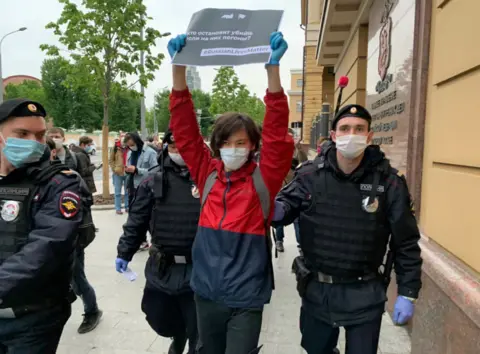
Murat Mukashev A young man holds a placard saying "stop the killers if they wear shoulder straps" as police escort him towards the camera
Mukashev was never a Putin supporter and had protested against the war and police violence

In prison in November 2024, he changed his mind. Friends said he was encouraged by Trump’s promises to end the war quickly and decided he needed to sign up as soon as possible to secure his release before a peace deal was reached.

“He saw this as a chance to be released instead of being imprisoned for 10 years of strict regime,” reads a statement from his support group.

There was no explanation of how he reconciled taking part in the war with his reluctance to kill.

On June 11 2025, Mukashev died fighting as part of an assault squad in the Kharkiv region of north-eastern Ukraine.

Like him, the majority of Russians killed at the front in 2025 had nothing to do with the military at the start of the full-scale war, BBC figures show.

But since the bloody battle for the city of Avdiivka in October 2023, there has been a steady increase in casualties among so-called “volunteers” – those who have voluntarily signed a contract since the start of the invasion.

They now appear to form the majority of Russia’s new recruits, as opposed to professional soldiers who joined the army before the invasion or those mobilised for military service afterwards.

A year ago 15% of Russian military deaths were volunteers, but in 2025 it was one in three.

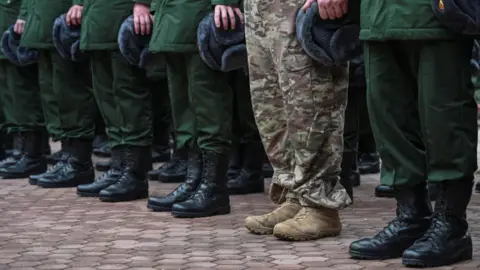
Reuters Men in uniform, with just legs and boots visible
File photo of Russian recruits in Rostov region

Local governments, under pressure to maintain a constant flow of new recruits, advertise hefty pay-outs, meet people who have large debts and campaign in universities and colleges.

This means that the Kremlin has been able to compensate for heavy losses at the front while avoiding the politically risky move of a large-scale mandatory mobilisation.

By October, 336,000 people had signed up for the military this year, according to National Security Council deputy chief Dmitry Medvedev – well over 30,000 a month.

Nato Secretary-General Mark Rutte has since said that 25,000 Russian soldiers are being killed every month. If both are right, Russia is still recruiting more soldiers than it is losing.

Based on obituaries and relatives’ accounts, most of those who signed up to fight did so voluntarily; but there are reports of pressure and coercion, especially on regular conscripts and those charged with criminal offences.

Some recruits mistakenly believe that after they have signed up for a year they can return to their old life with money in their pockets.

A new recruit can earn up to 10m roubles (£95,000; $128,000) in a year. In reality all contracts signed with the defence ministry since September 2022 are automatically renewed until the war is over.

According to Nato, the total number of Russian dead and wounded in the war is 1.1 million, and one official has estimated there have been 250,000 fatalities.

This is in line with the BBC’s calculations, although our list does not include those killed serving in the militia of two occupied regions in eastern Ukraine, which we estimate to be between 21,000 and 23,500 fighters.

Ukraine has also sustained heavy losses.

Last February, President Volodymyr Zelensky put the number of battlefield deaths at 46,000 and 380,000 others wounded.

Tens of thousands more were either missing in action or held captive, he added.

Based on other estimates and cross-referencing data, we believe the number of Ukrainians killed by now is as high as 140,000.

National Security Archive Publishes US records of three Bush II-Putin conservations

Overview by Prof. Geoffrey Roberts:

The Washington-based National Security Archive has just published the US records of three Bush-Putin conservations, including the memo on the April 2008 meeting, at which Putin supposedly said Ukraine was not a real/proper country/state.

At the first meeting in June 2001, Putin spoke about NATO expansion:

You know our position. You have made an important statement when you said that Russia is no enemy. What you said about 50 years in the future is important. Russia is European and multi-ethnic, like the United States. I can imagine us becoming allies. Only dire need could make us allied with others. But we feel left out of NATO. If Russia is not part of this, of course it feels left out. Why is NATO enlargement needed? In 1954, the Soviet Union applied to join NATO. I have the document… NATO gave a negative answer with four specific reasons: the lack of an Austrian settlement, the lack of a German settlement, the totalitarian grip on Eastern Europe, and need for Russia to cooperate with the UN Disarmament process. Now all these conditions have been met. Perhaps Russia could be an Ally.  But the real question is how we associate Russia with the rest of the civilized world. The fact is that NATO is enlarging and we have nothing to say about it.

(On the 1954 Soviet proposal and its background see: https://www.wilsoncenter.org/publication/molotovs-proposal-the-ussr-join-nato-march-1954 and https://www.wilsoncenter.org/publication/chance-for-peace-the-soviet-campaign-to-end-the-cold-war-1953-1955).

In September 2005, the two President’s discussed North Korea:

There may be a lot of nuts there, but not everyone is. I used to be a member of the Communist Party. I believed in the ideas of communism. I was prepared to die for them. It’s a long road to inner transformation. People are limited to the cubicle they live in. And many are sincere in what they believe. The North Koreans live in more seclusion than we lived in. They are more isolated than the Soviet Union was under Stalin. The overwhelming number are prepared to die. This is not East Europe or East Germany. For any serious change in mindset, there needs to be rapprochement between the North and South.

This is what Putin actually said about Ukraine in April 2008:

I’d like to emphasize accession to NATO of a country like Ukraine will create for the long-term a field of conflict for you and us, long-term confrontation…Seventeen million Russians live in Ukraine – a third of the population. Ukraine is a very complex state. This is not a nation built in a natural manner. It’s an artificial country created back in Soviet times. Following World War II Ukraine obtained territory from Poland, Romania and Hungary – that’s pretty much all of western Ukraine. In the 1920s and 1930s Ukraine obtained territory from Russia – that’s the eastern part of the country. In 1956 [sic] the Crimean peninsula was transferred to Ukraine. It’s a rather 1arge European country built with a population of 45 million. It’s populated by people with very different mindsets. If you go to western Ukraine you’ll see villages where the only spoken language is Hungarian and people wear those bonnets. In the east, people are wearing suits, ties and big hats. NATO is perceived by a large part of the Ukrainian population as a hostile organization…

This creates the threat of military bases and new military systems being deployed in the proximity of Russia. It creates uncertainties and threats for us. And relying on the anti-NATO forces in Ukraine, Russia would be working on stripping NATO of the possibility of enlarging. Russia would be creating problems there all the time. What for? What is the meaning of Ukrainian membership in NATO? What benefit is there for NATO and the U.S.? There can be only one reason for it and that would be to cement Ukraine’s status as in the Western world and that would be the logic. I don’t think it’s the right logic…And given the divergent views of areas of the population on NATO membership, the country could just split apart. I always said there’s a certain pro-Western part, and a certain pro-Russia part. Now the power there is held by the pro-Western leaders. As soon as they came to power they split within themselves. The political activity there fully reflects the attitudes of the population. The issue there is not accession to NATO, but to ensure the self-sufficiency of Ukraine, Also, their economy should be strengthened.

Seventy percent of the population is against NATO. Condi [Rice] told me in Slovakia and Croatia the population was opposed at first and they’re now in favor. What we are against is Ukraine’s accession to NATO, but in any case we should wait until a majority of ·the population is in favor, then let them accede, not vice versa.

The full texts of these documents may be found here:

https://nsarchive.gwu.edu/briefing-book/foia-russia-programs/2025-12-23/archive-lawsuit-opens-vladimir-putin-memconstelcons

The Lever: Corporations Invested In Lawsuits Before Venezuela Invasion

By Luke Goldstein & Lucy Dean Stockton, The Lever, 1/4/25

Just weeks before the American military operation in Venezuela to capture President Nicolás Maduro, the U.S. energy giant Halliburton filed an unusual lawsuit in international court claiming the Venezuelan government owed them damages for U.S. sanctions against the country.

A separate case against Venezuela is also being pursued by another fossil fuel giant whose board includes an oil magnate whose family has delivered large financial contributions to Republicans and conservative causes. One family member poured tens of thousands of dollars into a political committee focused on reelecting President Donald Trump in 2024.

Such companies with pending claims could now be among the first in line to receive a massive windfall from a new Trump-installed Venezuelan government that is willing to funnel the South American country’s cash to corporate plaintiffs.

Shortly after the U.S. military operation on Jan. 3, Trump declared that the United States would “run” Venezuela, along with making investments in the country’s oil and gas infrastructure and selling state-run oil assets. Venezuela is home to the largest oil reserves in the world, representing about 17 percent of the world’s global supply, though much of the country’s reserves remain untapped. 

In all, Venezuela is facing nine pending cases launched by investors and major corporations alleging financial damages related to the country’s nationalization of state industries, international sanctions, and political instability. The country has settled dozens more in recent decades. 

These cases are arbitrated within the World Bank’s International Center for Settlement of Investment Disputes, a governing body that has been widely criticized for prioritizing investors’ interests over those of sovereign states, and particularly those of developing nations. In 17 percent of such cases, the host country has been forced to settle

A U.S.-backed Venezuelan government could settle those cases or fail to adequately argue their side in court, using Venezuela’s resources to award companies with hundreds of millions in damages. 

Halliburton’s case seeks damages for the roughly $200 million in losses it allegedly incurred between 2016 and 2020 as it began to cease operations in the country to comply with the U.S.-imposed sanctions first imposed in 2005 and escalated in 2017 and 2020. But Halliburton is blaming Venezuela’s domestic instability for those losses and demanding the country now pay up.

Such a legal argument is reportedly rare in arbitration courts, and some financial analysts argued the move indicated that Halliburton potentially expected a military operation in Venezuela to install a more friendly government willing to cut a deal to make them whole. GOP allies have directly cited Halliburton as one of the energy companies that could invest in Venezuela to “rebuild their country” after regime change, as Trump’s former U.S. Secretary of State Mike Pompeo told Fox News in December. 

In a separate case filed in the World Bank’s arbitration courts, natural gas conglomerate The Williams Companies is seeking damages over a disputed contract and Venezuela’s nationalization of fossil fuel infrastructure in the early 2000s. 

Williams’ board includes Scott Sheffield, whose family has donated more than $6 million over the last 15 years, mostly to conservative causes and Republican candidates. That includes $165,200 worth of donations in 2024 from Sheffield’s son, Bryan, to the Republican National Committee, according to Federal Election Commission data compiled by the watchdog group Public Citizen. Those donations were earmarked for the “Trump 47 Committee,” a joint fundraising committee to support Trump’s 2024 campaign.

Other companies with pending cases against Venezuela for nationalizing their assets and causing other business disruptions include the food giant Kellogg’s, the cement and construction firm Holcim Group, packaging conglomerate Smurfit, and Gold Reserve, a mining conglomerate whose largest investors include a trio of U.S. investment firms. 

The Irish company Smurfit, which is publicly traded on the New York Stock Exchange, won a $469 million arbitration case against Venezuela last year over the company’s 2018 seizure of its assets in the country and has since filed for additional damages. 

For years, U.S. and other Western firms have sued the Venezuelan government in international arbitration courts for expropriated property and unpaid debts. 

In 2019, the U.S. oil and gas giant ConocoPhillips won nearly $9 billion in the World Bank’s arbitration court after Venezuela’s former president, Hugo Chávez, nationalized the company’s oil assets nearly 18 years earlier. And in 2021, Koch Industries won a $444 million case against the country for the expropriation of its fertilizer business by Chávez in 2010. 

Halliburton’s arbitration case, however, involves a different argument. The company’s exit from the market was the direct result of U.S. sanctions imposed on Venezuela in 2017 and 2020, not state nationalization. According to the Global Arbitration Review’s summary of the filing, Halliburton blames both U.S. sanctions and Venezuelan policy failures for the financial losses it incurred, but is suing only Venezuela for damages. 

“Halliburton also notes that changes in the Venezuelan government’s exchange rate and U.S. sanctions further complicated the viability of its operations in the country,” reads the review of the legal brief. Although Venezuela withdrew from the international treaty that enforces the World Bank’s arbitration rules in 2012, the country has still been forced to participate in these cases and abide by the court’s rulings.

An energy service company, Halliburton operates oil drilling infrastructure around the world, including the Deepwater Horizon offshore drilling rig that led to the fatal and environmentally catastrophic 2010 Gulf of Mexico oil spill. Since the 1940s, the company has been involved in extracting Venezuela’s massive oil reserves.

Halliburton has previously benefited from U.S. regime-change efforts. In 2003, Vice President Dick Cheney, the company’s former CEO, helped launch the Iraq War. After the country’s military-backed regime change, Cheney’s one-time employer secured lucrative contracts with the new U.S. occupying force to administer the country’s energy production.