By Kautilya The Contemplator, Substack, 1/7/26
I vividly remember a moment from a graduate seminar in international relations theory that I took at Columbia University in the early 2000s. It was taught by the late Professor Kenneth Waltz, one of the most consequential minds of twentieth-century international politics and the architect of the school of structural realism. I recall the setting. It was late afternoon in March, the light already beginning to fade outside. Eight of us students sat in close proximity around the eminent professor, listening as he spoke without notes, without flourish. There was an unhurried seriousness to the discussion. We moved deliberately through his ideas – structure over intent, power over rhetoric, limits over ambition – and wrestled with the larger questions of an emerging post-September 11 international order and the crises of the time.
It was early 2003. American forces were in Afghanistan, the invasion of Iraq was imminent, and although few yet recognized it, the limits of American power were about to be tested. The United States stood at what many believed was the apex of history – triumphant after the Cold War, unchallenged by any peer rival and convinced it was experiencing what Charles Krauthammer famously called the “unipolar moment”.
Yet, Waltz was unimpressed. With characteristic calm, he warned that empires do not collapse because they are weak, but because they become too powerful. An empire, he argued, is an entity that accumulates such vast power that it must continually seek external venues to project it. Power, once amassed beyond what is necessary for defense, demands use. Over time, this compulsion to project power outward becomes unsustainable. Costs accumulate, resistance hardens, domestic foundations erode and decline begins – not suddenly, but structurally.
Waltz walked us through history – the Mongols, the Romans, the Ottomans, the British Empire, the Soviet Union. Each believed itself exceptional. Each believed its dominance reflected permanence rather than circumstance. Each ultimately faded into history. The United States, he cautioned even then, was not exempt. More than two decades later, that warning reads less like theory and more like diagnosis.
Empire, Overstretch and the Structural Logic of Decline
Empires do not fall overnight. Their decline is a gradual unraveling of the foundational pillars of economic vitality, political coherence, military credibility and moral legitimacy. What realism teaches is that decline is not primarily a moral failure, it is structural.
Paul Kennedy articulated this with devastating clarity in his seminal work The Rise and Fall of Great Powers. His core thesis of “imperial overstretch” holds that when a state’s military commitments expand beyond the capacity of its economic base to sustain them, strategic failure becomes inevitable. Military power cannot indefinitely substitute for economic health at home. Eventually, the imbalance asserts itself.
Waltz’s structural realism complements Kennedy’s materially grounded analysis of imperial power. A system dominated by one state becomes unstable not because others are aggressive, but because power itself invites resistance. As Waltz observed, unbalanced power leaves weaker states little choice but to combine against the dominant one. Hegemony, in this sense, plants the seeds of its own unfolding. From Vietnam to Iraq, from Libya to Afghanistan, the American pattern has been consistent in that overwhelming force is deployed in pursuit of political outcomes it cannot sustain.
From Influence to Possession: Venezuela as a Turning Point
If earlier American excesses could still be framed, however implausibly, as misguided attempts to preserve order, recent developments mark a qualitative shift. The US seizure of Venezuelan President Nicolás Maduro represents not another intervention, but a transition from influence to possession.
This shift was openly acknowledged by President Trump himself. In the press conference that followed Maduro’s abduction, he stated bluntly that the United States would “run” Venezuela. The language is striking not merely for its aggression, but for its candor. There is no pretense of multilateralism, no invocation of international law, no claim of humanitarian necessity. This is empire speaking plainly.
Trump’s threats have not been confined to Venezuela. He has openly floated or threatened coercive action against multiple sovereign states: Colombia, Mexico, Cuba, Iran, Nigeria, Denmark (via Greenland) and Venezuela itself. This is not rhetorical excess but doctrinal candor, treating sovereignty as conditional and force as routine.
The “Donroe Doctrine” and Hemispheric Enclosure
Trump went further still by explicitly renaming the Monroe Doctrine the “Donroe Doctrine”. The original Monroe Doctrine, for all its imperial implications, was framed defensively as a warning against European recolonization of the Americas. The “Donroe Doctrine” strips away even that fig leaf. It asserts that the Western Hemisphere is not merely a sphere of influence, but an exclusive American domain in which Washington will deny extra-hemispheric competitors, explicitly framed by the administration in terms of China and Russia, the ability to base forces or control strategic assets.
Facing declining leverage globally, the United States is attempting to lock down what it still believes it can dominate absolutely – its near abroad. That is not the behavior of a confident hegemon, but one fortifying imperial red lines as its outer perimeter weakens.
Crucially, hemispheric consolidation does not imply a reduction in American ambitions toward Russia and China. Quite the opposite. Even as Europe is rhetorically de-prioritized, the United States remains committed to containing both powers simultaneously, despite the structural contradiction it entails.
Russia and China possess overwhelming military power in regions that are existential to their security – the post-Soviet space for Russia, the Western Pacific for China. Structural realism predicts that great powers will fight hardest, and most successfully, in precisely such theaters. This logic was anticipated by George F. Kennan, the architect of America’s Cold War containment strategy, who warned in 1997 that NATO expansion would be
“the most fateful error of American policy in the entire post-Cold War era”1,
precisely because it ignored how great powers respond when their core security interests are challenged. Russia’s imminent victory in the US-led proxy war in Ukraine is a clear illustration of this principle. Yet, US strategy continues to challenge both states in their core zones while asserting absolute dominance in the Western Hemisphere. This is not balance-of-power logic. It is imperial denial.
Military Power Without Strategic Victory
The United States still commands unparalleled military resources in the form of hundreds of overseas bases, a defense budget exceeding that of the next ten countries combined, and technological superiority across multiple domains, from precision strike and global surveillance to cyber and space. By any material measure, American military power remains immense. Yet, power measured in hardware increasingly fails to translate into strategic success.
The contradiction between US military capacity and strategic outcomes is no longer theoretical. It is empirical. The United States was defeated in Vietnam, despite overwhelming technological superiority. In Korea, Chinese intervention pushed US forces back to the 38th parallel, imposing a strategic stalemate that endures to this day. In Afghanistan, the Taliban outlasted and defeated the most powerful military coalition of the twenty-first century, emerging victorious after two decades of occupation. Most recently, the Houthis in Yemen, a lightly equipped movement, forced the US Navy into a defensive posture, disrupting global shipping and exposing the limits of American coercive power even at sea.
Iraq and Afghanistan
Nowhere is this failure more comprehensively illustrated than in Iraq and Afghanistan, wars that together consumed over $6 trillion and ended in strategic defeat. In both cases, the United States achieved overwhelming tactical dominance through rapid regime collapse, battlefield supremacy and uncontested control of the air, only to discover that none of this produced durable political outcomes. Firepower could not compensate for political incoherence, cultural ignorance or the absence of attainable strategic objectives. Victory was defined operationally, but never resolved politically. That failure was understood even by the regime the United States had just overthrown in Iraq. According to John Nixon, the CIA analyst who interrogated Saddam Hussein following his capture, the Iraqi leader remarked bluntly:
“You are going to find that it is not so easy to govern Iraq…You are going to fail in Iraq because you do not know the language, the history, and you do not understand the Arab mind.”2
It was a realist observation, not a cultural one. Overwhelming force cannot substitute for political legitimacy, local knowledge or societal coherence.
The chaotic withdrawal from Kabul in August 2021 was also not merely a logistical embarrassment or a failure of execution. It was a symbolic confirmation of imperial exhaustion. After twenty years of occupation, the world’s most powerful military exited a country it had fundamentally failed to remake, leaving behind a political order that collapsed almost instantly once American force was removed. The episode crystallized the deeper reality that coercive capacity without political legitimacy produces only temporary compliance, not lasting control.
In each case, the weaker side fought not for advantage, but for survival – a distinction decisive in history. The lesson here is not that American power is weak. It is that power alone does not determine outcomes when conflict becomes existential for the weaker party. When sovereignty, dignity and survival are at stake, materially inferior peoples have repeatedly demonstrated a willingness to absorb costs that liberal, post-industrial empires are structurally unwilling, and politically unable, to bear. Time, patience and social cohesion often outweigh technology when war becomes a struggle over existence rather than advantage.
History suggests that empires in decline often double down militarily, not because war works, but because alternatives have narrowed. When diplomacy loses credibility and internal reform proves politically unattainable, force becomes the default instrument. As retired US Army Col Andrew Bacevich has argued, the United States has increasingly come to rely on military power as a substitute for strategy, confusing activity with purpose and motion with direction.3 This addiction to force does not preserve empire. It accelerates its collapse by draining resources, hardening resistance and eroding legitimacy at home and abroad.
In this sense, American military dominance today resembles that of other late-stage empires – formidable in appearance, unmatched in scale, yet increasingly ineffective at shaping outcomes that matter. Power remains vast, but its returns are diminishing and its costs are compounding.
Economic Strain and Political Fragmentation Beneath the Imperial Façade
Kennedy’s framework again proves instructive in assessing the economic foundations of American power. The United States retains an enormous and innovative economy, but the alignment between its domestic economic structure and its global military commitments are increasingly strained.
Decades of de-industrialization have reduced the country’s capacity in key sectors critical to sustained great power competition, even as defense obligations have expanded. Infrastructure investment has lagged behind peer competitors. Income and wealth inequality are returning to levels not seen since the Gilded Age. Public debt has surpassed $34 trillion alongside a defense budget approaching $1 trillion annually.
At the same time, the dollar remains dominant but is no longer uncontested. Efforts by other states to conduct trade outside the dollar system reflect not imminent displacement, but structural adaptation aimed at reducing vulnerability to American financial coercion. No empire in history has sustained open-ended global military primacy without eventually confronting such internal economic tensions.
External projection also requires internal cohesion which is eroding. American politics is defined by polarization, institutional paralysis, contested elections and the normalization of political violence. Congress is dysfunctional, the judiciary is politicized and executive power expands without consensus or legitimacy. An empire divided against itself cannot sustain coherent external power. Its adversaries need not defeat it militarily. They can simply wait.
The Collapse of Dignity: Prestige, Language and the Degradation of High Office
Empires do not decline only through material exhaustion or military failure. They also decay symbolically. Prestige – what earlier generations called gravitas – is not ornamental. It is a form of power. When it erodes, coercion increasingly substitutes for authority, and vulgarity replaces legitimacy.
The conduct and language of senior American political figures in recent years are symptomatic of this deeper erosion of US prestige. The casual use of expletives, threats and street vernacular by White House officials and political elites is not merely a stylistic departure from earlier norms. It reflects the loss of confidence in the moral authority of office itself.
Former President Joe Biden’s public description of Russian President Vladimir Putin, the head of a nuclear-armed great power, as a “pure thug”4 and a “crazy SOB”5 marked a striking break with language historically associated with diplomacy and statecraft. Such language may resonate domestically as cathartic or performative, but in international politics it signals something far more consequential: the abandonment of restraint as a governing principle.
Similarly revealing is the repeated use by Secretary of War Pete Hegseth of the phrase “‘f’ around and find out”6 when referring to matters of war and national security. This expression, drawn from the lexicon of street intimidation rather than strategic discourse, has not only been used verbally but was recently formalized through a White House-released image bearing the label “FAFO”, depicting a stern and confrontational President Trump. The transformation of crude intimidation into official messaging is not strength projected with confidence. It is authority asserted without legitimacy.
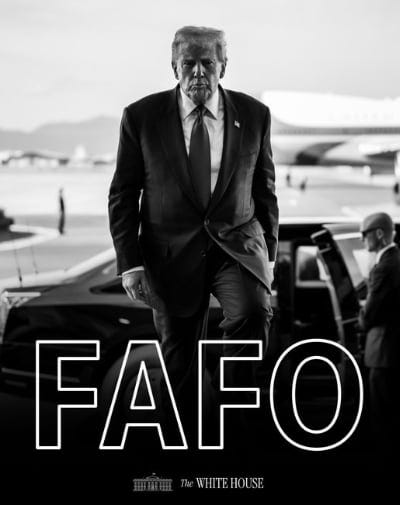
Senator Lindsey Graham’s remark that President Maduro’s “a** is in jail where he deserves to be”7 follows the same pattern. Whatever one’s view of Maduro, such language from a senior US senator toward a foreign head of state represents a collapse of the norms that once separated personal contempt from official conduct. The issue is not politeness for its own sake. It is the degradation of institutional voice.
Empires at their height are careful with words. Empires in decline are careless, because they increasingly rely on threat rather than persuasion, and on spectacle rather than credibility.
Prestige as Power and Its Historical Contrast
This degradation stands in sharp contrast to the conduct of earlier American statesmen, particularly during periods of genuine strategic confidence. President Dwight D. Eisenhower, who commanded the greatest military coalition in history, spoke with deliberate restraint even toward adversaries. President John F. Kennedy, during the Cuban Missile Crisis, understood that dignity and measured language were not signs of weakness but instruments of authority. The ability to restrain language was inseparable from the ability to restrain escalation.
What distinguished that generation was not moral purity, but strategic self-discipline. Even during moments of acute confrontation, American leaders understood that words carried systemic consequences in that public language shaped alliances, deterrence and legitimacy. The contemporary abandonment of this restraint reflects a deeper truth that declining empires often substitute performative aggression for actual authority. When prestige fades, leaders resort to shock, insult and theatrical dominance to compensate. The language of governance begins to resemble the language of coercion.
From Authority to Intimidation
The significance of this shift should not be underestimated. International order rests not only on material power, but on shared expectations of behavior. When the leading power in the world abandons the norms of diplomatic restraint, respect for office and calibrated speech that it once promoted and largely set the tone for, it accelerates systemic breakdown.
In this sense, the vulgarization of American political language is not an aesthetic complaint. It is a strategic signal. It tells allies that American leadership is increasingly impulsive. It tells adversaries that restraint has eroded and it tells domestic audiences that institutions no longer command respect, only fear or loyalty.
The late American political scientist Chalmers Johnson warned that empires lose legitimacy before they lose capability. The collapse of dignity at the highest levels of American governance is part of that process. When leaders no longer speak as custodians of a republic but as enforcers of an empire, decline has already moved from structure into culture. The loss of prestige is not a side effect of imperial decline. It is one of its clearest early indicators.
Imperial Methods Turned Inward: Blowback, Repression and the Return of Violence
Johnson, in his work Blowback: The Costs and Consequences of American Empire, also warned that empires unable to sustain dominance abroad inevitably turn coercive inward. Blowback, in his formulation, is not limited to foreign retaliation. It is the internal corrosion of political norms, civil liberties and social cohesion that follows imperial overstretch. The tools developed to control distant populations are eventually redeployed to manage dissent at home.
This pattern is now visible in the United States. Surveillance authorities introduced in the wake of September 11, 2001, have been normalized and absorbed into the permanent architecture of national security law. While some emergency provisions of the Patriot Act have expired, the broader surveillance and security apparatus it inaugurated remains entrenched. Policing has grown increasingly militarized and political dissent is more frequently interpreted through a security lens rather than a constitutional one. Gun violence has reached staggering levels with mass shootings now routine and an unmistakable sign of collapsing social trust.
On university campuses, once bastions of constitutional dissent, in 2024 and 2025, students exercising their First Amendment rights were met with riot police, mass arrests and force. Encampments were dismantled by armed officers. Students and faculty were dragged to the ground, zip-tied and detained. Campuses increasingly resembled occupied zones.
Censorship deepens the crisis. On questions of war and foreign policy, dissent is increasingly stigmatized and, in some contexts, managed through discipline, arrest and surveillance. The resulting social mistrust and polarization accelerate internal turmoil and corrode the legitimacy that sustained external power.
History’s Echoes and the Illusion of Exception
Every empire believes it is different. None are. China’s rise is not the cause of American decline but rather its consequence. Multipolarity itself is not chaos. The latter emerges when a declining hegemon refuses to accept limits.
Decline is not inevitable. Empire, however, is incompatible with renewal. Reversal would require abandoning the doctrines and institutional logic of empire. This would entail scaling back military commitments, restoring economic balance, rebuilding infrastructure, healing social fractures and recommitting to sovereignty as principle rather than obstacle. That would mean choosing republic over empire.
Waltz understood this long ago. Empires do not fall because they are attacked. They fall because they cannot stop expanding. The logic governing the American empire is not unmistakable. Unless restraint replaces compulsion, the United States will follow the same path as every empire before it, not as an exception to history, but as its confirmation.
If you’ve found this analysis valuable, please consider becoming a paid subscriber. Your support directly enables me to devote more time to deep research and long-form writing of this kind, free from algorithms and click-driven incentives.
So it’s a hopeless situation then. The empire must exhaust itself, and until then it’s messy, messy, messy…
Regarding post-911 America, one of Pascal Lottaz’s recent guests on his Neutrality Studies channel introduced me to the word “Securitocracy”. The Bureaucrat becomes the Technocrat becomes the Securitocrat. (This word must be fairly new because I’m getting spell-checked on it.)