Drop Site News: Jeffrey Epstein Recruited NSA Codebreakers for Genome “Manhattan Project”

By Ryan Grim, Murtaza Hussain, and Emily Jashinsky, Drop Site News, 2/10/26

In the decade before Russia’s invasion of Ukraine in 2022, the U.S. and Russia were engaged in high-stakes exchanges of advanced technology involving the Massachusetts Institute of Technology (MIT) and the Skolkovo Innovation Center—a Russian government-backed technology hub that aimed to jump-start a “venture” innovation ecosystem in Moscow.

Jeffrey Epstein sat at the crossroads of academia, philanthropy, and venture finance as these global capital flows were threatened by the brewing confrontation in Ukraine.

In 2013, during the early cryptocurrency boom, Epstein sought an audience with Vladimir Putin to encourage the Russian president to shift course from the MIT–Skolkovo model. Instead of playing “catch up” with the United States through venture-backed startups, Epstein proposed, Russia could help lead a new financial system based on a novel global currency.

Epstein funded the early development of cryptocurrency through the MIT Digital Currency Initiative, founded in 2015. MIT’s Bitcoin Core Development Fund helped pay bitcoin’s early developers to maintain the open-source software authored by Satoshi Nakamoto, bitcoin’s anonymous inventor. Epstein was an early investor in Coinbase, and he was friends with Brock Pierce, the co-founder of U.S. dollar stablecoin company Tether, which operates, in effect, the world’s largest crypto bank.

Epstein was also recruiting cryptographers to a more ambitious project: hacking the human genome. In an email to a redacted recipient in August 2012, Epstein wrote, “My biology gurus at harvard all agree that the signal intelligence used by the various agencies , could be put to work on breaking the dna code or protein signal problems. breaking foreign codes is the expertise of the us and nsa.” Epstein prompted the recipient to help him recruit “code breakers” from the various intelligence agencies: “it would be great to know which agency button to push.”

In an interview with Steve Bannon months before his death, Epstein revealed that he had purchased a property in New Mexico—the Zorro Ranch—as a research facility to attract the nation’s top scientists from the former “Manhattan Project” campus in nearby Los Alamos after the U.S. government cut funding for high-energy physics at the end of the Cold War. “In our world, the physical world, there were things that were just unexplainable,” he told Bannon. “I wanted to see if we could build tools so others smarter than me could help investigate it.”

The millions of documents published by the Justice Department last month reveal Epstein’s disturbing fascination with eugenic science, expressed through research linked to the intelligence services of multiple governments. Epstein covertly negotiated access to dangerous and ethically dubious technology, between financial elites, often alluding to grand ambitions for reshaping both the human genome and the world order.

Drop Site News has spent the past several months exposing Epstein’s ties to U.S. and Israeli intelligence. Our full series is available here. We also partnered with Jmail in their effort to make the full Epstein files accessible and searchable. View the archive at https://jmail.world/.

If you value this reporting, can you make a tax-deductible donation today to help us keep going?

Help us dig into Epstein

From left, Jeffrey Epstein, Bill Gates, and Boris Nikolic. Photograph from 2011 found in Epstein’s New York mansion.

Jeffrey Epstein Recruited NSA Codebreakers for Genome “Manhattan Project”

The financier pursued cryptographers to “hack” the genetic code, and develop “new signals intelligence” to understand inter-cellular communication.

In January 2010, Ilya Ponomarev, a member of the Duma—the Russian parliament— helped arrange a visit to Massachusetts Institute of Technology (MIT) by a group of senior Russian officials. He told a Latvia-based outlet he was in Boston to explore cooperation between Russian and American startups.

Vladislav Surkov, deputy of then-President Dmitry Medvedev, was part of the delegation. At the time, Surkov was seeking to develop the “second leg” of a managed multiparty system to counter-balance Putin’s dominant United Russia Party. After the visit, Surkov asked Ponomarev, a popular member of A Just Russia, the controlled opposition party, to become a “technology transfer” advisor for Viktor Vekselberg, a Russian-Israeli billionaire.

Vekselberg, owner of the conglomerate Renova Group, was in charge of the Skolkovo Innovation Center, dubbed Moscow’s “Silicon Valley,” a high-tech business district subsidized by Russian state-owned enterprises and administered by the non-profit Skolkovo Foundation.

With Ponomarev’s help, Vekselberg established the Skolkovo Institute of Science and Technology, or “Skoltech,” a $300 million research partnership paid by the Skolkovo Foundation to MIT. MIT and Skolkovo share profits and royalties from the partnership, which includes intellectual property related to CRISPR gene-editing technology. Skoltech supported research on RNA-targeting methods using CRISPR, and also owns rights to diagnostic technology based on the same RNA-targeting effector.
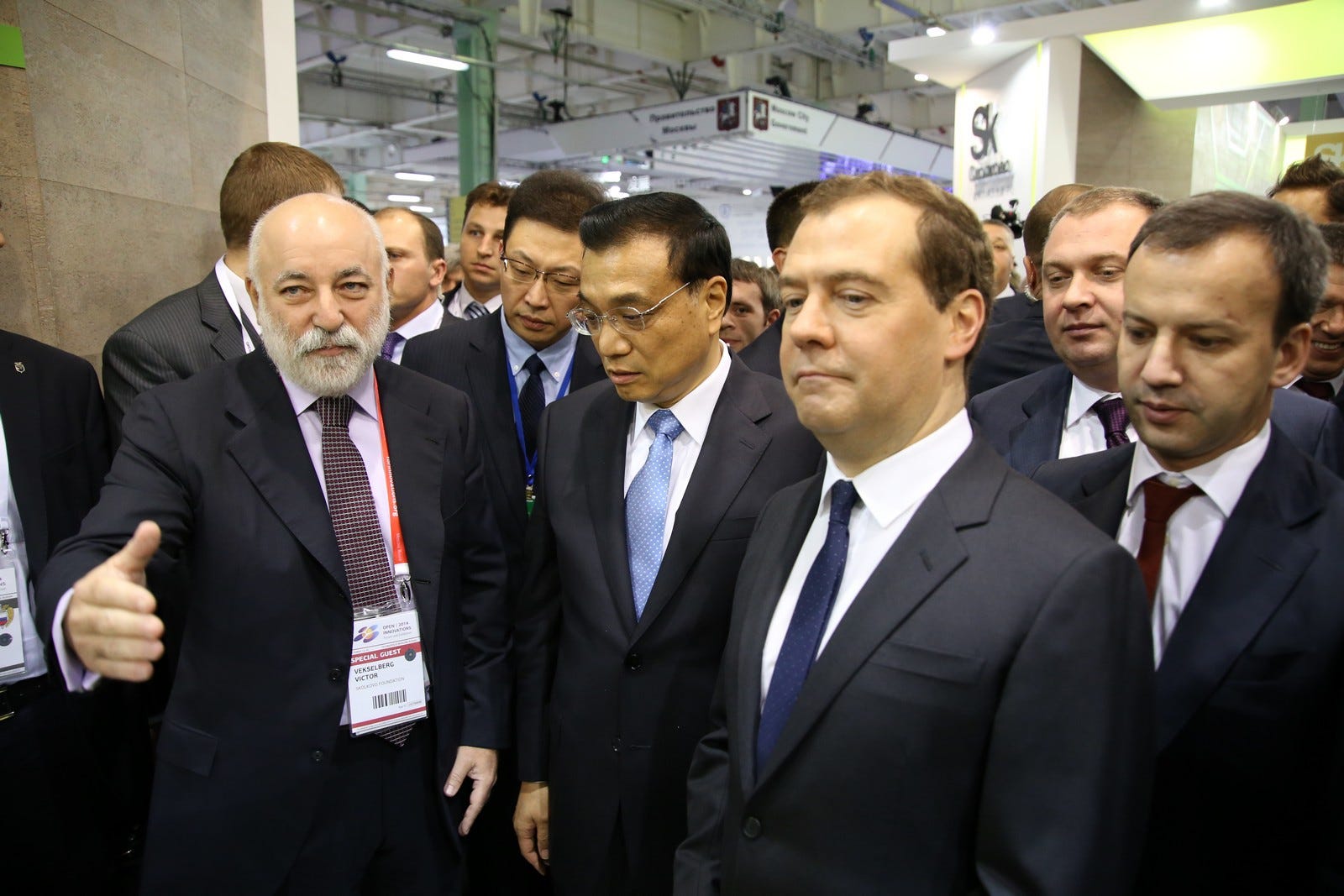
Former Russian Prime Minister Dmitry Medvedev, right; Li Keqiang, former Chinese premier, center; and President of Skolkovo foundation Viktor Vekselberg, left, visit the Skolkovo facility in Moscow. Photo: Wikimedia Commons

Like many of his ultra-wealthy peers, Jeffrey Epstein was fascinated by gene therapy and life-extension technology. He once suggested to news anchor Katie Couric—to her shock and disgust—that he even planned to clone himself. But his interest in genomics was more than a passing fancy; it was an enduring obsession during the final decades of his life.

In December 2006, before Epstein was jailed for prostitution of a minor in Palm Beach, Ghislaine Maxwell invited Google co-founder Sergey Brin and his then-girlfriend Anne Wojcicki to Epstein’s Little St. James Island, according to emails in Epstein’s hacked Yahoo! inbox vetted and published by Distributed Denial of Secrets. Wojcicki had founded a personal genomics startup called 23andMe, and Maxwell encouraged Epstein to cultivate a relationship with her. “Be v nice to her not stupid,” Maxwell wrote. “She is interested in mapping DNA etc ..she is key :)”
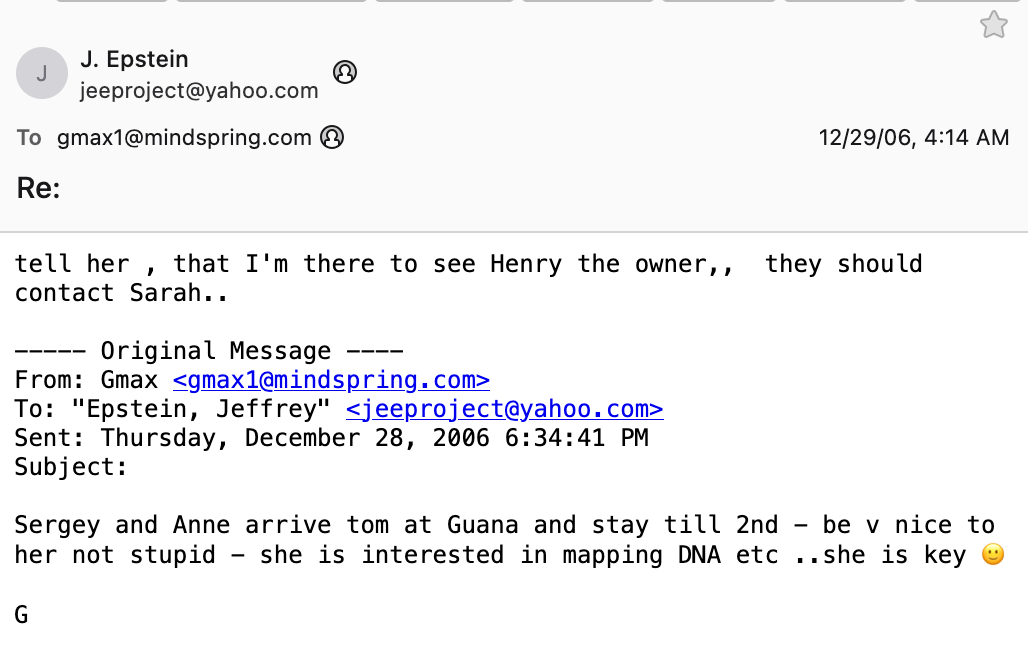
Email exchange between Jeffrey Epstein and Ghislaine Maxwell regarding Sergey Brin and Anne Wojcicki’s visit to Little St. James. Source: DDoS. View on Jmail.

That same year, Epstein had been in contact with leading Harvard geneticists George Church and Gary B. Ruvkun, who won a Nobel Prize in 2024 for his research into micro RNA. Epstein planned to fund Church’s Personal Genome Project at Harvard, and Ruvkun sought Epstein’s support for genomics research to elucidate “pleasure signals in the brain.” Ruvkun wrote to Stephen Kosslyn, later Harvard’s Social Science Dean, “let me know if this subject is too strange for our patron.” The correspondence was forwarded to Epstein, who wrote back, “the patron has no boundaries.”

After Epstein’s release from prison on sex crime charges in 2010, he began funding Church’s CRISPR gene-editing research. In November 2011, Church stirred some controversy by telling an interviewer that he hoped to clone a Neanderthal.

Epstein wrote to Church a few weeks later, after the scientist declined an invitation to an event, “did the cloning issue , give you pause?” Church replied, “Yes. I’m working toward this goal fairly rapidly but trying to do so in a way that minimizes risk to the field.”

“Why don’t you come and i won’t mention it,” Epstein coaxed him. “I just find it intellectually amusing.” Church did not reply to request for comment.
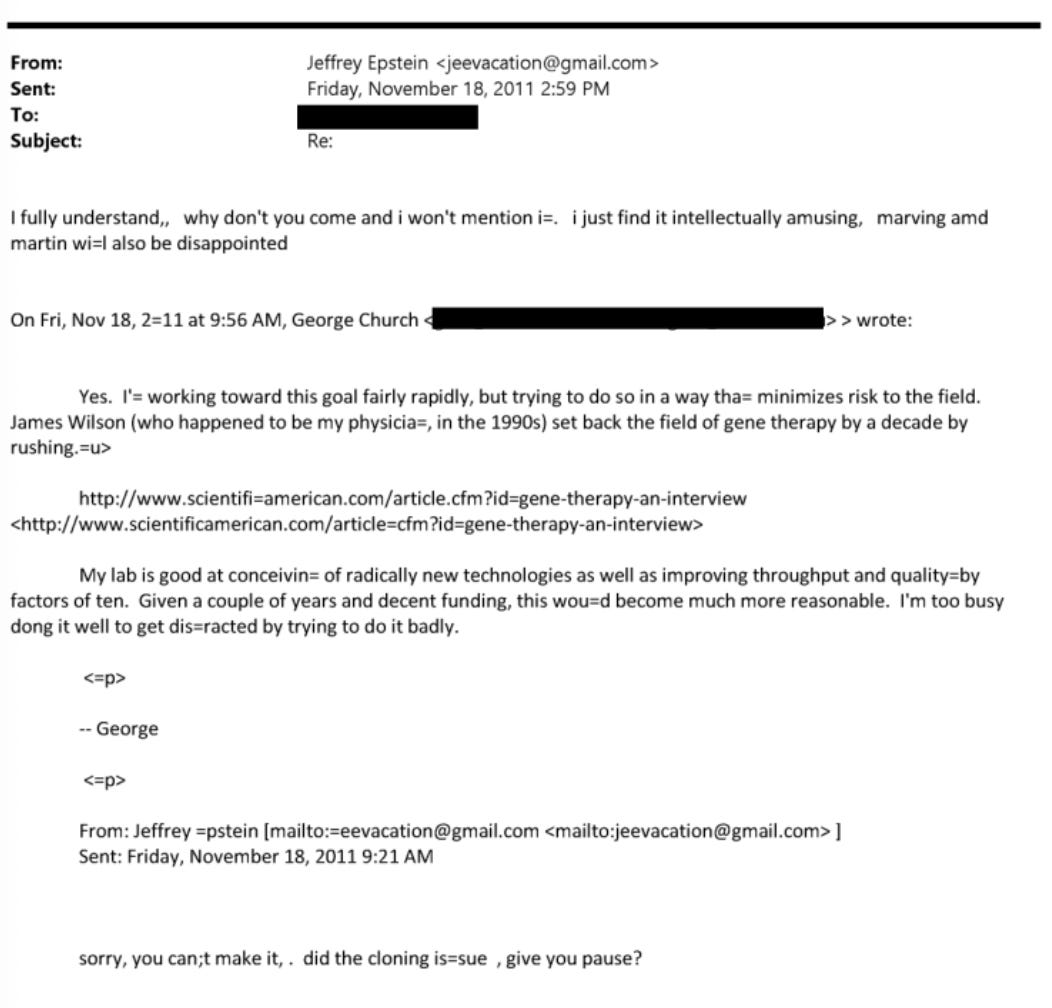
Email exchange between Jeffrey Epstein and George Church, likely referring to MIT scientists Marvin Minsky and Martin Nowak, whose research was funded by Epstein. Source: U.S. Department of Justice.

“Find Me The Top Hacker”

Epstein’s interest in gene-editing was not purely intellectual; it was personal. Joe Thakuria, Church’s Harvard Medical School colleague, helped Epstein conduct research on his own genome. In June 2014, Thakuria sent Epstein a $193,400 invoice for a package deal to mutate his adult stem cells “to increase longevity,” noting that “If we do this, he, like George Church, would be one of very few people in the world to have this done.” Later that year, Epstein tried to arrange a meeting between Church and Bill Gates to discuss “anti aging” and “genetic fabrication.”

MIT received millions of dollars in donations directed by Epstein to support pet projects that happened to closely intersect the frontier research conducted under the Skoltech partnership.

Epstein gave his first gift to the MIT Media Lab in 2002, to fund the research of artificial intelligence pioneer Marvin Minsky. Over the next decade, Epstein gave several large gifts to Seth Lloyd, a quantum computing researcher featured at the Russian Quantum Center in Skolkovo, who co-authored papers with Skoltech-funded researchers.

Microsoft, the technology conglomerate of which Bill Gates is a founder and major shareholder, also had formal ties to Skolkovo. In 2010, Viktor Vekselberg and Microsoft CEO Steve Ballmer signed a memorandum in Moscow to begin “a wide-ranging series of collaborative initiatives that will underpin the Russian Federation’s technology innovation agenda,” later opening an R&D center at the Skolkovo Innovation Center.

Skolkovo was one of several foreign funders of the MIT Media Lab, led by Epstein’s close friend Joi Ito. The Skolkovo partnership funded research grants for high-profile principal investigators like Chilean physicist César Hidalgo and Neri Oxman, hedge fund manager Bill Ackman’s wife, whose research Epstein had personally backed.

Epstein was also supporting the work of Madars Virza, a Latvian research scientist working on cryptocurrency at the Media Lab. In 2011, the Skolkovo Foundation funded Virza and Israeli scientist Eli Ben-Sasson’s research on Zerocash, a design for an anonymous cryptocurrency based on “zero-knowledge” cryptographic proofs—also backed by the Defense Advanced Research Projects Agency (DARPA).

In emails released by the Justice Department last month, Epstein discussed the cryptographic theory behind Zerocash with Italian hacker Vincenzo Iozzo, “ZeroCash…is essentially a ‘privacy preserving’ version of Bitcoin,” Iozzo wrote to Epstein. “If we use…similar [zero knowledge proofs] for our currency, we can enforce arbitrary rules on how the currency is spent.” Epstein invested in Ben-Sasson and Virza’s Electric Coin Company, to create the Zcash blockchain based on their research. Later, Epstein helped Virza make a bank transfer in the Virgin Islands before a “fork” in the Zcash code. Virza did not reply to request for comment.

Epstein’s interests in genes and cryptocurrency were deeply intertwined. He regarded the human genome as a cryptographic puzzle, and wanted to “hack” the genetic code.

As early as December 2009, Epstein reached out to Daniel Dubno, a CBS News producer who previously worked with DARPA and the Department of Homeland Security, to “find me the top hacker codebreaker, nsa type,” to assist in analysis of proteins.

That month, Epstein contacted MIT parallel computing pioneer Danny Hillis with the same request: “i am looking for nsa quality code theorist. biology at every level involves a host of Alice and Bob interactions, authentication, signnal processing. Noisy channels.” (In cryptographic theory, Alice and Bob are common placeholders for two parties trying to communicate with each other.)

In his messages to Hillis, Epstein seemed somewhat conversant in the frontier methods in artificial intelligence research at the time, writing, “THe math gets quite complicated. algebraic topologists ,sometimes look at the intersections in multidimensional spaces,” referring to the practice of representing a high-dimensional object as a collection of overlapping regions, then studying the pattern of their intersections.

Dubno followed up with Epstein a few months later, to inform him about a crypto workshop he was planning, with some promising recruits. “A bunch of Israeli hackers are in this with me as well as the chief disruption officer at Darpa, Dr. Peter Lee,” Dubno wrote. He added, “I’d design this so you’d get your questions answered if you’d help me get mine.” Epstein replied, “Im in.” Dubno visited Epstein’s island within a matter of days. Hillis and Dubno did not reply to requests for comment.

For the next decade, Epstein continued to recruit engineers from U.S. national security entities, including DARPA, to his genome hacking project. He asked Kathryn Ruemmler, the White House attorney who had handled the legal fallout from the Edward Snowden leaks, to help him source cryptographers from the National Security Agency. “Can you find a guy from nsa that can think about signal intelligence applied to DNA,” Epstein wrote . “I want to intercept communication between living cells in organisms.”

In late 2012, he had sent the same request to Boris Nikolic, Bill Gates’ top aide: “do you have any contacts at nsa so that we can use de encypriton (sic) in biological systems?” “Yes,” Nikolic replied, “There are no many places where I do not have someone ;)”

“A New Form Of Money”

Despite an auspicious start, the partnership between MIT and Skolkovo came under strain in 2012, caught between rising tensions between Washington and Moscow, and an increasingly restrictive political climate within Russia itself.

That year, major street protests broke out in Moscow and St. Petersburg against the Russian government. In response to the demonstrations, Putin accused the U.S. of fomenting unrest, and his foreign minister claimed the United States Agency for International Development (USAID) was attempting to influence Russia’s elections through “pro-democracy” non-profit and non-governmental organizations.

USAID was funding a major Russian civil society organization to conduct election monitoring, documenting allegations of voter fraud that fueled the protests. Ponomarev—now seen as a liberal opponent of the government—did not have public ties to USAID, which was a close partner of the Gates Foundation. Even so, as concerns mounted over his safety inside Russia, Nikolic, Gates’ science and technology advisor, quietly sought Epstein’s help to protect him.

In an email dated January 11, 2012, Nikolic asked Epstein to travel with him to Russia to meet Ponomarev. Nikolic forwarded a message from Ponomarev requesting an invitation to speak at the World Economic Forum that year “so that not only official Putin’s voice is heard.”

“He is a member of Duma,” Nikolic explained to Epstein, “and he and Alyona (his very smart and cute girlfriend) are the main organizer of the uprising against Putin…I am afraid what will happened to him. The stakes are huge.”

Nikolic believed that Ponomarev was in imminent danger. “He might replace Putin and become a president by himself (he will sooner or later) if he does not [get] killed before. It is super dangerous – any idea how to help him???” Nikolic signed off, “Pls do not forward this email.”
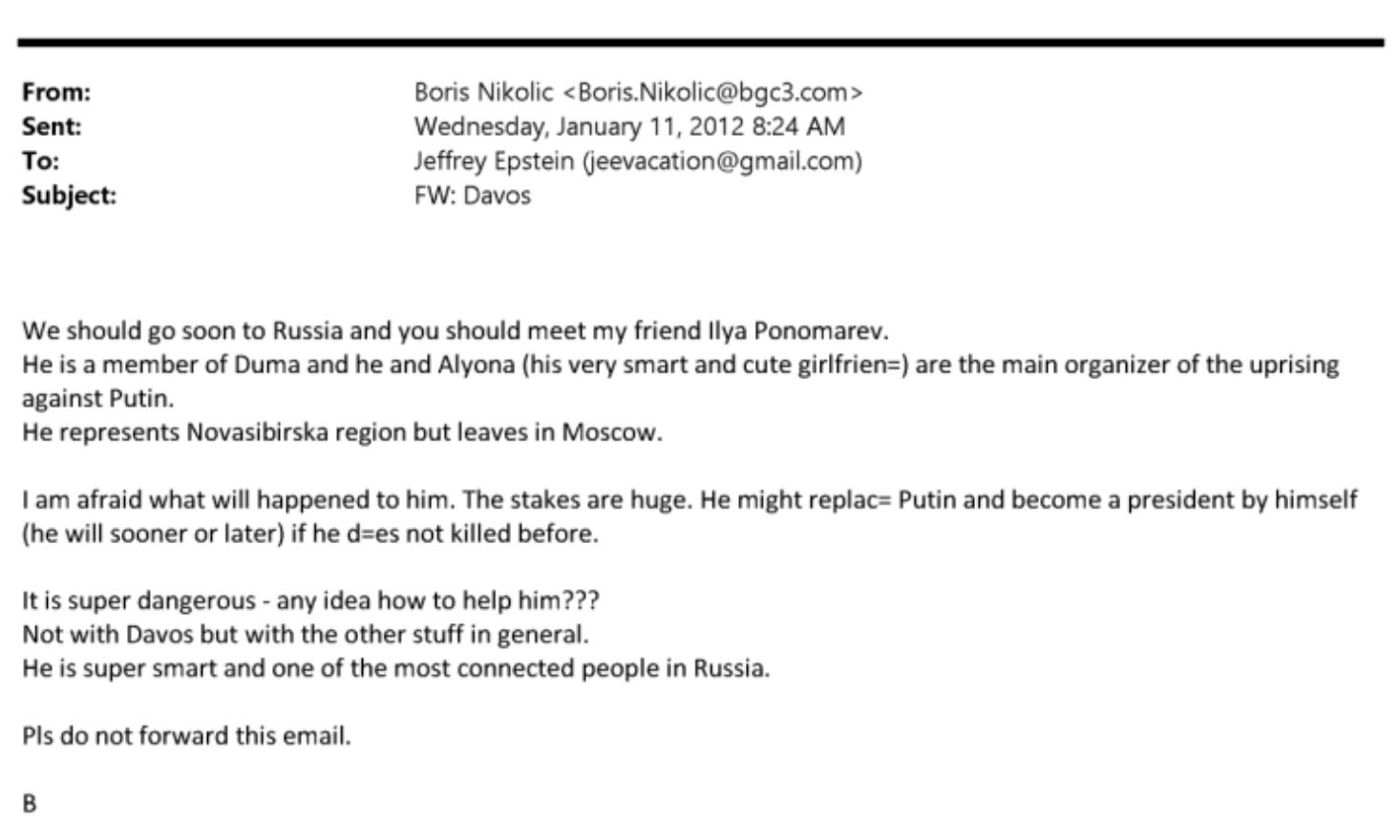
Nikolic invites Epstein to Russia to meet Putin rival Ilya PonomarevSource: U.S. Department of Justice.

The documents do not show whether Epstein responded, or if he acted on Nikolic’s email at all. Ponomarev did not speak at Davos that year. As Nikolic had warned, Ponomarev’s status in Russia quickly became more precarious. After Putin’s return in May 2012, Ponomarev led a failed filibuster to stall a bill drastically increasing penalties for participating in protests. In June 2012, Nikolic sent another message encouraging Epstein to build a relationship with Ponomarev, writing, “It is somewhat dangerous for me to spend more time with him. But I think it is worth it.”

The next month, the Russian government adopted a new “foreign agents” framework for foreign-funded NGOs, restricting the activities of civil society organizations. In September 2012, USAID was banned from Russia.

The MIT-Skolkovo partnership became a political flashpoint as the Kremlin moved to contain Ponomarev. In March 2013, Ponomarev resigned from his political party, A Just Russia, after being forced to break with the protest movement. Ponomarev and other high-profile figures connected to Skolkovo were investigated for suspected embezzlement, and a Moscow court ordered Ponomarev to pay back his lecture fees from Skolkovo.

The same month that Ponomarev was separating from his political party in Russia, Ehud Barak stepped down as head of Israel’s Defense Ministry. With Epstein’s help, Barak quickly negotiated a lucrative consulting agreement with Renova Group—the conglomerate owned by Vekselberg, the billionaire head of Skolkovo.

Barak told reporters that his retirement meant that he now would have time to “study, write, live and enjoy.” Instead, he immediately began working with Epstein to conduct covert diplomatic work in support of Israeli security interests abroad. One of their first priorities was securing a private meeting with Vladimir Putin to discuss a Russian-led resolution to the civil war in Syria, and the peaceful removal of President Bashar al-Assad from power.

Epstein offered Barak a strategy he often employed: using non-governmental multilateral institutions to engage state leaders through backchannels. Within days of Barak’s retirement, on March 27, 2013, Epstein and Bill Gates visited Thorbjorn Jagland, a member of the Nobel Peace Prize committee, accompanied by representatives of the International Peace Institute (IPI), a non-profit think tank specializing in multilateral diplomacy.

Barak and Epstein were simultaneously using the IPI to cut a security deal for Israel in Mongolia, in hopes of accessing mining interests in that country. Barak traveled to Ulaanbataar in late April 2013, and emailed Vekselberg to set up an urgent phone call: “met with most of the leaders from the President downwards and several business people. If your plans for Tuesday [have] not been changed I have a thought that could probably help.” That Tuesday, Vekselberg and Putin attended a meeting for the Board of Trustees of the Russian Geographical Society in St. Petersburg.
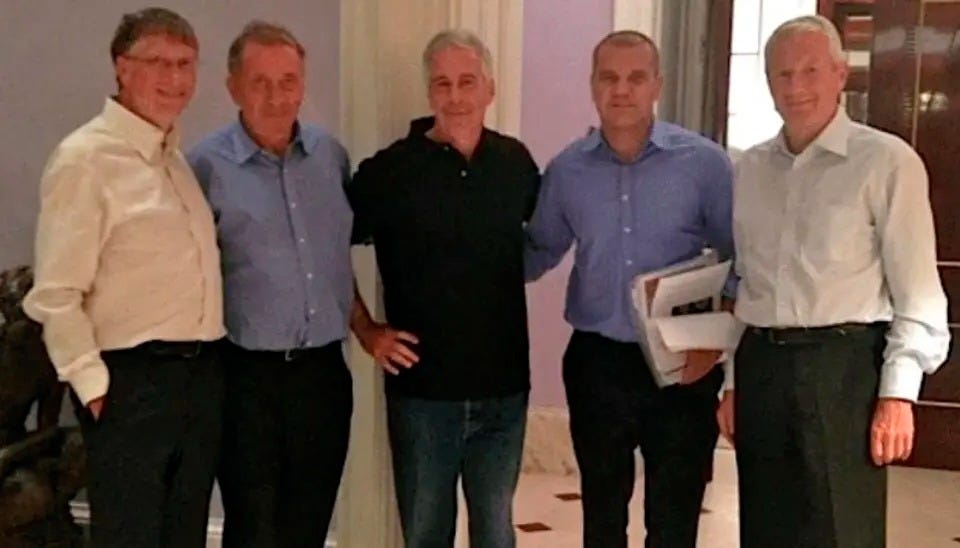
From left, Bill Gates, Terje Rød-Larsen, Jeffrey Epstein, Boris Nikolic, Thorbjorn Jagland. Source: U.S. Department of Justice.

On May 9, 2013, Epstein updated Barak on his efforts to engage Putin through Jagland: “jagland is going to see putin in sochi, jagland asked that I make myself availble to meet with him sometine in june, to explain how russia can structure deals in order to encourage western investment.” Barak wrote back: “i know Jagland for long time. probably we have to talk about it.”

The next day, Epstein laid out his proposal for Putin, in a May 10 email to Jagland: “When sputnik was announced, the West was caught flatfooted. The same can now happen with Russia taking the lead in finance.” Epstein suggested that Putin was chasing the wrong modernization model, “copying silicon valley, looking for start ups, playing catch up to Microsoft . apple google and the like.”

In place of the “Skoltech” model, Epstein wanted to offer Putin an alternate path: Russia could “get out in front and leapfrog the global community by reinventing the financial system of the 21st century.”

The American financier proposed a framework for a new global currency: “A new form of money, on a world wide basis… much larger than any single project envisioned by any govt. and at its core not really that difficult to bring to fruition.”

Jagland had no clue what Epstein was talking about. “Hi Jeffrey, all this is not easy for me to explain to Putin,” he wrote. “You have to do it. My job is to get a meeting with him.”

Epstein dialed back the message for Putin, writing, “You can tell him that you and I are close, and that i advise Gates. this is confidential, . I would be happy to meet him , but for a minimum of two to three hours, not shorter.”
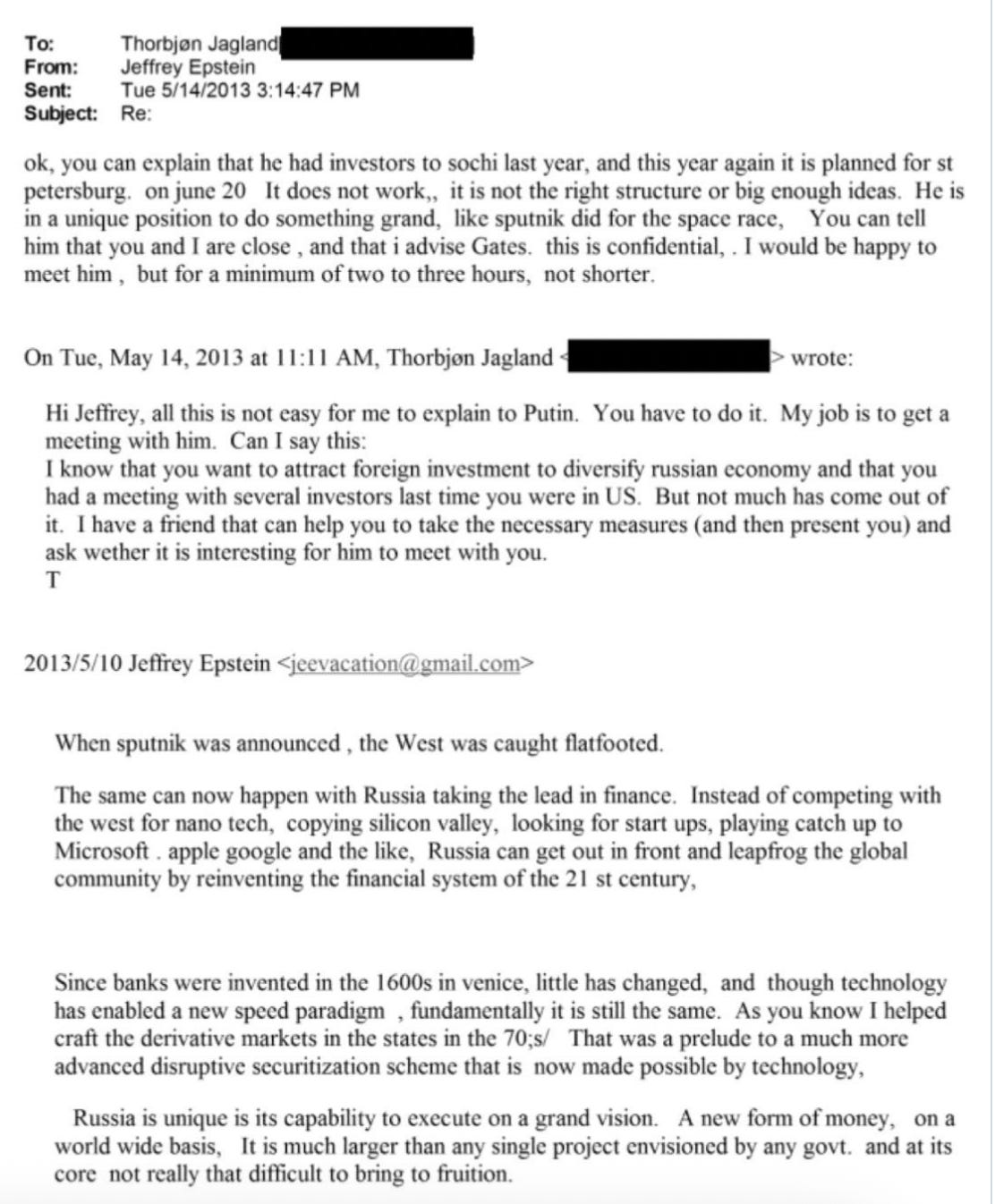
Email exchange between Jeffrey Epstein and Thorbjorn Jagland. Source: U.S. Department of Justice.

Jagland’s pitch to Putin appears to have worked. On May 22, 2013, Epstein claimed to Barak that he’d received, and rejected, an invitation to meet with Putin at the St. Petersburg International Economic Forum the next month: “Putin asked that i meet him in st petersburg the same time as his economic conference…i told him no, . If he wants to meet he will need to set aside real time and privacy.”

But, with close guidance from Epstein behind the scenes, Barak finally met Putin in late June 2013, during the St. Petersburg International Economic Forum.

“Access Remote Parts of Africa”

On August 6, 2013, the Kremlin extended Skolkovo’s funding through 2020, reversing the prior decision to gut the program. Barak and Epstein swiftly found an opportunity to profit from the Kremlin’s decision, making use of Epstein’s connection to the Gates Foundation.

Shortly after returning from St. Petersburg, Barak joined the advisory board of Parasight, an Israeli biotech company in the Skolkovo Innovation Center, which was developing technology to detect malaria in blood samples using computer vision AI. On August 10, 2013, Epstein connected Barak to Nikolic to get support for Parasight (now called Sight Diagnostics) from the Gates Foundation. Nikolic’s invitation to Barak appears in both the hacked dataset published by Distributed Denial of Secrets and the DOJ release last month, further corroborating the authenticity of the hacked Barak email cache.

Nikolic made plans to meet Barak in New York during the Clinton Global Initiative (CGI) in late September 2013. Nikolic wrote Barak: “I will be in NYC that whole week and I look forward to seeing you and catching up – most likely at Jeffrey’s – it is more interesting there than at CGI ;)”

Like most of the startups advised by Barak, Parasight’s roots were in Israeli military research units. Parasight co-founder Yossi Pollak is an alumnus of Talpiot, an elite Israeli Defense Forces science and technology program; Sarah Levy, a founding engineer and eventual chief technology officer, is also a Talpiot graduate and veteran of Unit 81, the secretive special technology unit of the Israeli Military Intelligence Directorate.

Barak’s point man on the Parasight project was his brother-in-law and business partner Doron Cohen, who served under Barak in Sayeret Matkal, the Israel Defense Forces’ elite special operations unit. Cohen and Barak were working together, in secret, on a security deal between Israel and the West African nation of Ivory Coast. In parallel, Epstein was shepherding the Gates Foundation into Ivory Coast, leveraging his close relationship with Nina Keita, the niece of President Alassane Ouattara; he tried to coordinate a meeting between Ouattara, Keita, and Gates on September 16, 2013, before the U.N. General Assembly that week.

Barak met Nikolic at Epstein’s mansion on September 20, 2013, and Barak introduced Nikolic to Parasight co-founder Daniel Levner via email. Levner later conveyed Nikolic’s feedback on next steps with the Gates Foundation: “Dr. Nikolic’s view is that the Gates Foundation’s driver in choosing technologies is the ability to access remote parts of Africa.”

Two months later, in November 2013, Barak received an email from Parasight’s founders asking for Vekselberg’s support for additional grant funding from Skolkovo. Barak discussed on the phone with Cohen, and one week later, the grant application was approved: Skolkovo pledged an additional $2.5 million to Parasight, on the condition that Parasight put $1.25 million of its own money into a new Russian entity.

Sight Diagnostics later developed portable malaria detection in collaboration with the U.S. Army Medical Research Directorate at Kisumu field station in Kenya, where the army runs programs for the U.S. Presidents’ Malaria Initiative, a USAID-led partner of the Gates Foundation. Drop Site was unable to confirm if Gates Foundation was directly involved in the Kenya trial. The Foundation, Nikolic, and Ponomarev did not respond to requests for comment.

Don’t forget to subscribe to Drop Site.

“Designer Babies”

The files released by the U.S. Justice Department and House Oversight Committee have shown Epstein deeply preoccupied with theories of racial and genetic superiority. In an anonymous essay recovered from Epstein’s files, titled “Africa, parasites, intelligence,” the writer mused that “For Africa, the environmental factor is parasites—disease—known to exert a strong negative effect on intelligence.” “And what is special about Jewish intelligence?” the author asked. “Surely it is that it emerged in mercantile settings, natural home of numbers, logic and mathematics.”

Calculations about the long-term viability of the Israeli state, and anxieties about the demographics of its Jewish population, formed a backdrop to Epstein and Barak’s engagement with Putin. In the last years of Epstein’s life, Barak shared grave concerns with Epstein about Israel’s looming demographic crisis. During a dinner at Epstein’s New York mansion in February 2013, Barak told former Obama economic adviser Larry Summers that Israel needs to solve its Jewish population shortage “before it’s too late” and stop “the slippery slope to a one state nation … with an Arab majority.”

Barak believed the best hope for Israel’s future was allowing for conversion into Judaism to promote migration, by breaking the orthodox Rabbinate’s authority to define who is a “Jew.” “Open the gates for massive conversion to Judaism,” Barak said.​​ “It’s a successful country, many will apply.”

Russian migration had been essential to Israel’s past success, and Barak hoped to repeat the pattern: “The Russian million changed Israel dramatically. Many would prefer to be Jews rather than Russians. Lots of young people, including women. We can easily absorb another million.” He proposed restricting migration from Arab and North African countries, telling Epstein and Summers, “We can control the quality much more effectively, much more than the founding fathers of Israel did. They took whatever came just to save people. Now, we can be more selective.”

As the relationship between the U.S. and Russia continued to deteriorate over the subsequent decade, Israel was forced to manage an increasingly tenuous balancing act between the two great powers. Epstein himself took a quiet interest in Russia’s growing conflict with Ukraine and NATO. On March 13, 2014, three days before a referendum on whether Crimea should join Russia, Epstein wrote to his broker at Deutsche Bank, “let’s play,” and instructed her to place a $250,000 bet against the Russian ruble. By the end of the year, the ruble had lost nearly 50 percent of its value relative to the U.S. dollar.

After the referendum, on March 18, Epstein messaged Ariane de Rothschild and her senior advisor Olivier Colom, a former aide to Nicolas Sarkozy and expert in the African mining industry: “ukraine upheaval should provide many opportunites , many.”
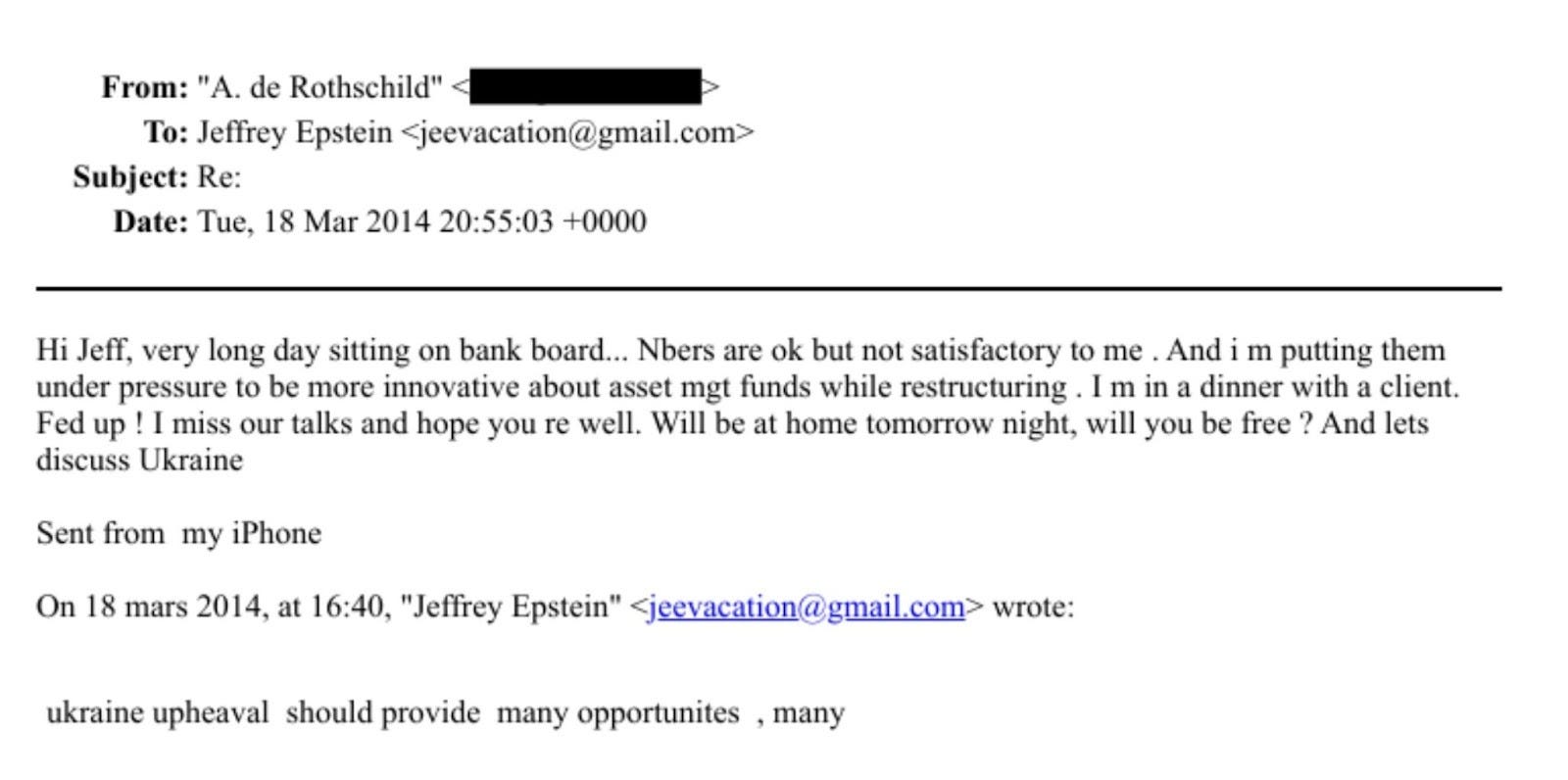
Email exchange between Jeffrey Epstein and Ariane de Rothschild. Source: U.S. Department of Justice.

On March 20, 2014, Ilya Ponomarev was the sole “no” vote in the Duma on Russia’s annexation of Crimea. He was vilified in Russian state media, and placed on a billboard in the center of Moscow which labelled him as a “national traitor.” Ponomarev fled to the United States soon after.

The next year, in June 2015, Epstein asked for Nikolic’s help obtaining asylum for a Russian woman whose name is redacted in the emails. Nikolic offered to introduce her to Ponomarev. “He knows most of leadership of LGBT community in Russia and has helped such application for asylum in USA in past,” Nikolic wrote, adding, “He will help.”

By this time, Nikolic had departed the Gates Foundation, and was helping steer major private capital into the gene-editing boom. In August 2015, Epstein’s Deutsche Bank banker, Paul Morris, forwarded a write-up on the CRISPR startup Editas Medicine, highlighting a $120 million funding round led by Nikolic.

In the final year before his death, Epstein supported a bio-lab in Ukraine for the production of “designer babies,” led by hacker Bryan Bishop. On July 21, 2018, Epstein wrote to Bishop, “i have no issue with investing the problem is only if i am seen to lead.” Bishop wrote back, “I have always envisioned there would be anonymity requirements about babies– we can’t publicly identify who these are or their parents or benefactors, it would brand the child as (essentially, and sadly) a freak for life in the media.”

Bishop planned to brainstorm with Epstein about ways to protect the anonymity of all persons involved. “I had always assumed the investor would need absolute anonymity, for these kinds of products,” Bishop wrote. “So the financial structure needs to be designed with these details in mind.”

After Russia’s invasion of Ukraine in 2022, Russian state media began spreading a “conspiracy theory” that the United States was operating secret military biological experiments to create “monster” soldiers in Ukraine. U.S. and Ukrainian officials categorically denied the allegations.

As the war unfolded, Ilya Ponomarev became a leader of the Freedom of Russia Legion, a volunteer militia of Russian defectors fighting for Ukraine, and joined the Congress of People’s Deputies, a shadow parliament of Russian opposition figures.

In 2019, a redacted sender wrote to Epstein regarding another vocal critic of Putin, Ukrainian President Volodmyr Zelenskyy. “Zelensky looking for help,” the person wrote, “Putin dismissive, saying he is run by Israelis.” According to Epstein’s calendar, he planned to stay at the Hyatt Regency in Kyiv in February, one month before the first round of Ukraine’s presidential elections. In another message, Epstein received a link to a May 2019 New York Times article on Ihor Kolomoisky, Zelenskyy’s Ukrainian-born, Israeli backer. Epstein wrote back, “I’m following the situation. Lot of fun.”
Col. Daniel Davis Interviews MIT Prof Ted Postol: IRAN: WHAT it CAN & CANNOT DO

YouTube link here.

Trump Privately Dreams of Iran Regime Change Glory as Democrats Cynically Weigh Political Benefits of War

By Ryan Grim, Jeremy Scahill & Mutaza Hussain, Drop Site News, 2/20/26

Since mid-January, as U.S. war planners have presented President Donald Trump with a spectrum of options for military action against Iran, Trump has repeatedly opined in private about his desire to go down in history as the president who “changed the Iranian regime” that has remained in power since the 1979 Islamic revolution.

Sources with knowledge of internal White House deliberations told Drop Site that Trump is emboldened by what he sees as a phenomenal success in his Venezuela strategy—issuing sweeping demands for capitulation under threat of removing the ruling government and then abducting President Nicolás Maduro when he refused to obey.

But, the sources said, Trump and his aides have pressed war planners for assurances that chaos produced by any U.S. military action would calm down in time for the midterm election season to kick into high gear.

Trump has suggested to aides that he would make a deal with Iran if its leaders bend to his central demands but he stands ready to unleash a massive military operation—potentially including one aimed at assassinating Iran’s leadership—if they do not. Trump has said he may consider an initial round of attacks in an effort to push Iran to submit. In that event, the massive firepower in the region would remain if he decided to move forward with a broader war. Iranian officials say they are currently working on a formal response to the U.S. position laid out in Geneva on Tuesday during indirect talks, but have cautioned Iran has its own red lines. Tehran, meanwhile, told the United Nations it would consider U.S. bases “legitimate targets” if attacked, putting U.S. servicemembers at serious risk.

Subscribe to Drop Site today:

The potential for fallout in the event of a regime change war is at the heart of the meek response from Democrats, who see Trump walking into a trap of his own making. The Democratic political calculation was laid bare in an unusually frank conversation last June between a senior foreign policy aide to Senate Majority Leader Chuck Schumer and a top official in an organization opposing Iran strikes.

In June 2025, at the same time Trump was floating the possibility of a strike against Iran, he spoke positively about encouraging progress in ongoing nuclear talks—suggesting that if a deal was met, those strikes would be off.

Schumer responded by mocking the president as TACO Trump—using an acronym for “Trump Always Chickens Out,” a phrase describing Trump’s propensity to make major threats and then back away. For opponents of war with Iran, Schumer’s taunt was counterproductive, and a coalition of more than two dozen organizations sent a letter urging Schumer to delete the video and give Trump political space to reach a diplomatic solution.

The letter led to a phone call between one of the letter’s organizers and the top foreign policy aide to Schumer, who laid out the thinking of many Democrats in the Senate. The organizer who took the call agreed to share details of the conversation in exchange for anonymity. A congressional source briefed on the call shortly afterward confirmed the details. The foreign policy aide, whom Drop Site agreed not to name, explained that a substantial number of Senate Democrats believed Iran ultimately needed to be dealt with militarily. But those Democrats, the aide explained, also understood that going to war again in the Middle East would be a political catastrophe. That’s precisely why they wanted Trump to be the one to do it. The hope was that Iran would take a blow and so would Trump—a win-win for Democrats…

Continue reading here.

***

The US is on the brink of a major new war that Trump has not even bothered explaining

By Glenn Greenwald, Substack, 2/20/26

President Trump has spent two months ordering a rapidly expanding and now-massive military buildup near Iran, with a focus on the Persian Gulf and nearby permanent U.S. military bases in close proximity to Iran (Iran, of course, has no military bases anywhere near the U.S.). The deployment includes aircraft carriers and other assets that would enable, at a minimum, an extremely destructive air campaign against the whole country.

The U.S. under both parties has been insisting for two decades that it must abandon its heavy military involvement in the Middle East and instead “pivot to Asia” in light of a rapidly rising China. Yet in the midst of those vows, Trump has now assembled the largest military presence in the Middle East since 2003, when the U.S. was preparing to invade Iraq with overwhelming military force.

One of the most striking and alarming aspects of all of this is that Trump — outside of a few off-the-cuff banalities — has barely attempted to offer a case to the American public as to why such a major new war is necessary. This unilateral march to war resembles what we saw in the lead-up to the bombing of Venezuelan boats, culminating in the U.S. invading force that abducted (“arrested”) the country’s President, Nicolas Maduro, and took him and his wife to a prison in New York.

In the weeks preceding the Venezuela operation, we heard a carousel of rationales. It was all necessary to stop the flow of dangerous drugs into the U.S. We needed to free the repressed Venezuelan peoples from their dictator. Trump’s embrace and expansion of the Monroe Doctrine — now dubbed the Donroe Doctrine — meant that we cannot tolerate communist regimes in “our region.”

But as soon as Maduro was removed, all of those claims disappeared. Contrary to the expectations of many, the U.S. left in place Maduro’s entire regime rather than replacing it with the pro-US opposition (a wise move of restraint in my view, but one that negates the “liberation” rhetoric). Discussions of the drug trade from Venezuela (a source of drugs for the U.S. that was always minor if not trivial, and did not include fentanyl) have completely disappeared. The only real outcome seems to be that the U.S. has more control over that nation’s oil supply, and barrels of it are now being shipped to Israel for the first time in many years.

In sum, we were given a low-effort smorgasbord to enable supporters of Trump’s actions toward Venezuela to mount arguments in favor of the operation, but there was no systematic attempt to convince the country at large. There was not even a live television address to the nation beforehand to explain it. And the role that Congress played was close to non-existent. All of that is similar to what we are seeing now concerning a far riskier, more dangerous, and complex war with Iran.


This massive build-up near Iran also signifies the U.S.’s complete inability — or lack of desire — to extricate itself from the Middle East and endless American wars there. In the first year of his second term — 2025 — Trump has already ordered sustained bombing of Yemen; extensive military deployments to support Israel’s attacks on Gaza, the West Bank, Lebanon, Syria, Iraq and Yemen; and Operation Midnight Hammer, which was sold to Trump’s base as a one-night-only bombing run that is now close to exploding into something far more protracted.

No matter how fast China’s power grows, the U.S. — despite emphasizing the vital importance of doing so over the last four administrations — simply cannot or will not reduce its massive military commitment to the Middle East. The real reasons why the U.S. does not sharply deprioritize the Middle East as a military focus deserve serious examination (oil is often cited as the reason, but the U.S. is a net exporter of oil, and multiple oil-rich countries in that region are perfectly eager to sell the U.S. as much oil as it wants to buy).

In this regard, it is hard not to notice that Trump’s very rapid movement toward war with Iran comes in the midst of yet another visit to the White House by Israeli Prime Minister Benjamin Netanyahu. It is not hyperbole to say that Netanyahu’s great dream for decades has been inducing the U.S. into a regime-change war with Iran to rid Tel Aviv of its most formidable adversary, and his dream is closer than ever to being realized.

There is no way to minimize the gravity of the moment. Trump himself has made clear that this huge armada on its way to Iran — far larger than the one deployed to Venezuela — is not for show. He has spent many weeks ratcheting up his war rhetoric. Trump’s public posture is ostensibly one of deterrence: he proclaims that his overarching desire is to strike “a deal” with Tehran in order to avoid the need for war, but he then quickly adds that the US will impose massive damage and violence on the country in the event that negotiations fail to produce the agreement he wants. In sum, he depicts threats of war as motivation for Iran to accept his terms.

That may seem to be a cogent theory of deterrence (or extortion) if one looks at it in isolation. Many world leaders, in general, and Trump, especially, believe that threats of war and military attack are often necessary for extracting the best diplomatic solution possible. But thus far, it has not averted wars.

One reason this tactic is losing efficacy is that it has lost its credibility. As I documented in my report last Tuesday, Trump’s words and actions about the current situation with Iran track almost completely his actions and words which preceded Israel’s surprise attack on Iran in June and the accompanying U.S. bombing of Iran’s nuclear facilities.


Up until the hours before Israel started a war with Iran by bombing Tehran in June, Trump was repeatedly trumpeting how great negotiations with Tehran were going, and he predicted with great confidence that all issues would be resolved without the need for military action against Iran. Central to this scheme was the Israeli “reporter” for Axios, Barak Ravid, who — before his overnight ascension to key reporter in the US for all matters Israel — served in Israel’s notorious Unit 8200 military intelligence unit as well as the IDF Reserves until 2024. This former IDF soldier, from his key perch at Axios and CNN, continuously circulated reports based on anonymous sources in both governments announcing a growing and virulent “rift” between the two leaders, all due to Trump’s refusal to allow Netanyahu to bomb Iran.

That public theater, by design, created the impression that a U.S. or Israeli military attack on Iran was highly unlikely because of how opposed Trump was to it. And that, in turn, manipulated Iran out of adopting a posture of maximum war readiness, given their belief in the sincerity of Trump’s assurances that a deal would be made.

But in the midst of all that, Israel suddenly launched a major attack on Iran, only to have the U.S. join in, with Trump eventually taking credit for all of it. This — quite understandably — created a global perception that Trump’s diplomatic conduct and statements, amplified by Ravid, were an obvious ruse to lure Iran into a false sense of security, so that Israel and the U.S. could attack Iran without much resistance.

When the Israeli attack on Iran was touted in Western media as a success, Trump instantly proclaimed that he and Netanyahu planned it together. He heralded Netanyahu (and implicitly himself) as a “war hero” and, on that basis, demanded that the Israeli president pardon Netanyahu on pending corruption charges.

When journalists asked Trump why the U.S. would not simply be in the exact same situation months from now, when Iran began rebuilding its nuclear program, Trump insisted that it would and never could happen. The U.S. “totally and completely obliterated” Iran’s nuclear program, he insisted, and Iran learned its lesson and knows not to try to rebuild.

Yet here we are just eight months later, seemingly closer to a full-on war with Iran than ever before. “Trump appears ready to attack Iran as U.S. strike force takes shape,” reads the headline in The Washington Post on Friday morning. The paper cites “current and former U.S. officials” as saying that “the Trump administration appears ready to launch an extended military assault on Iran.” While such a war is not yet inevitable, it is clear that the probability increases each day with more and more military assets arriving. That the U.K. is thus far refusing to allow the U.S. to use its military base in Diego Garcia as a launching ground for air attacks is proof that the U.S. is, at the very least, in serious, high-level preparation stages…

Continue reading here.

Cloning babies, Ukraine Labs, and Epstein: how Western media ignores Epstein Files revelations

By Uriel Araujo, InfoBrics, 2/6/26

Among the many revelations brought by the Epstein files recently released, one has been overlooked, if not almost entirely ignored. Buried amid many sordid sex-trafficking messages, there is a set of references to biological laboratories in Ukraine. They point to experimental research of an ethically extreme nature, tied to Jeffrey Epstein’s long-documented obsessions with eugenics, genetics, and human engineering. The near-total silence of the Western press on this is mind-blowing, to say the least.

The relevant material appears in email exchanges released by the US Department of Justice. In one message (file EFTA02625486) dated August 30, 2018, Epstein’s correspondent, Bryan Bishop, writes of “proceeding with more mouse testing at my Ukraine lab (surgeries/microinjection)”.

In another message from August 5, 2018 (file (EFTA01003966), the same individual outlines a project whose ambition is, simply put, staggering: “This gets us out of our self-funded ‘garage biology’ phase to the first live birth of a human designer baby, and possibly a human clone, within 5 years. Once we reach the first birth, everything changes and the world will never be the same again, much less the future of the human species”. The same exchange mentions the “use of funds” spreadsheet for a “designer baby and human cloning company”.

The author of these messages, Bryan Bishop, is a Bitcoin developer, self-described transhumanist, and biohacker with a public footprint in cryptocurrency and radical life-extension circles. His interest in funding cloning research has long been known, but the Epstein angle is only coming to light now. In fact, a forgotten 2019 piece by Antonio Regalado (senior editor for biomedicine for MIT Technology Review) details how Bishop was funding “a Ukrainian lab” to conduct experiments on mice connected to his “designer baby” project.

Bishop here is not a marginal crank emailing a nobody. He was actively seeking funding from Epstein, whose power, influence and financial reach was enormous, as we are increasingly learning. The correspondence suggests logistical planning rather than idle speculation, with Ukraine explicitly named as a site for laboratory work. Anyone can search for these messages in the Epstein Library.

Sputnik covered the exchange, explicitly mentioning Bryan Bishop, Ukraine, and the laboratory reference. By contrast, the Telegraph reported on the same email chain but, interestingly enough, carefully omitted any reference to Ukraine, reframing the story as a general tale of Epstein’s interest in eugenics and “designer babies”.

One may recall that Epstein’s fascination with genetics and selective breeding was already documented years ago. In 2019, before these emails were public, the Guardian reported that Epstein hoped to “seed the human race” with his DNA, allegedly planning to impregnate women at his infamous Zorro ranch in New Mexico ranch, where underage sexual abuse and human trafficking had been denounced. The New York Times also reported this, describing Epstein’s fixation on genetic engineering, and noting that prominent scientists attended his gatherings even after his 2008 conviction. No wonder: he was funding many of them.

What the newly released emails do is add is shift the story from grotesque fantasy to something that looks uncomfortably like an attempt at implementation. Be as it may, the mention of Ukraine as a site for such work inevitably intersects with a much older debate.

For years, allegations concerning biological laboratories in Ukraine have circulated, often dismissed in Western media as “Russian propaganda”. Yet the record is quite solid.

Speaking before the US Senate Foreign Relations Committee on March 8, 2022, then Under Secretary of State Victoria Nuland confirmed that the US was working with Ukrainian biological research laboratories. Documents dating back to 2012 show that the US Defense Threat Reduction Agency funded bioresearch in Ukraine, and leaked materials from March 2022 indicated that an agreement under the Obama administration led to the construction of laboratories handling “especially dangerous pathogens”.

One should also keep in mind that Ukraine has long been a hub for CIA activity, as even the New York Times acknowledged when reporting on the expansion of US covert operations there for over a decade. Epstein himself was no stranger to arms-dealings and CIA connections, even including Iran-Contra links.

I have recently argued that allegations of biological and chemical weapons use in Ukraine deserve serious scrutiny. Accusations involving prohibited weapons are not new, and claims about shady biological research facilities have surfaced repeatedly over the years. Again, Western outlets have largely waved these away, yet they have occasionally surfaced in mainstream media, including reporting on documents indicating Hunter Biden’s role in introducing Metabiota to Ukraine and its ties to pathogen research (Hunter being the son of former US President Joe Biden).

In fact, Ukraine’s well documented record of human rights infringements, including abuses reported by Amnesty International and Human Rights Watch, makes all of it more believable.

To be clear, the Epstein-Bishop emails do not, by themselves, prove the existence of a cloning program in Ukraine. That would be a claim requiring further evidence. But they do corroborate, in a limited yet disturbing way, the notion that Ukraine has been used as a permissive environment for ethically dubious research, shielded from scrutiny and potentially intertwined with Western intelligence networks. The fact that such material is emerging from the Epstein world, a network already tied to human trafficking and other atrocities is disturbing enough.

To sum it up, the Epstein files demand more than selective outrage and police investigation. They invite serious, sustained international scrutiny of covert biological research, and the institutions and figures that potentially enable it, including shady American players with their share of ties with intelligence agencies.

Reporting on this story by The Daily Mail can be found here.

Peace won’t save Ukraine: What comes after the war may be worse

By Dmitry Pauk, RT, 2/4/26

Dmitry Pauk is a journalist and RT reporter on cultural and political issues.

Four years after the escalation of the Ukraine conflict, some sort of peace deal appears to be somewhere around the corner as Moscow, Kiev, and Washington have started holding trilateral negotiations. But while these developments suggest peace could potentially soon be at hand, history shows that the struggles for Ukraine are likely far from over as the ‘echo of war’ is sure to ring out for some years to come.

The prolonged fighting has seen many Ukrainian men forced to the front line by the Kiev regime with estimates suggesting some one million Ukrainians have been mobilized since 2022. The physical and mental toll on these soldiers, many of whom did not want to fight in the first place, has been immense. 

Coupled with an influx of weapons to the country, many of which have made their way to the hands of civilians and criminal groups, Ukrainians appear to be in for many more years of internal strife, as has been the case in numerous countries following prolonged conflicts.

PTSD and substance abuse

In June, The Lancet Regional Health medical journal reported alarmingly high rates of PTSD and other mental health conditions among Ukrainian soldiers who had been “relentlessly” exposed to violence, trauma and death, while also noting a lack of adequate support systems in the country.

According to the Lancet, many combat-exposed Ukrainian soldiers, two-thirds of which already have PTSD, have been resorting to alcohol and drug abuse, particularly cannabis and synthetic ‘bath salts’ which cause severe health effects including behavior change, violence, depression, and suicide. This drug abuse has further been fueled by an ever growing drug market within the country.

Another study published in October by the New Line Institute, authored by several clinical psychologists, found that the issue extends to civilians as well, with 76% of respondents meeting PTSD criteria and 66% exhibiting significant moral injury between 2022 and 2023. 

“Trauma exposure, including PTSD and moral injury, can increase aggression among affected populations, creating a feedback loop in which societal violence escalates even in areas not directly attacked by military forces,” the authors noted citing extensive research on the issue.

Veterans and violence

The trauma and subsequent substance abuse among Ukrainian servicemen have already had an impact on Ukrainian families and communities, with increasingly frequent reports of veterans being involved in violent altercations with law enforcement, often involving firearms. 

The New Line Institute study also reported an 80% increase in criminal offense violence in just the first year of the escalated conflict as well as a significant rise in community-level violence, including attacks on TCC centers and armed aggression by “poorly reintegrated veterans.”

Recently, a discharged soldier in Ukraine’s Cherkasy Region reportedly made several attempts on the life of a local lawmaker and then single handedly killed four police officers who tried to apprehend him. Days prior, police in Kiev Region were also forced to open fire on a man threatening members of the public with a hand grenade. 

History of post-war issues

PTSD has long been linked with subsequent violent behavior. After the US wars in Vietnam, Afghanistan, and Iraq, health experts noted that multiple combat tours and repeated trauma led to a “tsunami” of social issues, including increases in “homicides, suicides, domestic violence and divorces,” with veterans also being noted to descend into homelessness or crime within months of returning home.

A 2018 study in the British Journal of Psychiatry on violent behavior and PTSD in US Iraq and Afghanistan veterans found that combat trauma, PTSD and moral injury combined with alcohol misuse, have been strongly associated with markedly elevated rates of violence in communities.

Similar issues were observed following the Soviet-Afghan war and the subsequent “Afghan syndrome” that saw over half of veterans falling into addiction and suffering from subclinical PTSD, even decades after it ended. 

Influx of weapons and Organized Crime

Another issue that could end up contributing to long-standing social unrest in Ukraine is the sheer amount of weapons that has trickled from the front line into the hands of the criminal groups and the overall population.

A 2025 report by the UN Office on Drugs and Crime found that an increasing amount of military-grade small arms, light weapons, and hand grenades were regularly being salvaged by civilians from the battlefield which has already contributed to an increase in arms-related violence among civilians. 

In the past, an uncontrolled flow of weapons into civilian hands has often triggered prolonged eras of violent organized crime, as was seen in the 1990s in Russia and other post-soviet countries following the collapse of the USSR when poorly secured military arsenals flooded into criminal hands.  

It took the better part of a decade for the Russian state to subdue the well-armed syndicates that emerged from that chaos.

Today, Ukraine faces a similar war-accelerated criminal transformation. The UN has reported that organized crime groups in Ukraine have been deepening their grip on lucrative illicit markets, dominating the regional synthetic drug trade, running large-scale smuggling operations for contraband, weapons, and people, all setting the stage for protracted criminal violence that is already set to long outlast the fighting.

People vs Government

The forced conscriptions and ‘busification’, along with rampant corruption and links between organized crime and top government officials have ultimately decimated the social fabric and relations between the state and the people in Ukraine.

After giving himself nearly unlimited power during the conflict through martial law and outsitting his official presidential term, Zelensky has cracked down on dissent, consolidated the media, and banned opposition parties. However, when he recently attempted to neuter Western-funded anti-corruption bodies, a glimpse of the nation’s pent up frustration became evident as massive protests broke out across all major cities.

But the strongest evidence for the inevitable standoff between the government and the people are the constant standoffs between military conscription police (TCC) and the public, which have been reported almost daily across Ukraine for the past several years and have been growing increasingly violent.

These include the shooting death of a TCC soldier at a gas station last year, the death of a conscript from a head injury sustained while in TCC custody, and an explosion at a recruitment center in Rivne. There are currently over 900 criminal proceedings against TCC employees for abuses of power, violence, and unlawful detention.

Far reaching consequences

European officials have also raised concerns already over an impending flood of Ukrainian soldiers with PTSD to neighboring countries after the conflict ends, who could end up posing a threat to civilians and participating in organized crime. 

“These extreme experiences related to stress, threats to life, witnessing injuries, destruction, hunger, and exhaustion will have great significance not only for Poland but for Europe. Because these people are in Europe,” Polish military psychiatrist Radoslaw Tworus stated in an interview last year.

”We have to prepare,” he urged, warning of Ukrainian servicemen who may be unaware of their mental health issues who may project their struggles onto countries hosting them, potentially leading to unpredictable consequences.

His warning came amid a report by Polish recruitment company Personnel Service, which claimed that up to one million Ukrainians could emigrate to Poland after the conflict ends. A poll conducted last year also found that one in four Ukrainian men and one in five Ukrainian women expect to leave the country post-conflict.

Similar issues in Russia

While similar issues have also been popping up in Russia, with a reported rise in violent crimes involving veterans with untreated PTSD returning from the front line, the scale of the issue in Ukraine and Russia is likely to differ in the long run. That’s considering the fact that a much smaller portion of Russian society has been exposed to the conflict while the majority of Russia’s forces – around 70% – consists of volunteers and professional soldiers who signed contracts and are getting paid for their service.

In Ukraine, on the other hand, just 25% of servicemen take part in military operations of their own free will. Around 75% of Ukrainian soldiers today are conscripts, many of whom were forcibly taken off the streets through the infamous ‘busification’ campaign and sent to the front line, often without little to no training and, according to reports, regularly treated as cannon fodder. Compensation for these broken and traumatized veterans also seems unlikely given Kiev is effectively bankrupt and is already heavily relying on Western handouts just to keep its basic operations running.

Post-war crisis state

Even if the guns fall silent tomorrow, the war for Ukraine will be far from over. The most immediate battles will simply shift from the trenches to the home front, with an entire traumatized generation and streets flooded with weapons and rising organized crime that arguably has already been ruling the country for the past several years.

Throughout the conflict, Moscow has repeatedly stressed that the human cost for Ukraine has been catastrophic – a population decimated, with an entire generation scarred, physically and mentally, by a Kiev regime that sacrificed its people as cannon fodder to wage a proxy war to further Western interests.

While the West keeps talking about the cost of rebuilding Ukraine, ultimately its greatest long-term challenge will likely be the reconstruction of its society, as well as addressing the issue of a coherent national identity that, as described by French historian Emmanuel Todd, has for years been defined by nothing other than opposing everything Russian.

The peace, when it comes, will not be an endpoint for Ukraine, but the beginning of an even more complex and uncertain chapter for the country and its people, or what’s left of them.

Jeremy Scahill & Murtaza Hussain: “This is Not a Dress Rehearsal”: U.S. Engaged in Massive Military Buildup as Threat To Bomb Iran Grows

By Jeremy Scahill & Murtaza Hussain, Drop Site News, 2/18/26

The U.S. military is in the midst of amassing an enormous fleet of aircraft and warships within striking distance of Iran as the region enters the Islamic holy month of Ramadan. It is the largest buildup of firepower in the Middle East since President Donald Trump authorized a 12-day bombing campaign against Iran last June that killed more than 1,000 people.

While Iranian and U.S. negotiators are speaking in cautiously optimistic tones about the latest round of indirect talks held Tuesday in Geneva and suggested another meeting was possible, comments from the highest levels of power in both countries drive home the reality that the U.S. may be on the verge of attacking the Islamic Republic.

“In some ways it went well. They agreed to meet afterward,” Vice President JD Vance told Fox News on Tuesday, following the talks. “But in other ways, it was very clear that the president has set some red lines that the Iranians are not yet willing to actually acknowledge and work through.” Vance maintained that Trump prefers a diplomatic solution, but warned that “the president reserves the ability to say when he thinks that diplomacy has reached its natural end.”

A former senior U.S. intelligence official who is an informal advisor to the Trump administration on Middle East policy told Drop Site that, based on his discussions with current officials, he assesses an 80-90% likelihood of U.S. strikes within weeks.

The extraordinary and expensive U.S. military buildup would be sufficient for a large-scale campaign against Tehran that goes far beyond the limited strikes that have taken place in the past. “It harkens back to what I saw ahead of the 2003 Iraq war,” said retired Lt. Col. Daniel Davis, a senior fellow and military expert at Defense Priorities, in an interview with Drop Site News. “You don’t assemble this kind of power to send a message. In my view, this is what you do when you’re preparing to use it. What I see on the diplomatic front is just to try to keep things rolling until it’s time to actually launch the military operation. I think that everybody on both sides knows where this is heading.”

Iran realizes that it is facing an unprecedented threat from the U.S. if a deal that conforms with Trump’s terms is not reached, former Pentagon official Jasmine El-Gamal told Drop Site. “This is not a dress rehearsal,” she said. “This is it. This is not the negotiations of last year or the year before or the year before that. They’re backed into a corner. There’s no off ramp.”

The ongoing deployment includes the stationing of dozens of aircraft including F‑15 strike fighters, F‑35 stealth fighters, Boeing EA‑18G Growler electronic‑warfare aircraft, and A‑10C ground‑attack aircraft at a military airbase in Jordan—despite the Jordanian government’s recent insistence that its territory would not be used as a base to attack Iran. Dozens more F-35, F-22, and F-16 fighter jets have also been observed by independent flight trackers transiting to the region over the past 48 hours, along with a large number of tanker refueling aircraft departing from the continental U.S.

Two carrier strike groups—each built around one aircraft carrier, several guided‑missile destroyers armed with Tomahawk missiles, and at least one submarine—are also being stationed nearby, along with several additional U.S. destroyers and submarines in regional waters near Iran to defend against ballistic missile attacks, as well as more than 30,000 U.S. military personnel and numerous Patriot and THAAD anti-missile batteries spread across regional military bases.

The aircraft carrier USS Abraham Lincoln, which has been in the region since late January, also carries an air wing of roughly 60–70 warplanes, including about 40–45 F‑35C and F/A‑18 strike fighters, as well as Growler electronic‑warfare jets, early‑warning radar aircraft, and MH‑60 attack helicopters.

The USS Gerald R. Ford—which last week was redirected from Venezuela to the Middle East—is the world’s largest and most advanced carrier, and can operate a similar mix of up to 75 aircraft. “The Ford was used for the campaign in Venezuela and eventually the strikes on [President Nicolás] Maduro. And now they’re being sent to the Middle East. They won’t be back for several months. So this is a crew that has been stretched to the limit,” said El-Gamal, who specialized in Middle East policy at the Defense Department. “The fact that that carrier is there tells me that this isn’t just a routine kind of, ‘Hey, let’s flex some muscle.’ He didn’t need that. He didn’t need to send that second carrier to flex muscle.”

President Trump explained the move in remarks at Ft. Bragg as a threat to the Iranians amid ongoing talks, saying, “In case we don’t make a deal, we’ll need it.”

Parallel Negotiations

In June, the Trump administration used the veneer of preparing for additional talks with Iran as cover to launch a surprise attack on the country. Both U.S. and Israeli warplanes struck military and civilian strikes across Iran and killed scores of senior and mid-level Iranian military and intelligence officials, including Mohammad Bagheri, Iran’s highest-ranking military official, Hossein Salami, the commander of the elite Islamic Revolutionary Guard Corps, and Amir Ali Hajizadeh, the IRGC’s chief of aerospace operations who commanded Iran’s ballistic missile strikes. The attacks also killed several Iranian nuclear scientists. Estimates put the number killed in the strikes at more than 1,000, including at least 400 civilians, alongside an additional 4,000 other Iranians—both military and civilian—wounded.

In a speech on Tuesday, Iran’s Supreme Leader Ayatollah Ali Khamenei struck a defiant tone and denounced the Trump administration’s approach to nuclear talks, charging that an ultimatum is not a negotiation. “The Americans say, ‘Let’s negotiate over your nuclear energy, and the result of the negotiation is supposed to be that you do not have this energy,” Khamenei said. “If that’s the case, there is no room for negotiation; but if negotiations are truly to take place, determining the outcome of the negotiations in advance is a wrong and foolish act.”

Acknowledging the “beautiful armada” Trump has boasted of sending to the region, Khamenei said, “The Americans constantly say that they’ve sent a warship toward Iran. Of course, a warship is a dangerous piece of military hardware. However, more dangerous than that warship is the weapon that can send that warship to the bottom of the sea.” He added, “The U.S. President has said that for 47 years, the United States hasn’t been able to eliminate the Islamic Republic. That is a good confession. I say, ‘You, too, will not be able to do this.’”

The Israeli military has also indicated it is making preparations for potential war with Iran. After meeting with Trump in Washington, D.C. last week, Israeli Prime Minister Benjamin Netanyahu put out his own list of priorities, which included ending both Iran’s enrichment program and addressing its ballistic missile capabilities. “[President Trump] is determined to exhaust the possibilities of achieving a deal which he believes can be achieved now because of the circumstances that have been created, the force projection,” Netanyahu said at a conference of presidents of major American Jewish organizations. “And the fact that, as he says, Iran must surely understand that they missed out last time, and he thinks there is a serious probability that they won’t miss out this time. I will not hide from you that I express my skepticism of any deal with Iran.”

El-Gamal, the former country director for Syria and Lebanon at the Office of the Secretary of Defense for Policy under the Obama administration, said she believes Trump would prefer to make a deal that he can claim goes beyond any Iranian concessions made in the 2015 nuclear deal brokered by the Obama administration, specifically dealing with ballistic missiles and support for regional resistance groups. “If he can get that without a military confrontation, he will take it,” she said, quickly adding that Iran almost certainly will continue to hold firm to its red lines against such demands.

“Right now, the ballistic missile program is essentially all Iran has left to maintain any sort of deterrence posture and defend itself and project any sort of power in the region,” she added. “And what is the Islamic Republic of Iran if it doesn’t have the ability—any government, by the way—if it doesn’t have the ability to project power as a serious player in the region, maintain deterrence capacity and defend itself? Then you might as well not be a government at all.”

The former senior U.S. intelligence official told Drop Site that Trump was intent on striking Iran in January, but was not satisfied with the options presented by the military based on the existing assets in the region. The renewed diplomatic talks gave the Pentagon time to dispatch more weapons, ships and planes, significantly expanding the scope and power of potential operations. Extensive deployments are necessary not only to conduct sustained attacks on Iran, but also to position munitions and aircraft for confronting Iranian retaliatory strikes against U.S. military facilities and Israel, which Iran has indicated would come under heavy bombardment in the event of a U.S.-led air war.

While several Arab countries have publicly stated they will not allow their territory or airspace to be used for an assault against Iran, in the event of large strikes, the U.S. would need to utilize command and control and targeting systems in several nations, as well as satellite and surveillance capabilities. Military assets in these countries, including advanced U.S. missile systems, would also be used to confront Iranian retaliatory action.

“Everything was set up” to strike in January, Davis said, “And then all of a sudden it didn’t happen.” Netanyahu was concerned that more defensive capabilities were needed to respond to Iranian retaliation, he said, and these concerns were echoed by Pentagon war planners. “And I think that that delayed it,” Davis added. “And then of course, right after that, you saw this big surge of air defense missiles going in all over the place.”

Following Trump’s inauguration in January 2025, Director of National Intelligence Tulsi Gabbard had asked Davis to join the administration in a senior post where he would have overseen the compiling of the Presidential Daily Briefing, a comprehensive intelligence summary presented each morning to the president. In March, as Davis was going through the background check process, Gabbard withdrew his name from consideration after lawmakers and pro-Israel groups protested, citing Davis’s criticism of Israel, the Gaza War and his opposition to military attacks on Iran. Davis said he maintains contact with what he described as some of the few remaining “sane foreign policy minds” in the administration. “They’re beside themselves because they feel powerless,” he said. “They can only go so far to say something or else they’ll be either removed or sidelined.”

Based on his experience with past U.S. war planning and missions, Davis said he believes the military would first strike Iranian air defense, command and control, communications facilities and senior leaders of the IRGC. It would also target Iran’s offensive missile capabilities, mobile launchers, naval bases and vessels. “We’ll be going after the political leaders simultaneously with a lot of this. They may even go with them concurrently with trying to take out the air defense so that they don’t get a chance to go to bunkers or whatever,” Davis said. “I think that that’s the idea, because if you can take out the senior leaders and decapitate the regime, then you have the chance for people to rise up, at least according to that hoped-for theory.” He added that the U.S. will also likely engage in broader attacks against Iranian security forces that would be used to quell or crush domestic uprisings or riots.

El-Gamal said she believes U.S. war planners are anticipating unprecedented Iranian counterstrikes and will seek to preemptively attack its offensive infrastructure. “You have to stop anything that the Iranians would have planned before they even have the chance to begin. It’s kind of akin to destroying a country’s air force fleet before you go to war,” she said. “If you look at it from that perspective and you look at the assets that are being sent to the region and you look at what the Iranians could be planning as retaliatory attacks on the carrier strike group, attacks on U.S. personnel in the region, and you look at everything that would be needed to do those attacks—the ballistic missiles, the short range missiles, the shaheds, then you will have to have a plan to attack all of it right at the beginning, at the onset. And if you’re going to assume or get ready for talks to fail, that would have to be your plan.”

Drop Site News is reader-supported. Consider becoming a free or paid subscriber.

Trump’s Strategy

In the aftermath of the June strikes, Trump and other senior officials boasted that they had effectively wiped out Iran’s nuclear program. “Our objective was the destruction of Iran’s nuclear enrichment capacity and a stop to the nuclear threat posed by the world’s number one state sponsor of terror,” Trump said in a White House address on June 21. “Iran’s key nuclear enrichment facilities have been completely and totally obliterated.” Defense Secretary Pete Hegseth claimed, “Our bombing campaign obliterated Iran’s ability to create nuclear weapons,” while Secretary of State Marco Rubio said, “This was complete and total obliteration. They are in bad shape. They are way behind today compared to where they were.”

Since those strikes, media reports have suggested Iran is secretly rebuilding and fortifying missile facilities damaged in previous U.S. and Israeli attacks. But satellite images showing the building or reconstruction of access tunnels, which form the basis of these media reports, are not evidence of attempts to build nuclear weapons.

For years, U.S. national intelligence estimates have consistently undermined the alarmist tone of senior U.S. and Israeli officials warning of Iran’s ability to imminently build a nuclear bomb. Those assessments determined that Iran halted its nuclear weapons program in late 2003. For decades, Khamenei has maintained his opposition to producing or using weapons of mass destruction. And Iran has publicly stated that the damage to its missile capabilities by the June war was far less significant than the U.S. claimed and that it has worked to rebuild its conventional missile capacity and stockpiles.

In addition to the U.S. military buildup, the White House has also been engaged in a prolonged economic war targeting Iran that has been described in increasingly blunt terms by Trump administration officials as a tool to generate social unrest inside the country.

At a Senate hearing earlier this month, U.S. Treasury Secretary Scott Bessent described a policy aimed at inflicting maximum economic harm on ordinary Iranians by targeting the strength of the Iranian currency. “What we have done is create a dollar shortage in the country,” Bessent said in response to questioning by Sen. Katie Britt (R-Ala.), stating that the policy had reached a “grand culmination” in December with the collapse of one of the country’s largest banks. “The Iranian currency went into freefall, inflation exploded, and hence, we have seen the Iranian people out on the street,” Bessent said.

The remarks echoed previous statements made by Bessent at the World Economic Forum in Davos in late January in the wake of mass public unrest in Iran. Following large peaceful demonstrations that began in late December against economic conditions in the country, the protests turned violent on January 8, spurring a series of events that would leave thousands of Iranians dead. Bessent described U.S. policy towards Iran at that time as “economic statecraft, no shots fired,” adding that the uprising showed that “things are moving in a very positive way here.”

As riots broke out and spread across the country, Trump called on Iranians to seize state institutions and promised help was on the way to support an insurrection. Police stations, mosques, hospitals, and other sites were attacked as security forces used overwhelming force to crush the rebellion. International human rights organizations have asserted that much of the violence consisted of unprovoked widespread attacks by Iranian security forces on peaceful protesters, while Tehran characterized the events as foreign-organized acts of terrorism.

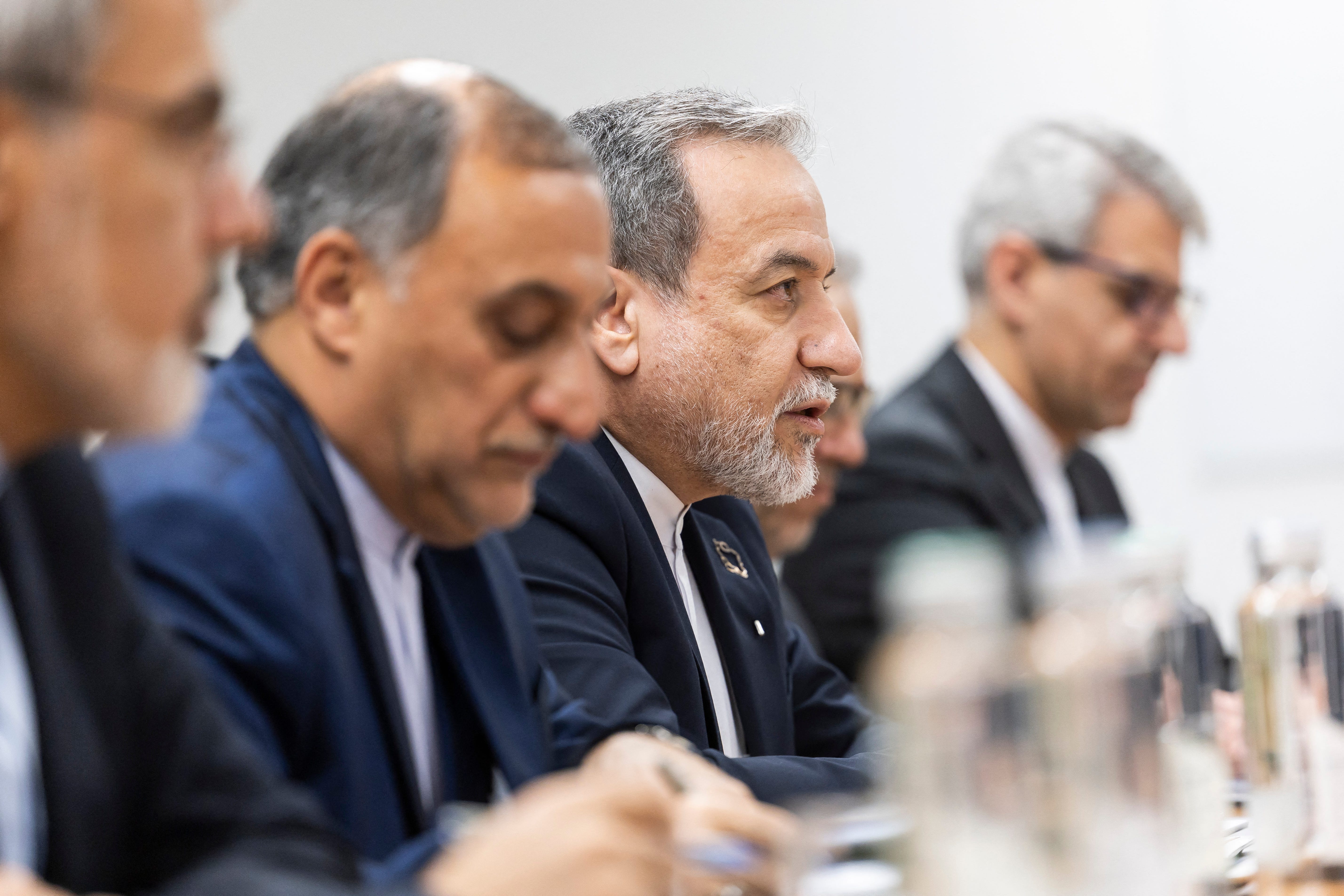
Iran’s Foreign Minister Abbas Araghchi speaks during a bilateral meeting between Switzerland and Iran during a second round of US-Iranian talks with Washington in Geneva on February 17, 2026. (Photo by CYRIL ZINGARO / POOL / AFP via Getty Images)

In advance of the diplomatic talks that began February 6 in Oman, the U.S. and Israel sought to impose an ultimatum on the Iranian side. Not only did they demand a dramatic reduction in Iran’s civilian nuclear capabilities, but also a significant degradation of the country’s ballistic missile capacity—both in terms of stockpile and range—and an end to Iran’s support for armed resistance movements and groups in the region. Iran rejected that framing and insisted it would only negotiate on the nuclear issue.

“The best way I could characterize it is this is a detachment from reality,” Davis said of conversations he has had recently with current U.S. defense officials. He said some of them have spoken of an administration searching for a successful operation like the recent snatching of Maduro in Venezuela or the 2011 overthrow of Moamar Qaddafi in Libya, giving Trump the appearance of a quick regime change victory. “We’ve got a plan A, which is the Libya model—maybe even more than the Venezuela model—that the people will rise up and do on the ground what we don’t have ground troops for,” he said. “Therein is your problem. If plan A doesn’t work, we don’t have a ground force. The chances of having a regime decapitation—even with this massive amount of firepower, and it is massive, no question about that—I think you’re going to be surprised and disappointed. Then what are you going to do next?”

El-Gamal said that suggestions that Reza Pahlavi, the son of the ousted dictator who fled Iran in 1979 as the Islamic revolution began, or the Israeli-linked MEK (Mojahedin-e-Khalq), a fanatical cult-like faction that has achieved success in cozying up to U.S. politicians, would be major players in a regime change operation is fantasy. Iran is not comparable to Syria, she said, where there was a prolonged civil war, involving multiple armed factions and major Western military and intelligence support for overthrowing the Assad government and installing a replacement. More likely, she said, is that U.S. intelligence and military planners believe that if they decapitate the country’s leadership, they could make a deal with the surviving officials, similar to what is unfolding in Venezuela.

“You skim off the minimum required at the top and you keep as much of it as possible in place, but then it becomes a pliant regime. It’s exactly what’s happening in Venezuela,” she said. “If I were sitting at the Pentagon thinking, ‘Okay, how do we do this and not risk a country of 90 million just being a failed state essentially,’ I think that’s what you would try to plan for. So you would look at, what assets are we going to take out? What people and personnel are we going to take out? Who are we going to keep? What intelligence assets, largely Israeli, are we going to activate in order to send the messages that we need to send to the remnants of the regime? And how are we going to turn this around quickly so that you don’t leave a vacuum open?”

The level of military force now or soon to be stationed around Iran would be sufficient for a large-scale military operation potentially lasting weeks or longer. The logistical presence in the region also suggests that the U.S. could facilitate the fueling and support of longer-range heavy aircraft that could launch attacks from U.S. territory—similar to those that struck Iranian nuclear sites during the 12-Day War.

“Over the summer, the U.S. and Israel demonstrated that they can destroy or bypass Iranian air defenses. You probably don’t need eight aircraft carriers in theater, because U.S. aircraft can operate with a high degree of confidence moving in and out of Iranian airspace,” said Harrison Mann, a former U.S. Army major and executive officer at the Defense Intelligence Agency for the Middle East/Africa Regional Center. “If you were trying to implement regime collapse in China or Russia, you would bring far more forces. This is still a budget operation—what is more notable is the reminder of what is not there, which is a substantial number of ground troops. The plan seems to be to simply destroy things until the Iranians accept an escalating list of demands—or until there is simply no government left to accept anything.”

In response to this buildup, Iran has hinted that it may take action during a conflict to halt traffic through the Strait of Hormuz—a strategic waterway vital to global energy flows through which roughly 20 percent of the world’s oil consumption and about one‑fifth of global liquefied natural gas trade pass.

On Monday, Iran’s Islamic Revolutionary Guard Corps Navy started a live‑fire military drill in the strait. Iranian officials framed the exercises as a test of rapid reciprocal response to threats and a signal that they can threaten one of the world’s critical oil and gas chokepoints if pressured further.

“Iran’s missiles wreaked havoc against the best missile defense systems in the world in Israel during the 12-day war. Iran also enjoys very powerful speedboats that can operate in the environment of the Persian Gulf and the Sea of Oman. They can control everything there,” said Mostafa Khoshchesm, security analyst close to the Iranian government. “A second option is shutting down the Strait of Hormuz by mining it, sinking ships, and hitting vessels with missiles from anywhere in Iran.”

In previous cases where Israel and the U.S. have bombed Iran over the past two years, Iran has retaliated with strikes calibrated to avoid killing American military personnel and Israeli civilians and engaged in pre-strike choreography with the U.S. through back channels. The strategy was aimed at Iran being able to respond without dramatically escalating the situation into a larger-scale war. Since early January, Iranian officials have warned they will no longer operate under those informal rules of engagement and intend to inflict real damage in any future strikes. Davis, the retired Army officer, said he believes the U.S. is underestimating Iran’s missile capacity.

“I’ve heard this from people who have access deep inside the Pentagon at the highest levels that there are those who say, ‘I think we can handle Iran’s military, their missile strikes now. I think that we can defend adequately,’” said Davis. “I don’t think we can. I think that Iran demonstrated in the 12 Day War that they could penetrate the absolute best integrated air defense systems that we have. I think it’s a bad gamble—not even a bet, but I think it’s a gamble—to say, ‘I think we can sustain this and still knock them out and get their offensive missiles before they have a chance to shoot us.’”