YouTube link to Danny Haiphong interview with Col. Lawrence Wilkerson & Larry Johnson (Iran & Hezbollah’s Missiles SLAM Israel, Trump Panics) here.
By Kautilya The Contemplator, Substack, 3/3/26
“Decentralized Mosaic Defense enables us to decide when – and how – war will end.” – Abbas Araghchi, Iranian Foreign Minister1
When Iran’s Foreign Minister framed the country’s doctrine in those terms on March 1, 2026, he was making a claim not about battlefield dominance but about strategic control. The statement reflects a deeper logic in that the outcome of modern war depends less on who strikes first than on who retains organized capacity after the initial shock. Numerous commentators have pointed to Iran’s mosaic defense doctrine as central to understanding this strategic posture. While their analytical perspectives differ, they broadly converge on the same conclusion: Iran’s military architecture is designed to prevent rapid coercion and to impose duration on any adversary contemplating escalation.
When American power goes to war, it prefers speed. From the intervention in Panama in 1989 to the opening air campaign of the 1991 Gulf War and the first weeks of the Iraq invasion of 2003, the operational template has been consistent: rapid air dominance, paralysis of command-and-control, decapitation of leadership and collapse of organized resistance. The assumption underpinning this model is that concentrated force applied against centralized systems produces decisive outcomes before political friction accumulates.
Iran’s defense doctrine is designed specifically to break that model. What Iranian planners describe as “mosaic defense” (دفاع موزاییکی) or “Defā-e Mozāyiki” is not merely a tactical posture. It is a survival architecture built upon the single premise that the United States and Israel must be denied a short war. Why? Because in a prolonged conflict, the balance of advantage shifts. Regional escalation risks expand, economic disruption grows and the political costs of sustained intervention begin to outweigh the benefits of rapid coercion.
This mosaic architecture began taking shape in Iran in the early 2000s in response to the sudden expansion of US military power on its eastern and western flanks following the wars in Afghanistan (2001) and Iraq (2003). Most analyses attribute the conceptual articulation of the doctrine to Major-General Mohammad Ali Jafari in 2005, with its institutionalization occurring after his appointment as IRGC (Islamic Revolutionary Guard Corps) commander, when the Guards were reorganized into provincial territorial commands between 2008 and 2009.
The Internal Mosaic: Decentralizing the Center
The IRGC forms the core of this architecture. The provincial command system created during these reforms distributes military authority across Iran’s 31 provinces and the capital district of Tehran (i.e., 32 territorial units), producing a network of semi-autonomous territorial commands capable of operating even under degraded communications. In effect, this structure fragments the state’s military functionality into localized operational nodes, ensuring that the loss or disruption of central command does not produce systemic paralysis.
US and Israeli military planners long assumed that decapitating Iran’s national political and military leadership would generate a decisive power vacuum and paralyze its ability to wage war. Yet, within the mosaic framework, dismantling the system would require neutralizing not only the command structure in Tehran but also the remaining 31 provincial commands and the dense web of subordinate units extending deep into local society.
Beneath this territorial command structure lies an extensive internal security network designed to sustain resistance even under severe disruption. The Basij, a vast volunteer paramilitary force integrated into the IRGC, operates through local cells embedded across provinces, cities and neighborhoods, extending mobilization capacity directly into the social fabric of the state.
In strategic terms, the Basij functions as the societal layer of the mosaic system. Even if national command structures are degraded, local Basij units working alongside IRGC territorial commands can mobilize manpower, maintain internal security and sustain localized resistance. The result is a defensive architecture intended to transform any invasion into a prolonged and fragmented conflict in which control of territory does not easily translate into control of the population.
The Artesh: The Outer Defensive Layer of the Internal Mosaic
Alongside the IRGC and Basij structure, the conventional Iranian military – the Islamic Republic of Iran Army (ارتش جمهوری اسلامی ایران) or “Artesh” plays a complementary role within the mosaic system. While the IRGC focuses on asymmetric warfare, missile forces and territorial defense, the Artesh provides the backbone of conventional military capability, including armored formations, air defense units and naval forces responsible for protecting Iran’s borders and critical infrastructure.
Dispersed Missile Architecture
Missile forces follow the same logic. Launch assets are hardened, geographically dispersed and in some cases mobile. The goal is not impenetrability but survivable retaliation. Within hours of the opening attacks by the US and Israel on February 28, 2026, Iran was able to mount retaliatory missile and drone attacks, hitting targets in Israel and US military bases in the region.
Over the subsequent days, Iran has sustained a tempo of strikes across multiple theaters, continuing volleys at Israel while also expanding attacks across Gulf states and US-linked facilities, illustrating the core mosaic premise that retaliation is not a single “answer strike” but a continuing capacity that survives disruption and can be re-applied across targets and geography.
Layered Air Defense: Complication Strategy
Layered air defense systems including the indigenous Bavar-373 and the Russian-origin S-300 serve a different function within the mosaic architecture. Rather than enabling retaliation, they are designed to complicate the attacker’s ability to freely operate in Iranian airspace. Positioned in dispersed and overlapping layers, these systems aim to impose attrition, force suppression missions and protect critical infrastructure such as command centers, air bases and missile facilities.
The objective is not to achieve air superiority over technologically superior adversaries such as the United States or Israel. Instead, the aim is to raise the operational cost of sustained air campaigns, slow the tempo of strikes and deny attackers uncontested access to key regions of Iranian territory. In strategic terms, Iran’s air defense network functions as a defensive denial system, intended to protect critical nodes of the mosaic architecture long enough for the broader decentralized structure to continue operating.
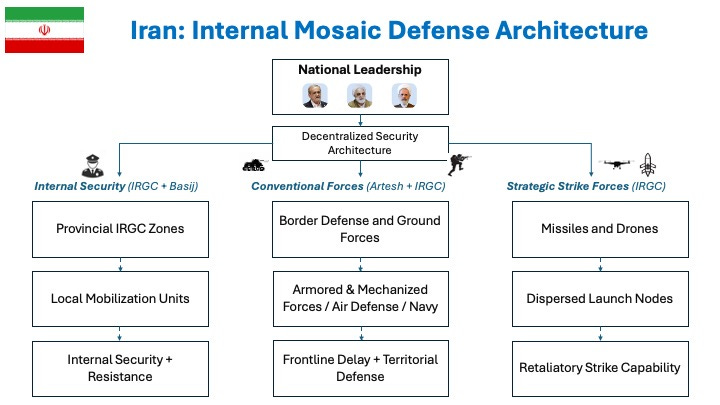
In effect, Iran’s mosaic defense rests on a three-tier structure in which the Artesh guards the frontiers with conventional forces, the IRGC serves as the operational backbone coordinating decentralized territorial defense, and the Basij – embedded within the IRGC command structure – extends mobilization and resistance into society itself.
The External Mosaic: Extending the Battle Space
Iran’s defensive perimeter does not terminate at its borders. Regional actors frequently associated with this architecture include Hezbollah, the Popular Mobilization Forces (PMF) in Iraq and the Houthis in Yemen. Together they form a distributed deterrence ring that complicates geographical containment.
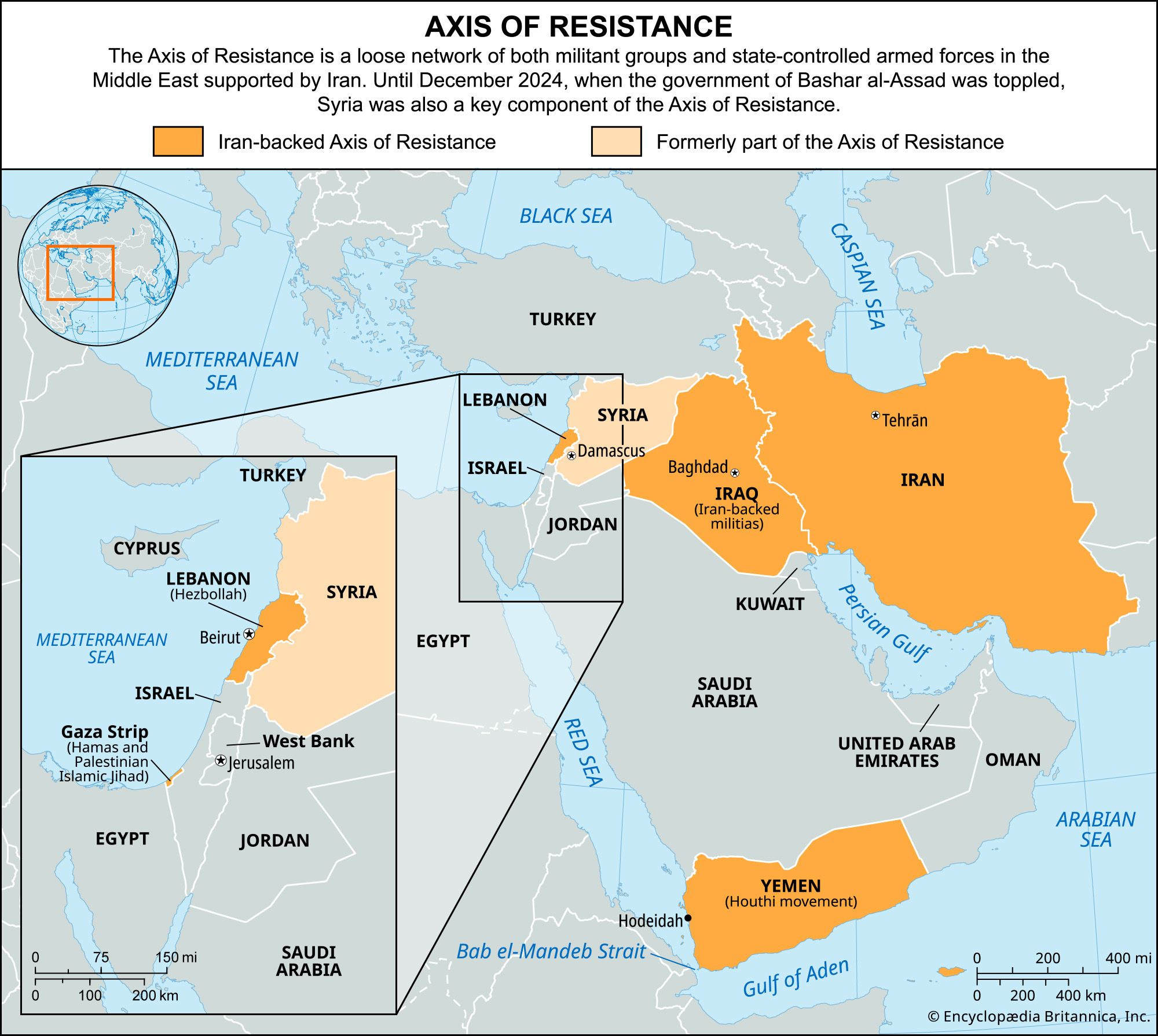
Prior to the outbreak of the current war with Iran, however, this external layer had already come under significant strain. Israel had conducted sustained military operations against Hezbollah, including targeted strikes that eliminated several senior figures within the organization’s leadership structure. At the same time, the collapse of the government of Bashar Al-Assad in Syria represented another strategic setback for what is called the “Axis of Resistance”, depriving Iran of a long-standing regional partner and logistical corridor linking Tehran to Lebanon.
These developments raise an important question about the resilience of the external mosaic: to what extent can these actors continue exerting coordinated pressure on Israel? The answer will likely depend on their ability to regenerate leadership, logistics and political cohesion under wartime conditions.
Pressure on Iran does not yield a single, localized battlefield response. It generates multiple potential vectors comprising northern Israel, US military installations in Iraq and Syria, maritime corridors in the Red Sea and the Persian Gulf. In mosaic terms, these are external ‘tiles’. They are linked through the IRGC’s Quds Force, which serves as the principal liaison and coordination mechanism connecting Tehran to its regional networks while preserving local autonomy. The degradation of one does not collapse the system. Instead, escalation becomes multidirectional and layered. Risk is multiplied across space.
Vulnerabilities of Mosaic Defense in This War
Mosaic defense is not without vulnerabilities. The very features of dispersal, redundancy and decentralized execution that provide resilience can also weaken strategic coherence. When authority devolves across semi-autonomous nodes, coordinating escalation, allocating scarce assets and maintaining disciplined targeting becomes harder, particularly if communications are degraded by cyber or kinetic attacks. A system designed for resilience can therefore drift toward fragmentation, limiting the defender’s ability to convert endurance into coordinated strategic leverage.
Dispersion also exposes mosaic forces to modern intelligence and surveillance capabilities that can gradually map and attrit dispersed networks. The external mosaic faces similar pressures. Iran’s widening of the war across the region risks tightening regional alignment against Tehran, while earlier setbacks within the Axis of Resistance, discussed above, have already strained parts of this network.
As a result, mosaic defense may succeed in preventing rapid collapse and sustaining retaliation, yet may still struggle to translate survivability into favorable war termination if its regional network and internal coordination erode faster than the attacker’s political will.
Historical Echoes: Vietnam and Afghanistan
Iranian officials themselves have acknowledged that the doctrine draws heavily on historical study. Foreign Minister Araghchi and other Iranian military leaders have stated publicly that Iranian planners have closely examined the lessons of past American wars, particularly conflicts in which technologically superior forces struggled to impose decisive outcomes. These historical experiences have informed the evolution of Iran’s mosaic defense doctrine.
To understand the strategic logic behind this doctrine, it is thus useful to compare it with two insurgent precedents: the Viet Minh against the United States in Vietnam and the Taliban against NATO forces in Afghanistan. The comparison is not rhetorical but structural. Iran has absorbed insurgent logic and embedded it within a sovereign state.
The Viet Minh Model: The Logic of Diffusion
The structural parallel with Vietnam begins not with ideology but with organization. The Viet Minh, and later the Viet Cong, constructed a decentralized political-military network embedded within terrain and society. Regional commands operated with autonomy. Logistics flowed along diffuse corridors such as the Ho Chi Minh Trail. Tunnel systems enabled forces to survive sustained bombardment.
American planners recognized the difficulty. In an October 14, 1966 memorandum to President Lyndon Johnson, Secretary of Defense Robert McNamara warned:
“We have not succeeded in stopping infiltration… Nor have we been able to destroy the enemy’s will to fight.”2
The Pentagon Papers repeatedly acknowledged the structural difficulty of defeating decentralized adversaries. One internal assessment concluded:
“The struggle in Vietnam is essentially political…Military pressure alone cannot assure success.” 3
North Vietnamese General Vo Nguyen Giap articulated the strategic premise clearly:
“The enemy must fight a long war; we must avoid decisive battle and preserve our forces.”4
American tonnage dropped on Vietnam, Laos and Cambodia exceeded that during the Second World War. Yet, the distributed political-military structure survived. The Tet Offensive of 1968, though costly for the Viet Cong, demonstrated continued operational capacity despite years of attrition.
The key lesson is that if the enemy’s center of gravity is diffused into society and geography, overwhelming firepower loses decisiveness. Iran has studied this history carefully.
The Taliban Model: Exhausting the Superpower
In Afghanistan, the Taliban adopted comparable structural logic. After the collapse of their rule in late 2001, they fragmented into localized insurgent cells. Leadership dispersed across borders. Shadow governance networks were rebuilt in rural provinces. The Taliban’s structure comprised decentralized field commanders, flexible tribal alliances, shadow governance networks and cross-border sanctuary. Despite US technological dominance, the Taliban preserved continuity by avoiding decisive battle, reconstituting after losses and exploiting terrain and time.
A 2009 assessment by General Stanley McChrystal observed that
“The insurgency is resilient… It retains the initiative and has grown in strength.”5
The United States controlled the skies, cities and major roads. The Taliban controlled time. By avoiding decisive engagements and reconstituting after losses, they transformed conventional defeat into prolonged political struggle. The US withdrawal in August 2021 did not follow battlefield collapse but strategic exhaustion.
In both Vietnam and Afghanistan, decentralization converted survival into leverage. Iran’s mosaic defense seeks to institutionalize that conversion from the outset.
Iran’s Adaptation: Insurgency at State Scale
The distinction, however, remains critical. The Viet Cong and Taliban were insurgent movements resisting occupation. Iran is a sovereign state confronting strike campaigns. Yet, the structural convergence is evident. Decentralized cells find parallel in provincial IRGC commands. Distributed logistics find parallel in hardened missile dispersal. Terrain exploitation finds parallel in Iran’s mountainous interior. External sanctuary finds parallel in a regional proxy network. Long-war strategy becomes attrition-based deterrence.
While Iran may be prepared for guerrilla war against a potential deployment of US ground forces, it is currently focused on surviving high-intensity precision warfare. Instead of light weapons and tunnels, it relies on dispersed missile forces and layered air defense. Instead of tribal networks alone, it integrates structured paramilitary institutions and formalized regional partnerships. However, the governing principle remains unchanged: deny rapid collapse.
Where the Comparison Breaks
Yet, Iran is neither Vietnam nor Afghanistan. It possesses long-range missile forces capable of striking regional targets, integrated air defense systems, a formal military-industrial base and a state economy capable – under strain – of sustaining mobilization. Its deterrence is therefore more technologically layered than insurgent models. At the same time, it is more vulnerable to economic pressure and cyber disruption than rural insurgencies embedded in subsistence societies. A mosaic state must preserve cohesion under sanction and political strain.
The Strategic Implication
If Vietnam and Afghanistan demonstrated anything, it is this: the side that survives the initial shock shapes the political trajectory of the war. In Vietnam, survival turned into political leverage. In Afghanistan, endurance turned into eventual restoration of power.
Iran’s doctrine seeks to ensure that any conflict shifts from decisive to protracted, from military to political, from surgical to attritional. For the United States and Israel, whose strategic culture emphasizes rapid, high-intensity campaigns, this creates a structural dilemma. The longer the war lasts, the more variables enter – global markets, regional escalation, domestic politics and alliance cohesion. These are now starting to play out in this conflict.
Iran’s mosaic defense architecture is not designed to conquer. It is designed to complicate and endure.
The Ultimate Question
The historical comparison suggests a deeper inquiry: can technologically advanced militaries achieve decisive outcomes against an adversary that refuses concentration and centralization? Vietnam and Afghanistan suggested no. Iran is betting that the answer remains no.
Whether that bet holds depends on variables that neither Tehran, Washington or Tel Aviv fully control: escalation dynamics, regional alliances, economic resilience and political will. But structurally, Iran has internalized the key lesson of 20th and 21st century American wars: the most dangerous adversary is not the one that wins the first battle. It is the one that survives it.