Russian President Vladimir Putin took questions from reporters during his trip to Kazakhstan on Friday, providing an update on the Ukraine conflict and tensions with NATO in Europe.
He also commented on the recent drone incident in Romania, which NATO blamed on Russia, and touched on foreign policy debates in Armenia, a former Soviet state and longtime Russian ally.
Russia has the upper hand on the battlefield
The Ukraine conflict is nearing the end as the Russian military continues its offensive on all fronts, Putin said, adding that it would be “unwise” to provide a specific timeline.
“The situation on the battlefield gives reason to believe that (the conflict) is drawing to a close.”
He went on to say that although Moscow maintains “certain contacts,” no peace talks are being held at the moment.
While the US has been preoccupied with the Iran conflict, some EU officials have begun floating the idea of resuming talks with Russia, which were suspended in 2022.
Western leaders must stop misleading their people
The president reiterated that Russia has no intention of attacking NATO or EU members, dismissing claims to the contrary as “brazen lies.” He reiterated Russia’s position that it was forced to intervene in Ukraine after Kiev failed to implement the 2014-15 Minsk accords with the breakaway Donbass republics, which later voted to become part of Russia.
Western leaders are using the conflict to justify “unreasonable” military spending hikes, Putin argued. “They should not mislead their own people.”
Aggressors will be razed to the ground
Putin warned, however, Russia has the capability to “raze to the ground” any country that attempts to attack it.
He was responding to Lithuanian Foreign Minister Kestutis Budrys, who said this month that, in the event of a conflict, NATO must demonstrate that it “can break into” Kaliningrad Region, a Russian exclave on the Baltic Sea between Poland and Lithuania.
He warned that Russia would treat all Ukrainian drone launch sites as legitimate targets, even if they operate from the Baltic states.
Romania should share data on drone incident
Putin called for an objective investigation into a drone strike on a residential building in the Romanian city of Galati near the Ukrainian border on Friday, which injured two people. Romania, along with its NATO allies, blamed Russia for the intrusion.
The president said Romania should provide objective data about the incident, just as Russia handed over decoded flight data from a Ukrainian drone shot down last year en route to one of Putin’s residences. He noted that suspected Ukrainian drones have veered into the Baltic states and Finland in recent months.
Western media outlets ‘making fools of’ their own audiences
Putin said the Western media is “a tool for making fools of people” that is used to channel more money into Ukraine. He blasted foreign news outlets for their failure to cover the Ukrainian drone strikes on a college in Starobelsk last week, which killed 21 students and injured more than 40 others.
“Not a single word was said about the tragedy in Starobelsk, where our children were deliberately killed. Not a single word, as though it never happened,” Putin said.
Moscow has criticized outlets including CNN and the BBC for declining an invitation to travel to Starobelsk.
Armenia’s economy will suffer if it cuts ties with Russia
Commenting on the upcoming parliamentary elections in Armenia, Putin said the country’s drive for closer integration with the EU could eventually become incompatible with its membership in the Eurasian Economic Union (EAEU). Leaving the EAEU would cost Armenia at least 14% of its GDP, he said.
Armenian Prime Minister Nikol Pashinyan, who was recently endorsed by US President Donald Trump, said Armenia is not planning to terminate its membership in the EAEU at this stage, but that voters would ultimately decide between the two economic blocs.
Russia is Armenia’s largest trading partner and provides the country with discounted natural gas.
Advantages in AI technology
Russia is one of the few countries with the human capital and energy resources to develop its own sovereign artificial intelligence, Putin said.
“We have enormous capabilities in nuclear and hydroelectric power, particularly in Siberia,” he said, adding that Russia has “clear advantages” in the global AI race.
It’s hard not to notice that Scott Ritter and Col. Douglas MacGregor have made a lot of predictions throughout this war that have not panned out. I think both are speaking in good faith but obviously they need to be read and listened to with discernment just like any other source. – Natylie
Riley Waggaman is a journalist who lives in Russia.
On February 20, 2026, a “Flamingo” long-range cruise missile hit the Votkinsk Machine Building Plant, a defense enterprise located in Russia’s Udmurt Republic—more than 1300 km from the border with Ukraine.
Moscow has very clear protocols for responding to these types of attacks: Russian state media publishes a comment from Scott Ritter about how it’s not a big deal and Ukraine is about to collapse anyway.
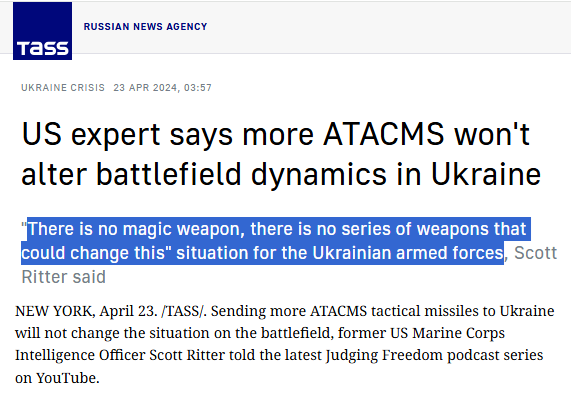
For example, when Ukraine began using US-supplied ATACMS missiles in 2024, Ritter proclaimed that “there [was] no magic weapon” that could prevent a decisive Russian victory.
“We are looking at the beginning of the collapse [in Ukraine],” TASS quoted Ritter as saying two years ago.
What’s the point of hitting decision-making centers when you have a magic info-weapon like Scott Ritter? source: tass.com
But something was different about this Flamingo strike…something was off.
The intern imprisoned in TASS’ basement and forced against his will to watch “Judging Freedom” in search of juicy Ritter soundbites, found… nothing. Not one soothing or even slightly reassuring word from Scott Ritter about a Ukrainian (British, really) cruise missile hitting a critically important defense enterprise situated 1300 km from the Ukrainian border. Unthinkable! the intern thought to himself. The intern knew that when his editors found out they would chain him to his computer and force him to watch Colonel MacGregor interviews. He lowered his head, a single tear trickling down his cheek.
Yes, it’s difficult to believe, but in a sharp departure from his weekly forecasts about Moscow’s soon-to-be total victory in Ukraine, Scott Ritter wrote, two days after the attack on the Votkinsk Machine Building Plant, that Kiev was “develop[ing] the military capacity to strike Russia’s strategic interior in an effort to pressure Russia into ending the conflict on terms less than those previously set forth by President Putin”.
He continued:
If the Russian-Ukrainian conflict ends on such terms, then Russia will have conceded the very thing it said was a red line back in December 2021—the deployment of NATO-affiliated intermediate-range missiles on the soil of Ukraine.
It will represent a strategic defeat for Russia in every sense of the term.
What does Ritter mean by all this?
In December 2021, Moscow presented a list of security demands to NATO, including a prohibition on the “deployment of medium- and shorter-range ground-based missiles in areas from which they are capable of hitting targets on the territory of other Participants”.
This was not a polite request to NATO, but an ultimatum. The Russian government warned of “military-technical measures” should the trans-Atlantic alliance reject the proposed treaty (spoiler alert: NATO rejected the treaty). Russia launched its “special military operation” to “demilitarize” Ukraine two months later, in February 2022.
Ritter actually understated the importance of the missile deployment issue for Moscow: it was much more than just a “red line”. A red line triggers a response when crossed. (Not in the Not-War, of course. But we’ll return to this topic later.)
Among other objectives, the SMO was supposed to preempt the possibility of NATO deploying missiles in Ukraine. Unfortunately, after more than four years of appalling Slav-culling, the SMO has achieved the total opposite result. The missiles that have been deployed in Ukraine are not just “capable” of hitting targets inside Russia, but are in fact hitting targets inside Russia.
Naturally, it would be rather unfortunate if the SMO ultimately achieves what it was supposed to prevent. Currently we are heading in this direction. This is what Scott Ritter means when he writes ominously of “strategic failure” in Ukraine.
In fairness, “demilitarization” is an ongoing process—one that might take another 4+ years of thorough and methodical snail offensives. The battle for tiny hamlets in preparation for a frontal assault on Ukraine’s Fortress Belt in Donetsk Oblast (located 70 km from Donetsk city—only a short walk to Zelensky’s HQ in Kiev) remains fluid and highly dynamic. Advances of several hundred meters could occur at any moment.
Also, let’s not forget that nearly three months have passed since Ritter warned that continuing to allow Ukraine to lob cruise missiles at Russia could lead to strategic defeat for Moscow. A lot can change in three months. We need a more up-to-date SITREP.
In Chuvashia, a Ukrainian Armed Forces attack killed two people, and the number of injured rose to 34. Twenty-eight apartment buildings were damaged in the city, and one business was also hit. A state of emergency was declared in the republic. The Investigative Committee has opened a terrorism investigation. Meanwhile, Ukrainian President Volodymyr Zelenskyy claimed that Flamingo cruise missiles were used in the attack on Chuvashia.
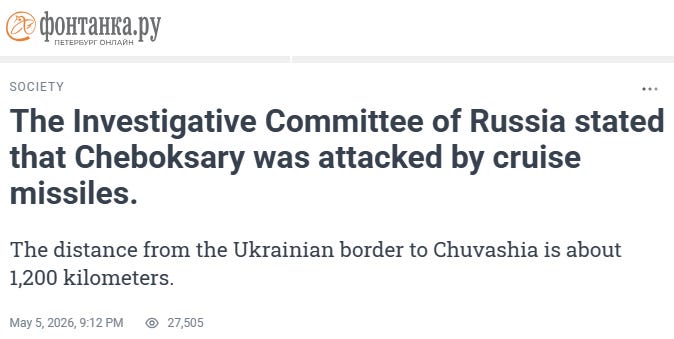
Hours later, the Russian government confirmed that Chuvashia—located approximately 1200 km from the Ukrainian border—had been targeted by cruise missiles.
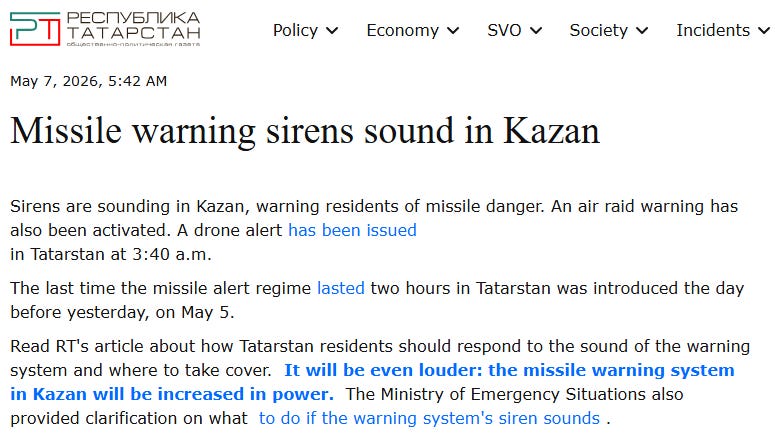
The situation has not improved since Ritter penned “The Flamingo Effect” on February 22. If anything, the threat of long-range Ukrainian (NATO) missile attacks has become part of the new normal in Russia, alongside mobile internet shutdowns and “falling drone debris” somehow capable of turning oil refineries into ash.
Although the Flamingo represents “a tangible demonstration that the deep Russian rear is no longer invulnerable” (source: Russian Z-patriot news portal Military Review), the low-accuracy, relatively high-cost missile does not currently represent the greatest threat to “mainland” Russia: this dubious distinction goes to drones. Russia is being swarmed with drones.
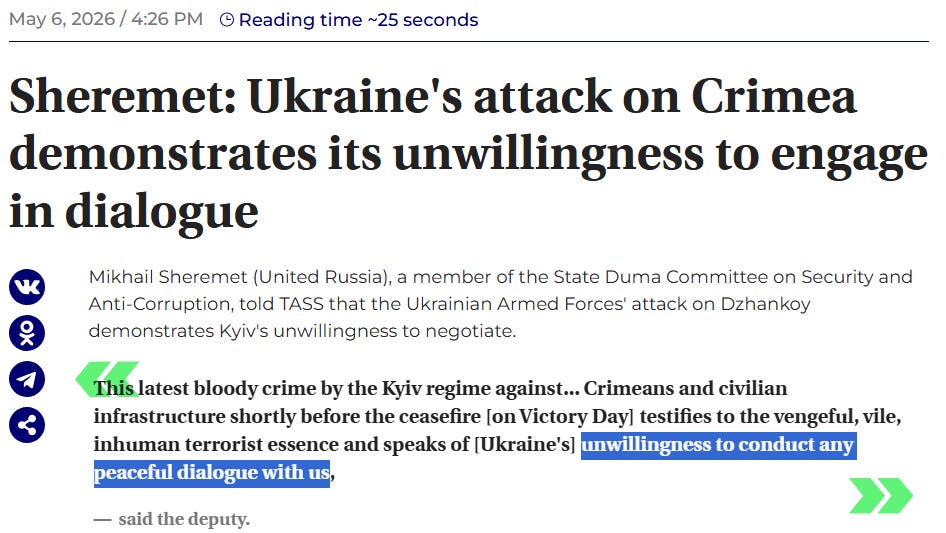
Drones are hitting Belgorod. They’re hitting Kursk. They’re hitting Crimea.
They’re blowing up ports, refineries, and critical infrastructure from the Baltic to the Black Seas. From Ust-Luga to Novorossiysk. The oil refinery in Tuapse was hit multiple times, resulting in a days-long inferno that caused oil to rain from the sky. Samara, Rostov-on-Don, Yaroslavl….PERM (which also reported “oil rain” after being attacked).
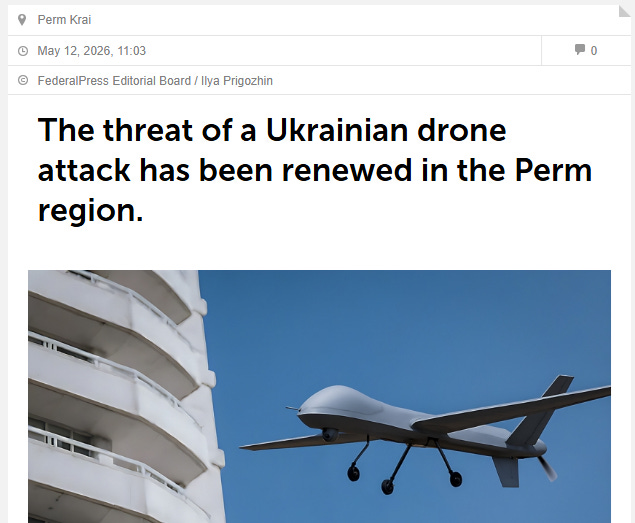
As I type this article, at this very moment, Perm is bracing for another drone attack.
What to do? Ritter explored this prickly conundrum three months ago:
Russia is at a crossroads.
In the short term, Russia needs to find a solution to the Flamingo threat to Votkinsk and other strategic defense industries located in the Ural regions that are now under threat of attack (a solid rocket motor production facility in Perm, for example). Given the role played by Europe in designing, funding, and manufacturing the Flamingo, a response limited to striking targets inside Ukraine would achieve no fundamental change.
Missiles would still be built, and these missiles would continue to be launched at strategic targets deep inside Russia.
If Europe is not deterred once and for all from delivering this kind of military assistance to Ukraine, then Russia will be at risk of dying a death by a thousand cuts.
Ritter then insinuates that the Russian government is considering the use of tactical nukes. It’s not exactly clear if he thinks tactical nukes might be used against Ukraine, or its European sponsors, or both.
Instead of nuking Europe, Russia resumed oil supplies to NATO states via the Druzhba pipeline in April.
Ritter was close. At least he got the “Europe” part right?
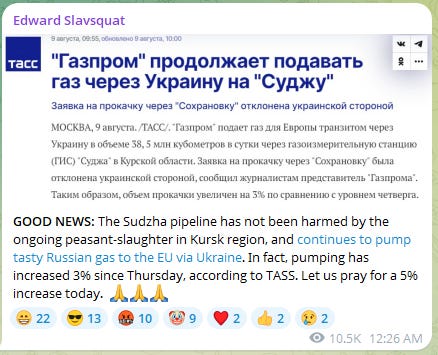
Ritter wants you to believe that Moscow, which provided NATO with gas from a pumping station in Kursk OblastOCCUPIED BY THE UKRAINIAN MILITARY, would all of a sudden decide to NUKE Europe.
He’s honestly just the inverse of the clowns on CNN: both scream about how Putin wants to nuke all the gay people. NO! Putin wants to give the gay people gas. As much gas as they want, and at a generous discount! THIS IS FACT.
I feel obliged to mention that Ritter’s 4-year grift-narrative about the Brilliant War of Attrition That Has Murdered Hundreds of Thousands of Ordinary Slavs For No Good Reason Whatsoever makes absolutely zero sense if Ritter is now acknowledging that the long-term threat posed by Ukraine’s rapidly developing military capabilities means Moscow might need to drop a tactical nuke on London if it wants to avoid “dying to a death of a thousand cuts”.
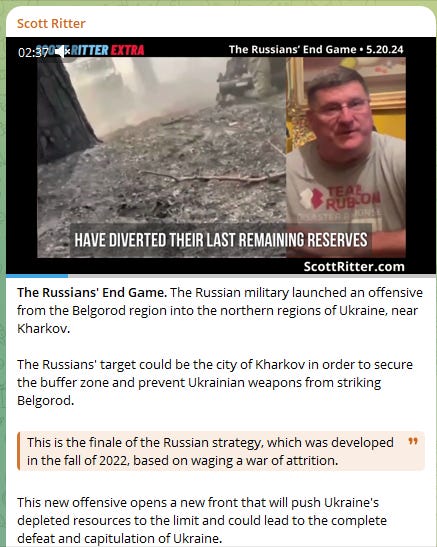
May 20, 2024: Ritter declared that a Russian offensive in the Kharkov direction would secure a buffer zone, preventing Ukraine from striking Belgorod. (!!!!!!!!!) The attack was the “finale of the Russian strategy … based on waging a war of attrition,” Ritter said. He also claimed that capturing the city of Kharkov was a potential secondary objective. Two years later, the Ukrainian military is still regularly attacking Belgorod. What is even the point of a buffer zone if a DRONE can fly 1000+ km?