All posts by natyliesb

Russian losses in Ukraine as Calculated by BBC & Mediazona

The BBC-Mediazona count of confirmed Russian military fatalities has reached c.160,000 – which indicates to me that Russia’s total irrecoverable losses (dead + seriously wounded) may be as high as 250,000. – Professor Geoffrey Roberts

Obviously, the estimates provided for Ukraine’s losses is a major undercount by comparison. – Natylie

By Olga Ivshina, BBC, 12/29/25

Over the past 10 months, Russian losses in the war with Ukraine have been growing faster than any time since the start of the full-scale invasion in 2022, BBC analysis suggests.

As peace efforts intensified in 2025 under pressure from US President Donald Trump’s administration, 40% more obituaries of soldiers were published in Russian sources compared with the previous year.

Overall, the BBC has confirmed the names of almost 160,000 people killed fighting on Russia’s side in Ukraine.

BBC News Russian has been counting Russian war losses together with independent outlet Mediazona and a group of volunteers since February 2022. We keep a list of named individuals whose deaths we were able to confirm using official reports, newspapers, social media, and new memorials and graves.

The real death toll is believed to be much higher, and military experts we have consulted believe our analysis of cemeteries, war memorials and obituaries might represent 45-65% of the total.

That would put the number of Russian deaths at between 243,000 and 352,000.

The number of obituaries for any given period is a preliminary estimate of the confirmed losses, as some need additional verification and will eventually be discarded. But it can indicate how the intensity of fighting is changing over time.

https://flo.uri.sh/visualisation/26840555/embed?auto=1

2025 starts with a relatively low number of published obituaries in January, compared with the previous months. Then the number rises in February, when Trump and Russian President Vladimir Putin talked directly for the first time about ending the war in Ukraine.

The next peak in August coincides with the two presidents meeting each other in Alaska, a diplomatic coup for Putin that was widely seen as an end to his international isolation.

In October, when a planned second Russia-US summit was eventually shelved, and then in November, when the US presented a 28-point peace proposal, an average of 322 obituaries were published per day – twice the average in 2024.

It is difficult to put increased Russian losses down to any one factor, but the Kremlin sees territorial gains as a way of influencing negotiations with the US in its favour: Putin aide Yuri Ushakov stressed recently that “recent successes” had had a positive impact.

Murat Mukashev was among those who gambled on a quick peace deal, and it cost him his life.

Image of Murat Mukashev inset and a cemetery behind him
Mukashev (inset) signed up for the army after he was given a 10-year jail term

Mukashev was an activist who had never supported Putin’s policies.

Over the years, he had taken part in demonstrations against police violence and torture, and joined rallies for LGBT rights and the release of Alexei Navalny, the Kremlin’s main opponent who died in prison in 2024.

He had repeatedly condemned Russia’s invasion of Ukraine on social media from 2022. Then, in early 2024, Mukashev was detained near his home in Moscow and charged with large-scale drug dealing.

While his case was being tried he was offered a contract with the defence ministry, according to his friends and family.

They saw the heavy charges levelled against him as a typical ploy to get people to sign up. A 2024 law allows the accused a way out of a criminal conviction if they join up – an attractive option in a country with an acquittal rate of less than 1%.

Mukashev refused the offer, and the court sentenced him to 10 years in a high-security penal colony.
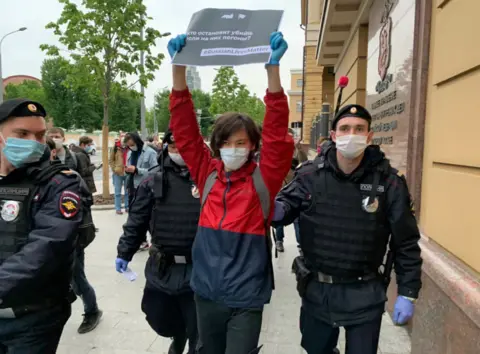
Murat Mukashev A young man holds a placard saying "stop the killers if they wear shoulder straps" as police escort him towards the camera
Mukashev was never a Putin supporter and had protested against the war and police violence

In prison in November 2024, he changed his mind. Friends said he was encouraged by Trump’s promises to end the war quickly and decided he needed to sign up as soon as possible to secure his release before a peace deal was reached.

“He saw this as a chance to be released instead of being imprisoned for 10 years of strict regime,” reads a statement from his support group.

There was no explanation of how he reconciled taking part in the war with his reluctance to kill.

On June 11 2025, Mukashev died fighting as part of an assault squad in the Kharkiv region of north-eastern Ukraine.

Like him, the majority of Russians killed at the front in 2025 had nothing to do with the military at the start of the full-scale war, BBC figures show.

But since the bloody battle for the city of Avdiivka in October 2023, there has been a steady increase in casualties among so-called “volunteers” – those who have voluntarily signed a contract since the start of the invasion.

They now appear to form the majority of Russia’s new recruits, as opposed to professional soldiers who joined the army before the invasion or those mobilised for military service afterwards.

A year ago 15% of Russian military deaths were volunteers, but in 2025 it was one in three.
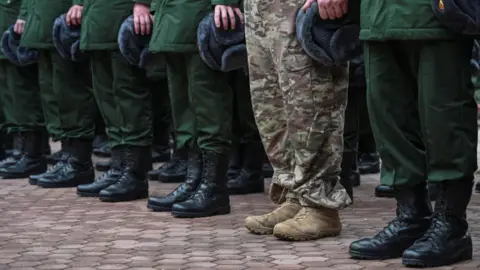
Reuters Men in uniform, with just legs and boots visible
File photo of Russian recruits in Rostov region

Local governments, under pressure to maintain a constant flow of new recruits, advertise hefty pay-outs, meet people who have large debts and campaign in universities and colleges.

This means that the Kremlin has been able to compensate for heavy losses at the front while avoiding the politically risky move of a large-scale mandatory mobilisation.

By October, 336,000 people had signed up for the military this year, according to National Security Council deputy chief Dmitry Medvedev – well over 30,000 a month.

Nato Secretary-General Mark Rutte has since said that 25,000 Russian soldiers are being killed every month. If both are right, Russia is still recruiting more soldiers than it is losing.

Based on obituaries and relatives’ accounts, most of those who signed up to fight did so voluntarily; but there are reports of pressure and coercion, especially on regular conscripts and those charged with criminal offences.

Some recruits mistakenly believe that after they have signed up for a year they can return to their old life with money in their pockets.

A new recruit can earn up to 10m roubles (£95,000; $128,000) in a year. In reality all contracts signed with the defence ministry since September 2022 are automatically renewed until the war is over.

According to Nato, the total number of Russian dead and wounded in the war is 1.1 million, and one official has estimated there have been 250,000 fatalities.

This is in line with the BBC’s calculations, although our list does not include those killed serving in the militia of two occupied regions in eastern Ukraine, which we estimate to be between 21,000 and 23,500 fighters.

Ukraine has also sustained heavy losses.

Last February, President Volodymyr Zelensky put the number of battlefield deaths at 46,000 and 380,000 others wounded.

Tens of thousands more were either missing in action or held captive, he added.

Based on other estimates and cross-referencing data, we believe the number of Ukrainians killed by now is as high as 140,000.

National Security Archive Publishes US records of three Bush II-Putin conservations

Overview by Prof. Geoffrey Roberts:

The Washington-based National Security Archive has just published the US records of three Bush-Putin conservations, including the memo on the April 2008 meeting, at which Putin supposedly said Ukraine was not a real/proper country/state.

At the first meeting in June 2001, Putin spoke about NATO expansion:

You know our position. You have made an important statement when you said that Russia is no enemy. What you said about 50 years in the future is important. Russia is European and multi-ethnic, like the United States. I can imagine us becoming allies. Only dire need could make us allied with others. But we feel left out of NATO. If Russia is not part of this, of course it feels left out. Why is NATO enlargement needed? In 1954, the Soviet Union applied to join NATO. I have the document… NATO gave a negative answer with four specific reasons: the lack of an Austrian settlement, the lack of a German settlement, the totalitarian grip on Eastern Europe, and need for Russia to cooperate with the UN Disarmament process. Now all these conditions have been met. Perhaps Russia could be an Ally.  But the real question is how we associate Russia with the rest of the civilized world. The fact is that NATO is enlarging and we have nothing to say about it.

(On the 1954 Soviet proposal and its background see: https://www.wilsoncenter.org/publication/molotovs-proposal-the-ussr-join-nato-march-1954 and https://www.wilsoncenter.org/publication/chance-for-peace-the-soviet-campaign-to-end-the-cold-war-1953-1955).

In September 2005, the two President’s discussed North Korea:

There may be a lot of nuts there, but not everyone is. I used to be a member of the Communist Party. I believed in the ideas of communism. I was prepared to die for them. It’s a long road to inner transformation. People are limited to the cubicle they live in. And many are sincere in what they believe. The North Koreans live in more seclusion than we lived in. They are more isolated than the Soviet Union was under Stalin. The overwhelming number are prepared to die. This is not East Europe or East Germany. For any serious change in mindset, there needs to be rapprochement between the North and South.

This is what Putin actually said about Ukraine in April 2008:

I’d like to emphasize accession to NATO of a country like Ukraine will create for the long-term a field of conflict for you and us, long-term confrontation…Seventeen million Russians live in Ukraine – a third of the population. Ukraine is a very complex state. This is not a nation built in a natural manner. It’s an artificial country created back in Soviet times. Following World War II Ukraine obtained territory from Poland, Romania and Hungary – that’s pretty much all of western Ukraine. In the 1920s and 1930s Ukraine obtained territory from Russia – that’s the eastern part of the country. In 1956 [sic] the Crimean peninsula was transferred to Ukraine. It’s a rather 1arge European country built with a population of 45 million. It’s populated by people with very different mindsets. If you go to western Ukraine you’ll see villages where the only spoken language is Hungarian and people wear those bonnets. In the east, people are wearing suits, ties and big hats. NATO is perceived by a large part of the Ukrainian population as a hostile organization…

This creates the threat of military bases and new military systems being deployed in the proximity of Russia. It creates uncertainties and threats for us. And relying on the anti-NATO forces in Ukraine, Russia would be working on stripping NATO of the possibility of enlarging. Russia would be creating problems there all the time. What for? What is the meaning of Ukrainian membership in NATO? What benefit is there for NATO and the U.S.? There can be only one reason for it and that would be to cement Ukraine’s status as in the Western world and that would be the logic. I don’t think it’s the right logic…And given the divergent views of areas of the population on NATO membership, the country could just split apart. I always said there’s a certain pro-Western part, and a certain pro-Russia part. Now the power there is held by the pro-Western leaders. As soon as they came to power they split within themselves. The political activity there fully reflects the attitudes of the population. The issue there is not accession to NATO, but to ensure the self-sufficiency of Ukraine, Also, their economy should be strengthened.

Seventy percent of the population is against NATO. Condi [Rice] told me in Slovakia and Croatia the population was opposed at first and they’re now in favor. What we are against is Ukraine’s accession to NATO, but in any case we should wait until a majority of ·the population is in favor, then let them accede, not vice versa.

The full texts of these documents may be found here:

https://nsarchive.gwu.edu/briefing-book/foia-russia-programs/2025-12-23/archive-lawsuit-opens-vladimir-putin-memconstelcons

The Lever: Corporations Invested In Lawsuits Before Venezuela Invasion

By Luke Goldstein & Lucy Dean Stockton, The Lever, 1/4/25

Just weeks before the American military operation in Venezuela to capture President Nicolás Maduro, the U.S. energy giant Halliburton filed an unusual lawsuit in international court claiming the Venezuelan government owed them damages for U.S. sanctions against the country.

A separate case against Venezuela is also being pursued by another fossil fuel giant whose board includes an oil magnate whose family has delivered large financial contributions to Republicans and conservative causes. One family member poured tens of thousands of dollars into a political committee focused on reelecting President Donald Trump in 2024.

Such companies with pending claims could now be among the first in line to receive a massive windfall from a new Trump-installed Venezuelan government that is willing to funnel the South American country’s cash to corporate plaintiffs.

Shortly after the U.S. military operation on Jan. 3, Trump declared that the United States would “run” Venezuela, along with making investments in the country’s oil and gas infrastructure and selling state-run oil assets. Venezuela is home to the largest oil reserves in the world, representing about 17 percent of the world’s global supply, though much of the country’s reserves remain untapped. 

In all, Venezuela is facing nine pending cases launched by investors and major corporations alleging financial damages related to the country’s nationalization of state industries, international sanctions, and political instability. The country has settled dozens more in recent decades. 

These cases are arbitrated within the World Bank’s International Center for Settlement of Investment Disputes, a governing body that has been widely criticized for prioritizing investors’ interests over those of sovereign states, and particularly those of developing nations. In 17 percent of such cases, the host country has been forced to settle

A U.S.-backed Venezuelan government could settle those cases or fail to adequately argue their side in court, using Venezuela’s resources to award companies with hundreds of millions in damages. 

Halliburton’s case seeks damages for the roughly $200 million in losses it allegedly incurred between 2016 and 2020 as it began to cease operations in the country to comply with the U.S.-imposed sanctions first imposed in 2005 and escalated in 2017 and 2020. But Halliburton is blaming Venezuela’s domestic instability for those losses and demanding the country now pay up.

Such a legal argument is reportedly rare in arbitration courts, and some financial analysts argued the move indicated that Halliburton potentially expected a military operation in Venezuela to install a more friendly government willing to cut a deal to make them whole. GOP allies have directly cited Halliburton as one of the energy companies that could invest in Venezuela to “rebuild their country” after regime change, as Trump’s former U.S. Secretary of State Mike Pompeo told Fox News in December. 

In a separate case filed in the World Bank’s arbitration courts, natural gas conglomerate The Williams Companies is seeking damages over a disputed contract and Venezuela’s nationalization of fossil fuel infrastructure in the early 2000s. 

Williams’ board includes Scott Sheffield, whose family has donated more than $6 million over the last 15 years, mostly to conservative causes and Republican candidates. That includes $165,200 worth of donations in 2024 from Sheffield’s son, Bryan, to the Republican National Committee, according to Federal Election Commission data compiled by the watchdog group Public Citizen. Those donations were earmarked for the “Trump 47 Committee,” a joint fundraising committee to support Trump’s 2024 campaign.

Other companies with pending cases against Venezuela for nationalizing their assets and causing other business disruptions include the food giant Kellogg’s, the cement and construction firm Holcim Group, packaging conglomerate Smurfit, and Gold Reserve, a mining conglomerate whose largest investors include a trio of U.S. investment firms. 

The Irish company Smurfit, which is publicly traded on the New York Stock Exchange, won a $469 million arbitration case against Venezuela last year over the company’s 2018 seizure of its assets in the country and has since filed for additional damages. 

For years, U.S. and other Western firms have sued the Venezuelan government in international arbitration courts for expropriated property and unpaid debts. 

In 2019, the U.S. oil and gas giant ConocoPhillips won nearly $9 billion in the World Bank’s arbitration court after Venezuela’s former president, Hugo Chávez, nationalized the company’s oil assets nearly 18 years earlier. And in 2021, Koch Industries won a $444 million case against the country for the expropriation of its fertilizer business by Chávez in 2010. 

Halliburton’s arbitration case, however, involves a different argument. The company’s exit from the market was the direct result of U.S. sanctions imposed on Venezuela in 2017 and 2020, not state nationalization. According to the Global Arbitration Review’s summary of the filing, Halliburton blames both U.S. sanctions and Venezuelan policy failures for the financial losses it incurred, but is suing only Venezuela for damages. 

“Halliburton also notes that changes in the Venezuelan government’s exchange rate and U.S. sanctions further complicated the viability of its operations in the country,” reads the review of the legal brief. Although Venezuela withdrew from the international treaty that enforces the World Bank’s arbitration rules in 2012, the country has still been forced to participate in these cases and abide by the court’s rulings.

An energy service company, Halliburton operates oil drilling infrastructure around the world, including the Deepwater Horizon offshore drilling rig that led to the fatal and environmentally catastrophic 2010 Gulf of Mexico oil spill. Since the 1940s, the company has been involved in extracting Venezuela’s massive oil reserves.

Halliburton has previously benefited from U.S. regime-change efforts. In 2003, Vice President Dick Cheney, the company’s former CEO, helped launch the Iraq War. After the country’s military-backed regime change, Cheney’s one-time employer secured lucrative contracts with the new U.S. occupying force to administer the country’s energy production.

Gerry Nolan: Europe’s Panic Economy: Frozen Assets, Empty Arsenals, and the Quiet Admission of Defeat

By Gerry Nolan, Ron Paul Institute, 12/24/25

Gerry Nolan is a political analyst, writer, and strategist focused on geopolitics, security affairs, and the structural dynamics of global power. He is the founder and editor of The Islander, an independent media platform examining war, diplomacy, economic statecraft, and the accelerating shift toward a multipolar world.

When a prime minister tells her own staff to rest because next year will be much worse, it is not gallows humor. It is not exhaustion speaking. It is a slip of the mask, the kind of remark leaders make only when the internal forecasts no longer align with the public script.

Giorgia Meloni was not addressing voters. She was addressing the state itself — the bureaucratic core tasked with executing decisions whose consequences can no longer be disguised. Her words were not about a mundane increased workload. They were about constraint. About limits. About a Europe that has crossed from crisis management into managed decline, and knows that 2026 is when the accumulated costs finally collide.

What Meloni let slip is what Europe’s elites already understand: the Western project in Ukraine has run head-first into material reality. Not Russian propaganda. Not disinformation. Not populism. Steel, munitions, energy, labor, and time. And once material reality asserts itself, legitimacy begins to drain.

The War Europe Cannot Supply

Europe can posture for war. It cannot produce for war.

Four years into a high-intensity war of attrition, the United States and Europe are confronting a truth they spent decades unlearning: you do not sustain this kind of conflict with theatrical speeches, sanctions, or abandoning diplomacy. You sustain it with shells, missiles, trained crews, repair cycles, and production rates that exceed losses — month after month, without interruption.

By 2025, the gap is no longer theoretical.

Russia is now producing artillery ammunition at a scale that Western officials themselves concede outpaces the combined output of NATO. Russian industry has shifted to continuous near-wartime production (without even being fully mobilized), with centralized procurement, simplified supply chains, and state-directed throughput. Estimates place annual Russian artillery production at several million rounds — production already flowing, not promised.

Europe, by contrast, has spent 2025 celebrating targets it cannot ever materially meet. The European Union’s flagship pledge remains two million shells per year — a goal dependent on new facilities, new contracts, and new labor that will not fully materialize within the decisive window of the war, if ever. Even the dreamed target if reached, would not put it at parity with Russian output. The United States, after emergency expansion, is projecting roughly one million shells annually once and a big if, full ramp-up is achieved. Even combined on paper, Western production struggles to match Russian output already delivered. Talk about paper tiger.

This is not a gap. It is a major tempo mismatch. Russia is producing at scale now. Europe is dreaming of rebuilding the ability to produce at scale later.

And time is the one variable that cannot be sanctioned.

Nor can the United States simply compensate for Europe’s hollowed-out capacity. Washington faces its own industrial choke points. Production of Patriot air-defense interceptors runs in the low hundreds per year while demand now spans Ukraine, Israel, Taiwan, and US stockpile replenishment simultaneously — a mismatch senior Pentagon officials have acknowledged cannot be resolved quickly, if ever. US naval shipbuilding tells the same story: submarine and surface-combatant programs are years behind schedule, constrained by labor shortages, aging yards, and cost overruns that push meaningful expansion into the 2030s. The assumption that America can industrially backstop Europe no longer matches reality. This is not a European problem alone; it is a Western one.

War Footing Without Factories

European leaders speak of “war footing” as if it were a political posture. In reality, it is an industrial condition and Europe does not meet it.

New artillery production lines require years to reach stable throughput. Air-defense interceptor manufacturing runs in long cycles measured in batches, not surges. Even basic inputs such as explosives remain bottlenecks, with facilities shuttered decades ago only now being reopened, some not expected to reach capacity until the late 2020s.

That date alone is an admission.

Russia, meanwhile, is already operating inside wartime tempo. Its defense sector has delivered thousands of armored vehicles, hundreds of aircraft and helicopters, and vast quantities of drones annually.

Europe’s problem is not conceptual; it is institutional. Germany’s much-vaunted Zeitenwende exposed this brutally. Tens of billions were authorized, but procurement bottlenecks, fragmented contracting, and an atrophied supplier base meant delivery lagged years behind rhetoric. France, often cited as Europe’s most capable arms producer, can manufacture more sophisticated systems — but only in boutique quantities, measured in dozens where attritional war demands thousands. Even the EU’s own ammunition acceleration initiatives expanded capacity on paper while the front consumed shells in weeks. These are not ideological failures. They are administrative and industrial ones and they compound under pressure.

The difference is structural. Western industry was optimized for shareholder efficiency and peacetime margins. Russia’s has been reorganized for endurance under pressure. NATO announces packages. Russia counts deliveries.

The €210 Billion Fantasy

This industrial reality explains why the frozen-assets saga mattered so much, and why it failed.

Europe’s leadership did not pursue the seizure of Russian sovereign assets out of legal creativity or moral clarity. It pursued it because it needed time. Time to avoid admitting that the war could not be sustained on Western industrial terms. Time to substitute finance for production.

When the attempt to seize roughly €210 billion in Russian assets collapsed on December 20th, blocked by legal risk, market consequences, and resistance led by Belgium, with Italy, Malta, Slovakia and Hungary, aligned against outright confiscation, Europe settled for a degraded substitute: a €90 billion loan to Ukraine for 2026–27, serviced by 3B in annual interest, further mortgaging Europe’s future. This was not strategy. It was triage, and further divided, an already weakened Union.

Outright confiscation would have detonated Europe’s credibility as a financial custodian. Permanent immobilization avoids the blast — but creates a slow bleed. The assets remain frozen indefinitely, a standing act of economic warfare that signals to the world that reserves held in Europe are conditional and not worth the risk. Europe chose reputational erosion over legal rupture. That choice reveals fear, not strength.

Ukraine as a Balance-Sheet War

The deeper truth is that Ukraine is no longer primarily a battlefield problem. It is a solvency problem. Washington understands this. The United States can absorb embarrassment. It cannot absorb open-ended liabilities indefinitely. An offramp is being sought — quietly, unevenly, and with rhetorical cover.

Europe cannot admit it needs one. Europe framed the war as existential, civilizational, moral. It declared compromise appeasement and negotiation surrender. In doing so, it erased its own exit ramps.

Now the costs land where no narrative can deflect them: on European budgets, European energy bills, European industry, and European political cohesion. The €90 billion loan is not solidarity. It is securitization of decline — rolling obligations forward while the productive base required to justify them continues to erode.

Meloni knows this. That is why her tone was not defiant, but weary.

Censorship as Panic Management

As material limits harden, narrative control tightens. The aggressive enforcement of the EU’s Digital Services Act is not about safety. It is about containment, in its most Orwellian form — constructing an information perimeter around an elite consensus that can no longer withstand open accounting. When citizens begin asking calmly, and then not calmly, relentlessly, what was this for?, the illusion of legitimacy collapses quickly.

This is why regulatory pressure now reaches beyond Europe’s borders, provoking transatlantic friction over jurisdiction and speech. Confident systems do not fear conversation. Fragile ones do.Censorship here is not ideology. It is insurance.

Deindustrialization: The Unspoken Betrayal

Europe did not merely sanction Russia. It sanctioned its own industrial model.

By 2025, European industry continues to pay energy costs far above those of competitors in the United States or Russia. Germany. the engine, has seen sustained contraction in energy-intensive manufacturing. Chemical, steel, fertilizer, and glass production have either shut down or relocated. Small and medium enterprises across Italy and Central Europe are failing quietly, without headlines.

This is why Europe cannot scale ammunition the way it needs to. This is why rearmament remains a promise rather than a condition. Cheap energy was not a luxury. It was the foundation. Remove it via self-sabotage (Nordstream et. al), and the structure hollows out.

China, watching all of this, holds the other half of Europe’s nightmare. It commands the deepest manufacturing base on earth without having entered wartime footing. Russia does not need China’s breadth, only its strategic depth behind it in reserve. Europe has neither.

What Meloni Actually Fears

Not hard work. Not busy schedules. She fears a 2026 in which Europe’s elites lose control of three things at once.

Money — as Ukraine’s funding becomes an EU balance-sheet problem, replacing the fantasy that “Russia will pay.”

Narrative — as censorship tightens and still fails to suppress the question echoing across the continent: what was this all for?

Alliance discipline — as Washington maneuvers for exit while Europe absorbs the cost, the risk, and the humiliation.

That is the panic. Not losing the war overnight, but losing legitimacy slowly, as reality leaks out through energy bills, shuttered factories, empty arsenals, and mortgaged futures.

Humanity at the Abyss

This is not just Europe’s crisis. It is civilizational. A system that cannot produce, cannot replenish, cannot tell the truth, and cannot retreat without collapsing credibility has reached its limits. When leaders begin preparing their own institutions for worse years ahead, they are not forecasting inconvenience. They are conceding structure.

Meloni’s remark mattered because it pierced the performance. Empires announce triumph loudly. Systems in decline lower expectations quietly, or loudly in Meloni’s case. 

Europe’s leadership is lowering expectations now because it knows what the warehouses contain, what the factories cannot yet deliver, what the debt curves look like — and what the public has already begun to understand.

For most Europeans, this reckoning will not arrive as an abstract debate about strategy or supply chains. It will arrive as a far simpler realization: this was never a war they consented to. It was not fought to defend their homes, their prosperity, or their future. It was fought for greed for Empire, and paid for with their living standards, their industry, and their children’s future.

They were told it was existential. They were told there was no alternative. They were told sacrifice was virtue.

Yet what Europeans want is not endless mobilization or permanent austerity. They want peace. They want stability. They want the quiet dignity of prosperity — affordable energy, functioning industry, and a future that is not mortgaged to conflicts they did not consent to.

And when that truth settles, when the fear recedes and the spell breaks, the question Europeans will ask will not be technical, ideological, or rhetorical.

It will be human. Why were we forced to sacrifice everything for a war we never agreed to and told there was no peace worth pursuing? And this is what keeps Meloni up at night.

Steven Starr: Drone attack on Putin residence directed at a Russian nuclear command and control center

By Steven Starr, Substack, 12/30/25

Professor Steven Starr is the former director of the Clinical Laboratory Science Program at the University of Missouri. His work on nuclear issues has appeared in both the Bulletin of the Atomic Scientists and the Federation of American Scientists.

A drone attack carried out against one of Putin’s residences was also an attack against a Russian nuclear command and control center located at the residence, according to the ex-adviser to the office of the President of Ukraine, Alexey Arestovich, and a military expert interviewed by Sputnik news and Tass.

This is yet another drone attack that attempted to kill the Russian President; the first occurred when Putin was traveling to Kursk in his helicopter and was attacked by a drone swarm. This second drone attack against Putin’s residence was also an attack against a component of the nuclear triad (the nuclear control center in the residence), which under Russian law and military code, justifies a nuclear response.

Who carried out these attacks?

The Russian FSB Chief stated that the British were behind the attacks on the Russian strategic nuclear bombers in June 2025; this attack followed the drone attacks against the Russian land-based nuclear early warning radar sites in May 2024. Ukraine was blamed for the May attacks, but the NY Times later reported that US Generals located in Wiesbaden are directing the war in Ukraine; the US uses its satellite and aerial reconnaissance to provide targeting information for attacks on Ukraine — and Russia.

RT quoted the (British) Financial Times in October 2025, stating that the US was responsible for guiding almost continuous drone attacks against Russian infrastructure — within Russia — “for the last several months”. In other words, throughout the time when the Trump administration has been conducting “peace negotiations” with Russia, the US continues to conduct drone attacks against Russian oil refineries, airports, etc. And now: A Russian nuclear command and control center?

Tass interviewed a Russian military expert who stated that the drone attack on Putin’s residence was guided by NATO systems.

Andrey Marochko stated:

“”The West is clearly involved in this provocation, since the tactical and technical characteristics of the drones launched by Ukrainian militants allow for targeting using geolocation and the NATO satellite system. Therefore, as always, I believe that Britain and the so-called coalition of the willing are involved here, as they provided the target coordinates and flight instructions for these drones. The components for these drones are also supplied by the West,” he said.

Meanwhile, increased interference on the high seas by the Baltic States and NATO is taking place against tankers carrying Russian oil; even drone attacks against the Russian “shadow fleet” are occuring. Drone attacks on ships at sea require satellite intel for targeting purposes; is the intel supplied by NATO member states or the US?

Apparently US and NATO leaders believe that Russia will forgo direct military action in response to this escalating violence against Russia. But under such circumstances, Russia cannot forever carry out reprisals strictly against targets in Ukraine.

In an interview today with Glenn Diesen, Stanislav Krapivnik said that there is now immense public pressure in Russia to take more forceful military action against Ukraine and NATO in response to this war being waged against Russia.

***

Western mainstream media is generally treating this incident as an unproven allegation by Russia as is reflected in the Euronews article below. – Natylie

Russia sticks to Putin residence attack claims as allies question Moscow’s motives

Euronews, 12/31/25

Moscow has continued to claim a Ukrainian drone attack on Putin’s residence on Wednesday, in what Kyiv, EU, and US officials have seen as a means to disrupt US-led peace talks.

Moscow stuck to its guns again on Wednesday, furthering its claims of an alleged Ukrainian drone attack on President Vladimir Putin’s dacha, in what allies have described as an apparent attempt to throw a spanner into US-led peace talks to end Russia’s all-out war.

In the latest attempt at backing the Kremlin’s claims, the Russian defence ministry released a video purportedly showing a downed drone it said Kyiv launched at Putin’s residence in Novgorod overnight on Monday.

The video shows a damaged drone lying in snow in a forested area at night, next to what appears to be a masked member of Russian military personnel talking about the UAV as the footage shows close-ups of the drone and its internal parts.

In another segment of the footage, two masked Russian troops sitting inside a military vehicle state that “On the night of 29 December, an attempt was made to strike an aircraft-type UAV on the territory of a protected facility.”

No evidence was provided to confirm that the alleged drone attack took place near Putin’s residence. Euronews could not independently verify the authenticity of the footage or the location where it was filmed.

Putin’s spokesperson Dmitry Peskov initially dismissed providing further proof to back Moscow’s claims, stating on Tuesday, “I don’t think there needs to be any evidence here.”

‘No noise, no explosions,’ Valdai residents say

Putin’s residence, also known as Dolgiye Borody or “Long Beards,” is situated near the town of Valdai, whose residents told domestic media outlets they did not witness any signs of a drone attack.

“There was no noise that night, no explosions, nothing,” one resident told Mozhem Obyasnit outlet. “If something like that had happened, the whole town would have been talking about it.”

Russian Foreign Minister Sergei Lavrov said Monday that an alleged Ukrainian drone attack involved 91 long-range drones.

“Such reckless actions will not go unanswered,” Lavrov told Interfax news agency, stating Moscow’s negotiating stance would shift following.

Lavrov did not clarify whether Putin was present at the residence during the alleged attack.

Russian foreign minister’s figures contradicted the official report from the Russian Defence Ministry, which first claimed that its forces took down a total of 89 Ukrainian drones overnight on Monday, 18 of which in the Novgorod region.

Putin’s Valdai dacha — a vacation retreat for top-level officials since the Soviet times — is protected by significant air defence installations including at least a dozen surface-to-air batteries, according to reports.

‘Deliberate distraction’

Kyiv immediately dismissed Moscow’s claims of the attack. Ukrainian President Volodymyr Zelenskyy shot back at Moscow’s claims, calling it “another lie from the Russian Federation”.

“It is clear that yesterday we had a meeting with (US President Donald) Trump, and it is clear that for the Russians, if there is no scandal between us and America, and we are making progress, for them it is a failure,” Zelenskyy stated in a conversation with journalists on Monday afternoon.

“They do not want to end this war, they are only capable of ending it through pressure on them. Well, I am sure they were looking for reasons,” he added.

Since then, several European and US officials echoed Zelenskyy’s belief that by insisting on the alleged attempt on Putin’s life, Moscow is deliberately derailing the US-led peace talks, which US President Donald Trump has been actively pushing forward in recent weeks.

On Wednesday, EU foreign policy chief Kaja Kallas accused Russia of promoting “unfounded claims,” branding the allegation as a “deliberate distraction”.

“Moscow aims to derail real progress towards peace by Ukraine and its Western partners,” Kallas wrote on X.

One day earlier, US ambassador to NATO Matthew Whitaker also cast doubt on Russia’s allegations, stating he would want to see US intelligence instead.

“It is unclear whether it actually happened,” Whitaker said in an interview for Fox Business.

“It seems to me a little indelicate to be this close to a peace deal, Ukraine really wanting to get a peace deal done, and then to do something that would be viewed as reckless or not helpful,” Whitaker added.

Ukraine and its allies have previously accused Moscow of intentionally stalling on any ceasefire or peace agreements, while the Kremlin continued to repeat its maximalist demands as a prerequisite for talks to progress.

Merz warns of hybrid war

On Monday, the Kremlin said Putin informed US President Donald Trump of the alleged Ukrainian attack during the call and that this led to Moscow’s change in its position in the negotiations as announced by Lavrov, Russian state-run media reported.

Asked about the alleged attack later on Monday, Trump — who spoke to the press in Florida together with Israeli Prime Minister Benjamin Netanyahu — said, “I don’t like it, it’s not good.”

“It’s a delicate period of time, it’s not the right time. It’s one thing to be offensive … it’s another thing to attack his house,” the US president added. “I was very angry about it.”

Quizzed on whether Washington had any intelligence to corroborate Moscow’s claims, Trump said, “Well, we’ll find out. You’re saying maybe the attack didn’t happen, it’s possible too, I guess.”

“But President Putin told me this morning it did.”

Meanwhile, German Chancellor Friedrich Merz accused Russia of pursuing a hybrid war against Europe in his New Year’s address on Wednesday.

“A terrible war is raging in Europe, one that poses a direct threat to our freedom and our security. Russia is continuing its war of aggression against Ukraine with undiminished intensity, however,” Merz said.

“And this is not a distant war that does not concern us. After all, we are seeing more and more clearly that Russia’s aggression was and is part of a plan targeted against the whole of Europe.”

“Germany is also facing sabotage, espionage and cyberattacks on a daily basis,” he added.​​​​​​​