Bloomberg shared what it claimed to be the transcripts of calls between Trump’s Special Envoy Steve Witkoff and Putin’s top foreign policy aide Yury Ushakov as well as between Ushakov and Putin’s other advisor Kirill Dmitriev about the Ukrainian peace process. The gist of the Witkoff-Ushakov call was Witkoff’s proposal to have Putin suggest a Gaza-like 20-point peace deal for Ukraine during an upcoming call with Trump while the Ushakov-Dmitriev one implied that the leaked draft was Russian-influenced.
Ushakov declined to comment on his talks with Witkoff but said that “Somebody tapped, somebody leaked, but not us” whereas Dmitriev flat-out described his purported call with Ushakov as “fake”. For his part, Trump defended Witkoff’s alleged “coaching” of Ushakov on how Putin should deal with him by reminding everyone “That’s what a dealmaker does. You got to say, ‘Look, they want this – you got to convince them with this.’ That’s a very standard form of negotiations.”
As regards the possibility that the draft framework was Russian-influenced, the notion of which has been pushed by the legacy media to discredit the proposed mutual compromises therein, that was already debunked. Secretary of State Marco Rubio, who also serves as National Security Advisor, said that “The peace proposal was authored by the U.S. It is offered as a strong framework for ongoing negotiations It is based on input from the Russian side. But it is also based on previous and ongoing input from Ukraine.”
Therefore, neither transcript is scandalous even if their contents were accurately reported, yet the question arises of who might have tapped and leaked these calls. Intriguingly, earlier the same day that Bloomberg later published their report, Russia’s Foreign Intelligence Service warned that the UK “aims to undermine Trump’s efforts to resolve the conflict by discrediting him.” Readers will recall the UK’srole in Russiagate, which they conspired with the CIA, FBI, and the Clinton camp to cook up to against him.
Seeing as how they can no longer collude in this way with their three prior conspirators, the UK might therefore have resorted to leaking those two calls with Ushakov that they might have tapped (possibly among many others) as a last-ditch attempt to discredit the latest unprecedented progress towards peace. This provocation might also have been meant to make Trump panic and fire Witkoff out of fear of another Russiagate 2.0 investigation if this scandal helps the Democrats flip Congress next year.
Firing Witkoff, who’s been central to the recent progress towards peace, could ruin the process right at its most pivotal moment as Zelensky is reportedly considering meeting with Trump very soon to finalize the details of the US-mediated peace framework with Russia. By holding firm, Trump is therefore obstructing efforts to ruin everything that he’s achieved thus far on a Russian-Ukrainian peace deal and consequently revive the Russiagate hoax for helping the Democrats during next year’s midterms.
Accordingly, Bloomberg’ Russian-US leaks can be considered a British intelligence operation for derailing the peace process and perpetuating the conflict from which the UK profits, not to mention meddling in the midterms by giving a fake news-driven boost to the Democrats. Trump revealed that Witkoff will meet with Putin on Monday and might even be joined by his son-in-law Jared Kushner, who helped negotiate the Gaza deal, so more British provocations are expected out of desperation to ruin their talks.
Russian President Vladimir Putin has reiterated Moscow’s position after what his press secretary, Dmitry Peskov, called an “information frenzy” over various possible frameworks for resolving the Ukraine conflict.
The Russian president touched on this and other issues during a press conference in Bishkek, Kyrgyzstan on Thursday as he wrapped up a state visit to the Central Asian country.
Russia views the US-drafted peace roadmap aimed at ending the hostilities positively on the whole, but a considerable amount of work would be required before it could be implemented in any form, Putin said.
He also pointed out that it is “legally impossible” to ink a peace accord with the current Ukrainian leadership, which, according to Moscow, is no longer legitimate.
Here are the key takeaways from Putin’s remarks:
US peace proposal
No draft of Ukraine peace deal yet – Putin
Russia does not rule out the possibility of the US proposal potentially serving as the “basis of any future agreements,” Putin pointed out.
He noted, however, that so far, the Americans have merely proposed a set of issues that still need to be thoroughly discussed and formulated. Therefore, it is too early to speak of any draft peace deal as of now.
The Russian president added that the US leadership does take into account “our stance… in certain respects.”
Ukrainian leadership illegitimate
Putin described the prospect of signing an agreement with authorities in Kiev as “legally impossible.”
According to the Russian president, not holding elections was “a fundamental, strategic mistake,” thus rendering Vladimir Zelensky an illegitimate leader.
Zelensky refused to authorize presidential elections in May 2024, citing martial law. With his mandate now expired, Moscow argues that any officials he has appointed lack legitimacy as well, rendering any agreements they sign legally void.
Russian military’s advances
According to Putin, Ukraine’s entire frontline in Russia’s Zaporozhye Region faces collapse as Russian forces “are effectively bypassing the entire Ukrainian fortified line.”
“Our ‘Dniepr’ grouping faces them on one side, while the ‘Vostok’ group is encircling them from the north,” he explained.
Putin added that the recent gains by Russian troops have not gone unnoticed by those in the West “who realize the potential consequences” of such developments. He stated that these voices are pushing for ending the conflict as soon as possible before the entire frontline “folds.”
The Russian president estimated that in October alone, Kiev lost 47,000 troops, but mobilized only around 16,500, with rampant desertion making the situation even more dire for the Ukrainian military.
Putin emphasized that Russia will cease hostilities once Ukrainian troops leave Russian territories they still occupy.
“And if they don’t, we will make them,” he concluded.
European security
Putin dismissed claims made by certain EU officials that Russia harbors aggressive intentions toward its Western neighbors.
Putin restates condition for ending hostilities with Ukraine
The Russian president suggested that European leaders might be “trying to create an illusion for their populations” or “catering to defense companies.”
“Maybe they’re trying to prop up their domestic political ratings, given the lamentable state of their economies. But in our eyes, of course, it’s just nonsense – complete lies,” he said.
He expressed a willingness to discuss broader European security with all parties interested, noting that Moscow had previously suggested holding such talks.
Divisions in the West hampering peace efforts
Commenting on the recent alleged leaks of communications between US presidential envoy Steve Witkoff and top Kremlin aide Yuri Ushakov published in the Western media, Putin argued that they have highlighted a major “problem.”
Actors holding “differing opinions within the collective West and in the US are battling it out… regarding what is going on and what needs to be done to stop the war,” the Russian president stated.
He recounted how there appeared to be a general understanding between Washington and Moscow on several key points following the summit in Alaska in August, only for President Donald Trump to slap sanctions on two major Russian oil companies last month.
Next step
Russia expects US officials to arrive in Moscow next week to continue discussions over the peace roadmap, the president revealed.
While it is not yet clear who exactly will come, the Russian delegation will be headed by Foreign Ministry officials, as well as presidential aides Vladimir Medinsky and Yury Ushakov, Putin said.
***
Link to transcript of Putin’s Press Conference here.
***
Ukraine Rejects Trump’s Peace Plan – U.S. Reacts To Its Defiance
After rejecting a plan that would see Ukraine concede territory to Russia its leadership has come under new pressure.
Trump’s 28-point Ukraine plan, leaked by former U.S. envoy to Ukraine Keith Kellogg, was an attempt to shut the war down – at least for now. The European dimwits, Secretary of State Marco Rubio and the Ukrainian ruler managed to sabotage it:
“One camp, including Vance, special envoy Steve Witkoff and other officials, views Ukraine as the primary obstacle to peace and favors using U.S. leverage to force Kyiv to make major compromises, according to multiple current and former officials.
“The other camp, represented by Rubio and other officials, sees Russia as the culprit for having launched an unprovoked invasion of its neighbor and says Moscow will relent only if it pays a price for its aggression through sanctions and other pressure.
‘With his deputies vying for his attention along with Republican lawmakers and European leaders, President Donald Trump has veered back and forth on how to resolve the conflict.’
While the 28-point plan included several points Russia could not agree to (like a 600,000 strong Ukrainian army), it also included significant concession Ukraine would have to make. It could have been the base for further discussions with Russia. But Rubio allowed the Ukrainians to shrink the plan down to 19 points by taking out any Ukrainian concessions while adding erroneous demands (a 800,000 strong Ukrainian army) which are unacceptable to Russia.
Trump is, as usual, behaving like a weathervane unable or unwilling to force his will on the opponents of his plan.
The Ukrainian army is collapsing. Pokrovsk had been enveloped and occupied a week ago. But Zelenski and others kept claimed that the Ukrainian was winning that battle. As the army breaks down and its soldiers flee from their positions (in Russian) other cities, like Huleipole and Siversk, will soon fall too.
There is no way for Ukraine to win the war. The longer the war takes the more will be lost for Ukraine.
The utter delusion behind the rejection of Trump’s 28 point plan was demonstrated by the European High Representative for Foreign Affairs Katja Kallas:
“We still need to get from a situation where Russia pretends to negotiate to a situation where they need to negotiate”
Sure. And how are going to get there? After 19 rounds of EU sanction on Russia the 20th package will certainly take care of it?
During the latest round of negotiations the acting president of Ukraine Vladimir Zelenski had named the chief of his office Andrei Yermak and the Secretary of the National Security and Defence Council Rustem Umerov as negotiators.
This was widely seen as an attempt to protect both persons from prosecution for their involvement in a recent case of large scale corruption.
Yermak admitted as much when he called up Simon Shuster at The Atlantic to put an end to the current round of negotiations:
“Volodymyr Zelensky, in the next phase of talks to end the war in Ukraine, intends to draw a red line at the most contentious issue on the table: the Russian demand for Ukraine’s sovereign territory. As long as he remains the nation’s president, Zelensky will not agree to give up land in exchange for peace, Ukraine’s chief negotiator, Andriy Yermak, told me today in an exclusive interview.
“Not a single sane person today would sign a document to give up territory,” said Yermak, who has served as Zelensky’s chief of staff, lead negotiator, and closest aide throughout the full-scale war with Russia.
“As long as Zelensky is president, no one should count on us giving up territory. He will not sign away territory,” he told me by telephone from Kyiv. “The constitution prohibits this. Nobody can do that unless they want to go against the Ukrainian constitution and the Ukrainian people.”
Russia will ignore such nonsense and take by force whatever territory it thinks it needs. Further down Yermak explains to Shuster why he was tasked with negotiations:
“In our interview, Yermak responded at length for the first time to the investigation and the resulting calls for him to step aside. “The pressure is enormous,” he told me. “The case is fairly loud, and there needs to be an objective and independent investigation without political influence.”
‘By appointing him to lead Ukraine’s negotiating team despite the scandal, Zelensky made clear to the people of Ukraine that Yermak continues to enjoy his trust, he said. The people of Ukraine “see that I have been beside the president all these years during all the most difficult, tragic, and dangerous moments,” Yermak said. “He trusted me with these negotiations that will decide the fate of our country. And if people support the president, that should answer all their questions.”
Ukraine has now officially rejected the core element – land for peace – of Trump’s plan. The U.S. immediately responded to this open defiance. Today, by using its control over the Ukrainian National Anti-Corruption Bureau (NABU) and various ‘nationalist’ and fascist media in Ukraine, it hit back at Yermak:
The National Anti-Corruption Bureau (NABU) and the Specialised Anti-Corruption Prosecutor’s Office (SAPO) are conducting searches at the office of Andrii Yermak, Head of the Office of the President of Ukraine, in the government district on the morning of 28 November.
Source: Ukrainska Pravda journalist at the scene
Details: Ukrainska Pravda journalists managed to record around 10 employees from NABU and SAPO entering the government district.
The independent Ukrainian outlet Strana summarizes the political background of this action (machine translation):
“Observers drew attention to the fact that the searches began just before the visit of US Army Secretary Daniel Driscoll, a representative of Donald Trump, to Kiev. According to a popular version, he should put pressure on the Ukrainian authorities to agree to concessions under the Trump peace plan, including with regard to the withdrawal of Ukrainian troops from the Donbass.
“And just yesterday, Yermak solemnly proclaimed that as long as Vladimir Zelensky is president, Ukraine will not make territorial concessions.
“Therefore, many people in political circles associate the searches of Yermak’s apartment with these events. That is, according to this version, Washington, with the help of NABU, makes it clear to Zelensky that the situation is serious and it’s time to adjust the position on the peace plan.
“According to another version, the searches are connected with the long-running line of the “anti-Green coalition” to deprive the president of real power and turn him into the “queen of England” by losing control of the parliamentary majority and the government. One of the central elements of this plan is the dismissal of Yermak, which Zelensky has so far refused to do. But now, apparently, they decided to present him with new arguments in favor of such a step.”
I seriously doubt the second explanation though this is not a neither nor situation. NABU is unlikely to act on anything without having a green light from the U.S. ambassador in Kiev.
Zelenski and Yermak will certainly hit back at NABU. A few month ago they had already tried to neuter it but had to retreat under pressure from Washington and Europe. They can use security services under their control -Ukraine’s FBI equivalent SBU – to arrest and indict NABU official.
The race is on.
[Note: Yermak resigned on Friday as reported by Euronews – Natylie]
War termination is back in the news again this week due to all the kerfuffle surrounding the US government’s 28 point peace plan for Ukraine. I thought, therefore, that this would provide a good opportunity for reviewing my latest read: Jan van Aken’s book, How Wars End: A Hopeful History of Making Peace.
Van Aken is a former member of the German parliament for the Left Party, and has also worked for Greenpeace, as a biological weapons inspector, and as a policy advisor at the Rosa Luxemburg Foundation. His book is part a personal reflection on his experiences in the world of conflict resolution, and part a summary of the findings of academic peace research, put together in an accessible, jargon-free manner for a popular audience.
The author ’s positions are perhaps what one might expect from someone on the German political left, including a commitment to disarmament, an assertion of the need for transitional justice, a strong preference for negotiations with all parties in violent conflicts, and a preference for non-military solutions. Peaceful tools for resolving conflicts exist, van Aken says, “But far too rarely are they given a chance, because military thinking has become so dominant.” “I’d like to live in a country where it’s all about prioritising a civil approach: always look for a peaceful, civil solution first and take your finger off the trigger while you’re thinking,” he states near the end of the book.
No doubt this will lead hardline Realists and foreign policy hawks to denounce van Aken as naïve. Indeed, in the one online review I was able to find, Britain’s conservative Daily Telegraph newspaper attacked his book as offering a “hopelessly unrealistic appraisal of the world’s many ongoing nightmares.” Certainly, van Aken’s proposals don’t pay much heed to harsh military realities. That said, dismissing everything he says is, in my view, a mistake. I did find some useful points in his book that one can use to appraise the ongoing efforts to bring the war in Ukraine to an end, and it’s worth paying them some attention.
First, van Aken notes that “the idea that there could be non-military solutions at all is an indispensable prerequisite for starting negotiations.” Donald Trump’s efforts to end the war in Ukraine have been much criticized, but the American president at least recognizes the possibility of a negotiated end to the war. That makes him practically alone – to date, we have yet to see a similar recognition from political leaders in Russia, Ukraine, or Europe. If only by pushing them to accept the possibility of a negotiated solution, his efforts are to be welcomed.
Second, van Aken has some interesting things to say about ceasefires. These, he writes, “are viewed critically in peace research … Genuine reliability … can only be achieved if the ceasefire is based on a negotiated agreement.” Part of the problem, he comments, is that “Ceasefires can even make peace negotiations more difficult. When the guns fall silent, a military stalemate … is no longer so damaging and the will to engage in serious negotiations drops dramatically.” This is very relevant to the Ukrainian war, as Ukraine and its European allies have so far insisted on there being an unconditional ceasefire that should precede any negotiations. According to van Aken, this is unlikely to succeed. The negotiations should precede the ceasefire, which should come about when agreement has been reached. As von Aken says, “it is possible to fight and negotiate at the same time,” and this is the recommended path. Controversially, he adds that “anyone who sets preconditions doesn’t actually want to negotiate.” Insisting that a ceasefire is a precondition of negotiations is almost an admission of an unwillingness to negotiate.
Third, van Aken points out that “without trust, it won’t work.” In the article that I wrote about war termination for Landmarks magazine, I made much the same point. Wars tend to drag on because neither side trusts the other to abide by any agreement that they make. This is why the issue of security guarantees has become so prominent in the Ukraine war. The problem, however, is that both sides in that war define their security guarantees in ways that are interpreted by the other as a guarantee of insecurity. The only way out is to find some way of providing reassurances of security that don’t frighten the other party. As van Aken notes, this requires “creative ideas.”
This is, of course, easier said than done. Van Aken argues that while Ukraine needs security guarantees, promises of NATO membership are unrealistic. He suggests a UN peacekeeping force made up of countries friendly to Russia, like China and India. “If some of the UN soldiers came from countries closely allied with Russia, the border would be fairly secure. … it’s hard to imagine the Russians opening fire on Chinese or Indian peacekeepers,” he writes. I’m not sure if this is practical, but it is at least creative.
Fourth, van Aken notes that “a slow, gradual tightening of sanctions isn’t very likely to be effective, because the target country can adapt more easily to it … either all and fast, or nothing at all.’ Besides this, there is “a crucial factor for a sanction’s success: an end must be in sight. … Only if there is a clearly defined policy for lifting the sanctions can the targeted country’s government make an ongoing cost-benefit calculation: if we take step x, it’s guaranteed that sanction y will be lifted. … It sounds logical, but it’s rarely the case in reality. The European Union’s resolutions on the Russia sanctions don’t even formulate clear goals.”
Van Aken’s conclusions about sanctions fit with academic studies of the topic. Gradual, incremental sanctions have a very bad track record, especially when there is no obvious off ramp. It would appear that the West’s approach to this question has not been well informed, and its failure is thus no surprise. It’s almost certainly too late to do anything about it, though. The moment when massive, instant sanctions could have been imposed has been and gone. Further incremental sanctions are unlikely to be any more successful in coercing Russia than those implemented to date.
Fifth, van Aken argues that “The key to cooperative security lies in thinking about the other side’s security interests, and in responding to them. … Even if I don’t understand a security concern from the other side and think it’s completely inappropriate, if one side feels threatened, I have to take it seriously; only if both sides feel safe can they refrain from further armament. … if your opposite number feels threatened, take it seriously and find a solution.” This is an important point, and one that I have often made myself. The fact that you think that the other party’s security concerns are objectively mistaken is not a reason to ignore them. What matters is that they, subjectively, feel concerned. Ignoring that subjective feeling may lead to disaster.
There is a lot more than this in the book, but I don’t want to make the review too long. Suffice it to say that you don’t have to agree with everything that van Aken says to get something out of it. Above all, I think that he is right to stress that to obtain peace you first have to imagine that peace is possible. If all you do is prepare for war, war is likely what you’ll get. It’s a message that I think needs to be much more widely broadcast.
Jennifer Matsui teaches English at a vocational college in Tokyo and contributed regularly as a freelance writer to counterpunch.org. She currently publishes her work at Playdough Republic on Substack.
The German theologian and Nazi resistance figure Dietrich Bonhoeffer defined stupidity, not as an individual intellectual deficit, but a power-borne disease spreading through the body politic, infecting a large swathe of the general population. “(E)very great explosion of power in the public sphere, whether political or religious, infects a large part of humanity with stupidity”.
His posthumously published “Letters and Papers from Prison” was written as he awaited execution after being arrested for his role as a co-conspirator in a plot to assassinate Hitler. In one landmark essay “On Stupidity”, he reflects on the scourge of moral idiocy gripping the nation under Nazi rule. His first hand account of the near identical circumstances and conditions of war time Germany still resonate in the present, as yet another holocaust goes largely unnoticed by the general population. Bonhoeffer elucidates why critical thought and moral reasoning are abandoned during a ‘power surge’, and replaced with the human equivalent of barnyard sounds.
The difference between stupidity and evil, according to Bonhoeffer, is the underlying nihilism that impels the latter to eventually self-destruct. “Evil always carries within itself the germ of its own subversion”. The evil person is at least partially conscious of his own malicious nature, and acts in accordance with this self-governing principle. The word itself can be prescribed to states and individuals carrying out acts of extreme cruelty. (See Israel.) The evil-doer can be viewed through a psychological lens that factors in the circumstances that has led to his pathological ill-will towards all of humanity.
A stupid populace, on the other hand, requires greater effort to confront, owing to its diffuseness throughout different socio-economic groups without regard to intellectual acuity. Then as now, the very people you think would know better are usually the first ones to abandon their principles as soon as these superficially held and seldomly examined beliefs become a social or political liability. There are few clues or foreshadowing events to this turnaround. This particular strain of social contagion seemingly strikes without regard to an individual’s reputation as a respected or upstanding member of the community. Conversely, a person without any distinguishing moral or intellectual features may prove highly resistant to an outbreak of stupidity. Think Candace Owens and Tucker Carlson, who have demonstrated a moral clarity on the issue of Israel’s genocide of the Palestinians utterly lacking in more sophisticated and learned liberal media circles.
Bonhoeffer considered stupidity a sociological phenomena, rather than a personality defect. The afflicted are not united by having experienced adversity or significant life challenges, but made stupid. During these times of momentous gains for a particular power structure, ordinary people function as faultily engineered cogs in a system specifically designed to grind each other down. As previously rational people relinquish their critical faculties in goose-step with the crowd, they no longer require this obsolete, friction-producing brain mechanism. Without it, they are no longer weighted down by morality, thus able to navigate present circumstances on a leaner vessel, toward the tide of public opinion.
Our sensory capabilities are deliberately eroded through relentless exposure to officialdom’s self-serving narratives. These absurdly spun tales always insist on the culpability of the other for their own crimes, projecting their own power as helpless in the face of the powerless. In this reverse engineered reality, entire societies devolve to keep apace with the latest “new normal”. Not even a genocide, live-streamed and formally acknowledged by a growing number of governments, human rights organizations and international courts, can convince this willfully blinkered majority that an actual genocide is taking place.
The effort to formulate sound judgment becomes nearly impossible once the balance of power is tipped to this vertiginous degree. Under these conditions, entire societies go into flight mode, and shed the excess weight of their conscience as they seek a safe harbor in the crowd. Taking an autonomous stance on the issues of the day became not just a personal risk, but a futile solo journey through remorseless headwinds determined to stymy any attempt to break through them.
In this day and age, it’s easy to draw too obvious parallels between braying German mobs of yore, and their equally mindless “MAGA” counterparts. Still, it would be somewhat disingenuous to attribute stupidity to this demographic alone. The kind of willful ignorance Bonhoeffer saw in his largely educated countrymen was not merely the result of the gullible hordes falling for crude propaganda, but the systemic pressures placed upon entire societies whenever the predator class feels the invisible hand of the market tightening around it’s own throat. In turn, it places a chokehold on our critical faculties, applying increased pressure to produce and perish.
How else does one react to an electric cattle prod shock, except with stupefaction? When applied collectively to human livestock populations, the herd will eventually all fall in line, and moo uselessly at the single lightbulb illuminating its slaughter pen, thinking it’s the moon.
The viral spread of stupid during an oligarchic power surge doesn’t only affect the economically disadvantaged and “uneducated”, it strikes the educated classes just as hard — if not harder. It is particularly prevalent in people who would otherwise appear resistant to emotional appeals to support state-sponsored violence. Like their right wing counterparts, they are hardly immune to state-sponsored stupidity. As lawmakers, they just as eagerly sign off on any bill that further bankrupts their country and undermines its sovereignty.
The thickness of their particular skulls isn’t the result of a congenital defect, but a fortification against information contradictory to what it has already received from on high. You can compel a large swathe of the population to “Trust the science” or “Stand with Israel” as it carries out a genocide, as long as the opponents of these murderous objectives are sufficiently scapegoated as lumpen outliers, out of step with reality, and “racist”.
Status, which this particular demographic values over all else, can only be achieved or maintained through conformity to the prevailing ideology of the cloud-dwelling class above them. You don’t need a secret password to enter their realm, the right buzzwords will signal potential eligibility to attend their Venice nuptials and swanky charitable fundraisers. Believing in whatever absurdity they concoct to justify whatever atrocity they undertake for profit is a sure way to burnish one’s credentials, and make one’s lanyard stand out in a sea of credentialed strivers all vying for an invitation to the Vampires’ Ball.
Stupid’s insistence on its own virtues makes it all the more difficult to confront. Its more liberal-leaning, establishment-serving constituents have the spoils of their own stupidity to back them up. They can point to their organic wine cellars and personal vegan chef as rewards handed out to them by “The Universe” in appreciation for their goodness.
An outbreak of stupid usually occurs at a time of crisis, especially one engineered to grant extra powers to the state, and further enrich the corporate interests in partnership with this endeavor. As the latter demands more time and labor from workers to meet tighter deadlines and more ambitious targets, independent thought is de-prioritized in favor of a leaner, more economical approach to thinking. Just as we pop something pre-made into a microwave to reduce the time and effort required to eat, we apply the same rationale to how we process information: consume it quickly and move on to more important things.
Stupidity can be deployed to undermine the institutions intended to safeguard the citizenry against abuses of power, transforming them into partisan safe spaces, insulated from all viewpoints contrary to the current power structure. The current Zionist occupation of US campuses and all branches of government is part of a greater effort to remove whatever guardrails remain to prevent the entire country from falling off a cliff.
The kind of stupidity Bonhoeffer observed in his time was a conditioned response to the systemic pressures placed upon entire societies whenever the predator class feels the invisible hand of the market tightening around it’s own throat. In turn, it places a chokehold on our critical faculties, applying increased pressure to produce and perish.
How else does one react to an electric cattle prod shock, except with stupefaction? When applied collectively to human livestock populations, the herd will eventually all fall in line, and moo uselessly at the single lightbulb illuminating its slaughter pen, thinking it’s the moon.
Solitude, once an adequate defense against the kind of stupid that crowds engender, no longer guarantees a respite from groupthink inanities as screen time takes up nearly the entirety of time spent alone. We agree to the non-negotiable terms and conditions of digitized house arrest, allowing Big Tech deep tissue access to our thoughts in exchange for our brains.
It requires constant intellectual shortcuts to navigate an all-encompassing system that incentivizes a more streamlined approach to thinking. Stupidity requires an element of ingenuity; the same thought processes that turns chicken into frozen nuggets, which is often why it’s called ‘smart’. As reality has become fully absorbed into representation, it follows that context, reference and precedence are no longer required to make the leap from belief to its bumpersticker version, globalized capital to industrial scale slaughter.
Stupidity becomes the mind’s hastily constructed defense against the predatory forces of capital that control not just the upward flow of wealth, but hold the levers of power, even as it shifts from one aged out oligarch’s scepter to the next. Change in one’s circumstance is barely perceptible at first as one war-mongering dotard morphs into the next. But as accumulative power snowballs, its transformative effects are not just overwhelming, but outright dystopian – alien even. We experience the equivalent of a waking up after 20 years in a coma, distilled down to a 24 hour news cycle. You got to bed believing that genocide is bad, and wake up in a world that has reversed its stance on the issue.
The cost of thinking, like rent and food, is prohibitively high, which means we have to cut back on luxuries like skepticism. Putting recent events into some historical context is considered a wasteful expenditure like excess packaging; a morally condemnable offense committed by unrepentant polluters of the public sphere. One must simply accept, for example, that Putin — out of the blue and for no reason — just decided one day to invade the Ukraine. We are similarly meant to swallow the Israeli version of events that occurred on October 7th, the day that Hamas — out of the blue and for no reason — launched its own offensive on an “innocent” Eastern European population.
The official explanations are handed to us like a dietary supplement in capsule form, not food for thought, but a synthetic substitute formulated to prevent it. The US owes its stupidity in large part to Israel’s surging power in the US. The laws of physics dictate the consequences of this present dynamic between dog and tail, just as they determine the trajectory of a falling object. The inevitable crash will permanently sever the bonds between canine and control lever.
Gravity seems already set in motion as more and more high profile individuals are coming forward to state what has long been obvious: Israel is committing a genocide. Arguably, this altered stance has more to do with personal brand damage control than a genuine moral reckoning with the present, but it does suggest an opening of the cloud cover of stupid blanketing much of the earth.
Empire is clearly tapped out. Israel has sucked dry its already scant reserves of international good will, while robbing the American public of its every last dollar, and depriving it of its sense. By cranking itself up to “11” over the last two years, Zionist power has exceeded its limit, causing it to plunge headlong from its own recklessly scaled heights. We can all go back to not sleeping.
Kautilya The Contemplator decodes power, empire and strategy through the lens of ancient statecraft and modern realism.
In the present age, it has become common to view the United States and Russia as irreconcilable adversaries, their fates locked in a perpetual contest for dominance. Commentators in the mainstream media speak of this rivalry as if it were an immutable law of geopolitics. Yet, the notion that hostility between Washington and Moscow is natural or eternal is a historical fiction. For most of its early life as a nation, the United States enjoyed a relationship of goodwill, respect and even quiet solidarity with Russia.
In the late 18th and early 19th centuries, the young American republic was shaped by figures who looked favorably upon Russian leaders, while Russia in turn extended gestures, subtle but consequential, that strengthened America’s independence. From Catherine the Great’s refusal to send Cossack troops to suppress the American Revolution to Russia’s dramatic show of support for the Union during the Civil War, the history of Russian-American relations is filled with episodes of amity rather than antagonism.
This forgotten tradition of friendship contradicts the dominant trend of US foreign policy since the 20th century, which has cast Russia as a perpetual enemy. To recover this earlier history is not to indulge in nostalgia, but to remind ourselves that enmity is not inevitable and that geopolitics is shaped by choices, not fate.
Catherine the Great and the American Revolution
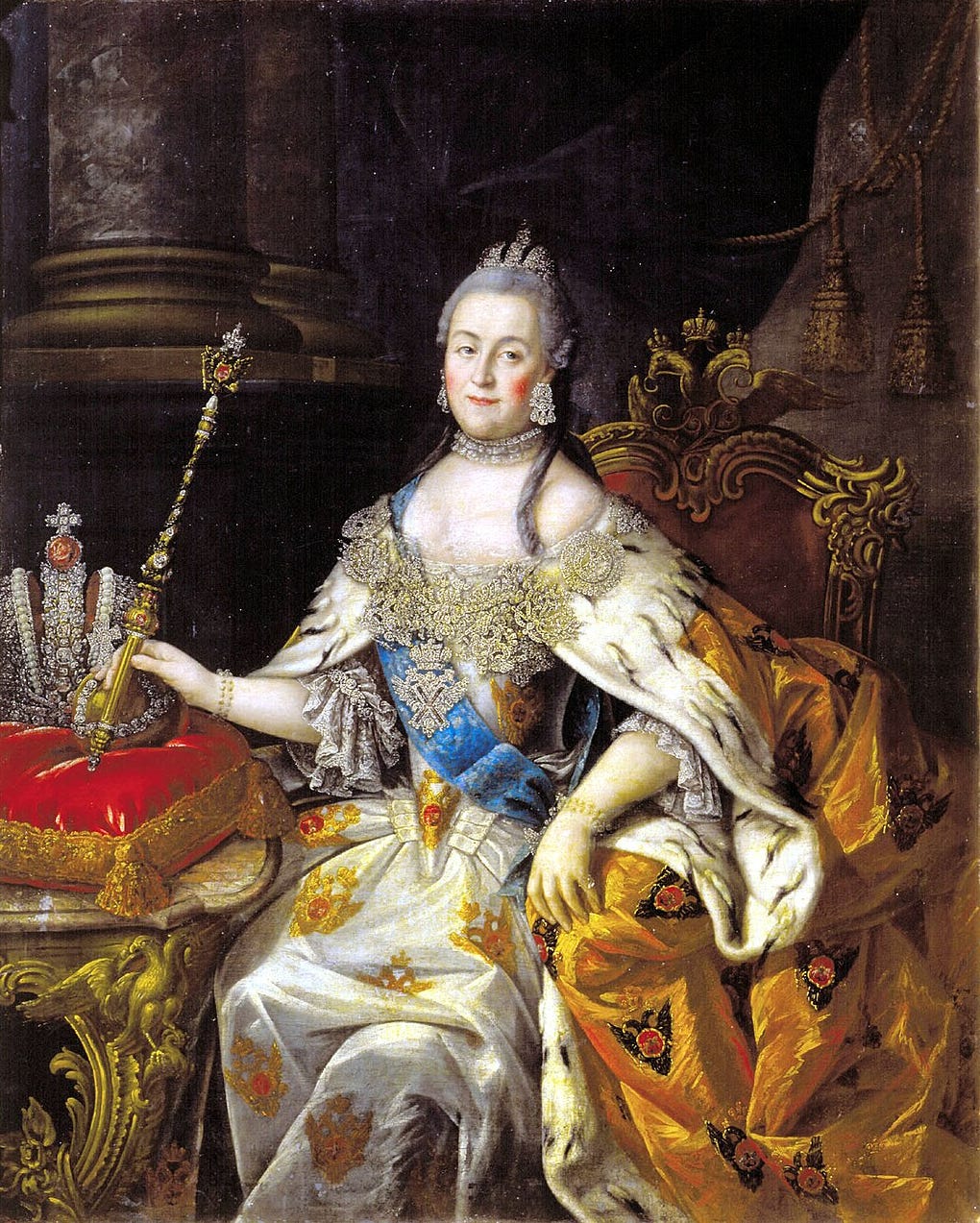
The earliest moment of Russian support for American independence came during the War of Independence itself. In 1775, when Britain sought to crush the colonial rebellion, it scoured Europe for mercenaries. Prussia and the German principalities obliged, sending thousands of Hessians to fight under the British flag. On September 1, 1775, London also appealed to Catherine II of Russia, requesting 20,000 Cossack troops to deploy against the insurgent colonies.1
Catherine refused categorically. Her reasoning was straightforward. Russia would not expend blood to defend Britain’s empire. As she saw it, the request was an affront to Russian sovereignty, an attempt to use Russia as a hired army for British colonial interests. By turning down Britain, Catherine not only preserved Russia’s independence of action, but indirectly aided the American cause. Had thousands of Russian Cossacks landed in America, the balance of forces might well have shifted in Britain’s favor.
Catherine II of Russia. Oil on canvas by Alexey Antropov, 18th century.
Catherine’s stance was consistent with her broader diplomatic outlook. She was wary of Britain’s naval dominance and its capacity to coerce neutral powers. In 1780, she established the League of Armed Neutrality, declaring that neutral nations had the right to trade with belligerents without interference, unless goods were explicitly contraband. This challenged Britain’s efforts to blockade French and Spanish shipping and weakened London’s ability to isolate the American colonies.2
Though Russia never formally allied with the United States, Catherine’s refusal to send troops and her assertion of neutral rights amounted to an indirect but vital form of support. At America’s moment of birth, Russia acted not as an enemy, but as a power whose policies gave space to the Republic’s survival.
Thomas Jefferson’s Admiration for Tsar Alexander I
With independence secured, American leaders looked outward to cultivate relations with foreign powers. Thomas Jefferson, a principal author of the Declaration of Independence, founder of the University of Virginia and America’s third president, held Russia in particular high regard. Having entered office in 1801, he was a statesman steeped in Enlightenment ideals.
Deeply skeptical of monarchy, Jefferson nonetheless praised Tsar Alexander I as “the most virtuous of the sovereigns of Europe” in a December 1804 letter to Albert Gallatin.3 What Jefferson perceived in Alexander I was an earnest attempt at enlightened governance. Alexander had spoken of constitutional reform and sought to position Russia as a stabilizing, peace-oriented power after the Napoleonic Wars. Jefferson, ever sensitive to tyranny and abuse of power, saw in him a monarch who, if not republican, at least embodied restraint, reason and moral seriousness.
Jefferson’s respect was not only personal admiration but also rooted in strategic logic. For a young United States still wary of Britain, Russia appeared as a natural counterweight. Unlike France, whose revolution devolved into violence, or Britain, which continued to menace America’s sovereignty, Russia was a great power that neither threatened US independence nor sought to draw it into European intrigues. To Jefferson, cultivating cordial relations with Russia offered the Republic a powerful friend across the Atlantic who had little interest in curtailing American growth.
Diplomatic exchanges between Washington and St. Petersburg reflected this respect. In 1807, Alexander proposed a closer diplomatic relationship. His interest was not opportunistic. He viewed the United States as a novel political experiment whose success was worth encouraging. Jefferson supported the idea and just after he left office, President James Madison appointed John Quincy Adams as America’s first minister to St. Petersburg in 1809.
Russia and the War of 1812
When the United States declared war on Britain in 1812, Russia was simultaneously facing Napoleon’s massive invasion. John Quincy Adams had established warm relations with the Russian court and observed the unfolding of Napoleon’s invasion. His dispatches to Washington praised Russian resilience and carried news of Moscow’s burning and the French retreat. American newspapers of the time expressed sympathy for Russia’s struggle against Napoleon, seeing in Alexander’s stand a defense of balance and liberty in Europe.
Russia also sought to play a constructive diplomatic role in the American conflict with Britain. Alexander offered to act as a mediator between the United States and Britain in the War of 1812. Although Britain declined the initial proposal, the Russian overture laid the groundwork for later peace negotiations. These efforts eventually culminated in the Treaty of Ghent in 1814, which ended the war on largely status quo terms.
Thus, during one of the most tumultuous years in both American and Russian history, the two countries’ foreign policies converged in a spirit of mutual respect, sympathy and potential cooperation.
Admiral John Paul Jones: America’s Naval Hero in Russian Service
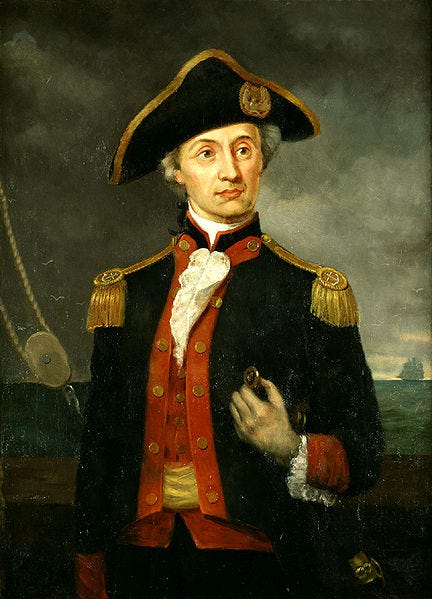
Few episodes capture the unexpected friendship between Russia and America better than the career of Admiral John Paul Jones. As the celebrated “Father of the US Navy,” Jones won immortal fame by capturing HMS Serapis in 1779, becoming a legend of the Revolution.4 Yet his story did not end there. It took him into the service of the Russian Empire.
In 1788, Catherine the Great invited Jones to join the Russian Navy as a Rear Admiral in the Black Sea fleet during the Russo-Turkish War.5 Despite court intrigue, he commanded with distinction in operations against the Ottomans. The appointment symbolized Russia’s esteem for American military talent and the openness of both sides to cooperation.
Portrait of Admiral John Paul Jones. Painted circa 1890, Charles Wilson Peale.
Jones died in Paris in 1792. His remains were returned to the United States in 1905 with full honors and today lie at the US Naval Academy in Annapolis. Jefferson, then in Paris, admired Jones and supported his European ventures, further cementing Russian-American links.
Jefferson’s admiration endured long after Jones’s death. At his estate at Monticello, Jefferson displayed a bust of John Paul Jones in his Tea Room, alongside those of George Washington, Benjamin Franklin and the Marquis de Lafayette. This was a plaster copy of the famous Houdon bust, presented to Jefferson as a gift by Jones himself.6 The placement reflected Jefferson’s esteem, ranking Jones among the foremost heroes of America’s independence.
Jones’s Russian command, coupled with his honored memory at Monticello, demonstrated a level of mutual respect between the two nations that is almost unthinkable today. A founding figure of the American navy was also, for a time, a commander of the Russian fleet, and in Jefferson’s eyes, worthy of standing in symbolic company with Washington, Franklin and Lafayette.
Russia and the American Civil War
If Catherine’s refusal in the 18th century represented an indirect gesture of support, and Jones’s service embodied personal respect, Russia’s conduct during the American Civil War amounted to direct solidarity. When the Union faced an existential crisis, Russia emerged as one of its few reliable friends.
By 1862, Britain and France were seriously considering recognizing the Confederacy, drawn by their dependence on Southern cotton and their desire to see the Union fractured. Such recognition could have tilted the balance of the war, encouraging Confederate resistance and perhaps even prompting European military involvement.
Russia, however, stood firmly with the Union. Tsar Alexander II, who had emancipated the serfs in 1861, identified with the Union’s struggle against slavery. However, strategic calculation also played a role. Britain and France, Russia’s adversaries during the Crimean War of 1853-56, were considering aligning with the Confederacy. Supporting the Union gave Russia a chance to also frustrate its European adversaries.7
The most dramatic gesture came in 1863, when Russia dispatched its Baltic fleet to New York Harbor and its Pacific fleet to San Francisco. Officially, these deployments were to safeguard Russian vessels in the event of war with Britain. However, their presence was widely interpreted in America as a show of friendship and deterrence. Newspapers hailed Russia as “our only friend in Europe,”8 and the symbolism of Russian warships anchored in US ports during the nation’s darkest hour resonated deeply with the American public.
The Union never forgot this moment of solidarity. In an era when its very survival was at stake, Russia had extended a hand of friendship when others hesitated.
US Humanitarian Aid to Russia’s Famine of 1891-92
Friendship was not limited to diplomacy. It extended to humanitarian compassion. When famine struck Russia during 1891–92, triggered by crop failures and a harsh winter, the American people responded with extraordinary generosity.
Across the United States, churches, charities and civic groups raised money and collected grain. The US government supported the effort and American ships carried thousands of tons of food to feed starving Russian peasants. One of the largest shipments came aboard the steamer Missouri, organized by the American Red Cross under the leadership of Clara Barton.9
Russian newspapers reported with gratitude on the American aid and Tsar Alexander III personally thanked the United States. This moment demonstrated that the bond between the two nations was not merely strategic but also human. Ordinary Americans, with no geopolitical agenda, gave to save lives in Russia.
This episode stands in sharp contrast to the hostility of today. Where sanctions now aim to impoverish ordinary Russians, in the late 19th century Americans mobilized to relieve their suffering. It is a powerful reminder of a different moral tradition in US-Russia relations.
The 20th Century Reversal
Given this history, the trajectory of US foreign policy toward Russia in the 20th century appears paradoxical. With the Bolshevik Revolution of 1917, Washington’s perception shifted from cordiality to suspicion. The ideological gulf between American republicanism and Soviet communism deepened into outright hostility after the Second World War, culminating in the Cold War.
What is striking, however, is how completely the earlier record of friendship was erased from memory. The Grand Alliance during the Second World War, in which Americans and Russians fought shoulder-to-shoulder against Nazi Germany, was quickly overshadowed by postwar confrontation. By the 1950s, the narrative of Russia as a natural enemy had become entrenched in American political consciousness.
Even after the Soviet Union collapsed in 1991, this narrative persisted. Instead of building on Russia’s overtures for partnership, the United States pursued NATO expansion, economic encirclement and interventions in Russia’s near abroad.10 Russia’s desire to be integrated into a cooperative European security order was rebuffed. The earlier tradition of mutual respect, embodied by Jefferson’s admiration or Russia’s support during the Civil War, was forgotten.
Recovering Forgotten Lessons
The history of US–Russia relations reveals a tradition of friendship that challenges today’s assumptions. Catherine the Great refused to serve Britain’s empire against America, Jefferson praised Alexander I as a virtuous sovereign and Russia supported the Union during the Civil War with its fleets in American harbors. At key turning points, Russia acted not as America’s enemy, but as its friend.
To remember this history is to expose the contradiction in America’s present foreign policy. Enmity with Russia is not inevitable. It is a political construction sustained by choices that ignore a long record of amity. If the United States could once admire Russia’s leaders and welcome its support in times of crisis, there is no reason why it cannot again imagine a relationship built on respect rather than hostility.
History does not dictate the future, but it offers lessons. One lesson is unmistakably clear: the United States has thrived when it recognized Russia not as a threat to be contained, but as a power with which friendship was both possible and beneficial. To recover that tradition is not naïve nostalgia. It is the rediscovery of a truth America once knew but has since forgotten.
If you’ve enjoyed this analysis, I’d love to welcome you as a subscriber. It’s free, and you’ll get every new essay delivered directly to your inbox. No algorithms, just thoughtful writing.
1 Ragsdale, Hugh. Catherine the Great and the American Revolution. The William and Mary Quarterly, 1988.
2 Dull, Jonathan R. A Diplomatic History of the American Revolution. Yale University Press, 1985.
3 Jefferson to Gallatin, Dec. 1804. The Papers of Thomas Jefferson. Princeton University Press.
4 Morison, Samuel Eliot. John Paul Jones: A Sailor’s Biography. Little, Brown, 1959.
5 Thomas, Evan. John Paul Jones: Sailor, Hero, Father of the American Navy. Simon & Schuster, 1980.
6 Monticello.org. John Paul Jones Bust (Sculpture), Monticello Collections Database, 2024.
7 Lincoln, W. Bruce. The Great Reforms: Autocracy, Bureaucracy, and the Politics of Change in Imperial Russia. Northern Illinois University Press, 1979.
8 Curtis, George Ticknor. Life of James Buchanan: Fifteenth President of the United States, vol. 2. New York: Harper, 1869.
9 Barton, Clara. The Red Cross in Peace and War. American Historical Press, 1899.
10 Gaddis, John Lewis. The Cold War: A New History. Penguin, 2006.