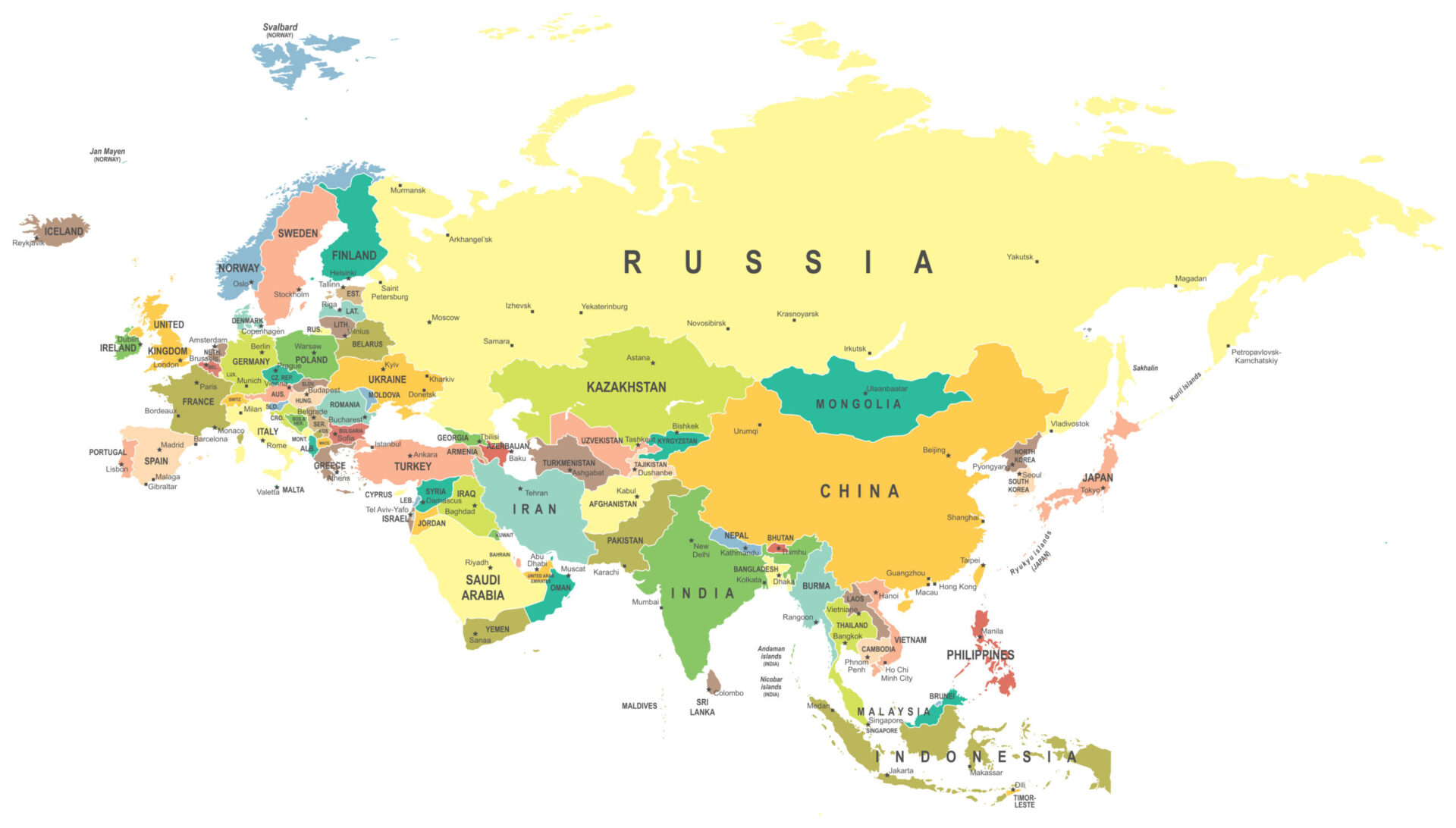
As sanctions have their intended effect – getting companies from the US and allied countries to leave Russia – there’s also an unintended effect as competitors from countries led by India, Turkey and China pick up the slack.
Despite the bad news, Russians can justify harboring hope based on the actions of some countries that do not support the sanctions and are increasing their involvement in Russia’s economy.
Anecdotal evidence for this includes such hints of ambiguity as a rhetorical question from US national public radio network NPR (April 13, 2022): “The West is hammering Russia with sanctions. But, do they work?”
Nearly 300 American, European, East Asian and other foreign companies have completely stopped doing business in Russia since the invasion of Ukraine, according to a survey conducted by the Yale School of Management.
More than 470 have suspended or scaled back their operations and more than 110 others have postponed new investments.
Prominent firms that have either abandoned or suspended their businesses in Russia include oil companies BP, Exxon and Shell; aircraft manufacturers Airbus and Boeing; telecom equipment vendors Ericsson and Nokia; and tech companies Alphabet (Google), AMD, Apple, Cisco, Global Foundries, Intel, Nvidia, Samsung, TSMC and Qualcomm.
Will this cripple the Russian economy? Some people think so. Investment Monitor published an article entitled: “Taiwan’s semiconductor ban could spell catastrophe for Russia” (March 18, 2022).
More about this later. The Mayor of Moscow, Sergey Sobyanin, blogged that in his city, “According to our estimates, about 200,000 people are at risk of losing their jobs.“
On April 24, Jeffrey Sonnenfeld and his research team at the Yale School of Management published an updated list of companies that have halted or curtailed their operations in Russia. Sonnenfeld is senior associate dean for leadership programs at the school and president & CEO of the Yale Chief Executive Leadership Institute (CELI).
Sonnenfeld and CELI Director of Research Steven Tian are openly biased, proclaiming a clear and simple goal: “Every corporation with a presence in Russia must publicly commit to a total cessation of business there.”
Apartheid comparison
They compare their effort to the boycott of apartheid South Africa: “The corporate exodus contributed to the end of apartheid, and was a remarkable display of the power that companies have. When they’re courageous enough to use that power for good, it can help topple repressive governments.”
Their survey ranks companies as follows:
-Grade A: Withdrawal – Clean break. Companies totally halting Russian engagements or completely exiting Russia (299 companies)
-Grade B: Suspension – Temporarily curtailing most operations while keeping options open for return (364 companies)
-Grade C: Scaling Back – Reducing some significant operations but continuing others (112 companies)
-Grade D: Buying Time – Postponing new investments while continuing substantive business. (143 companies)
-Grade F: Digging In – Defying demands for exit or reduction of activities. Companies that are continuing business-as-usual in Russia (181 companies)
This points to tough times ahead for Russia. But before seeing it as an unmitigated negative, we need to add another category:
Grade E: Eurasia – Indian, Turkish and Chinese companies seeking to take advantage of the mass withdrawal of Western and East Asian competitors from the Russian market.
Where Yale and many other Westerners see moral certitude, the non-Western world tends to see hypocrisy and opportunity. Why?
Conflicting viewpoint
The “Costs of War” research project conducted by the Watson Institute for International and Public Affairs at Brown University concludes that:
-More than 929,000 people have died in America’s post-9/11 wars due to direct war violence, and several times as many due to the reverberating effects of war.
-Over 387,000 civilians have been killed as a result of the fighting.
-The number of war refugees and displaced persons is about 38 million.
-The wars have been accompanied by violations of human rights and civil liberties, in the US and abroad.
Has this led to a campaign to impose economic sanctions on America? Of course not.
With this double standard and their own interests in mind, the majority of the world’s nations have refused to support sanctions on Russia. The most important of these are China, India and Turkey.
India
According to the Indian government, about 300 Indian companies are now operating in Russia. According to the Indian press, many more are on the way. The president of the Federation of Indian Export Organizations (FIEO), A Sakthivel, explains:
“Export to Russia is not much, only in agriculture and pharmacy products. Now that the whole of the West is banning Russia, there will be a lot of opportunities for Indian firms to enter Russia.”
The FIEO is an association established by the Indian Ministry of Commerce and the private sector to assist entrepreneurs and exporters in foreign markets. It represents more than 200,000 Indian exporters.
Susil Dungarwal, founder of Indian retail consultancy Beyond Squarefeet Advisory, says:
“We are seeking to take Indian brands to Russia as most of the American and European brands don’t sell there anymore… Say one guy was running 50 stores of Calvin Klein as a master franchisee in Russia. Now, Calvin Klein is no more there, but that company still has 50 empty stores with him. So, either he closes those 50 stores and exit the business, or he can bring alternative [Indian] brands” (“As global brands take flight, Indian retailers book tickets for Russia.”
Sakthivel was understating the case: Indian business in Russia ranges from tea, coffee and tobacco to seafood, spices and rice, textiles and footwear, pharmaceuticals, IT services, coal, oil and natural gas.
Pricing some or all of this trade in rupees and rubles should help India circumvent Western economic sanctions and reduce its dependence on the US dollar. India already has a rupee-rial trading arrangement with Iran.
A few Indian companies do not like what they see in Ukraine. One, Infosys, is shutting down in Russia (Grade A); and three more – Reliance, Tata Motors and Tata Steel – are suspending operations there (Grade B).
But 13 Indian companies are conducting business as usual (Grade F).
Turkey
“Over 3,000 Turkish businesses are working in different economic sectors in Russia,” Russian Deputy Prime Minister Alexander Novak said at last summer’s Turkish-Russian Business Forum. “We are certainly interested in investments, the input of experience and professionalism to Russia in areas where our Turkish partners have expertise.”
Turkey, which also has (or had) more than 600 companies working in Ukraine, is also interested – in stopping the war and revitalizing its business interests in both countries, not in making the disruption of its economy even worse by implementing sanctions.
Speaking on Turkish television, Foreign Minister Mevlüt Çavuşoğlu said, “As a principle, we didn’t participate in such sanctions in a general sense [in the past]. We have no intention of joining in these sanctions, either.”
Turkish President Recep Tayyip Erdogan explained that,
“We are buying nearly half of the natural gas we use from Russia. Separately, we are making our Akkuyy Nuclear Power Plant with Russia. We cannot set these aside… So there is nothing that can be done here. We must maintain our sensitivity on this issue. Firstly, I can’t leave my people in the cold of the winter. Secondly, I cannot halt our industry. We must defend these.”
Turkish companies are active in the Russian markets for commercial building, transport infrastructure and industrial plant construction, real estate development, machinery, electrical equipment, auto parts, aviation, foods, textiles, metals and minerals, renewable energy and natural gas. The two countries are also working to facilitate trade in Turkish lira and rubles.
It is notable that the Yale survey mentions only one Turkish company – Turkish Airlines (Grade F), which is still flying to Russia. Not on its radar are more than 3,000 other Turkish companies representing the world’s 11th largest economy in purchasing power parity terms.
A NATO member with a growing industrial economy and a population of 85 million, Turkey is an important economic partner of both Russia and Ukraine. Or perhaps the researchers concluded that trying to lay a guilt trip on Turkey would be an exercise in futility.
China
Yale’s Grade F list includes 41 Chinese companies (including one from Hong Kong and two from Taiwan). These include state-controlled construction, engineering and energy firms, banks, SAIC Motor, and several prominent tech companies including Alibaba, ANT, China Mobile, Oppo, Tencent, Xiaomi and ZTE.
Huawei, which has suspended new orders and furloughed some staff in Russia, is classed Grade D, but its actions may be an attempt to avoid attracting more American attention.
In any case, Huawei is already the largest telecommunications equipment, software and services vendor in Russia. Along with ZTE, it stands to pick up the market share abandoned by Nokia and Ericsson.
It also seems likely that China will do what it can to replace the semiconductors that Russia can no longer import from the West and East Asia. It won’t be a complete replacement, but it should grow with time as China’s own semiconductor industry develops.
It is not clear exactly how many Chinese companies are doing business in Russia, but information from various media and government sources suggests that the number is at least in the hundreds, perhaps in the thousands, and that it is likely to increase.
The Chinese government is helping private Chinese companies “fill the void in the Russian market” with special emphasis on small and medium-sized enterprises that are less likely to attract attention than large state-owned enterprises. The companies concerned, which are already highly motivated, are unlikely to waste the opportunity.
Wang Chuanbao, president of the Federation of Overseas Chinese in Moscow, puts it in a larger context: “We will actively assist incoming Chinese companies in studying and collaborating with the Russian market, as well as explore ways to work with Russian companies under the backdrop of the belt and road strategic development.”
Russia and China are also increasing the amount of trade denominated in rubles and yuan, reducing their reliance on the dollar.
Import substitution
This brings us to import substitution and the erosion of Western technological dominance. In the case of China, this possibility (or threat, depending on your point of view) has received a lot of attention. In the case of Russia, the West seems to be as complacent as it is about Turkish industry.
But the country that was first into space and that graduates more engineers and gets a bigger bang for the military buck than the United States is more capable than many observers seem to think.
Commercial aircraft – as I reported in “China’s jets set to challenge Boeing and Airbus” – is a good example. When imports of composite materials were blocked by American sanctions, Russian industry developed its own. The first flight of a Russian aircraft with composite wings made in Russia was successfully completed last December.
A year before that, Russia’s United Aircraft Corporation (UAC) began flight tests of the first Russian passenger plane equipped with Russian engines since the collapse of the Soviet Union.
Now, with Boeing and Airbus having suspended operations in Russia and sales of aircraft and aircraft parts to Russia having been prohibited, we should assume that if the Soviet Union could make its own passenger aircraft (Ilyushin and Tupolev), Russia (and China) probably can, too.
In March, TASS reported that UAC plans to deliver more than 20 regional and medium-haul passenger jets to domestic customers this year. UAC also says it can ramp up production of Ilyushin and Tupolev aircraft if needed. Limited numbers of these older aircraft are still being produced.
Intended to stifle progress, sanctions actually incentivize technically competent nations such as Russia (and China) to make themselves more competitive.
In summary, a new Russian economy is likely to emerge as Indian, Turkish, Chinese and Russian companies move into markets vacated by Europeans, Americans, Japanese, South Koreans and others opposed to the war in Ukraine.
The adjustments will take time, but they are shaping up to be a serious but temporary inconvenience for Russia while leading to substantial and sometimes permanent losses for America and its allies and a big step forward for the Eurasian economy.
The combined losses of BP, Exxon and Shell from abandoning their businesses and assets in Russia are estimated at about $30 billion. The aggregate losses of all the withdrawals, suspensions and curtailments are yet to be calculated.
The value of future opportunities lost or gained in a country of about 150 million people with enormous quantities of natural resources and a GDP almost as large as Germany’s on a purchasing power parity basis is incalculable.
Gordon M. Hahn, Ph.D., is a Senior Researcher at the Center for Terrorism and Intelligence Studies (CETIS), Akribis Group, San Jose, California, www.cetisresearch.org; an expert analyst at Corr Analytics, www.canalyt.com; and an analyst at Geostrategic Forecasting Corporation (Chicago), www.geostrategicforecasting.com. He is the author of the forthcoming book from McFarland Publishers Ukraine Over the Edge: Russia, the West, and the Making of the Ukrainian Crisis and ‘New Cold War.
Recent reporting suggests that my sense that Russian President Vladimir Putin had not planned to invade and was instead engaged in coercive diplomacy in massing troops around Ukraine is supported, though not necessarily confirmed by US intelligence, according to a recent report on US per-war intelligence. The decision to invade and, in particular, to conduct a ‘special military operation’ rather than declare war on Ukraine has led to a prolonged conflict fraught with the risk of escalation and direct NATO involvement. NATO countries are already de jure co-belligerents, bringing — together with Russia — the world to the brink of a world war that could quickly go nuclear.
The relevant report notes: “Putin did not make a final decision to invade until just before he launched the attack in February, according to senior current and former U.S. intelligence officials.” “The CIA was saying through January that Putin had not made a decision to invade.” “Putin was still keeping his options open.” “It wasn’t until February that the agency and the rest of the U.S. intelligence community became convinced that Putin would invade” “Putin waited until almost the last minute to decide to start a war with Ukraine” (https://theintercept.com/2022/03/11/russia-putin-ukraine-invasion-us-intelligence/).
The new report has some erroneous information that exculpates Ukrainian actions that might have prompted Putin’s decision to invade, believing that 8 years of unfulfilled Minsk agreement promises and three months of stalling on his proposals for Ukraine, NATO, and European security architecture settlements had proven finally futile: “‘Biden took the unusual step of making the intelligence public, in what amounted to a form of information warfare against the Russian leader. He also warned that Putin was planning to try to fabricate a pretext for invasion, including by making false claims that Ukrainian forces had attacked civilians in the Donbas region of eastern Ukraine, which is controlled by pro-Russian separatists. The preemptive use of intelligence by Biden revealed ‘a new understanding … that the information space may be among the most consequential terrain Putin is contesting,’ observed Jessica Brandt of the Brookings Institution” (https://theintercept.com/2022/03/11/russia-putin-ukraine-invasion-us-intelligence/). Ignored by Ms Brandt is that Washington was issuing disinformation; something that would also make Putin less likely to believe his ‘Western partners,’ as he used to refer to them.
There is no benefit for Washington or the US intelligence community to issue the report indicating a last minute decision by Putin as disinformation. The event has already occurred. Moreover, the US government and intel and Western narrative is that Putin is bent on territorial expansion and recreating the USSR. Therefore, a narrative in which Putin was not initially prepared to invade Ukraine goes against this traditional narrative. The same is true for the origins of the August 2008 Five-Day Georgian-Ossetiyan/Russian War, which was sparked by Georgian President Mikheil Saakashvili’s invasion of South Ossetiya and the August 7-8 bombing of its sleeping capitol with inaccurate GRAD rockets, killing tens if not hundreds of Ossetiyan civilians and 19 Russian peacekeeping troops.
Putin’s decision to invade was likely driven by several factors: (1) Western intransigence and dismissive, even disdainful reaction to Putin’s demand for a reordering of the European security architecture, fist of all an end of NATO expansion, especially to Ukraine; (2) a Ukrainian commitment to non-aligned status; and (3) Kiev’s defiance of and challenge through escalation to the explicit threat posed by Putin’s troop deployments and coercive diplomacy. By February, Washington and NATO had made it clear they had not intention of even considering an end to NATO expansion to Ukraine, insisting on the inviolability of its ‘open door’ policy. This was occurring on a background of several years of expanding NATO-Ukrainian military cooperation, most notably U.S. and its allies continued training of Ukrainian forces, including neo-Nazi formations such as the terrorist Azov and Right Sector’s Ukrainian Volunteer Army, the conduct of NATO exercises with Ukraine designed to make Kiev’s forces interoperable with NATO forces much as NATO member-states’ armies are, the construction by the British of a proto-naval base on Ukraine’s Black Sea coast, and NATO’s conduct of military flights over Ukrainian territory. These developments prompted Putin to see and state that Ukraine de facto was already a NATO member.
Similarly, Ukrainian President Volodomyr Zelenskiy refused to make any clear expression of a willingness to renounce the Poroshenko-era constitutional amendment on Kiev’s aspiration to NATO membership and the mandatory implementation of policies aimed at achieving that membership. Days before the February 24th invasion, Zelenskiy rejected a February 19th proposal from German Chancellor Olaf Scholz that would have included Kiev’s renunciation of its aspiration to NATO membership, a declaration of Ukraine’s neutrality, and a joint American-Russian security guarantee codified in a treaty to be signed by Presidents Biden and Putin. The Wall Street Journal reported that Zelenskiy’s rejection of the German offer “left German officials worried that the chances of peace were fading.” French President Emmanual Marcon had the same sense and in a phone call issued an appeal to Biden to make another push for diplomacy. “I think the last person who could still do something is you, Joe. Are you ready to meet Putin?” Macron said to Biden. But Washington expressed no interest in more diplomacy (www.wsj.com/amp/articles/vladimir-putins-20-year-march-to-war-in-ukraineand-how-the-west-mishandled-it-11648826461 and www.defenddemocracy.press/zelensky-rejected-german-security-proposal-before-russian-invasion/). It may or may not be relevant that “Biden’s warning on February 18 that the invasion would happen within the week turned out to be accurate,” since Biden’s indifference to forestalling Putin’s invasion helped fulfill his ‘prophecy’ (https://theintercept.com/2022/03/11/russia-putin-ukraine-invasion-us-intelligence/).
Nevertheless, Sholtz continued to engage Putin. In a February 21st call to the Kremlin, Sholtz tried to forestall Putin’s recognition of the independence of Ukraine’s breakaway LNR and DNR (https://www.rferl.org/a/germany-scholz-phone-talk-putin/31714435.html). Putin surely was informed of Zelenskiy’s rejection of the proposal and of the Americans’ lack of interest in engaging either Kiev or Moscow. Perhaps Putin hoped that the threat of such a declaration would concentrate Zelenskiy’s mind at the last minute and prompt him to take a neutrality position seriously. No such reconsideration on Zelenskiy’s part came, and Russia recognized the breakaway regions’ independence and then invaded Ukraine along several fronts.
However, it is very likely that by the time Sholtz’s February 21st call, Putin had already issued the order to begin military operations. Zelenskiy’s actions helped Putin in deciding. Putin’s final decision was also prompted by the Ukrainian army’s military escalation in Donbass. From the OSCE SMM monitoring mission’s data, it appears that Ukrainian side — regular Ukrainian army forces or the informal volunteer armed formations of the DUK type — provoked Putin’s moves, first, to recognize the DNR/LNR’s independence, then to attack Ukraine. The first major escalation occurred on the evening of February 18-19 from the Ukraine government-controlled side of the contact line. In the Donetsk region/DNR “The majority of ceasefire violations were recorded on the morning of 19 February in areas east, east-south-east, and south-east of Svitlodarsk (government-controlled, 57km north-east of Donetsk), on the evening and night of 18-19 and 19-20 February in areas north, north-north-east, and north-north-west of Shyrokyne (government-controlled, 100km south of Donetsk) and on the morning of 19 February close to Staromykhailivka (nongovernment-controlled, 15km west of Donetsk).” In the Luhansk region, “(t)he majority of ceasefire violations were recorded in areas close to the disengagement area near Stanytsia Luhanska (government-controlled, 16km north-east of Luhansk) during the day on 19 February (see below), and in areas inside and close to the disengagement area near Zolote (government-controlled, 60km west of Luhansk) during the day and evening of 18, 19 and 20 February. In the previous reporting period, the SMM recorded 975 ceasefire violations in the region, the majority of which also occurred near the disengagement areas near Stanytsia Luhanska and Zolote” (OSCE SMM Report, 20 February 2022, p. 4, http://www.osce.org/files/2022-02-20-21%20Daily%20Report_ENG.pdf?itok=82567). On According to the Ukrainian website Tsenzor.net, during this period and for some period before, Ukraine’s authorities were refusing journalists access to conflict zone to around 400 journalists, permitting access only to a selected 25 ‘international journalists.’ Some journalists had been denied access for over a month (https://echo.msk.ru/news/2982672-echo.html). On February 21, Ukrainian fire on Donetsk put a coal mine ventilator off line, forcing more than 250 Donbass miners to evacuate from the mines (https://echo.msk.ru/news/2983086-echo.html).
Meanwhile, in the same period, Zelenskiy displayed virtually no effort to meet Moscow halfway on security issues and even escalated tensions by implying Kiev was ready to reconsider its non-nuclear status rather than its non-aligned status. At the February 19th Munich Security Conference, Zelenskiy issued a not very vailed threat to reconsider its adherence to the Budapest Memorandum, which had led to the post-Soviet exchange for Ukraine’s recognized sovereignty over Crimea in return for Kiev’s transfer of all Soviet nuclear forces on Ukraine SSR territory to Moscow. Zelenskiy stated that if NATO would not guarantee Ukraine’s security even as Kiev and NATO insisted on Ukraine’s NATO aspirations in defiance of Moscow’ security concerns, then “Ukraine will have every right to believe that the Budapest Memorandum is not working and all the package decisions of 1994 are in doubt” (https://euromaidanpress.com/2022/02/19/ukraine-now-has-neither-weapons-nor-security-zelenskyy-demands-budapest-memorandum-consultations/). Zelenskiy’s threat of possible acquisition of some nuclear capability demonstrated clearly Kiev’s unwillingness to bend to Moscow’s demands.
Special Military Operation, War, and Total War
Putin’s decision also included limits on the war, which Moscow calls a ‘special military operation.’ This aspect of the war is particularly intriguing and telling. The Russian army has refrained from shelling anywhere near central Kiev. Unlike the US war in Iraq, Putin’s war is not war, no less total war. There have been no airstrikes or missile attacks on the Ukrainian government’s central civilian and military leadership, and civilian infrastructure has gone largely untouched, despite thousands of targeted rockets raining down on military targets. In Iraq and in any full-scale war such targets are priority in order to disrupt leadership. In the first days of the US-led war in Iraq, Sadaam Hussein’s presidential office, intelligence service headquarters, the Defense Ministry, and other government buildings were targeted. So far in the Russo-Ukrainian ‘war’ the Office of the President, Rada, government ministries, the Defense Ministry and General Staff headquarters have not been targeted. In this sense, Putin’s ‘operation’ is not a war in the way we usually understand a full-out declared war.
In addition, numerous video speeches Zelenskiy has made demonstrate precisely where he is located: in, around, and underneath the Presidential Office. Why has Putin not ordered the Russian military to hit such targets? First, he needs or at least needed at the war’s outset to have a negotiating partner with legitimacy inside Ukraine who can sign and carry through any ceasefire agreements and final peace treaty, if he hopes to avoid having to occupy all of Ukraine and getting bogged down in a guerilla war quagmire, which very possibly could emerge in western Ukraine. In other words, the fact that Putin has not targeted Zelenskiy, regardless of unconfirmed reports in Western media of special forces teams hunting him down, demonstrates that Putin is preserving and prefers an option in which he and Zelenskiy agree to terms.
On the other hand, the Russian invasion force that moved south from Belarus to threaten Kiev may not have been deployed merely to hold Ukrainian troops in place so that they could not move south to help the nearly encircled 60,000 force in Donbass. It may also may have represented an alternative option for a potential Plan B or C that could have been built around an encricelment and blockade of Kiev in the event Zelenskiy and his government evacuated to Lviv or elsewhere to the west. In this case, the Russians would have been in a position to establish a new, friendly regime without having to enter into force-destroying urban warfare or even prolonged operations beyond Donetsk and Luhansk, though a western Ukrainian-based insurgency would have been the likely result as it may be in future under numerpus scenarios. The new regime would have been less able than Zelenskiy’s Maidan regime to guarantee fulfillment of agreements, but the Ukrainian military likely would have stood down, and Russian forces could have moved forward with de-nazification in Mariupol, Dnepropetrovsk, and elsewhere.
We will know that all hope for a negotiated settlement is lost when Russian operations begin against such government and critical civilian installations, perhaps preceded by a vote in the Russian Federal Assembly on a resolution declaring war on Ukraine. This will be the last step prior to the present Ukrainian regime being forced to escape to Lvov and likely then surrendering or being annihilated. This could lead to a prolonged guerrilla war conducted by Ukrainian partisans, with any departure of Russian forces leading to an Iraqi/Syrian scenario of various forces prolonging chaos, including terrorist attacks carried out by Ukrainian nationalist, ultranationalist, and neofascist groups. The only stopgaps to such catastrophic outcomes are a concerted Western drive to push forward Russo-Ukrainian peace talks or WW III.
The Vulnerabilities
Therefore, Putin’s decision to undertake a ‘special military operation’ and at the same time limit the war far below the total war threshold along with Western decisions to deepen the conflict by providing massive military assistance to Kiev rather than to contain and end it through diplomacy make a ‘World War III’ scenario beginning across Europe with the potential to spread through a Taiwan conflict through much of Asia more likely. By avoiding total war, Putin has allowed NATO countries, led by the US, to act as co-belligerents as James Carden and constitutional lawyer Bruce Fein have noted. Supplying billions of dollars in weapons, financial aid, and military intelligence, NATO countries have violated any accepted legal definition of neutrality and open themselves up to direct military retaliation (https://asiatimes.com/2022/04/us-a-co-belligerent-in-ukraine-war-legal-expert-says/). The stakes were raised this week when British officials urged Kiev to use weapons London is supplying to attack Russian territory, leading to a Russian warning that any such attack, should it materialize, is already in the que for “lightning” retaliation upon Putin’s orders. Germany will replace Polish Soviet era tanks that the Poles have now pledged to send to Ukraine. Numerous other NATO members have sent lethal weapons to Ukraine. At the same time, attacks on a television tower and arms depot in Transdniestria carried out by unknown forces but blamed on Ukrainians by Russia and Transdniestria. This raises the specter of Transdniestrian and Russian forces in the breakaway Moldovan region entering the war, which could bring in Moldova’s fraternal state and NATO member Rumania. In other words, the US and a host of other NATO states are co-belligerents; some on the verge of becoming direct participants.
Whether one or both parties want it or not, their actions have set the stage for a Kremlin decision to declare war, meaning total war, on Ukraine, A Russian declaration and accompanying escalation of violence is likely to be followed by a NATO intervention supported by a desperate and illegitimate US administration, which appears bent on aping Ukrainian and Russian authoritarianism at home and creating a besieged fortress rally around the flag dynamic before the upcoming elections in which the Democrat Party-state is destined for a resounding defeat (https://dossier.substack.com/p/ministry-of-truth-biden-admin-appoints?s=r).
Russia started this war, viewing de facto or de jure NATO expansion to Ukraine as an existential threat. Now the West is backing a war to defeat Russian in Ukraine, set the stage for Ukraine’s NATO membership, bring the war to Russian territory while simultaneously the collective West seeks to create political chaos inside Russia through massive economic sanctions in an attempt to bring Putin’s removal from power. In short, the existential threat has not gone away; it has simply been transformed and intensified. We are at the edge looking into the abyss without any seriousness in diplomatic purpose, no less the requisite grave urgency now necessary to preserve what remains of peace.
Bernadine Joselyn is a member of the board of the American Committee for US-Russia Accord (ACURA).
Before the war, I had no real connection to Poland. My friend Melanie’s grandparents were Polish, and some years ago she’d visited and came home with pictures of the church in the village where they were married.
I’d made a brief trip to Warsaw in the early 1990s, on at TDY [Temporary Duty] assignment from the American Embassy in Moscow. While almost every detail of the trip is blurred and gone, I do retain a visceral memory of the Soviet Palace of Culture and Science, completed in 1955, the year before I was born.
With its elaborate combination of Russian Baroque and Gothic styles, the “Palace” was instantly recognizable as a pompous version of Stalin’s “seven sisters” towers built in Moscow after the war. A gift from the Soviet Union to the people of Poland, Warsaw’s iteration was built from the rubble of a city devastated by the Nazis. Hitler ordered his army to raze as it retreated from Warsaw; nearly ninety percent of the city was destroyed. Then, by 1955, it was rebuilt.
At the time of my first visit, on the tail of the revolutionary wave of 1989 that eventually would topple a forty-year post-war run of communist rule in much of Central and Eastern Europe, private retail commerce was booming in Warsaw. In an eclectic display of primitive capitalism, out from behind tiny dirty windows of thousands (easy) of kiosks lining Warsaw’s streets, new entrepreneurs purveyed a crazy mash-up inventory of nylons, cigarettes, gloves, beer, vodka, bubble gum, newspapers, condoms, head-phones, cassette tapes, Fanta, Coke, snacks, you name it, that somehow made each kiosk unique and each the same.
At that time, Moscow had kiosks like these, too; but a difference was that here in Warsaw, the kiosks also sold bananas.! Bananas for sale! Still a great luxury in Moscow, the sight of bananas for sale on Warsaw streets felt thrilling. Daring, even. Better times were coming to the people of the former Soviet Bloc.
A few months later I accompanied then U.S. Ambassador to Russia Jack F. Matlock, Jr. and Polish-born [then former] National Security Advisor Zbigniew Brezinski on a train trip to the site of the Katyn massacre, in Russia’s Smolenskaya Oblast, just east of the border with Belarus’. In a statement from the then still unmarked site, Brezinski called on Mikhail Gorbachev to admit that it was the Soviet’s NKVD, and not Nazi Germany, that had executed nearly 22,000 Polish military officers at the Katyn Forest, an admission Gorbachev later made.
Despite my two advanced degrees in international affairs, other than these two personal experiences in Poland, my awareness of “things Polish,” of the role of Polish culture and identity in the world, was pretty limited. I knew that Pope John Paul II was Polish. I knew about Lech Walesa of Solidarnost’, Frederick Chopin, Madame Curie, Copernicus, and I had an understanding that Polish is a western Slavic language, though written in Latin Script. One of my classmates in my Foreign Service Officer Russian Language Class was a Polish speaker, and the language was just similar and different enough to really mess up his Russian.
Fast forward thirty-two years to February 24, 2022, the day Putin directs the Russian Army across the border in a Special Operation to denazify and demilitarize Ukraine, and “liberate” the oppressed Russian-speaking people of the Donbas.
When the news comes, I’m at home with my husband, Denys, in Grand Rapids, Minnesota, the town where we met and married. Denys was born in Kyiv to a Russian mother and a Ukrainian father; now he’s taken US citizenship.
My Moscow-born son, Alexander, now twenty-three, is in Hollywood.
Denys’s parents, Olga and Anatoliy, are at home in Kyiv, in the apartment where Denys grew up. Alex and I met them there eight years ago on a visit to Alex’s Russian father in Moscow, their first meeting since we left Moscow, when Alex was two.
Alex’s father, Valery, is at home in Moscow, where he still lives in the apartment where he grew up, in the House on the Kotelnicheskaya Embankment, one of those “Seven Sisters,” built by Stalin, this one ended up being used to house party members. The gargantuan complex was completed in 1940. His grandmother, come to the city from her village, found a job washing floors for the KGB. Through her modest position she managed to be assigned a “corner” of a four-room multi-family “kommunalka” apartment. After forty years, she, her daughter and grandson had outlived the other original co-inhabitants, and at the time of Moscow’s great housing privatization, in 1989, the entire top floor apartment with balcony views over the Moskva River and the Kremlin, came into the private ownership of Valery’s mother. And since her death in February 2020, to him. He’s lived there his entire life.
In the spring of 1999, a year before I left Moscow with my infant son, NATO, without UN approval, launched an aerial bombing campaign against Yugoslavia prompted by its ethnic cleansing of Albanians. As one of the founders of Russia’s new “Liberal Party,” one of many to form in the wake of the fall of Communist party control, Valeriy was vociferously opposed to that bombing, which killed about a thousand Yugoslav forces, and half as many civilians. That action marked the beginning of Valery’s sharp anti-American turn, a hostility that grew throughout the Clinton administration, and contributed to his determination to stay in Russia. He neither saw nor sought a future for himself in the West.
Valeriy continues to hold the job he had when Alex and I left Moscow on July 4, 2000; senior staff for the International Affairs Committee of Russia’s Federal Council.
From my perch working for a rural community building foundation in north central Minnesota, I had maintained my ties to Russia through a shared cultural connection with Denys – we often spoke Russian together at home – but also as a member of the board of a couple of organizations dedicated to better cultural understanding between the United States and the countries of the former Soviet Union and to moderation in U.S. foreign affairs. I had watched the buildup of Russian troops on the border with Ukraine with alarm, but like most informed observers, did not believe Putin would actually invade. It would be too costly.
In fact, before then war, I was, and pretty much remain, aligned with a small, but maligned sub-set of Western observers who assign to the West much of the blame for Putin’s threating behavior. Especially to George W. Bush – with his relentless push for NATO membership for Georgia and then Ukraine – and also to Bill Clinton, with his “democracy building” in the East, of which I was a part throughout most of my diplomatic service in Moscow.
Ever since the 2008 Bucharest Summit, when NATO, ignoring Bush’s vow of “not one inch” [east for NATO], issued a “compromise” statement promising that Ukraine “will” join NATO, Putin had warned the West of his red line. The U.S. wouldn’t allow the Soviet Union to put missiles on its border in Cuba, and had taken the world to the brink of nuclear war to make sure it didn’t. Putin was no less likely to allow NATO weapons on its border with Ukraine. And the West knew it.
And yet, a military invasion by Russia still seemed, to borrow a tortured metaphor from the not-so-distant World War, Beyond the Pale. When it happened, I was stunned. There on TV was Putin recognizing the breakaway self-proclaimed “Peoples’ Republics” of Donetsk and Lugansk. Now he’s announcing that, to defend them and their oppressed Russian-speaking residents, his is authorizing a “special operation” into Ukraine. His purpose, he says, is to ensure the “demilitarization” and “de-Nazification” of Ukraine, and to block its entry into NATO. The “operation” was beginning as he spoke.
In the first days of the war, as Russian troops approached Kyiv, Denys and I were gripped with fear for his parents and relatives in their homes in the southern outskirts of the city. We trembled for them as a long convoy of Russian armored vehicles lined up through the northern suburbs of Ilpwin and Bucha, later to be devastated in the wake of the forces’s retreat. Denys’s mother is crippled with Rheumatoid Arthritis and in pain to move. Their house had no back-up electricity, and if the power went out, they would lose both water and heat.
Nevertheless, his parents were reluctant to leave. It was as if they were listening to different information; and they were. Both were sympathetic to Putin’s arguments, and told Denys they agreed that his generation had been “Infected” by Ukrainian nationalism. Under previous President Poroshenko, the Verkhovna Rada had voted to add to the country’s constitution it’s intention to join NATO, and had mandated the use of Ukrainian language in public schools and all public events.
As Russian troops bore down on Kyiv, it seemed only the threat of Denys flying there himself to drag them out that persuaded his parents reluctantly to agree to leave the city. Their nephew drove them in his car, timing the trip to be within curfew. They were stopped by home front soldiers at check points several times along the way, but made it before dark to a relative’s house in a small village about two hundred kilometers to the south. There was a well, a cellar full of preserved food, no steps to get in or out of the house, and a garden where Denys’s mother could sit in the sun. Their nephew, his wife and their two small children joined them there. Thanks to a cellphone connection his folks were able to continue to tune into Russian media via the computers they had brought with them from Kyiv.
There they stayed for five days or so, in seemingly comparative safely, until one night they heard air defense sirens. Turns out the village was near a hydro-dam on the Dnepr River, and Ukrainian troops were near-by to defend it, a target for Russian strikes. After much deliberation, they decided they’d be safer in Kyiv after all, and returned. There they remain, as Russian forces continue to withdraw from the capitol towards the contested republics in the east. They are hoping to get a generator. They are hunkering down and hoping for the best.
In the first days of the war, one of the organizations on whose board I serve was forced to grapple with how to respond to Putin’s invasion. With the word “Russian” in our name, we were challenged to say something, to do something. The Museum of Russian Art in Minneapolis, for example, painted over their huge marquee sign with the Yellow and Blue colors of the Ukrainian flag. We took a poll of board members: with Russia suddenly toxic, what could/ should we do with our mission? Double down on citizen diplomacy… two-track it, like during the Cold War? Be anti-war, and support anti-War Russians? Be pro-Ukrainian? What about the new diaspora? Something else?
Another organization’s board I’m on had been struggling over a statement about What is to Be Done?, only to withdraw it at the last minute when the invasion happened.
In the days just after, America’s foreign policy hawks had a field day. Anti-Russian vilification reached proportions worthy of caricature. One foreign policy analyst told colleagues in dismay, “As I speak, legislation is being introduced in Congress to cancel all Sister City relationships with Russia and send home Russian Fulbright Fellows – and that’s the Democrats’ bill!” Another said, “When it comes to Russia, the parties are Tweedle Dee and Tweedle Dum.”
Five days or so into the war I decided to text Valery on the Viber app he uses, popular in Russia, to check-in. I wrote that, regardless of his views on what was happening, I wanted him to know that I was thinking of him, that Denys’s parents were in danger in Kyiv, and that the war was very confusing to Alex, who strongly identified as Russian and, like his dad, had long admired Putin.
Valery wrote back that it was too bad that some old people in Kyiv might have to be the innocent victims of Putin’s “Special Operation,” but that they had their nationalistic, Nazified government to thank, and they should bring their grievances there.
About two weeks into the war, our lives still on hold as we did little but consume the news, someone forwarded me an email from an organization recruiting volunteers to go to the Polish-Ukrainian border to help war evacuees. It hadn’t occurred to me to even imagine myself in that role, but here was a chance.
I clicked through the short application. Languages spoken, it asked. Proud to check Russian, I was soon put in my place to see the full list of over a dozen sought-after languages: Ukrainian, Polish, German, Hebrew, French… Indeed, the ID badges eventually issued to us listed the languages each volunteer spoke; some folks’ tags boasted impressive lists. The record I saw was six.
The application’s next question, about skills, was even more humbling. Could I: Drive a truck; Set up Internet networks; Deliver licensed medical assistance; Provide psychological or other counseling; Cook; Interpret….? Ummm…. Not so much. In the end, it seemed all I had to offer was my Russian language skills and foreign service experience in Moscow and other cities across the former Soviet Union. I pushed Send.
The next day they called me back. Was I ready to leave on Tuesday? This was Thursday. Did I understand this was ”The Joint” – formally the American Jewish Joint Distribution Center, or JDC? The woman on the phone explained in Russian-accented English that “The Joint” had been formed in 1914 to support and protect Jews stranded in then Ottoman-controlled Palestine, and that it has been providing assistance to Jews fleeing persecution and war ever since. It would be a two-week assignment on the border with Ukraine, receiving and supporting evacuees as they fled the war.
With the support of my work colleagues and family I was able to say Yes. I signed up. Luckily, I had a ready-to-go valid passport and COVID vaccines and boosters. I packed a back-pack and small carry-on with items I imagined myself handing out to people as they crossed over: boxes of raisins, bags of nuts, chocolate bars, gum, coloring books and crayons, socks, rain ponchos, coffee…. I made it all up. Most of the stuff I bought turned out to be useless, though I did end up leaving the food with the folks at World Central Kitchen, to put out along with so much else, in the never-closing round-the-clock feeding operation they ran at the evacuee center.
Denys found and bought my tickets and drove me to Duluth. I flew to Minneapolis, then Helsinki, then Warsaw, arriving around 1 PM, the first of my team to get there. After meeting up with the other two women, and a quick stop at the JDC headquarters in Warsaw, where we were issued our JDC de rigor Israeli-blue jackets and shook hands with the overall coordinator for Poland, we bundled into a van for the three-hour drive south and west to a small and tidy “zayezd” – tavern-cum-bowling-alley-with-bar-restaurant, where we had rooms for the duration of our stay. Each morning, our mostly-Polish-only-speaking-driver, Kuba, would meet us at the front door and drive us the twenty-minute trip past fields and woods and small hamlets to the refugee center. The roads were narrow, tarred, with no shoulder, winding right through tiny communities of tidy brick houses each planted with fences of cedar bushes. In the still fallow fields, we saw miniature Roe Deer and Storks returning to their nests.
The evacuee center at Korcwoza, about twenty kilometers from the actual border, was in a huge wholesale warehouse space, repurposed for the evacuees. It was one of a half dozen set up by the Polish government, with lots of international assistance, to receive and process the over four million mostly Russian-speaking Ukrainian war evacuees flooding into Poland as a result of Russia’s attack. Signage was in Russian, Ukrainian, Polish, and sometimes, English. The kitchen, staffed by the amazing World Central Kitchen, served delicious hot food around the clock.
An entire room was filled with used clothing and other donated supplies, like a huge, messy Thrift Store, all for free. There were piles of strollers and wheel chairs. Back packs and suitcases. And mountains of clothing and shoes.
At a free store counter volunteers handed out soap, shampoo, feminine hygiene products, diapers and wipes. There was a generous pile of pet supplies, dog and cat food, and animal carriers and leashes.
And along with the piles and piles of cots, there were piles and piles of blankets and pillows. But no showers. And no laundry of blankets.
Some French people had set up and staffed a room for teenagers, with a ping pong table and video games. There was a pre-school room where, to my chagrin, volunteers were showing a video cartoon about Jesus on a loop.
Guarded by Polish National Guard and firefighters, the center was staffed by folks from a surprisingly far-flung mishmash of organizations that comprise what can only be described as the international humanitarian and crisis assistance complex. Besides the International Committees of the Red Cross and Red Crescent Societies, I saw represented Doctors without Borders, International Sikhs, Jehovah’s Witness, the United Nations, the International Rescue Committee, Rotary, Oxfam, World Vision, Care International, and many others, including, of course, “The Joint.”
There were also many self-appointed “volunteers” who had simply shown up. Plenty of the folks I met – from London, Brisbane, Lisbon, Copenhagen – hadn’t waited for an application to accidently float into their inboxes to get here. One tatted up couple from Denver, with no family or professional ties to this part of the world, explained that after hearing the news one day they simply bought plane tickets, went to the airport, rented a car when they landed in Warsaw, and drove here to the Center.
We met in the World Central Kitchen operation, which handled food preparation for the whole center, as part of that day’s food crew. Over the course of six hours, we made about six hundred sandwiches, and as many soups and salads, that we individually packaged and packed up in bins of fifty to be distributed by truck and car and handed out free to evacuees at train stations and bus stations across Poland.
The scale of the center’s food operation alone was mind-boggling. I worked in the kitchen three days, and each day a different mix of volunteers showed up to take instructions from the Polish-only speaking chef-in-charge. The part of the warehouse devoted to food preparation was freshly restocked each morning waist-deep with crates of fresh produce from somewhere, crusty rolls that were soft and chewy inside, watercress for the sandwiches, creamy Dutch cheese and delectable German cold cuts. Salads included nuts and raisins and fancy homemade dressing. It was a labor of love. We rocked out to a hip-hop sound track hosted by three young volunteers, also tatted, from London. They were sleeping in their van in the center parking lot.
The week my team arrived, the number of evacuees arriving at the center had fallen from five thousand a day to just five hundred a day; but even so, each person, each family, was a story of loss, trauma and need, and the effect in aggregate was overwhelming.
With Ukrainian men between the ages of sixteen and sixty forbidden from leaving the country, the evacuees were overwhelmingly women and children. Some elderly men. The few men of fighting age stood out, and the involuntary question, “Why are You here?,” would sound involuntarily in my head. I feared they could see it, unasked in my eyes. And not just mine. I overheard one man’s half-sentence, “… they wouldn’t take me, medical….”
Some of the women and children had fled under bombing, with nothing; some had had a few hours to prepare. Some had been dropped off at the border by their husbands and fathers, and then walked across, where they got on buses for the short ride to our center. Some had come by bus from L’viv, just a short ride away. Many arrived with no more than a couple of plastic grocery bags worth of possessions. Most had phones; their connection to the world. Those without were the truly disposed. A phone was the first order of need.
Many people came with pets. I saw one girl with two white mice in her shirt pocket. A few cats. Mostly dogs, mostly little ones. One woman told me she had stood nine hours in line at the border to get the paperwork she needed to take her dog with her. One family, whose business was dog breeding, arrived needing a temporary home not only for themselves, but for their seven dogs.
But how temporary? That was the second question we asked the families, for it determined the range of options we would offer. For the duration of war? Or for good? Are you planning to return? The answer often was, there is nothing left to return to.
The first question we asked the families was: Do you have anyone to take you in? Most said No. In that case, after directing them to the counter where they could get free the SIM cards they needed for their phones to work in Poland, we helped them carry their bags to the central information counter. There volunteers, with their list of spoken languages written in big magic marker on their badges, stood ready to answer questions about how to get from where we were to almost any other point in Europe.
Around the great hall were displayed flags of receiving countries, with volunteers standing underneath at makeshift “counters” of up-turned wooden shipping crates, ready to answer questions and welcome evacuees to their country.
Compared to the generous and hassle-free options offered by the many European countries represented, the path to getting on a list for the United States was daunting and fraught. I met only one family, with friends in Canada, even remotely interested in going to North America; plus, it was so far. The European Union had granted automatic visitor status to Ukrainian war evacuees. Many of the countries were providing free buses to host families ready to take them in. Free medical care and insurance, a daily expenses allowance, free schooling and language classes. Job placement assistance. By this point, about a month into the war, nearly four million evacuees had crossed the border into Poland, and Poland was “full,” as people were saying. Center volunteers were pointing the evacuees further into Europe.
To my amazement, some of these rescue systems had been stood up by individual volunteers just since the war began. One guy I met from Copenhagen, Mark, was kind of like that couple from Denver, only with a real plan. He organized a list of volunteer host families in Denmark, recruited a gratis bus company, and showed up at the center to offer evacuees temporary homes in Denmark. In one week, he placed one hundred twenty-five people with host families. Another guy from Stockholm did the same thing. The Swedish government was offering social security payments to Ukrainian evacuees for up to two years. I helped them process evacuees who were HIV-positive, and one with Tuberculosis. I remembered my days in Counselor Affairs with the U.S. Foreign Service; how the U.S. made would-be immigrants show up for their final processing with actual chest x-rays to prove they were free of TB. The immigrant visa waiting room would be a sea of people clutching their over-sized manila x-ray envelopes.
Our first night in Poland we drove straight from Warsaw’s Federick Chopin airport to the border at Medyka to assist an ambulance transfer of special evacuees; a group of frail elders who had survived the Holocaust. Now they were being evacuated again. The five had been driven by a Doctors without Borders ambulance crew from eastern Ukraine to the border with Poland, where they were being met by a German ambulance crew that would drive them to a hospital in Berlin, before flying on to their final destination in Israel. One of the elderly men told me he was eight the first time he was forced to evacuate his home; now he’s eighty-eight.
The German crew spoke neither Ukrainian nor Russian, and the Ukrainian evacuees no German, so our job was to help translate for the medics as they settled the evacuees in the ambulance bus, strapping them into cots for the ten-hour ride ahead, taking their blood pressure, asking about any medications.
After the ambulance set off, we ducked into the welcome tent right there at the border. It was, like all the centers I saw, very well stocked with all manner of supplies that put my hapless backpack offerings to shame. There were shelves stacked with baby food and supplies of all ilk, stuffed animals, books, clothes, hot food and drink. Sleeping bags. An orthodox icon set up in the corner, with chairs for worship.
During the weeks I was at the center, most of the evacuees were arriving from areas then under active Russian attack: Mariupol; Dnipro; Zaporzhzhia; Kherson; Kramatorsk; Kharkiv. One woman had driven from Ukraine’s western border to Mariupol to rescue her invalid mother who was trapped there alone, with no way to escape. Under rocket fire she and her husband drove their car into the devastated city. They had had no communication with her mom for over a week, and arrived to find her building bombed. When they opened the door of the sixth-floor apartment, they found her mother sitting waiting, with her documents in plastic bag on her lap. Neighbors had been bringing her tea and bread. The son-in-law carried her down the collapsing stairwell and they put her in a shopping cart to wheel her through the debris-choked streets to their car. Having made it back out of the city on bombed roads, managing to refuel the car along the way, she and her mother and husband were now sitting before me, about to be on their way by van to Berlin, and then, thanks to Joint, on to Israel, where they lived by right of the husband’s Jewish heritage. The mother sat silently in her wheelchair, rocking.
Another woman whom I aided arrived alone. She told me she was looking for her sons, ages ten and six. As their city was coming under increased attack, with air raid sirens every day and night, she reluctantly signed a paper giving permission for her estranged husband to take their sons with him and his new girlfriend out of the country. She couldn’t leave, because she was caring for her ailing mother. When her mother died two weeks later, she left for the border, texting her husband for their whereabouts. He acknowledged her text, but refused to disclose where he was with their sons. She knew only that they were in Germany “somewhere.”
I helped her find a space in the center to claim a cot where she could spend the night, and after that would catch sight of her, invariably on her phone. The third morning she told me that, in the absence of any news, she had decided to continue on to Berlin; in any case, she’d be in Germany. Closer to her sons. He couldn’t hide them from her indefinitely, she reasoned. The boys were asking for her.
Several of the evacuee families were Roma. One family group included seven people from four generations. They didn’t want to be separated, which meant that after five days, they were still at the Center, unhoused. One young Roma woman, in particular, caught my attention. Visibly pregnant, with an infant on one arm and a toddler on the other hand, she had not a moment’s rest. The children’s faces were dirty. They were crabby and unruly. An older woman I assumed was her mother scolded her. She looked very tired.
One morning I approached an old woman, who said her name was Anya, who was standing alone clutching a single plastic bag of belongings. I asked her the first question, in Russian, “Do you have anyone to take you in?”
“My daughter,” she said, looking up. “But I don’t know her telephone number.”
“Let me help you look for it,” I offered, and we proceeded to empty her bag and then dig through her pockets.
The tips of several fingers on both of her hands were deeply cut, and their rough skin betrayed what I learned later had been over thirty years of work packaging cement blocks. We interrupted our search for the phone number to take her to the Medic station. There I helped translate as she peppered her answers to the doctors’ questions with stories about how her mother had raised her to be a hard worker, how her daughter’s boyfriend in Germany was cheating on her with a younger woman, and how before leaving home she had emptied her bank account to bring her life savings to her daughter. And how tomorrow would be her eighty-first birthday.
The medics asked me to ask her if they could take her picture – to show their funders. Covering her ruined teeth with her ruined hand, she flashed, No! They backed off graciously, and did their best to tape up her fingers. But the bandages soon flew off, as she continued to dig for her daughter’s phone number. At last, we found it on a crumpled piece of paper in a pocket. But her phone was so out of date, it wasn’t compatible with the offered free SIM card, and we couldn’t get it to work.
So, we dialed up the number on my phone. A woman answered. I explained in Russian who I was and that I was with her mother at an evacuee center on the Polish border. I heard her sharp intake of breath. At that moment, I was watching as Anya pulled out from her bag a three-inch thick wad of bills wrapped in a small rag– the lifesavings she said she had withdrawn.
“Put her on a train,” the daughter was saying. “I can’t come there for her.” What to do? There was no way Anya was going to make it to Berlin by herself on a train.
In the end, we got one of the volunteer drivers, who had shown up to help (all of the volunteer drivers had to register with Polish police), to drive her to her daughter’s flat in Nuremburg. The next day he texted me a photo of Anya being met by her daughter.
Another mother who had fled her bombed city with two young daughters, turned to me with tears in her eyes to ask, as we were setting up their cots, “What is he liberating us from?” She paused. “From our homes, our places of work, from our lives before this.”
A woman from Severdonetsk recounted how, four days into the war, she still had not heard from her brother, in Tver’, Russia, and wondered, with bombs falling around her, why he was not calling to check on her. So, she called him. He told her it was the Ukrainian forces shelling them in order to blame Russia. “He believed Russian TV over me,” she disclaimed, stunned.
Another evacuee shared that her parents in Ekaterinburg denied her reports that Russian bombs had destroyed their apartment building. “I can’t call them anymore,” she told me.
A mother arriving from Kharson described the two weeks she and her family had spent in the basement of their apartment building without heat, light or water. Fetching water from a nearby hydrant, they cooked and washed over a fire in the building courtyard, burning furniture for fuel, and surviving on stashes of macaroni and potatoes. They told ironic jokes of the Soviet days when every family had hidden in their apartment, against the inevitable calamity, Salt, Matches, and Vodka.
Communications had been taken out the first day of the war, and there was no news from anywhere. They cowered at night to the sound of air defense sirens. They held out until they couldn’t any more, and then they fled. And here they were, along with hundreds of others, walking through the center door with their backpacks and their suitcases. Some had been on the road three days already. Some had taken the train from L’viv, an hour-and-a-half away.
After a few days at the border, I decided to text Valery to tell him where I was. His response was to warn me not to speak Russian, because of the oppression faced by Russian-speakers. He forwarded me the text of a woman from Bucha, who blamed the atrocities of what the Ukrainians call the “Russian Orcs,” on Ukrainian soldiers themselves. ”Read this,” he wrote. “These are the stories your media doesn’t show you.”
I said the evacuees I was meeting were innocent victims of Russian aggression. He repeated they should blame their own government for creating conditions that made it necessary for Russia to defend the interests of the oppressed Russian-speakers in the newly recognized Peoples Republics of Donetsk and Lugansk.
One day we drove to the border crossing at Medyka, whence evacuees boarded buses to get to us at the center in Koscawa, the next stage on their journey. Kuba parked our van and we walked over to the actual border, first at the car crossing, and then at the pedestrian crossing, marked by a tall metal fence.
Beyond the fence was a kind of “no-man’s-land” stretching to the Ukrainian border, barely visible in the distance. Evacuees crossed here on foot, pulling luggage, carrying bags, pulling pets and kids. Honestly, once they reached and crossed the fence into Poland, the scene had the feeling of an international fair, with the sidewalks lined on both sides with booths decked out with Blue and Yellow balloons and banners, offering assistance of all ilk, all free.
Here were port-o-potties and med tents. Cots. Phone charging stations. Chairs and benches to rest. Free food and drink. Hot and cold. Candy. Water. Sandwiches. Soup. Some of the volunteers standing there to offer assistance, like my team member, Maria, a Canadian Jewish-Russian émigré, had collected money at home, and were handing it out. Usually, this was most successful after a conversation, because the evacuees were overwhelmingly reluctant to accept charity. When Maria explained that the money was not from her personally, but had been collected from a lot of different people who wanted to help, it made it easier for them to take it.
The day I flew to Poland, my son Alexander had been missing in Hollywood for a couple of days. Now, a week had passed without any word. In faraway Poland, I was imagining the worst. The fourth night I was there, with a nine-hour time difference between us, a strange number with an LA area code rang on my phone, and it was Alex. He was okay. He had been “found” by a group of Moms camping on the beach, who fed him, clothed him, and loaned him their phone. They partnered with me and Denys on a plan to help Alex come home to Minnesota for a visit. Denys found and ordered a bus ticket.
My heart unclenched. Helping evacuees with my son homeless and gone missing had been hard. Each mother’s squeeze of her child’s hand, each loving glance, cut my heart like a knife with loss and fear. Having heard his voice, that pain flowed out of me, but only deepened my empathy for every mother, all seeking above all to protect their children from risk and harm.
After our two weeks at the border were up, Kuba drove our team of three back to Warsaw. We arrived on a Friday, Shabbat, and were invited as guests at Warsaw’s “Reform” synagogue. Ironically, the synagogue was located on ul. Jerozolimskie – Jerusalem Street? The service began at 7 PM with the rabbi announcing he was going to conduct it in three languages – English, Polish, and Russian – in honor of the evacuees and international visitors, on this, the first Shabbat in two years with no masks or social distancing.
The next day I walked from my hotel to Old Town, Stare Miasto. It was hard to absorb that the entire quarter had been rebuilt from rubble. Bricks were recovered and cleaned and piled, one by one, and then the streets rebuilt. Today they were strewn with Ukrainian flags and signs of support. “Be Strong Like Ukraine.” “#PolandLovesUkraine.” Stunning window displays of amber jewelry also caught my eye.
Perhaps the most disturbing sight of my visit was in a museum of the history of Warsaw: a striped prisoner uniform from Treblinka. From the sixth-floor windows at the top of the restored townhouse opened a view across the old square to Warsaw’s new skyscrapers in the distance. Stalin’s “Seven Sister” imitation is now framed by undulating twenty-first-century glass towers.
When I sent Valery a selfie in front of the Palace, he shot back a photo of himself there, too, from the eighties, when he was attending a founding congress of his new Liberal Party. “Do you remember me when I looked like this,” he asked.
On my supposed last day in Warsaw, I found my way by foot to a remnant of the wall that had once enclosed the Warsaw Ghetto. The experience sucked me into an intense vortex of Google-and-YouTube-enabled learning about that most bitter chapter in human history. Well acquainted with images of the Allies’ liberation of Paris in August 1944, I was ignorant of the Allies’ betrayal of Poland during and after the Warsaw Uprising. I had never before thought about the fact that I was born a mere eleven years after the end of the Second World War. I had never felt it so close to my own life.
Then, I went to get the COVID test required twenty-four hours in advance of my flight home. I walked there, too, afraid to get lost on mass transit. Arriving at the testing site ninety minutes before it opened, I took a long walk around the neighborhood, ducking into a bookstore with a rich English language section, where I picked up the novel “Flights,” by the Polish 2018 Nobel Prize winner for Literature, Olga Tokarczuk. The book jacket sold it for me as an apt companion to my adventure: “Flights explores what it means to be a traveler, a wanderer, a body in motion not only through space but through time. Where are you from? Where are you going? we call to the traveler. …”
Returning to the test site, I was first in line when the staff opened the door at 2 PM. I took the test, not thinking much of it, returning after fifteen minutes for the results. “You’re positive,” the young man told me blithely. I was stunned. My jaw dropped. After five minutes like that, he had to ask me to leave. I stumbled out of there in disbelief. This meant I couldn’t fly home. But I didn’t feel sick. Maybe it was a false positive? I found another testing site. Walked there. Again positive.
Thus began my five-day quarantine in a hotel room in Warsaw, awaiting a negative test, which eventually came. I slept. I read Olga Tokarczuk, including a passage describing the journey of Frederick Chopin’s heart, carried back to Poland from Paris in a jar by his sister, fulfilling his death wish.
Denys called me in my hotel room while I was convalescing, and asked, was I changed by the experience? Yes, I think I was. As the chef from World Central Kitchen told me, it’d be awkward to go back to complaining that the Uber driver forgot the chopsticks with the sushi. Though he hastened to disclaim that he probably would still complain.
The day I finally left Poland, having gotten the coveted negative COVID test, news reports were anticipating an increase in evacuees at the border, as Russia’s offensive in the East intensified. I had a home to go back to. Most of the people I had met in the past two weeks did not.
I flew from Warsaw to Chicago, to Minneapolis, where I caught a bus to Brainerd, where Denys and Alex, who had made it to Minnesota after a few adventures of his own, drove to meet me. On the way to the cabin we stopped for the ingredients we needed to make traditional Russian Orthodox Easter foods – Pashka and Kulitch.
Valery texted to say that he was going to St. Petersburg for Orthodox Easter next weekend, and that he would pray for us. Though he’s not religious, he said, his mother’s death two years ago had “not passed without leaving its mark.” Xristos Voskres. Vo Istinu, Voskres. Христос воскрес. воистину воскрес.
Anne-Laure Bonnel is a French free-lance journalist and documentary film-maker. She made “Donbass” during a 2015 trip to the area to report on the civil war there. Western mainstream media outlets have attempted to smear Bonnel and her work in Donbass.