YouTube link here.
Dialogue Works Interviews MIT Professor Theodore Postol on Ukraine, Russia, & Putin
YouTube link here.
YouTube link here.
By Michael Mechanic, Bulletin of the Atomic Scientists/Mother Jones, 4/1/24
This article was originally published by Mother Jones.
Nuclear war is a topic few care to think about. We sometimes call it unthinkable. But we need to think carefully, and to talk—particularly with high-ranking foreign officials whose motives we may have reason to distrust, just as they distrust ours—about how we can collectively avoid launching a weapon that would end our civilization.
Pulitzer Prize finalist Annie Jacobsen’s timely new book, Nuclear War: A Scenario, is a lightning-fast read intended to put the nuclear threat squarely back on everyone’s radar. Her narrative thread, as the title suggests, is a fact-based (though thankfully fictional) scenario that shows how a nuclear launch can escalate into World War III at dizzying speed.
Jacobsen tees up her cinematic approach with chapters describing how we got here, including a discussion of America’s Single Integrated Operational Plan (SIOP) for General Nuclear War—which was devised in the 1960s and, as Jacobsen details in this book excerpt published today by Mother Jones, was more or less a recipe for the end of the world.
Because that’s nuclear war: One bad assumption, one shot, one retaliation, and it’s unstoppable.
Your book is frightful. What made you want to write in such detail how a nuclear war could unfold?
As a national security reporter, I have written six previous books on military and intelligence programs—CIA, Pentagon, DARPA—all designed to prevent nuclear World War III. During the Trump administration, amid the “fire and fury” rhetoric, I was watching STRATCOM commanders and deputy commanders speak freely on C-SPAN about the dangers therein. I began to wonder, My god, what would happen if deterrence failed? I began to interview people during COVID, when people had more time on their hands for someone like me—and that began the terrifying process of learning that nuclear war is, in essence, a sequence of events, and that once it starts it almost certainly will not stop.
The US public hasn’t thought a whole lot about nuclear weapons since the Cold War. We have more nuclear nations today, but far fewer weapons in the global arsenal. Are we safer now?
Well, as I show in the book, it doesn’t take but one weapon to set off a chain reaction to unleash the current arsenal, which is forward deployed in launch-on-warning positions and could be fired in as little as a minute—15 minutes for the submarines. There are enough weapons in those positions right now to bring on a nuclear winter that would kill an estimated 5 billion people.
Are there too many? Absolutely. Have we made progress? The all-time high in 1986 was 70,481 nuclear weapons. Now, there are approximately 12,500. But to your point, there are nine nuclear-armed nations, not just two or three superpowers. And that presents a lot of unknowns that create serious unease and room for catastrophe.
So we may be less safe because we don’t really know how certain nations might behave—notably North Korea.
Absolutely. Reporting and writing this book was one surprise after another. For example, I did not know until I had it confirmed with US nuclear experts that North Korea does not announce any of its missile tests, whereas the other countries do. North Korea has launched 100 missiles since January 2022. After you read my book, you realize what happens to the US nuclear command and control apparatus in the seconds and minutes after a launch is seen by the advanced super satellite system we have. You can now imagine what goes on in those command centers.
A total frenzy.
Imagine!
One thing that really struck me is the unbelievable speed at which nuclear war is waged.
Gen. Robert Kehler, the former commander of STRATCOM, said to me that the world could end in the next couple of hours. It took me a minute to ask my next question, because coming from someone in that position of authority—the most significant role in the entire nuclear apparatus—that really blew my mind.
Ditto goes for an interview I did with President Barack Obama’s FEMA chief, Craig Fugate. Of course, FEMA is the agency in charge of what’s called population protection planning for American citizens in the event of hurricanes, floods, earthquakes. Fugate told me that after a nuclear war, there wouldn’t be any population protection planning because everyone would be dead.
Help is not coming.
I said, “Well, what should people do?” He more or less said, “Self-survive, and don’t forget your morals, and I hope you stocked Pedialyte”—because radiation poisoning makes you vomit and have diarrhea and away go all of your electrolytes, which leads to secondary problems.
I learned from your book that FEMA plays a unique role in the event of a nuclear attack, and it’s not what one might expect.
That’s right. In the ’50s and ’60s, the US position was that a nuclear war could be fought and won. That is no longer the official position. But plans were put in place for the continuity of government programs—the idea that the government must continue functioning no matter what. That is also a fantasy.
To hear from former Secretary of Defense Bill Perry about the madness and mayhem and anarchy that would follow, in his mind, in the event of a nuclear war, you really get the sense that civilization will fail. I believe one of the reasons so many of these sources went on the record for me is because they know that this is the truth. And they know it is up to the people to change the trajectory of where we’re headed. I mean, my god, look at the saber-rattling going on as we do this interview.
Potential nuclear nightmares range from an accidental detonation to a massive “decapitation” strike to someone using a small nuke on the battlefield. You picked the madman scenario: North Korea inexplicably launches a long-range missile at Washington, DC. Why that one?
I did a series of interviews with [physicist] Richard Garwin, who is now 95. He is arguably the most knowledgeable person about nuclear weapons on the planet, and he probably knows more about policy over the long lens of history because he was 23 or 24 years old when he designed the first thermonuclear bomb.
In the “Ivy Mike” test, it exploded with 10.4 megatons of power—about 1,000 Hiroshimas. Garwin said to me that his biggest fear was now, and always had been, the madman theory you referred to. He used the French phrase Après moi, le déluge—after me, the flood—referring to this idea that a maniacal, egotistical, narcissistic madman leader could launch a nuclear weapon for reasons no one would ever know.
And to counterattack North Korea, as in your scenario, the US would need to send missiles over Russia, which has a very unreliable early warning system.
That’s right. Learning about the technological limitations of some of the Russian systems was just as terrifying as any part of reporting this book.
It’s almost like you’d want to reach out to the Russians and say, look, just take our technology so you won’t launch on a false alarm—but the US would never do that.
There have been many opportunities to have a dialogue with the Russians—Putin inquired about joining NATO back during the Clinton administration. One really has to lean upon one’s leaders to think about communicating rather than saber-rattling, because I hope that my book demonstrates in appalling detail how horrific nuclear war would be. And we know from the Proud Prophet war games that no matter how it begins, it ends in nuclear apocalypse.
For context, Proud Prophet was a classified series of war games President Ronald Reagan ordered in 1983. Civilian and military planners convened for two weeks to run through scenarios that could spark a nuclear war and see how they played out.
That Proud Prophet was declassified is interesting. Nuclear war games are among the government’s most jealously guarded secrets. I printed a copy of what a couple pages of the declassified war game look like—95 percent is redacted. It’s literally a couple of headers and a few numbers.
But when something like that gets declassified, it becomes very valuable to the people. An individual like Paul Bracken—a civilian professor at Yale who participated in Proud Prophet—can now speak about it in general terms. He wrote in his own book that everyone left very depressed, because no matter how the nuclear scenario begins—if NATO is involved or not involved, China is involved or not—it always ends the same way, the most terrible way, because America has a “launch on warning” policy.
We do not wait to absorb a nuclear blow. Once a missile is on the way and there is secondary confirmation from ground radar, the president is asked to launch a counterstrike. In the book—I have the president asking this because it came up in my discussions with sources—he says, “How do we know it’s a nuclear weapon?”
And we don’t.
That is a fact. The answer is, Well, it could be a biological weapon. Another answer I was told is that no one launches a ballistic missile at the United States unless they’re expecting a counterattack. So now you are looping into the Orwellian world of: This is deterrence. Deterrence will hold. Don’t you dare launch at us or else! Which becomes part and parcel for why the counterattack is required, per the deterrence doctrine. There is no room for saying, well, maybe we’ll wait and see.
Once you break deterrence, everything else goes out the window.
Correct. One of the most haunting quotes in the book is from the deputy commander of STRATCOM, Lt. Gen. Tom Bussiere. I located an unclassified discussion he had with insiders, and the quote is along the lines of, When deterrence fails, it all unravels. In seconds and minutes and hours—not days and weeks and months.
Twelve thousand years of civilization extinguished in a few hours.
General Kehler was not speaking hyperbolically when he said that.
Say more about “launch on warning.” You cite Paul Nitze, a former defense secretary and later presidential adviser, calling the policy “inexcusably dangerous.” Presidents Bush, Obama, and Biden wanted it scrapped. So why is it still in place?
I’d like to shout out William Burr, who runs the National Security Archive at George Washington University, because many of those quotes and documents come from that organization, which made them accessible to journalists like me. Nitze was one of the biggest hawks across the Cold War. To have a guy like that go on the record and say this is inexcusably dangerous says a lot.
Multiple presidents have campaigned on the promise that they will change this dangerous policy, but then they become president and you never hear of it again. That speaks to the kind of secret-keeping that is dangerous and can be changed. I wrote Nuclear War: A Scenario for the layperson to be able to rip through it in a night, no matter how terrifying. I do not bog the reader down with polemics or jargon, because this is an issue everybody should know about. Because only in knowing about it is change possible. We can look to The Day After battle, what’s known in inner circles as the Reagan Reversal policy of 1983.
Wait, what’s that?
So in 1983—I’m dating myself here—I was a high school student. And I watched the ABC movie The Day After.
I was the same age, and watching it too.
It’s a fictional account of a nuclear war between America and Soviet Russia, and half the country watched it. Interestingly, behind the scenes, ABC got a lot of pressure not to air it. Well, one very important American watched it: Reagan had a private screening at Camp David. His chief of staff tried to suggest that he shouldn’t watch it, but he did. And he wrote in his diary that he became “greatly depressed,” and he picked up the phone and called [then–Soviet President Mikhail] Gorbachev, and the two leaders communicated—which is really the only solution for any of this.
Because of those communications and because of their conference and because of the treaty, the insane nuclear arsenal has been reduced to the approximately 12,500 we have now, which is a considerable reduction. The president’s position prior to seeing The Day After was a much harder, more saber-rattling approach. He changed his position and became much more dovish.
“Launch on warning” puts extraordinary pressure on a president. The one in your scenario is pretty clueless. He hasn’t ever rehearsed. Nobody told him he’d have just six minutes to choose from a Denny’s breakfast menu of existential options in response to what may or may not be an incoming nuke. It’s hard to believe the Pentagon doesn’t put every new president through a series of war games.
I was just as surprised as you are. But that’s coming from multiple secretaries of defense and national security advisers—people in a position to advise the president on a nuclear counterattack. The best summation came from Leon Panetta, who explained that as White House chief of staff he was witness to the fact that the president is primarily concerned with domestic issues—like his popularity. I asked Panetta how clued in he was when he was the CIA director, and he said almost not at all, because the CIA is about intelligence, not nuclear operations.
Only when he became secretary of defense did it really hit home, the weight of all of this. He spoke about visiting missile silos, submarine bases, and nuclear command bunkers—once you go to places like that, your entire perspective changes. And that is why I believe he was willing to go on the record. You really get the sense that things are precarious once they begin, and decisions follow that are out of everyone’s control.
Right. And our continued existence depends not only on our internal communications and processes, but those of our adversaries, about which we know little.
Absolutely.
Your book busts some common myths, for instance the belief that the US could shoot down an incoming nuclear missile. We really can’t defend against nuclear weapons, can we?
We can’t. That is pure fantasy. During the final fact-checking incantations, I had the book read by a lieutenant general who ran these scenarios for NORAD. I was almost hoping someone would say, Annie, you should take this part out of the book, because we have a secret Iron Dome that you can’t report on. No. The truth is that the United States relies upon 44 interceptor missiles to stop any incoming missiles. Russia alone has 1,674 nuclear warheads in “ready to launch” position. Adding to that, according to congressional reports, the interceptors are only approximately 50 percent effective.
Under the best of circumstances.
Absolutely, like when you’re doing a test and you know precisely where the missile is going to be. It’s a curated test. So people have this idea that we have an Iron Dome–type shield. And we don’t.
The Reagan Reversal bit reminds me of a moment from your scenario. Your secretary of defense is sworn in as president because the president and others in the line of succession are dead or AWOL, and he has this moment of humanity. Russia has launched all its ICBMs at us, so we know we’re goners. And the new guy asks: Why respond now if all it will do is kill millions more people? The STRATCOM commander is like, Nope, we’re doing this. Humanity is already doomed, yet Russia and the United States keep launching their weapons until practically none are left. It’s nonsensical. But is it realistic?
It is if you talk to the sources I spoke to. A lot of the decision-tree situations involving the defense secretary came from my multiple discussions with former Secretary of Defense Bill Perry, who has thought a lot about this—and what an individual’s thought process would be. The point of including that question was to demonstrate how the madness of MAD—mutual assured destruction—takes over.
I asked [retired weapons engineer] Glen McDuff—the curator of the classified museum at the Los Alamos National Laboratory—the question you’re kind of asking me: What did he think, as an insider, about the notion that people would not follow orders? He basically said: Annie, I would suggest betting on Powerball, because you’d have a better chance of winning than betting on a high-ranking individual in the nuclear command and control system not following orders.
Right. It seems like folks in the nuclear command and control structure have rehearsed these scenarios over and over. They’re on autopilot to a degree. Which gets at the notion of “apes on a treadmill” that you write about late in the book: We’ve made this plan, and we’re going to follow it—even if it’s completely bonkers.
Apes on the treadmill was just such a brilliant concept. It goes back to the Cold War when it was used as a metaphor for people slavishly following away in this nuclear arms race.
But even more interesting was the present-day anecdote I found. It was a scientific experiment having nothing to do with the original metaphor but was literally apes on a treadmill. The researchers were studying bipedalism: They put humans on the treadmill and they put apes on the treadmill. Anecdotally, one of the scientists said, and I’m paraphrasing, that some of the apes got fed up with walking to nowhere and got off the treadmill.
I thought, my god, the apes are smarter than the humans when it comes to mutual assured destruction.
Russia Matters, 6/3/24
Russia’s leading scholar of nuclear arms Alexey Arbatov has crossed swords with one of the most renowned pro-Kremlin experts on geopolitics, Dmitri Trenin, on whether and how nuclear arms control can be revived, while also debating whether the tenets of Russia’s nuclear deterrence should evolve. In a commentary for Interfax, Arbatov describes Russia’s current approach as defensive deterrence, but also acknowledges the calls for a transition to offensive deterrence made by what he has described, tongue-in-cheek, perhaps, as “independent strategists,” and which would be employed to support the country’s military offensives. In his commentary, Arbatov also calls for “restoring arms control, renovating the negotiation process and expanding them from bilateral to various multilateral formats and new weapons systems.” In his turn, Trenin writes in his commentary for Interfax that “arms control is dead and will not be revived.” Moreover, Trenin calls for “an active strategy of nuclear deterrence that would lower the threshold for use of nuclear weapons that is too high today.” Instead of authorizing use of nuclear weapons over “a threat to the very existence of the state,” Russian strategic documents should authorize such use over “a threat to the vital interests of the country,” according to Trenin. Implementing Trenin’s suggestion would require revising not only the language on the use of nuclear weapons in the 2014 Military Doctrine and 2020 Basic Principles of State Policy of the Russian Federation on Nuclear Deterrence, but also the language on national interests in, for instance, Russia’s 2021 National Security Strategy, which describes national interests such as “maintaining… harmony” and in “conservation of natural resources.”*
by Dmitry Trenin, RT, 5/13/24
Two and a half years into its war against the West in Ukraine, Russia certainly finds itself on a course toward a new sense of itself.
This trend actually predated the military operation but has been powerfully intensified as a result. Since February 2022, Russians have lived in a wholly new reality. For the first time since 1945, the country is really at war, with bitter fighting ongoing along a 2,000-kilometer front line, and not too far from Moscow. Belgorod, a provincial center near the Ukrainian border, is continuously subjected to deadly missile and drone attacks from Kiev’s forces.
Occasionally, Ukrainian drones reach far deeper inland. Yet, Moscow and other big cities continue as if there were no war, and (almost) no Western sanctions either. Streets are full of people and shopping malls and supermarkets offer the usual abundance of goods and food items. One could conclude that Moscow and Belgorod are a tale of two countries, that Russians have managed to live simultaneously both in wartime and peacetime.
This would be a wrong conclusion. Even the part of the country that ostensibly lives ‘in peace’ is markedly different from what it was before the Ukraine conflict began. The central focus of post-Soviet Russia – money – has not been eliminated, of course, but has certainly lost its unquestionable dominance. When many people – not only soldiers but civilians, too – are getting killed, other, non-material values are coming back. Patriotism, reviled and derided in the wake of the Soviet Union’s collapse, is re-emerging in force. In the absence of fresh mobilization, hundreds of thousands of those who sign contracts with the military are motivated by a desire to help the country. Not just by what they can get from it.
Russian popular culture is shedding – slowly, perhaps, but steadily – the habit of imitating what’s hot in the West. Instead, the traditions of Russian literature, including poetry, film, music are being revived and developed. A spike in domestic tourism has opened to ordinary Russians the treasures of their own country – until recently neglected, as a thirst for travel abroad was quenched. (Foreign travel is still available, but difficult logistics make reaching other parts of Europe far less easy than before).
Politically, there is no opposition to speak of against the current system. Almost all of its former figureheads are abroad, and Alexey Navalny has died in prison. A lot of former cultural icons who, after February 2022, decided to emigrate to Israel, Western Europe, or elsewhere, are fast becoming yesterday’s celebrities, as the country moves on. Those Russian journalists and activists who criticize Russia from afar are increasingly losing touch with their previous audiences, and are saddled with accusations of serving the interests of countries fighting Russia in the proxy war in Ukraine. By contrast, nearly two-thirds of young men who left Russia in 2022 for fear of being mobilized have returned, some of them quite embittered by their experience abroad.
Putin’s statement about the need for a new national elite, and his promotion of war veterans as the core of that elite, is more of an intention than a real plan at this stage, but the Russian elite is definitely going through a massive turnover. Many liberal tycoons essentially no longer belong to Russia; their desire to keep their assets in the West has ended up separating them from their native country.
Those who stayed in Russia know that yachts in the Med, villas on the Cote d’Azur, and mansions in London are no longer available to them, or at least no longer safe to keep. Within Russia, a new model of a mid-level businessperson is emerging: one who combines money with social engagement (not the ESG model), and who builds his/her future inside the country.
Russian political culture is returning to its fundamentals. Unlike that of the West, but somewhat similar to the East – it is based on the model of a family. There is order, and there is a hierarchy; rights are balanced by responsibilities; the state is not a necessary evil but the principal public good and the top societal value. Politics, in the Western sense of a constant, often no-holds-barred competition, is viewed as self-serving and destructive; instead, those who are entrusted with being at the helm of the state are expected to arbitrate, to ensure harmony of various interests, etc. Of course, this is an ideal rather than reality. In reality things are more complex and complicated, but the traditional political culture, at its core, is alive and well, and the last 30 to 40 years, while hugely instructive and impactful, have not overturned it.
Russian attitudes to the West are also complex. There is appreciation of Western classical and modern (but not so much post-modern) culture, the arts and technology, and of living standards to an extent. Recently, the previously unadulterated positive image of the West as a society has been spoiled by the aggressive promotion of LGBTQ values, of cancel culture, and the like. What has also changed is the view of Western policies, politics and especially politicians, which have lost the respect most Russians once had for them. The view of the West as Russia’s hereditary adversary has again gained prominence – not primarily because of Kremlin propaganda, but as a function of the West’s own policies, from providing Ukraine with weapons that kill Russian soldiers and civilians, to sanctions which in many ways are indiscriminate, to attempts to cancel Russian culture or to bar Russians from world sports. This hasn’t resulted in Russians viewing individual Westerners as enemies, but the political/media West is widely seen here as a house of adversaries.
There is a clear need for a set of guiding ideas about “who we are,” “where we are in this world” and “where we are going.” However, the word ‘ideology’ is too closely linked in many people’s mind with the rigidity of Soviet Marxism-Leninism. Whatever finally emerges will probably be built on the values-led foundation of traditional religions, starting with Russian Orthodoxy, and will include elements from our past, including the pre-Petrine, imperial, and Soviet periods. The current confrontation with the West makes it imperative that some kind of a new ideological concept finally emerges, in which sovereignty and patriotism, law and justice take a central role. Western propaganda pejoratively refers to it as “Putinism” but, for most Russians, it may be simply described as “Russia’s way.”
Of course, there are people unhappy with policies that have deprived them of certain opportunities. Particularly if those people’s interests are largely in money and individual wealth. Those in this group who have not gone abroad are sitting quietly, harbor misgivings and privately hope that somehow, at whatever cost to others, the “good old days” come back. They are likely to be disappointed. As for the changes within the elite, Putin is aiming to infuse fresh blood and vigor into the system.
It doesn’t look like some sort of ‘purge’ is coming. The changes, nonetheless, will be substantial, given the age factor. Most of the current incumbents in the top places are in their early 70s. Within the next six to ten years these positions will go to younger people. Ensuring that Putin’s legacy lives on is a major task for the Kremlin. Succession is not merely an issue of who eventually emerges in the top position, but what kind of ‘ruling generation’ comes in.
A more positive take from Varoli. I hope he’s right. – Natylie
By John Varoli, Substack, 6/3/24
Last week, the White House stirred up a media frenzy about allowing Kiev to use U.S. weapons to attack sites “inside Russia”, though ostensibly only regarding the HIMARS short-range missile launcher system to hit targets in the Belgorod Region.
What’s behind this decision? Strategically it changes little. So, most likely it’s part of a media campaign to boost Biden’s dismal ratings, to deflect from NATO’s battlefield defeats and to galvanize public opinion in an election year amid the White House’s failed crusade against Russia.
On May 30, the New York Times wrote: “President Biden, in a major shift pressed by his advisers and key allies, has authorized Ukraine to conduct limited strikes inside Russia with American-made weapons, opening what could well be a new chapter in the war for Ukraine. Mr. Biden’s decision appears to mark the first time that an American president has allowed limited military responses on artillery, missile bases and command centers inside the borders of a nuclear-armed adversary.”
No, there won’t be any “new chapter in the war for Ukraine”. As often, the NYT dutifully labors on behalf of the White House to create the illusion that NATO/ Kiev will be able to turn the tide against Russia and then ethnically cleanse the Donbass and Crimea regions of its Russian-speaking population.
The stark reality is that over the past 12 months, the U.S., UK, France and several other NATO states have been helping Kiev to bomb Russian cities, military bases and industrial infrastructure. For example, in summer 2023 the UK began to supply Kiev with Storm Shadow missiles as part of efforts to terrorize south Russian cities.
On May 30, NATO Secretary General Jens Stoltenberg admitted that several NATO states “never imposed any” restrictions on the use of their weapons, by which he meant the UK, France and Czech Republic. The latter’s “Vampire” multiple rocket launcher has often been used in Kiev’s terrorist attacks against Russia’s Belgorod Region that have killed many people at family events and city markets.
Meanwhile, for the past 18 months the U.S. Army’s HIMARS system has been used by Kiev to commit numerous war crimes throughout Donbass, especially in the city of Donetsk, where public markets and other civilian areas are often targeted, leaving many dozens dead and injured.
Kiev’s missile and drone attacks over the past year were only possible thanks to U.S. support, primarily real-time battlefield intelligence from Pentagon satellites and Reaper drones operating over the Black Sea. Also, earlier this year the NYT revealed that the CIA plays a direct role in attacks against Russia, which is why the U.S. is now widely considered to be a leading sponsor of terrorism.
Many American experts have erroneously described the recent White House decision to attack “inside Russia” as a watershed that could lead to World War 3. I disagree. Russia won’t take the bait because it’s already winning the war. Time is on Russia’s side. Zelensky’s unpopular regime is collapsing, and there’s also the possibility that all of NATO will go down with him.
Moscow’s reaction to the May 30th announcement to strike “inside Russia” has been relatively mild. Why? First, Russia’s powerful air defenses have been able to deal successfully with most U.S./ NATO missiles and drones; and in general there have been many reports of NATO missiles’ overall poor technical performance, especially when faced with Russian jamming.
Second, Moscow realizes that the White House has a wider plan to ignite the world on fire and kill as many people as possible. Thus, President Putin will continue to exercise the restraint he has shown over the ten years of the Donbass conflict. Moscow only responds by punishing NATO’s offensive capabilities inside Ukraine, never hitting infrastructure and command centers inside NATO, even though international law gives Moscow that right.
Putin’s response last week sounded menacing but don’t expect any threat to be carried out: “Officials from NATO countries, especially the smaller European countries, should be fully aware of what is at stake. Before talking about ‘striking deep into Russian territory,’ they should remember that their countries are small and densely populated. This unending escalation can lead to serious consequences.”
NATO certainly won’t heed that message. In February 2022, Putin warned the West to stay out of Ukraine, but that was quickly ignored. Then in September 2022 Russia’s Foreign Ministry said that if the U.S. supplied Kiev with longer-range missiles, it would cross a “red line” and become “a party to the conflict”. Again, NATO crossed the red line with impunity.
Then, in October 2023, Putin labeled U.S. supplies to Kiev of long-range tactical ballistic missiles (ATACMs) “another mistake by the U.S.” But no punishment was ever carried out, further giving the West reason to believe that Russia is weak. Moscow truly has a credibility problem.
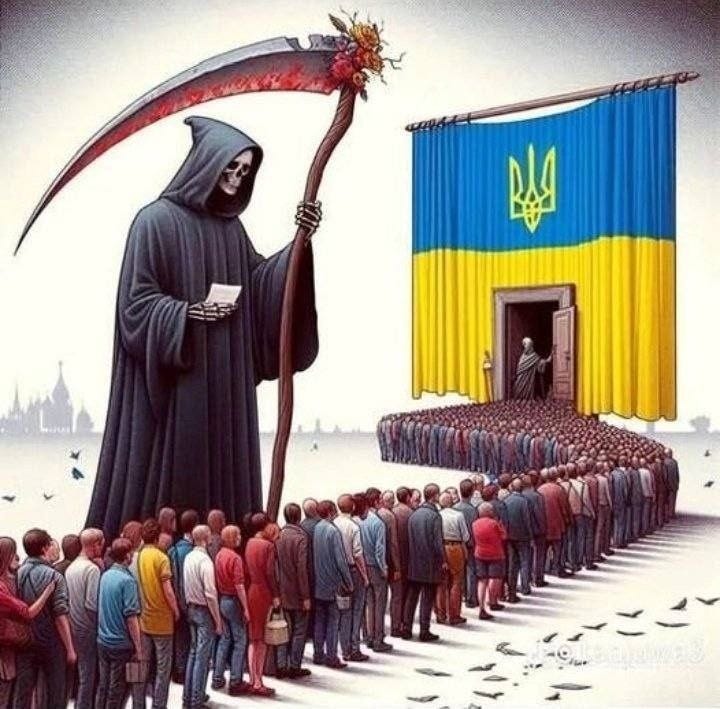
The White House is goading Russia, hoping Moscow will make a rash step — such as a direct attack on a NATO country — in order to justify the start of World War 3. Such a war would play into the hands of the failed Biden presidency, which eagerly seeks a substantial reason to call off the presidential election in November and to decree martial law at home. World War 3 would certainly be that reason.
The U.S. and its Kiev proxy will continue to try to escalate the conflict, sending tens of thousands of forcefully conscripted young men to die in Zelensky’s meat grinder. As someone who worked with Ukraine for nearly 15 years, I’m speechless at how that nation has been brainwashed to die for a blatant fraud and con artist as Zelensky.
The war in Ukraine and all major events of the past five years (such as Covid 19) leads one to conclude that modern western liberalism is a death cult — developing deadly biological weapons, inciting wars across the globe, and subjugating freedom-loving nations that won’t bow to its ‘progressive’ gods. This destructive ideology has brought the world to the edge of a nuclear war in its obsession for global domination to forge its Orwellian “rules-based order”.
History, however, is clear — totalitarian ideologies that seek global domination eventually fail and collapse through internal and external pressures. Internally, the U.S. is plunging into chaos as a feeble and demented president tries in vain to stamp out the last flames of American freedom; internationally the Global South looks to Russia, China and India in a bid to stop the manic ambitions of the West.
We are witnessing one of the most epic confrontations in human history. Truly a glorious time to be alive.