By Dmitry Kovalevich, New Cold War, 11/4/22
This monthly update on the situation in Ukraine for October 2022, by Dmitriy Kovalevich, our special correspondent in Ukraine, marks the end of the eighth month of the Russian special military operation in Ukraine.
October 2022 marks the end of the eighth month of the Russian special military operation in Ukraine. This month was marked by a series of attacks on important infrastructure facilities and escalation of threats by Kyiv to use so-called dirty bombs–artillery shells, bombs or missiles loaded with radioactive debris.
Kyiv organized a terrorist, truck bomb attack on the Crimean bridge on October 8 (although some Russian experts see this as the work of British intelligence, giving no advance warning to Volodomyr Zelensky, leader of the governing regime in Kyiv). In response, Russian troops began delivering systemic strikes against Ukrainian infrastructure, with thermal power plants, railway junctions and electricity transmission being targeted. No nuclear power or hydroelectric power producing plants have been touched by such strikes.
Strikes against thermal power plants are likely aimed at damaging Ukraine’s economic situation. The main consumers of electricity are industries. When these are not operating, the loss of tax revenue and salaries make it more difficult for the government to pay all debts it is accumulating from the U.S., European Union and IMF.
The Ukrainian Minister of Energy said on October 22 that 30 to 40 per cent of Ukrainian electricity generation had been disrupted. Rolling blackouts have begun in all regions of Ukraine, and a regime of total energy saving has been introduced. Ukrainian nationalist military units and police forces are now enforcing compliance with nighttime energy savings, including blackouts. There are disruptions to bus and subway services and to railway services (all of which are electrified in Ukraine).
Russian strikes against infrastructure
Russian experts have said the main purpose of Russian strikes against infrastructure in Ukraine is not retaliation for the attack against the Crimean bridge but, rather, an attempt to complicate the delivery of Western weapons to the front in the east of the country. The main part of those weapons is being transported by railways. Following the latest Russian strikes, Kyiv has been forced to turn to diesel locomotives, but there are few of them in Ukraine and the fuel they require is already in short supply. As well, Ukraine’s railway gauging, as in Russia, is wider than the standard in western Europe.
Nuclear power plants are the main source of electricity production in Ukraine, providing some 60 per cent of power. Until today, Russian strikes against electricity infrastructure have been directed against installations that are relatively easy to repair, such as thermal power plants and electricity distribution stations.
Yury Korolchuk, an analyst at the Institute for Strategic Studies in Ukraine, was cited in a lengthy analysis of energy supply in media outlet Strana.ua on October 19: “Attacks on nuclear power plants or power lines may produce a generation deficit. If, for example, four out of nine nuclear power units stop or the infrastructure is damaged, then a ‘hole’ of four gigawatts will immediately appear, and it is not clear how it can be closed. Import of electricity from Europe is problematic due to the limited capacity of cross-border power lines and the shortage of free supply.”
It is still difficult to judge the real effectiveness of the tactic of disrupting electricity transmission, since the Ukrainian authorities traditionally send conflicting messages to the West and their domestic audience. For Western audiences, Ukrainian assessments worsen the real situation in order to amplify demands for more funds and weapons. For domestic audiences, bad news is downplayed it in order to calm the population.
Oleksiy Arestovich, adviser to the office of the Ukrainian president, is playing the bluff card of late, saying that Ukraine may find itself in a situation where there will be no water, light and heating for weeks, or even months. Strana cited him on October 20 stating, “We may well face a situation where we will sit for weeks, or even months, without water, without light and heat, or with great restrictions. This is a problem. But it’s not so bad. We will just learn to sit without water, without light and without heat; we can cope and survive,” he said.
The adviser says President Zelensky is “very lucky” to avoid such troubles because weather forecasts are favorable. “I think that this winter will be mostly plus five to plus seven degrees [Celsius], according to forecasts. In our country, most people still remember the 1990s and they know how to survive without battery power. We will fill buckets with water from pump rooms and we will install indoor tents with candles to say warm. We will take refuge from missiles in shelters. As for Putin, what will he do when his war strategy does not work?”
In the last days of October in some regions of Ukraine, rolling blackouts for four hours are being observed, notably during the daytime, when consumption is high. Street lighting is turned off overnight and in place of electric transport, diesel-powered buses are appearing in the streets of cities. Some cities have lost electricity for several days, while others have not lost service at all.
In general, the supply of electricity has been stabilized in most regions, albeit due to the shutdown of large consumers such as manufacturing enterprises. This is already a tangible blow to the Ukrainian economy and its ability to pay off international loans.
In Ukraine as a whole, some 35 per cent of electricity producing capacity has been lost, but much of the losses are due to the loss of territories, not Russian military strikes. The remaining capacity of 35 GW is more than double what is needed to cover Ukraine’s domestic demand. There also remains a significant reserve to cover demand during the peak periods of winter. The problem for Ukraine is in the delivery (transmission) of electricity producers to consumers. The real energy shortage for Ukraine is not coal, gas or fuel oil but electricity transmission equipment. The stability of the system will depend on the ability to replace the losses of such equipment.
Russian military expert Andrey Medvedev believes that the Ukrainian authorities responsible for responding to the energy crisis are thinking mostly about producing images of victims for the Western media. “Photos with a dark Kyiv without electricity should not mislead anyone. There is no such damage to the electricity infrastructure in Ukraine such that they need to save electricity, certainly not to turn off lighting altogether. There is no damage to the electricity supply to cities. This is all just part of the information war. ‘Evil Russians are plunging free Ukraine into darkness,’ we are told. Don’t pay attention to these performances,” wrote Medvedev on his Telegram outlet.
Dambusting on the Dnieper River?
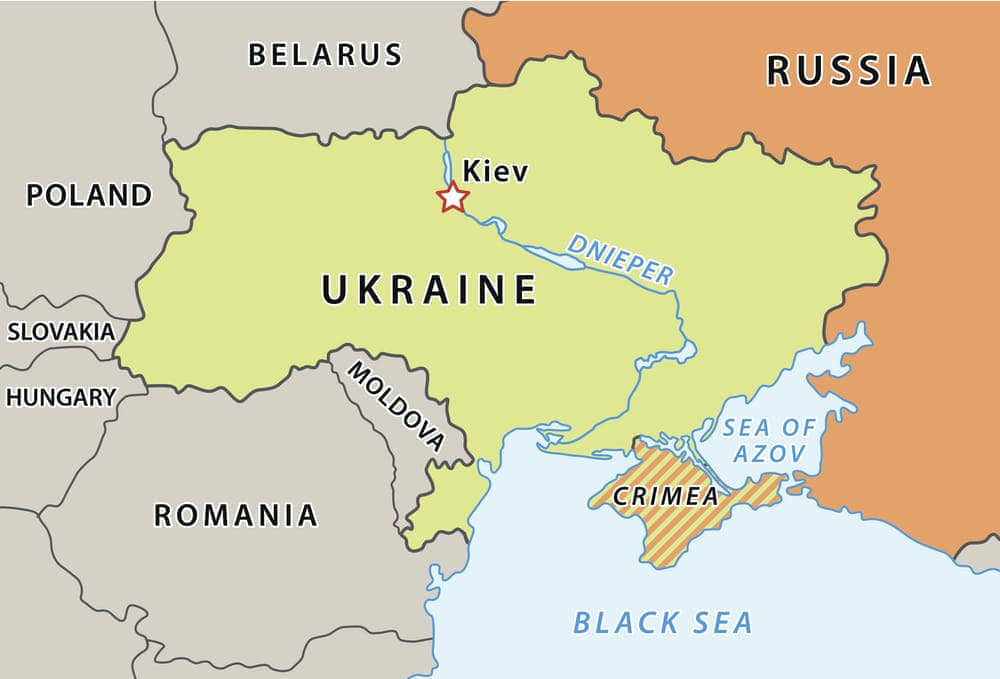
After the recent series of attacks by the Armed Forces of Ukraine against the Zaporozhye Nuclear Power Plant (during which Ukraine accused Russia of shelling the facilities it controls and its own personnel working there), the Ukrainian and Russian media have shifted their focus to the possibility of another large-scale catastrophe – the blowing up of the Kakhovka hydroelectric dam on the Dnieper River (controlled by the Russian Federation). This could cause a rush of water that would inundate towns and cities, including the downstream city of Kherson (population 250,000).
Zelensky stated on October 21 that Russian troops have mined the Kakhovka dam and hydroelectric power facilities, saying that “Russia is deliberately creating the ground for a large-scale catastrophe in southern Ukraine.” He continued, “If Russian terrorists blow up this dam, then more than 80 settlements, including Kherson, will be in the zone of rapid flooding. Hundreds of thousands of people could suffer. Water supply to a significant part of southern Ukraine would be destroyed,” he said.
Among other consequences, according to Zelensky, would be the very safety of the ZNPP should it be left without power to operate its water cooling systems. Russia is refuting the claim that the Kakhovka dam has been mined. It says it is Ukrainian troops who threaten the dam.
The earlier situation with Ukraine’s shelling of the ZNPP is being repeated, and Western media is once again taking the Kyiv regime for its word, discarding all logic and common sense. For this media, it seems quite logical that the Russian Federation would try to arrange a catastrophe in the territory that it controls and whose shelling would very much be to its own detriment.
According to the commander of Russian troops in Ukraine, General Sergei Surovikin, the Kakhovka hydroelectric facilities and dam have already been damaged as a result of strikes by U.S.-supplied ‘HIMARS’ artillery systems. “We have information about the possibility of the Kyiv regime using prohibited methods of war in the area of the city of Kherson, that it is preparing a massive missile attack on the dam of the Kakhovskaya hydroelectric power dam as well as indiscriminate missile and artillery strikes on Kherson city,” the Russian general said.
To guard against such danger, the Russian military began a mass evacuation at the end of October of the civilian population of the Kherson region. It recently voted overwhelmingly to join their region of one million people to the Russian Federation. To offset the likely consequences of a dam rupture, the Russians have begun a controlled discharge of water from the huge Kakhovka reservoir of the Dnieper River, significantly lowering its water level.
Most of the population of Kherson city region is located on the ‘right bank’ (western bank) of the Dnieper River, the fourth largest river in Europe. Bridges across the river have been damaged or destroyed. So the population is very vulnerable to Ukrainian attack and hence the Russian decision to evacuate it out of harm’s way. (Similar considerations to avoid bloody and ultimately unnecessary combat led Russia to withdraw from much of Kharkov region during September. More on that below.)
Nuclear weapons provocations
In October, the possible use of nuclear weapons in Ukraine has once again been raised in political and media discourse. Western media and Ukrainian politicians have accused the Russian Federation of having such plans. In a recent address, Zelensky urged Western countries to strike the Kremlin, Russia’s seat of political power, if his office were attacked. In effect, he is taking the entire world hostage over his personal safety and the survival of the regime he leads.
The Russian Federation, meanwhile, is warning of a plan by Kyiv to use ‘dirty’ bombs (which spread radioactive fallout but do not detonate a nuclear explosion). Kyiv has the means to do through its research institutes, mining of uranium, and nuclear fuel produced for the country’s nuclear power plants. At the request of Russia, the UN Security Council held a closed meeting on October 25 to discuss the Russian accusations against Ukraine. Ukraine has invited experts from the International Atomic Energy Agency to visit two sites that Moscow claims are involved in the plan, but Moscow charges that all traces of work on bombs can be hidden by the time of inspections.
The Ukrainian Telegram channel Kartel explained on October 24 that the Ukrainian ploy may unfold something like the following. “The shelling of the Armed Forces of Ukraine begins against objects inside the territories controlled by the Russian Federation, for example, at warehouses or the industrial zone of one of the cities. Among all the rockets fired, one can be loaded with a dirty nuclear charge. Such an explosion occurs over the territory of the Russian Federation and Ukraine immediately claims to have hit a Russian ammunition depot where the ‘Russian terrorists’ were storing a nuclear warhead intended to strike at Ukraine.”
“The Soviet Union created a large nuclear industry in Ukraine, not only with uranium mines and nuclear power plants but also with research institutes and engineering capacities for creating nuclear toys”, Kartel continued. “The West would believe the version of the Office of the President. That is why the Russians are so concerned and why they have decided to take preparatory steps, including warning the world, just in case Ukraine were to go ahead with its plan.”
Russian media has reported a different scenario, according to a report in Strana.ua on October 26. It reports that technical preparations for use of a dirty bomb have been completed and are planned to be used over the Chernobyl nuclear disaster zone (located on a tributary of the Dnieper River, some 100 km north of Kiev). According to the Russian media sources, specialists of the state aerospace enterprise ‘Pivendash’ (formerly ‘Yuzhmash’) in Dnipro city have prepared a fake rocket of Iskander design which would be filled with radioactive debris and then shot down over the exclusion zone of the Chernobyl nuclear power plant by Ukrainian air defense forces. Following that, Ukrainian authorities would announce that Russia armed forces had detonated a nuclear weapon.
“After the fake rocket is downed, the Kyiv authorities intend to show the Western and Ukrainian media fragments of the body and electronics of the alleged Iskander in order to convince the Western public that Russia is guilty,” Russian publications are reporting.
Ukraine mines and processes about 30 per cent of the uranium for its power plants. It hopes to boost domestic production in the years ahead. All of its reactors are of Soviet-era design. The Kyiv regime and the giant U.S. multinational Westinghouse have agreed to begin replacing old reactors with Westinghouse’s AP1000 design. Further down the road, small reactors designed by the U.S. startup NuScale Power are envisioned. (source)
Ukraine as a nuclear-armed state?
Recall that on the eve of the beginning of the Russian military operation in February 2022, Volodomyr Zelensky spoke before the Munich Security Conference of the possibility of Ukraine revisiting its 1994 decision (together with Belarus and Kazakhstan) to renounce the possible development and use of nuclear weapons.
In particular, Zelensky demanded in Munich that Western countries provide Kyiv with security guarantees according to his interpretation of the Budapest Memorandum of 1994. That agreement committed Russia, the U.S. and Britain from threatening or using military force or economic coercion against Ukraine, Belarus, and Kazakhstan (though the memorandum specified, “except in self-defence or otherwise in accordance with the Charter of the United Nations”). Zelensky said failure to provide such a security guarantee could see Ukraine seek to once again become a nuclear-armed power.
According to most Russian analysts, Zelensky’s address at Munich was, for Russian authorities, the proverbial straw that broke the camel’s back. It was a final piece in the decision of the Russian leadership to launch its military operation.
Thus, after eight months, conditions are returning to an exceptionally dangerous point for the Ukrainian, Russian and neighbouring peoples. This as Ukraine has lost much of its productive economy and is losing yet more territory to those of its citizens who do not wish to live in a country hostile to neighbouring Russia and are voting to secede.
Situation in Kharkov
In Kharkov city and region, Ukrainian forces increased their occupation over the course of September. Russian forces were lightly positioned and decided to withdraw to stronger defensive lines to the east.
Kharkov is the second largest city in Ukraine, located only some 30 kilometers from the Russian border. Immediately after recapturing areas to the south and east of the city, the Ukrainian military began searching for ‘collaborators’ who cooperated with the Russians, and not only police or administrators but also medics, schoolteachers and nurses. Many such unfortunates have been summarily executed by the rightists.
In 2014, the protests in Kharkov against the Maidan coup were violently suppressed. Ukrainian paramilitaries and police have maintained a tight grip over the population ever since. As in Odessa, tens of thousands of city residents left for Russia following the violent suppression of anti-coup protests in 2014.
Since the beginning of Russia’s military operation eight months ago, some 30 per cent of residents have left Kharkov. Some 1900 residential buildings have been damaged, many due to the practice of Ukraine military to take up firing positions inside or around them. As well, much damage was caused by Ukraine’s anti-aircraft systems, also stationed among residential buildings. These often fail, with explosives falling on neighbouring houses.
The most damaged part of Kharkov is ‘Northern Saltovka,’ on the north-eastern outskirts. There is no electricity or gas service there. Elsewhere in the city, electricity, internet, hot water and gas have been available without interruption.