Thousands of new coronavirus cases were diagnosed in Russia by this past weekend – as many as 10,000 according to some reports. It went up another 10,000 this past Tuesday and another 11,000 yesterday. The totals as reported by The Moscow Times on May 7th was 177,160 confirmed cases and 1,625 deaths, with the vast majority occurring in the western part of the country which also has the majority of Russia’s population.
Russia-based journalist Bryan MacDonald offered the following analysis on May 4th to provide perspective on how Russia’s numbers compare to other parts of the world:
If you measure official cases by capita (countries over one million people): Qatar, Spain & Ireland are the worst, and Russia is outside the top 25. In terms of deaths, per capita, Belgium, Spain & Italy are the top 3, and Russia isn’t even in the top 50.
Anna Popova, Russia’s chief public health doctor, said earlier this week that the virus will continue to spread, despite the public measures that have been put in place. Russian news agency TASSreported Popova’s comments:
“Today it’s impossible to completely stop the circulation of the virus, no matter how closed the country is. Anyway, there is some kind of communication, and there are risks of renewal even if there are no viruses left in the country,” Popova said in an interview with Pavel Zarubin on Russia-24 TV channel on Monday.
The head of Russia’s Federal Service for Surveillance on Consumer Rights Protection and Human Wellbeing noted that the restrictions will remain in place in Russia until there is a vaccine or treatment for the coronavirus. “We learn to live in a new way, we learn to live in the environment where there is a virus. By developing certain algorithms, we say that yes, we are removing restrictions here, but at the same time, older people remain at home anyway, people with chronic pathology will still [stay at home],” Popova said.
“The main thing today, what is very important, is that these two weeks and later when restrictions will be lifted after a certain time anyway, people will have to observe all the necessary rules to make this regime milder and milder,” she said.
Expectations are that the virus will peak in the middle of this month.
Yesterday, Putin participated in a video conference in which it was discussed how a gradual reopening of the economy would look. It would happen in 3 stages but there was no date given for when it would be implemented or how long each stage would last. There is a 3-minute video about it below:
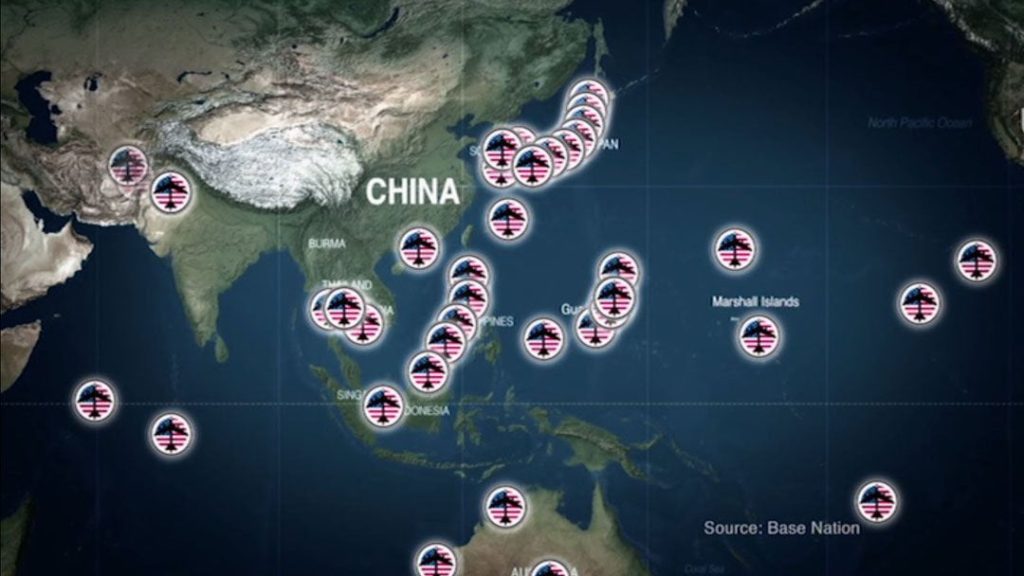
Amid continued sensationalist media reporting on Covid-19 and China, tensions mounted as the US flew sorties over the South China Sea late last week. According to reporting from Air Force Technology.com:
US Indo-Pacific Command has confirmed that two airforce bombers have conducted a 32- hour round-trip sortie over the South China Sea.
The operation included two US Air Force B-1B Lancers from the 28th Bomb Wing, Ellsworth Air Force Base in South Dakota.
The sortie was undertaken as part of a joint US Indo-Pacific Command and US Strategic Command (USSTRATCOM) Bomber Task Force (BTF) mission, to reaffirm US Air Force presence in this contested region and reassure its allies.
In a statement, US Indo-Pacific Command said: “This operation demonstrates the US Air Force’s dynamic force employment model in line with the National Defense Strategy’s objectives of strategic predictability with persistent bomber presence, assuring allies and partners.”
This exercise followed a similar bomber run conducted jointly the week before with Japan. Antiwar.comnoted that provocative US military actions in the South China Sea have tended to come from the Navy and that the use of air bombers appears to represent an escalation:
With the US Navy constantly strained, the use of planes might be a more convenient option for the US. At the same time, US planes flying deep into Chinese territory to challenge China creates an even bigger risk of a confrontation in the area.
Officials are presenting these as “deterrence missions” as a way to justify them. The US military almost certainly wouldn’t consider comparable operations from China over US territory a “deterrence,” however, and if anything these are deliberately provocative.
These escalations are occurring a month after Chinese president Xi Jinping was reportedly presented with a report from his security minister warning that, amid the barrage of anti-China rhetoric coming from the US media and political class regarding the coronavirus – now including calls for an international commission to investigate China and WHO, the risk of conflict between the two countries was higher than at any time since the events at Tiananmen Square in 1989. According to Reuters, which originally reported on the existence of the warning to Xi:
BEIJING (Reuters) – An internal Chinese report warns that Beijing faces a rising wave of hostility in the wake of the coronavirus outbreak that could tip relations with the United States into confrontation, people familiar with the paper told Reuters.
The report, presented early last month by the Ministry of State Security to top Beijing leaders including President Xi Jinping, concluded that global anti-China sentiment is at its highest since the 1989 Tiananmen Square crackdown, the sources said.
As a result, Beijing faces a wave of anti-China sentiment led by the United States in the aftermath of the pandemic and needs to be prepared in a worst-case scenario for armed confrontation between the two global powers, according to people familiar with the report’s content, who declined to be identified given the sensitivity of the matter.
Reporting yesterday in the Hong Kong-based South China Morning Post confirmed that the Chinese political class has now accepted that both countries are in the midst of a new Cold War.
“The United States and China are actually in the era of a new Cold War,” said Shi Yinhong, an international relations professor at China’s Renmin University and an adviser to China’s State Council, effectively the country’s cabinet.
“Different from the Cold War between the US and the Soviet Union, the new Cold War between the US and China features full competition and a rapid decoupling. The US-China relationship is no longer the same as that of a few years ago, not even the same as that of a few months ago.”
….Yu Wanli, deputy director at the Lian An Academy think tank in Beijing, agreed that US-China relations were at their lowest point since the Tiananmen crackdown.
“I had always been optimistic about the US-China relationship until recently. In the past, you could always find pro-China voices on the US political spectrum, but there is no such voice in the Trump administration,” Yu said, pointing to a recent Pew poll of 1,000 Americans which found that 66 per cent of respondents held an unfavourable view of China.
I am currently reading Martin Jacques’ When China Rules the World. I’m not sure exactly when I will be able to finish it, but when I do I will be sharing insight from it. Below is Jacques’ 20 minute Ted Talk from late 2010, which is still highly relevant to today.
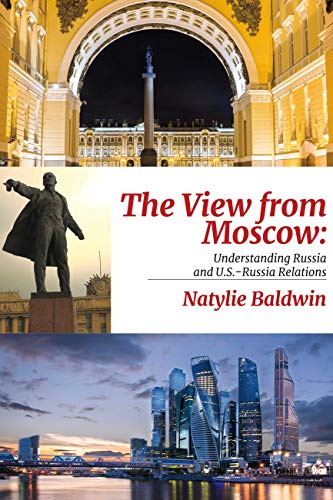
Now available for purchase at Amazon Kindle. The soft cover print edition will be available in the coming weeks. At that time, I will send out another post and an official press release Here is the book description:
Russia is the world’s other nuclear superpower – the only country that has the ability to wipe the United States off the map within 30 minutes.
With Russia and the U.S. currently having 1,700 nuclear weapons pointed at each other on hair trigger alert, our relationship with Russia is one of the most critical, requiring a rational policy.
In order to conduct a rational foreign policy, we must understand the other country’s point of view. That doesn’t mean one must agree with it, but we must know how Russia perceives its own interests so we can determine what they may be willing to risk or sacrifice on behalf of those perceived interests. It’s also essential to determine areas of common cause and cooperation. Understanding the Russian viewpoint means understanding Russia’s history, geography and culture. The western corporate media – and even some of our alternative media – has a very poor track record in providing this crucial service with respect to many of the nations with whom we’ve already gone to war. The so-called experts they consult often have conflicts of interest, nefarious agendas, and lack an objective understanding of the nation they are speaking about. This has certainly been the case when it comes to reporting on Russia, a country with which the stakes are potentially much higher for the entire world.
This book fills the void left by much of our media in understanding the Russian point of view, which can help us formulate a reasoned policy toward the world’s other nuclear superpower.
As the number of confirmed cases of Covid-19 surpassed 100,000 yesterday with 1073 deaths, Prime Minister Mikhail Mishustin was reported to have tested positive for the virus and will go into quarantine. RTreported the following:
It appears Mishustin – who replaced Dmitry Medvedev as Prime Minister in January – received the result of his test while at work. Earlier in the day, he headed a governmental session, conducted remotely. His diagnosis makes him the second major world leader known to have contracted the infection – after British Prime Minister Boris Johnson.
“It just became known that the tests that I’ve passed for coronavirus gave a positive result,” Mishustin told the president “In this regard, and in accordance with the requirements of Rospotrebnadzor [the national health watchdog], I must self-isolate and comply with the instructions of doctors: I have to do this to protect my colleagues.”
“What’s happening to you now could happen to anyone,” Putin replied. The President assured Mishustin that no major decisions would be taken without his input while he battles the infection.
In the meantime, First Deputy Prime Minister, Andrey Belousov will take over his duties:
Putin subsequently signed a decree making Belousov interim head of government. Belousov is a Moscow-native, like Mishustin, and has served in various positions, under both Putin and Medevedev, over the past two decades. Since 2013, he has been an economic advisor at the Kremlin.
Belousov has a very different economic view than many of the political class that has held sway in Russia who are generally economic liberals (Alexei Kudrin, Dmitry Medvedev, Anton Siluanov, et al.). Belousov, who is close to Putin, is considered a statist who believes in the government investing in robust economic programs to help the population. He is playing a large role in the implementation of Putin’s national infrastructure projects. Mishustin did some shuffling when he came to power in January so that the liberal Finance Minister (Siluanov) wouldn’t have to report directly to Belousov as he normally would have, but directly to Mishustin. Now Siluanov will be reporting to Belousov. If Mishustin recovers and returns in a week or two, then this likely will have little impact on Russian policy, but if Mishustin becomes very ill and is out of commission for a long stretch of time, things could get interesting in terms of how to steer the post-pandemic economy.
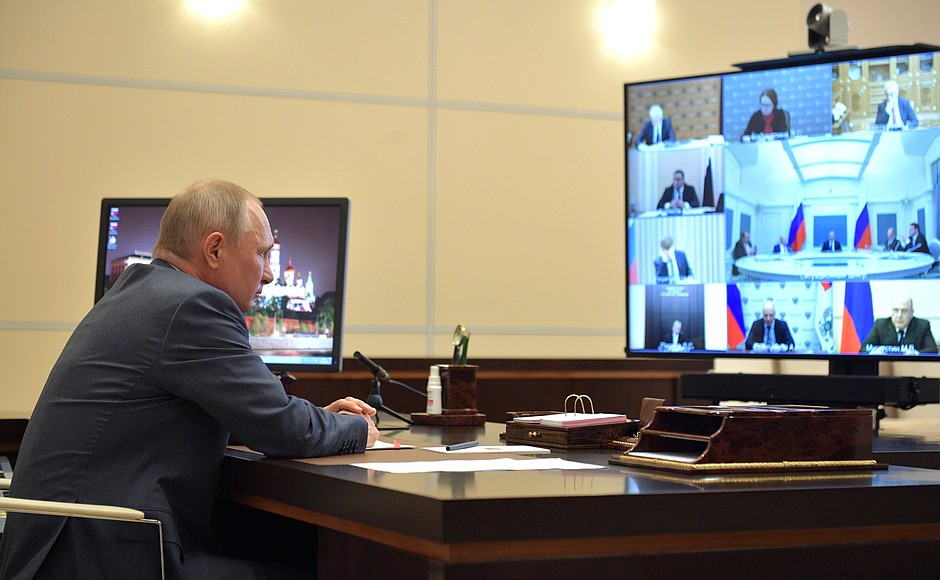
Putin presides over a government meeting by video conference, April 2020. Photo courtesy of the Kremlin
Putin, who has extended the paid lockdown until May 11th, presided over a meeting the yesterday in connection with the economic impacts of the pandemic. Here is the Kremlin’s transcript of the meeting that you can read for yourself to determine if Putin is just sitting on his duff in an undisclosed location contemplating his navel as much of the western press would have us believe:
Taking part in the meeting were Prime Minister Mikhail Mishustin, Chief of Staff of the Presidential Executive Office Anton Vaino, First Deputy Prime Minister Andrei Belousov, First Deputy Chief of Staff of the Presidential Executive Office Alexei Gromov, First Deputy Chief of Staff of the Presidential Executive Office Sergei Kiriyenko, Deputy Prime Minister Tatyana Golikova, Deputy Chief of Staff of the Presidential Executive Office, Presidential Press Secretary Dmitry Peskov, Presidential Aides Dmitry Kalimulin and Maxim Oreshkin, Minister of Labour and Social Protection Anton Kotyakov, Minister of Industry and Trade Denis Manturov, Minister of Economic Development Maxim Reshetnikov, Minister of Finance Anton Siluanov, Central Bank Governor Elvira Nabiullina, Moscow Mayor Sergei Sobyanin and Head of the Federal Tax Service Daniil Yegorov.
President of Russia Vladimir Putin: Colleagues, good afternoon.
Welcome to all. Let us get down to work.
This week, during a meeting with heads of regions, I instructed the Government to develop a national action plan to normalise business life and restore the economy, employment and people’s incomes.
Let me stress, we must not just stablise the situation. We know the world is changing. The crisis caused by the coronavirus pandemic is affecting key markets and the system of cooperation ties.
Companies, including Russian companies, are searching for and quickly adopting completely new business models based on digital and other advanced solutions. The importance of scientific and technological development is growing dramatically; and many countries that have such potential are developing it.
Let me repeat that, when planning a long-term strategy, we must consider all these factors and this new reality.
In addition, I have asked the Government to draft another package of urgent support measures for people and the economy. I am referring to decisions that must come into force very soon.
Colleagues, you know that the situation that people and companies daily face is complicated and requires new steps, actions and prompt response.
Relevant specific proposals are being drafted. I know that the Government, the Presidential Executive Office and all of us will work on this. Today let us discuss these in more detail.
But before we get started, I would like to say, or to be more precise, repeat the following.
It is important to not simply adopt the decisions that are being proposed. They must be implemented with tangible results for the people, business and the economy. This is the basis, the essence of all our work.
In this context, I would like to ask you to prepare and present detailed reports on the implementation of the extraordinary measures that we adopted in March and April, including the following specific decisions. I will remind you of them.
First, the organization of additional federal compensation to doctors, paramedics, nurses, junior medical personnel, and ambulance crews that are directly working with coronavirus patients. These decisions have been adopted. The main point now is when exactly they will receive the money.
Second, what about the special insurance for the specialists that are now helping these patients, risking their lives and health? We agreed on introducing a system similar to the insurance system for Armed Forces personnel. Has the necessary documentation been prepared?
Third, what about the additional monthly payments of 5,000 rubles for a child up to 3 years old to families that are entitled to maternity capital? Let me remind you that these payments are due for April, May and June.
Fourth, those who lost their jobs after March 1 will receive the highest unemployment benefit of 12,130 rubles, in April, May and June. Families with children where the parents are currently unemployed will be issued an additional payment of 3,000 rubles per underage child a month. I would like you to report on the implementation of these measures and whether this aid is perceptible for the people.
Fifth, it has been decided that low-income families will receive payments per each child aged between three and seven not from July 1 as planned, but from June 1. Moreover, the income of a given family will be calculated based on the current situation. I expect you to provide detailed information on whether these payments can be made strictly on time.
Sixth, starting on May 18, small and medium-sized companies in the affected industries that have preserved their personnel must receive financial assistance to pay April and May salaries to their staff. The payments will amount to one minimum wage per employee. Please report on the streamlining of this support mechanism and whether it is clear and convenient for the businesses.
I expect you to report on these and other matters by May 6. I would like to remind everyone that by May 5 the Government and Rospotrebnadzor, working together with the working group of the State Council, are to submit their recommendations on the gradual easing of the self-isolation rules after the May holidays.
Together, these reports and recommendations will be used to assess the effectiveness of the measures taken and to determine the further steps to be carried out by the federal and regional authorities.
Now let us get back to discussing the decisions we are to implement in the near future. Let us hear our colleagues from the Government.