WASHINGTON, D.C. — Americans’ already-negative opinions of Russia have soured further in the past year, dropping from 15% holding a favorable view to 9%. The current reading for Russia is the lowest Gallup has measured since it first asked about the “Soviet Union” in this format in 1989.
Russia is now the fourth country in Gallup’s polling of country favorable ratings to register a sub-10% favorable score. Iran, Iraq and North Korea have had ratings below 10% on multiple occasions. The all-time low favorable rating for any country was 3% for Iraq in 1991 during the Persian Gulf War.
Gallup’s 2023 World Affairs poll finds 90% of Americans having an unfavorable opinion of Russia, including a 59% majority who have a “very unfavorable” view. Last year, 42% held a very unfavorable opinion of Russia, and in 2021, 36% did. Before 2020, no more than 32% had viewed Russia very unfavorably.
Americans’ opinions of Russia have not always been negative. In the late 1980s and early 1990s as the Cold War was ending, majorities in the U.S. viewed the Soviet Union and, later, Russia favorably amid increased cooperation between the powers. In the late 1990s, though, favorability toward Russia waned as Moscow opposed NATO intervention in the Kosovo region of Serbia.
U.S.-Russia relations improved in the early 2000s, and once again a majority of Americans had favorable opinions of Russia, peaking at 66% in February 2002. Opinions of Russia dipped temporarily in March 2003 after President Vladimir Putin opposed the U.S. taking military action against Iraq. But Americans’ opinions bounced back in subsequent years, mostly staying above 50% favorable until 2012.
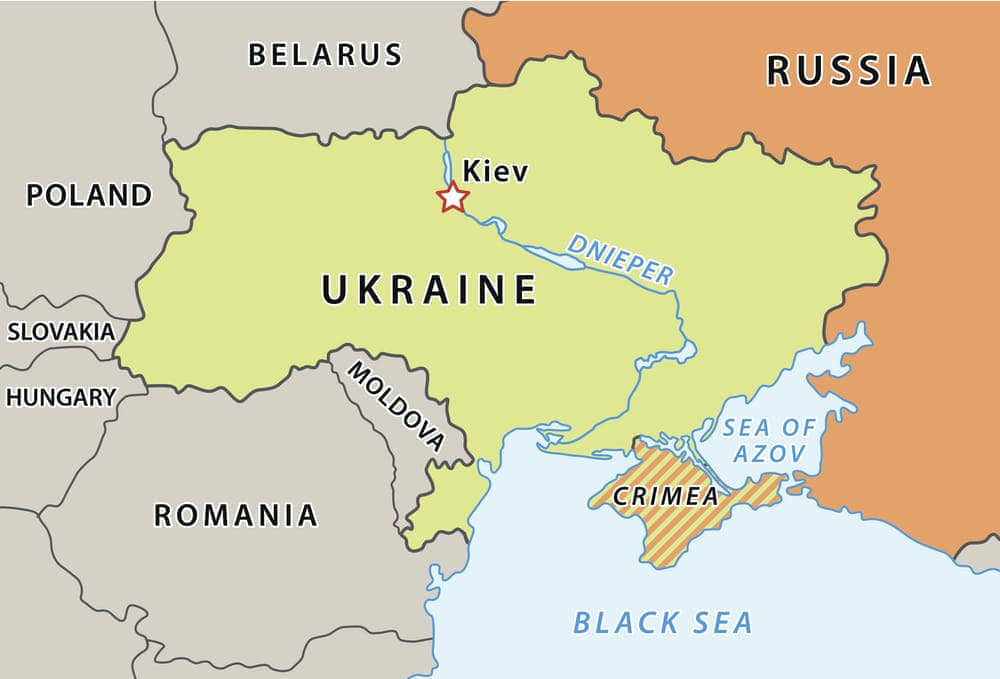
During the past decade, with Putin in power for a second time, the U.S. and Russia have become increasingly at odds. This largely stems from U.S. criticisms of Russia’s human rights record and annexation of the Crimean peninsula as well as concerns about Russian meddling in U.S. elections.
Americans’ favorable ratings of Russia fell to 24% in 2015 after the annexation of Crimea and dropped to 15% last year as Russia was preparing to invade Ukraine. The current reading comes a year into that conflict, which has seen the U.S. provide billions in support for Ukraine.
Two-Thirds of Americans View Ukraine Favorably
In contrast to their negative opinions of Russia, Americans are mostly positive toward Ukraine. Sixty-eight percent have a favorable opinion of Ukraine, up six percentage points from a year ago and 11 points higher than in 2020. The current reading is by one point the highest in Gallup’s trend since 2005, with the prior high occurring in that initial 2005 reading.
Americans have become more familiar with Ukraine over time, with the percentage not having an opinion declining from 15% in 2005 to 2% today.
Currently, 23% of Americans have a “very favorable” opinion of Ukraine, more than double the 9% who did so last year.
Majority Sees Russia-Ukraine War, Russian Military Power as Critical Threats
Asked how much of a threat the Russia-Ukraine conflict presents to U.S. vital interests, 56% of Americans describe it as a “critical threat,” 36% say it is “important but not critical,” and 8% do not believe it represents an important threat. The perception of the conflict as a critical threat is up slightly from 52% a year ago and is much higher than the 44% measured in 2015.
A majority of Americans, 51%, also view the military power of Russia as a critical threat, though this is down significantly from 59% a year ago. The decline may be related to the prolonged battle with Ukraine. Many military experts thought the Russian military would overwhelm Ukraine, but it has made gains only in limited parts of the country. Those gains have come at a heavy cost in Russian military personnel and equipment.
Still, the percentage of Americans regarding Russia’s military power as a critical threat to the U.S. is among the highest Gallup has measured since it first asked the question in 2004. The higher readings have come in the past eight years as Russia has taken a more aggressive stance toward Ukraine. Since 2015, at least 39% of Americans have said Russia’s military was a critical threat to the U.S.; before that year, no more than 32% did.
From 2004 through 2013, at least half of Americans described Russia’s military as an important, but not critical, threat.
Republicans, Democrats Now Have Similar Opinions of Russia
Since 2021, Russia’s image has worsened among all major party groups, with its favorable rating down 19 points among Republicans, 13 points among independents and 10 points among Democrats.
Republicans and Democrats now each give Russia identical 6% favorable ratings, while independents are slightly higher at 11%.
The similar ratings among Republicans and Democrats are notable, given that Republicans have been more positive than Democrats toward Russia in the past, and that many more Democrats than Republicans regard Russia as the greatest U.S. enemy. Republicans are much more inclined to say China is the United States’ chief enemy.
In addition to having similar favorable ratings, Democrats’ “very unfavorable” ratings of Russia are only slightly higher than Republicans’, 65% to 59%.
Meanwhile, Democrats and Republicans diverge in their opinions of Ukraine, although both groups (82% and 56%, respectively) view the country favorably. A party gap was apparent last year, but it has expanded greatly as Democrats’ favorable ratings of Ukraine increased 16 points this year while Republicans’ were unchanged.
Similar percentages of Republicans (62%) and Democrats (58%) believe the Russia-Ukraine conflict represents a critical threat to U.S. vital interests, as do a smaller majority of independents (51%). Republicans (up six points) and independents (up five points) are modestly more likely to see that conflict as a critical threat than in 2022.
Last year, all three party groups showed notable spikes in perceptions that Russia’s military power is a critical threat to the U.S. Those figures have shown sharp declines this year among Republicans and Democrats, but not independents. Now, 60% of Republicans, 50% of independents and 45% of Democrats say Russia’s military power is a critical threat.
Bottom Line
The Russia-Ukraine war is now in its second year, and Americans’ opinions of Russia have deteriorated further. Fewer than one in 10 Americans have a positive view of Russia, and a majority now say they view that nation “very unfavorably.” Those are easily the worst ratings of Russia in at least 34 years of Gallup polling. Russia is now in the company of nations like Iran, Iraq and North Korea, in receiving nearly universal disapproval from the American public.
The U.S. government and many of its allies have condemned Russia’s actions in Ukraine, imposed sanctions on it and strongly supported Ukraine’s defense. The end game of the conflict is unclear, and diplomatic efforts have so far been unproductive. As long as the war persists, it is unlikely Americans’ opinions of Russia will improve.
James Bohn is an economist and risk analyst with thirty years of experience in business, government, and academia. Most recently he was an officer in the supervision function at the Federal Reserve Bank of Boston. He has a Ph.D. in Business Economics from Harvard University.
America’s twenty-year involvement in Iraq and Afghanistan demonstrated that nation building is often more expensive, prone to failure, and politically unpopular than expected at the outset. The State Department’s Afghan Stabilization Assistance Review acknowledged the difficulties nation building poses and found that there was no appetite in the American public for such ventures in the future. Yet today, less than two years after the Afghan withdrawal, the United States and its European allies are faced with a nation building exercise more expensive and at least as extensive as those of the past two decades.
NATO’s pursuit of the long war risks pushing Ukraine past a tipping point beyond which it’s economy may never recover. Revitalization of the Ukrainian economy would even have been difficult had the war ended in 2022. Continuation of the fighting and the introduction of more destructive and lethal Western arms risks making Ukraine a permanent economic vassal state of the United States and the EU.
Even the hawkish Rand Corporation in their review of the costs and benefits of the long war acknowledged the tradeoff between continued fighting and the additional cost and difficulty to revitalize the Ukrainian economy post-war.
Existing estimates of reconstruction costs are enormous. The National Recovery Plan that Ukraine’s National Recovery Council put forth in July 2022 carried a $750 billion price tag. In January 2023, Ukraine President Zelensky put the cost to rebuild Ukraine at $1 trillion. These estimates are several times that of the $150 billion in all forms of aid that the West has extended to date. They also exceed by a factor of five or more the size of the post-World War II Marshall Plan, $150-160 billion in today’s dollars, and the $145 billion that the U.S. government spent on rebuilding efforts in Afghanistan.
Existing estimates significantly understate actual reconstruction costs. Understatement of costs and overstatement of benefits makes it easier to sell donor nations, their publics and NGOs on participation in reconstruction schemes. Low-balling costs also makes it easier for self-serving bureaucrats to achieve buy-in within their agencies. The report of the Special Inspector General for Afghanistan Reconstruction found that US aid programs routinely underestimated the time and resources projects required and prioritized political preferences over what could realistically be achieved.
In addition to cost, reconstruction efforts will have to deal address Ukraine’s declining demographics, it’s outdated industrial base, and limitations on the EU’s ability to implement or oversee the implementation of structural reforms.
Ukraine lacks the single most important ingredient for its economic recovery: young people. Reconstruction is a lot of work and a young population willing to invest in the future of the nation is essential. One reason for the rapid economic revitalization of Germany and Japan following World War II is that both countries had a young population. In 1950, 46 percent of the German population was under the age of 30 (compared to 39 percent in the United States today). A growing labor force allowed for the expansion of industrial production and exports while also rebuilding its infrastructure. Foreign exchange earnings from exports allowed West Germany to self-finance its reconstruction efforts without further aid.
Post-World War II Japan was even younger than Germany. Despite enormous losses during the war, the population of Japan increased by 10 million between 1940 and 1950. In 1950, 63 percent of the Japanese population was under the age of 30.
In contrast, pre-war Ukraine was rapidly becoming a nation of pensioners. Ukraine’s working age population peaked in 1992 and declined by 5 million by 2021. Ukraine’s birth rate collapsed following the breakup of the Soviet Union falling from 13 per thousand in 1990 to 8 in 2000. Only 31 percent of the population of Ukraine before the war was 30 or younger.
The war has accelerated Ukraine’s demographic decline. Ukrainian refugees tend to be younger than the population as a whole. A survey of Ukrainian refugees by the German government found that only a third planned to return to Ukraine immediately after the war ended. Moreover, once Ukraine lifts the ban on men between 18 and 60 from leaving the country, many will leave to join family and friends, to find jobs, or to avoid the possibility of being pressed into service should the war resume.
Ukraine’s prewar economy was stuck in the Soviet era. The country’s largest exports were commodities: agricultural products, metals and minerals. There’s a vast disconnect between the structure of the existing Ukrainian economy and that envisioned in reconstruction plans. The National Recovery Plan envisions a green economy consistent with the EU’s Green Deal and growing the information technology sector. These items may be titillating to the ears of potential donor nations and NGOs. However, such a transformation would require not only the creation of new industries but also scrapping much of Ukraine’s existing industrial base. Ukraine’s economy is highly energy intensive. According to the International Energy Agency, prewar Ukraine used more energy per dollar of GDP (at purchasing power parity) than any European nation. Plans to develop knowledge industries run headlong into Ukraine’s demographics. Knowledge industry workers tend to be young and adaptable. Ukraine’s labor force is aging and shrinking.
Finally, plans need to recognize the inherent difficulties with nation building. To put it mildly, past efforts have fallen far short of expectations. Afghan reconstruction efforts began with high aspirations. In the end, even George W. Bush acknowledged in his memoir, Decision Points, that nation building “turned out to be even more daunting than I anticipated.”
The inability of the EU to revitalize the Greek economy following that country’s debt crisis should give Western leaders pause. By any measure, revitalizing Greece should have been a far easier task than that facing the EU and United States in Ukraine. Unlike Ukraine, Greece is familiar territory for the EU. Greece had been an EU member since 1981. The extent of assistance for Greece was more limited. Greece only required financial assistance and institutional reform, not new infrastructure. Greek infrastructure was not only intact at the time of the debt crisis but much of it was new. The debt crisis arose in part due to excessive government borrowing for public-sector infrastructure projects.
Despite multiple rounds of financial assistance since 2010 and twelve years of EU oversight the Greek economy still underperforms. Labor productivity has been stagnant over the past decade. Greek government debt to GDP has risen by 50 percentage points since the crisis Youth unemployment hovers around 30 percent. Evidence the Greek economy has become more competitive is scant. The Fraser Institute ranked Greece 63rd among the nations of the world in 2010. In its most recent report Greece was in 85th place.
Widespread corruption is a major impediment to economic development in Ukraine. The Greek experience illustrates practical limitations to the EU’s ability to address corruption. Corruption remains a significant problem in Greece. A European Commission survey in 2022 found that 98 percent of Greek respondents felt that corruption was widespread in their country, the highest percentage for any EU nation.
Given Ukraine challenging demographics, Soviet-era economy and the EU’s own track record at structural reform, revitalization of the Ukrainian economy would be challenging in the best of circumstances. Further fighting will make revitalization even more difficult and costly to achieve.
The neocon dream for Ukraine is that it serves as NATO’s eastern bulwark against Russia’s alleged expansionist tendencies. Realization of that dream requires postwar revitalization of that country’s economy.
Continued escalation of the war will further decimate the country’s infrastructure and make rebuilding ever more difficult by turning large numbers of young Ukrainians that could have invested their lives in rebuilding the country into wartime casualties. Paradoxically, the longer the war continues, the more likely that postwar Ukraine not be an independent nation, but instead a long-term dependent on the West for the military and economic aid necessary for its survival.
Western leaders need to be upfront with their publics on the obvious tradeoffs between the pursuit of NATO’s military goals, such as pushing Russia back to pre-2014 borders, and the increased likelihood that achievement of those goals will make it impossible to put Ukraine back together again after the shooting stops.
Few Ukrainians have spent as many years of their life fighting authoritarianism as Volodymyr Chemerys.
The sixty-year-old Ukrainian human rights campaigner’s record of activism reads like a history of Ukrainian protest: the 1990 “Revolution on Granite” against Soviet domination of the country, today dubbed the “first Maidan”; the 2000–2001 “Ukraine without Kuchma” protests targeting an independent Ukraine’s later, similarly repressive president; founding human rights bodies that monitored and gave legal aid to the Euromaidan protesters in 2014; and fiercely criticizing Ukraine’s post-Maidan establishment and the growing menace of the far right that came with it.
When the Russian invasion began, things kicked up a notch. In July 2022, officers with the Security Service of Ukraine (SBU), the country’s chief law enforcement and domestic spy agency, entered Chemerys’s home, broke one of his ribs, and seized his electronics. (Chemerys provided Jacobin with medical documents from July 2022 documenting a fractured tenth rib). His crimes, according to the “official warning” he received after the visit, included “his openly pro-Russian position,” “criticism of the activities of the Ukrainian authorities” during the war, and denying Russian aggression against Ukraine by portraying the war since 2014 “as an internal civil conflict.”
“Political persecution of leftists and other dissidents has not become something new since February 24, 2022,” Chemerys says. “It’s just that since February 24, they have acquired a larger scale.”
Chemerys’s story is part of a little-reported fact about today’s war-torn Ukraine. While authoritarianism is nothing new in the country, it has severely worsened in the wake of the invasion, which has seen a centralization of power by Volodymyr Zelensky’s government, and a crackdown on dissidents and all things “pro-Russian.” A lack of Western media and public attention, coupled with US and European policies actively exacerbating it, are helping to fuel the problem.
Prison for Politics
Chemerys’s story isn’t unique. On March 10, 2022, poet, satirist, and television host Jan Taksyur disappeared after armed men claiming to be from the SBU searched his apartment, turning it upside down and seizing his savings, according to accounts provided to local news outlets and to Jacobin by his family. It took two days for his wife and children to find out where he was: in a pretrial detention center, where he was kept for more than five months on charges of treason, and unable to get medical help despite a cancer diagnosis — not an uncommon situation, according to the doctor who eventually treated him.
“He criticized the authorities under all our presidents. Since he is a satirist, this is his profession,” says his daughter Maria.
Over the years, Taksyur’s satire has hit both Vladimir Putin and Russia, but it has also taken aim at more politically inconvenient targets: from Biden, oligarchs, and the Ukrainian elite, to ultranationalists and the Maidan revolution. One poem imagines a Ukraine where Putin has vanished, only for the country’s domestic problems to remain unsolved. Another mocks the impulse to cast any dissent or unhappiness with life in Ukraine as Kremlin subversion — the very impulse Taksyur would fall victim to.
The pacifist Ruslan Kotsaba, proclaimed a prisoner of conscience by Amnesty International in 2015, went through a similar ordeal. Kotsaba’s prosecution for “high treason” predated the Russian invasion, after a 2015 video post labeling the war over the Donbas a “fratricidal civil war” and urging resistance to military conscription got him labeled a traitor, prosecuted, and imprisoned for sixteen months.
But Kotsaba says things took another turn immediately after Moscow invaded last February, when the judges presiding over his case took on a “more aggressive and uncompromising attitude.” Sensing the court would now more likely take their side, he says, prosecutors recalled the dozens of witnesses whose absence had previously gummed up the trial’s progress and proceeded without them. Kotsaba believes his conviction had already been decided on.
“This staged process was for propaganda reasons, to ascribe popular antiwar sentiment to traitors and to blame people with antiwar views for the insufficient readiness of people for military recruitment,” he says today from Brooklyn, where he’s been able to secure temporary political asylum.
Repression Escalates
Both antiwar activists like Kotsaba and experts in Ukrainian politics say political repression in the country has become worse since the start of the war.
“Zelensky used the Russian invasion and the war as a pretext to eliminate most of the political opposition and potential rivals for power and to consolidate his largely undemocratic rule,” says University of Ottawa political scientist Ivan Katchanovski.
March 3, 2022 saw the Ukrainian criminal code amended to include significantly harsher punishments for treason when committed under martial law — imposed the day of the invasion — and adding the new offenses of “collaborative activities” and “assistance to the aggressor state,” meant to simplify the law and speed up investigations and trials. Such changes had been introduced earlier but failed to get off the ground until the war.
Under the new law, “collaborationism” includes a broad range of activities, from supporting aggression against Ukraine, to spreading propaganda in education, to protesting or handling information in ways that help the enemy. Mykyta Petrovets, a lawyer at the Kyiv-based Regional Center for Human Rights, acknowledged that how responsibly the new laws are wielded comes down to how authorities interpret them.
Since the law’s passage, treason and collaboration cases have exploded. According to data from the prosecutor general’s office, while 663 criminal proceedings for treason were recorded over the period 2014–2021, that number ballooned to 1,062 over 2022 alone. From February to March that year, the figure shot up more than fivefold, to 278. The number of collaborationist offenses, meanwhile, reached 3,851 between June, when they were first recorded, and the end of the year, with over six hundred referred to the courts.
For Chemerys, these changes are a way to silence Ukrainians with the “wrong” views and to make “speaking anything other than official propaganda in Ukraine” an imprisonable offense. Kotsaba charges they’re a way to keep society “scared and obedient” and to distract attention from Ukraine’s internal problems. Others point to Zelensky’s markedly weakened prewar approval ratings.
As reports of the arrest of dissidents began spreading early in the war, Zelensky and his party first suspended and then banned eleven opposition parties over “links to Russia.” Alongside the suspension of two of the 2019 election’s top vote-getting parties, most prominent was the ban on Ukraine’s second-largest bloc, the pro-Russian Opposition Platform — For Life (OPZZh). This occurred even though most of its major figures took a pro-Ukraine position in the war and have since become reliable backers of Zelensky’s policies in parliament.
OPZZh held nearly 10 percent of seats in parliament and, in 2020, achieved a major upset when its candidate beat a member of Zelensky’s party for the mayoralty of the president’s own hometown. A few months later, the two parties were running neck and neck in the polls, shortly before Zelensky began targeting OPZZh with sanctions and banning several of its media outlets on the basis that they were spreading Russian propaganda. In the process, he broke a previous explicit promise never to do such a thing and earned a scolding from the EU.
“We never know what’s the basis of these accusations, what’s the pro-Russian link, because there’s no proof that any of the workers of these TV channels worked for Russian intelligence,” says Ukrainian journalist and press-union leader Serhiy Guz, who adds that many of the anchors from the shuttered outlets went on to get jobs at pro-government channels. “It starts to look like a political accusation rather than a genuine crime.”
Since OPZZh’s ban in 2022, a number of its leaders — including cochairman and close Putin friend Viktor Medvedchuk, but also officials who have made no pro-Russian statements since the war — have been arrested, exiled, and stripped of their citizenship. Some, including the OPZZh candidate who became mayor of Zelensky’s hometown, have been killed.
“Medvedchuk is an odious figure,” says Olga Baysha, author of Democracy, Populism, and Neoliberalism in Ukraine. “However, one should not forget that Medvedchuk’s television channels represented the views of different groups within Ukrainian society that opposed Ukraine’s war against Donbas, the prosecution of dissenters, or Zelensky’s neoliberal reforms.”
“Public opinion polls before the Russian invasion showed that pro-Russian parties and politicians had strong support in many regions in the east and south of Ukraine,” says Katchanovski. “But pro-Russian sympathies primarily involved support for closer relations with Russia.”
Also banned were a collection of left-wing parties, like the Union of Left Forces and the Socialist Party of Ukraine, once an important force of leftist opposition that by 2022 had fallen into disarray. Since then — at the SBU’s “initiative,” according to the agency — the courts have upheld the ban on all these and three other parties, as well as upholding the earlier ban on the Communist Party of Ukraine (KPU). Part of a wider “decommunization” effort launched after the 2014 Maidan uprising, the KPU’s 2015 ban was condemned by Amnesty International as a “flagrant violation of freedom of expression and association” that “sets a dangerous precedent.”
Meanwhile, Zelensky has also centralized nearly all of Ukraine’s national TV channels into one government-controlled platform. Late last year, he further tightened government control of Ukraine’s media, signing into law a widely criticized bill that had earlier been considered too extreme by journalists, MPs, and media experts, with one press-freedom activist calling it “extremely toxic.” The law gives unprecedented powers to Ukraine’s state broadcasting regulator to fine and revoke the license of media outlets, block publications without a court order, and force social media platforms and search engines to remove content. Combating Russian propaganda was again the stated basis for the measure.
“All opposition figures previously promoting the peaceful resolution of conflict with Russia have either fled or are in prison,” says Kotsaba. “Any thought about peace talks is perceived as playing for Putin, as the work of enemy agents.”
“Mass media that could present different points of view were closed in Ukraine and the majority of Western mass media also ignored information about political persecution in Ukraine,” says Chemerys. “Therefore, the only way to report on what is happening with human rights in Ukraine was obviously to create a Telegram channel.”
The Hunt for Traitors
One of those Telegram channels was “Repression of the Left and dissenters in Ukraine,” which from its creation on March 15 documented the deteriorating state of political freedoms and human rights in wartime Ukraine.
“Charges of state treason and collaboration are often trumped up and used as a form of political repression without any evidence of actual treason and collaboration,” says Katchanovski.
Some of the cases highlighted in the channel bear this out. On April 14, Ukraine’s State Bureau of Investigation announced it had taken into custody a Mariupol city council member and leader of the local OPZZh branch, charging he had spoken “in favor of restoring economic ties with Russia” prior to the war, and “that on the eve of the military invasion, the collaborator on his official page in Facebook wrote a call for the overthrow of the current Ukrainian government.” The latter is a highly questionable interpretation of the culprit’s February 22 post, which read simply: “The authorities that failed to restore peace in Ukraine and reintegrate the Donbas must go.”
A week later, the SBU announced it had “neutralized” the Workers’ Front of Ukraine in Odessa, a Marxist organization founded in late 2019, charging the group was “coordinated and funded by the occupiers.” Though providing no evidence for that charge, the SBU cited as among the group’s subversive activities the printing of “anti-Ukrainian materials,” trying “to spread the forbidden communist symbolism with calls for the resuscitation of the Soviet Union,” and planning “mass rallies.”
The outlets reprinting the SBU’s charges added that the group had also written “anti-capitalist posts.” They pointed to one published in the war’s second week, which lamented that the war had rehabilitated Ukraine’s oligarchs and political elites while strengthening reactionary extremists, and that it wouldn’t have happened without the “diligent efforts of both domestic and foreign big capital.” The organization told Jacobin that the member detained in Odessa was released, and that accusations of Kremlin links are a “way to discredit the organization” that “was used before the war” to widespread ridicule, but has become more effective since the invasion.
Drawing particular international attention has been the arrest and prosecution of communists Mikhail Kononovich, leader of the KPU’s youth wing, and his twin brother Aleksander. Ethnic Belarussians with Ukrainian citizenship, the brothers were accused by the SBU of working for both Russian and Belarussian intelligence and of holding “pro-Russian and pro-Belarusian views.” The Kononoviches say that the accusations are fabricated and politically motivated and, in a recent statement, charged that they had been beaten and tortured while detained for seven months, stating that “now in Ukraine, ‘communist’ means death.” Before the war, they had campaigned against Zelensky’s push to allow private sell-offs of Ukrainian farmland and sparked controversy for a variety of views, including advocacy for the rights of Russian speakers and against fascist movements in the country.
They’re far from the only leftists targeted. In March, a Telegram news channel approvingly posted images of an alleged “saboteur” being arrested in the Dnipropetrovsk region. The figure was identified as left-wing activist Oleksandr Matyushenko. In the past, Matyushenko has charged that “after Euromaidan, the right[-wing] consensus fully dominates Ukraine,” and that government and right-wing opposition “compete with each other in anti-communism and xenophobia.” He has also criticized far-right militias like the Azov Regiment and the oligarch bankrolling them. One of the photos of his arrest shows a man’s hand hovering over a bloodied Matyushenko, holding the Nazi-inspired Azov emblem.
Matyushenko’s wife later told the German left-wing newspaper Junge Welt that SBU members had entered and searched their apartment, confiscating computers and other property, while another man in military uniform — the one brandishing Azov’s emblem — spit in her face, cut her hair with a knife, and beat her husband for hours. The two were later taken to SBU headquarters, she said, where officers interrogated them, threatening to slice off their ears.
Kharkiv activist Spartak Golovachev, a critic of the Ukrainian government who had earlier been detained for taking part in anti-Maidan protests in the region, was likewise reportedly arrested in March, when he was delivering humanitarian aid to local residents. His last Facebook post said simply that people were “break[ing] down the door armed in Ukrainian uniform. Goodbye.”
It echoed the final post of Odessa-based newspaper editor Yuriy Tkachev (“They have come for me. It was nice to talk”) before his March arrest by the SBU. A prominent blogger attacked in the past for spreading “pro-Russian narratives” — like backing the 2014 anti-Maidan protesters in Odessa and investigating far-right involvement in a deadly 2014 fire there that left dozens of them killed — Tkachev was initially accused of “high treason” for allegedly producing “combat propaganda in the interests of the Russian occupiers” and giving out sensitive military information. Yet the evidence supposedly backing this charge is tenuous at best: screenshots show Tkachev asking members of his Telegram channel for information about what kind of fighting, if any, was happening where they were located.
After searching his home, the SBU claimed to have found explosives. Both Tkachev and his wife both vehemently rejected the charge, saying that the explosives had likely been planted. Among other things, Tkachev has questioned in court why he would keep explosives in a laundry basket with his linen, where the SBU says they were found. Prosecutors also noted a batch of items with Soviet iconography they found in the couple’s apartment.
“Repression, without a doubt, created an atmosphere of fear in society,” says Chemerys. “Ukrainians are afraid to express their opinions — probably more than in the time of the USSR, which I, as a dissident at the time, remember.”
“All Ukrainian journalists and bloggers who did not want to promote Zelensky’s version of ‘truth’ had to either shut up (voluntarily or under duress) or, if possible, emigrate,” says Baysha.
One such journalist is Vasyl Muravitsky, who has found asylum in Finland as his prosecution — which began before the war — has continued in absentia. Muravitsky has been charged with, among other things, high treason and violating Ukraine’s territorial integrity, though the specific accusations of the SBU, the press, and others are that he disseminated “anti-Ukrainian” content, and that he was working on orders from Moscow.
His case was widely criticized. Amnesty called it “unfounded” and declared him a prisoner of conscience, while the head of the National Union of Journalists of Ukraine said authorities hadn’t provided any evidence. Reporters Without Borders argued the details of the case “indicate that he was arrested above all for working for Russian state media.”
“A lot of journalists self-censor now,” says Guz, who argues that the press keeps not only military information secret, but general criticisms of the government. “The danger is that when we stay quiet about the problems, we eliminate the ways to solve things.”
A Rash of Blacklists
This crackdown has been assisted by the spread of private blacklists of alleged traitors. One of the most notorious is Myrotvorets, or “Peacemaker” — founded in 2014 by interior ministry official and former MP Anton Gerashchenko — which the UN high commissioner for human rights recommended Ukrainian law enforcement investigate six years ago. As far back as 2015, days after the site posted their personal information, a journalist and a former MP who had both taken part in the “anti-Maidan” movement were gunned down outside their homes, with a nationalist group taking credit.
Over the years, as the site’s list of names ballooned to more than 130,000, it has included everyone from NGO activists, foreign politicians, and pro-Russian separatists, to Orthodox priests, Western celebrities, and even Kremlin critics — anyone who happened to take the “wrong” position in the eyes of the country’s nationalists. At one point, it featured the more than two hundred people who survived the 2019 crash of a Russian passenger jet headed for illegally annexed Crimea.
These names are added by a secret panel of unknown administrators, and the blacklist’s use as a resource for law enforcement — along with the involvement of a former SBU officer and its listing of the CIA’s headquarters of Langley, Virginia as an address — has prompted much speculation.
The site may be most notorious for labeling as “terrorist collaborators” and doxing more than five thousand journalists and others who applied for press accreditation to work in separatist areas in 2016, sparking threats against them and their families. Despite this, Gerashchenko was later appointed under Zelensky to head journalist safety, of all things, at the interior ministry. He has since become a prominent Ukrainian voice in the West since the invasion.
While Myrotvorets’s scandals have diminished its standing, a liberal alternative has appeared in the form of Chesno (“Honestly”), a prominent NGO originally focused on fair elections and good government that had played a leading role in the Euromaidan revolution. On March 17, it announced it was launching a “Register of Perpetrators of Treason” focusing on politicians, judges, media figures, and law enforcement officers.
At the time of writing, it listed 1,118 names, many of them sporting rap sheets as dubious as some of those targeted by the SBU. Chemerys (a “propagandist of leftist views”) is among them, with his alleged crimes including “condemn[ing] the struggle against collaborators,” running a telegram channel “where Marxism was justified,” demanding the far-right Azov Regiment disband, and advocating for implementing the Minsk agreements.
Chesno allows Ukrainians to anonymously accuse “potential traitors” through a web form and submit evidence (while also giving them the option of not providing any). Charging that “treason has become a family affair,” it has urged Ukrainians to submit family members of accused traitors, and has promoted and lauded the “guerrilla glory” of the successful assassination of alleged collaborationists in territories like Kherson retaken by the Ukrainian military.
Collaboration in the Eye of the Beholder
Yet the line between a collaborator and someone trying to survive can become markedly blurry under foreign occupation. When asked, in light of the new anti-collaborationist laws, what options Ukrainians in occupied territories had, Petrovets explained that they should either gather evidence that they were forced to cooperate with Russian forces — a “dangerous” act, he acknowledged — or opt for “the best option” and flee, something he recognized “not everyone can do.”
Indeed, one Kherson rabbi who, in line with his religious beliefs, stayed put when Russian forces rolled in so he could keep providing residents with food and medicine, later came under suspicion of collaboration when Ukrainian forces retook the city. His was just one of several similar cases documented by the New York Times.
Feminist activists from Ukraine’s south and southeast told Jacobin about similar blacklists being compiled in Russian-occupied towns. (The activists’ names are being withheld to protect their identities).
“There are no clear rules and algorithms for who should be on these lists and for which accusations,” one says. “A lot of these lists are done in an emotional way. This is usually done by a local official somewhere or through public groups and social media.”
Numerous Telegram channels exist to name and shame Ukrainians for collaborating with the occupying forces. Often posts can contain no specific accusations. When they do, most are unsubstantiated and can veer in troubling directions. One post accuses several women, one as young as nineteen, of having “intimate” relations with Russian forces. The lists contain full names, photos, social media accounts, and even phone numbers and addresses of the accused. For the “Repression of the Left” channel, which documented many such cases, these instances were ominous signs of the country’s drift toward “totalitarianism.”
Lists like these have also come from officials, with the southeastern town of Melitopol’s mayor publishing a list of ninety people, most of whom were women, the activists told Jacobin. While some residents did genuinely try to assist Russian forces, many of those accused “were just random people,” one of them says, such as those appointed as school directors and administrators.
Indeed, by October last year, twelve collaborator cases were opened into teachers in the Kharkiv region, who were held criminally liable for continuing to work under the Russian occupation and implementing Russian educational policies, or for accepting positions they were appointed to by the invading forces. One Telegram list is replete with lists of educators at schools and kindergartens named as alleged collaborators. One “junior teacher,” charges one, “went to work with the orcs as a school headmaster,” citing a Facebook post informing people about an upcoming medical examination at a local hospital.
It’s not just teachers. One elderly Kupyansk resident, the director of a local soccer stadium during the Russian occupation of the city, was charged with providing “assistance to the aggressor state,” facing as many as twelve years in prison. His crime? According to police, “the attacker organized and supervised the holding of football matches and competitions,” “hired employees for complex maintenance of the institution,” and “held cultural and mass events with elements of propaganda.” A railway official was similarly accused of treason for supervising, under the occupation, the repair of a station damaged in the fighting.
Likewise charged with “collaborative activity” is the man appointed by Russian forces to head the Izyum Central Hospital (which continued to operate and save lives during the occupation despite bombing and shelling), who at one point allegedly urged residents to cooperate with occupying forces. The official criminal complaint against him details as his crime that he “voluntarily took a position related to the performance of organizational and administrative tasks . . . in the occupation administration of the aggressor state.”
For some Ukrainians, “collaboration” hasn’t meant actual material assistance to invading forces, but simply holding the wrong views, often by expressing pro-Russian sentiment or support for Moscow’s invasion. This was the case for five accused collaborators in Zhytomyr, most of them in their fifties and sixties, whose crimes as detailed by police were saying such things on social media and in public spaces. Another elderly woman was charged for telling fellow shoppers that Russia was merely invading to “defeat Nazism.” In one on-the-ground report, a seventy-five-year-old woman in liberated Kherson was referred to the police as a potential collaborator for saying “it was better when the Russians were here” and that Crimea belongs to Moscow.
At the same time, Russian-controlled territories of Ukraine have seen a spate of killings of officials installed by occupying forces. This came after Gerashchenko’s disclosure in April that a “Ukrainian Mossad” (referring to the Israeli security service) had been created that “works in the occupied territories,” so that “when you hear that someone in the [occupied territories] suddenly died, this is the work of our special services.”
Arresting Authoritarianism
“The war is moving the society towards a more authoritarian life,” says Guz. As one example, he points to a newfound social acceptance of tying lawbreakers up outdoors in the freezing cold.
But there are others. Suspecting “pro-Russian” views and even collaboration with Moscow, the SBU has been carrying out raids on hundreds of churches and monasteries belonging to the Ukrainian Orthodox Church (UOC), which falls under the patriarchate of its war-supporting Russian wing (though nearly three hundred Russian Orthodox clergy have condemned the war). Dozens of the UOC’s clergy have been either sanctioned or are being criminally investigated, even as the church has declared independence from Moscow, condemned the war, and supported Ukrainian forces. A draft bill introduced in December to ban the UOC and ensure Ukraine’s “spiritual independence,” in Zelensky’s words, caused an uproar.
Crackdowns on Russian cultural heritage — one of the policies that fueled civil strife in the country where many speak and ethnically identify as Russian — has intensified. The war has seen numerous regional and local bans on Russian products, and speaking and even learning Russian, so that by November, there were nearly no schools left that taught the language. June saw the Zelensky government create a special council to coordinate “the country’s movement for de-Russification”; parliament passed several laws curtailing Russian books and music. Fines for speaking Russian, even for the mayor of a Russian-speaking city, aren’t out of the question, while a leading university outright banned the language from its campus. This February, the government celebrated purging the country’s libraries of nineteen million books, some written in Ukrainian but from the Soviet era, and eleven million written in Russian.
“The problem with Ukraine’s struggle against the so-called ‘pro-Russian agenda’ is that this has been an agenda of millions of Ukrainian citizens whose opinions were completely ignored,” says Baysha. “What is called ‘de-Russification’ is in fact Ukraine’s war against its own citizens for whom the Russian language is a mother tongue and the Russian Orthodox Church is a religion of their ancestors.”
Much of this is the lamentable product of wartime jingoism, which typically sees an upsurge in countries that come under attack. But some of it is also being driven by US and European policy.
While its 2022 financials haven’t been released, in 2021, Chesno (the liberal NGO now running its own blacklist of alleged traitors) received 42 percent of its funding from the US government-funded National Endowment for Democracy (NED) and the National Democratic Institute for International Affairs (NDI), which contributed the lion’s share of that money. The NDI is one of the private NGOs aligned with one of the United States’ two parties, and is itself funded by the NED, the United States Agency for International Development (USAID), and the US State Department, among others.
Meanwhile, Zelensky’s draconian media law wasn’t passed over Europe’s objections, but at its urging. When first introduced in 2020, it was with the express backing of EU bodies, its passage tied to Ukraine’s eventual accession to the union. Despite eventually stalling under a hail of criticism — and despite clearly violating the EU-Ukrainian association agreement’s provision on “respecting human rights and fundamental freedoms in the country, particularly media freedom” — the Council of Europe and the EU delegation to Ukraine called for its immediate adoption at the time. The EU delegation likewise gave its thumbs-up when the bill was resurrected last year, despite being condemned by press-freedom groups in both Ukraine and Europe.
US and European taxpayers, in other words, are unwittingly being made complicit in the country’s backsliding away from democratic freedoms and liberal pluralism. But it doesn’t have to be that way.
“Western governments have strong influence over the Ukrainian government and its policies since Ukraine is a US client state and became almost totally dependent on Western support during the war with Russia,” says Katchanovski. “They can make the Zelensky government follow policies that pertain to democracy and the rule of law.”
Indeed, for years, the United States and EU have used a combination of financial aid, future EU membership, and political pressure to push Ukrainian leadership to enact various reforms. US analysts and commentators have already suggested using such aid to do everything from nudging the Ukrainian government to the negotiating table, to advancing anti-corruption and good governance efforts. Why not add steering the country away from the illiberal, authoritarian direction it has taken during the war to that list?
“It should be taken seriously, as seriously as the military aid, as it’s the defense of the democratic institutions,” Guz says. “The war is making the government much more authoritarian, because it’s a self-defense instinct of society. It’s precisely the role of the West to help Ukraine not to get to the same level of authoritarianism as in Russia.”
“And the West isn’t responding to the risks that exist nowadays,” he adds.
But that can’t happen if the Western public isn’t even aware of the country’s authoritarian lurch in the first place. Making sure it is aware is the task of the press, whose uncritical portrayal of Zelensky has exasperated Ukrainian human rights campaigners.
“Western media have not been presenting their readers and viewers meaningful accounts of what has been going on,” says Baysha. “Western journalists overwhelmingly take Zelensky’s words at face value.”
In the meantime, Chemerys continues to speak out against authoritarianism in Ukraine, despite a leukemia diagnosis that put him in the hospital for months. Though growing repression has driven Ukrainian leftists underground, he says, he’s certain left-wing movements will eventually return stronger than before, being, in his eyes, the only movements that can offer Ukraine a better postwar model.
He continues to be targeted for his efforts. In December, after Ukraine’s central bank withdrew a controversial order mandating that banks check the financial activities of those listed on the Myrotverts blacklist, the Vienna-based Raiffeisen Bank offered to do so in its place voluntarily — using the liberal, US-funded Chesno’s list instead. On top of everything else, Chemerys was soon ordered to explain the funds being credited to his account. He released a statement rejecting the notion that having Marxist views should require special justification and condemned “grant-eaters like Chesno, together with the Kyiv authorities and the ultra-right” for turning Ukraine “into a country where everyone should think, speak, and pray only as they and their Western masters want,” he wrote in a statement. “Marxism needs no justification.”
Lucy Komisar’s beat is the secret underbelly of the global financial system — offshore bank and corporate secrecy — and its links to corporate crime; tax evasion by the corporations and the very rich; empowerment of dictators and oligarchs; bribery and corruption; drug and arms trafficking; and terrorism. Her dozens of articles on the subject since 1997 have appeared in publications as diverse as The Nation magazine and the Wall Street Journal. She was winner of 2010 Gerald Loeb, National Press Club, Sigma Delta Chi, and National Headliner awards for her exposé of Ponzi-schemer Allen Stanford, which she brought to the Miami Herald. The Loeb award is the country’s most prestigious prize for financial journalism.
How do you make a good propaganda film? How do you expose it before it wins a truth-telling award and embarrasses the prize-givers — before they discover it’s a pseudo-documentary that has been nominated for an “Oscar” – before the white envelopes are opened before millions of people on Oscar night, March 12th?
“Navalny” is a slick production full of easily-documented fabrications, disinformation, with lots of clever visuals to distract and manipulate viewers. It is about Russian political activist Alexei Navalny, who according to the respected Levada Institute has shown 2% support in Russia. But he and the film have a great deal of backing in Washington and London.
The three people credited as the production’s authors are Canadian Daniel Roher; he admits he has never visited Russia nor speaks Russian. Bulgarian Christo Grozev of Bellingcat; this is an organization openly hostile to Russia which acknowledges financing by governments of the U.S, UK and Europe. And Russian Maria Pevchikh; she has worked for Navalny’s organization but has lived mostly outside Russia since 2006 and in 2019 obtained a British passport. CNN and Der Spiegel, which have put their names on the findings, acknowledge they joined an investigation by the group Bellingcat. This challenges the film’s credibility as an independent production.
The film’s hero, Alexei Navalny, has strong Washington ties. Navalny was a 2009-2010 fellow of the Open Society Foundations financed by George Soros, which supported a network of opposition NGOs in Russia before being banned in 2015. Then 2010, he graduated from the Yale Greenberg World Fellowship, which was originally called White House Fellows under Bill Clinton’s presidency. The first program director of the Yale World Fellows was Dan Esty, energy and environmental policy adviser for the 2008 Obama campaign.
When Navalny returned from the U.S. to Russia, he started an anti-corruption campaign. It was endorsed by Secretary of State Hillary Clinton. Navalny is also allied with exiled oligarch Mikhail Khodorkovsky; he was jailed for ten years for documented tax evasion using offshore shell company transfer pricing to launder profits of oil company Yukos, which he obtained through the infamous corrupt loans for shares deal in the Boris Yeltsin years.
However, Navalny has had his own criminal fraud problem, along with his brother Oleg.
In 2008, when the state-owned Russian Post decided to end collecting parcels from clients’ distribution centers, Oleg Navalny, persuaded several companies to shift to the privately owned Chief Subscription Agency (GPA), not revealing it was a company he, Alexei and their parents had just set up in tax haven Cyprus. Later, Yves Rocher Vostok, part of the French cosmetics firm, sued that they were deprived of free choice and weren’t told GPA was using subcontractors which charged around half as much as they paid GPA and that the Navalny cutout kept the difference as profit. A court gave Alexei a suspended sentence of 3 ½ years and his brother a prison sentence of the same term.
The European Court on Human Rights found, “By all accounts, GPA was set up for profit-making purposes and the applicants thus pursued the same goal as any other founder of a commercial entity.” So, in spite of questionable insider tricks, the European court deemed it no crime, because that is how business is done. But it was still an ethics problem for the “fighter against corruption,” because some people think that making money off such insider dealing is unethical.
Although the plaintiff Yves Rocher was part of a French company, which sued for damages in France, Western media depicted the trial as a sham instigated by President Vladimir Putin and didn’t report the full details of the case. Navalny’s violation of his conviction parole by failing to return to Russia as soon as he had recovered his health in Germany were the grounds for his arrest on January 17, 2021, and his subsequent court sentence to prison, where he remains. U.S. court rules for parole violations would not be different.
Navalny also became a player in America’s Russiagate operation. He published a video in 2018 claiming that Russian businessman Oleg Deripaska acted as a messenger between President Donald Trump’s ex-campaign chief Paul Manafort and a top Kremlin foreign policy official. The Trump-Russia stories have all been proved false, including this one. However, Navalny has not corrected his anti-Trump video. This confirms not only his standard for truthfulness in documentary work, but also what allies he has made in the U.S.
During the Russian regional election campaign of 2020, Navalny was making regular trips out of Moscow to promote his anti-corruption organization. He claimed popular support, though according to the Levada Poll, he was drawing no more than 2% among Russians countrywide – less in the regions, more among the young in Moscow.
On August 20th, winding up a campaign in southeastern Siberia, Navalny got on the regularly scheduled flight from Tomsk to Moscow and fell ill. On the pilot’s decision, the aircraft made an unscheduled landing in Omsk, and Navalny was taken to a city hospital. The emergency ward staff treated his symptoms and stabilized his condition. A medical evacuation aircraft arrived from Germany the next day after Navalny’s wife, Yulia Navalnaya, received Kremlin permission for his treatment in Germany, and he was flown from Omsk to Berlin August 22, with Navalnaya and Pevchikh accompanying him on the flight.
Navalny has had a history of medical conditions known to reflect the sudden reduction in blood sugar and cholinesterase levels – diabetes, Quincke’s Disease, and allergies leading to anaphylactic shock. This information, which had been reported in Russia and by Navalny sources well before the Tomsk incident, was not made public after his arrival in Germany.
The earliest claims that Russian intelligence agents had poisoned Navalny were made by CNN, which said they were based on a Bellingcat investigation. The CNN articles, December 14 and 21, 2020, scripted the essence of what the film produced the following year and released in 2022.
The film starts with Navalny returning to Russia after several months in Germany and then goes to flashbacks.
In one of the flashbacks Navalny makes an admission whose honesty is worth noting. He is complaining that he has gone to Novosibirsk in Siberia to make a movie about local corruption. He says, “I expected a lot of people who’d try to prevent our filming, confiscate our cameras or just break our cameras or try to beat us. I expected that sort of things and I was very surprised, like, “Why is nobody here?” “Why is there kind of…” I even have this strange feeling like, like a lack of respect. Like, seriously? I’m here and where is my police?” This is evidence from Navalny himself that he was far less important than he, the western press, and the filmmakers claim he was. It casts doubt from the beginning of the Navalny film that the president of Russia was out to get him and sent hitmen to Tomsk.
But let’s get to the fabrications at the heart of the film. There’s a long section about how Christo Grozev, identified as working for Bellingcat, buys travel and contact data on the Darknet to find the names and phone numbers of Federal Security Service (FSB) agents who had been traveling on planes to Siberia in August of 2020. There is no way to verify that the charts and faces substantiate what Grozev and Bellingcat say they prove, at least not at any standard required in any prosecution service or court in the U.S. In fact, CNN reported December 14, 2020, “CNN cannot confirm with certainty that it was the unit based at Akademika Vargi Street that poisoned Navalny with Novichok on the night of August 19.”
The Great Phone Call Hoax
The real test of the veracity of the film, the “smoking gun” to which everything is leading, is the great telephone call hoax.
Those who made the film have understood the psychology of manipulating audiences. Slowly you bring them into a secret scam to be played on the bad guys. In this one, it starts with Navalny putting on a body mike. Why? He is not going somewhere to secretly record someone. Only his own team is in the room. The real recording microphone is off camera, where the film audience can’t see it.
But the body mike is a special effect, it’s a dramatist’s stage trick. Click the arrow. Navalny speaks to the camera: “Now I’m totally feel like I’m an undercover agent, with the wired up.” Does the audience know they are the butt of a theatrical joke?
Navalny calls three “FSB” agents. This is a setup for a veracity diversion, a factoid – that’s a seeming truth disguising a fake. We can be sure of this now, because he says to each of them, “I am Navalny; why do you want to kill me?” And the fake people hang up. What is the point of that? It’s to convince the audience of Navalny’s film production that the FSB was being telephoned. The voices are not real, they sound the same – either computer generated or acted by a professional mimic.
But then there’s his pièce de résistance, the interview with “the scientist” whom Grozev tells Navalny to call, because he will be more likely to talk than the regular FSB agents.
Navalny declares (as translated), “Konstantin Borisovich, hello my name is Ustinov Maxim Sergeyevich. I am Nikolay Platonovich’s assistant.” He says, “I need ten minutes of your time …will probably ask you later for a report …but I am now making a report for Nikolay Platonovich … what went wrong with us in Tomsk…why did the Navalny operation fail?”
According to Bellingcat, (the real) Kudryavtsev worked at the Ministry of Defense biological security research center and is a specialist in chemical and biological weapons. Supposedly not so stupid.
The talkative “Konstantin” says, “I would rate the job as well done. We did it just as planned, the way we rehearsed it many times. But when the flight made an emergency landing the situation changed, not in our favor….The medics on the ground acted right away. They injected him with an antidote of some sort. So it seems the dose was underestimated. Our calculations were good, we even applied extra.”
Navalny was questioned by the Berlin Staatsanwaltschaft (District Attorney) on December 17, 2020. Did he tell them about the phone call to Konstantin Kudryavtsev, which allegedly took place on December 14?
The office confirmed the interrogation, but when I sent a link to Navalny’s claims about the December 14th “call” three days earlier, a spokesman said they could not comment further.
There are key clues to the film’s fabrications. They deal with dates and timing which are not subject to dispute: the dangers of Novichok, the date of “Kudryavstev’s” “cleaning” in Omsk, and the date of the phone calls.
Novichok
First about the “poisoning.”
Yulia Navalnaya says in the film, “After a week I was unexpectedly called to the Ministry of Foreign Affairs.” As the Navalny group arrived August 22, that would have been about August 29th. “They said we have discovered that your husband was poisoned with an agent from the Novichok group.”
It was not the Charité lab that found this. The German Government announced not one week but two weeks after the group’s arrival that a laboratory of the German Armed Forces had identified a nerve agent from the Novichok group in blood samples collected after the patient’s admission to Charité.
Unlike the civilian doctors, who had not found Novichok, the military lab would not release details of its tests. There was no toxicology report, no name of the expert in charge of the testing and of the interpretation of the results, no name and formula of the chemical compound of the “Novichok group.” The Germans refused to send any medical or toxicological evidence they claimed to substantiate the attempted homicide to Moscow prosecutors investigating the crime. From then on, by hearsay and without evidence, the story became the West’s “Putin poisoned Navalny.”
Second, Navalny’s underpants. Navalny, his wife Yulia, his assistant Pevchikh, his press spokesman, others in his group, and the reporters publishing what they were told had been claiming until that moment that the instrument of the Novichok, the poison vector, had been a tea cup at the airport café, then a water bottle in the Tomsk hotel room.
Pevchikh, she repeatedly told the press, had filmed the removal of the hotel room water bottles, taken them secretly to Omsk, then loaded them on the medevac flight to Berlin in the luggage of one of the medevac crew, and delivered them from the German ambulance into the Berlin hospital by hand. But then, after four months had elapsed, the story became underpants.
A CNN clip not in the film claims the poison was put on the underpants “across the seams” at the button flap, but in what form – powder, aerosolized spray, or gel? Was the FSB counting on Navalny not to notice or feel moisture as he dressed? Was the poison then in direct contact with his body?
On the plane, Navalny fell ill, and the pilot diverted to Omsk, where he was transferred to a hospital. The calculated lethality of the dose should have been fatal after symptom onset. However, the first symptoms appeared only after several hours, and they remained non-lethal for at least one more hour between Navalny going to the toilet cabin on his flight and his reaching Omsk hospital.
The Timing of Kudryavtsev’s trip and “cleaning”
CNN declares that “Kudryavtsev” flies from Moscow to Omsk on August 25, five days after the event, to take possession of Navalny’s clothes and “clean” them. It displays a visual of a flight from Moscow. But the FSB would have known of the diversion to Omsk August 20th. Would it have waited five days to send an agent there?
The film script puts Kudryavtsev in Tomsk for the job. At least he knows the details of where the Novichok was placed. He says, “We did it as planned.”
Were the underpants still considered dangerous? Did hospital workers who undressed Navalny get sick? Many people were exposed to Navalny and his deadly underpants, but not one has been reported to have fallen ill. The passengers who attended him in the plane and who flew on to Moscow have not reported medical problems.
The film “Kudryavtsev” voice says, “When we arrived [in Omsk], they gave [the underpants] to us, the local Omsk guys brought [them] with the police.” Did any police fall ill?
“Kudryavstev” says, “When we finished working on them everything was clean.” He explains that solutions were applied, “so that there were no traces left on the clothes.” CNN, in its video, has “Kudryavtsev” saying that he also cleaned Navalny’s pants, not mentioned in the film. Alexei is shown in Berlin holding the underpants. Did the Omsk police ship the “decontaminated” item to Germany?
There are more problems with this story.
There is conflicting information about whether Navalny’s underpants remained in Omsk.
Navalny’s press secretary Kira Yarmysh posted a tweet August 20, 2020 with the text: “Julia took Alexei’s things with her. She said that she did not allow them to be confiscated.” However, The Guardian reported September 21 that Navalny “demanded that Moscow return his clothes.” At any rate, the Charité Hospital said it did not test the water bottles or clothing.
Most important is the date of the phone call.
Ronald Thomas West, who identifies as a U.S. Special Forces veteran working in Europe, writes, with irony:
West says, “ The poisoning happened on 20 August, the ‘hoax call’ is made on 14 December, and released by Bellingcat on 21 December. Now, wait a minute. The context of the call, a desperate demand for answers of what went wrong (Navalny didn’t die) for a report to higher up authority, is something you would expect within the first 48 hours, not nearly three months later. By the time this call was made, that dust should have settled and been vacuumed up by Russia’s intelligence services, everyone would have been debriefed by this time, including the target of the hoax call.”
The Trojan Horse
Maya Daisy Hawke, the film’s co-editor, makes an unusual admission on her website. She said “It’s the best thing I ever worked on; the highlight of my career,” and adds, “Navalny was a Trojan horse.” I emailed her and asked what she meant, pointing out that Merriam-Webster defines trojan horse as “someone or something intended to defeat or subvert from within usually by deceptive means.” She walked it back and said, “They were hastily chosen words on a personal social media post.” She declined further comment and told me to contact the film’s publicist. I did. Charlie Olsky of Cineticmedia also declined to answer questions.
The film supports an analysis of the Russian public that is fallacious.
An unidentified woman says, “What to do with Navalny presents a conundrum for the Kremlin, let him go and risk looking weak, or lock him up, knowing it could turn him into a political martyr.” A U.S. broadcast reporter says, “Unexpectedly, Vladimir Putin has a genuine challenger. More than any other opposition figure in Russia, Alexei Navalny gets ordinary people out to protest.”
However, Eric Kraus, a French financial strategist working in Moscow since 1997, explains, “Mr. Navalny was always a minor factor in Russia. He had a hard-core supporter base — Western-aspiring young people in Moscow and St. Petersburg — the ‘Facebook Generation.’ He was never much loved out in the sticks and could never have polled beyond 7% nationwide, even before the war. Ordinary Russians now increasingly see the West as the enemy. Navalny is seen as the agent of forces seeking to break or constrain Russia. Now, he would get closer to 2%.” (Kraus has been cited as an expert by western media.)
Kraus said, “He is the supreme political opportunist. In Moscow, speaking in English to an audience of Western fund managers and journalists, it is the squeaky clean, liberal Navalny. Full of free markets, diversity, and social justice. Hearing him a few months later out in Siberia, speaking in Russian, one encounters an entirely different animal – fiercely nationalistic, angry and somewhat racist – there, his slogan is “kick out the thieves” but especially “Russia for the ethnic Russians,” anyone without Slavic blood, especially immigrants from the Caucuses, are second-class citizens.”
Another drama!
Finally, if readers can take any more drama, I ended up in the center of one!
As a member of the Council on Foreign Relations, I was invited to a November 9, 2022 “Navalny” screening by CNN at 30 Hudson Yards in Manhattan. The post-film moderator was Timothy Frye, professor of post-Soviet foreign policy at Columbia University; the speakers were the filmmakers. I recorded them. Frye asked about “the one scene where Navalny is talking and getting the fellow to, you know, tricking him into speaking.”
Filmmaker Roher explained the political purpose: “And then the war started and what I understood was that this film became not just a film but we were now on a mission to remind the world that Vladimir Putin is not Russia and Russia is not Vladimir Putin and is Navalny.”
In the talk-back, I asked a question. “My name is Lucy Komisar, and I’m an investigative journalist. I want to delve more into the Kudryavtsev story. Mr. Navalny was questioned by the prosecutor in Berlin on December 17th. And three days earlier was the phone call with Kudryavtsev. Did he tell the prosecutor about the phone call which I assume they would have to check the authenticity of, and what did they determine about him? He claims on the phone call he examined these things on August 25 …. But on August 20 ….” [In fact,“Kudryavtsev” didn’t give the August 25th date, Bellingcat did.]
Interruption by Prof. Frye: “This is all on the issue and nobody else. Which is that after we stop in 10 minutes. There will be drinks. Okay, that’s….”
LK: “The point is the press secretary said Alexei’s things were taken by Yulia before that, and she didn’t allow them to be seized. So how could they have been examined by this man after they were already taken away? And finally, the Berlin doctor said they didn’t detect any poisoning in Navalny’s blood, but two weeks later it was the German Armed Forces laboratory that said, yes.
So, all these things I think are contradictory and I would like to know the facts of why these contradictions exist.”
Christo Grozev: “Almost none of this was actually correct and including the sequence of events. I mean this was reactive and FSB officer on screen on recording that I made on my phone confessing to all of that.”
LK: “You said it’s him, but we don’t know it’s him.”
Grozev: “Well, I think the rest of the world knows and now okay. Be nice to know who you work for because….”
LK: “Oh, is this gonna be a [Joe] McCarthy question now?”
And at the end, Prof. Frye: “Well, thank you, Tim, Maria, Christo and Daniel. Thanks also to CNN HBO Max Warner Brothers Pictures … .”
He invited us all to drinks at Milos, a trendy restaurant in the complex. I went to the reception and asked Roher if I could interview him. He screamed at me, Noooo! And accused me of working for the Russians.
Then on the 17th I got an email from Nancy Bodurtha, Council on Foreign Relations Meetings and Membership Vice President. She had received complaints about my “conduct” at the screening. She threatened that I could be dropped from membership.
She said: “I have received numerous complaints concerning your conduct at CFR’s November 9 documentary screening and discussion of Navalny. As stated in the member handbook, CFR is committed to maintaining a civil and respectful environment. All members are expected to exhibit the highest levels of courtesy and respect toward speakers, moderators, staff, guests, and one another. As a nonpartisan organization committed to hosting a wide range of viewpoints and perspectives to be debated and discussed freely, it is essential that the Council foster an inclusive and welcoming environment free from verbal, written, or physical harassment of any kind.
Per the Council’s By-Laws, a member may be dropped or suspended from membership for any conduct that is prejudicial to the best interests, reputation, and proper functioning of the Council.
Please be advised that further misconduct may result in suspension with the possibility of the termination of your membership as determined by the board of directors.”
I replied:
“Dear Ms. Bodurtha
Regarding “numerous complaints concerning your conduct at CFR’s November 9 documentary screening and discussion of Navalny” which you cite, please send me copies of the complaints, including who sent them. I’m sure you agree that a Council member has the right to specifics on such an attack. If a person seeks anonymity, that raises questions about the truthfulness of their charges.
Did you investigate the complaints? If not, why not? If so, what were your findings?
Do you know what I said at the meeting? Like many journalists, when I ask a question of public figures in a public place, I record the interchange to make sure I can quote correctly.
[Here I repeated the recorded Q&A.]
What part of my question do you find objectionable? What as a journalist did I not have a right to ask? How was this harassment? Does courtesy and civility mean one cannot challenge what a film or speaker says?
Does allowing a wide range of viewpoints end when the challenge is to a view a Council staff member may not support? Were my statements deemed so dangerous that you voice a threat to throw me out of the Council? Who signed off on the decision to send me your notice?
After the film, I attended a reception where I encountered the filmmaker Daniel Roher and asked if I could interview him. In the presence of many people, he screamed at me, No! and said I was working for the Russians. Pretty much what Christo Grozev suggested. This persuades me that the “numerous complaints” came from Roher and his collaborators.
I look forward to you telling me who made the complaints, what they said, if you investigated their truthfulness and what in the above citation you find objectionable.
I don’t like attempts at intimidation. Neither should the Council. Nor would the Board. If I was not intimidated by killer racists in the early 60s, when I spent a year as editor of the Mississippi Free Press, I will hardly be intimidated now.
This persuades me I must write an article about the film and mention the “complaints” and your threat, which I dismiss as part of the cancel culture and deeply harmful to our society. Accordingly, let’s be clear that this exchange is on the record.
Lucy Komisar”
Her response was
“Lucy: I acknowledge receipt of your response to my email and reiterate the Council’s expectation that members exhibit the highest levels of courtesy and respect toward speakers, moderators, staff, guests, and one another. Best, Nancy”
Navalny, Bellingcat, and the filmmakers have made a documentary about the FSB creating not a professional hit, but a plan for immeasurable chaos, with high odds of failure and exposure to the public. The only professionalism is the filmmakers’ strike against their targets: the western media, the film’s audience, and maybe voting members of the Academy of Motion Picture Arts and Sciences.
Linked to by Johnson’s Russia List, ACURA (American Committee on US Russia Accord) and Naked Capitalism.
In Neville Chamberlain’s expression, in war, whichever side may call itself the victor, there are no winners, but all are losers. The brutal war in Ukraine is now in its second year with no serious prospect of ending. All the main parties—Russia, Ukraine, and the West—remain committed to victory rather than a mutually acceptable settlement based on negotiations without preconditions. What follows is a preliminary assessment of the main parties’ relative gains and losses per their stated objectives. These gains and losses incorporate political, military, and economic dimensions.
Ukraine and its people—those living in the territories controlled by Kyiv and those claimed by Russia in the eastern and southern parts—are the war’s most significant victims. Millions of refugees, thousands of killed civilians, and well over a hundred thousand soldiers killed or wounded on a battlefield is a gruesome but incomplete list of human suffering in the country. The Ukrainian economy survives only on foreign assistance. Nearly one-third of the potential labour force is unemployed.
While the Ukrainian state has survived, it has already lost about 20 percent of its territory with bleak prospects of regaining it. Ukrainians are united and committed to fighting, but the costs are extremely high and growing.
Ukrainian leaders, encouraged by the West, have refused to negotiate with Russia and continue to believe in achieving full victory before the end of 2023 or even earlier. However, judging by the past year’s record, Ukrainian officials have been unsuccessful in securing their country’s peace, prosperity, and territorial integrity.
Western nations set the high bar in what has become a proxy war against Russia in Ukraine. According to their goals, Russian military power should be degraded, while the Russian economy should be severely undermined, making it exceedingly difficult to continue with the war. As a result, Ukraine should be able to insist on its peace terms.
Not only have these goals not been achieved, but there are growing signs they cannot be reached in principle. Indeed, the West’s own military and energy resources are dwindling. There are also increasing signs that Western populations are tiring of the war and its costs.
Americans and Europeans are not roused by the brave rhetoric of the existential fight for the “rules-based international order” or securing freedom from autocracies. The increasing costs and the low capacity for ideological mobilization will make it difficult to sustain the West’s course of defeating Russia on the battlefield.
Additional military supplies—air defence, tanks, long-range rockets, and fighter planes—will take time to produce, deliver, and train Ukrainians to use. In the meantime, Russia is also adapting to the realities of military escalation by increasing its military production and remaining prepared to engage in more intense warfare. Even without resorting to nuclear weapons, Russia has the capacity to attack critical transportation and logistical centres, mobilize additional troops, and target the Ukrainian leadership.
What’s more, the conflict is being gradually internationalized, with Iran, China, and other powers increasingly backing Russia. From the beginning, the war has been conducted in the nuclear shadow, and the potential for a nuclear escalation should not be taken lightly. Those who think that Vladimir Putin is bluffing have been unpleasantly surprised in the past and may be surprised again.
The West cannot win the Ukraine war by defeating Russia and it is losing the ability to end the conflict. The deterrence strategy without dialogue was flawed from the beginning and now has eliminated the prospect of negotiating a peaceful settlement. By not encouraging negotiations in Istanbul in March 2022 and placing bets on coercing Moscow to accepting peace on Western terms, the United States and NATO countries have strengthened anti-Western attitudes among Russians.
Although most Russians are unwilling to fight the Ukrainian army, Russians are increasingly convinced that the West is their real enemy. Most of them now share the Kremlin’s narrative of fighting a long war for national survival in the manner of past conflicts against Napoleon and Nazi Germany.
Because the West has set such ambitious goals, it now painfully realizes the impossibility of meeting them. The Western nations are, therefore, losing the war per their stated objectives and their position in the first half of the year. Instead of developing a face-saving strategy, the US today, as earlier in Vietnam and Afghanistan, is becoming a hostage of its own uncompromising, values-driven stance.
Russia is no longer losing the war and has improved its strategic and tactical position following the withdrawal from Kherson in August 2022 and the partial mobilization in September-October 2022. The Russian military continues to make incremental gains in Donbas. Meanwhile, the Russian economy has survived the pressure of Western sanctions, losing 2.1 percent of its GDP in 2022, against expectations of about 12 percent.
The Russian leadership is preparing for a protracted war and estimates that it has resources sufficient for several years of fighting without major social and economic disruptions in the country
In addition, Russia’s reputation with non-Western countries remains significant. According to a recent poll, most Chinese, Indians, and Turks view Russia as an ally or necessary partner. They also think Russia remains strong or has become stronger since intervening in Ukraine. Russia’s great power status has been preserved at least in the eyes of non-Western nations.
However, on balance and by its standards, Russia is not set to win and is not winning the war. Although Moscow has improved its position since the early months of the invasion, it has not moved closer to its stated goals of “demilitarization” and “de-Nazification” of Ukraine. Just as the West cannot demilitarize Russia, Russia cannot accomplish this fully in Ukraine. In addition, because of the war’s brutality, Moscow lost the support of many Ukrainians who favoured strong ties with Russia.
Ukrainian political and military resolve remains strong, as is the West’s commitment to military aid, intelligence resources, and financial assistance. Russia’s military advancement is based on heavy Russian losses and remains slow. For example, as acknowledged by Yevgeny Prigozhin, the head of the Wagner Group, it would take the Russian army one and a half years to secure control of Donbas and three years to capture broader territories east of the Dnieper River.
Russia’s military escalation will have to come with high political costs at home and abroad and may not be undertaken except in response to a significant escalation by Kyiv or NATO.
Overall, none of the parties has met its political and military objectives. The paradox is that neither is rational enough to indicate an openness to robust negotiations and a political compromise. Russia’s signalled preferences include preserved control over newly gained territories. These preferences are opposed to Ukrainian and Western demands, as summarized in Zelensky’s peace plan.
A recent Chinese proposal to stop the fighting in Ukraine and begin negotiations without Russia’s withdrawal from Ukrainian territory is also not acceptable to Ukraine and the West
Therefore, moving toward a compromise will take more human suffering and military escalation. As difficult as it is to accept, things will have to get worse before they get better.