SCOTT RITTER: ‘My Life’s Work Melting Before My Eyes’

By Scott Ritter, Consortium News, 7/7/24

On July 1 the Russian delegation to the Vienna Negotiations on Military Security and Arms Control organized a round table on “The Transformation of the World Order in the context of the Ukrainian Crisis.” This article is derived from the author’s presentation there.

Reflecting on my participation on July 1 in the Russian-hosted forum in Vienna on the ongoing transformation of the world order, I was struck by the words of Ambassador Alexander Lukashevich, the permanent representative of the Russian Federation to the Organization for Security and Co-operation in Europe (OSCE). 

The ambassador told a very personal story when he took part in the Istanbul summit back in November 1999 as a junior diplomat in the delegation he now heads. There, despite tensions that existed between the United States/NATO and the Russian Federation over NATO’s then bombing of Serbia, OSCE leaders, through a process of dialogue, adopted three foundational documents that served as the framework for European security for the next two decades. 

These were the Charter for European Security; the Agreement on Adaptation of the Treaty on Conventional Armed Forces in Europe; and the Istanbul Summit Declaration.

The Charter for European Security reaffirmed the commitment to a free, democratic and integrated Europe as defined by the geographic and political boundaries set forth by the territories encompassed by the OSCE,  which coexisted in peace, with their respective individuals and communities enjoying freedom, prosperity and security.

The Agreement on Adaptation of the Treaty on Conventional Armed Forces in Europe (CFE) served to modify the existing CFE Treaty to consider the disintegration of the Soviet Union and the Warsaw Pact; the unification of Germany; and the expansion of NATO, all with the goal of facilitating equitable security and stability for all parties to the treaty.

Finally, the Istanbul Summit Declaration outlined the shared vision for European security and cooperation, emphasizing strengthening cooperation between the OSCE and other international organizations,  enhancement of OSCE peacekeeping efforts, and expansion of OSCE-backed police activities designed to maintain the rule of law.

Ambassador Lukashevich lamented that the conflict in Ukraine, beginning with the 2014 Maidan coup that saw Ukrainian President Viktor Yanukovich ousted by U.S. and E.U.-backed Ukrainian nationalists, has undermined and destroyed all three of the Istanbul Summits crowning achievements.

INF
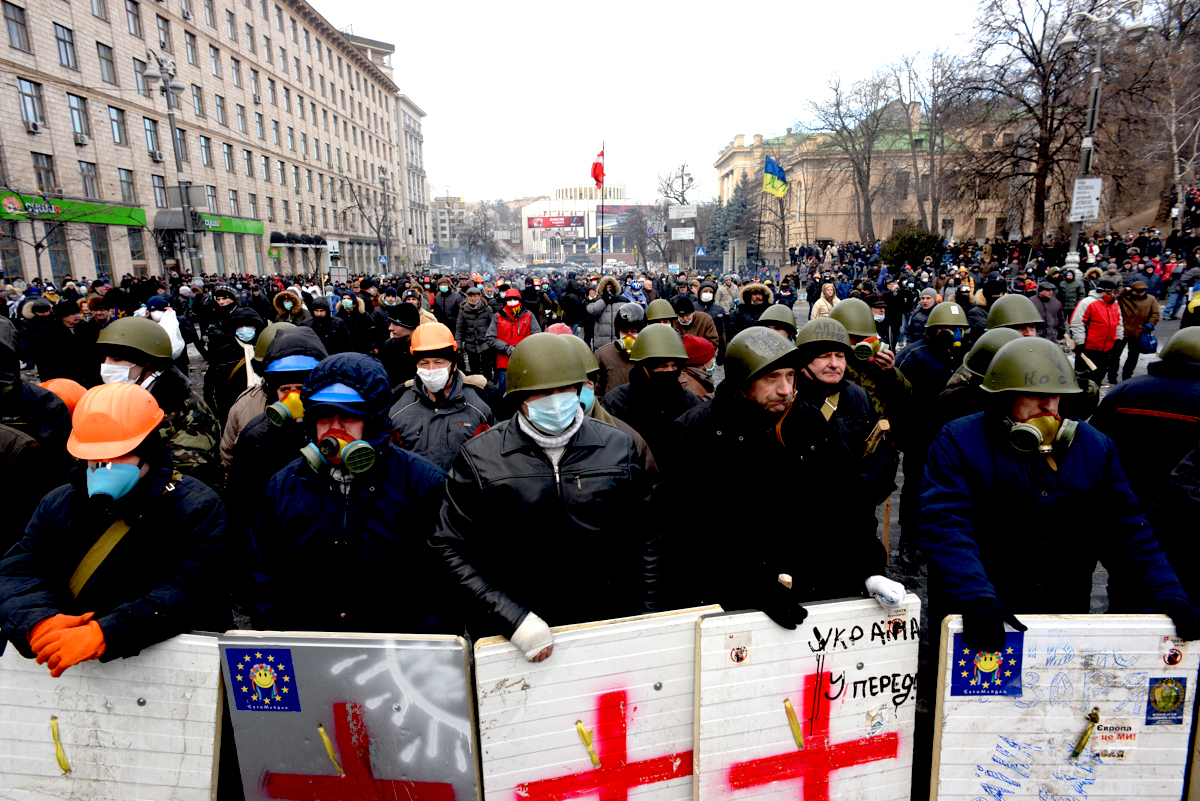
Helmeted protesters face off against police on Dynamivska Street during the Maidan uprising in Kiev, Jan 20, 2014. (Mstyslav Chernov, Wikimedia Commons, CC BY-SA 3.0)

The OSCE, working at the behest of NATO, used the Minsk Accords to further the expansion of NATO, instead of brokering peace in Ukraine. Today, NATO is engaged in a war with Russia using Ukraine as its proxy. In short, the very processes of peace and security Lukashevich said he’d worked so hard to create and implement back in 1999 were “melting before my eyes.”

I had been involved in a process of foundational importance to European security — the implementation of the Intermediate Nuclear Forces (INF) Treaty. The INF Treaty was signed by President Ronald Reagan and the General Secretary of the Communist Party of the Soviet Union Mikhail Gorbachev on Dec. 8, 1987. 

In February 1988 I was one of the first military officers assigned to the newly created On-Site Inspection Agency (OSIA), created by the U.S. Department of Defense to implement the INF Treaty. 

In June 1988 I was dispatched to the Soviet Union as part of an advanced party of inspectors to install a multi-million-dollar monitoring installation outside the gates of a Soviet missile factory in the city of Votkinsk, some 750 miles east of Moscow in the foothills of the Ural Mountains. 

For the next two years I worked in the company of my fellow American inspectors, side-by-side with our newfound Soviet colleagues, to implement a treaty which, without our mutual commitment to making the world a safer place through disarmament, would most likely have failed in the face of deep-seated opposition in both the U.S. and Soviet Union (you can read about my experiences in my book, Disarmament in the Time of Perestroika.) 

Square One
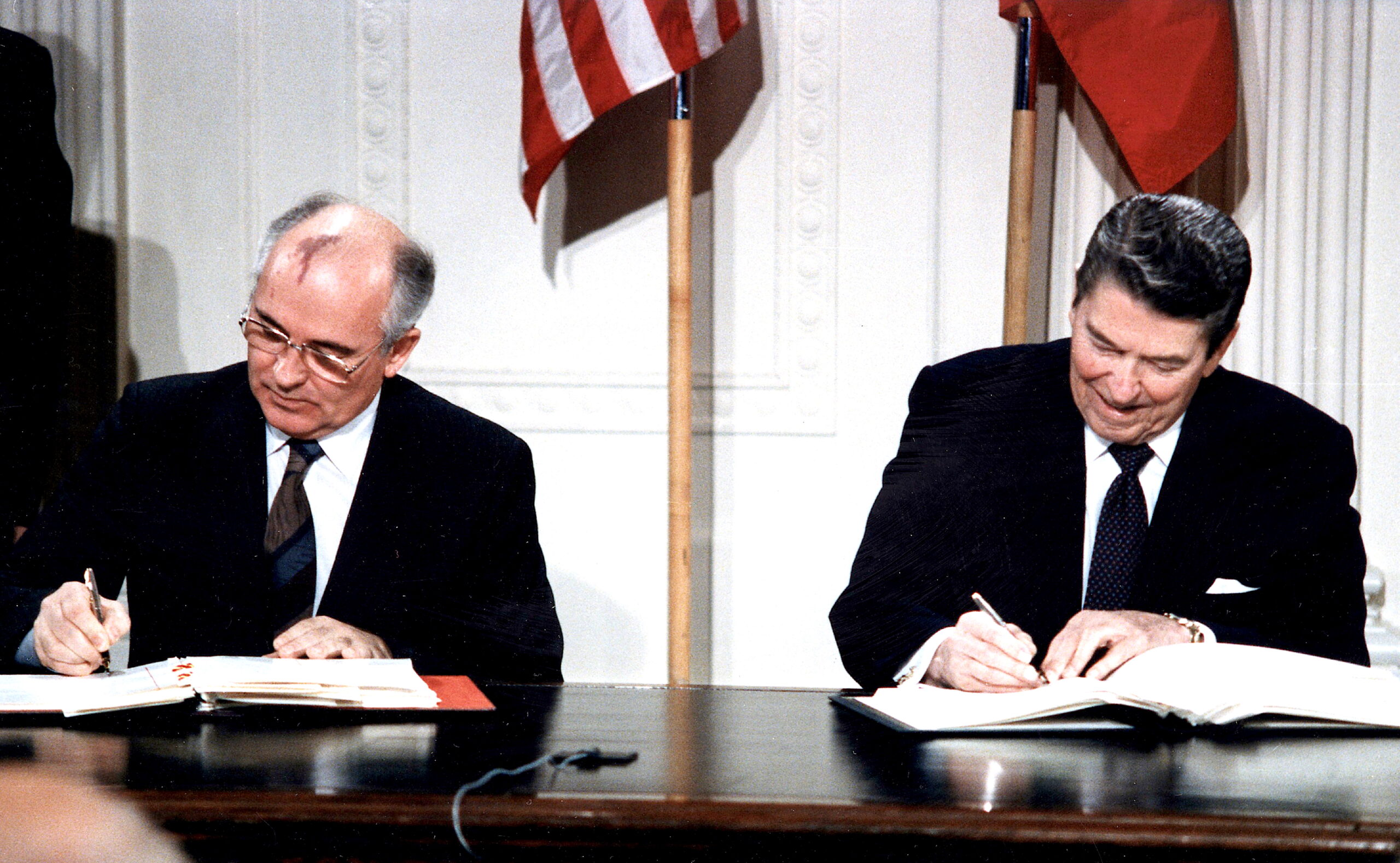
Gorbachev and Reagan signing the INF Treaty in the White House in 1987. (White House Photographic Office – National Archives and Records Administration, Wikimedia Commons, Public domain)

On June 28 last month, a mere three days before the Russian round table in Vienna, Russian President Vladimir Putin announced that Russia was going to resume production of short- and intermediate-range missiles — the very weapons myself and my fellow American and Soviet inspectors had worked so hard to eliminate. Putin said he would weigh their potential deployment in Europe and elsewhere to offset similar deployments by the United States of intermediate-range missiles in Europe and the Pacific. 

Putin was referring to the deployment by the U.S. of Mk 70 containerized missile launchers capable of firing the SM-6 “Typhon” dual-capability missile as well as the Tomahawk ground-launched cruise missile. The SM-6 has a range of under 310 miles, making it compliant under the terms of the INF Treaty, the Tomahawk’s range of 1,800 miles makes it an INF-capable system.

The United States withdrew from the INF Treaty in 2019, during the presidency of Donald Trump. Russia, however, indicated that it would not either produce or deploy INF-capable missiles (despite being accused by the U.S. of doing just that in justifying its decision to withdraw from the landmark arms control agreement) so long as the U.S. did not introduce them into Europe. 
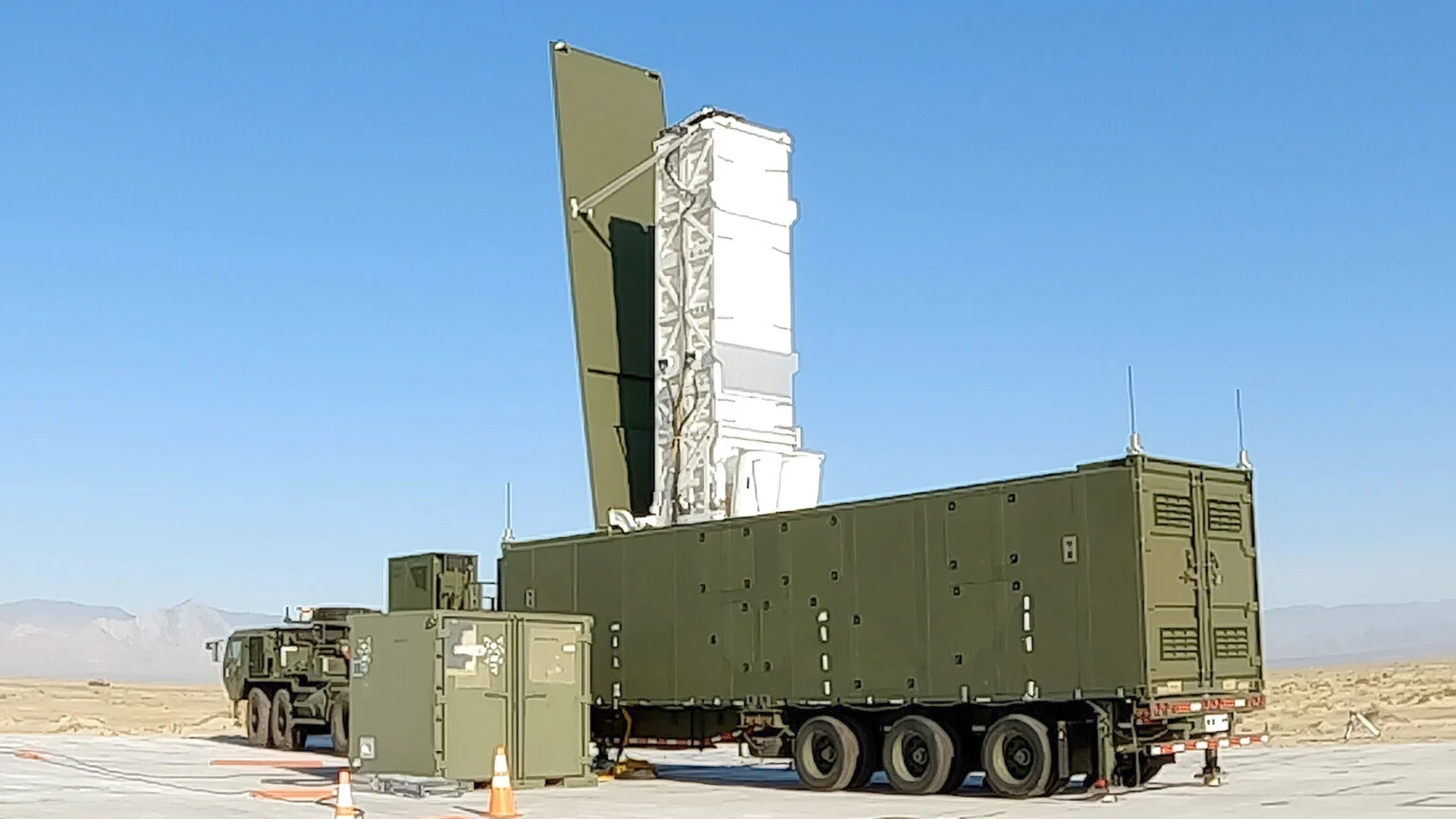
U.S. Army Typhon medium-range capability missile system. (US Army, Wikimedia Commons, Public domain)

In September 2023, the U.S. deployed two Mk 70 launchers onto the soil of Denmark as part of NATO military exercises. And in May of 2024 the U.S. likewise deployed the Mk 70 launcher on the soil of the Philippines. These actions prompted Putin’s response.

In short, we have literally gone back to square one when it comes to arms control and nuclear disarmament — to a time when Cold War politics nearly brought the U.S. and Russia to the edge of the nuclear abyss.

That is where we stand today.

Like Ambassador Lukashevich, I am literally watching my life’s work melt before my eyes.

The difference between now and then is stark. Four decades ago, we had an engaged public, and diplomats who talked to one another.

June 24 marked the 42nd anniversary of the million-person march in Central Park against nuclear war and for nuclear disarmament.

The political pressure created by this event resonated into the halls of power.

‘Walk in the Woods’
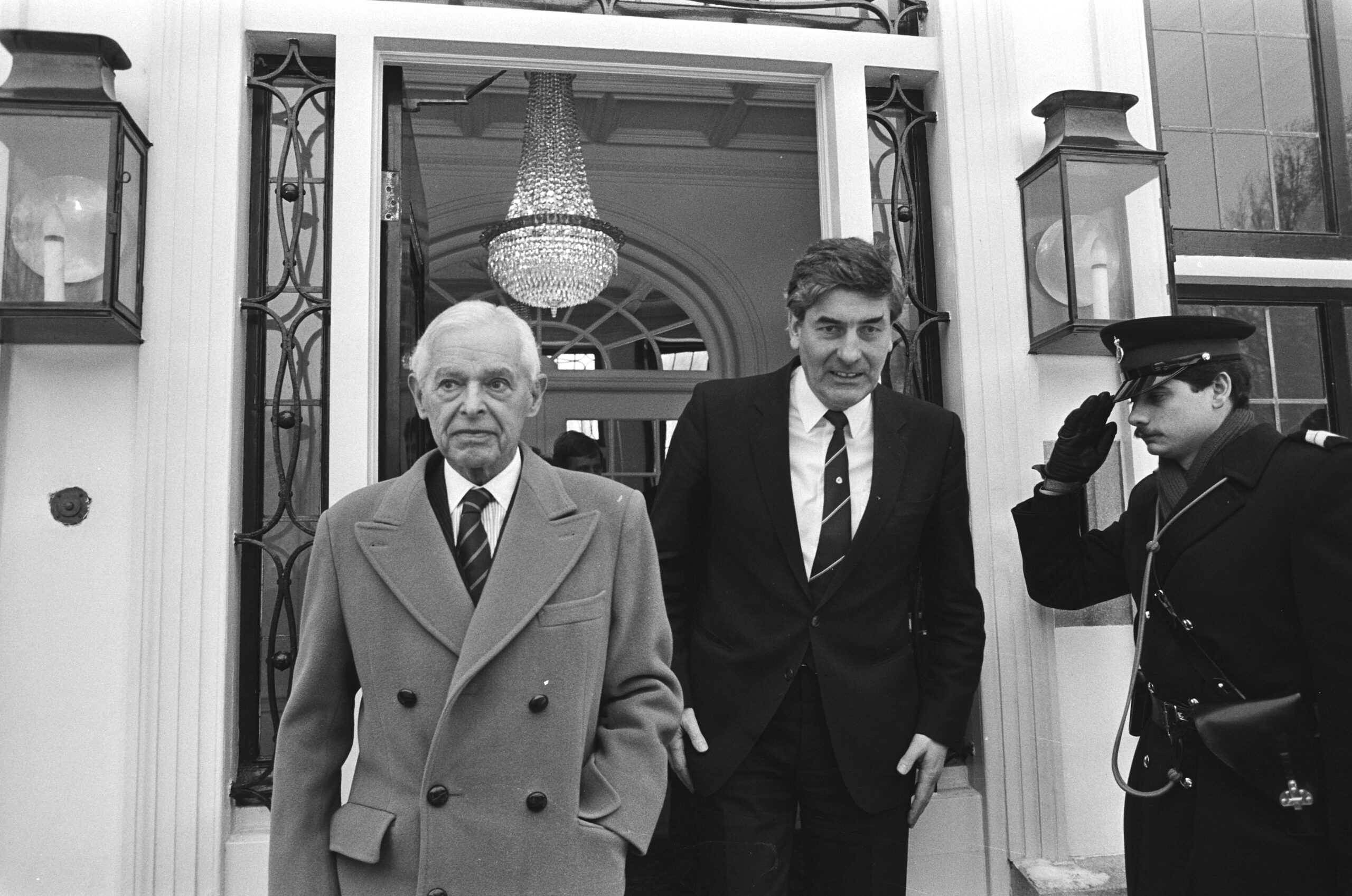
 Nitze, left, visiting The Hague in January 1985 while serving as U.S. arms control adviser. (Rob Croes/Anefo, CC0, Wikimedia Commons)

July 16 will mark the 42nd anniversary of the famous “Walk in the Woods” conducted by Paul Nitze and Yuli Kvitsinsky, respectively the U.S. and Soviet lead negotiators for INF talks that, at the time, were stymied.

Faced with a calcified recalcitrance on the part of U.S. hardliners, the two men took a walk in the woods outside Geneva, Switzerland, where they outlined possible ways to break the negotiation impasse.

The ideas that Nitze and Kvitsinsky came up with never came to pass — neither the U.S. nor the Soviet Union were ready to undertake such drastic actions.

But their courageous stab at diplomacy at a time when neither side was talking to the other shook free the rust that had frozen their respective sides, lubricating the machinery of diplomacy, and set in motion the processes that led to Reagan and Gorbachev signing the INF Treaty some five and a half years later.

The key take-away from the Nitze-Kvitsinsky “Walk in the Woods” was that, when it comes to meaningful arms control, success is not immediate. The process of arms control must be seen in the long term. 

It was also clear that fear fueled consideration of positive outcomes that eventually led to an equitable solution in the form of the INF Treaty.

There is no doubt in my mind that within the ranks of the Russian and U.S. diplomatic corps today are two men possessed of the vision and courage of Paul Nitze and Yuli Kvitsinsky who can, if given the opportunity, recreate the magic of the “Walk in the Woods.” That magic helped create the conditions for negotiations that helped pull the U.S. and Soviet Union from the nuclear abyss more than four decades ago. 

But two hurdles must be crossed first. It is difficult to imagine a U.S. and Russian diplomat walking and talking today when, as Professor Sergey Markedonev, a fellow participant at the Vienna round table pointed out, official U.S. policy precludes even shaking hands with Russian diplomats. 

It’s Up to the American People

To cross that bridge the U.S. government needs a signal from the American people that such behavior is not acceptable.

We need a modern-day version of the June 1982 Central Park million-person rally in support of nuclear disarmament and arms control and against nuclear war.

America has an election coming up in November where issues of our collective existential survival as a people and nation are on the line.

There is no more existential issue than that of nuclear war.

As was the case in June 1982, we, the people of the United States, need to send a collective signal to all who seek to represent us in the highest office of the land, that we will not tolerate policies that lead toward nuclear war.

That we insist on policies that promote nuclear disarmament and arms control.

That we demand that our diplomats begin talking with their Russian counterparts.

I’m tired of watching my life’s work melt before my very eyes.

It’s time to rebuild the foundations of our collective survival.

To make mainstream the cause of disarmament that once saved us from nuclear Armageddon.

Scott Ritter is a former U.S. Marine Corps intelligence officer who served in the former Soviet Union implementing arms control treaties, in the Persian Gulf during Operation Desert Storm and in Iraq overseeing the disarmament of WMD. His most recent book is Disarmament in the Time of Perestroika, published by Clarity Press.

The views expressed are solely those of the author and may or may not reflect those of Consortium News.

Oliver Boyd-Barrett: NATO is a Nightmare, to Russia

By Oliver Boyd-Barrett, Substack, 7/10/24

The above table is taken from a publication for the Quincy Institute by George Beebe, Mark Episkopos and Anatol Lieven (Beebe et al). The paper makes a very important argument, one that needs to be assessed carefully by those who may consider that Russia is a force that is unbeatable by the entirety of NATO.

The paper concedes that Russia has no expansionist intentions, but that there is definitely an escalatory danger. This danger calls for diplomacy in view of the fact that in a full-scale war with NATO as a whole, Russia faces a force whose collective GDP exceeds Russian by a factor of 20 and for this very reason Russia could be highly incentivized to reach out for a nuclear option. The paper talks of 3:1 Russian disadvantage in active duty ground forces; 10:1 military advantage (air, naval), and a NATO capacity to establish a naval blockade on Russian shipping. See the table for further details and note that the table excludes North America and Turkey (!)

Much of the confidence that Russia regularly exudes and which it inspires in its defenders lies in the original justness of its cause and in the expectation that ultimately Russia is at war with Ukraine, even if Ukraine benefits from (or is entirely dependent on) western weapons, or that, at worst, it might find itself dragged into confrontations with its immediate neighbors. Consider the following conclusions from the Beebe et al. paper:

  • Russia has an overwhelming military advantage over the national militaries of the Baltic states of Lithuania, Latvia, and Estonia.
  • In a conflict limited to the militaries of the “Eastern Arc” of NATO states bordering Russian territory, such as Poland, Hungary, Romania, and Finland, Russia would have a 3:1 advantage in ground forces but no advantage in naval vessels or warplanes.
  • In a conflict against all European NATO countries with no U.S. involvement, Russia would be outnumbered 2:1 in active-duty ground forces and at a much larger disadvantage in air and naval forces.

Perhaps most worrying for Russia is this quotation from the conclusions of a recent study by the Center for Strategic and International Studies which states that:

“The VKS [Russian air force] is at a distinct quantitative and qualitative disadvantage when compared to the combined airpower strength of NATO. Although some of Russia’s newest fighters have fifth-generation characteristics, none can truly be called fifth generation. … In an air-to-air fight, Russia would be outclassed in numbers and tactical ability by a NATO force. In addition to a numerical disadvantage, Russian forces are not as trained as NATO pilots. Despite attempted modernization, Russia has struggled to build a modern air force. Russia conducts little training at integrated air operations. Most training flights are only formations with small numbers of aircraft. Additionally their pilots generally fly less than 100 hours a year, about a third of what the average NATO pilot flies.”

The behavior of NATO over the past year, and the inclusion now of Sweden and Finland (with its extensive border with Russia) might certainly lend weight to the impression that internal conflicts notwithstanding, the body as a whole is preparing for full-scale war. It is in the light of this possiblity that future discussions must be directed. I anticipate the paper will excite quite a bit of push-back from the more astute of the conflict’s observers and will report on this in the coming days.

One of the most important issues to be discussed at the NATO summit in Washington (in addition to whether NATO should promise Ukraine an “irreversible” – i.e. Trump proof – path to membership of NATO, together with $40 billion aid in 2025) is whether to set up a NATO command in Ukraine itself, which, if agreed, removes any pretence that this is still a Ukraine-Russia conflict and not a NATO-Russia conflict. The idea comes from an address by US National Security Adviser, Jake Sullivan, to a forum hosted by the US Chamber of Commerce and co-sponsored by defense contractors. This is occurring not only in the context of a recent and important expansion of NATO, but also in a significant growth in the number of NATO members who are complying with an agreement in 2014 that they should dedicate at least 2% of their GDPs to military expenditure. In the past few years the number of countries that fulfill this basic minimum has risen from 9 to 23 of the 32-member alliance. In 2024, NATO allies are expected to “invest” $500m billion in defense (up from $325 billion in 2020). Russia by contrast is expect to spend $391.2 billion in 2024. But I would note that what Russia is able to buy with $391 billion is at least as much as the purchasing power of NATO’s $500 billion.

NATO’s chief Jens Stoltenberg has recently claimed that NATO could have 100,000 forces “where they need to be” within a week, and 200,000 a month, rising to 500,000 within the “ensuing weeks.” These figures have surprised many – and been derided by some.

The Beebe et al. analysis does not take into account how the balance of forces would be impacted by the involvement of China or other BRICS nations in active support of Russia. Since China must know that a defeat of Russia by NATO will precipitate full NATO attention to China (even, or especially under Trump in the US White House) China has considerable incentive to become a more active partner in the defense of Russia against NATO.

The report does not discuss in any detail how a sufficient consensus for full-scale war can be achieved in what is becoming a highly fractious environment in Europe, as exemplified in recent European and national elections, a fractiousness that not only includes the Ukraine skepticism of countries such as Hungary, Slovakia, Serbia and Turkey, and now, perhaps France and Italy, but also has to deal with a strong anti-war sentiment everywhere, amidst declining living standards for the majority.

Elections

In follow up to my considerations yesterday as to the significance of recent elections in France for the future of the NATO proxy war with Russia over Ukraine, I note that even in the immediate aftermath of the success of the New Popular Front there are growing indications that the Front itself is disunited, and that it is veering rightwards in compliance, most likely, with the terms of its agreement with the Macron bloc to head off the threat of Marine Le Pen.

Melanchon’s middle class France Unbowed (LFI) is in an alliance that includes the powerful but pro-business Socialist Party (PS). One faction of the LFI, represented by Clementine Autain, may support a government led by the Socialist Party in partnership with the French Communist Party. This would produce a sell-out entity comparable with Greek SYRIZA (formed in 2015) and the Spanish Podemos (formed in 2019) which, in power with the PSOE, has backed Azov and sent weapons to Israel.

As for Britain, the new Labour Party Defense Secretary has already visited Ukraine even as his bosses were headed for the NATO summit in Washington. One might also note the outcome of an investigation by the investigatory outlet, Declassified, which finds that the Israel lobby funded (to the tune of over $700,000) half of the new British cabinet (13 out of 25), including the Prime Minister, the Chancellor, Foreign Secretary, Home Secretary and UK Trade Secretary. This, even as the group of 10 top UN independent experts finds there is famine throughout Gaza that is the result of a deliberate Israeli policy of mass starvation, confirming the latest (June 25) assessment of the Integrated Food Security Phase Classification (IPC).

Kit Klarenberg: Collapsing Empire: Georgia and Russia Restore Diplomacy

By Kit Klarenberg, Substack, 6/15/24

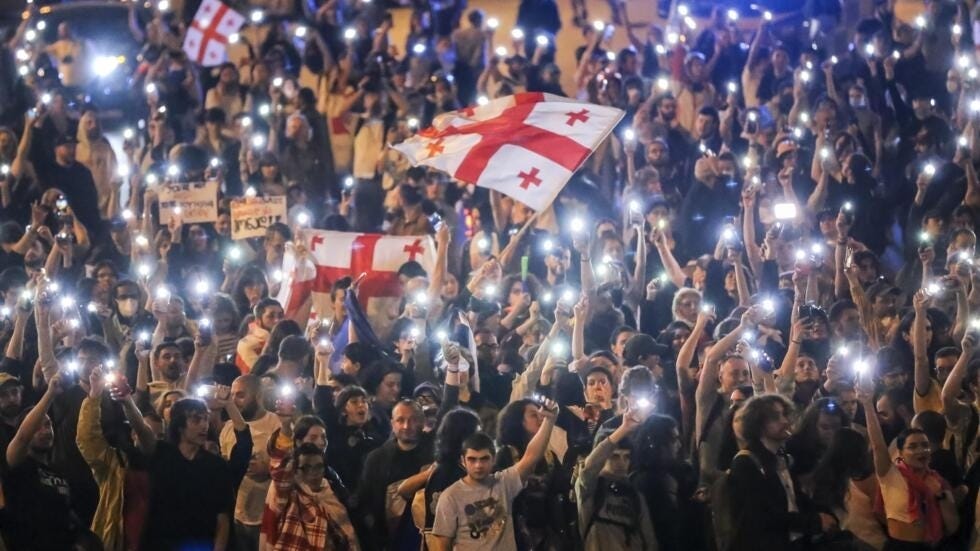
It’s been reported by Georgian media that Tbilisi is now “actively working” to restore the country’s diplomatic relations with Moscow, severed by the then regime in August 2008, following its trouncing in a calamitous five-day war with Russia. While this may seem mundane to outside observers, it is a seismic development, amply testifying to the extraordinary pace and scale of the US Empire’s self-inflicted collapse.

Over decades, Washington has invested enormous energy and money into turning Georgia against Russia. Tbilisi has deep and cohering cultural, economic, and historic ties with its huge neighbor. Today, nostalgia for the Soviet Union is widespread, and Joseph Stalin remains a local hero for a significant majority of citizens. While public support for Euro-Atlantic integration and EU and NATO membership is strong, recent developments have prompted many Georgians to reconsider their country’s relationship with the West.

Since taking office in 2012, the ruling Georgian Dream has struck a delicate balance between strengthening Western ties and maintaining civil coexistence with Moscow. This has become an ever-fraught dance since the outbreak of the Ukraine proxy conflict, with external pressure to impose sanctions on Russia and send arms to Kiev perpetually rising. Against this backdrop, there have been multiple apparent plots to overthrow the government and install a more belligerent administration.

In order to neutralize the threat of a coup by Georgian Dream’s domestic and international adversaries, legislation compelling foreign-funded NGOs – of which there are over 25,000 in Tbilisi – has been passed. Its gestation produced a bitter showdown with the EU and US, ending with lawmakers who voted for the law being sanctioned by Washington and the threat of further action to come. Along the way, Georgian citizens were confronted with the poisonous reality of their relationship with the West. And they didn’t like it.

‘Foreign Assistance’

Contemporary media reports on Ukraine’s 2014 Maidan “revolution” either ignored the unambiguous Western role in fomenting it or dismissed the proposition as Russian “disinformation” or “conspiracy theory”. Ever since the proxy conflict began, Western journalists have become even more aggressive in rejecting any and all suggestions that the insurrectionary upheaval in Kiev was anything other than an overwhelmingly – if not universally – popular grassroots public revolt. 

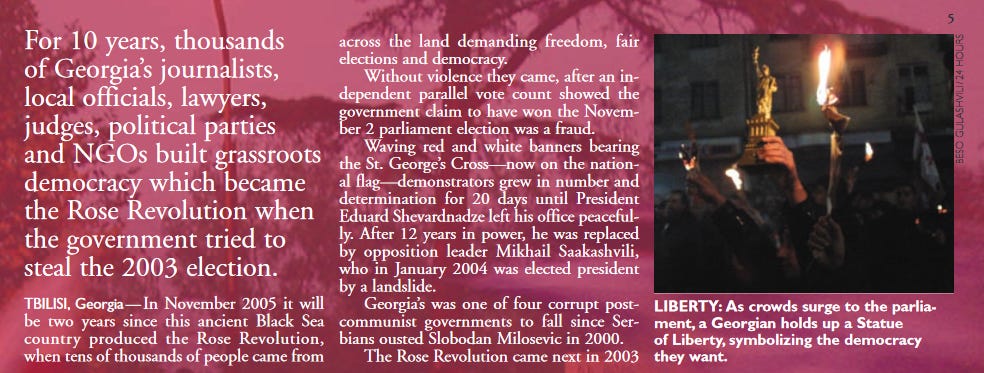
Yet, it was not long ago that the Empire unabashedly advertised its role in orchestrating “color revolutions” throughout the former Soviet sphere, of which Maidan will surely in future be considered the final installment. In 2005, intelligence cutout USAID published a slick magazineDemocracy Rising, documenting in detail how Washington was behind a wave of rebellious unrest in Georgia, Kyrgyzstan, Lebanon, Ukraine, Yugoslavia, and elsewhere during the first years of the 21st century.

An excerpt from Democracy Rising

Two years prior, the Washington-sponsored “Rose Revolution” unseated longtime Georgian leader Eduard Shevardnadze, replacing him with handpicked, US-educated Mikheil Saakashvili, a close associate of George Soros. Shevardnadze had since Tbilisi’s 1991 independence from the Soviet Union eagerly served as a committed agent of Empire, opening up his country to far-reaching privatization for the benefit of Western investors and extensive societal and political infiltration by US and European-funded organizations.

In a bitter irony, such subservience was Shevardnadze’s ultimate undoing. Brussels and Washington exploited this space to lay the foundations of his overthrow, financing individuals and organizations who would serve as shock troops in the “Rose Revolution”. For instance, Democracy Rising reveals that in 1999, US funding “helped Georgians draw up and build support for a Freedom of Information Law, which the government adopted.” This allowed Western-funded media and NGO assets “to investigate government budgets, [and] force the firing of a corrupt minister.”

The US, moreover, bankrolled the training of “lawyers, judges, journalists, members of parliament, NGOs, political party leaders, and others” to wage war against their government. The official purpose of this largesse was to “give people a sense that they should regulate the government.” As per Democracy Rising, “the Rose Revolution was the climax of these efforts.” Following Tbilisi’s November 2003 election, US-financed exit polling suggested the official result – pointing to the victory of a coalition of pro-Shevardnadze parties – was fraudulent.

Scores of anti-government activists from across the country then descended upon Tbilisi’s parliament building, ferried on buses paid for by Washington. Nationwide demonstrations led by US-bankrolled NGOs and activist groups raged for weeks, culminating on November 23 with activists storming parliament brandishing roses. The very next day, Shevardnadze resigned. One recipient of Western support remarked in Democracy Rising, “without foreign assistance, I’m not sure we would have been able to achieve what we did without bloodshed.”

As the USAID pamphlet noted, many US-financed and trained assets in Georgia central to the Rose Revolution went on to become officials within Saakashvili’s government. One, Zurab Chiaberashvili, was appointed as chair of Tbilisi’s Central Election Commission from 2003 to 2004, before becoming mayor of Tbilisi. He was quoted in Democracy Rising as saying:

“Under US assistance, new leaders were born…[the US] helped good people get rid of a bad and corrupted government…[this assistance] made civil actors alive, and when the critical moment came, we understood each other like a well-prepared soccer team.”

The Empire’s in-house journal Foreign Policy has conceded the results of the “Rose Revolution” were “terribly disappointing”. Far-reaching change “never really materialized,” and “elite corruption still continued apace.” Saakashvili was no more democratic or less authoritarian than his predecessor – in fact, his rule was brutal and dictatorial in many ways Shevardnadze’s was not. Questions abound about his involvement in several suspicious deathshe directed security services to assassinate rivals, and at his personal behest, prisons became politicized hotbeds of torture and rape.

The Empire could forgive Saakashvili all this though, for further facilitating his country’s economic rape and pillage, and even more crucially, intensifying Tbilisi’s anti-Russian agitation locally and internationally. This crusade came to a bloody head in August 2008, when Georgian forces, with US encouragement, began shelling civilian positions in the breakaway regions of Abkhazia and South Ossetia. Moscow intervened to decisively defend the pair. As many as 200,000 locals were displaced in subsequent battles, with hundreds killed.

Dissident journalist Mark Ames visited sites of the fighting in December of that year and witnessed “an epic historical shift” – “the first ruins of America’s imperial decline.” The Georgian army had been trained, armed, and even clothed by the US over many years, only to be comprehensively crushed by Russia’s military – and there was “no American cavalry on the way.” His first-hand insights led Ames to dub the outbreak of war that year, “the day America’s empire died.”

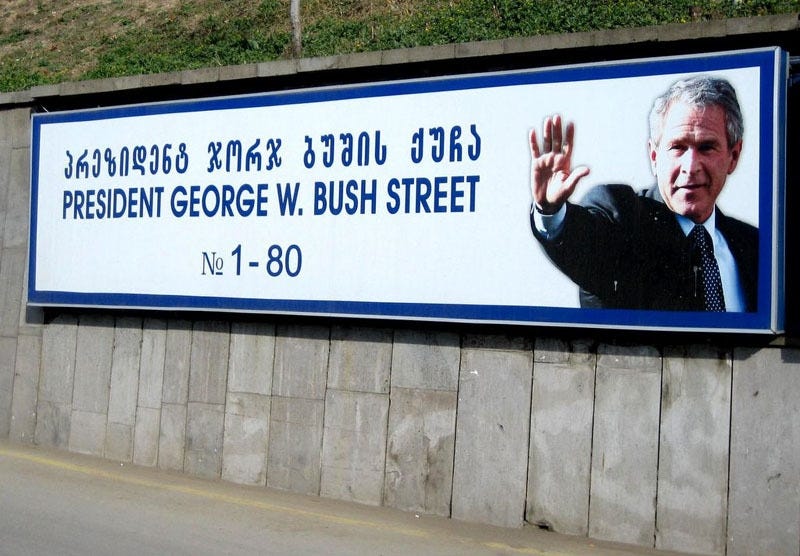
A road in Tbilisi, Georgia

Ames had previously visited Georgia in 2002 to report on the arrival of US military advisors to the country. As the journalist records, “At the time, the American empire was riding high.” TIME magazine had recently celebrated George W. Bush’s inauguration with a column declaring that Washington was “the dominant power in the world, more dominant than any since Rome,” and thus positioned “to re-shape norms, alter expectations and create new realities,” via “unapologetic and implacable demonstrations of will.”

US military expansion into Georgia was one such bold “demonstration of will.” Military advisors were dispatched ostensibly to train Tbilisi’s soldiers to combat “terrorism”. In reality, as Ames wrote, the purpose was to tutor them “for key imperial outsourcing duties.” It was expected that “Georgia would do for the American Empire what Mumbai call centers did for Delta Airlines: deliver greater returns at a fraction of the cost.” The move would also secure Washington’s “strategic control of the untapped oil in the region.”

The benefit for Georgia? “[Moscow] wouldn’t fuck with them, because fucking with them would be fucking with us – and nobody would dare to do that.” In the event, however, Saakashvili’s intimate bromance with the West was no deterrent at all. The blitzkrieg’s success, moreover, left Russia “drunk on its victory and the possibilities that it might imply”:

“Now it’s over for us. That’s clear on the ground. But it will be years before America’s political elite even begins to grasp this fact…We have entered a dangerous moment in history – America in decline is reacting hysterically, woofing and screeching and throwing a tantrum, desperate to prove that it still has teeth. Russia, meanwhile, is as high as a Hollywood speedballer from its victory…If we’re lucky, we’ll survive the humiliating decline…without causing too much damage to ourselves or the rest of the world.”

The Maidan coup starkly showed the Empire failed to learn lessons from the 2008 war, and Ames’ hope that Washington’s “humiliating decline” could be endured by US citizens and politicians alike “without causing too much damage to ourselves or the rest of the world” was futile. The West is now struggling to confront its undeniable defeat on Ukraine’s eastern steppe and accept the unraveling of its long-running efforts to absorb Moscow’s “near abroad”, openly mulling direct intervention in the proxy conflict. God help us all.

All Kit’s investigations are free to read, thanks to the generosity of his readers. Independent journalism nonetheless requires investment, so if you took value from this article or any others, please consider sharing, or even becoming a paid subscriber. Your support is always gratefully received, and will never be forgotten. To make a one-off donation, please click this link.

Tarik Cyril Amar: Trump the Peacemaker?

By Tarik Cyril Amar, Website, 7/1/24

The likely next president of the US, Donald Trump, has signaled that he has a plan for bringing the war in Ukraine to an end. Or, at least, two of his advisers have such a plan. More importantly, they have submitted it to Trump. And most importantly, they have said that he has responded positively.

As one of the plan’s authors has put it, “I’m not claiming he agreed with it or agreed with every word of it, but we were pleased to get the feedback we did.” It is true that Trump has also let it be known that he is not officially endorsing the plan. However, it is obvious that this is a trial balloon which has been launched with his approval. Otherwise, we would have either not have heard about it or it would have been disavowed.

The two Trump advisers are Keith Kellogg, a retired lieutenant general, and Fred Fleitz, a former CIA analyst. Both held significant positions on national security matters during Trump’s presidency. Currently, both play important roles at the Center for American Security: Kellogg serves as co-chair and Fleitz as vice chair. Both, finally, are clear about their belief in what is perhaps Trump’s single most defining foreign policy concept: America First. Fleitz recently published an article asserting that “only America First can reverse the global chaos caused by the Biden administration.” For Kellogg, the “America First approach is key to national security.” The Center for American Security, finally, is part of the America First Policy Institute, an influential think tank founded in 2022 by key Trump administration veterans to prepare policies for his comeback.

Clearly, this is a peace plan that has not come out of nowhere. On the contrary, it has not merely been submitted to Trump to receive his – unofficial – nod, it has also emerged from within Trumpism as a resurgent political force. In addition, as Reuters has pointed out, it is also the most elaborate plan yet from the Trump camp on how to get to peace in Ukraine. In effect, this is the first time that Trump’s promise to rapidly end this war, once he is back in the White House, has been fleshed out in detail. The adoption of the plan or any similar policy would obviously mark a massive change in US policy. Hence, this is something that deserves close attention.

What does the plan foresee? In essence, it is built on a simple premise: to use Washington’s leverage over Ukraine to force the country to accept a peace that will come with concessions, territorial and otherwise. In the words of Keith Kellogg, “We tell the Ukrainians, ‘You’ve got to come to the table, and if you don’t come to the table, support from the United States will dry up’.” Since Kiev is vitally dependent on American assistance, it is hard to see how it could resist such pressure. Perhaps to give an appearance of “balance” for the many Republicans still hawkish on Russia, the plan also includes a threat addressed to Moscow: “And you tell Putin,” again in Kellogg’s terms, “he’s got to come to the table and if you don’t come to the table, then we’ll give Ukrainians everything they need to kill you in the field.”

Yet it is obvious that, despite the tough rhetoric about Russia, the plan will cause great anxiety in Kiev, not Moscow, for two reasons. First, the threats addressed to Russia and Ukraine are not comparable: If the US were to withdraw its support from Ukraine, Kiev’s Zelensky regime would quickly not just lose the war but collapse. If the US were to, instead, increase its support for the Zelensky regime, then Moscow would respond by mobilizing additional resources, as it has done before. It might also, in that case, receive direct military assistance from China, which would not stand by and watch a potential Russian defeat unfold, because that would leave Beijing alone with an aggressive, emboldened West. In addition, Washington would, of course, have to weigh the risk of Russia engaging in counter-escalation. In sum, the plan threatens Ukraine with certain defeat, regime, and, possibly, even state disintegration; it threatens Moscow with a harder time – a type of threat that has no record of success.

The second reason the plan is bad news for Ukraine but not for Russia is that the peace it aims at is much closer to Moscow’s war aims than to those of Kiev. While the document that has been submitted to Trump has not been made public, American commentators believe that a paper published on the site of the Center for American Security under the title “America First, Russia, & Ukraine” is similar to what he – or his staff – got to see. Also authored by Kellogg and Fleitz, this paper, too, repeatedly stresses just how “tough” Trump used to be toward Russia. Plenty of strutting there for those who like that kind of stuff.

These statements, however, are balanced by an emphasis on what used to be called diplomacy: “At the same time,” we read, “Trump was open to cooperation with Russia and dialogue with Putin. Trump expressed respect for Putin as a world leader and did not demonize him in public statements … This was a transactional approach to US-Russia relations … to find ways to coexist and lower tensions … while standing firm on American security interests.”

That already is a tone that Kiev cannot but find disconcerting. Because under Biden, US strategy – and therefore that of the collective West – has been built not merely on an extremely belligerent approach (as if that were not bad enough already) but, more importantly and more detrimentally, on the obsessive idea that there is no alternative. Everything, to its adherents, is “appeasement” except constant escalation to “win.” There is no room for genuine quid pro quos and compromise. That attitude is vital to America’s unrelenting support for Ukraine and, in particular, the fact that it has crossed one red line (meaning those previously recognized by Washington itself) after the other, with no (good) end in sight.

Hence, a Trumpist approach that is also anything but “soft” on Russia, while, however, acknowledging the possibility of de-escalation through negotiation is already a major departure from current US policy. You could even think of it as being inspired by the Reaganite foreign policy of the 1980s, which also combined pronounced “toughness” with a genuine readiness to compromise. Yet there would be one big difference: Toward the end of the Cold War, Washington was dealing with a pliable, even naïve Soviet leadership. That was a grave mistake – if made for mostly admirably idealistic reasons – that Russia’s current leaders see very clearly, are still angry about, and will not repeat.

In the case of the war in Ukraine, this means that any settlement, even with a newly “transactional” Washington “coming to the table” would involve not one but two “tough” players: Moscow will not agree to any compromise that fails to factor in that it has gained the upper hand in this war. That, in turn, means that, beyond the basic Trumpist mood of conditional conciliatoriness, details will be decisive.

Unfortunately for the Zelensky regime and fortunately for everyone else (yes, including many Ukrainians who won’t have to die in a proxy war anymore once peace comes), in that domain as well, the realm of the concrete and specific, the plan developed by Kellogg and Fleitz shows some progress. The authors, first of all, recognize important elements of reality that the current US leadership is either lying or in denial about: for instance, that this is a proxy war as well as a war of attrition, that Zelensky’s “10-point plan” (essentially a blueprint for what could only happen if Ukraine were to win the war, that is, never) “went nowhere,” and that Ukraine cannot sustain the war demographically.

They also acknowledge that Russia will refuse to take part in peace talks or agree to an initial ceasefire if the West doesn’t “put off NATO membership for Ukraine for an extended period.” In fact, an “extended period” will not suffice; Moscow has been clear that never means never. But Kellogg and Fleitz may be formulating their ideas carefully with a view to how much their readers in America can take at this point. The plan also, again realistically, raises the option of offering a partial and, eventually, complete dropping of sanctions against Russia. Ukraine, on the other side, would not have to give up the aim of recovering all its territory, but – a crucial restriction – would have to agree to pursue it by diplomatic means only. The implication is, of course, that Kiev would have to give up de facto control over territory in the first place.

And there you have it: This is a proposal that, pared down to essentials, foresees territorial concessions and no NATO membership for Ukraine. It’s no wonder that Kellogg and Leitz conclude their paper by admitting that “the Ukrainian government,” “the Ukrainian people” (that is sure to be an over-generalization, by the way), and “their supporters” in the West will have trouble accepting this kind of negotiated peace. We could add: especially after more than two years of an avoidable (as the authors also recognize) and bloody proxy war. Yet that tragedy has already happened. We can wish it had not, but we cannot undo the past. The real question is about the future. Kellogg and Leitz, and Trump as well, if he will follow such a policy, are right that the dying must end, and that the only way to make it end – as well as avoid further escalation, perhaps to global war – is a compromise settlement built on reality.

RT: Zelensky not really running Ukraine – The Times

RT, 6/10/24

Multiple Ukrainian officials have complained to British daily The Times about the growing power of Vladimir Zelensky’s chief of staff Andrey Yermak, who they say de facto runs Ukraine.

The 52-year-old has previously been described as “Zelensky’s right-hand man” and “Ukraine’s real power broker.” Officials in Kiev now say he has become something more, the outlet has reported.

“Yermak’s authority has surpassed that of all of Ukraine’s elected officials bar the president,” The Times’ Maxim Tucker wrote in the article published on Friday. “Some sources went so far as to describe him as the ‘de facto head of state’ or ‘Ukraine’s vice-president’ in a series of interviews.”

Tucker, who previously worked as Amnesty International’s campaigner on Ukraine, claimed to have spoken with “senior government, military, law enforcement and diplomatic sources,” many of whom requested anonymity. He described Yermak as Zelensky’s “greatest flaw,” and his behavior as “thirst for power.”

“Concern is mounting that Zelensky is increasingly reliant on a handful of sycophantic domestic voices,” Tucker noted, as the number of people with direct access to him shrinks while Yermak’s team expands.

Zelensky’s “big mistake has been to entrust so much authority to Yermak, who is clearly intoxicated with power,” said Daria Kaleniuk, executive director of the Anti-Corruption Action Center.

Military officials have also blamed Yermak for arranging the firing of General Valery Zaluzhny in February, because he saw him as a rival. A spokesman for the Zelensky’s office denied this, saying Zaluzhny was not fired but promoted to ambassador to the UK, “which signifies a high level of trust.”

A spokesperson for the presidential office, which Yermak runs, dismissed all criticism of the chief of staff as “propaganda attacks.” Yermak has a “direct but efficient management style,” they said, which has delivered successes such as the Swiss “peace summit” next week.

Zelensky “is the one who makes all the key decisions,” the spokesperson insisted.

Yermak is a former film producer whom Zelensky – an actor turned politician – brought into the government in 2019. He has recently begun moving into the spotlight, attending the ‘Democracy Summit’ in Denmark alongside former NATO secretary general Anders Fogh Rasmussen, himself a paid adviser to the Ukrainian government.

It was Yermak and Rasmussen’s ‘International Working Group on Security Issues and Euro-Atlantic Integration of Ukraine’ that first proposed lifting all the restrictions on the use of Western weapons supplied to Kiev, which was quickly amplified by former British PM Boris Johnson. The talking point then spread to NATO capitals until the White House eventually agreed to it.

Analysis & Book Reviews on U.S. Foreign Policy and Russia