Politico: The dark side of Zelenskyy’s rule

By Jamie Dettmer, Politico, 10/31/25

As Russia began its full-scale invasion of Ukraine nearly four years ago, Volodymyr Kudrytskyi, then head of Ukraine’s state-owned national power company Ukrenergo, was scrambling to keep the lights on.

Somehow, he succeeded and continued to do so every year, earning the respect of energy executives worldwide by ensuring the country was able to withstand Russian missile and drone strikes on its power grid and avoid catastrophic blackouts — until he was abruptly forced to resign in 2024, that is.

Kudrytskyi’s dismissal was decried by many in the energy industry and also prompted alarm in Brussels. At the time, Kudrytskyi told POLITICO he was the victim of the relentless centralization of authority that Ukrainian President Volodymyr Zelenskyy and his powerful head of office Andriy Yermak often pursue. He said he feared “corrupt individuals” would end up taking over the state-owned company.

According to his supporters, it is that kind of talk — and his refusal to remain silent — that explains why Kudrytskyi ended up in a glass-enclosed cubicle in a downtown Kyiv courtroom last week, where he was arraigned on embezzlement charges. Now, opposition lawmakers and civil society activists are up in arms, labeling this yet another example of Ukraine’s leadership using lawfare to intimidate opponents and silence critics by accusing them of corruption or of collaboration with Russia. Zelenskyy’s office declined to comment.

Others who have received the same treatment include Zelenskyy’s predecessor in office, Petro Poroshenko, who was sanctioned and arraigned on corruption charges this year — a move that could prevent him from standing in a future election. Sanctions have frequently been threatened or used against opponents, effectively freezing assets and blocking the sanctioned person from conducting any financial transactions, including using credit cards or accessing bank accounts.

Poroshenko has since accused Zelenskyy of creeping “authoritarianism,” and seeking to “remove any competitor from the political landscape.”

That may also explain why Kudrytskyi has been arraigned, according to opposition lawmaker Mykola Knyazhitskiy, who believes the use of lawfare to discredit opponents is only going to get worse as the presidential office prepares for a possible election next year in the event there’s a ceasefire. They are using the courts “to clear the field of competitors” to shape a dishonest election, he fears.

Others, including prominent Ukrainian activist and head of the Anti-Corruption Action Center Daria Kaleniuk, argue the president and his coterie are using the war to monopolize power to such a degree that it threatens the country’s democracy.

Kaleniuk was in the courtroom for Kudrytskyi’s two-hour arraignment, and echoes the former energy boss’s claim that the prosecution is “political.” According to Kaleniuk, the case doesn’t make any legal sense, and she said it all sounded “even stranger” as the prosecutor detailed the charges against Kudrytskyi: “He failed to show that he had materially benefited in any way” from an infrastructure contract that, in the end, wasn’t completed, she explained.

The case in question is related to a contract Kudrytskyi authorized seven years ago as Ukrenergo’s then-deputy director for investments. But the subcontractor didn’t even begin work on the assigned infrastructure improvements, and Ukrenergo was able to claw back an advance payment that was made.

Kaleniuk’s disquiet is also echoed by opposition lawmaker Inna Sovsun, who told POLITICO, “there’s no evidence that [Kudrytskyi] enriched himself.”

“There was no damage done. I can’t help but think that this is all politically motivated,” she said.

Sovsun turned up to the arraignment to offer herself as a bail guarantor if needed — two other lawmakers offered to act as guarantors as well, but the judge instead decided on another procedure to set Kudrytskyi free from pre-trial detention by requiring the payment of bail bond of $325,000.  

One senior Ukrainian adviser, who asked not to be identified so they could speak about the case, dismissed the defense’s description of the case against Kudrytskyi as being politically motivated and claiming there was no substance to the embezzlement allegations. “People should wait on this case until the full hearing,” he added.

But for former Deputy Prime Minister Ivanna Klympush-Tsintsadze, the case “doesn’t look good from any angle — either domestically or when it comes to international partners.” The timing, she said, is unhelpful for Ukraine, as it coincides with Kyiv’s ongoing appeal for more European energy assistance ahead of what’s likely to be the war’s most perilous winter.

With Russia mounting missile and drone strikes on a far larger scale than before, Ukraine’s energy challenge is likely to be even more formidable. And unlike previous winters, Russia’s attacks have been targeting Ukraine’s drilling, storage and distribution facilities for natural gas in addition to its electrical power grid. Sixty percent of Ukrainians currently rely on natural gas to keep their homes warm.

Some Ukrainian energy executives also fear Kudrytskyi’s prosecution may be part of a preemptive scapegoating tactic to shift blame in the event that the country’s energy system can no longer withstand Russian attacks.

Citing unnamed sources, two weeks ago Ukrainian media outlet Ukrainska Pravda reported that former energy executives fear they are being lined up to be faulted for failing to do enough to boost the energy infrastructure’s resilience and harden facilities.

“They need a scapegoat now,” a foreign policy expert who has counseled the Ukrainian government told POLITICO. “There are parts of Ukraine that probably won’t have any electricity until the spring. It’s already 10 degrees Celsius in Kyiv apartments now, and the city could well have extended blackouts. People are already pissed off about this, so the president’s office needs scapegoats,” he said, speaking on condition of anonymity to discuss the matter freely.

“The opposition is going to accuse Zelenskyy of failing Ukraine, and argue he should have already had contingencies to prevent prolonged blackouts or a big freeze, they will argue,” he added.

Senior fellow at the Atlantic Council and author of “Battleground Ukraine” Adrian Karatnycky also worries about the direction of political travel. “While he’s an inspirational and brave wartime leader, there are, indeed, worrying elements to Zelenskyy’s rule,” he said.

Alexander Mercouris: WILL RUSSIA LOSE THE PEACE?

By Alexander Mercouris, Substack, 11/12/25

Recent Russian breakthroughs on the Ukrainian battlefronts, and in particular the encirclement of large numbers of Ukrainian troops in the towns of Kupiansk and Pokrovsk, have now brought the full Russian conquest and liberation of Donbas into sight, bringing closer the end of the war.

Whilst there continues to be speculation about a possible eventual diplomatic outcome, the disastrous failure of the Trump administration’s outreach to Moscow, and the implacable opposition of the Europeans and the Zelensky government to any diplomatic outcome, makes that outcome now extremely unlikely.

In the event that there is no negotiated settlement few now doubt that the result will be a Russian military victory. Apparently this possibility was for the first time conceded in a debate in the British House of Lords, which is a part of the British Parliament.

This outcome may be much closer than is widely realised.

Since the summer of 2022, after Ukraine walked back its initial apparent agreement to the Istanbul settlement, the war has dragged on, becoming a story of sieges and incremental advances over a limited territory. Many people assume that movement on the battlefields will continue slow. US President Trump is said to have thrown away maps of the battlefields Zelensky tried to show to him saying that he was ‘sick of looking’ at maps of the same places.

In reality, the story of the last 2 years, since the defeat of Ukraine’s 2023 summer counteroffensive, is of Russia achieving increasing battlefield dominance, both on the ground and in the air.

On the ground the Russians have now reached Ukraine’s last big fortified line in Donbas and appear about to break through, with the key city of Pokrovsk about to fall.

In the air the Russians have asserted overwhelming dominance, both above the front lines and in Ukraine’s rear, with the latest Russian combined missile and drone strike plunging most of Ukraine into darkness.

By contrast reports from Ukraine speak of an army desperately short of men and equipment, unable to take offensive action, and crippled by heavy losses and mass desertions.

Ukraine’s budget is out of control, with money flows from the West the only thing standing between Ukraine and bankruptcy, and possible hyperinflation. Whilst it is difficult to come across reliable figures, all the indications are that real economic activity is in sharp decline.

Recently in The London Times Roger Boyes, the newspaper’s veteran foreign affairs commentator, who is known to be very well connected in London, doubted that Ukraine could hold out beyond Spring. He may be right.

This reality has inevitably restarted the long debate about what a Russian victory might look like and whether the Russians could win the war but might lose the peace. Articles discussing this topic and raising this possibility have recently appeared by Yves Smith in Naked Capitalism and by English Outsider in Moon of Alabama. Other commentators who think the same thing include to my knowledge Professor John Mearsheimer and the Substack writer known as Aurelien.

I would summarise this view as follows:

Ukraine is a society deeply divided on geographical lines with the Ukrainian speaking west of Ukraine, in contrast to the predominantly Russian speaking east of Ukraine, strongly nationalistic and fiercely hostile to Russia. Occupation of western Ukraine would therefore place the Russians in control of a population bitterly hostile to themselves, and risking a likely insurgency. The US and NATO will refuse to recognise, and will continue to be, implacably hostile to Russian and to any Russian occupation of any part of Ukraine, whether in the east or west, including Crimea.

The Russians in the event of victory would therefore find themselves facing a trap, with no easy answers.

If they were to hold back from occupying Ukrainian speaking western Ukraine, this territory would quickly fall under the control of a nationalist government hostile to Russia, and would align itself with the West. In time it would probably join NATO and and would agree to host NATO troops on its territory. Very probably these would deploy long range missiles, which would have Moscow within their reach. Given that these missiles are likely in time to be hypersonic, this would drastically reduce reaction times.

In that case Russia would have fought a long and difficult war only to find that all it had achieved was to hold NATO back by a few hundred kilometres but still leaving itself in a dangerous strategic position, with NATO significantly closer to Moscow and positioned on the territory of a permanently hostile neighbour which, with NATO’s backing, would almost certainly refuse to recognise Russia’s territorial acquisitions in eastern Ukraine, and therefore Russia’s new western borders.

If the the Russians, in order to prevent this eventuality, were to occupy nationalist Ukrainian speaking western Ukraine, they would however risk the insurgency I mentioned earlier, with the high probability that NATO would support it.

In that case the insurgency would drain Russian resources, damage Russia’s reputation, and in time create divisions within Russian society, potentially leading to defeat and eventual destabilisation.

This is a well founded view. I believe it was one which the Russians were vividly alive to before and at the start of the war. It explains the repeated efforts they made to negotiate a compromise, including the 2014 and 2015 Minsk Agreements, the abortive Istanbul Agreement of 2022, the June 2024 proposals (which on The Duran we refer to as ‘Istanbul Plus’), and the compromise Putin was ready to agree with Trump in Alaska, which could be called a modified Istanbul Plus.

It was also this thinking which lay behind the two draft Treaties the Russians proposed to the United States and to NATO just before the start of the war, in December 2021.

My sense is that events in the war are however causing a shift in the Russian thinking and that the Russians no longer fear this outcome to the extent that they once did.

I believe I am not the only person who has detected a significant hardening of the Russian view since Alaska. Perhaps I am wrong, but I sense that for the first time the option of occupying and ultimately absorbing the whole of Ukraine into Russia is being seriously considered and is no longer as inconceivable as it once was. Medvedev scarcely conceals the fact that for him this is the desired outcome. Recently, at the St. Petersburg Economic Forum in June, Putin even said that “Ukraine is ours”.

Briefly, I think that commentators who write of Russia ‘losing the peace’ and facing an intractable challenge in western Ukraine may be underestimating the extent to which the war has itself reshaped attitudes both in Ukraine and Russia, and may be altering the political geography. Pre-2022 western Ukraine, and even more pre-2014 western Ukraine, was every bit as implacably hostile to Russia as these commentators say. However I suspect the war is reshaping attitudes even there.

The war, which has lasted almost four years, and which is set to continue, at least for a time, has devastated Ukraine.

Thousands have died, including disproportionately large numbers of western Ukrainian nationalists who flocked to join the army in 2022. Of those who joined up in 2022, and who have survived, many by now will be wounded or at least deeply traumatised. Millions of others have fled. When Alex Christoforou and I visited Hungary last year a Hungarian diplomat who has travelled around Ukraine told us of the extent to which Ukraine’s countryside has been emptied of people and of the disturbing effect that causes. I wonder whether the critical mass of people to support an insurgency any longer exists.

As the Russian army advances west many of those with nationalist and anti Russian views who still remain, including in Kiev, will probably flee to Europe rather than remain. Whilst this is deplorable, should it happen it will reduce the pool of people who might support an insurgency still further.

Insurgencies historically have relied heavily on the support and involvement of young people. Even before the war Ukraine’s number of young people was critically small. Many have now fled and show little interest in returning. Those who remain overwhelmingly oppose service in the army and participation in the war, which is why even Zelensky has opposed reducing the conscription age despite intense pressure to do so by Western governments. This is argues against a youthful population brimming with patriotic fervour and anti-Russian nationalism ready to rise up in an insurgency against the Russian occupier.

Beyond these intractable demographic facts there is the fundamental question of whether, in the event of defeat, there would be any strong desire on the part of any part of the remaining population of Ukraine to continue or resume the war by way of an insurgency or otherwise.

It is an iron law of insurgency that it can only continue and succeed if it has the support of a critical mass of the population. As Mao Zedong wrote in chapter 6 of his classic On Guerrilla Warfare“guerrillas must live amongst the people as fish in the sea”. In the absence of such support an insurgency will fail, and may even find it impossible to get started.

I don’t know that there has been any study of the subject, but my sense is that following long and bitter wars, which have resulted in the sort of huge losses and devastation that has happened in Ukraine, the mood of the population of the defeated side tends to be at the end of the war one of exhaustion and demoralisation, rather than defiance. The overwhelming desire is for a return to stability and normality, which in effect means peace. Examples include the Confederacy, which broke away from the United States in the 1860s, more recently Germany and Japan after the Second World War, and in the modern Russian context, Chechnya.

In every one of these cases expectations of continued post-war resistance, widely predicted in all of these cases, with actual attempts to organise it in some of these cases, went unfulfilled. This despite the passionate commitment the population made in all of these cases to the war whilst it was underway. On the contrary, in each one of these cases, attempts to organise resistance after the war failed precisely because they were strongly opposed by the population, who saw resistance – seen correctly as an attempt to refight a war which had already been lost – as unacceptable because endangering the peace.

The key pre-conditions for preventing an insurgency seem to me to be (1) that the defeat must be so overwhelming and so total that there seems to be no realistic way of reversing it; and (2) moderation and restraint on the part of the victor.

In the conflict in Ukraine we are now close to seeing (1), whilst Putin’s entire approach all but guarantees (2).

A number of further points can be made:

Firstly, in the case of Ukraine, the level of support for the war on the part of the population has anyway always been uneven, falling well short of the overwhelming support which existed in the Confederacy, Germany and Japan. The Russian speaking part of the population has never been fully committed to the war. My impression is that outside the admittedly large section of the population which passionately supported the 2014 Maidan coup, which however has never been a majority, support for the war has been thin. The explosive increase in desertion rates and the hostility shown to army recruiters speak for themselves.

Ukraine since it gained independence in 1991 has never been a state which could be considered a success. For some of its people its history of political conflict, violence, corruptions ethnic nationalism and economic failure, must make it, when it is all over, a nightmare they will want never to go back to. The baroque behaviour of Zelensky and his associates will probably reinforce this view. This may not be true of everyone but I would not be surprised if a substantial constituency appears in postwar Ukraine strongly opposed to Ukrainian nationalism and its manifestations.

I have heard that in Ukraine over the last two years, despite fierce attempts by the Ukrainian authorities to suppress use of Russian, everyday use of Russian has strongly reasserted itself. Supposedly Russian is once again the most common language young people use with each other. I saw a recent complaint from a Ukrainian education official who complained that Russian has again become the language schoolchildren in Kiev speak in with each other. Supposedly Russian is once more the language overwhelmingly used in the workplace and on the factory floor, and I have heard that its use is becoming more prevalent even in the army. I have no statistics to confirm any of this, all information I have about this is purely anecdotal, but for the record I believe it to be true. If so it is further reason to doubt that Ukraine’s population after the war would want to engage in further prolonged resistance on behalf of a defeated nation whose language they have turned their backs on.

Lastly, any resistance within a defeated postwar Ukraine would have to look to the United States and NATO for support. However the primary lesson many – probably most – Ukrainians will have taken from the war is that the United States and NATO cannot be relied upon. After all their support was insufficient to defeat Russia whilst Ukraine had an army and existed as a state. Why would any Ukrainian believe that US and NATO would make possible the defeat of Russia when they are gone? Would the totality of Ukraine’s disaster – caused precisely by Ukraine being led by NATO down what Professor Mearsheimer has called the ‘primrose path’ – not in fact cause most Ukrainians to be deeply suspicious of any future ‘offers’ of ‘help’ from the West?

All of this of course assumes some kind of Russian presence in ‘right bank’ Ukraine, ie of Ukraine west of the Dnieper, and perhaps ultimately the occupation or even absorption by Russia of the whole country. Officially that is still not Russian policy and perhaps it never will be. However it does seem to me that steps to prolong the war, thereby making Ukraine’s defeat even more total, now run the very real risk of bringing precisely that outcome about.

If so, then any Western plans that depend on inciting an insurgency to bog down and weaken Russia in Ukraine may be ill-conceived and based on a whole set of wrong assumptions. As Putin never tires to point out, Russia and Ukraine have a long shared history and the commonalities between them as eastern Slav nations are profound. It is far from impossible that a reabsorption of Ukraine, including its western regions, even including Lviv, back into Russia might be long lasting and successful. If so then any Western plans to lure Russia westwards in order to bog it down or weaken it might end up producing the opposite result. They might instead lead to the permanent enlargement of Russia and the disappearance of Ukraine.

Since I presume this is not an outcome the West wants, by far its better course is to negotiate a compromise whilst there is still a Ukraine left. That does not however seem to be a course the West is inclined to follow.


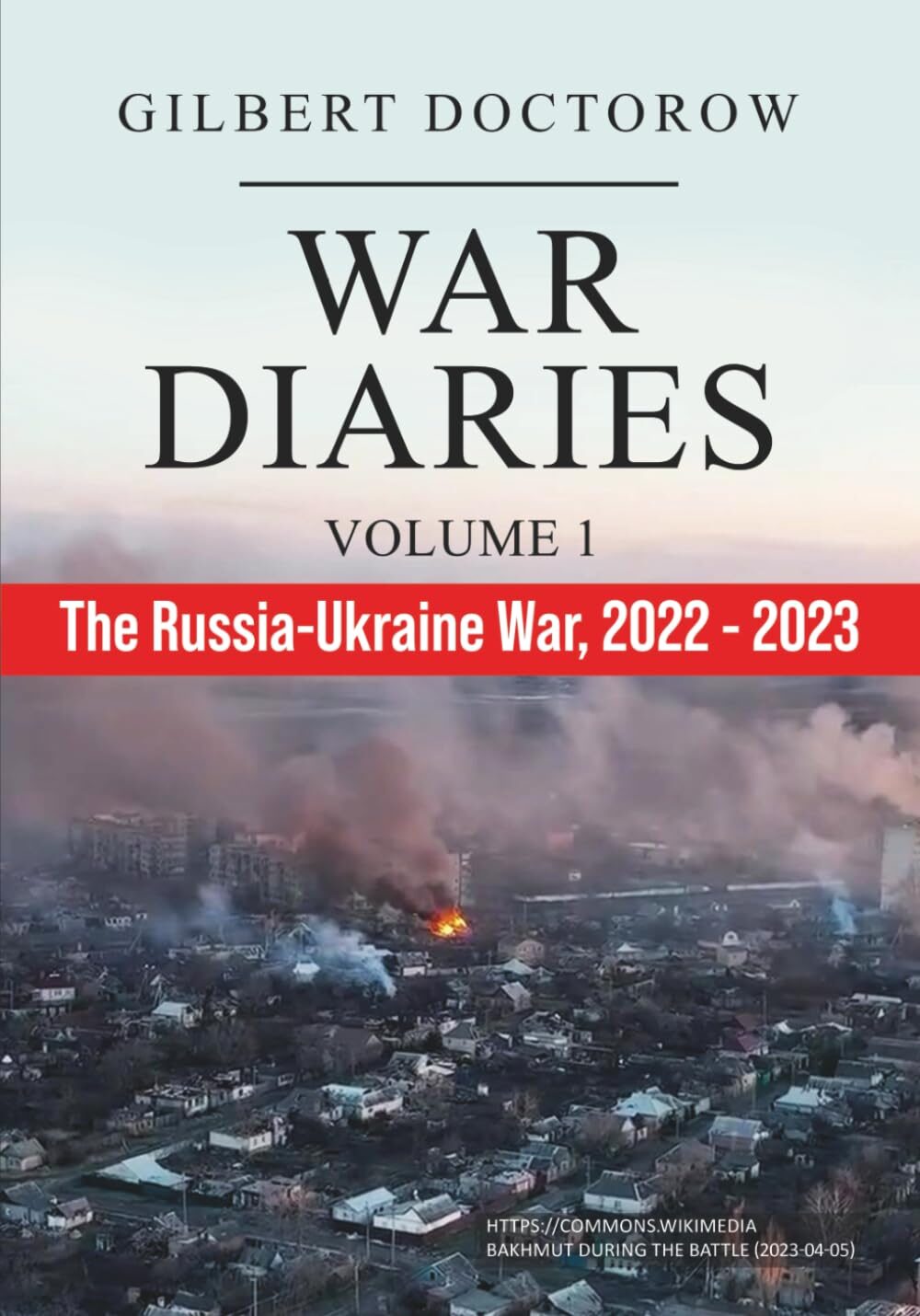
Review of Gilbert Doctorow’s War Diaries: Volume I – The Russia-Ukraine War, 2022-2023

War Diaries is a collection of writer and analyst Gilbert Doctorow’s regular essays on the Russia—Ukraine war covering the first two years of 2022—2023.  He has been a specialist on Russia for many years and readers of this blog will be familiar with him as I have cross-posted him plenty of times and reviewed other books by him. 

To summarize his background and expertise on Russia and the former Soviet Union, he was born and raised in the U.S., but his grandparents were Russian emigres.  His family background fostered a curiosity about Russia and he studied the country and its history at both Harvard and Columbia, including taking courses under the notorious Richard Pipes.  He then traveled through Western and Eastern Europe on a fellowship, and received another fellowship that enabled him to study for a year at the state archives in Leningrad and Moscow from 1971-72.  It was during this time that he met a young Russian writer who would become his wife. He earned his living doing consultancy work for U.S. companies with major industrial projects at the time in the Soviet Union.  Thus began a career that would span through the 1990’s working in management and consultancy positions for companies, mostly in the food processing, liquor and agribusiness industries, throughout Europe and Russia.  Through his work, he acquired a deep knowledge of the language and culture of Russia. Though his home base is in Brussels, he lives part-time in St. Petersburg and has provided regular updates over the years on what the Russian situation is like socially and economically in response to sanctions and varying degrees of war.  Some of those dispatches from 2022 and 2023 are included in his anthology.

The bulk, however, involve essays describing and analyzing the lead-up to and first two years of what is known in Russia as the “special military operation (SMO).”  In much of the western mainstream media it is referred to as “Russia’s full-scale invasion of Ukraine.” His essays also regularly provide a summary of what the domestic Russian media are saying – something that much of western media and punditry largely ignore, which is negligent if one’s purpose is to actually inform an audience or readership about Russia and its policies.

The book is over 700 pages long, so I have provided a review and thoughts on points throughout the essays that I found particularly interesting.*

Doctorow starts the book off with essays from one year prior to the SMO to provide context, with particular attention to how the Covid pandemic had already paved the way for the severance of economic and travel connections between Russia and the West. This is something that had become obscured to me over time and his mentioning it was an interesting reminder that the West was continuing its gradual mission since 2003 of finding a multitude of reasons to distance itself from and vilify Russia.

A recurring theme in Doctorow’s writing is the West’s refusal to understand, much less take seriously, Russia’s concerns and how its perceptions of relations directly inform what actions it will take:

“My overriding concern has been that the U.S. and foreign policy communities are ‘flying blind’ as they conduct their war on Russia since they do not take into account anything being said on the other side of the barricades. That can be fatal. We simply will not know how and why we are under missile attack should it come. Our leaders insist that Vladimir Putin’s actions are unknowable when nothing could be further from the truth.” (page xiv)

It would be difficult to disagree with Doctorow on this since Putin first clearly delineated Russia’s concerns with the West’s treatment of Russia and its legitimate interests in the very public forum of the Munich Security Conference in 2007. He has reiterated those points to varying degrees in subsequent speeches and interviews over the years as well as making concrete proposals to negotiate a more equitable security architecture in the Euro-Atlantic region at least twice since 2007 to avoid escalation. It was the West, led by Washington, that constantly dismissed Russia’s concerns and attempts at meaningful diplomacy.

Part of the answer to why Washington doesn’t seem able to display any strategic empathy and doesn’t know how to negotiate is provided by Doctorow himself in the following observation:

“U.S. policy is based on scenarios written by political scientists with the intellectual capacity and life experience of college sophomores; Victoria Nuland is an outstanding example.” (page 6)

Expounding on this theme later, he states:

“The problem in Washington is that no one on Capitol Hill or in the foreign policy community wants to acknowledge the obvious facts about Russia today. Everyone is happy with the version of a slovenly, chaotic Russia led by a merciless dictator, whose regime is fragile and just needs a little push, like Nicholas II’s autocracy, to tilt over and collapse. This is rubbish and if it remains the foundation of U.S. policy towards Russia under Biden then we can expect nothing much to happen to reduce the dangers of nuclear war or move towards calmer waters in international relations.” (page 25)

As I’ve written before, the people in Washington who serve as advisors and staff the executive branch are largely of poor quality.  They are pampered ideologues who are too arrogant to understand their own ignorance at worst (e.g. Michael McFaul) or career-climbing opportunists who know better than to stray much from the establishment narrative no matter how dangerously distorted it may be (e.g. Fiona Hill). In any event, Doctorow was very accurate in recognizing that the Biden administration’s attitude did not bode well.

Refreshingly, the author acknowledges that he was wrong in some of his analysis or predictions leading up to the SMO and in the early days of the fighting. For example, he (along with many others) predicted that the war would be relatively short. He admits that he did not initially take into consideration the following: 1) the US-led West’s view that this was a war to weaken Russia, using Ukraine as a proxy, and its willingness to increasingly escalate its provision of weapons and assistance to Ukraine that simply delays Ukraine’s inevitable defeat rather than facilitating victory, and 2) Russia’s approach to fighting the war has given consideration to the fact that Ukrainians are an historically fraternal people and therefore they wanted to forego a “shock and awe” style war of overwhelming destruction and mass civilian casualties. Ukraine does not look like Fallujah in 2003 or Gaza in 2025.

“Moscow wished to avoid civilian casualties in Ukraine to prevent revanchism after the fighting was over. This necessarily slowed the progress on the battlefield versus what we onlookers in the West expected. And when the acts of terror committed against Russian civilians put an end to Moscow’s indulgence for Ukrainians, the political calculations of the Kremlin to avoid casualties among its own troops that might kindle political disturbances within Russia nonetheless required avoidance of heroic mass offensives and storming of cities. This also slowed the Russian advance versus the forecast of outside observers.” (p. xv)

Regarding the actual invasion or start of the SMO, Doctorow says it was a response to the major increase in attacks by Kiev on the Donbas in the days prior and to prevent what Moscow believed to be a major imminent attack by Kiev on the rebel oblasts:

“The Russian invasion of Ukraine was timed to forestall what Moscow perceived to be an imminent and massive campaign by Kiev to storm the rebellious provinces of the Donbas. [A major uptick in attacks by Kiev on the Donbas was recorded by the OSCE in the days prior to the start of the SMO]. In that respect, defense of compatriots and of the Russian World was a motivating factor.  However, there was also a wholly different and less often publicly stated motivation at the level of strategic defense of the Russian Federation.

After all, Russia was deeply concerned over the advancing NATO presence in Ukraine during the time since 2014 when American and European advisors supervised the rebuilding of the Ukrainian armed forces and prepared the country for accession into NATO, an ambition that they had been promoting since 2008. Intelligence reports indicated that the British in particular were busy preparing to set up naval installations in one or another Ukrainian Black Sea port, and other NATO infrastructure was being introduced inland. The Russians expected the placement of US missiles in Ukraine, all of which would pose threats to Russian security with or without NATO membership.” (page xvii)

Doctorow also admits that he did not see the real significance at the time of the draft peace agreement of April 2022 scuttled by the West in the person of Boris Johnson who advised Ukrainian president Zelensky to keep the conflict going with the West insisting it would help Ukraine fight Russia for as long as it takes.  As those who have been following the war closely will know, the draft agreement would have left Ukraine with a much better deal than it will ever get now or in the future and hundreds of thousands of Ukrainian men would still be living their lives rather than moldering in the ground.  The terms provided that Ukraine could join the EU [whether the EU will ever actually accept them as a full member is another matter], and Kherson and Zaporozhe and the Donbas would be independent in exchange for Crimea being recognized as de facto Russian, Ukraine being formally neutral and foreign military personnel and installations being prohibited on Ukrainian territory.

With respect to the initial sanctions imposed by the West after the start of the SMO, Doctorow points out how these were an extension of previous punitive measures against Russia including the Magnitsky Act for alleged human rights violations and sanctions in response to the Crimea annexation (or reintegration depending on your point of view).  Russia’s response in the form of import substitution and strengthening economic ties with the non-West had been developing and has continued to keep Russia’s economy going, rendering western predictions of a dramatic economic collapse foolhardy.

It will be interesting to read Volume II when it comes out. I’m sure it will provide interesting commentary on what will no doubt be a continuing refusal on the part of the US-led West, due to its incompetence and hubris, to deal with reality when it comes to Russia.

*Doctorow’s books are always hefty and therefore tend to look a bit intimidating. Potential readers can peruse the Foreword, Introduction, and Table of Contents so they can pick and choose what will be most interesting and valuable to them.

Russia Matters: Zelenskyy Faces Outrage at Home Over $100M Corruption Scandal as EU Warns Aid Depends on Reform

Russia Matters, 11/14/25

  1. Ukraine’s anti-corruption agencies (known by their acronyms NABU and SAPO) announced on Nov. 10 that they had uncovered a $100 million kickback and money laundering scheme at the Energoatom state-owned nuclear energy company.1 The 15-month inquiry, which has been codenamed “Midas,”focuses on allegations of illegal payments by Energoatom contractors—typically 10–15% of contract value—to retain business.3 Suspects reportedly include Minister of Justice Herman Halushchenko, Energy Minister Svitlana Hrynchuk and Volodymyr Zelenskyy’s onetime business partner, Timur Mindich.4 Mindich—who is suspected of having allegedly run the kickback scheme—fled Ukraine as investigators closed in, while the two ministers resigned. With arrests already underway (prosecutors named seven suspects, with five detained), Zelenskyy—who was elected president in April 2019 on a promise to root out the pervasive graft,5 but who then came under strong fire at home and in the West in summer 2025 for attempting to defangthe two anti-corruption agencies—called for arrests, promised a reset at Energoatom and sanctions on those involved. The scandal has fueled public outrage at home—particularly amid the ongoing blackouts caused by Russian attacks—and has increased pressure on Zelenskyy’s government to deliver lasting accountability.6
    1. European leaders issued warnings to Ukraine this week, saying that continued military and financial support depends on Kyiv taking decisive action against corruption. European Commission spokesman Guillaume Mercier called on Ukraine to protect its anti-corruption bodies and ensure clean handling of international financial support. German Chancellor Friedrich Merz told Zelenskyy that Europe expects Ukraine to advance anti-corruption reforms, while German Foreign Minister Johann Wadephul stressed that Western aid hinges on stronger anti-corruption measures. Dutch Finance Minister Eelco Heinen also emphasized that EU aid packages are conditional on Ukraine’s fight against graft. Italy’s Deputy Prime Minister Matteo Salvini warned that more aid could prolong the war and worsen corruption. Hungarian Foreign Minister Péter Szijjártó called for a freeze on EU funds to Ukraine, while Hungarian Prime Minister Viktor Orban declared that “the golden illusion of Ukraine is falling apart.” Asked if the disclosures have shaken EU confidence, Lithuanian Finance Minister Kristupas Vaitiekunas responded in blunt terms: “Maybe, but what other options do we have?” according to The Washington Post.
  2. In the period of Oct. 14–Nov. 11, 2025, Russian forces gained 165 square miles of Ukrainian territory, an increase over the 154 square miles these forces gained during the previous four-week period, according to the Nov. 12, 2025, issue of RM’s Russia-Ukraine War Report Card. This week, Russian forces have been advancing into the eastern towns of Pokrovsk and Myrnohrad, which they are “very likely” to seize, according to ISW. Ukraine’s DeepState OSINT reportedly announced on Nov. 12 that Russia’s gain of 15 square miles (40 square kilometers), made in the preceding 24 hours, was the largest daily territorial gain by the Russian troops since the start of the year. DeepState also reported that Russian forces captured the following settlements in southeastern and eastern Ukraine on Nov. 7–14: Novoe, Novouspenivske, Rivnopillia, Uspenivka, Katerynivka, Novomykolaivka, Yablukove and, most recently, Stepova Novoselivka. Since Jan. 1, 2025, average Russian monthly gains have been 170 square miles, according to the RM card.
    1. Russia launched 98 ballistic missiles into Ukraine in October, a record since observations began in May 2023, with only 17 intercepted by Ukraine, according to the card.
  3. Ukrainian prosecutors estimate that 290,000 cases have been opened for desertion or absence without leave since the start of the war, highlighting the severe manpower crisis facing Ukrainian forces, according to The New York Times. In October alone, nearly 20,000 such cases were recorded—the highest monthly figure this year—as Russian troops exploit gaps along thinly held lines in Pokrovsk and Myrnohrad, where just four to seven infantrymen defend each kilometer of the 1,000 kilometer frontline, according to Financial Times. “The result [of desertions] is that the [Ukrainian] land forces are not expanding but are actually declining in numbers,’’ Konrad Muzyka, director of Rochan Consulting, told FT.
  4. A German federal police investigation has concluded that an elite Ukrainian military unit, directed by Gen. Valeriy Zaluzhniy, was responsible for the September 2022 Nord Stream pipeline bombings, aiming to disrupt Russian energy revenues and Moscow’s ties with Germany, The Wall Street Journal reported. Investigators relied on surveillance photos and boat rental records, issuing European arrest warrants for three Ukrainian soldiers and four divers.7 The findings have triggered diplomatic friction: Poland has refused to extradite one suspect, hailing him as a hero, while Italy is considering a similar extradition request, according to WSJ. The case has intensified political divisions within Germany—where the far-right has capitalized on public anger over energy prices—and across Europe, straining unity and stirring debates about continued aid to Kyiv. [As regular readers of this blog know, this narrative of who and how the Nordstream pipeline bombing was carried out is not very credible. Apparently, German authorities must decide on a narrative that doesn’t admit their own cravenness in allowing self-righteous allies to destroy their infrastructure and economy. – Natylie]
  5. Russian Foreign Minister Sergei Lavrov stated that the Russia-China Treaty of Good-Neighborliness, Friendship and Cooperation remains fully relevant and that the approaching expiration date of July 16, 2026, will not go unnoticed by either side, according to Kommersant. Lavrov indicated that Moscow and Beijing are working on extending or updating the treaty as its term nears completion, according to Kommersant. It will be interesting to see if there will be new definitions of the Russian-Chinese relationship if the signatories update the treaty rather than extend it.*

Analysis & Book Reviews on U.S. Foreign Policy and Russia