Dan Kovalik & Rick Sterling: Journey to St. Petersburg, Moscow, and Crimea (Part 1 of 3)

By Dan Kovalik & Rick Sterling, Dissident Voice, 5/25/23

At the end of April of this year, the two of us ventured together to Russia. We went with the purpose of fact-finding and also to make a point that we do not believe that Russia should be isolated from the world through sanctions and travel bans.

At this moment, Russia is more isolated from the West than it has ever been, quite possibly in history. As just one example, while V.I. Lenin was able to famously travel from Finland via train to St. Petersburg, even during the height of WWI, the train from Finland to Russia ceased operating after February 24 of 2022. And indeed, it was through Finland that we decided to travel to Russia, simply because there are now very limited ways to travel there. Thus, while for years, even during the Cold War, one could easily fly directly from the US to Russia on Aeroflot and other airlines, that is no longer possible due to sanctions. Now, one can only fly there through Serbia, Turkey or the UAE, but those flights are quite expensive.

And so, we ended up choosing to fly to Helsinki, Finland and have a Russian friend who has a non-Russian passport (Russians with only Russian passports cannot travel to Finland) drive from St. Petersburg to pick us up. This turned out to be more easily said than done as our friend’s car broke down at the Finnish/Russian border. And so, we took a very expensive, three-hour cab ride to the border, met up with our friend and crammed ourselves into the cab of a tow truck to drive the remaining three hours to St. Petersburg – a quite inauspicious beginning to our journey.

Saint Petersburg streets are busy from early morning til late at night. This photo taken at 11:30pm

St. Petersburg (Leningrad)

Our first several days were spent in St. Petersburg, formerly “Leningrad.” We stayed strategically at the Best Western in Uprising Square – so named by the new Bolshevik government in 1918 to commemorate the Great October Revolution of 1917. In the Square is located the Moscow train station which we used to great effect during our journey, as well as the Leningrad Hero-City Obelisk. The Obelisk commemorates Leningrad’s designation as one of 13 “hero cities” in the Soviet Union which distinguished themselves for their exceptional sacrifices in resisting the Nazis during WWII. Two other cities we visited on our trip (Moscow and Sevastopol, Crimea) are also honored with this designation, as is Kiev, Ukraine and of course Volgograd (formerly “Stalingrad”).

During our stay, the city of St. Petersburg sure seemed more like Leningrad, for it was beginning to be decked out in red flags with hammers and sickles and stars to commemorate both May Day and Victory Day over the Nazis on May 9. We were told by long-time residents that the ubiquitous display of such symbols of the USSR was something new (at least since the collapse of the Soviet Union in 1991), and was spurred on by Russia’s Special Military Operations beginning in February of 2022. It appears that the Russian people, and the Russian government as well, are looking to the legacy of the Soviet Union as a source of strength, pride and unity during this time of war – a war that they view, we believe quite rightly, was forced on them.

The newly released Russian Federation “concept” on foreign policy states quite explicitly that Russia’s current foreign policy is informed by the two main objectives and successes of the USSR – the defeat of Nazism and global decolonization. Certainly, on paper at least, this belies the claim of some Western leftists that Russia is motivated in its relations with other nations by imperialist concerns.

Dan takes his turn playing guitar on St Petersburg street at 11 pm

While in St. Petersburg, we visited the site of the terrorist attack which claimed the life of Russian journalist Vladlen Tatarsky and wounded over 30 others, at least 10 gravely. The attack involved the bombing of a cafe in the picturesque University district of St. Petersburg along the Neva – a soft target if there ever was one. The cafe remains closed, and three sets of memorials for Tatarsky are set up around it, consisting of flowers and photos. Of course, the Western press has tried to do everything it can to justify this vicious attack upon civilians, writing off Tatarsky as “pro-Kremlin” and “pro-war” (as if the Western press can’t be fairly characterized as “pro-war” and “pro-Pentagon”) and simply glossing over the numerous other civilians wounded in the assault as collateral damage.

Rick and Dan at the site where Russian journalist was killed

Moscow

As planned, we left St. Petersburg by train to Moscow after several days. We took the faster “Sapsan” (Falcon) train to Leningrad Station in Moscow (it is still called that). The train ride, reaching 120 mph, was smooth and comfortable. We sat across from two Russian women, one of whom was quite friendly. She told us of her son who lives in Boston and who, quite sadly for her, she hasn’t seen in years. She kept sliding over hard candy to share with us. And, when she saw Dan nervously biting his nails, she kindly handed him her nail filer for him to use. This type of sharing on the train is quite common in Russia as we would continue to discover on our journey.

Rick with train compartment companions

Moscow too was being decorated for the May 9 Victory Day celebration. Red Square was sealed off from the public to prepare for the event, and the city was on high alert for possible terrorist attacks, one of which would come while we were in Russia with the drone attack upon the Kremlin itself. Despite the fears of attack, Muscovites were out on the streets day and night. Both Moscow and St. Petersburg were incredibly vibrant – much more so than our cities back home which are still feeling the effects of the lockdowns during the pandemic. Gorky Park was particularly lively with throngs of families with children enjoying the spring weather, swings and slides. Colorful tulips were in full bloom.

From appearances, Russia largely did not appear to be a country at war. However, everyone we talked to confided in us about their concerns for the war – for the loss of life on both sides, the fact that it was lasting much longer than people had expected, and the danger that the war could expand into a greater conflagration. Some Russians expressed their fear that nuclear weapons would end up being used before this was all over, though they believed that the US would be the first to launch them. At the same time, the Russians showed their usual stoicism in the face of such dangers, with one family with whom Dan had dinner stating almost matter-of-factly that “Russia has always had difficult times, and it will have them again.”

After several days in Moscow, and our hopes for visiting the Donbass falling through, we took the long, 27-hour train ride to Crimea – a region now fully in the crosshairs of the proxy war.

Arriving in Crimea

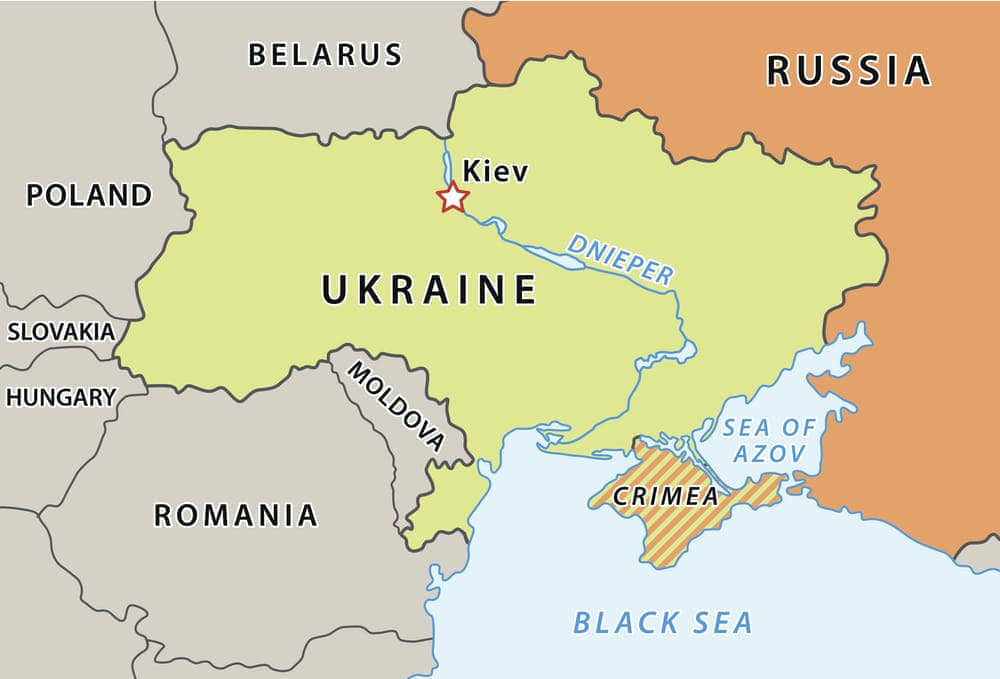
Ukrainian President Zelensky says he will “take back” Crimea. US leaders Victoria Nuland and Jake Sullivan say they support him. Indeed, Sullivan recently suggested Ukraine is free to use the F-16 fighter jets in attempting to “recapture” Crimea.” We traveled to Crimea to see the situation and learn details of how and why Crimea seceded from Ukraine in 2014.

A highlight of the train ride was passing over the new 12-mile long Kerch Strait bridge which connects mainland Russia to the Crimean peninsula. As our train approached the bridge, we could see that saboteurs had been active. There was a fuel tank on fire in the near distance. A couple passengers did not want us to photograph this, probably thinking it gives publicity to the enemy.

As we departed the train in Crimea at the beautiful station in the Capitol city, Simferopol, the loudspeakers on the platform greeted us with traditional Russian songs.

We then drove the roughly two hours to Yalta where we stayed while in Crimea. Along our drive, we saw the giant mosque which the Russian government is building along the highway in an area where Tatars, who generally practice the Islamic faith, protested to have land to live and worship. The Tatars had been persecuted during WWII as suspected collaborators and forcibly removed from Crimea to other Soviet Republics.

A number of Tatars have moved back to Crimea over the years and now make up about 12 percent of the population of Crimea. Meanwhile, about 65 percent of the Crimean population is ethnic Russian and about 15 percent is Ukrainian, though about 82 percent of the population overall speaks Russian on a daily basis.

As we were told while in Crimea, one of the first things President Putin did after Crimea returned to Russia in 2014 was to try to make good relations with the Tatar community by “rehabilitating” them from the claims of collaboration made by Stalin government, giving them the land they protested for, providing them with modest monetary reparations and building them the new Mosque.

Historical Background

All in all, we spent five days seeing the sights and meeting people in the capital Simferopol, Sevastopopol and Yalta. We were guided by translator and native Crimean Tanya. In the past, Tanya worked for US Aid for International Development (USAID), teaching Russian to US Peace Corps volunteers.

Crimea has a rich agricultural sector. It was severely hampered after Ukraine dammed the canal bringing fresh water from the Dnieper River. After Russian forces intervened, they removed the dam and agriculture is once again thriving. Crimean cities are busy with the streets and sidewalks full. In the parks, there are teens skate boarding and seniors playing chess.

The situation in Crimea is emblematic of the Ukraine crisis overall. In both Crimea and the Donbass (eastern Ukraine), the majority of people are ethnically Russian, their native language is Russian and they voted overwhelmingly for the elected but overthrown President Yanukovich.

From the 15th century Crimea was part of the Ottoman Empire. It became part of the Russian Empire in 1783 after the army of Catherine the Great defeated the Turks.

In 1921, Crimea became the Crimean Autonomous Soviet Socialist Republic as part of the Russian Soviet Socialist Republic.

In 1954, Soviet Premier Khrushchev designated Crimea to be part of the Ukraine republic. This was done without consulting the Crimean people but it was not a major change since they were all part of one country, the Soviet Union. As we were told in Crimea, “Nobody could imagine the Soviet Union breaking up.”

As the Soviet Union was breaking up, Crimeans held a referendum in January of 1991. They voted overwhelmingly (94% in favor) to become the “Autonomous Republic of Crimea” and to separate from Ukraine. There was contention with Kiev and ultimately it was agreed that Crimea would be autonomous but within Ukraine. There was desire but not the urgency to secede from Ukraine at this point.

The desire to separate from Ukraine became more urgent in late 2013 and early 2014 as Crimeans watched with alarm as Russophobic ultra-nationalist and neo-nazi groups increasingly dominated violent protests in Kiev’s Maidan plaza. The book To Go One’s Own Way documents how the Crimean parliament and presidency issued statements, pleas and warnings about the threat to Ukrainian unity beginning in November 2013.

As we discuss in an upcoming article, the government of Ukraine reacted to the Crimean referendum to reunite with Russia quite punitively, and it continues to punish the Crimeans for their decision. At the same time, Russia has actively invested in the peninsula and made major improvements in the overall infrastructure there. In light of the foregoing, it is safe to say there are relatively few Crimeans who ever wish to return to Ukraine.

Dan Kovalik is a human rights attorney and author of seven books. Rick Sterling is a journalist based in the San Francisco Bay Area. Read other articles by Dan Kovalik and Rick Sterling.
Prof. Geoffrey Roberts: Putin’s invasion of Ukraine was a war of choice, not necessity

Earlier today I posted an excerpt of a piece by Ray McGovern in which he presents John Mearsheimer’s response to his question of whether Russia had any other viable options than war in February of 2022. Mearsheimer answered that he did not think Putin had any other option. Given McGovern’s recent comments, it seems that he agrees with Mearsheimer’s assessment. Below is a rebuttal by Prof. Geoffrey Roberts whose articles explaining Putin’s reasons for invading in 2022 I’ve posted in the past. While he has demonstrated that he understands very well Putin’s concerns that led to his decision to invade, he disagrees that it was necessary. – Natylie

By Prof. Geoffrey Roberts, Brave New Europe, 5/31/23

‘Did Putin have ‘other options’ on Ukraine?’ asked Ray McGovern, ex-CIA analyst and long-time anti-war activist. His question was directed at the signatories of a recent statement in the New York Times calling for an urgent diplomatic initiative ‘to end the Russia-Ukraine war before it destroys Ukraine and endangers humanity.’

Whilst welcoming this intervention by a group of distinguished former US national security officials, McGovern queried their assumption that invading Ukraine was just one of Putin’s options in February 2022.

McGovern’s own answer to the question (in an interview with Judge Napolitano) is that Putin had no choice but to go to war to safeguard Russia’s security.

The NYT statement’s eminent signatories can speak for themselves, but McGovern’s question is a good one and merits a response from those like myself who oppose both Putin’s invasion of Ukraine and the Western proxy war on Russia.

Shortly after the outbreak of hostilities, a group of Russian Studies scholars, myself included, issued an ‘appeal’ headlined ‘End the Invasion of Ukraine Now!’:

The invasion is Putin’s war, a war of choice not necessity. The prime responsibility for the conflict, and all its sorrowful, devastating and dangerous consequences, is his.

Nothing that has happened in the last 15 months has led me to change my mind.

Ukraine’s economy has been wrecked and its society devastated by hundreds of thousands of casualties and the mass flight of millions of its citizens. In Eastern and Southern Ukraine, the homelands of millions of pro-Russian Ukrainians have been laid waste. Russia has suffered thousands of casualties, including an estimated 30,000-40,000 fatalities. Tens of thousands of Ukrainians are fighting in both sides’ armies, with many millions more actively supporting either the pro-Russian or the Ukrainian nationalist cause. Ukrainian ultra-nationalism has never been stronger, or more virulent, and both Russia and Ukraine are now much more authoritarian and repressive societies.

Russia and the West are locked in an economic and sanctions war whose price is being paid by the hundreds of millions of people struggling with sky-rocketing energy costs and inflationary food prices. NATO continues to expand with Finland’s admission into the organisation, and Sweden is slated to follow. Never has the Western military alliance’s collaboration been so deep and far-reaching, or more dangerous.

We are on the cusp of a renewed nuclear arms race and the threat of atomic warfare has never been greater. Arms manufacturers are coining it and Western hawks are cock-a-hoop about their long-sought-after confrontation with Russia. In academia there are calls for ‘decolonising’ Russian Studies and, even, for a McCarthyite purge of anyone who refuses to toe the anti-Russia line. The lies, distortions, manipulations, and inversions of the relentless and unrestrained propaganda war signal that the post-truth age truly has arrived, and with a vengeance.

None of this is Putin’s sole responsibility. He started the war but the West has kept it going. Without the West’s proxy war against Russia, the battles in Ukraine would have ended long ago, thereby saving the lives of hundreds of thousands of people.

Had Putin known then what we know now about the course of the war, would he have gone ahead with the invasion? I very much doubt it. I strongly suspect he would have persisted with his extant policy of militarised diplomacy.

Initiated in late 2021, Putin’s strategy of diplomatic demands backed by the threat of military force certainly got the West’s attention. He was inundated with phone calls and visits from western leaders urging him to keep the peace. NATO and the United States stonewalled his key demands for Ukraine’s neutralisation and an end to NATO’s expansion, but they did concede the admissibility of Russia’s core principle of the indivisibility of security. There was also some negotiating progress on arms control issues. Slowly but surely the strategy was beginning to work.

When, in mid-February 2022, Putin asked his foreign minister whether Russia should continue negotiating, Lavrov replied: “I think our opportunities are far from exhausted. Negotiations should not be endless, but I think we should still continue to pursue and build on them at this point.”

Lavrov evidently believed Putin would continue his militarised diplomacy, and judging by their remarks at the Russian Federation’s Security Council on 21 February, so did other members of his inner circle, such as former President Dmitry Medvedev, the Council’s secretary, Nikolai Patrushev and the FSB’s foreign intelligence chief, Sergey Naryshkin.

That expectation was widespread in the West, too, where many astute and well-informed commentators were adamant Putin would be mad to go to war when the diplomatic game had only just begun. “Godot Likely to Arrive Before Russia Invades Ukraine” was the headline of Ray McGovern’s piece for antiwar.com on 22 January 2022.

A month later, Putin shocked and surprised us all by abruptly abandoning diplomacy and launching a large-scale invasion of Ukraine.

My answer to McGovern’s question – what else Putin could have done? – is that he should have stuck to diplomacy.

With the benefit of hindsight, it is easy to argue the strategy of militarised diplomacy had little chance of success. But Putin did not know that at the time, and nor do we know now that diplomacy was destined to fail. The only way to test that hypothesis would have been for Putin to continue his diplomatic offensive for a few more months. The same applies to what might have happened if Putin had taken an intermediate course of action, such as incorporating rebel Donetsk and Luhansk into the Russian Federation rather than signing mutual defence pacts with each of them as pretext for the Special Military Operation (SM0).

No war is inevitable until the moment of decision. All wars are the result of contingency and choice. On the eve of the Ukraine war, Putin had a range of available choices. We can’t be sure what any of their outcomes would have been. All we know for certain is that the consequences of Putin’s actual choice – irrespective of the final outcome of the war – have been calamitous and potentially catastrophic.

Putin chose war because he felt it was the best choice, not because he had no alternatives.

Following publication of our ‘appeal’, I put on my historian’s hat and set out to explore the reasons for Putin’s momentous decision to go to war. I concluded he went to war to prevent Ukraine from becoming an ever-stronger and threatening NATO bridgehead on Russia’s borders. The invasion was a preventative action designed to nip in the bud a dire, future threat from a heavily armed, ultra-nationalistic Ukraine that, with NATO’s help, would seek to recover Crimea and the Donbass by force.

My surmise is that what tipped the balance of his calculations in favour of military action was Zelensky’s inflammatory speech to the Munich Security Conference on 19 February 2022 in which he threatened Ukrainian re-acquisition of nuclear weapons.

As I also noted in my article, some pro-Russia supporters have attempted to shore up the case for war by claiming Ukraine’s armed forces were actively preparing a major attack on the Donbass. However, there is no convincing evidence for this hypothesis and it is not a justification that Putin himself has used. It was a preventative war that Putin launched at the end of February 2022, not a pre-emptive strike.

Explanation is not the same as justification. While Putin may see his invasion of Ukraine as a necessary, defensive act, we don’t have to accept his rationalisations. Moreover, we are entitled to judge his action by its results as well as its motivations and intentions.

The only valid moral-political justification for war is necessity. Putin’s decision-making failed that test because a fundamental threat to Russian security in the form of a powerful NATO enclave in Ukraine was emergent but not yet fully formed. His fears about Ukrainian nuclear rearmament were authentic but they were also exaggerated: it is far from clear the West would have been a willing accomplice of Zelensky’s nuclear ambitions given Ukraine’s commitments under the Nuclear Non-Proliferation Treaty. Above all, the possibilities of a negotiated solution to the Ukrainian crisis had not been exhausted when he decided to invade. There was time and scope for the continuation of diplomacy.

Sticking to peace entailed its own risks and costs, notably NATO’s continued military build-up in Ukraine, but going to war was hardly a risk-free option.

Paradoxically, the person who started the Ukraine war may also be our best hope for ending it and securing a ceasefire and a negotiated settlement of the conflict.

Putin’s invasion of Ukraine was not so much an abandonment of militarised diplomacy as its radicalisation. Putin went to war to force Ukraine and the West to concede what they had refused to negotiate. As the abortive Istanbul peace talks of spring 2022 show, he came tantalisingly close to success in the form of a deal with Ukraine that could have ended the war before it really got going. Reportedly, those talks were curtailed by Ukraine at the West’s behest, but that is no excuse for Putin’s miscalculations in launching the SMO, the over-estimation of his own military forces and the under-estimation of Ukrainian resilience and of Western resolve.

The longer the war goes on the bigger will be the price of peace for Ukraine in terms of its statehood and lost territories. But, remarkably, Putin remains open to diplomacy and to a negotiated end to the war, providing the terms meet Russia’s security requirements and protect the interests of pro-Russian Ukrainians.

Currently, the prospects for peace are depressingly dismal, but as the contingencies of the war change, so, too, will the range of feasible human choices, hopefully in a direction that leads to a ceasefire and then to the kind of diplomatic settlement that could and should have prevented the conflict in the first place.

Ray McGovern: John Mearsheimer on Putin’s Options on Ukraine

By Ray McGovern, website, 5/24/23

When Professor John Mearsheimer spoke on “Where is the Ukraine War Going?” at the Committee for the Republic on May 22, I was able to ask the first question of the Q & A. I referred to the conventional wisdom that Putin had “other options” to invading Ukraine and noted that, so far, no one has able to tell me what those options are. I asked John if he knew what those espousing that conventional wisdom might be talking about. My question and Mearsheimer’s response can be seen beginning at minute 51:30 of the video:

The following is a transcription of John’s comments:

“No, I don’t think he had any options. I do believe that Putin was deeply committed to finding a negotiated settlement to the problem. As I said to you in my formal comments, he was deeply committed to the Minsk agreement because what he wanted to do was to shut down the conflict in the Donbas so he would not have to invade.

And, with regard to NATO expansion, EU expansion, and the efforts to make Ukraine a Western bulwark on Russia’s border, he went to great lengths to explain to the West why that was unacceptable. And on December 17, 2021, he sent a letter to Biden and to NATO saying that you have to do x y and z, so we can find a solution to this problem. And we refused to go along. And I think that Putin was left in a position where he felt he had no choice, because, to answer your question, there was no other way to deal with the problem. So I think that he, with great reluctance, invaded Ukraine.”

Tucker Carlson Weighs in on Destruction of the Nova Kakhovka Dam on First Episode of His Independent Show on Twitter

Link here.

Prof. Geoffrey Roberts: A grim vision of nuclear warfare in Ukraine

By Prof. Geoffrey Roberts, Pearls & Irritations, 5/24/23

Geoffrey Roberts is a specialist in Soveiet and Russian foreign and military policy, Geoffrey Roberts is Emeritus Professor of History at UCC and a Member of the Royal Irish Academy. His latest book is Stalin’s Library: a Dictator and His Books (Yale University Press 2022).

In Ukraine, grim visions of a new age of nuclear warfare are the natural counterpart of western hardliners’ march of folly towards the nuclear brink. Thankfully, there is an alternative, one that has been possible since the very beginning of the conflict and now has growing support among Western publics.

The Harvard-based website, Russia Matters, recently published an article by retired Brigadier-General Kevin Ryan with the alarmist but accurate headline ‘Why Putin Will Use Nuclear Weapons in Ukraine’.

According to Ryan, who served as a US defence attaché in Moscow, Putin’s use of tactical nuclear weapons is all but preordained because Russia does not have the conventional military power to defeat Ukraine.

In support of this supposition, Ryan recycles the well-worn mantras of western wishful thinking about the military situation in Ukraine: Russia is running out of materiel, its troops are of poor quality and Kiev is going to launch an offensive that will decisively turn the tide of the war in its favour.

As Bakhmut falls and Ukraine reels under successive waves of Russian missile strikes on its infrastructure, air defences and ammunition dumps, Ryan’s words ring more than a little hollow.

Most observers see Putin’s nuclear sabre-rattling as an instrument to deter and limit direct western involvement in the war, but Ryan construes it as evidence that Putin is preparing to use tactical nukes to defeat Ukraine’s coming offensive.

While Ryan is right to emphasise that Western decision-makers underestimate the chances of nuclear war in Ukraine, it is their own escalatory policies that constitute the main risk, not the possibility that Putin might decide to authorise the use of tactical nuclear weapons.

Ryan rightfully points out that Putin has defined Russia’s proxy war with NATO in Ukraine as existential for the Russian Federation. But does that mean battlefield defeat or the loss of occupied territories in Ukraine will prompt him to press the nuclear button?

Putin has defined the existential threat to Russia as Western aspirations to break-up the Russian Federation and subjugate its peoples. That is the outcome he is pledged to do everything in his power to avert, even if it means risking strategic nuclear war.

Ryan also finds foreboding Putin’s appointment of his General Staff Chief, Valery Gerasimov, as overseer of the ‘Special Military Operation’ in Ukraine, together with the heads of Russian ground and air forces as his deputies. This is worrying, says Ryan, because these three officers control Russia’s tactical nuclear weapons, though he concedes that they can only use them at Putin’s behest. Even so, as the 1962 Cuban missile crisis showed, the risk of unauthorised use of tactical nuclear weapons by local commanders is not to be lightly dismissed.

In the absence of a Stavka (HQ) headed by a military-political Supreme Commander – as was the case with Joseph Stalin during the Great Patriotic War – the aforementioned high command structure is only logical, especially when Gerasimov is also the country’s leading military strategist.

Gerasimov and his team must surely be willing and able to use tactical nuclear weapons should Putin consider it necessary, but their conduct of the actual war signals no such strategy or intention. The low risk, force-conservation grind of Russia’s attrition tactics are, if anything, indicative of a concern to restrict the war to the use of conventional weaponry.

The very real danger of nuclear escalation in Ukraine arises not from a putative Putin decision to win on the battlefield at any cost, but from the West’s constant crossing of its own red lines on military aid to Ukraine. NATO states began by sending large quantities of ammunition, small arms and defensive weaponry, then came long-range howitzers and HIMARs followed by air defence systems, tanks and armoured vehicles. Britain has now supplied Ukraine with long-range missiles capable of hitting a multitude of targets deep in Russia. Next will come F16 fighter jets, flown, perhaps, by western as well as Ukrainian pilots.

Western weapons, technicians, trainers, military planners, intelligence gatherers and special forces have killed or contributed to the deaths of tens of thousands of Russian soldiers. At some point Putin may well decide to retaliate by stepping on to the escalatory ladder himself, with who knows what consequences if his spilling of American blood leads to a tit-for-tat response from would-be two-term President Joe Biden.

We will know soon enough if Ryan’s prognostications about the future course of the war are correct. But let’s assume, for the sake of argument, he is right and that facing defeat in Crimea or the Donbass, Putin would go nuclear. Surely that means we should redouble efforts to end the war as soon as possible? What sense does it make to continue a proxy war with Russia that, according to Ryan, is leading to Ukraine’s nuclear obliteration?

Pessimism and passivity are the natural allies of Ryan’s alarmism. Far from advocating restraining Ukraine so as to avoid nuclear escalation, Ryan is content for the West to simply “anticipate a nuclear weapon will be used.” And since, according to him, the use of nuclear weapons by Putin is inevitable, the West needs to prepare for a world in which they have been normalised as a weapon of war.

Ryan seems to discount the possibility that the United States would respond to Putin’s use of nuclear weapons in Ukraine by radical escalatory action of its own – a dubious assumption given Professor Joseph M. Siracusa’s recent report from the NATO-funded Tallinn Security Conference, where a high-ranking American official claimed it would be met by a massive US conventional attack on Crimea and on Russia’s Black Sea fleet.

According to Perth-based political scientist, Siracusa, the numerous Western hawks at the conference were gung-ho for throwing gasoline on the fires of the Ukraine war.

Siracusa’s reporting reveals that the true danger of nuclear escalation stems not from what Putin may or may not do, but from the inscribed logic of the western hardline view of the war as a zero-sum game in which either Russia or the West must triumph.

It is not clear to what extent Ryan supports such extremism but his grim vision of a new age of nuclear warfare is the natural counterpart of the western hardliners’ march of folly towards the nuclear brink.

Thankfully, there is an alternative, one that has been possible since the very beginning of the conflict and now has growing support among Western publics: a peace for land deal in which Ukraine concedes already-lost territory to Russia in exchange for security guarantees about its future as an independent, sovereign state. Such a deal would be a bitter pill for Ukrainians to swallow after so much sacrifice, but it would be far better fate than becoming the nuclear wasteland envisaged by General Ryan.

Analysis & Book Reviews on U.S. Foreign Policy and Russia