Medea Benjamin & Nicholas JS Davies: G7 Versus Diplomacy for Ukraine

ukrainian flag waving in wind with clear sky in background
Photo by Nati on Pexels.com

By Medea Benjamin & Nicholas JS Davies, Consortium News, 5/31/23

When Japan invited the leaders of Brazil, India and Indonesia to attend the G7 summit in Hiroshima, there were glimmers of hope that it might be a forum for these rising economic powers from the Global South to discuss their advocacy for peace in Ukraine with the wealthy Western G7 countries that are militarily allied with Ukraine and have so far remained deaf to pleas for peace.

But it was not to be. Instead, the Global South leaders were forced to sit and listen as their hosts announced their latest plans to tighten sanctions against Russia and further escalate the war by sending U.S.-built F-16 warplanes to Ukraine. 

The G7 summit stands in stark contrast to efforts of leaders from around the world who are trying to end the conflict. In the past, the leaders of Turkey, Israel and Italy have stepped up to try to mediate. Their efforts were bearing fruit back in April 2022, but were blocked by the West, particularly the U.S. and U.K., which did not want Ukraine to make an independent peace agreement with Russia. 

Now that the war has dragged on for over a year with no end in sight, other leaders have stepped forward to try to push both sides to the negotiating table. In an intriguing development, Denmark, a NATO country, has stepped forward to offer to host peace talks. On May 22, just days after the G7 meeting, Danish Foreign Minister Lars Løkke Rasmussen said that his country would be ready to host a peace summit in July if Russia and Ukraine agreed to talk. 

“We need to put some effort into creating a global commitment to organize such a meeting,” said Rasmussen, mentioning that this would require getting support from China, Brazil, India and other nations that have expressed interest in mediating peace talks. Having an EU and NATO member promoting negotiations may well reflect a shift in how Europeans view the path forward in Ukraine.

Also reflecting this shift is a report by Seymour Hersh, citing U.S. intelligence sources, that the leaders of Poland, Czechia, Hungary and the three Baltic states, all NATO members, are talking to Ukraine’s President Volodymyr Zelensky about the need to end the war and start rebuilding Ukraine so that the 5 million refugees now living in their countries can start to return home.

On May 23, right-wing Hungarian President Viktor Orban said, “Looking at the fact that NATO is not ready to send troops, it’s obvious that there is no victory for poor Ukrainians on the battlefield,” and that the only way to end the conflict was for Washington to negotiate with Russia. 

Meanwhile, China’s peace initiative has been progressing, despite U.S. trepidation. Li Hui, China’s special representative for Eurasian affairs and former ambassador to Russia, has met with Russian President Vladimir Putin, Zelensky, Ukraine’s Foreign Minister Dmytro Kuleba and other European leaders to move the dialogue forward. Given its position as both Russia’s and Ukraine’s top trading partner, China is in a good position to engage with both sides.

Lula Appoints Peace Envoy 

Another initiative has come from President Lula da Silva of Brazil, who is creating a “peace club” of countries from around the world to work together to resolve the conflict in Ukraine. He appointed renowned diplomat Celso Amorim as his peace envoy.

Amorim was Brazil’s foreign minister from 2003 to 2010, and was named the “world’s best foreign minister” in Foreign Affairs magazine. He also served as Brazil’s defense minister from 2011 to 2014, and is now Lula’s chief foreign policy adviser. Amorim has already had meetings with Putin in Moscow and Zelenskyy in Kyiv, and was well received by both parties.

On May 16, South African President Cyril Ramaphosa and other African leaders stepped into the fray, reflecting just how seriously this war is affecting the global economy through rising prices for energy and food. Ramaphosa announced a high-level mission by six African presidents, led by President Macky Sall of Senegal. He served, until recently, as Chairman of the African Union and, in that capacity, spoke out forcefully for peace in Ukraine at the U.N. General Assembly in September 2022.

The other members of the mission are Presidents Denis Sassou Nguesso of Congo, Abdel Al-Sisi of Egypt, Yoweri Musevini of Uganda and Hakainde Hichilema of Zambia. The African leaders are calling for a ceasefire in Ukraine, to be followed by serious negotiations to arrive at “a framework for lasting peace.” U.N. Secretary-General Guterres has been briefed on their plans and has “welcomed the initiative.”

Pope Francis and the Vatican are also seeking to mediate the conflict. “Let us not get used to conflict and violence. Let us not get used to war,” the pope preached. The Vatican has already helped facilitate successful prisoner exchanges between Russia and Ukraine, and Ukraine has asked for the pope’s help in reuniting families that have been separated by the conflict. A sign of the pope’s commitment is his appointment of veteran negotiator Cardinal Matteo Zuppi as his peace envoy. Zuppi was instrumental in mediating talks that ended civil wars in Guatemala and Mozambique. 

Will any of these initiatives bear fruit? The possibility of getting Russia and Ukraine to talk depends on many factors, including their perceptions of potential gains from continued combat, their ability to maintain adequate supplies of weapons, and the growth of internal opposition. But it also depends on international pressure, and that is why these outside efforts are so critical and why U.S. and NATO countries’ opposition to talks must somehow be reversed.

The U.S. rejection or dismissal of peace initiatives illustrates the disconnect between two diametrically opposed approaches to resolving international disputes: diplomacy vs. war. It also illustrates the disconnect between rising public sentiment against the war and the determination of U.S. policymakers to prolong it, including most Democrats and Republicans. 

A growing grassroots movement in the U.S. is working to change that:

  • In May, foreign policy experts and grassroots activists put out paid advertisements in The New York Times and The Hill to urge the U.S. government to be a force for peace. The Hill ad was endorsed by 100 organizations around the country, and community leaders organized in dozens of congressional districts to deliver the ad to their representatives.
  • Faith-based leaders, over 1,000 of whom signed a letter to President Biden in December calling for a Christmas Truce, are showing their support for the Vatican’s peace initiative.
  • The U.S. Conference of Mayors, an organization that represents about 1,400 cities throughout the country, unanimously adopted a resolution calling on the President and Congress to “maximize diplomatic efforts to end the war as soon as possible by working with Ukraine and Russia to reach an immediate ceasefire and negotiate with mutual concessions in conformity with the United Nations Charter, knowing that the risks of wider war grow the longer the war continues.” 
  • Key U.S. environmental leaders have recognized how disastrous this war is for the environment, including the possibility of a catastrophic nuclear war or an explosion in a nuclear power plant, and have sent a letter to President Biden and Congress urging a negotiated settlement. 
  • On June 10-11, U.S. activists will join peacemakers from all over the world in Vienna, Austria, for an International Summit for Peace in Ukraine
  • Some of the contenders running for president, on both the Democratic and Republican tickets, support a negotiated peace in Ukraine, including Robert F. Kennedy and Donald Trump

The initial decision of the United States and NATO member countries to try to help Ukraine resist the Russian invasion had broad public support.

However, blocking promising peace negotiations and deliberately choosing to prolong the war as a chance to “press” and “weaken” Russia changed the nature of the war and the U.S. role in it, making Western leaders active parties to a war in which they will not even put their own forces on the line. [Consortium News argues that the nature of the war didn’t change; it was the nature of the Western war from the beginning.]

Must our leaders wait until a murderous war of attrition has killed an entire generation of Ukrainians, and left Ukraine in a weaker negotiating position than it was in April 2022, before they respond to the international call for a return to the negotiating table? 

Or must our leaders take us to the brink of World War III, with all our lives on the line in an all-out nuclear war, before they will permit a ceasefire and a negotiated peace? 

Medea Benjamin is co-founder of Global Exchange and CODEPINK: Women for Peace. She is the co-author, with Nicolas J.S. Davies, of War in Ukraine: Making Sense of a Senseless Conflict, available from OR Books in November 2022. Other books include, Inside Iran: The Real History and Politics of the Islamic Republic of Iran (2018); Kingdom of the Unjust: Behind the U.S.-Saudi Connection (2016); Drone Warfare: Killing by Remote Control (2013); Don’t Be Afraid Gringo: A Honduran Woman Speaks from the Heart (1989), and with Jodie Evans, Stop the Next War Now (2005).

Nicolas J. S. Davies is an independent journalist and a researcher with CODEPINK. He is the co-author, with Medea Benjamin, of War in Ukraine: Making Sense of a Senseless Conflict, available from OR Books and the author of Blood On Our Hands: the American Invasion and Destruction of Iraq.

This article is from  Common Dreams.
It’s time for Russia to turn inward

Emphasis in original. – Natylie

Edward Slavsquat is a moniker sometimes used by Riley Waggaman, an American writer and journalist who has lived in Russia for close to a decade. He has contributed to many websites, including Anti-Empire, Russian Faith, Brownstone InstituteUnlimited Hangout, and Geopolitics & Empire. He worked for Press TV, Russia Insider, and RT before going solo.

By Edward Slavsquat (Riley Waggaman), Substack, 5/20/23

Close your eyes and imagine that the United States is swallowed by a giant sinkhole.

Within a matter of seconds, Earth is instantly and permanently dedollarized. Suddenly, as if roused from deep hypnosis, the world’s money-grubbing elites see the error of their ways, and renounce Moloch.

This great awakening is keenly felt in Moscow.

Spiritual enlightenment pulsates through Russia’s halls of power; the unapologetic nepotism, greed, cynicism, and insolence—the institutionalization of perverse untruths—all gone.

Instead of using embezzled funds to buy super-yachts with hulls that span three time zones, Russia’s judicious public servants and God-fearing “entrepreneurs” build hospitals and roads and other useful, life-nurturing things.

Nikolai Gogol predicted this wonderful turn of events in his famous novel, Dead Souls: Once Russia Dumps The Dollar, Our Souls Will Feel Much Better.

Yes, even back in 1842, US dollar hegemony was the leading cause of needless suffering in Russia. But this multi-generational nightmare has finally come to an end.

If only Gogol could have lived to see it…

You can open your eyes now.

For far too many decades, Washington has wielded dollar hegemony to carry out a global campaign of extortion and outright terror. That is to say, our current global financial system is a bit unsound; it should be replaced with something different. It will be, eventually.

But whether the global reserve currency is the US dollar, or Pokémon cards, or a digital ruble pegged to borscht, nothing will fundamentally change for Russians if their political elites continue their time-honored tradition of stubbornly refusing to invest in Russia.

Even now, when the stakes are rather high—and becoming increasingly higher—Moscow has shown little interest in harnessing the country’s vast natural wealth for the betterment of ordinary Russians.

In fact, even as Russia is practically donating oil and gas to its many “trusted partners”, Gazprom is pursuing a policy of price “liberalization” at home. (That’s a euphemism for “unrestricted price hikes”, in case you were wondering.)

Well, there’s no such thing as discounted oil—someone, somewhere, has to pay for it. And why not the Russian people?

Dedollarization and Russia’s “turn to the East” won’t amount to much without comprehensive deoligarchization, and the adoption of a new economic model, which prioritizes domestic development and social uplift over servicing the needs of foreign “partners”.

There’s a lot to discuss. Let’s use oil-for-rupees as a springboard.

Russia’s economic sovereignty: status update
EDWARD SLAVSQUAT·MAR 21
Russia's economic sovereignty: status update
“We have increased our economic sovereignty many times over. After all, what did our enemy count on? That we would collapse in 2-3 weeks or in a month,” Russian president Vladimir Putin said during his visit to the Ulan-Ude Aviation Plant last week.
Read full story

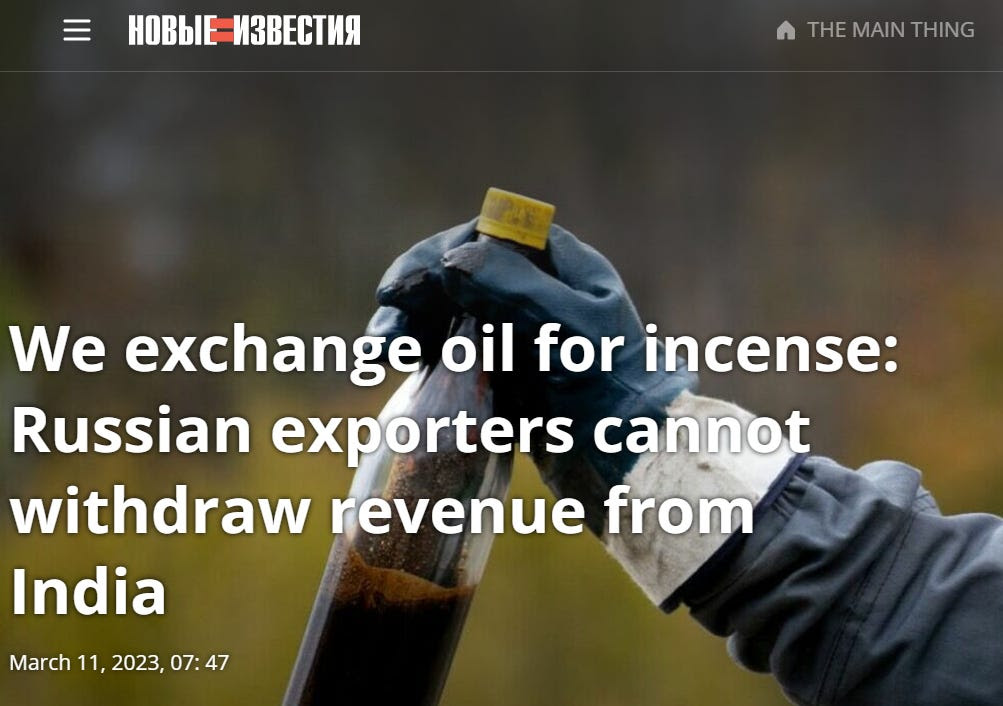
On May 4, your humble correspondent described oil-for-rupees as a face-melting farce. Mostly because Moscow was trading discounted oil for currency it didn’t need and couldn’t even use, while New Delhi sold its refined Urals crude to the West—for dollars and euros, obviously.

On May 5, Russian Foreign Minister Sergei Lavrov called an emergency press conference, and with the cameras rolling, announced that “everything Edward Slavsquat said about oil-for-rupees is absolutely 100% correct; he is a very astute and handsome young man.”

That’s a paraphrase. In Lavrov’s own words:

[Russia has] billions of rupees in Indian bank accounts, and we need to use this money. But for this, rupees must be converted into other currencies. This is being discussed.

Alas, this is not exactly news. Russian media quickly realized Moscow was getting the fuzzy end of the lollipop after this settlement scheme was introduced in mid-December.

One of several Russian media reports detailing the oil-for-rupees scheme (source)

The lopsided deal was aptly summarized by a Russian economist back in March:

A huge trade imbalance is forming in Russian-Indian trade, and Russian banks [with vostro accounts in India] are already refusing to accept rupees: they do not want to accumulate surpluses of Indian currency, since there is nowhere to use them.

In other words, it turned out that oil companies, in general, gave India “oil for nothing.”

There hasn’t been much progress towards converting Russia’s mountain of rupees into currencies that Moscow can actually use. But credit where credit is due: New Delhi announced earlier this week that it would allow Russia to dip into its stockpile of rupees to settle outstanding debts.

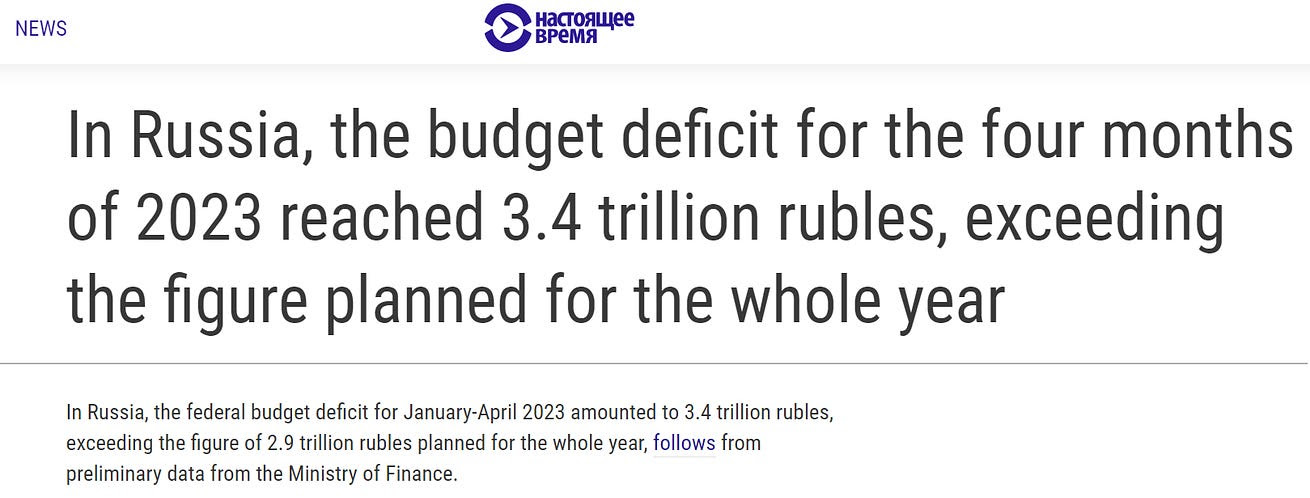
Of course, in an ideal world, Russia would be allowed to convert its rupees into rubles, and then use these rubles to help plug its ballooning budget deficit.

source

But I digress.

Oil-for-rupees (which, just to avoid any confusion, has been shelved for the time being, and was probably phased out, quietly, by the end of February) is symptomatic of a much larger economic woe.

As a result of 10,000+ Western sanctions (and an energy embargo that is not actually enforced), Beijing and New Delhi currently account for an estimated 7090% of Moscow’s oil exports, up from 45% in August. (China deserves a separate blog post. Stay tuned.)

Because Moscow has spent the last 30 years serving as a resource conveyor belt for the West, and because the domestic market was completely neglected, Russia is now at the mercy of the East. Moscow may be pivoting to Asia, but India and China dictate the terms.

India has been inhaling Urals crude at a discount. How big of a discount? We don’t know exactly, but the Indian government disclosed last month that most of the oil supplied by Russia was bought for less than $60/barrel—below the price ceiling set in December by the G7, Australia, and the European Union.

Moscow seems to have accepted the fact that New Delhi isn’t willing to defy Western dictates: At the end of April, Russian President Vladimir Putin signed a decree allowing oil sales to “friendly countries” that comply with the $60/barrel price cap. A rather revelatory capitulation.

The mere fact that Russia agreed (even if only temporarily) to trade oil for a currency that isn’t fully convertible, and isn’t particularly useful, should be evidence enough that New Delhi is taking full advantage of the situation. And who could blame them?

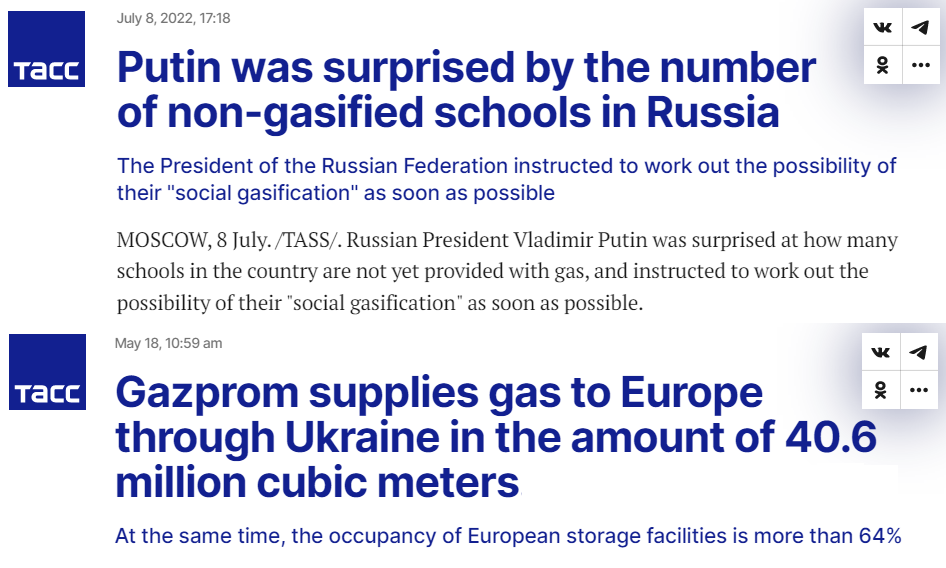
Considering Russian energy majors are willing to exchange “oil for nothing”—and pay Kiev to transit gas across Ukraine—maybe they could find it in their hearts to install gas lines in Russian schools?

sources: TASS / TASS

“Unfortunately, a large number of schools in our country have not yet been gasified. I looked at the figures: to be honest, even I was surprised—a lot [of schools are without gas],” Putin said in July.

This is not a problem limited to schools, unfortunately.

A Russian government audit published in 2020 found that hundreds medical facilities across the country were without running water or central heating.

Proposal: Gazprom should build a gas pipeline to Russia. They could call it SchoolStream.

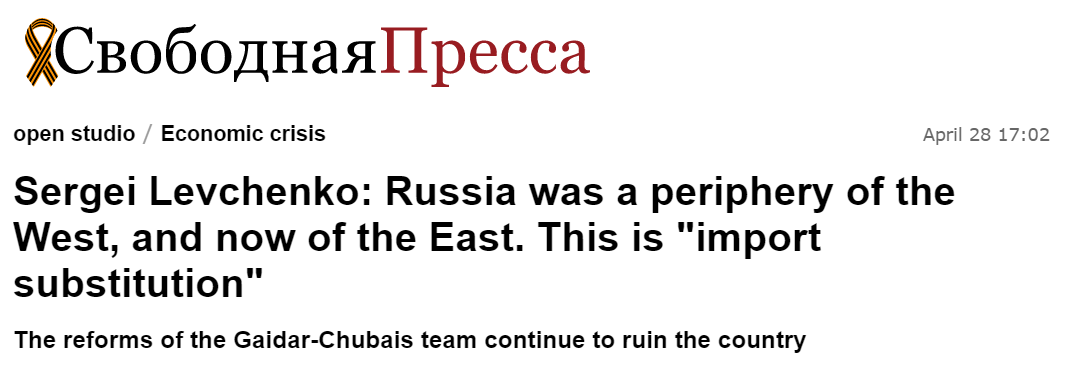
Much of what I’ve just typed was pointed out by Sergei Levchenko, Deputy Chairman of the State Duma Energy Committee, during an interview last month with Free Press.

source

After Levchenko commented on the seemingly inevitable introduction of “price liberalization” at home (tariffs for gas are already raised every year, although the price is set by regulators), the interviewer turned to Russia’s “pivot to the East”:

Free Press: [Moscow] is now deploying our entire hydrocarbon pipeline, let’s call it that, to the east, to China and India. Well, there’s nothing to hide: They will take advantage of the situation, they will ask for discounts and so on. That is, it will be very painful for our domestic economy. Are such fears correct?

Levchenko: Absolutely correct … We have been trying for a long time to become the periphery not only of the West, but also of the East … We have created a situation in our country where we only serve others with the help of our hydrocarbons.

The Duma Deputy then elaborated on how this economic model came into being:

The representatives of the state work mainly for our commodity oligarchs, and they primarily search for ways to get into peoples’ pockets. As a result, we have tens of millions of people who live below and near the poverty line, and at the same time we have about 100 “dollar billionaires”. Do you think that the representatives of these dollar billionaires are going to take money from their owners? No, of course not—it is the people who should be burdened. […]

And where do dollar billionaires, who send money abroad, come from? We need to develop the country, and not allow the rich to squeeze us, to continue to make money and place it somewhere in [foreign] banks, or bury gold coins abroad. […]

We simply need to invest in the country … The [ruling elite] don’t know how to develop the country, they don’t know how to take care of the people. They only know how to squeeze and send; squeeze, send. They are great specialists here, but they were taught in the West.

(I have nothing to add here, but I sent Levchenko’s comments to Karine Bechet-Golovko, a visiting professor at Moscow State University, who had some very thought-provoking things to say. The interview will be published in the nearest future.)

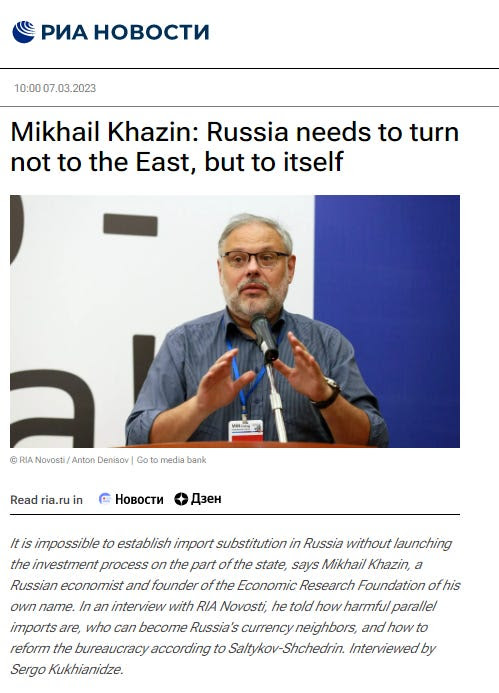
Interestingly, the core of Levchenko’s argument found its way into the pages of Russian state media in March.

source

Russian economist Mikhail Khazin (who is very pro-Putin) told RIA Novosti:

Russia shouldn’t turn to the East—it should turn inward. The turn to the East, which we are talking about so much today, is, in my deep conviction, just an attempt to plug the holes that have formed in the country after the departure of Western companies.

To summarize: It’s time for Russia to turn inward. It’s long, long overdue, really.

Kevin Gosztola: British Counter-Terrorism Police Detain And Interrogate British Journalist At Airport

internet writing technology computer
Photo by Markus Winkler on Pexels.com

By Kevin Gosztola, The Dissenter, 5/31/23

Kit Klarenberg, a British journalist previously published by The Dissenter, was detained and interrogated by British counter-terrorism police when he arrived at the London Luton Airport on May 19.

Police were particularly interested in his reports for The Grayzone and seized his electronic devices.

The incident was reported by The Grayzone, where Klarenberg regularly covers the British military and security services and their influence over media organizations in the United Kingdom.

Klarenberg was traveling from his home in Belgrade, Serbia, to visit family and friends. He was surrounded by police and issued a “Notice of Detention under Schedule 3 to the Counter-Terrorism and Border Security Act 2019” after he exited the airplane.

Under the notice, police required Klarenberg to answer questions from police, provide any information that was requested, including PINs and passcodes to his electronics, declare whether he had any documents “of a kind specified” by police, and cooperate with any searches of his person or property.

Police also instructed Klarenberg to refrain from obstructing or interfering with officers as they took photographs, fingerprints, and DNA samples, which were authorized by the police superintendent. If he failed to comply, he was told that he would face prosecution.

Subscribe To The Dissenter

The Grayzone posted a “communique” from a British police detective on July 27, 2022, which had notified Klarenberg of an investigation into “allegations” that related to “offenses of harassment, malicious communication and offenses under the computer misuse act.”

The “communique” was a response to Klarenberg’s reporting on anonymously leaked emails and documents that detailed U.K. intelligence-linked plots against academics and journalists, including The Grayzone.

Although Klarenberg was later notified by the Metropolitan Police that the matter was closed and he would not be arrested if he “attended” the U.K. in the future, that notification prepared him to anticipate potential harassment when he traveled.

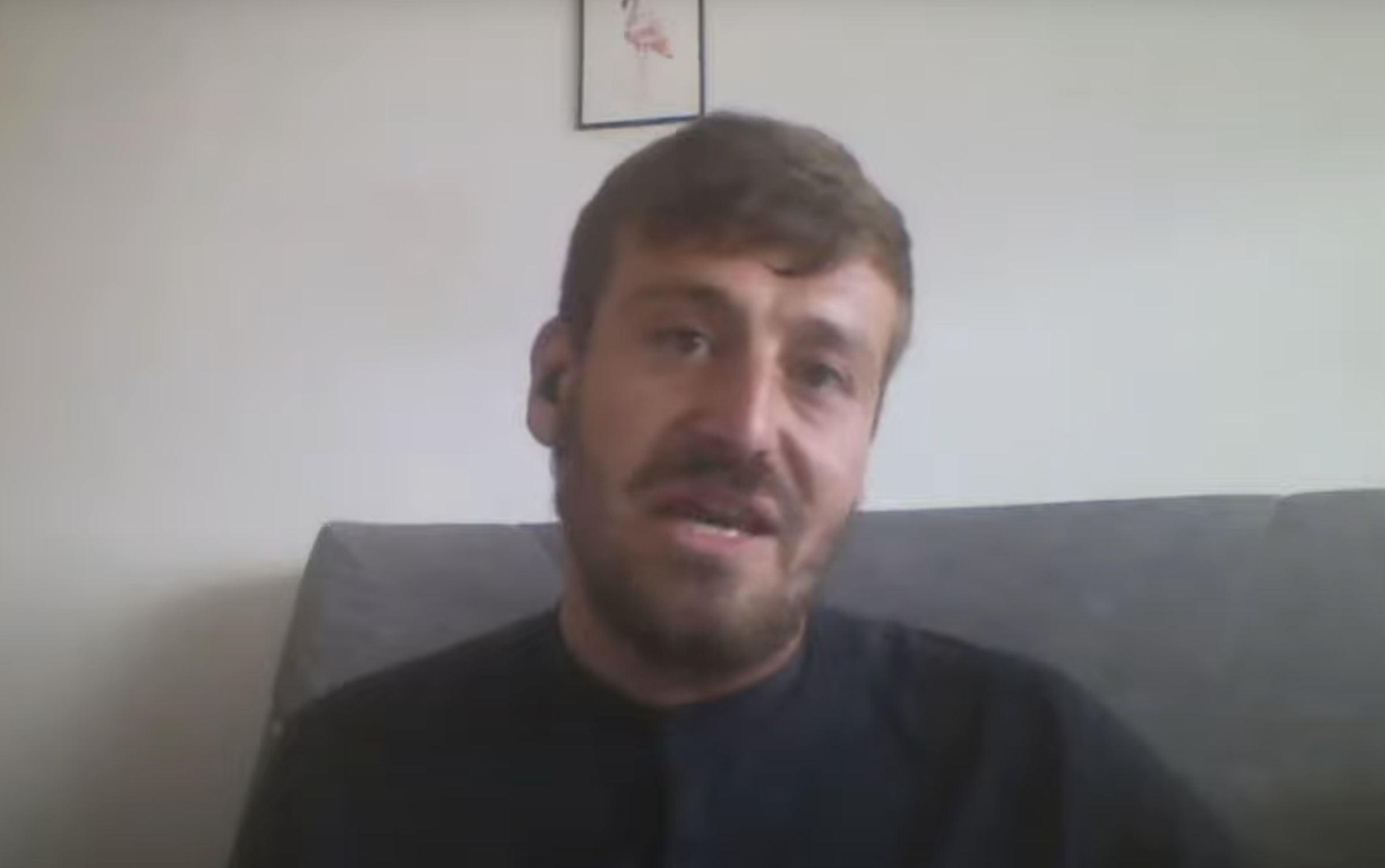
Kit Klarenberg, who was interviewed for an episode of The Dissenter’s weekly podcast “Unauthorized Disclosure” in July 2022.


Police in the U.K. “demanded to know why Klarenberg lived in Serbia,” according to Grayzone founder Max Blumenthal. They wanted to know the names of websites that published his journalism, and they were primarily focused on his work for The Grayzone.

Klarenberg was asked how much The Grayzone paid him, “how often, and into which bank account.” He was asked who owned the site and how regular his interactions were with Blumenthal.

Detractors have repeated a range of unproven and false claims about The Grayzone, where they allege that the website receives “opaque” funding and so Blumenthal must be receiving support from within Russia when considering how United States foreign policy is covered.

Naturally, that inspired the counter-terrorism police to ask if The Grayzone had some “agreement” with “Russia’s Federal Security Bureau (FSB) to publish hacked material.” They wanted to know if Klarenberg had any contact with “FSB operatives” or if he was in contact with “current or former personnel of Russian state media.” They even explicitly asked if The Grayzone was “sponsored by Russia.”

Subscribe To The Dissenter

“Throughout the interview, the counter-terrorism police probed Klarenberg aggressively on his political affiliations and beliefs,” Blumenthal added. “Was he involved in any activist causes in Belgrade? What did he think of the Russian government? Did he have an opinion on Russia’s arrest of Evan Gerskovich of the Wall Street Journal? What did he think of Rishi Sunak? One officer complained incessantly about Keir Starmer being ‘useless,’ prompting Klarenberg to wonder if the comments were a dangle aimed at drawing him out.”

The U.K. government amended their terrorism law in 2019 to grant police new powers to “stop, question, search, and detain a person at a U.K. port or the Northern Ireland border area.” Police were authorized to use the powers to determine “whether a person appears to be someone who is or has been in engaged in hostile activity.”

If the police decide under Schedule 3 that a person, like Klarenberg, presents some type of “counter-terrorism” threat, they are supposed to notify the person that they are now being questioned under Schedule 7 of the U.K.’s terrorism law, which was adopted in 2000. (It does not appear Klarenberg was ever questioned for a “counter-terrorism purpose.”)

***

British counter-terrorism police invoked Schedule 7 in April when they questioned and arrested French publisher Ernest Moret, the foreign rights manager for Editions La Fabrique, after he arrived in London on to attend the London Book Fair.

Police detained Moret and demanded that he give authorities his phone and pass codes. They asked him about his involvement in protests against pension reform in France. When he refused to share his pass codes, officers arrested Moret for “obstruction.”

Verso Books senior editor Sebastian Budgen told The Nation Magazine that British officers “threatened [Moret] saying he would never be able to travel again because he’d be labeled a terrorist.” Authorities also “boasted that the UK’s the only country where authorities can download and keep information from private devices.”

Officers seized Moret’s computer and phone. Although he was released after authorities jailed him overnight, he was threatened with prosecution.

Similarly, police seized a tablet, two memory cards, and an “old SD card, mostly containing music,” from Klarenberg. Everything but the SD card was returned a week later, and Klarenberg was informed that he remains under investigation.

Natasha Hakimi Zapata wrote in the same article for The Nation, “The Terrorism Act of 2000, passed prior to the September 11 attacks under Labour Prime Minister Tony Blair’s government, is indeed one of the most far-reaching anti-terrorism laws in Europe—if not the world.”

“While application of the law has been found to disproportionately discriminate against people from marginalized ethnicities and religions—especially Muslims, in the wake of September 11—Brazilian politician David Miranda was detained for nine hours at London’s Heathrow Airport in 2014. Miranda was carrying sensitive data from NSA whistleblower Edward Snowden to his partner, journalist Glenn Greenwald, and—just as in Moret’s case—Schedule 7 of the 2000 act was cited.”

“Both Britain’s High Court and Court of Appeal have maintained that the stop was ‘lawful’ because of ‘pressing national security concerns,’ despite also admitting that it was ‘an indirect interference with press freedom,’” Zapata added.

WikiLeaks founder Julian Assange has been detained by the U.K. government at the behest of the U.S. government for over 4 years. The U.S. government is prosecuting him for journalism that he produced back in 2010 and 2011.

His wife Stella Assange highlighted the incidents against Klarenberg and Moret and warned journalists and publishers who travel to the UK: “Expect to be interrogated at the border and charged under terrorism legislation in relation to your publishing activity.”

Lily Lynch: How NATO Seduced the European Left

By Lily Lynch, UnHerd, 5/16/23

Lily Lynch is a writer and journalist based in Belgrade, Serbia.

In January 2018, Nato secretary-general Jens Stoltenberg held an unprecedented press conference with Angelina Jolie. While InStyle reported that Jolie “was dressed in a black off-the-shoulder sheath dress, a matching capelet and classic pumps (also black)”, there was a deeper purpose to this meeting: sexual violence in war. The pair had just co-authored a piece for the Guardian entitled “Why NATO must defend women’s rights”. The timing was significant. At the height of the #MeToo movement, the most powerful military alliance in the world had become a feminist ally. “Ending gender-based violence is a vital issue of peace and security as well as of social justice,” they wrote. “NATO can be a leader in this effort.”

This was a new and progressive face for Nato, the same one it has since used to seduce much of the European Left. Previously, in the Nordic countries, Atlanticists have had to sell war and militarism to largely pacifist publics. This was achieved in part by presenting Nato not as a rapacious, pro-war military alliance, but as an enlightened, “progressive” peace alliance. As Timothy Garton Ash effused in the Guardian in 2002, “NATO has become a European peace movement” where one could watch “John Lennon meet George Bush”. Today, by contrast, following Russia’s full-scale invasion of Ukraine, Sweden and Finland abandoned their long-standing traditions of neutrality and opted for membership. Nato is portrayed as a military alliance — and Ukraine a war­ — that even former pacifists can get behind. All its proponents seem to be singing is “Give War a Chance”.

The Jolie campaign marked a dramatic turn in what Katharine A.M. Wright and Annika Bergman Rosamond call “Nato’s strategic narrative” in several ways. First, the alliance embraced celebrity star power for the first time, imbuing its unremarkable brand with elite glamour and beauty. Jolie’s star power meant that the alluring images of the event reached apolitical audiences with little knowledge of Nato. Second, the partnership seemed to usher in an era in which women’s rights, gendered violence and feminism would assume a more prominent role in Nato rhetoric. Since then, and especially in the past 12 months, telegenic female leaders such as the Finnish Prime Minister, Sanna Marin, German Foreign Minister, Annalena Baerbock, and Estonian Prime Minister, Kaja Kallas, have increasingly served as the spokespersons of enlightened militarism in Europe. The alliance has also intensified its engagement with popular culture, new technologies, and youth influencers.

Of course, Nato has always been PR-conscious, and has long engaged culture, entertainment, and the arts. Who could forget the 1999 album Distant Early Warning from electronic duo Icebreaker International, recorded with funding from the defunct “NATOarts” and inspired by the radar stations along Alaska and Canada’s northern periphery built to alert Nato of an incoming Soviet nuclear strike? Or the 2007 feature film HQ, produced by Nato’s public diplomacy division, which depicts life inside the alliance and a mock diplomatic response to a crisis in the fictional state of Seismania? Just about everyone it turns out. But what makes Nato’s more recent strategic turn so effective is that it has successfully echoed candidate countries’ progressive local traditions and identities.

No political party in Europe better exemplifies the shift from militant pacifism to ardent pro-war Atlanticism than the German Greens. Most of the original Greens had been radicals during the student protests of 1968; many had demonstrated against American wars. The early Greens advocated for West Germany’s withdrawal from Nato. But as the founding members entered middle age, fissures began to appear in the party that would one day tear it apart. Two camps began to coalesce: the “Realos” were the moderate Greens, politically pragmatists. The “Fundis” were the radical, uncompromising camp; they wanted the party to remain faithful to its fundamental values no matter what.

Predictably, the Fundis believed that European peace would be best served by West Germany’s withdrawal from the alliance and tended to favour military neutrality. Meanwhile, the Realos believed that West Germany needed Nato. They even argued that withdrawal would return matters of security to the German nation-state and risk rekindling militaristic nationalism. Their Nato was a post-national, cosmopolitan alliance, speaking numerous languages and flying a multitude of flags, protecting Europe from Germany’s most destructive impulses. But Nato membership at the end of history was one thing. Germany going to war again — the most forbidden of taboos after World War II — was something else entirely.

Kosovo changed everything. In 1999 — the 50th anniversary of Nato’s founding — the alliance began what academic Merje Kuus has called a “discursive metamorphosis”. From the mere defensive alliance it was during the Cold War, it was becoming an active military compact concerned with spreading and defending values such as human rights, democracy, peace, and freedom well beyond the borders of its member states. The 78-day Nato bombing of what remained of Yugoslavia, ostensibly to halt war crimes committed by Serbian security forces in Kosovo, would forever transform the German Greens.

At a chaotic May 1999 party conference in Bielefeld, the Realos and Fundis fought bitterly over the bombing. Green Foreign Minister Joschka Fischer, the most prominent Realo, supported Nato’s war; for this, conference attendees pelted him with red paint. The Fundis’ proposal called for an unconditional cessation of the bombing, which would have also meant the collapse of the Green-Social Democratic Party (SDP) coalition government. The peace proposal failed, crushing the anti-war faction of the party, who would leave the Greens in droves. Instead, the Realos’ moderate resolution triumphed by a comfortable margin. After a brief pause, the bombing of Yugoslavia was allowed to continue. With the Greens’ crucial support, the Luftwaffe flew sorties over Belgrade, 58 years after their last aerial bombardment of the Serbian capital. It was the first German military operation undertaken in Europe since the Second World War.

Following the start of the full-scale war in Ukraine, the German Greens’ Foreign Minister Annalena Baerbock has continued in Fischer’s tradition, scolding countries with traditions of military neutrality and imploring them to join Nato. She has invoked Desmond Tutu’s line: “If you are neutral in situations of injustice, you have chosen the side of the oppressor.” And the Greens have even ventriloquised their own dead members, including Petra Kelly, an anti-war icon and longtime advocate for non-alignment who died in 1992. Last year, Greens co-founder Eva Quistorp wrote an imaginary letter to Petra Kelly in the newspaper FAZ. The letter borrows Kelly’s moral stances and inverts them to justify the Greens’ embrace of war. Quistorp wants us to think that if Kelly were alive today, she would have been a Nato supporter. Addressing the long-dead Kelly, Quistorp asserts, “I bet you would shout out that radical pacifism makes blackmail possible.”

Earlier this year, Germany’s Federal Foreign Office also rolled out a new “Feminist Foreign Policy”, the latest of several European foreign ministries to have done so. This new orientation, also adopted by France, the Netherlands, Luxembourg and Spain, paints cosmopolitan militarism with a faux-radical feminist gloss, opening the domain of war and security to women’s rights activists. No-nonsense feminist leaders are depicted as the ideal foil to authoritarian “strongmen”.

Sweden was the first country to adopt such a policy in 2014, permitting it to project its longstanding state feminism abroad, and to assume a new moral posture in the international arena. Domestically, there were positive Atlanticist stories in women’s magazines. In the “Mama” section of the Swedish newspaper Expressen, targeted at female readers, one interview with Angelina Jolie emphasised that Nato can protect women from sexual violence in war. Jolie also stressed that there is little difference between humanitarian aid workers and Nato soldiers, as they “are striving towards the same goal: peace”.

The academic Merje Kuus has written that Nato enlargement involves “a two-fold legitimation” strategy. First, Nato is rendered ordinary and unremarkable, pedestrian and everyday, and second, it is portrayed as above reproach, vital, an absolute moral good. The effect of this, she says, is the simultaneous banalisation and glorification of Nato: it becomes so blandly bureaucratic that it is below debate, and so “existential and essential”, that it is above debate. And this legitimation strategy has been evident in the limited, tightly-controlled debate about Euro-Atlantic integration in the Nordic countries, neither of which held referendums on membership. After decades of popular resistance to the alliance, Nato, it seems, is above democracy. But as Kuss writes, that does not mean that Nato is imposed on a society. The aim is instead “to integrate it into entertainment, education, and civic life more broadly”.

Evidence of this is everywhere. In February, Nato held its first ever gaming event. A young employee of the alliance joined popular Twitch streamer ZeRoyalViking to play Among Us and casually chat about the danger disinformation poses to democracy. With them was a mountaineer influencer and environmental activist named Caroline Gleich. As their astronaut avatars navigated a cartoon spaceship, they spoke about Nato in glowing terms. By the event’s end, the stream had turned into a recruitment effort: the alliance employee talked about the perks of his job and encouraged viewers to check the Nato website for employment opportunities in fields such as graphic design and video editing.

The event was part of Nato’s “Protect the Future” campaign. This year it included a graphic novel competition for young artists. The alliance also courted dozens of influencers with large followings on TikTok, YouTube, and Instagram, and brought them out to the headquarters in Brussels. Other influencers were dispatched to last year’s Nato Summit in Madrid, where they were asked to create content for their audiences.

The European Left has been utterly captivated by this show. Following the path taken by the German Greens, major Left-wing parties have abandoned military neutrality and opposition to war and now champion Nato. It is a stunning reversal. During the Cold War, the European Left organised mass protests attended by millions against US-led militarism and Nato’s deployment of Pershing-II and cruise missiles in Europe. Today, little more than the hollowed-out radical rhetoric remains. With hardly any remaining opposition to Nato left in Europe, and the alliance’s creeping expansion beyond the Euro-Atlantic area, its hegemony is now nearly absolute.

National security experts: war in Ukraine is an ‘unmitigated disaster’

By Blaise Malley, Responsible Statecraft, 5/17/23

An open letter calling for a swift diplomatic end to the war in Ukraine was published on Tuesday [May 16th] in the New York Times. The letter’s 14 signatories consisted mostly of former U.S. military officers and other national security officials, including Jack Matlock, Washington’s former ambassador to the Soviet Union; Ann Wright, a retired U.S. Army colonel and former diplomat; Matthew Hoh, a former Marine Corps officer and State Department official; and Ret. Col. Lawrence Wilkerson, who served as Secretary of State Colin Powell’s Chief of Staff. [https://eisenhowermedianetwork.org/russia-ukraine-war-peace/]

Many are longtime critics of U.S. foreign policy and post-9/11 war policies.

The letter calls the war an “unmitigated disaster” and cautions that “future devastation could be exponentially greater as nuclear powers creep ever closer toward open war.”

While condemning Vladimir Putin’s “criminal invasion and occupation,” the letter, which notes the serial invasions of Russia by foreign adversaries, encourages readers to understand the war “through Russia’s eyes.”

“In diplomacy, one must attempt to see with strategic empathy, seeking to understand one’s adversaries,” according to the letter. “This is not weakness: it is wisdom.”

“Since 2007, Russia has repeatedly warned that NATO’s armed forces on Russian borders were intolerable – just as Russian forces in Mexico or Canada would be intolerable to the U.S. now, or as Soviet missiles in Cuba were in 1962,” the letter reads. “Russia further singled out NATO expansion into Ukraine as especially provocative.” 

The missive, which appeared on page 5 of the Times’ print edition, lays out the history of warnings by key U.S. national security officials, politicians, and others about the dangers of NATO expansion in the late 1990s, and again in 2008 when then-U.S. Ambassador to Russia and current CIA director William Burns cautioned Secretary of State Condoleezza Rice against pushing for NATO membership for Ukraine.

Accompanying the text is a timeline of the deterioration in relations between Moscow and the West that begins in 1990, when Secretary of State James Baker assured Russia that NATO would not expand eastwards, until Russia’s invasion in February of last year.

“NATO expansion, in sum, is a key feature of a militarized U.S. foreign policy characterized by unilateralism featuring regime change and preemptive wars,” according to the letter, which suggests that Washington’s “failed wars” in Iraq and Afghanistan have been two of the results.

President Joe Biden has vowed that Washington will continue to aid Kyiv “as long as it takes.” The letter’s signers fear that this is a recipe for escalation that could result in catastrophe.

“As Dan Ellsberg has warned courageously and unceasingly, we — the world — are at the nuclear brink again, perhaps closer to the edge than ever before. It only requires one step to go over and then our steps end forever,” Wilkerson said in the statement released by the Eisenhower Media Network, which funded the full-page advertisement. “If that’s not sufficient reason for a return to diplomacy, our extinction is at hand; the timing is all that is in question.”

To date, the United States has sent $37 billion worth of military aid to Kyiv. High-level discussions with officials in Moscow have been rare, and a number of other entities, including China, Brazil, and the Pope, have taken on the mantle of pushing for a diplomatic solution.

What Washington’s role will look like going forward is more uncertain, with recent reporting as well as revelations from Pentagon leaks suggesting that the administration will continue supporting Ukraine through the anticipated counteroffensive against Russian forces before possibly reassessing, although officials have disputed that narrative.

The letter, entitled “The U.S. Should Be a Force for Peace in the World,” urges the Biden administration to pivot towards pursuing a negotiated solution to end the war “speedily.”

“This reality is not entirely of our own making, yet it may well be our undoing,” the letter concludes, “unless we dedicate ourselves to forging a diplomatic settlement that stops the killing and defuses tensions.”

Analysis & Book Reviews on U.S. Foreign Policy and Russia