Prof. Paul Robinson: Belgorod raid: Why are Russian neo-Nazis fighting Putin?

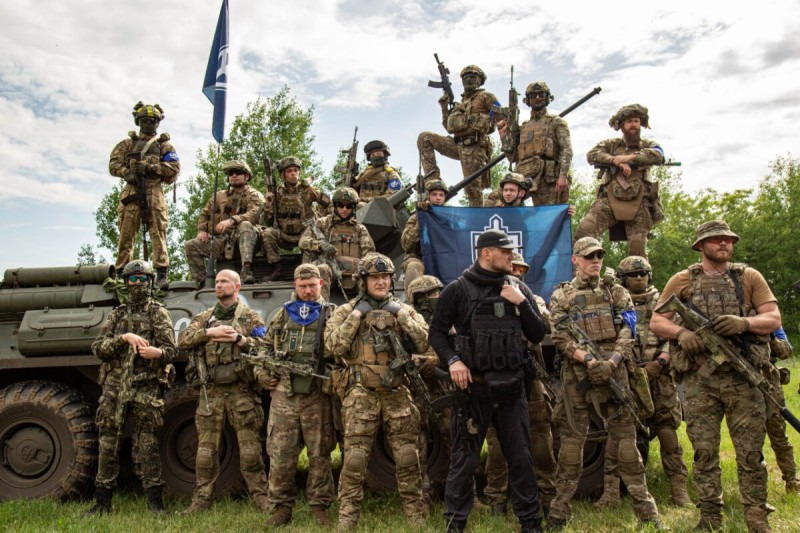
Pro-Ukrainian Russian fighters at a press conference after completing their Belgorod Oblast raid. Photo courtesy the Ukrainian Independent Information Agency (UNIAN)/Wikimedia Commons.

By Prof. Paul Robinson, Canadian Dimension, 5/25/23

The war between Russia and Ukraine escalated further this week when two armed groups crossed from Ukraine into the Russian province of Belgorod and briefly occupied a village before being driven out by Russian troops. According to the Russian government, 70 “terrorists” were killed in the process.

What makes this episode unusual is not the fact that it took place on Russian soil but that the “Ukrainians” in question appear in fact to have been Russians, albeit Russians fighting on the side of Ukraine. They were members of two groups, the Freedom of Russia Legion (FRL) and the Russian Volunteer Corps (RVC), the latter of whom had undertaken a smaller, but somewhat similar, incursion into the Bryansk region of Russia in March of this year. The CBC reported the story as “Freedom Fighters Seize Small Part of Russia.” As so often, though, the reality is rather more complex than this headline suggests.

Little is known about the FRL, other than that it was founded by former Russian Parliamentary Deputy Ilya Ponomarenko. The organization’s Telegram channel has stated that its aim is “the preservation of a one and indivisible Russia within its 1991 borders,” a slogan clearly echoing that of the anti-Bolshevik White army of General Denikin in the Russian Civil War, “Russia, One and Indivisible.” One Legion member interviewed by CNN declared himself a “devoted member” of the Russian Orthodox Church and stated that “he misses the Tsarist era which predated the Soviet Union.” All this suggests a somewhat conservative and nationalist disposition.

The Russian Volunteer Corps is much more radical. Its leader, Denis Kapustin (who nowadays goes by the alias Denis Nikitin), is a one-time football hooligan whom the Guardian newspaper describes as “a Russian neo-Nazi who claims he once kept a framed photograph of Joseph Goebbels in his bedroom.” According to the Financial Times, Kapustin/Nikitin also goes by the nom-de-guerre “Rex” in honour of “his white nationalist clothing brand White Rex,” and is “a former mixed martial arts fighter with ties to neo-Nazis and white nationalists across the Western world.” In 2019, his far-right activities earned him a 10-year ban from the European Schengen zone. Since then he has lived in Ukraine.

The RVC is overtly ethno-nationalistic. The Russian language has two words for “Russians”—“russkie’ and ‘rossiyane.’ “Russkie” are ethnic Russians. “Rossiyane” are citizens of the Russian Federation, of any ethnicity. In a statement of its aims, the RVC declared: “We are ‘russkie’—we are not ‘rossiyane,’” and argued that the Russian Federation should be a “Russian [russkoe] national state” consisting of “predominantly ethnic Russian regions.”

The involvement of the RVC raises the interesting question of why far-right Russian ethno-nationalists would be fighting on behalf of Ukraine against their own country. According to the narrative commonly peddled by the Western media, Putin and the state he leads are “ultra-nationalist,” even “fascist.” Yet it seems that real Russian fascists don’t like him.

An explanation can be found in a speech Putin made last week in which he discussed the “State National Policy Strategy.” In this he commented that a growing majority of Russians identified first and foremost as citizens (in other words, as Rossiyane) and only secondly as members of this or that ethnic group (such as Russkie). This, said Putin, was a thoroughly good thing. He remarked that:

From generation to generation, our forbears worked together for the good of our common and vast Motherland and multiplied the spiritual heritage of a single state with the diversity of their languages and traditions, and formed its unparalleled multiethnic and multi-religious culture. Our state was built around values of multiethnic harmony. This is the bedrock foundation underlying our consolidation. … Our adversaries, that I mentioned earlier, people with neo-colonial mindsets—halfwits, in fact—are unable to realize that diversity makes us stronger.


Putin has said this sort of thing many times in the past. His government has been quite intolerant of Russian nationalism, fearing that it might incite ethnic conflict and so destabilize the country. In the 2010s, many Russian nationalists fell foul of laws outlawing extremist speech and were arrested. As a result, they tended to view Putin decidedly negatively. Following the invasion of Ukraine, some changed their minds and decided that Putin was after all on their side. Others like Nikitin, however, seized the opportunity to take up arms against him. For them, a smaller but ethnically more Russian state is preferable to a larger but more diverse one. Imperialistic projects, such as the Russian attack on Ukraine, are consequently viewed as undesirable.

While this may explain why members of the Russian far-right are willing to fight for Ukraine, it doesn’t explain why the Ukrainian state views them as desirable allies. They are, after all, not particularly interested in Ukraine itself. The reason may be purely pragmatic and cynical, based on the principle that “my enemy’s enemy is my friend.” Contrary to Russian claims, the Ukrainian state is far from being fascist. Nevertheless, since the 2014 Maidan revolution, it has been more than willing to tolerate the far-right for the practical reason that it provides a strongly motivated source of military manpower. Likewise, the Russian militias help to fill the ranks.

The Russians also serve a political purpose. The Ukrainian government regularly says that it is fighting a purely defensive war, and is not interested in invading Russia. But launching attacks on Russian territory helps to divert Russian resources from other fronts and can be seen as demonstrating to the Russian people that Moscow is incapable of defending them. The Ukrainian authorities have rather implausibly claimed that the FRL and RVC are unconnected to them, and have described the attack on Belgorod province as an uprising of the Russian people within Russia. The Russian militias constitute a mechanism through which Kyiv can carry out such actions while denying that it is.

Kyiv’s previous dalliances with the far-right have produced short term practical military benefits, but have arguably been politically counterproductive in that they have helped to alienate part of the Ukrainian population while giving Moscow an opportunity to portray Ukraine as fascist. The same dynamic may now repeat itself. On the one hand, the attacks on Belgorod provide some tactical advantages to Ukraine. On the other hand, they enable the Russian authorities to paint Ukraine as a “terrorist state” and strengthen Moscow’s propaganda narrative that Kyiv is in league with neo-Nazis. Rather than weakening support in Russia for the war, these attacks may therefore have the opposite effect.

Paul Robinson is a professor in the Graduate School of Public and International Affairs at the University of Ottawa and a Senior Fellow at the Institute for Peace and Diplomacy. He is the author of numerous works on Russian and Soviet history, including Russian Conservatism, published by Northern Illinois University Press in 2019.

James Carden: What the 68-year-old Austria treaty could tell us about Ukraine today

By James Carden, Responsible Statecraft, 5/15/23

Monday May 15th marks 68 years since the signing of one of the least heralded but most important agreements of the 40-year Cold War.

The State Treaty for the Re-Establishment of an Independent and Democratic Austria, otherwise known as the Austrian State Treaty, was signed by representatives of the United States, the Soviet Union, France and Great Britain in Vienna on May 15, 1955.

The Treaty ended Austria’s 17 years of foreign occupation (first, by the Nazis from 1938-1945, and then, the Big Four from 1945-1955) and set the stage for its independence and neutral status.

In his message to the U.S. Senate requesting ratification of the treaty, President Dwight D. Eisenhower noted that “The Austrian State Treaty represents the culmination of an effort by the Western Powers extending over a period of more than eight years to bring about Soviet agreement to grant Austria its freedom.”

It should be noted that those eight years were among the most fraught of the first Cold War. Yet, only a handful of years after Stalin’s brutal consolidation of Soviet hegemony over Eastern Europe; the Soviet Union’s detonation of a hydrogen bomb; the Korean War; and only a year before the brutal Soviet crackdown in Budapest, Austria’s occupying powers were able to come to a peaceful modus vivendi over the status of Austria, setting the stage for Austria’s successful postwar transformation.

In the years preceding the Treaty’s signing, one of the principal obstacles that needed to be overcome (along with the issue of Soviet compensation) was the issue of Austrian neutrality. In a bid to win Soviet approval of the Treaty, the Austrian foreign minister sent a message to Moscow via neutral India, that Austria would refrain from joining any military bloc — East or West. Eisenhower initially objected, worrying that the West Germans would follow suit and scuttle American plans for its rearmament and incorporation into NATO. This issue, however, was put to bed in October 1954 with the signing of the Protocol to the North Atlantic Treaty on the Accession of the Federal Republic of Germany.

The Treaty and the accompanying declaration of neutrality was unquestionably good for Austria. As the late historian of Europe Tony Judt pointed out 40 years after the Treaty’s signing, Austria’s Cold War was marked by a “remarkable political continuity.” Upon declaring itself “permanently neutral” Austria transformed into “a stable and prosperous country at the center of Europe.”

Writing in the Bulletin of the Atomic Scientists in February 2022, nuclear experts Thomas Shea and Kateryna Pavlova observed that the Treaty “has proved remarkably successful. Today, Vienna hosts well-respected international organizations like the United Nations and the Organization of Petroleum Exporting Countries. The city was deemed the “most livable” for 10 years running on a survey that compared world cities on political, social and economic climate, medical care, education, and infrastructure conditions.”

Puzzlingly, Washington and its hawkish allies in Europe have again and again rejected the eminently sensible idea of neutrality in favor of a dogmatic insistence on NATO membership for Ukraine. Though interestingly, according to the journalist Ben Aris, negotiators representing Ukraine in a round of diplomacy conducted in April 2022 were willing to concede to Moscow’s demand to keep out of NATO in exchange for “bi-lateral security agreements with all its Western partners —something the Russian delegates accepted.”

And whatever one thinks of the motives, leadership and domestic political arrangements of Russia, Austria’s revitalization in the decades following the signing of the Treaty suggests there was (and is) a good deal of merit to the idea of Ukrainian neutrality. As The Quincy Institute’s own Anatol Lieven has observed:

“A declaration of neutrality has generally been treated, both in the West and in Ukraine itself, as a colossal and dangerous sacrifice by Ukraine. But modern European history does not altogether bear this out. Being drawn into great-power rivalry may not be such a wonderful thing as the U.S. foreign and security establishment — safely isolated from any resulting horrors — tends to imagine. And if sufficient guarantees are in place, neutrality can be a great boon for a nation.”

As the war in Ukraine drags on into its second year with little end in sight, the Biden administration and its Western partners could do worse than familiarize themselves with this too often overlooked success story from the first Cold War.

Ben Aris: Russian Prime Minister Mishustin attends Sino-Russian business forum in Beijing to work on better integration

By Ben Aris, Intellinews, 5/24/23

Russian Prime Minister Mikhail Mishustin travelled to Beijing for a Sino-Russian business forum to boost rapidly developing economic ties on May 24.

The Sino-Russian business forum is a “good platform to strengthen co-operation between Russia and China,” Prime Minister of China Li Qiang told the forum participants during the plenary session.

“China is ready to further expansion of economic and trade exchanges with Russia and co-operation development, both in terms of quality and quantity. This forum provides a good platform to business communities of the two countries to strengthen exchanges and co-operation,” the Chinese prime minister said, cited by the China Central Television.

Mishustin arrived with a large delegation that included a number of Russian tycoons subject to Western sanctions, including from the key fertiliser, steel and mining sectors. Russian exports of oil, gas and raw materials to China have soared since sanctions were imposed over a year ago.

Amongst the delegation were vice-premiers Dmitry Grigorenko, Dmitry Chernyshenko and Denis Manturov, several ministers, including the head of the Ministry of Transport, Vitaly Savelyev, and the head of the Ministry of Agriculture, Dmitry Patrushev. Amongst the businessmen were the owners or heads of the largest enterprises: Alexei Mordashov (Severstal), Andrey Guryev (Phosagro), German Gref (Sberbank), Andrey Kostin (VTB), Igor Shuvalov (VEB) and others.

However, in a sign of the lopsided nature of Russia’s relations with China and the threat of sanctions, the Chinese delegation was thin. There were no top government officials and no big-hitting Chinese businessmen in the corresponding Chinese delegation.

“The Chinese are warmly welcomed, but they are very afraid of sanctions. Even those big businessmen who wanted and were ready to speak publicly were not allowed to the meeting by the official authorities – they do not want to take even the smallest risk. No offence – their position is clear,” one of the forum participants told Vedomosti.

Deputy Prime Minister Alexander Novak, who was part of the delegation, said Russian energy supplies to China would increase by 40% year on year in 2023, Russian state media reported. China has begun to import record amounts of Russian crude oil since Europe imposed restrictions on the import of Russian oil.

The Russian prime minister is scheduled to hold talks with Chinese President Xi Jinping and his counterpart Li to discuss boosting trade and economic ties, with special attention on industry, energy, transport industry and agriculture.

“Amid today’s global economic recovery we are facing numerous challenges, as uncertainty and instability are mounting. China is committed to high-quality development and top-level openness. We are ready to strengthen our mutually beneficial co-operation with all countries, including Russia,” Li said.

Beijing and Moscow have been drawn together by rising tensions in recent years as both countries have come under increasing pressure from the US. Those tensions erupted into war 15 months ago when Russia marched into Ukraine. Since then China has given Moscow limited support as Beijing tries to avoid bringing down sanctions on itself, but broadly backs President Vladimir Putin’s call for a “multi-polar” world. The relationship went to a new level after Xi went Moscow in March to show solidarity with Putin. Some analysts took that meeting as an act of open defiance by Beijing and an explicit challenge to the US’ claim to be the global leader.

The unintended consequence of the extreme sanctions regime imposed by the West on Russia has been to unsettle the Global South, which is now being drawn into the BRICS bloc led by China and Russia. A key element of that is to de-dollarise international trade, with the yuan as the leading contender to replace the dollar.

Sino-Russian trade soaring

Russia has become China’s seventh partner in terms of trade turnover in the first quarter of 2023, according to Mishustin.

“China has been Russia’s biggest trade partner for 13 consecutive years, with the scale of mutual investment surging,” Li added.

Speaking at a plenary meeting of the Russian-Chinese business forum in Shanghai, Mishustin highlighted the significant growth in bilateral trade between the two countries.

“China has been Russia’s main trading partner for more than ten years. And in the first three months of this year, our positions in a similar Chinese list have also changed – they have risen from tenth to seventh place,” Mishustin said.

The volume of mutual trade between Russia and China has been steadily increasing, with a growth rate of about a third annually in 2021-2022.

In 2022, the trade turnover reached approximately $190bn, and the momentum has continued into 2023. Mishustin reported that the turnover in the first quarter of 2023 had risen by almost a quarter, reaching $52bn.

Work is also underway to expand mutual access to agricultural markets. “Last year, agricultural trade increased 42% to $7bn. In the first quarter of this year, exports to the Chinese market grew by another 91% (from last year) to $2.4bn,” the Economics Ministry said ahead of Mishustin’s trip to China.

“I am sure that this year we will fulfil the task set by the heads of state, Vladimir Vladimirovich Putin and Xi Jinping, to bring mutual trade to $200bn,” Mishustin stressed.

China’s foreign trade turnover in 2022 amounted to $6.31 trillion, with the United States as its main partner with a trade volume of $759bn. Following the US, South Korea, Japan, Taiwan, and Hong Kong are China’s other major trading partners, with turnovers exceeding $300bn with each country.

However, the improvement of logistics infrastructure remains a key challenge that Russia and China need to address. Chinese Premier Li Qiang emphasised the importance of enhancing logistics infrastructure during the plenary meeting.

Mishustin also noted this problem. “Russia and China share a long land border. And its infrastructure needs to be improved,” the prime minister said. To do this, according to him, it will be necessary to increase the capacity of transport arteries, modernise checkpoints, expand air traffic and unlock the potential of the Northern Sea Route as the shortest route from Asia to Europe.

As Russia and China aim to strengthen their economic partnership and overcome logistical challenges, further investments in infrastructure and collaborative efforts will be crucial to sustain and enhance the bilateral trade between the two nations.

The Russian Ministry of Economic Development and the Ministry of Commerce of China signed a memorandum on deepening co-operation in the services trade sphere, the press service of the Russian ministry said the same day, Tass reports.

As a result of negotiations between Russia and China, five documents were signed in the field of trade, medicine, sports and intellectual property, according to a Russian government statement.

The memorandum on deepening investment co-operation in the sphere of trade in services was signed by the Ministry of Economic Development of the Russian Federation and the Ministry of Commerce of the People’s Republic of China.

Russia’s agricultural organ Rosselkhoznadzor and the Main Customs Administration secured the agreements with protocols on phytosanitary requirements for grain and plant materials exported from Russia for the medical region of China.

The prime ministers of Russia and China will hold another meeting at the end of this year to compare notes and “synchronise their watches,” Mishustin said during a meeting with Chinese President Xi.

“We have agreed to activate the logistical work and mechanisms for holding regular meetings of the heads of government of Russia and China. It encompasses five intergovernmental commissions at the deputy prime ministerial level and more than 80 sector-specific working groups. We will compare notes at the next regular meeting of prime ministers, which will take place at the end of this year,” Mishustin said as reported by Tass.

Separately, Chinese Foreign Minister Qin Gang said that more and more voices are calling for a ceasefire in Ukraine, during a meeting with his Dutch counterpart a day earlier.

“At present, more and more peaceful and rational voices speaking in favour of a ceasefire and an end to hostilities [in Ukraine] can be heard,” the Chinese Foreign Ministry quoted Qin as saying.

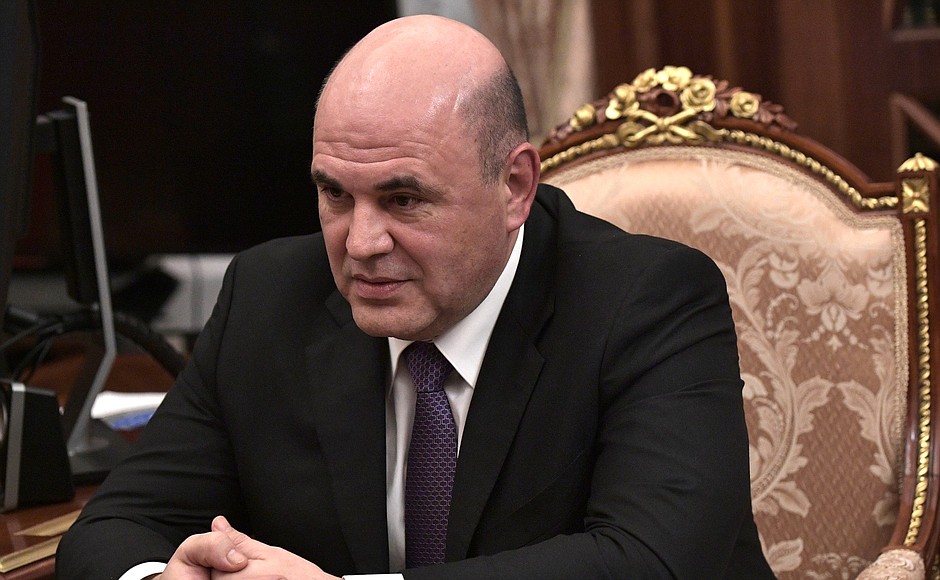
Russia Matters: Russia’s Prime Minister Mishustin: A Quiet Technocrat Who Toes the Line and Gets Results

Russia Matters, 5/11/23

Ever since Mikhail Mishustin was hoisted from his job as tax chief to become Russia’s prime minister in 2020, analysts have said he would not be a potential successor to Vladimir Putin after the president’s term ends next year. This take was hard to argue against. As Carnegie’s Tatiana Stanovaya wrote back then: “Mishustin does not have any political experience or popularity with the electorate, and is not part of Putin’s inner circle.”

What Mishustin does have is Article 92 of the Russian constitution, which would make him interim president — and commander-in-chief of a country at war — if something were to abruptly stop Putin from carrying out his duties. Last week, the Kremlin claimed that two drones destroyed over Putin’s Moscow residence had been sent to assassinate him. Though there are still multiple alternative explanations that are at least as compelling, the incident does spark some curiosity about the man who would take over the presidency if Putin dropped out of the picture before his term is up.

Describing the softspoken Mishustin as a “faceless functionary without ambition” seems off the mark. It is true that he lacks both the insider credentials of a more obvious potential successor like Security Council head Nikolai Patrushev and the populist appeal of hawkish firebrands like former president Dmitry Medvedev (whom he replaced as prime minister) and Duma speaker Vyacheslav Volodin. But those who track Russia’s fiscal health have praised Mishustin as a highly competent technocrat, who oversaw a doubling (if not tripling) of budget revenue when he ran the tax service. Granted, that image of competence may be bolstered by the prime minister’s alleged preoccupation with his public persona. In either case, now — as his government helps Russia overcome unprecedented sanctions pressure — it also seems to have translated into a measure of popular appeal: Mishustin’s approval rating, according to the Levada Center, has climbed from around 50% at the start of 2020 to more than 70% as of this April.

Like many other senior Russian officials, Mishustin appears to have been caught off guard by Putin’s decision to mount a full-fledged invasion of Ukraine in February 2022, but he has publicly stayed loyal to his boss. At an emergency meeting called by Putin three days before he sent Russian troops over the border, Mishustin suggested Moscow continue dialogue with the West about the two breakaway statelets in eastern Ukraine before deciding whether to recognize them. (They were recognized later that day.) And though the prime minister usually speaks about the war obliquely, without the vitriolic saber-rattling of his predecessor, he has stayed on in his role, not challenging the Kremlin’s messaging, working for Russia’s “technological and economic sovereignty” in the face of pressure from “the collective West.” The details have changed but the ethos is the same as in fall 2020, when an official at a research institute that Mishustin was visiting began his story of progress by recalling a visit some years earlier by “your colleague” Putin, during his time as prime minister; Mishustin corrected him: “Not a colleague, but our leader.”

Below we have started collecting a sampling of Mishustin’s quotes, mostly since his appointment as prime minister, meant to shed light on his views on issues that impact vital or important U.S. interests. (Notes on formatting and sources come after the quotes themselves.)


I. U.S. and Russian priorities for the bilateral agenda

Nuclear security and safety:

  • Rosatom is doing a great deal of work to rehabilitate ‘uranium legacy’ sites in Kirghizia [i.e., Kyrgyzstan]. (Interfax, 05.09.23).

North Korea’s nuclear and missile programs:

  • No significant developments.

Iran and its nuclear program:

  • No significant developments.

Leaks of U.S. intelligence assessments:

  • No significant developments.

Humanitarian impact of the Ukraine conflict:

  • On the allocation of more than 2.5 billion rubles for a federal workforce retraining project under which Ukrainian refugees would be eligible for a free education: Funds will go toward grants to organizations that train workers needed on the labor market. (Telegram, 03.30.23)

Military aspects of the Ukraine conflict and their impacts:

  • Lauding a recent uptick in the production of military equipment: This was achieved thanks to the prompt detection and elimination of a whole series of technological obstacles in production processes both in the organizations of the defense-industrial complex and in those cooperating with them… These are all preliminary results. It is necessary to continue acting in the same vein, there is still a lot to be done. Our industry is gradually coping with current challenges and leveling the situation out. (Telegram, 12.27.22)
  • Now the needs of the Armed Forces in equipment have increased significantly. … It is important to continue the construction of fortifications on the line of deployment of our troops. Most of them are already fully equipped. Also, new strongholds are being built for the border service and the existing strongholds are being equipped. (Government.ru, 03.31.23)
  • The government has approved the charter of the Defenders of the Fatherland State Fund for Supporting Participants in the Special Military Operation, established on the initiative of the president… First of all, this involves comprehensive support for the families of those killed in action and veterans of the special military operation. It also includes assistance for our defenders in obtaining social support measures, essential medications and medical devices, technical rehabilitation systems, vouchers for health centers and home care, as well as education, advanced training and employment opportunities and, of course, psychological counselling. … Caring for our defenders is our common task. (Government.ru, 05.11.23)

Punitive measures related to Russia’s war against Ukraine and their impact globally:

  • Unprecedented sanctions were imposed on our country. But their initiators did not achieve their main objective. They failed to undermine our financial stability. (AFP/MT, 09.08.22)
  • The global order is undergoing a serious change. Some Western countries [have] decided that they can use illegitimate economic sanctions, restrictions and political pressure to impose their rule, while ignoring the interests of others. Such attempts are bound to fail. (TASS, 12.05.22)
  • Speaking about sanctions before the State Duma: Let’s be realistic, the outside pressure on Russia is not weakening… But we still expect the adaptation period to end in 2024. Russia will embark on the path of long-term progressive development. … Russian people were the target… but we survived. (AFP/MT, 03.23.23)
  • Promoting integration within the EAEU [Eurasian Economic Union], as well as with partner countries, is another priority. We have continued reinforcing cooperation with friendly countries who share our views and values. Attempts to shut us out of the global economic space through sanctions [have] failed. (Government.ru, 03.23.23)
  • No doubt, the current situation could be called the most difficult in three decades for Russia… Such sanctions were not used even in the darkest times of the Cold War. (Reuters, 04.07.22) 
  • Some industries found themselves in a rather difficult situation due to Western partners refusing to carry out planned deliveries. (Government.ru, 05.02.23)

Ukraine-related negotiations:

  • No significant developments.

Great Power rivalry/new Cold War/NATO-Russia relations:

  • We are faced with the task of ensuring the development of the country’s economy under the restrictions imposed by unfriendly countries. Russia is still part of the global world, so we will continue to expand and strengthen our trade and economic ties with those who are interested in such cooperation. (Government.ru, 03.14.23)
  • Last year saw the start of a deep transformation of the world order. More and more countries have come to realize that a fair world of the future is incompatible with the rules imposed by the collective West. The transition to multipolarity is gathering speed. Russia is at the cutting edge of this process. (Government.ru, 03.23.23)
  • The West continues to do everything possible to limit the Russian economy’s access to global finance — loans and investments — and to restrain the development of Russia not only in the short term, but also in the long term. (Government.ru, 03.28.23)

China-Russia: Allied or aligned?

  • Russia will provide the necessary support in terms of enriching the content of trade and economic cooperation and facilitating further consolidation within the SCO [Shanghai Cooperation Organization]. (TASS, 11.01.22)
  • In the new geopolitical reality, the comprehensive and strategic partnership between Russia and China will fully reveal its great creative potential. (TASS, 12.05.22)
  • Speaking to Chinese President Xi Jinping: It is meaningful that your first foreign visit after having been re-elected is to our country. This testifies to the special nature of Russian-Chinese relations entering a new era. (Government.ru, 03.21.23)
  • Our work is coordinated through … regular meetings of the leaders of the Russian and Chinese governments, which is a unique format that includes five intergovernmental commissions and more than 80 subcommittees and working groups. (TASS, 03.21.23)
  • We value Russia and China’s strong cultural and humanitarian ties. They are founded on our peoples’ historical traditions of friendship and mutual respect. (TASS, 03.21.23)
  • We in Russia are truly interested in the further strengthening of our comprehensive partnership and strategic cooperation with China. Our relations are at their highest level in a centuries-long history, and they influence the formation of the global agenda with respect to the logic of a multipolar world order. (TASS, 03.21.23)
  • We believe that the development of trade, economic, scientific and technical cooperation with China is very important. Following the talks between President Vladimir Putin and President of the People’s Republic of China Xi Jinping in Moscow, the two leaders adopted a joint statement on the development of practical cooperation between Russia and China in the medium term. As a follow-up, my colleague, Premier of the State Council of China Li Qiang, and I will soon approve Plan 2030, which will embrace all the main areas of cooperation with our Chinese partners. (Government.ru, 03.23.23)
  • The Russian side rates highly the Sino-Russian relations of a comprehensive strategic partnership and strategic interaction, and it plans to expand friendly ties with the People’s Republic of China, deepen practical cooperation and facilitate the two countries’ joint development. (TASS, 04.04.23)

Missile defense:

  • No significant developments.

Nuclear arms control:

  • No significant developments.

Counterterrorism:

  • No significant developments.

Conflict in Syria:

  • No significant developments.

Cyber security/AI:

  • Speaking in 2018: But if destiny chooses a different path for me [other than government service], I would work in innovations, with new technologies, in the same field as I have always worked: transformation, related to the digital economy. (Reuters, 01.15.20)
  • On a new technological order, including artificial intelligence, robots, sensors, 3D printing and more: By implementing new technologies, it is possible to ensure the growth of efficiency in all sectors of the economy, from agriculture to the service sector, improve the quality of products, establish more environmentally friendly production, and reduce costs. New forms of creating added value are also emerging. (Telegram, 04.26.23)

Energy exports from CIS:

  • For Russia, the Caspian has great significance. Above all, given its strategic location in the center of Eurasia, at a crossroads of transportation and energy arteries, as well as having a large amount of natural reserves and unique bioresources in its waters. (TASS, 10.06.22)

Climate change:

  • No significant developments.

U.S.-Russian economic ties:

  • No significant developments.

U.S.-Russian relations in general:

  • No significant developments.


II. Russia’s domestic policies

Domestic politics, economy and energy:

  • [Putin is] not my colleague, but our leader. (RIA, 11.20.20) 
  • Of course, the risks have not gone away. So far, the collective West has not managed to push our country out of the global economy, and their attempts have led to ultra-high prices on the world market, and to fears about how to endure the coming winter. However, it is obvious that they will continue to elbow us out of customary sales areas. This should be taken into account when drawing up plans for the future, not forgetting about our own strategic tasks. (TASS, 09.14.22)
  • The [economic] decline, inevitable in this situation, was quite moderate. However, we managed to bring the economy back to a growth trajectory. (Government.ru, 03.23.23)
  • The replacement of the dollar and euro in our foreign trade has allowed us to expand operations with friendly states. (Government.ru, 03.23.23)
  • We need to take all possible measures to ensure stable population growth in Russia. … [A] set of measures was formed to provide additional support to families with children. … But work must be continued to radically overcome the existing demographic trends. (Government.ru, 04.04.23)
  • Everything that can be done in Russia today must be done in Russia. Every kopek of added value produced by the hands of Russians, in this sense, is a contribution to import substitution and the creation of the country’s technological and economic sovereignty. (Interfax, 04.05.23)
  • On simplifying the procedure of obtaining Russian citizenship for scientists and ethnic Russians: Regarding citizenship, we will definitely consider proposals [from a lawmaker making the request]. (TASS, 04.06.23)
  • The government will provide additional support to our pharmaceutical manufacturers. They will be able to receive subsidies from the state for the development and subsequent registration of domestic drugs, analogues of which are now under the influence of foreign patents. (Interfax, 04.10.23)
  • We expect that as the adaptation period ends, we will be able to [establish] “budget rules” as early as 2025, which will help strengthen confidence in economic policy in the long term. (Government.ru, 04.14.23)
  • We will combine in a special register specific projects that contribute to the structural adaptation of the economy, primarily eliminating the low level of localization and critical dependence on suppliers and buyers from unfriendly states. The list of types of production and services is approved by the Government. It includes, among other things, medicines, equipment, unmanned aerial and automotive equipment and software development and testing. (Government.ru, 04.17.23)

Defense and aerospace:

  • The volumes of production of the necessary machinery and equipment and other necessary property are systematically increasing. And now we need to actively increase factory capacity. To this end, the Government has made decisions to subsidize investment projects for the modernization of enterprises. (Government.ru, 02.08.23)
  • See also section on “Military aspects of the Ukraine conflict and their impacts” above.

Security, law-enforcement and justice:

  • No significant developments.

III. Russia’s relations with other countries

Russia’s general foreign policy and relations with “far abroad” countries:

  • Despite such rapid growth of the trade turnover, we [Russia and Iran] have good opportunities to further boost trade and, certainly, scale up mutual investments in such areas as energy, industrial cooperation, transport, agribusiness, innovation, and many other lines. (TASS, 10.06.22)
  • We welcome the Iranian side’s decision to provide comfortable conditions for Russian business. Due to the withdrawal of companies of unfriendly states from Russia, a large number of areas have been freed up in our market that our Iranian partners will be able to occupy. So it is a two-way street and they are welcome in Russia. (TASS, 10.06.22)

Ukraine:

  • We have been preparing for many months for a possible reaction to the recognition of the LNR and DNR [separatist “people’s republics” of Luhansk and Donetsk in eastern Ukraine]. I mean, first and foremost, import replacement and analysis of all risks that we might encounter in the event of such a decision. (RG, 02.21.22)
  • Last October, the Donetsk and Lugansk people’s republics, Zaporozhye and Kherson regions became an integral part of Russia. The president asked us to ensure their integration in the single socioeconomic space of our country. We launched a pension and social security system there with regular payments and benefits. I want to thank all members of parliament for this work. The relevant legislative acts were promptly adopted by the State Duma and approved by the Federation Council. This decision is very important for over 1.5 million people who started receiving pension benefits, and 1 million citizens who received social benefits and monetary compensation. We provided support to the people whose homes were destroyed or damaged, and to those who were injured as a result of hostilities. Last year, we started to restore infrastructure in the new regions to help them return to normal life and activities. (Government.ru, 03.23.23) 

Russia’s other post-Soviet neighbors:

  • By stepping up cooperation on international markets, we stand for fullest unlocking of the growth potential of the common EAEU market, ensuring the free movement of goods, services, capital and the labor force. … We are already improving our approaches on the basis of international experience. (TASS, 10.21.22)
  • Under the current conditions, the opening of joint high-tech production sites is becoming particularly important. (TASS, 02.03.23)
  • It is necessary to ensure the technological sovereignty of the five nations. It is necessary to make such help available to our enterprises and more actively attract development institutions to it as soon as possible. (TASS, 02.03.23)
  • The Union State [of Russia and Belarus] has a great future in the emerging multipolar international architecture. The deepening of integration will serve the benefit of the peoples of our countries. (Government.ru, 03.27.23)
  • Together we are stronger and capable of handling the most difficult challenges and achieving the goals that we have set in various fields, from ensuring security to improving the welfare of our people. And, of course, resisting external pressure. The deepening of Russian-Belarusian integration is our response to it. This is the mission that our presidents — Vladimir Putin and Alexander Lukashenko — have set for us. (TASS, 03.27.23)

This is the fourth in our series of compilations of quotes by Putin’s potential successors; earlier installments covered Nikolai Patrushev, Dmitry Medvedev and Vyacheslav Volodin. All sections may be updated in the future. The quotes above are divided into categories similar to those in Russia Matters’ news and analysis digests, reflecting the most pertinent topic areas for U.S.-Russian relations broadly and for drivers of the two countries’ policies toward one another. Bulleted text that is not italicized, bracketed or in parentheses is a direct quote. Quotes linked to English-language sources were taken from the source indicated; quotes linked to Russian-language sources were translated by RM. Entries in each subsection are in chronological order, from oldest to newest.

This item is also part of Russia Matters’ “Clues from Russian Views” series, in which we share what newsmakers in/from Russia are saying on Russia-related issues that impact key U.S. national interests so that RM readers can glean clues about their thinking. The opinions expressed in the compiled quotes are solely those of the speaker.

Study: U.S. Terror Wars Contributed to 4.5 Million Estimated Deaths

person s hands covered with blood
Photo by NEOSiAM 2021 on Pexels.com

Cost of War Project of Watson Institute, 2023

War’s destruction of economies, public services, infrastructure, and the environment leads to deaths that occur long after bombs drop and grow in scale over time. This report reviews the latest research to examine the causal pathways that have led to an estimated 3.6-3.7 million indirect deaths in post-9/11 war zones, including Afghanistan, Pakistan, Iraq, Syria, and Yemen. The total death toll in these war zones could be at least 4.5-4.6 million and counting, though the precise mortality figure remains unknown. Some people were killed in the fighting, but far more, especially children, have been killed by the reverberating effects of war, such as the spread of disease. 

The report examines the devastating toll of war on human health, whoever the combatant, whatever the compounding factor, in the most violent conflicts in which the U.S. government has been engaged in the name of counterterrorism since September 11, 2001. Rather than teasing apart who, what, or when is to blame, this report shows that the post-9/11 wars are implicated in many kinds of deaths, making clear that the impacts of war’s ongoing violence are so vast and complex that they are unquantifiable.

In laying out how the post-9/11 wars have led to illness and indirect deaths, the report’s goal is to build greater awareness of the fuller human costs of these wars and support calls for the United States and other governments to alleviate the ongoing losses and suffering of millions in current and former warzones. The report highlights many long- term and underacknowledged consequences of war for human health, emphasizing that some groups, particularly women and children, suffer the brunt of these ongoing impacts.

READ FULL PAPER >

Executive Summary (PDF) 

Analysis & Book Reviews on U.S. Foreign Policy and Russia