Link here.
Nicolai Petro Discusses ‘The Tragedy of Ukraine’ and Conflict Resolution with Anatol Lieven
Link here.
Link here.
By Norman Solomon, Salon, 2/21/23
Ever since Russia invaded Ukraine a year ago, media coverage of the war hasn’t included even the slightest mention of intercontinental ballistic missiles (ICBMs). Yet the war has boosted the chances that ICBMs will set off a global holocaust. Four hundred of them — always on hair-trigger alert — are fully armed with nuclear warheads in underground silos scattered across Colorado, Montana, Nebraska, North Dakota and Wyoming, while Russia deploys about 300 of its own. Former Defense Secretary William Perry has called ICBMs “some of the most dangerous weapons in the world,” warning that “they could even trigger an accidental nuclear war.”
Now, with sky-high tensions between the world’s two nuclear superpowers, the chances of ICBMs starting a nuclear conflagration have increased as American and Russian forces face off in close proximity. Mistaking a false alarm for a nuclear-missile attack becomes more likely amid the stress, fatigue and paranoia that come with protracted warfare and maneuvers.
Because they’re uniquely vulnerable as land-based strategic weapons, with the military precept of “use them or lose them,” ICBMs are set to launch on warning. So, as Perry explained, “If our sensors indicate that enemy missiles are en route to the United States, the president would have to consider launching ICBMs before the enemy missiles could destroy them. Once they are launched, they cannot be recalled. The president would have less than 30 minutes to make that terrible decision.”
But rather than openly discuss — and help to reduce — such dangers, U.S. mass media and officials downplay or deny them with silence. The best scientific research tells us that a nuclear war would result in “nuclear winter,” causing the deaths of about 99 percent of the planet’s human population. While the Ukraine war is heightening the odds that such an unfathomable catastrophe will occur, laptop warriors and mainstream pundits keep voicing enthusiasm for continuing the war indefinitely, with a blank check for U.S. weapons and other shipments to Ukraine that have already topped $110 billion.
Meanwhile, any message in favor of moving toward real diplomacy and de-escalation to end the horrendous conflict in Ukraine is apt to be attacked as capitulation, while the realities of nuclear war and its consequences are papered over with denial. It was, at most, a one-day news story last month when — calling this “a time of unprecedented danger” and “the closest to global catastrophe it has ever been” — the Bulletin of the Atomic Scientists announced that its “Doomsday Clock” had moved even closer to apocalyptic midnight: just 90 seconds away, compared to five minutes a decade ago.
A vital way to reduce the chances of nuclear annihilation would be for the United States to dismantle its entire ICBM force. Former ICBM launch officer Bruce G. Blair and Gen. James E. Cartwright, a former vice chair of the Joint Chiefs of Staff, wrote: “By scrapping the vulnerable land-based missile force, any need for launching on warning disappears.” Objections to the United States shutting down ICBMs on its own (whether or not reciprocated by Russia or China) are akin to insisting that someone standing knee-deep in a pool of gasoline must not unilaterally stop lighting matches.
What is at stake? In an interview after publication of his landmark 2017 book “The Doomsday Machine: Confessions of a Nuclear War Planner,” Daniel Ellsberg explained that nuclear war “would loft into the stratosphere many millions of tons of soot and black smoke from the burning cities. It wouldn’t be rained out in the stratosphere. It would go around the globe very quickly and reduce sunlight by as much as 70 percent, causing temperatures like that of the Little Ice Age, killing harvests worldwide and starving to death nearly everyone on Earth. It probably wouldn’t cause extinction. We’re so adaptable. Maybe 1 percent of our current population of 7.4 billion could survive, but 98 or 99 percent would not.”
However, to Ukraine war enthusiasts proliferating in U.S. media, such talk is notably unhelpful, if not perniciously helpful to Russia. They have no use for, and seem to prefer silence from, experts who can explain “how a nuclear war would kill you and almost everyone else.” The frequent insinuation is that calls for reducing the chances of nuclear war, while pursuing vigorous diplomacy to end the Ukraine war, are coming from wimps and scaredy-cats who serve Vladimir Putin’s interests.
One corporate-media favorite, Timothy Snyder, churns out bellicose bravado under the guise of solidarity with the Ukrainian people, issuing declarations such as his recent claim that “the most important thing to say about nuclear war” is that “it’s not happening.” Which just goes to show that a prominent Ivy League historian can be as dangerously blinkered as anyone else.
Cheering and bankrolling war from afar is easy enough — in the words of Andrew Bacevich, “our treasure, someone else’s blood.” We can feel righteous about providing rhetorical and tangible support for the killing and dying.
Writing in the New York Times on Sunday, liberal columnist Nicholas Kristof called for NATO to further escalate the Ukraine war. Although he noted the existence of “legitimate concerns that if Putin is backed into a corner, he could lash out at NATO territory or use tactical nuclear weapons,” Kristof quickly added reassurance: “But most analysts think it is unlikely that Putin would use tactical nuclear weapons.”
Get it? “Most” analysts think it’s “unlikely” — so go ahead and roll the dice. Don’t be too concerned about pushing the planet into nuclear war. Don’t be one of the nervous nellies just because escalating warfare will increase the chances of a nuclear conflagration.
To be clear: There is no valid excuse for Russia’s invasion of Ukraine and its horrific ongoing war on that country. At the same time, continually pouring in vast quantities of higher and higher tech weaponry qualifies as what Martin Luther King Jr. called “the madness of militarism.” During his Nobel Peace Prize speech, King declared: “I refuse to accept the cynical notion that nation after nation must spiral down a militaristic stairway into the hell of thermonuclear destruction.”
Yahoo News!, 3/16/23
Erik Møse, Chair of the United Nations Human Rights Council (UN HRC) Independent International Commission of Inquiry on Ukraine, said during a press conference on 16 March that the Commission’s investigation into human rights violations in Ukraine has not found evidence that Russia committed genocide in Ukraine.
Source: Interfax-Ukraine, citing Møse’s statement during a UN HRC press conference
Quote from Møse: “We have not found that there has been genocide within Ukraine.”
Details: Møse said that during the investigation the Commission has noted “that there are some aspects which may raise questions with respect to that crime… [i.e., the crime of genocide – ed.] but we have not yet put in any conclusion here”.
Background:
***
However, the UN did find evidence of war crimes committed by Russia in Ukraine as Democracy Now! reported:
In Geneva, the U.N.-mandated Independent International Commission of Inquiry on Ukraine said Thursday Russia has committed wide-ranging war crimes in Ukraine, including possible crimes against humanity. Erik Møse is chair of the commission.
Erik Møse: “The commission has concluded that the Russian authorities have committed numerous violations of international humanitarian law and international human rights law, in addition to a wide range of war crimes, including the war crime of excessive incidental death, injury or damage, willful killings, torture, inhuman treatment, unlawful confinement, rape, as well as unlawful transfer and deportation.”
**
On Friday, the International Criminal Court issued an arrest warrant for Russian president Vladimir Putin. According to a report from Euronews:
The International Criminal Court says it has issued an arrest warrant for Russian President Putin for war crimes because of his alleged involvement in abductions of children from Ukraine.
The court said in a statement that Putin “is allegedly responsible for the war crime of unlawful deportation of population (children) and that of unlawful transfer of population (children) from occupied areas of Ukraine to the Russian Federation.”
It also issued a warrant Friday for the arrest for Maria Alekseyevna Lvova-Belova, the Commissioner for Children’s Rights in the Office of the President of the Russian Federation on similar allegations.
A Kremlin spokesperson called the arrest warrant “outrageous and unacceptable”, and labeled the ICC’s decisions as “legally void.”

Oakland Institute, 2/21/23
Download the report: https://www.oaklandinstitute.org/sites/oaklandinstitute.org/files/takeover-ukraine-agricultural-land.pdf
-One year into the war, a new report reveals how oligarchs and financial interests are expanding control over Ukraine’s agricultural land with help and financing from Western financial institutions.
-Aid provided to Ukraine in recent years has been tied to a drastic structural adjustment program requiring the creation of a land market through a law that leads to greater concentration of land in the hands of powerful interests.
-Ukraine’s crippling debt is being leveraged by financial institutions to drive post-war reconstruction towards further privatization and liberalization in several sectors, including agriculture.
-Ukrainian civil society, academics, and farmers are demanding the suspension of the land law and of all land transactions; and calling for an agricultural model no longer dominated by oligarchy and corruption.
Oakland, CA — One year after the Russian invasion of Ukraine, a new report from the Oakland Institute, War and Theft: The Takeover of Ukraine’s Agricultural Land, exposes the financial interests and the dynamics at play leading to further concentration of land and finance.
“Despite being at the center of news cycle and international policy, little attention has gone to the core of the conflict — who controls the agricultural land in the country known as the breadbasket of Europe. Answer to this question is paramount to understanding the major stakes in the war,” said Frédéric Mousseau, Oakland Institute’s Policy Director and co-author of the report.
The total amount of land controlled by oligarchs, corrupt individuals, and large agribusinesses is over nine million hectares — exceeding 28 percent of Ukraine’s arable land. The largest landholders are a mix of Ukrainian oligarchs and foreign interests — mostly European and North American as well as the sovereign fund of Saudi Arabia. Prominent US pension funds, foundations, and university endowments are invested through NCH Capital, a US-based private equity fund.
Several agribusinesses, still largely controlled by oligarchs, have opened up to Western banks and investment funds — including prominent ones such as Kopernik, BNP, or Vanguard — who now control part of their shares. Most of the large landholders are substantially indebted to Western funds and institutions, notably the European Bank for Reconstruction and Development (EBRD) and the World Bank.
Western financing to Ukraine in recent years has been tied to a drastic structural adjustment program that has required austerity and privatization measures, including the creation of a land market for the sale of agricultural land. President Zelenskyy put the land reform into law in 2020 against the will of the vast majority of the population who feared it would exacerbate corruption and reinforce control by powerful interests in the agricultural sector. Findings of the report concur with these concerns. While large landholders are securing massive financing from Western financial institutions, Ukrainian farmers — essential for ensuring domestic food supply — receive virtually no support. With the land market in place, amidst high economic stress and war, this difference of treatment will lead to more land consolidation by large agribusinesses.
The report also sounds the alarm that Ukraine’s crippling debt is being used as a leverage by the financial institutions to drive post-war reconstruction towards further privatization and liberalization reforms in several sectors, including agriculture.
“This is a lose-lose situation for Ukrainians. While they are dying to defend their land, financial institutions are insidiously supporting the consolidation of farmland by oligarchs and Western financial interests. At a time when the country faces the horrors of the war, the government and Western institutions must listen to the calls made by the Ukrainian civil society, academics, and farmers to suspend the land law and all land transactions. The necessity to prioritize an agricultural model no longer dominated by oligarchy and corruption, where land and resources are controlled by and benefit all Ukrainians, is the way forward for post war reconstruction,” Mousseau concluded.
By Dave DeCamp, Antiwar.com, 3/16/23
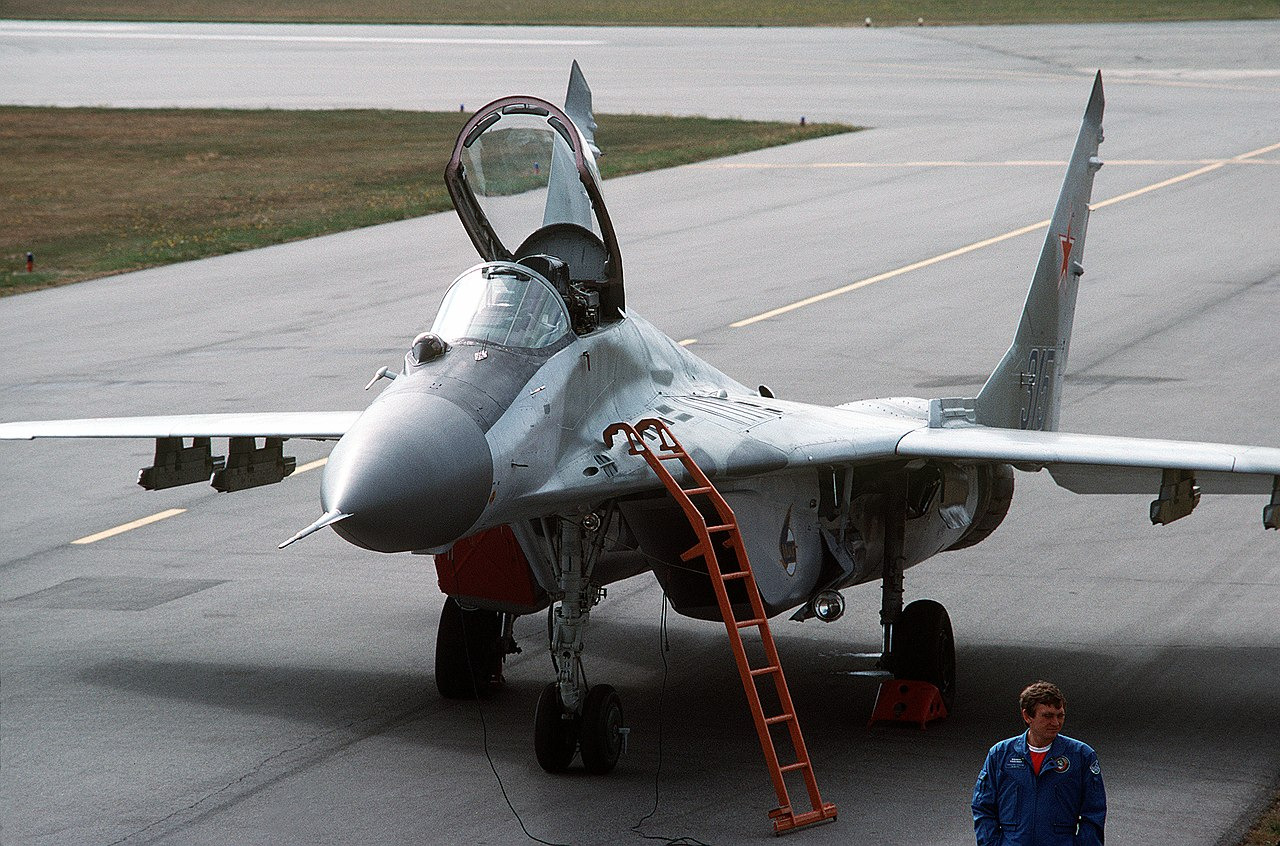
Poland will become the first NATO member to supply Ukraine with fighter jets as Polish President Andrzej Duda said Thursday that his country plans to give Kyiv four Soviet-made MiG-29 fighter jets in the coming days.
“In the coming days, we are handing over four aircraft to Ukraine in full working order,” Duda said at a press conference. Ukrainian pilots are trained to use the MiG-29, so the Polish planes can be used in battle once they arrive. Duda said Poland will send more MiG-29s after the first four are delivered.
Last year, in March 2022, Poland offered to give MiG-29s to the US to transfer them to Ukraine, but the Pentagon declined, citing concerns of escalation. NATO diplomats said at the time that Russia could perceive the move as the alliance directly entering the war.
But now, the US and its NATO allies are less concerned about escalation, and Poland’s move could inspire other alliance members to provide Ukraine with aircraft. Poland led the charge to give Kyiv German-made Leopard tanks.
According to The Wall Street Journal, Ukraine’s MiG-29s are already armed with NATO equipment, including AGM-88 High-Speed Anti-Radiation Missiles, or HARMs, which have a range of about 50 miles. Ukraine’s MiGs are also firing US-provided Joint Direct Attack Munition-Extended Range (JDAM-ER), precision-guided bombs that can hit targets up to 45 miles away.
Duda said he was open to providing Kyiv with American-made F-16s, which would require extensive training for Ukrainian pilots. The US is already laying the groundwork for the training as at least two Ukrainian pilots have arrived in the US to assess their skills.