By Ben Aris, Intellinews, 4/28/23
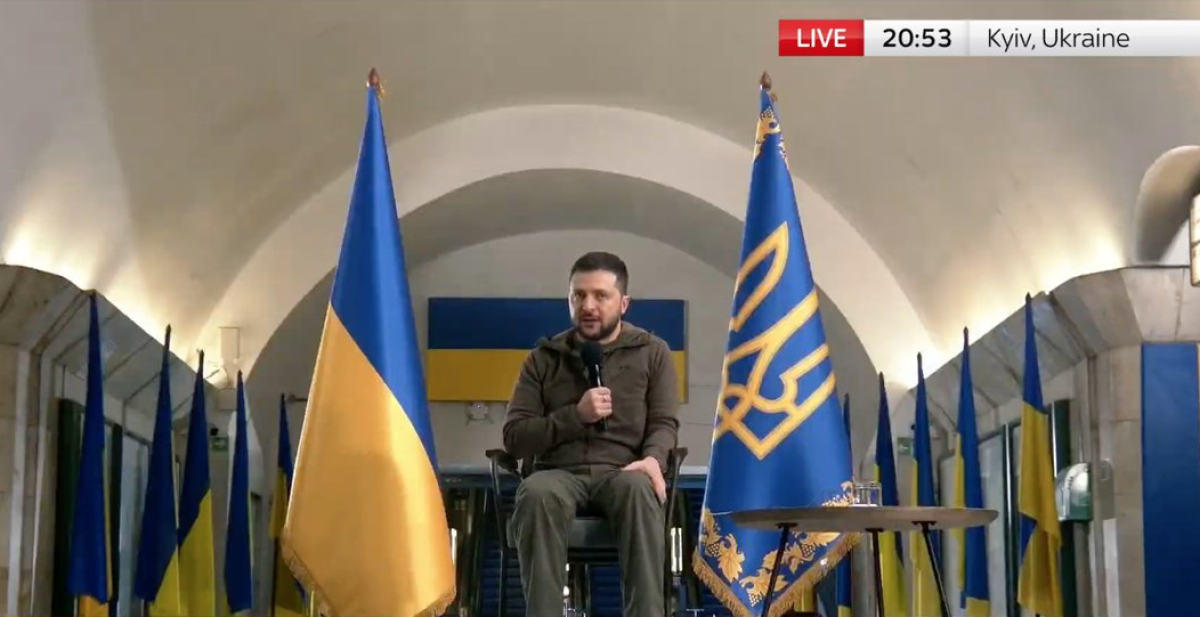
Talk of peace plans is back in the news after China’s President Xi Jinping and Ukrainian President Volodymyr Zelenskiy had a “long and meaningful” telephone call on April 26.
But a workable formula still seems a long way off. The Russian and Ukrainian starting positions are so far apart it seems impossible to close them. The Kremlin is insisting that not only does it keep all the land it has captured but that Kyiv recognises the four Ukrainian regions Moscow annexed in September as Russian. Kyiv says that talks can’t start until all Russian troops have left the country and returned to the 1991 borders. Obviously these two positions are irreconcilable. There is no common ground on which to start talks.
China entered the diplomatic fray on the anniversary of the start of the war with a 12-point peace plan proposal and is trying to position itself as a neutral arbitrator. And it is true that of all the great powers, China is best positioned to bring a deal about. Xi is as close to President Vladimir Putin as a foreign leader can get and, while Beijing’s relations with Washington are less than good, they are at least, for the meantime, still cordial. Moreover, with his trip to Moscow to see Putin in March, Xi has drawn up a chair at the top table of international diplomacy. China’s position on the war can no longer be ignored.
Having said all that, the peace deal that China has proposed is also a non-starter. While the text was full of nice sentiments like “respect for territorial sovereignty”, “an end to hostilities”, and the “prevention of the use of nuclear weapons” the practical part, where the lines of demarcation should be and who controls what territory, are no better than the Russian demands. China’s plan would concede the Donbas, the land bridge and Crimea to Russia and turn the whole of eastern Ukraine into a demilitarised zone.
Nevertheless, it’s a starting gambit that no one expects to be accepted and the goal is to start talks, not draw up an ideal solution at the first pass. What is encouraging is that Xi seems to be genuinely interested in seeing an end to the war.
So what would a possible deal look like? Ukraine and Russia came within a whisker of doing a deal in May, until it was reported that UK Prime Minister Boris Johnson flew into Kyiv and killed it off, saying that the West would not support any peace deal with Russia.
However, during the April process real progress was made and several points were agreed between the Russian and Ukrainian sides that can be built on. The points in a deal would have to deal with the problems listed below. And before proceeding further it should be acknowledged that the atmosphere is currently so toxic it would be a miracle if many of these suggestions could be made to work.
Nato: The first and easiest point to agree on is that Ukraine should give up its Nato ambitions and return to a position of neutrality that was enshrined in its constitution until 2014, when former President Petro Poroshenko changed it and made Nato membership an national ambition.
The Russian Ministry of Foreign Affairs issued an eight-point list of demands in December 2021 that in effect only had one demand that really mattered: Ukraine be permanently barred from joining Nato by a “legally binding guarantee” to that effect.
The Ukrainian negotiators conceded the point and suggested that instead Ukraine sign bi-lateral security agreements with all its Western partners – something the Russian delegates accepted.
The US refused to accept Russia’s insistence on locking Ukraine out of Nato in the January round of diplomacy just before the war, but the point here is to ensure Ukraine’s security, not for it to join Nato per se – something that the US seems more keen on that it cares to admit.
Russian security deal: Any security deal for Ukraine needs a similar security deal for Russia if stability is to return to Europe. The problem with Nato, as far as Russia is concerned, is that it is excluded from the treaty, which was specifically set up to protect Europe from the Soviet Union. The Kremlin argues that the Soviet Union no longer exists and in 2008 proposed Europe sign off on a new post-Cold War pan-European security pact that this time includes Russia and takes in the new realities – a proposal that was rejected out of hand.
For security deals with Ukraine to work, this concern of Russia’s over its security also needs to be addressed, and the idea of a new pan-European security pact needs to be revived. However, as Russia has already drawn up a template, this should be relatively easy, as there is plenty of common ground.
At the same time, once peace arrives, the arms control talks that were kicked off with the signing of a new START treaty in January 2021 should be revived and all the lapsed Cold War missile and security agreements put back in place.
Donbas and the land bridge: The question of territory will be much more difficult, as obviously Russia will not want to give up any territory it has captured without being forced to.
Of all the territory that Russia now holds in the southeast, it has the least claim to the land bridge, which was occupied at great military cost, including the destruction of Mariupol, the main city in the region. The referenda held last September as part of the annexation were an even more obviously sham than that held in Crimea in 2014. As part of a lasting deal – one that not only ends this war, but prevents the next one – the land bridge should be returned to Ukraine.
The large numbers of Donbas residents holding Russian passports – some 600,000 people – makes the question of the Donbas region much more complicated to solve. The situation is made even more complicated by the share of the locals that genuinely want to join Russia. Over the last eight years in an underreported story, the Ukraine army has been shelling the towns in the Donbas, including residential areas with civilian casualties, creating local animosity amongst a proportion of the local population.
The Russian constitution obliges the government to protect Russian citizens wherever they are, which has been used as a justification for launching the “special military operation” but is thin grounds for the occupation of the territory, and is no grounds for annexation.
During the April peace talks Ukrainian President Volodymyr Zelenskiy offered to meet with Putin personally to negotiate on the status of the Donbas. One option on the table was to grant the region some sort of “autonomous” status, but within Ukraine. That would hand political control to Moscow that would clearly back the local regimes, as it has done in South Ossetia and Abkhazia that were hived off Georgia. The Kremlin signalled it was open to this conversation, but it is not clear if it would accept it.
Another choice would be to create a new country, “Donbas Republic”, (without the “the” as the definite article is used for regions but not countries), but for the local economy to be viable it would need to keep Mariupol as a port and access to the sea. It’s unlikely either side would agree to this as, there is no precedent for a country based on the Donbas region.
The most likely outcome is a stalemate where the issue of the Donbas is kicked down the road to be solved “later” by some form of “referendum” or commission and turns into a frozen conflict, similar to northern Cyprus.
Crimea: Russia will never agree to give up Crimea under any circumstances. While the Kremlin can invent some excuses to lay claim to the Donbas, Russians believe Crimea is part of Russia and has been since it was annexed by Catherine the Great in the 16th century. Even the Ukrainians saw it as “Russian,” at least in a cultural sense, according to Gallup polls taken before the war. However, one fix here would be if the Kremlin agreed to pay for it, like the Tsar’s sale of Alaska to the US.
An obvious price would be $300bn – three times more than the value of the entire pre-war economy – which would solve the problem of how to expropriate the frozen Central Bank of Russia (CBR) money that can’t be touched legally thanks to Europe’s strong property rights. There is a chance the Kremlin will agree to this, as it has surely already written that money off anyway. At least another Alaska deal would bring some sort of closure for everyone involved.
Although an ugly solution, it has the benefit of reducing tensions by putting some legitimacy on Russia’s occupation and provides Ukraine some tangible compensation for its loss. Many Ukrainians would accept the deal as a compromise that allows them to rebuild their ruined country, and that would contribute to avoiding a new war in the future. It would provide the ready cash Ukraine needs to rebuild, which is very unlikely to be provided by its Western partners, private investors or multilateral development banks.
Free trade agreements: The final and key part of a peace plan that will last is to sign free trade agreements (FTAs) between the EU, Ukraine and Russia.
Ukraine was invited to join the EU last July, but in reality it has no chance of doing so for at least a decade, as the EU is not ready for Ukraine mainly because of the size of Ukraine’s agricultural sector. That was amply illustrated by the recent bans on Ukrainian wheat to Central Europe, which has crashed the local grain markets.
A new FTA, or an expansion of the Deep and Comprehensive Free Trade Area (DCFTA) already in place, would allow the EU to regulate imports from Ukraine, but also let Ukraine trade its way out of its current economic abyss and so negate, or even eradicate, its dependence on IMF programmes or donor loans.
When Rome finally destroyed Carthage for the first time, the city quickly bounced back by energetically trading with Rome and was able to repay all its reparations to Rome, early and with interest. The fact that Rome destroyed Carthage a second time, and much more thoroughly, only highlights the need to think long term and build a peace that allows for growth and recovery as well as simply stopping the shooting.
Import duties on Ukrainian goods to the EU have been temporarily suspended, but the current DCFTA system of quotas is so small they are used up in the first weeks of every year.
An FTA between Russia and Ukraine would also reopen Ukraine’s eastern border to trade, which would only add to its income. Moreover, entrepreneurial Russians, who already know the market well, would pour into Ukraine, and this is the fastest route to real foreign direct investment (FDI), unsavoury as that may sound.
And if there is a FTA between Ukraine and Russia, there needs to be one between Russia and the EU too, as open borders between Ukraine and EU as well as Ukraine and Russia will simply push Russian goods through Ukraine into the EU and vice versa. The Russians will be as keen to regulate trade with Ukraine crossing its border as the EU. Indeed, it was the EU’s refusal to include Russia in Ukraine’s DCFTA talks that caused the beginning of the worsening of relations between all involved.
The benefits of a new comprehensive trade deal between Russia and the EU would also bring huge new economic benefits for the EU, returning all the cheap and copious raw materials and energy, as well as access to the giant Russian consumer market – increased in size by a third by the addition of the Ukrainian market.
All of this may seem pie in the sky because of the political considerations, but a deal along these lines is inevitable thanks to the proximity of the two countries. As I wrote in another blog, [in] the geography of diplomacy, proximity matters and the geography in this case says Ukraine and Russia should be close commercial partners, even if their ideologies are currently at loggerheads. For example, despite the fact that the two have been at war for more than a year, Russian gas is still transiting Ukraine and the Russian state-owned national gas company Gazprom is still paying hundreds of millions of dollars in transit fee payments to its Ukrainian counterpart Naftogaz, scrupulously sticking to the terms of the 2019 contract. Bottom line: prosperity breeds peace and poverty leads to hate and violence.