This is a quick summary of the points Putin just made in his address announcing a special military operation in the Donbas. I came into it after he’d started. I will send out a link to a recording or transcript as soon as I’m aware they are available- Natylie
Putin said this operation will be taking place pursuant to a request by the Donbas forces to curb aggression. Putin cited the friendship treaties recently signed with the LPR and DPR as well as the UN Charter as justification for the operation. He said that Russian forces will not occupy Ukraine.
Putin appealed directly to members of the Ukrainian military to immediately lay down their arms and cited the history of their ancestors in fighting off Nazis in WWII. Putin mentioned that the coup forces from 2014 don’t want a peaceful resolution in Donbas. For 8 years, Putin said Russia had done everything it could to purse a peaceful process. But he said that Russia now has to stop “genocide” of the people [in Donbas] who pin their hopes entirely on Russia. Any bloodshed will be on the conscience of the Kiev regime.
Putin also issued a warning that those outside who try to interfere – Russia’s response will be immediate, “consequences you’ve never faced before in your history.” He further stated that the US is an empire of lies – “you have the force but you don’t have the brains.”
Putin said that the US has shown no respect for Russia’s security concerns. Instead NATO has been toughening their talk and Russia cannot continue to stand idly by as further NATO infrastructure and Anti-Russian forces receive cutting-edge weapons that are placed in Ukraine. It would be irresponsible as NATO countries have supported extreme and NeoNazi forces in Ukraine and Russian intelligence believes they will push for war in Crimea like in the Donbas. According to Russian intelligence, a clash with these NeoNazi forces is inevitable they are just biding their time. Russia will not allow them to acquire nuclear capabilities in Ukraine with this influence.
Putin also asserted that the people of [eastern] Ukraine have never been asked how they want the country they live in to be organized. He stated that truth and justice is on Russia’s side.
At the end he appealed to fellow Russians that the soldiers of the Russian armed forces will perform their duties professionally, that the business community and social and political factions will come together, “the destiny of Russia is in safe hands with our multiethnic population.”
The American Committee for US-Russia Accord believes that diplomacy is key to solving disputes and conflicts, and we have supported and called on all parties to the current crisis in Ukraine to seek a resolution of differences through diplomatic means, respecting international law and international borders.
As advocates of a diplomatic resolution we are gravely concerned that Russia has chosen to abandon the path of dialogue, diplomacy and negotiation by deciding, on February 21st, to unilaterally recognize Donetsk and Luhansk as independent Republics and order peacekeeping troops to these areas of Ukraine. We are also dismayed by US secretary of state Antony Blinken’s decision to cancel a planned meeting with Russian foreign minister Sergei Lavrov this week.
It is not lost on us that the precedent for President Putin’s decision to recognize the breakaway republics was set by the United States. Almost exactly fourteen years ago, on February 18, 2008 the US unilaterally recognized Kosovo’s independence in the face of Russian objections. Nevertheless, Mr. Putin’s actions are a violation of the territorial integrity and sovereignty of Ukraine, which we do not condone. This action by Russia, coming on the heels of the US and NATO’s rejection of Russia’s security proposals, opens a dangerous new juncture bringing with it an escalation of tensions that will benefit no one.
We appeal to Russia to confine its military presence to the Donetsk and Luhansk People’s Republics and to Ukraine to avoid military action against the breakaway enclaves. A cease-fire in the area is essential if there is any chance of finding a peaceful solution.
Yet, if Moscow’s actions in recent days and weeks, are, as we believe, deeply concerning, so too is the increasingly hardline being taken by Ukrainian president Volodymyr Zelensky who promised voters, when he ran for and won the presidency in 2019, that he would pursue a path to peace and end the war in the Donbas. Unfortunately, his speech to the Munich Security Conference last week amounted, in our view, to something close to a declaration of war.
The Ukrainian government then has to shoulder its share of the blame for the current crisis, particularly for its refusal to implement the essential provisions of the Minsk Protocols (2015), including respect for Russian language rights in Ukraine.
Sadly, we must also recognize that Mr. Zelensky’s profoundly unwise address was no doubt influenced by the same liberal and neoconservative war hawks in America’s political class and media who so loudly applauded it. The resemblance between today and February 2014, when the US aided and abetted Ukraine in its most self-destructive impulses, is hard to miss.
Also shameful is the complicity of our own national security establishment, including the veritable parade of former generals and intelligence officials who now seemingly shape the amnesiac and militaristic coverage of our most influential media outlets.
And so, as Russia and Ukraine inch closer and closer to the abyss of war, what is needed is not a rush to cede to the hawks in both parties who are braying for conflict, but for intense negotiations —at the UN, at the OSCE, and among the signatories to the Minsk Protocols. It is time to recognize that there remain options that, if pursued in good faith, could bring the current crisis to a peaceful conclusion.
To that end, we recommend a moratorium on NATO membership and a return to the Conventional Forces in Europe and Intercontinental Ballistic Missile treaties. We believe the crisis can and should ultimately be resolved by a declaration of Ukrainian neutrality and the withdrawal of Russian forces from the Donbas. To that end, we applaud the restraint shown by both France and Germany, and are particularly supportive of President Emmanuel Macron’s efforts towards ending the crisis.
To our own President, Mr. Biden, we say: American interests in Ukraine will never outweigh those of Russia’s; the US and NATO cannot and will not win a war on the ground against Russia in its own backyard; sanctions will not somehow, some way prevail this time and may indeed damage the American economy. This crisis is fundamentally, at its core, about the grave mistake of NATO expansion.
In the end, we must recognize that diplomacy is the only answer to the crisis. We urge President Biden and his administration to encourage and, if need be, help facilitate, the hard but necessary work of diplomacy that is being undertaken by our allies in Paris and Berlin.
For the American Committee for US-Russia Accord,
Signed,
Katrina vanden Heuvel, President of ACURA; Editorial Director and Publisher of The Nation magazine
James W. Carden, Senior Consultant to ACURA; former Advisor to the Special Representative for Intergovernmental Affairs, U.S. State Department
Christopher C. Dyson, Executive Vice President, The Dyson-Kissner-Moran Corporation
Bernadine Joselyn, founding Director of Public Policy and Engagement, Blandin Foundation; former Foreign Service Officer, U.S. State Department
Cynthia Lazaroff, award-winning documentary filmmaker and founder of NuclearWakeUpCall.Earth
Anatol Lieven, PhD, Senior Research Fellow on Russia and Europe, The Quincy Institute
Jack F. Matlock, PhD, U.S. Ambassador to the Soviet Union 1987-1991; U.S. Ambassador to Czechoslovakia from 1981-1983
Krishen Mehta, former Partner, PricewaterhouseCoopers; Senior Global Justice Fellow, Yale University
Nicolai Petro, PhD, professor of political science, University of Rhode Island; former special assistant for policy in the Office of Soviet Union Affairs, U.S. State Department
David C. Speedie, former Senior Fellow and Director of the Program on U.S. Global Engagement at the Carnegie Council for Ethics in International Affairs in New York
I just wanted to send a quick note to let you all know that I have implemented updates to my website, including updated security features. Visitors to the site should no longer encounter security warnings as it now has the https protocol. Thank you.
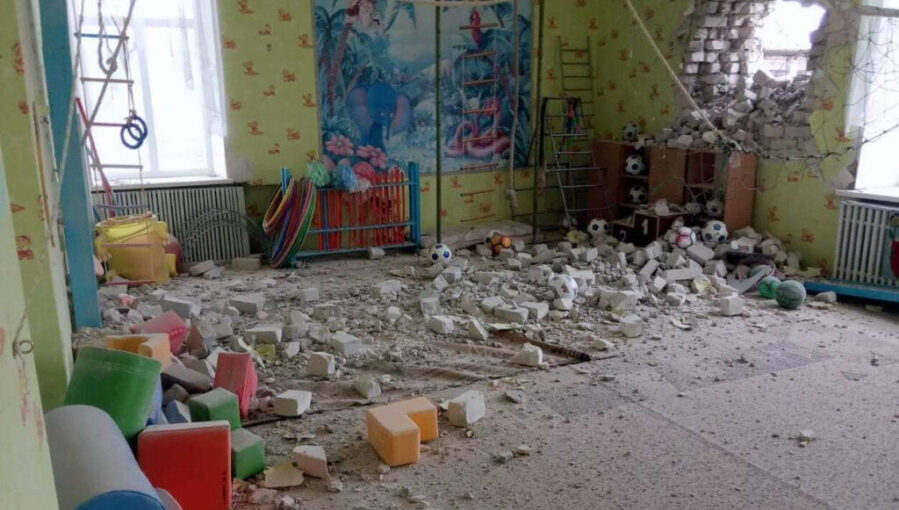
DONETSK, UKRAINE – FEBRUARY 17: (—-EDITORIAL USE ONLY â MANDATORY CREDIT – “UKRAINIAN CHIEF OF GENERAL STAFF / HANDOUT” – NO MARKETING NO ADVERTISING CAMPAIGNS – DISTRIBUTED AS A SERVICE TO CLIENTS—-) A view from the shelled kindergarten in eastern Ukraine on February 17, 2022. (Photo by Ukrainian Chief of General Staff / Handout/Anadolu Agency via Getty Images)
Gav Don trained as an officer in the Royal Navy and has a degree in international law. He grew a global energy intelligence business over 25 years and now specialises in geopolitical analysis, focusing on the interactions between politics, law, energy and armed force.
Ukrainian authorities over the weekend claimed that Russian forces had attacked a nursery school 14 km north-east of the centre of Luhansk. The claim was supported by two photographs of damage to the school, showing a purported shell hole in the ground floor wall. Western news channels immediately picked up the claim, describing it as a Russian provocation designed to justify a forthcoming Russian response. UK open source channel Bellingcat added to the news flow with an analysis which was intended to corroborate the trajectory and source of the shell.
Close examination of the photographs of the damage quickly reveals the Ukrainian government claim and the Bellingcat analysis to be comprehensively false.
Starting inside the damaged nursery room, the photograph shows a hole roughly one metre across. Bricks from the wall are heaped from the foot of the wall to three metres into the room. Below the hole stands a wooden cupboard containing footballs. The cupboard remains standing, and a handful of footballs rests both in the cupboard and at the edge of the rubble pile.
Apart from the rubble, the room has suffered no damage. There are no signs of a high explosive detonation of any kind. The wall coverings are undamaged. A quantity of brick rubble rests precariously on the lower ledge of the hole, where even a very small impact shock would dislodge it. The window one metre from the centre of the hole is undamaged. This was clearly not a high-energy event. The internal walls are not deformed outwards in any way by blast, and there is no evidence of any heat or fire damage.
These features show clearly that there was no explosion inside the room. It is possible that an incoming shell might fail to detonate, for one of several reasons. However, the location of the footballs on the shelves of the cupboard below the hole suggests that there was no impact shock, and the photograph does not show an undetonated shell or mortar round. A high-speed shell striking a building usually punches a small entry hole, not much larger than its own diameter, not a one metre rubble hole.
In contrast, the damage shown is completely consistent with damage to the wall inflicted from outside, by a standard road-worker’s tractor-mounted pneumatic drill. When a drill is applied to a brick wall as it penetrates and moves a brick, the moving brick will carry adjacent bricks with it, forming exactly the shallow V-shaped hole the photograph displays. A drill-attack also leaves a quantity of rubble on the bottom edge of the hole (unless someone takes the trouble to remove it, which clearly did not happen here). Here rubble appears to have been moved by hand from near the hole a little further into the room, to simulate the effects of shock, and footballs placed on top of the rubble pile.
Moving to the outside photograph of the building, approximately three metres square of the render has been removed. Looking at the lower part of the render, there are clear signs that it has been pulled away from the building, as the edges of the damage area face outwards. The same outward trending damage is visible to the left of the neat square one-metre hole in the wall below. The render appears to have been pulled or grabbed to remove it, in an uneven fashion, as the damage on one side is 1.5 metres higher than the damage on the other.
On the ground at the foot of the wall the removed render and insulation has been scattered up to ten metres laterally, at 90 degrees from the hole, and there is an area at the foot of the wall with less rubbish scatter – probably the area where the excavator was placed.
If a high explosive detonation had occurred outside the wall (as it would on impact with a graze fuze) the wall would have deformed inwards, all adjacent glass would have shattered, there would be clear marks of fire and shrapnel spatter on the wall exterior, and rubble would be scattered uniformly in an arc of roughly 45 degrees away from the wall, as well as large quantities of rubble accompanied by fire and shock damage inside.
Taking this evidence as a whole, it is unarguable that the building was not attacked by a shell.
Ukrainian reports claim that the attack happened while the nursery was occupied by children and teachers, who were in another room. However, the photograph of the interior shows clearly that outside the room it is dark. There is no time stamp on the photograph, but it is likely that this photograph was the first to be taken, and was taken very shortly after the damage was inflicted, at night, when the building was unoccupied.
The nursery is located four kilometres north-east of the Contact Line, in Ukrainian-held territory. The evidence as presented strongly suggests that Ukrainian forces damaged the nursery with an excavator, probably equipped with a pneumatic drill attachment, and then released the photographs in an attempt to make a case that Russian forces had carried out an attack on an occupied children’s nursery.
That trope has been enthusiastically taken up by European and US media. Prime Minister Boris Johnson went so far as to describe it as a false flag attack designed to justify a Russian assault. He omitted, however, to clarify how an attack on a nursery in Ukraine-held territory would either motivate or justify a move by Moscow, or to explain how an attack on a Ukrainian asset on Ukrainian territory could be a false flag move by anyone other than Kyiv.
Events over the past two days within the Donetsk and Luhansk Republics are somewhat shrouded in the fog of near-war. It seems reasonably clear that the two leaders of the Republics have ordered some sort of mass evacuation of civilians from the republics to Russia, and in this context the number 700,000 has been repeated in multiple media channels. That number coincides with the number of people in the Republics who have received Russian passports. The total population of the Republics is somewhere in the region of 3.5mn.
However, bne Intellinews sources inside the republics do not corroborate a movement of this number of people. One source cited the movement of 25,000 people across the Russian border on Friday. There is a clear ambiguity as to whether the Republics have ordered women and children to leave, or have simply advised them to do so, and as to whether large numbers of people are actually evacuating.
bne Intellinews sources on the ground report that Ukrainian forces on the contact line have shelled civilian targets regularly for “years”, at intervals ranging from days to months. The rate of fire has certainly escalated. OSCE Monitoring recorded 1,413 shell and mortar detonations within the Republics on Friday, including rounds from 122-mm mortars banned under the Minsk ceasefire.
One resident of a western suburb of Donetsk (actually an ethnic west Ukrainian living in the Republic) stated that 10 shells had landed around her settlement 600 metres from the Contact Line, and that the shelling was the worst she had experienced since 2015. The truth probably lies somewhere in the middle of two extremes – there is more shelling than there has been recently, but not as much as “constant”, and not aimed directly at homes or other buildings.
Shelling appears to have been “harassing” rather than aimed. Republic authorities on Saturday stated that no-one had been killed in the republics by shelling. They also claimed to have details of plans for a Ukrainian invasion of the republics, but it seems unlikely that, if they did, they would disclose that fact.
Ukrainian sources cite a smaller number of similar artillery and mortar detonations on Ukrainian territory. Sources do not report which side fired first.
With these events tension between Russia and the Western allies has reached a new and uncomfortably high level. Mainstream media have drawn a (fatuous) connection between the nursery attack and Russian plans to invade Ukraine. The connective tissue between the two appears weak at best, but both US and UK authorities are continuing to forewarn of a major attack based on (unrevealed) intelligence. There is as yet no evidence that Russian Federation troops are located in the republics, but there is clear evidence that the republics have initiated a call-up of reservists….