Putin & Erdogan Agree to Another Ceasefire in Idlib After 6 Hours of Difficult Talks; Trump Agrees to Putin’s Proposed Summit of 5 UN Permanent Security Council Members

After a tense phone call over a week ago that reportedly devolved at one point into a shouting match between Putin and Erdogan, the two leaders met in Moscow and agreed to another ceasefire in Syria’s Idlib province. The talks lasted for 6 hours last Thursday and concluded with agreement to a ceasefire and the establishment of a buffer zone, along the M4 highway, to be patrolled jointly by Turkey and Russia. Additionally, the “rebels” are supposed to evacuate from south of the highway.

Thursday’s agreement is considered an “additional protocol” to the Sochi Agreement of 2018. The ceasefire took effect on Friday morning and the joint patrols are due to start on March 15th.

Scott Ritter describes the reality on the ground after about a week of clashes between the Syrian Army and Turkish forces – the latter of which received no substantive support from Washington/NATO, which motivated the talks between Erdogan and Putin:

This [Turkish] operation soon fizzled; not only was the Turkish advance halted in its tracks, but the Syrian Army, supported by Hezbollah and pro-Iranian militias, were able to recapture much of the territory lost in the earlier fighting. Faced with the choice of either escalating further and directly confronting Russian forces, or facing defeat on the battlefield, Erdogan instead flew to Moscow.

The new additional protocol, which entered into effect at midnight Moscow time on Friday, March 6, represents a strategic defeat for Erdogan and the Turkish military which, as NATO’s second-largest standing armed force, equipped and trained to the highest Western standards, should have been more than a match for a rag-tag Syrian Army, worn down after nine years of non-stop combat. The Syrian armed forces, together with its allies, however, fought the Turks to a standstill. Moreover, the anti-Assad fighters that had been trained and equipped by the Turks proved to be a disappointment on the battlefield.

One of the major reasons behind the Turkish failure was the fact that Russia controlled the air space over Idlib, denying the Turks the use of aircraft, helicopters and (except for a single 48-hour period) drones, while apparently using their own aircraft, together with the Syrian Air Force, to pummel both the Turkish military and their allied anti-Assad forces (though neither side has officially confirmed the Russians bombing the Turks – that would be a disaster for the talks). In the end, the anti-Assad fighters were compelled to take shelter within so-called ‘Observation posts’– heavily fortified Turkish garrisons established under the Sochi Agreement, intermingling with Turkish forces to protect themselves from further attack. [Turkey’s] Operation Spring Shield turned out to be a resounding defeat for the Turks and their allies.

Forgive my cynicism but this sounds reminiscent of previous agreements that have broken down. The Turks did not live up to their obligations under the Sochi Agreement to remove jihadists such as terrorist group Hayat Tahrir al-Sham (HTS aka Al Qaeda/Al Nusra re-branded) from established de-escalation zones. Turkey’s failure to do this prompted the Syrian Army to remove the terrorists (“rebels”) themselves. According to Ritter, the additional protocol just agreed on reiterates the goal of pushing out the terrorists but does not elaborate on how it is to be achieved.

As military analyst Moon of Alabama points out:

This ceasefire is unlikely to hold over a longer period. But it brings a useful pause for the Syrian army that will allow it to recover a bit and to take care of its men and equipment.

This for now also ends the Turkish threat to attack the Syrian army and to reconquer all areas it had liberated over the last months.

Erdogan, who had made many demands, saw none of them fulfilled. The agreement will cost him political points within his party.

So it sounds like Erdogan took a big risk with his blustering action in Syria and ended up laying an egg. But I doubt Erdogan is suddenly going to give up the ghost rather than continue to find ways to throw sand in the gears of Syria’s push to regain full control over their sovereign territory.

A Redlines interview by Anya Parampil with Iranian professor, Mohammad Marandi, who just got back from Idlib, gives an update from on the ground as well as a good discussion of the history of the Syrian war.

For those who like symbolism – and have a propensity for Schadenfreude, here is a photo of Erdogan’s visit to Moscow and the decor he was subjected to during part of his meeting with Putin – courtesy of Russian historian and geopolitical analyst Nina Byzantina. (Note: you will only be able to see this image if you go to this post on my blog, it will not show up in the email version of this post – NB).

************************************************************************

In response to Putin’s January call for a summit of the 5 permanent UN Security Council members to discuss peace and other global issues of importance, France and China had quickly announced their receptivity. The US and UK, however, had been mum.

Last Wednesday, Russian news agency TASS reported that Russian Foreign Minister Sergei Lavrov confirmed that president Trump has now agreed to the summit, which might take place at the UN on the sidelines of a General Assembly meeting in New York. Izvestia reported the following on March 4:

According to Lavrov, besides the challenging issue of nuclear disarmament, the parties are expected to discuss regional conflicts, new challenges and threats such as international terrorism, drug trafficking and other forms of organized crime, as well as human trafficking, migration issues and new technologies, which could slip out of control and pose a serious threat to humanity.

It’s easier to arrange this meeting of the five UNSC permanent members in New York, said Pavel Podlesny, Head of the Center for Russian-American Relations at the Institute for the US and Canadian Studies. “China and France backed the idea to meet a long time ago and now the US has agreed, and therefore Britain has no other option. It’s easier to hold the discussion in New York ahead of a session of the UN General Assembly as Donald Trump has offered,” he noted.
Bernie Sanders’ Foreign Policy Adviser Matt Duss’s Comments at Quincy Institute’s Forum on “A New Vision for America in the World”

Matt Duss is Bernie Sanders’ adviser on foreign policy. He represents a mild improvement on post-Cold War foreign policy – he’s not a Neoconservative and he acknowledges that the Palestinians have rights.

However, I’ve noted some very poor takes by Duss on Twitter such as one comment in which he seems to suggest that the main problem with Trump’s Venezuela policy is that it has been handled incompetently and allowed “Russia to screw with us in our own backyard.” He invokes a cold war narrative against Russia and seems to suggest that our interference in Venezuela isn’t really a problem – all in one tweet. He did receive significant criticism from Bernie supporters about it.

More recently, he put out a tweet supporting an article in The Guardian in which he suggested that the United States should support democracy activists in Russia and highlighted Alexey Navalny as representing the democratic opposition there. Others had to school him on who Navalny actually is: a right-wing racist xenophobe who actually referred to Central Asian immigrants in Russia as cockroaches.

This underscores the problem with Bernie Sanders and his campaign’s dangerous ignorance on the world’s other nuclear superpower in particular, as well as with their overall Manichean framework of the world’s democracies taking on the world’s “authoritarian” governments as outlined in a major speech given by Sanders on foreign policy in 2017 at Westminster College.

Last week, Duss was interviewed at a conference put on by the new think tank the Quincy Institute for Responsible Statecraft, which advocates for restraint in U.S. foreign policy. A video was posted this past weekend of the event and I watched the first half, which included a discussion with Gen. David Petraeus – who said what one would expect him to say while also engaging in a lot of what Tim Black would call ear fatigue, yammering on about a lot of stuff that has nothing to do with the question asked until most people in the audience were wishing someone would pull the fire alarm and force an evacuation.

Congressman Ro Khanna also made an appearance and said some reasonable things, which cleansed the palate a bit after the bad taste left by Petraeus.

About an hour and a half into the conference Matt Duss was interviewed, along with Joe Biden’s foreign policy adviser and program director at the German Marshall Fund, Julianne Smith. Here are a few highlights of what Duss said in response to an initial set of questions from the moderator, Jonathan Tepperman – editor of Foreign Policy Magazine:

Most worrisome foreign policy issue facing a new president – Duss said climate change. It needs a multilateral response and will affect many other issues such as immigration.

How can damage Trump has done to alliances and “rules-based order” be repaired – Duss said that based on some of his conversations with allies in Europe, the election of Trump and his policies has made them begin to wonder if they’d misunderstood the U.S. Duss, however, did state that we should realize that Trump is not such a departure from the U.S.’s foreign policy of the last 20 years – i.e. after 9/11, which saw the “securitization of immigration,” the vilification of Muslims and a general demonization of diplomacy.

Moving forward – Duss said that we shouldn’t necessarily just return to the past on all foreign policy issues. Some challenges will require creating a new consensus and a comprehensive review of what institutions and policies are needed to meet current challenges. He also said that foreign policy should be rooted in an overall U.S. political consensus. I wasn’t really sure what this meant as he didn’t elaborate.

Israel/Palestine – Duss reiterated the need to return to a 2-state solution framework and international law and resolutions governing this basic framework. He did note that Israel’s actions, such as expansion of settlements, has undermined this. He said that Sanders would be more willing to put pressure on Israel to abide by its obligations. He mentioned Sanders’ characterization of Netanyahu as a “right wing nationalist” and connected that to the campaign’s overall critique of “right wing” “authoritarians.”

At this point, questions from the audience were allowed.

Are there any justifications ever for regime change wars and, if so, what are they? – Duss eschewed regime change wars, saying simply “Let’s not do it.”

What is the guiding principle or “north star” of your foreign policy? – Duss said that the strength of our democracy would guide our foreign policy in addition to reliance on allies and partnerships with other countries to create a “democratic consensus.”

This sounded vague to me. What does this actually mean in practice?

What role should sanctions have in foreign policy? Individual v. sectoral sanctions? – Duss said there should be more coherence on the use of sanctions, acknowledging that there had been an “over use” of them and that they sometimes have the effect of preventing diplomacy. He seemed to be more amenable to individual sanctions over sectoral sanctions so as not to harm civilian populations.

Duss was asked about the Manichean framework of democracies v authoritarian governments and whether democracy promotion could just be used as a tool for regime change – Duss stated that Sanders is not neutral on the issues of democracy and human rights. Although the U.S. needed to be more humble in terms of intervening in other countries, there should be a push for international norms.

Again, I’d like to know what exactly this means. What types of intervention are acceptable under this framework and who defines what constitutes democracy and violations of human rights? Do small countries get to tell larger (more powerful) countries that they are violating democracy and human rights? If so, what recourse do they have in effecting change in the larger country? If the U.S. is going to decide whether Russia, for example, is violating democracy and human rights, what sources are they going to be relying on to determine that? Alexey Navalny? Matt Duss – who clearly knows squat about Russia?

Grayzone journalist Max Blumenthal asked Duss about Ro Khanna’s recent twitter comment in the aftermath of the Russiagate accusations against Bernie’s campaign that we should trust the intel agencies. He also asked why Bernie is not demanding proof of the allegations – Duss said that Sanders had been briefed convincingly regarding Russian election interference (for 2020) and that Sanders would oppose any election interference by any foreign country.

What should our nuclear posture and position on “no first use” of nuclear weapons be? – Duss said Sanders supported a no first use position.

Interestingly, one member of the audience asked about reining in the defense budget and how such a reduction could be implemented with respect to congress, etc. This question was ignored.

Ukraine Opens Criminal Investigation into Pressure Allegedly Placed on Former Prosecutor Shokin by Joe Biden; Video Series: Putin Answers Questions on 20 Topics for 20th Anniversary of His Governance of Russia – Part I

On February 27th, Interfax [a private Russian news agency that is generally considered reliable] reported that a criminal investigation has been opened up by Ukraine’s State Bureau of Investigation regarding alleged pressure put on Ukraine’s former prosecutor Viktor Shokin by former Vice President Joe Biden.

The investigation was opened in response to a motion filed by Shokin. The State Bureau of Investigation was court ordered to register the case.

In his motion, Shokin spoke of pressure put on him by Biden, Teleshetsky said.

“The reason for the pressure was the investigation being conducted by the Prosecutor General’s Office of Ukraine into grave crimes of international corruption linked with the activities of former Ecology Minister of Ukraine Mykola Zlochevsky and top managers at the Burisma company,” he said.

Shokin’s motion was filed with the State Bureau of Investigation back on January 28, 2020, but information about the criminal offence was added to the Unified Register of Pre-Trial Investigations only on February 24 after the country ordered the bureau to register the case, Teleshetsky said.

The case was opened on the charge of interfering in the work of an official of a law enforcement agency, he said.

Even though Shokin included Biden’s name in the motion, which prompted the opening of the case, the investigation itself mentions only a “U.S. citizen,” without giving any names, Teleshetsky said.

The State Bureau of Investigation is also handling criminal cases opened in response to Shokin’s motion on charges of disclosing pretrial probe secrets to employees of the National Anti-Corruption Bureau of Ukraine, he said.

“Bearing in mind the fact that a possible suspect in all three of these criminal offences could be Joseph Biden, as a person who, in our opinion, is involved in these events, we deem it necessary to merge all the cases into one, in order to ensure an effective investigation and set up a competent investigative group, as well as a group of experienced prosecutors who can ensure the investigation within a reasonable period of time,” Teleshetsky said.

************************************************************************

The Russian news agency, TASS, conducted a comprehensive interview with Vladimir Putin on 20 different topics for the 20th anniversary of his initial election as Russian president. It will be a multi-part video series to be posted at intervals through the end of March. Below is a link to the first video with English subtitles. Unfortunately, I could not embed the video.

https://putin.tass.ru/en?_ga=2.127845517.142265297.1581953885-311200542.1578148349

Peace Deal Signed Between U.S. & Taliban; Russia Sends Warships to Coast of Syria After Turkish Attacks, Turkey Downs 2 Syrian Fighter Jets; Assange Hearing Continued to May, Chris Hedges Interviews Joe Lauria re Assange Case

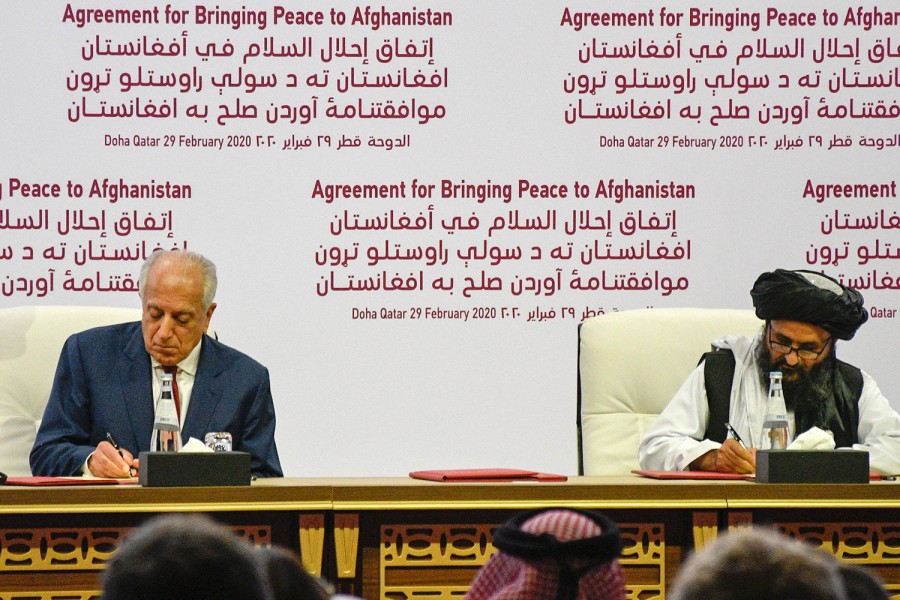
Zalmay Khalilzad, America’s special envoy for Afghan reconciliation, signs a peace deal with the Taliban, along with Mullah Abdul Ghani Baradar, the militant group’s top political leader, in Doha, Qatar, on Saturday, Feb. 29, 2020.
J.P. LAWRENCE/STARS AND STRIPES

On Saturday, February 29th, the U.S. and the Taliban signed a peace deal in which U.S. forces will the leave Afghanistan in stages. Stars and Stripes reported the following details:

DOHA, Qatar — The United States and its foreign allies will withdraw all forces within 14 months and end the war in Afghanistan if the Taliban renounces terror groups and abides by a joint agreement signed in Doha on Saturday.

The agreement mandates a phased drawdown of American, NATO and foreign partner troops from Afghanistan and a disavowal of al-Qaida and other terror groups by the Taliban.

It also calls for intra-Afghan talks to include the Taliban and the government in Kabul beginning March 10, as well as security cooperation by all sides in fighting the Islamic State…

…The U.S. is expected to reduce its troop strength in Afghanistan from about 12,000 to 8,600 within 135 days, the agreement states. All U.S. troops and their allies would also completely withdraw from five unspecified bases. Remaining troops would leave within 14 months of Saturday’s accord.

A reduction in troops to 8,600, about the number in Afghanistan when President Donald Trump took office in 2017, would not harm a counterterrorism mission that combats ISIS and other groups, U.S. military officials have said since last fall.

According to the agreement, the U.S. will continue to fund the Afghan government and can halt the drawdown of forces if it determines that the Taliban are not living up to their end of the deal. How this would be determined is not explained. Additonally, an exchange of prisoners – 5,000 Taliban fighters and 1,000 Afghan government troops – will occur on the first day of negotiations between the Taliban and the Afghan government on March 10th.

Analysis of the deal is provided by journalist Azmat Khan on Democracy Now!

https://www.democracynow.org/2020/3/2/us_taliban_peace_deal

In the aftermath of clashes between Syrian troops and Turkish forces, the Russian government has announced it will be sending two warships armed with cruise missiles to the coast of Syria. The parties to the conflict have given different explanations for the clashes and the Turkish president is threatening to continue attacks on Syria:

Over 30 Turkish troops were killed in Idlib Province, and Russia says that they hold Turkey responsible for their own casualties. They said Turkey was not disclosing the location of their troops, and also were embedded with Islamist rebels, making themselves a target.

Turkey has denied this, saying they weren’t with the rebels, and that they’d told Russia where their troops were when they got killed. The Turkish forces are threatening more attacks on Syria going forward.

On Sunday and into Monday, Turkey continued both air and ground attacks on the Syrian army in Idlib:

Throughout Sunday and into Monday, Turkey has launched a flurry of airstrikes against the Syrian military in Idlib Province, and new ground offensives aiming to reclaim territory in the border province, to expel the Syrian government and ultimately replace it with Turkish-backed rebels.

Turkish officials have vowed to continue to move against Syria, and have promised to move against any Syrian government targets as legitimate military targets. On Saturday, 48 Syrian soldiers were killed. Turkey subsequently downed a pair of aircraft.

According to al- Jazeera, Turkey shot down the two Syrian fighter jets in retaliation for Syria’s downing of a Turkish drone hours before. The pilots, however, survived by parachuting to safety. The Syrian government claims it has now closed airspace over the province:

Amid the escalating tensions, the Syrian government closed the airspace over Idlib, with one official telling [Syria’s state run news agency] SANA any aircraft “that violates our airspace will be treated as a hostile flight that must be shot down and prevented from achieving its objectives”.

************************************************************************

With respect to the extradition hearing for Julian Assange in London, the court has continued the hearing until May 18th. Below is an interview of Consortium News editor Joe Lauria, who has been covering the Assange hearing from London, by Chris Hedges.


Syrian/Russian Airstrikes Kill 34 Turkish Soldiers in Idlib as Erdogan Tries to Invoke Article 4 of NATO; Tulsi Surrogate Debates Bernie Surrogate on Foreign Policy

Yesterday Turkish forces in the Idlib province of Syria, who have been attempting to stave off the defeat of Turkish-backed terrorist “rebels,” were killed as a result of airstrikes that have been officially blamed by Turkey on the Syrian government but may have involved the Russian air force. Newsweek reported the following:

Turkish Hatay province Governor Rahmi Dogan has announced that at least 33 Turkish soldiers were killed in airstrikes blamed on the Syrian government against their positions in the country’s northwestern province of Idlib. The count has risen steadily since an initial announcement of nine dead and more injured, some critically.

The Syrian Observatory for Human Rights, a U.K.-based monitor supportive of Syria’s exiled political opposition, first reported a death toll of up to 34 Turkish soldiers earlier Thursday in an area where both the Syrian and Russian air forces were highly active. The monitor did not assign responsibility for the strikes.

Erdogan has been talking tough about how he will spare no effort to stop the Syrian government from re-taking control of its own territory in Idlib, which it is feared would result in hundreds of thousands of additional refugees crossing into Turkey, among other problems. Scott Ritter reported yesterday for RT that Erdogan had consulted with NATO – invoking Article 4 – but seems to have had little success in getting the alliance on board to assist Turkey in Syria:

Turkey engaged NATO in Article 4 consultations, seeking help regarding the crisis in Syria. The meeting produced a statement from NATO condemning the actions of Russia and Syria and advocating for humanitarian assistance, but denying Turkey the assistance it sought.

The situation in Idlib province has reached crisis proportions. A months-long military offensive by the Syrian Army, supported by the Russian Air Force and pro-Iranian militias, had recaptured nearly one-third of the territory occupied by anti-Assad groups funded and armed by Turkey. In response, Turkish President Recep Tayyip Erdogan dispatched thousands of Turkish soldiers, backed by thousands of pieces of military equipment, including tanks and armored vehicles, into Idlib to bolster his harried allies.

The result has been a disaster for Turkey, which has lost more than 50 soldiers and had scores more wounded due to Syrian air attacks. For its part, Russia has refrained from directly engaging Turkish forces, instead turning its attention to countering Turkish-backed militants. Faced with mounting casualties, Turkey turned to NATO for assistance, invoking Article 4 of the NATO charter, which allows members to request consultations whenever, in their opinion, their territorial integrity, political independence or security is threatened.

Among the foundational principles of the NATO alliance, most observers focus on Article 5, which declares that an attack against one member is an attack against all. However, throughout its 75-year history, Article 5 has been invoked only once – in the aftermath of 9/11 – resulting in joint air and maritime patrols, but no direct military confrontation. The wars that NATO has engaged in militarily, whether in Kosovo, Afghanistan, Libya or Iraq, have all been conducted under Article 4, when NATO made a collective decision to provide assistance in a situation that did not involve a direct military attack on one of its member states….

…The best Turkey could get from its Article 4 consultation, however, was a lukewarm statement by Jens Stoltenberg, the NATO secretary general, condemning Syria and Russia while encouraging a diplomatic resolution to the fighting in Syria that focused on alleviating the unfolding humanitarian crisis regarding refugees. This is a far cry from the kind of concrete military support, such as the provision of Patriot air defense systems or NATO enforcement of a no-fly zone over Idlib, Turkey was hoping for.

Antiwar.com has also reported that comments out of Washington don’t seem to indicate much interest in direct military assistance to Turkey at this time:

US officials are making clear they aren’t considering joining the war in any real way. Defense Secretary Mark Esper in particular said that “I don’t see any likelihood that we would be back along the border.

In a failed effort to pressure the European nations to support Turkey’s continuing gambit in Syria, Erdogan decided to open up the Turkish border into Europe, namely Bulgaria and Greece, for 72 hours to allow Syrian refugees to head into the EU.

A telephone conversation took place between Erdogan and Putin in which the Kremlin confirmed that a meeting could take place in the near future but no date was given. Other than the airing of views between the two and an agreement to ” step up the corresponding interagency consultations and to examine the possibility of soon holding a meeting at the highest level,” nothing concrete was announced.

************************************************************************

Tulsi surrogate Niko House debates Bernie surrogate Ben Burgis on their respective candidates’ policies. The debate primarily focuses on foreign policy but some domestic policy is touched on as well.

Analysis & Book Reviews on U.S. Foreign Policy and Russia