By Alan MacLeod, Consortium News, 12/4/25
Trump loyalist and C.I.A. contractor Larry Ellison’s purchase of CNN appears imminent, and marks the latest venture into media for the world’s second-richest individual.
But Ellison is not alone.
Indeed, the world’s seven richest individuals are all now powerful media barons, controlling what the world sees, reads, and hears, marking a new chapter in oligarchical control over society and striking another blow at a free, independent press and diversity of opinion.
Media Monopoly
Paramount Skydance — an Ellison-owned company — is in pole position to purchase Warner Brothers Discovery, a conglomerate that controls gigantic film and television studios, streaming services like HBO Max and Discovery+, franchises like DC Comics, and TV networks such as HBO, TNT, Discovery Channel, TLC, Food Network, and CNN.
This lead is largely due to Ellison’s proximity to President Donald Trump, who will ultimately have to sign off on such a deal.
Ellison has already spoken to senior White House officials about axing CNN hosts and content that Trump is said to dislike, including anchors, Erin Burnett and Brianna Keilar.
It is this willingness to completely re-orientate the network’s political direction that has made him the White House’s preferred purchaser of Warner Brothers Discovery. He is reportedly so wealthy that he can afford to pay in cash.
Ellison, whose net worth stands at a staggering $278 billion, has been on a media spending spree of late. Earlier this year, he provided the funds for Skydance to purchase Paramount Global, another gigantic conglomerate that controls such products as CBS, BET, MTV, Comedy Central, Nickelodeon, Paramount Streaming and Showtime.
Immediately upon being appointed CEO of CBS News, Larry’s son, David, began drastically re-orientating the network’s political outlook, firing staff, pushing it to become pro-Trump, and appointing self-described “Zionist fanatic” Bari Weiss as its editor-in-chief.
The Ellison family, however, is far from finished. In September, President Trump signed an executive order approving a proposal to force through the sale of social media platform TikTok to an American consortium led by Ellison-owned tech company, Oracle.
Under the planned arrangement, Oracle will oversee the platform’s security and operations, giving the world’s second-richest man effective control over the platform that more than 60 percent of Americans under 30 years of age use for news and entertainment.
Trump himself stated that he was extremely pleased that Oracle would be controlling the platform. “It’s owned by Americans, and very sophisticated Americans,” he said.
The Ellison family’s sudden venture into the realm of media and communications has shocked many, with senior media figures sounding the alarm.
Longtime CBS News anchor, Dan Rather, warned that “we all have to be concerned about the consolidation of huge billionaires getting control of nearly all of the major news outlets.”
“It is a particularly tough time for anybody working at CBS News,” he stated, citing pressure to change coverage to be more pro-Trump. “I think if [the Ellisons] were to buy CNN, it would change CNN forever, and it might be another very serious wound to CBS News,” he concluded.
Billionaire Capture
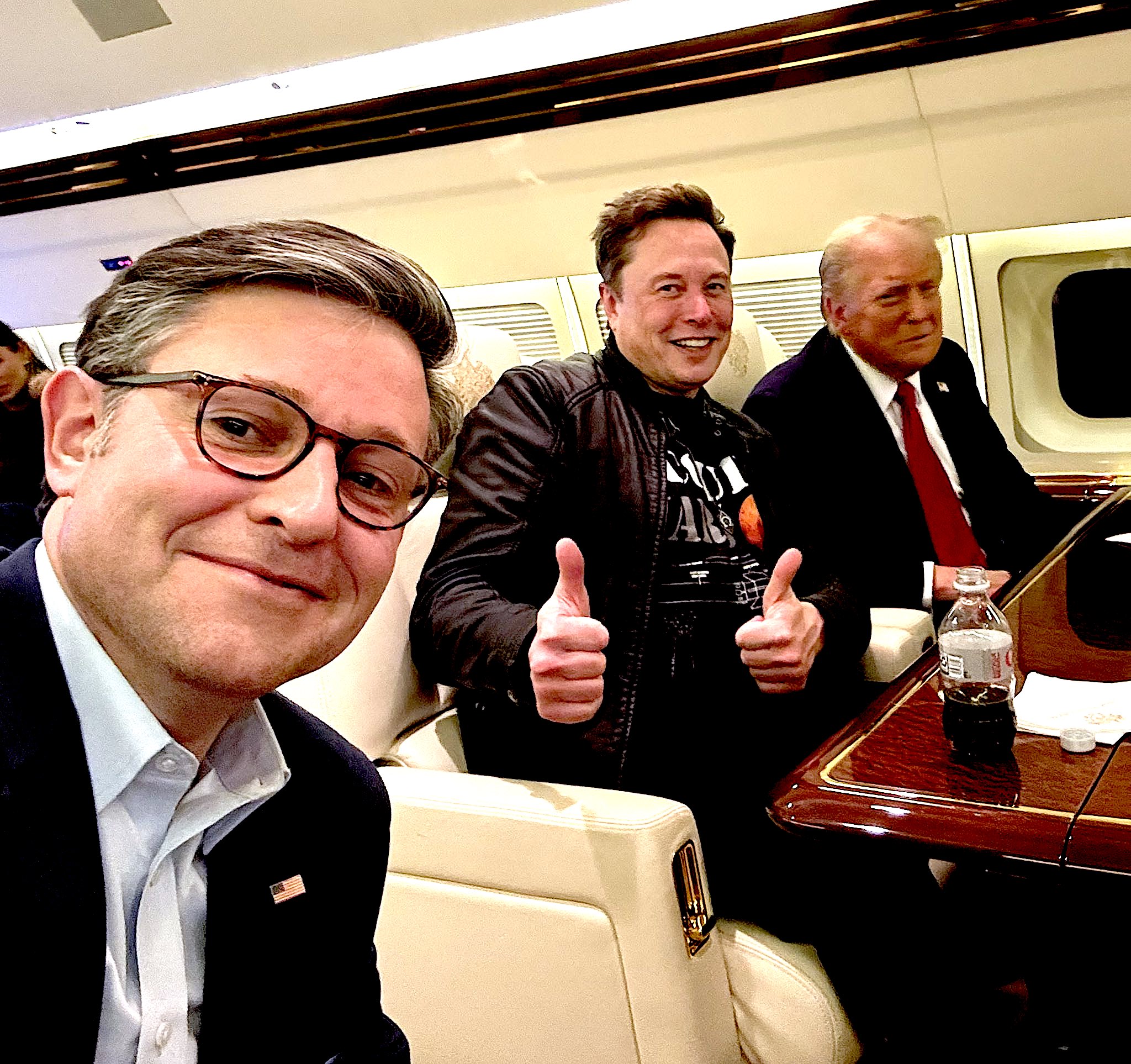
U.S. House Speaker Mike Johnson, Elon Musk and President-elect Donald Trump on Nov. 16, 2024. (Office of Speaker Mike Johnson, Wikimedia Commons, Public Domain)
Rather is correct. No other period in history has seen such a rapid and overwhelming buy up of our means of communications by the billionaire class – a fact that raises tough questions about freedom of speech and diversity of opinion.
Today, the world’s seven richest individuals are all major media barons, giving them extraordinary control over our media and public square, allowing them to set agendas, and suppress forms of speech they do not approve of.
This includes criticisms of them and their holdings, the economic system we live under, and the actions of the United States and Israeli governments.
Sitting on a fortune of over $480 billion, Elon Musk is the wealthiest person in world history, and is projected to, within the next decade, become the planet’s first trillionaire.
In 2022, Musk purchased Twitter, in a deal worth around $44 billion. The South-African born tech magnate quickly set about turning the platform into a vehicle for advancing his own far-right politics.
In 2024, for example, he was a key figure in promoting an attempt to topple Venezuelan President Nicolás Maduro, spreading misinformation about the country’s election and even threatening Maduro with a future in the notorious Guantánamo Bay prison camp.
He has also very publicly rewritten his generative AI chatbot, Grok, on multiple occasions, so it would produce more conservative responses to users’ questions. One result of this was that Grok began to praise Adolf Hitler.
Musk overtook Jeff Bezos last year to become the world’s richest man. And like Musk, the Amazon founder and CEO has made several moves into the world of media.
In 2013, Bezos bought The Washington Post for $250 million, and quickly began exerting his influence on the newspaper, firing anti-establishment writers and hiring pro-war columnists. This came just months after he bought a minority stake in Business Insider (now rebranded to Insider).
One year later, in 2014, Amazon paid nearly a billion dollars to purchase Twitch, a streaming platform which hosts around 7 million monthly broadcasters. Amazon also owns a wide range of other media ventures, including movie studio MGM, audiobook platform, Audible, and movie database website, IMDB.
French billionaire, Bernard Arnault, meanwhile, has been buying up large swaths of his country’s media outlets. The chairman of luxury conglomerate, Louis Vuitton Moët Hennessy (LVMH) and the world’s seventh-richest man now sits on a media empire that includes daily newspapers such as Le Parisien and Les Echoes, magazines such as Paris Match and Challenges, as well as Radio Classique.
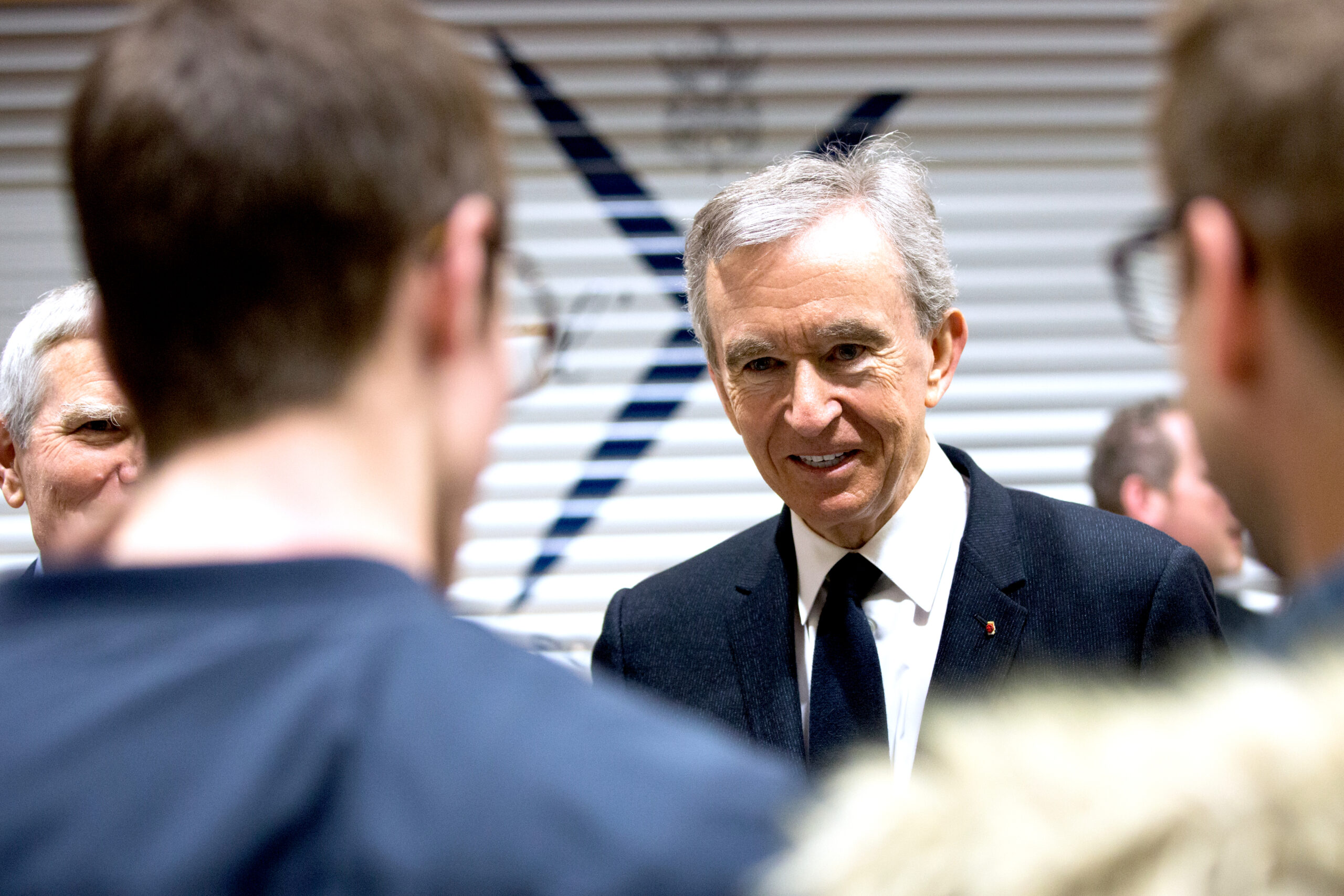
Bernard Arnault in 2017. (Jérémy Barande, CC BY-SA 2.0, Wikimedia Commons)
The remaining three individuals rounding out the top seven list all owe their wealth primarily to their media empires.
Google co-founders Sergey Brin and Larry Page are collectively worth over half a trillion dollars. Google has become the dominant force in today’s hi-tech economy, and is also a major player in social media, having bought YouTube in 2006 for $1.65 billion.
Thirty-five percent of Americans use the video platform as a primary source of news.
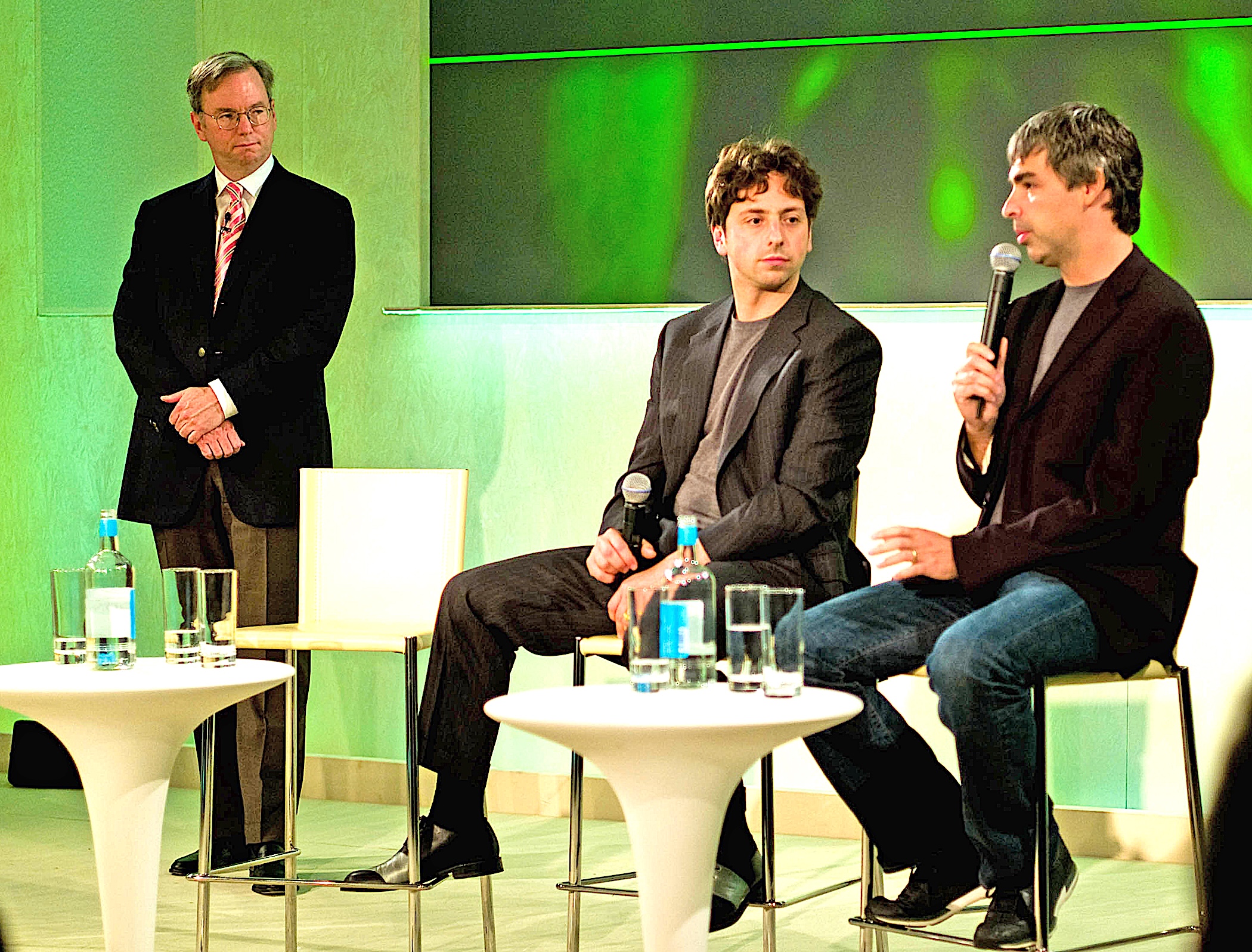
From left, Google’s Eric Schmidt, Sergey Brin and Larry Page, 2008. (Joi Ito /Wikimedia Commons/CC BY 2.0)
Mark Zuckerberg, meanwhile, owes his $203 billion fortune to his social media and tech ventures, including Facebook, Instagram, and WhatsApp. Like YouTube, Zuckerberg’s companies are major players in the modern news landscape, with 38 percent, 20 percent and 5 percent of Americans relying on Facebook, Instagram, and WhatsApp for their news and views.
MAGA Mouthpieces
Many of these wealthy individuals have joined forces with President Trump in an effort to support Republican policies and push a conservative worldview. Chief among these is the Ellison family, who quickly announced significant changes as CBS News, promising “unbiased” coverage and more “varied ideological perspectives” — widely understood as a shift towards right-wing, pro-Trump coverage.
Larry Ellison holds deeply conservative views, and became a top donor and fundraiser for the Republican Party, and a close Trump confident. Indeed, one Trump insider, noting his influence, went so far as to call Ellison the “shadow president of the United States.”
Musk, of course, very publicly turned Twitter into a conservative-dominated platform, and was an unofficial member of Trump’s cabinet, becoming de facto head of the Department of Government Efficiency.
Zuckerberg has also taken a number of steps to align his platforms with the MAGA movement, including firing his fact-checking team (widely associated with liberal politics) and prioritizing what he calls “free speech.” Content moderation teams, the Meta CEO said, would be moved from California to Texas, “where there is less concern about the bias of our teams.”
Zuckerberg replaced Meta’s president of global affairs, the former Liberal Democrat deputy prime minister of the United Kingdom, Nick Clegg, with prominent Republican Joel Kaplan, who was George W. Bush’s chief of staff.
He also appointed Dana White, the chief executive of the Ultimate Fighting Championship and a close Trump ally, to Meta’s board, despite his complete lack of relevant experience.
Many of these moves were likely made in response to Trump’s threat to imprison Zuckerberg “for the rest of his life” if he did anything to “cheat” him out of a 2024 presidential election victory. Zuckerberg subsequently met with Trump at Mar-a-Lago, and, alongside Bezos and other tech moguls, donated $1 million to Trump’s inaugural fund.
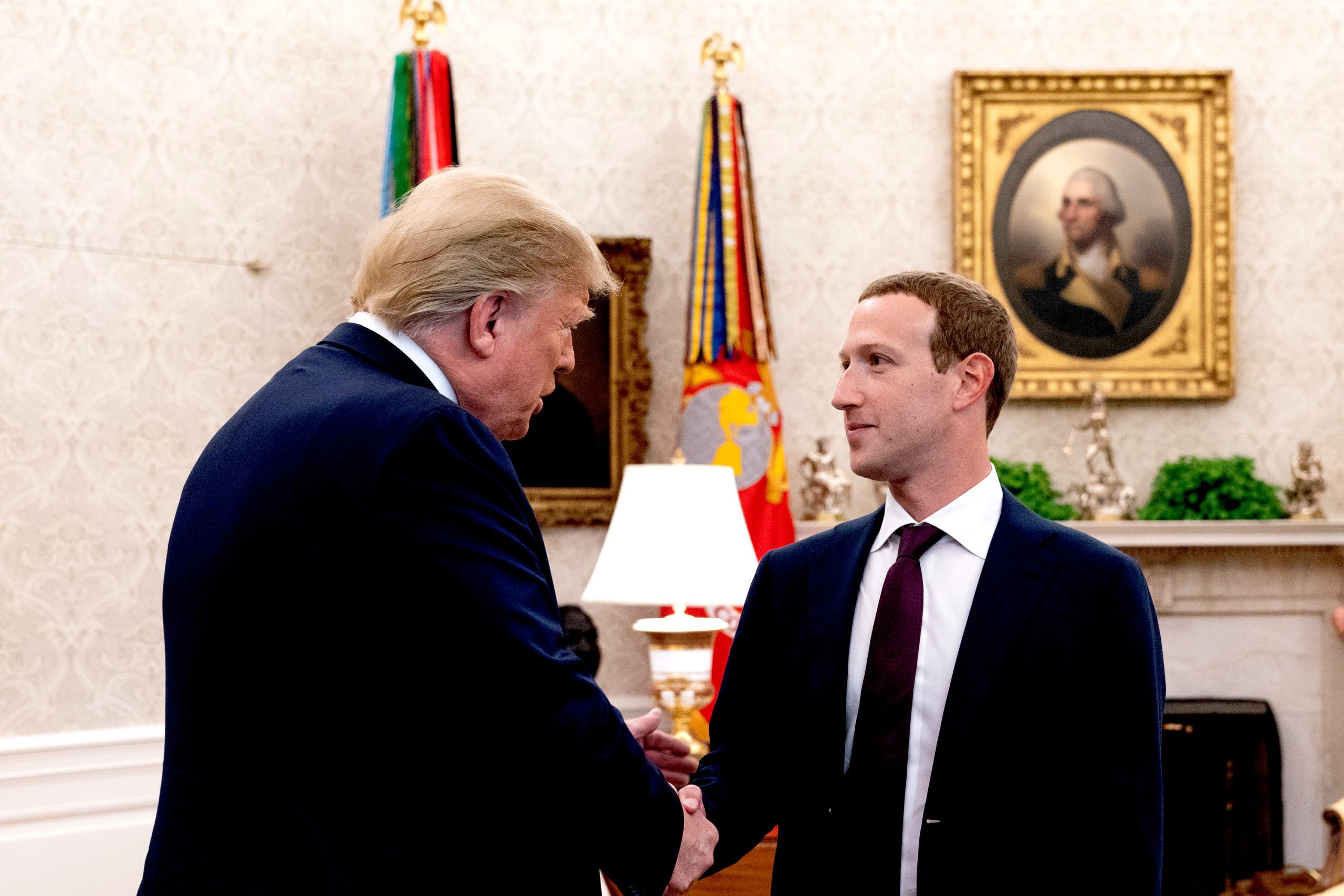
Trump with Zuckerberg in the White House in September 2019. (White House, Joiyce N. Boghosian)
Bezos, meanwhile, pursued similar measures at The Washington Post, announcing that the newspaper would no longer publish opinions skeptical of capitalism.
“We are going to be writing every day in support of defense of two pillars: personal liberties and free markets,” Bezos wrote, noting that readers wishing to see alternative viewpoints can find them on “the internet.”
The decision was widely seen as a major shakeup, and provoked public opposition from Post employees. “Massive encroachment by Jeff Bezos into The Washington Post’s opinion section today,” said the newspaper’s lead economics journalist Jeff Stein. “[It] makes clear dissenting views will not be published or tolerated there.”
The move was quite the reversal for Bezos, who had once called Trump a “threat to democracy.” Yet, by January 2025, he was sitting with Zuckerberg, Musk and Arnault in prominent positions behind Trump at his inauguration.
Considering his nationality, Arnault has a surprisingly close relationship with Trump. In 2019, the French billionaire opened a new Louis Vuitton factory in Alvarado, Texas, a move that some have suggested was an attempt to please the president.
Trump attended the facility’s opening, calling Arnault an “artist” and a “visionary.” Due to their relationship with the Trumps, the Arnault family have become unofficial intermediaries between the French and U.S. governments.
They were hosted by the Trumps at Mar-a-Lago in 2023, and, during an escalating trade war earlier this year, Bernard visited the White House to dampen down tensions between the U.S. and France.
Pentagon Contractors
A key factor in the rise of many of the world’s top seven richest individuals is their proximity to the U.S. national security state, with many of their companies growing wealthy in part due to feeding from the trough of Pentagon contracts.
Today’s wars and espionage rely as much on hi-tech computing equipment as tanks and guns, and in 2022, the Department of Defense awarded Amazon, Google, Microsoft, and Oracle a $9 billion cloud computing contract.
Bezos’ Amazon has long enjoyed a close relationship with the C.I.A., having signed a $600 million contract with the agency in 2014. Yet both Google and Musk’s aerospace company, SpaceX, have been intertwined with Langley since their inception.
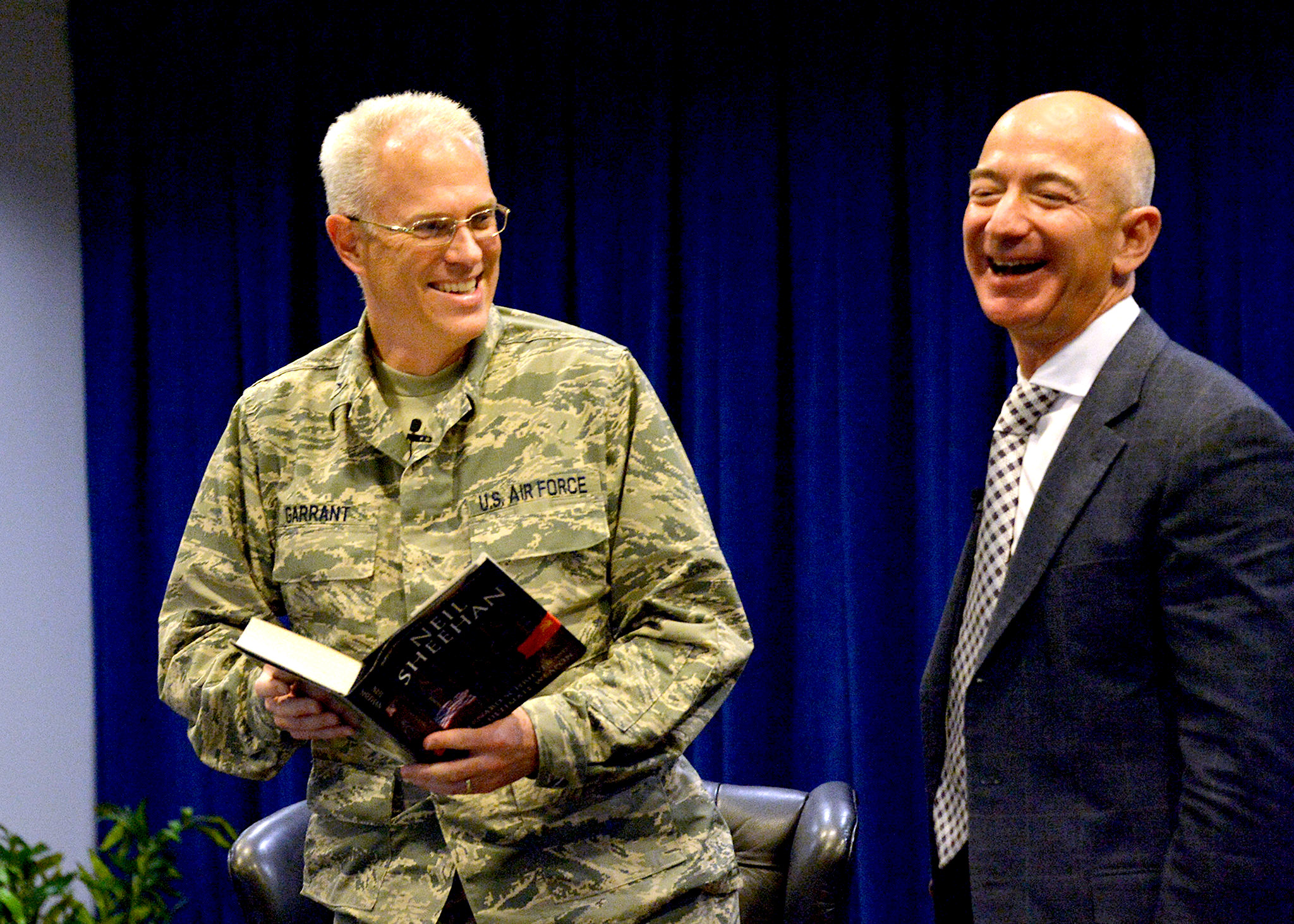
Bezos, on right, visiting the Los Angeles Air Force base, Space and Missile Systems center to speak at Gordon Conference Center, Oct. 25, 2017. (Los Angeles Air Force Base Space and Missile System Center/Flickr/Public Domain)
The C.I.A. bankrolled and oversaw Brin’s PhD research at Stanford University, work which would later form the basis of Google. As one investigation noted, “senior U.S. intelligence representatives including a C.I.A. official oversaw the evolution of Google in this pre-launch phase, all the way until the company was ready to be officially founded.”
As late as 2005, In-Q-Tel, the C.I.A.’s venture capitalist arm, was a major shareholder in Google. These shares were a result of Google’s acquisition of Keyhole, Inc., a C.I.A.-backed surveillance firm whose software eventually became Google Earth.
By 2007, the government was using enhanced versions of Google Earth to surveil and target enemies in Iraq and beyond, according to The Washington Post. By this time, the Post also notes, Google was partnering with Lockheed Martin to produce futuristic technology for the military.
There also exists a revolving door of employment between Google and various branches of federal government.
It would be no stretch, meanwhile, to state that Elon Musk owes his largesse in no small part to his intimate relationship with the C.I.A.
In-Q-Tel chief Mike Griffin helped birth SpaceX, providing support and advice from the beginning, and even accompanied Musk to Russia in 2002, where the pair attempted to purchase cheap intercontinental ballistic missiles to start the company.
Griffin repeatedly championed Musk at the C.I.A., describing him as the “Henry Ford” of the space industry, and worthy of the government’s full support.
Still, by 2008, SpaceX was in dire straits, with Musk unable to make payroll and believing both SpaceX and Tesla Motors would be liquidated. But he was saved by an unexpected $1.6 billion NASA contract that Griffin had helped secure.
Today, SpaceX is a powerhouse. But its primary customers continue to be U.S. government agencies, such as the Air Force, Space Development Agency and the National Reconnaissance Office. And recently, the Pentagon has recruited him to help it win a nuclear war.
A new SpaceX spinoff company, Castelion, is working on building a network of armed satellites circling North America, designed to shoot down enemy nuclear missiles.
A successful operation would give the United States an impervious shield, and allow it to act as it wants around the world, without threat of retaliation, effectively ending the era of mutually assured destruction, and plunging the planet into a dangerous new epoch.
Six of the seven members of Castelion’s leadership team and two of its four senior advisors are ex-Space X employees. The other two advisors are former high officials from the C.I.A., including Griffin himself. Elon named his oldest child Griffin Musk. Another of his sons, X Æ A-12, is named after a C.I.A. spy plane.
No billionaire, however, is more intimately connected to the C.I.A. than Larry Ellison. Ellison began his career by working with the C.I.A. on a database system called Project Oracle. In 1977, he would co-found tech giant Oracle (named after his previous project).
The C.I.A. was Oracle’s only customer for some time, before Ellison branched out and began to win contracts with other branches of the national security state, including Navy Intelligence, Air Force Intelligence and the NSA.
That close partnership continues to this day. In 2020, the company won a 15-year contract with the C.I.A. and 16 other U.S. intelligence agencies worth tens of billions of dollars.
And today, its upper ranks are filled with former C.I.A. executives. One example of this is Leon Panetta, former C.I.A. director and secretary of defense, who sits on its board of directors.
Arming & Supporting Israel
Another key attribute that many of the world’s richest individuals share is their passionate support for Israel and its expansionist project.
Nowhere is this more evident than with Ellison, who has made it his life’s goal to advance the Jewish State’s interests, both at home and abroad. Ellison is an enthusiastic supporter of Prime Minister Benjamin Netanyahu, with whom he vacationed on his private island in Hawaii.
So impressed was he with the embattled prime minister that he offered him a seat on Oracle’s board, replete with a yearly salary of $450,000.
Ellison is the largest single donor to the Israeli Defense Forces (IDF). In 2017 alone, he pledged $16.6 million to build a new training facility for IDF soldiers, whom he described as defending “our home.” At a fundraiser, he explained that:
“Through all of the perilous times since Israel’s founding, we have called on the brave men and women of the IDF to defend our home. In my mind, there is no greater honor than supporting some of the bravest people in the world, and I thank Friends of the IDF for allowing us to celebrate and support these soldiers year after year. We should do all we can to show these heroic soldiers that they are not alone.”
David Ellison is no less ardent a Zionist, and even met with a top Israeli general in order to aid a project spying on American citizens, according to an investigation by The Grayzone.
The scheme was aimed at attacking American citizens participating in pro-Palestine activism in the face of Israel’s attack on Gaza. The documents also mention Brin’s name as a potential collaborator in the plan.
Oracle’s Israeli CEO, Safra Catz, is also a close friend of Netanyahu’s, and describes the corporation as on a “mission” to support Israel. Together, Catz and Ellison have enforced a strict pro-Israel stance across the company.
In the wake of the October 2023 violence, Catz instructed that the words “Oracle stands with Israel” must be printed on company screens across the world in more than 180 countries.
Unsurprisingly, the support and collaboration with Israel has led to significant pushback among employees. Catz’s response to their concerns was blunt. “We are not flexible regarding our mission, and our commitment to Israel is second to none,” she said, adding:
“This is a free world and I love my employees, and if they don’t agree with our mission to support the State of Israel, then maybe we aren’t the right company for them. Larry and I are publicly committed to Israel and devote personal time to the country, and no one should be surprised by that.”
It has been widely reported, even in the corporate media, that the Ellison family’s foray into the world of media was triggered by their desire to help Israel in its public relations battle, something Tel Aviv is keenly aware that they are losing.
As Jonathan Greenblatt, director of the pro-Israel Anti-Defamation League said, “We really have a TikTok problem, a Gen Z problem,” explaining that young people around the world are being exposed daily to videos of Israeli aggression, leading to a PR disaster.
Former congressman Mike Gallagher, a leader in the attempts to ban TikTok, explained how his bill had failed, but, after Oct. 7, 2023, and the worldwide outrage at Israeli actions, it found new life on Capitol Hill, and was passed into law, forcing its imminent sale to a consortium led by Oracle.
This pro-Israel sea change has already occurred at CBS News, with the hiring of Bari Weiss as editor-in-chief. Weiss first came to public attention while still at college, founding an organization that attempted to have Muslim and Arab professors fired for their pro-Palestine views.
As the Financial Times noted, “Weiss has won over Ellison partly by taking a pro-Israel stance, according to people familiar with the matter.”
Last week, at the Jewish Leadership Conference, she stated that she sees her mission at CBS as “redraw[ing] the lines of what falls in the 40 yards of acceptable debate” in America by sidelining voices like Hassan Piker and Tucker Carlson, and elevate “charismatic” leaders like Alan Dershowitz, who represents “the vast majority of Americans.”
Zuckerberg’s platforms – Facebook, Instagram, and WhatsApp – have displayed a no less concerted bias in favor of Israel. As far back as 2016, Facebook was collaborating with the Israeli government on matters of censorship, with Justice Minister Ayelet Shaked revealing that the social media platform complied with 95 percent of her requests for pro-Palestine content to be removed.
The Facebook/Israel partnership was deepened in 2020 when the company appointed Emi Palmor, the former director general of the Ministry of Justice of Israel and an ex-spy with IDF intelligence group Unit 8200, to its oversight board, a 21-person committee ultimately in charge of the political direction of the site.
Zuckerberg’s platforms have long shut down Palestinian voices on dubious “hate speech” grounds. However, the censorship was drastically increased after the Oct. 7 attacks.
Human Rights Watch released a report detailing the “systemic censorship of Palestinian content on Instagram and Facebook,” noting how they reviewed 1050 cases of censorship of Palestinian voices, including those documenting human rights abuses against themselves.
The study concluded that 1049 of them were entirely peaceful utterances of support for Palestine, and did not break any of Meta’s terms of service.
In 2023, Instagram also inserted the word “terrorist” into the bios of thousands of users who mentioned they were Palestinian. When challenged on this, they claimed it was an auto-translation bug.
Internally, Meta staff have complained about systematic suppression of their voices and the creation of a “hostile and unsafe work environment” for Palestinian and Muslim employees.
WhatsApp, meanwhile, is a battleground in more than one sense. The Israeli military is using Palestinians’ WhatsApp data in order to track and target tens of thousands of people in Gaza. It is unclear how or whether Meta is collaborating with the Israeli military in this endeavor.
However, it has been suggested that some of the dozens of former Israeli spies now working in top jobs at Meta could be producing backdoors in the software, or simply passing the data onto their former colleagues.
A 2022 MintPress investigation found hundreds of former Unit 8200 operatives working at Meta, Google, Amazon, and Microsoft.
Zuckerberg himself is known to be a strong supporter of Israel, and has numerous familial connections to the state. After the October 2023 attacks, he released a statement denouncing Hamas and other resistance forces as “pure evil,” an action that earned him an official thank you from the State of Israel.
Musk has also put himself and his vehicles in the service of Israel. In November 2023, he traveled to Israel to meet with both Netanyahu and President Isaac Herzog and offer his unqualified support to their attack on Gaza.
Describing Hamas as “evil” and “revel[ing] in the joy of killing civilians,” Musk attempted to publicly whitewash Israeli violence, stating unequivocally that the IDF goes out of its way “to avoid killing civilians.” At the time of his visit, Israeli strikes had killed at least 20,000 people in four weeks of bombings.
Netanyahu has stated that Twitter is among Israel’s “most important weapons” in the war, and defended Musk from accusations of fascism, after he gave a Nazi salute at the Conservative Political Action Conference.
During his visit, Musk also signed a deal with the government of Israel, giving the latter effective control and oversight over Starlink communications portals operating in Israel and Gaza.
Google and Amazon, too, are key players facilitating the hi-tech genocide in Gaza. In 2021, the pair signed a $1.2 billion contract with the Israeli government to provide cloud computing and AI infrastructure to the IDF — technology that has been used to target the civilian population of the densely-populated strip.
The deal has sparked a rebellion among employees, who organized sit-ins and other protests against their collaboration.
Many other Google employees, however, are intimately linked with the State of Israel. There are at least 99 former Unit 8200 spies working in key positions at the Silicon Valley giant.
One prominent example is Gavriel Goidel, who was a longtime commander and head of learning at Unit 8200, before being hired by Google to become the company’s head of strategy and operations.
Google has also collaborated in disseminating Israeli government propaganda to tens of millions of Europeans, despite the content breaking its own terms of service.
Part of this may be down to the disposition of Brin himself. Normally avoiding the limelight and refraining from making political statements, the Russian-born magnate bitterly condemned the United Nations as “transparently antisemitic” after it released a report detailing his company’s participation in the Gaza genocide.
“Throwing around the term genocide in relation to Gaza is deeply offensive to many Jewish people who have suffered actual genocides,” he added.
Arnault has remained quiet on Gaza. He has, however, invested heavily in Israel. Diamonds and other precious stones are a mainstay of the Israeli economy, and the Frenchman’s luxury brands disseminate the stones globally.
Activists have called for Israeli diamonds to be labeled conflict minerals and boycotted by ethical consumers. He also invested in Israeli tech and security firm, Wiz, a company recently purchased by Google for $32 billion.
Earlier this month, LVMH signed a $55 million deal with Israeli actress and former IDF soldier, Gal Gadot, making her the face of their brand.
We are living in an era of unprecedented global inequality. Together, these seven individuals — Musk, Ellison, Page, Brin, Bezos, Zuckerberg and Arnault — control more wealth than the bottom 50 percent of humanity (over 4 billion people) combined. Sitting on heretofore unimaginable fortunes, they have begun buying up assets, including media outlets, at record pace.
For billionaires, the utility of capturing the press is threefold: firstly, it shields them and their class from press scrutiny and criticism.
Second, it gives them a mouthpiece to push the public debate towards even more business-friendly laws and regulations. And third, they can use their outlets to champion any causes and promote any other agendas they have.
We have seen all three play out here, as, collectively, our press is rapidly moving towards more conservative, pro-Trump, pro-Israel positions, shutting out any dissenting voices from their ranks.
The effect on democracy, a free society, and the public’s right to a diversity of opinions has been highly deleterious. When it comes to media, we already suffered from an illusion of choice.
However, the supercharged concentration of ownership of American and global media in the hands of just a handful of individuals has only exacerbated this problem.
There once was a time that individuals looking for alternative viewpoints would simply go online to find them. But with censorship of dissenting opinions — particularly on Israel/Palestine — growing, this is becoming increasingly unviable.
In short, then, what the planet’s mega-rich capture of our media system shows is that billionaires are not only a serious drain on resources, but an existential threat to an open society and the free flow of information.
Alan MacLeod is senior staff writer for MintPress News. He completed his PhD in 2017 and has since authored two acclaimed books: Bad News From Venezuela: Twenty Years of Fake News and Misreporting and Propaganda in the Information Age: Still Manufacturing Consent, as well as a number of academic articles. He has also contributed to FAIR.org, The Guardian, Salon, The Grayzone, Jacobin Magazine and Common Dreams. Follow Alan on Twitter for more of his work and commentary: @AlanRMacLeod.
This article is from MPN.news is an award winning investigative newsroom. Sign up for their newsletter.
Views expressed in this article and may or may not reflect those of Consortium News.