The One Lovely Blog Award


cropped-Ukraine-Book-FrontCover-Art.jpg

I’ve recently been informed that I’ve been nominated for the “One Lovely Blog” award.  It is basically a share-the-love type chain letter among bloggers who give a shout-out to their favorite blogs.  My friend, J.T., over at Russia Reviewed has bestowed the honor on me.   Each recipient nominates their 3 favorite blogs.  My 3 faves, in addition to Russia Reviewed are:  Pox Americana by Greg Maybury down in Australia, Russia Observer by Patrick Armstrong in Canada, and kulturcritic, who writes on topics ranging from anthropology, ethics and sustainable communities to politics and foreign policy.


Me in Moscow, October, 2015


After nominating other blogs for the award, a nominee is supposed to provide interesting facts about him or herself.  So here are 5 about me:

  1.  I also write fiction.  I have completed one novel, which I will be submitting to agents in a few months, and I am about 2/3 of the way through my second novel.  I tend to revisit variations on the theme of humans’ inclination toward self-destructiveness, on both an individual and collective level.
  2.  I am an animal lover who has a particular fondness for cats, which I’ve had all of my life.  Right now, I have 2:  a fat orange tabby and a more svelte tortoiseshell calico.  They divide their time by eating, sleeping, strutting around and trying to sit on my keyboard.
  3.  I’m an only child.
  4.  When I have time, I like to bake gluten-free, vegan goodies.  No, I’m not a vegan – I just have multiple food allergies.
  5.  My day job is legal secretary.  I was considering law school after graduating from college, but decided against it after working in the field and seeing what being a lawyer really required.  My vision had been to become a lawyer specializing in international law after seeing the film Judgment at Nuremburg.


Russia Pushes Back on NATO Expansion

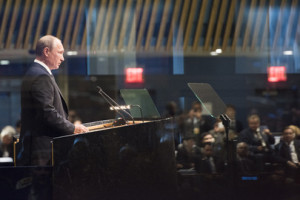
Russian President Vladimir Putin addresses UN General Assembly on Sept. 28, 2015. (UN Photo)

Russian President Vladimir Putin addresses UN General Assembly on Sept. 28, 2015. (UN Photo)

Can Russian President Vladimir Putin turn the tables on NATO and the European Union in the Balkan states that are not yet members of the Atlanticist project? According to Filip Kovacevic, a political science professor who specializes in Russia and Eastern Europe, Putin has a plan. Some details were provided in an exclusive report in May on the nascent project by Russia to counter NATO expansion into the remaining Balkan countries that have not yet been swept into the Western alliance.

The plan has its origins in the grassroots movement that arose in the aftermath of the first Cold War, which called for non-alignment and cooperation with both East and West.  Kovacevic describes the movement as follows:


“Their members were generally young people who were enthusiastic, honest and genuinely committed to the public good, but were plagued by the lack of funding and faced with frequent media blackout and open discrimination. Nonetheless, their programs articulated the most promising and humane geopolitical vision for the Balkans.  They conceptualized the Balkans as a territorial bridge between the West and the East rather than as the place of persistent confrontation, or the ‘line of fire’ as formulated by the U.S. Secretary of State John Kerry in 2015. They wanted the Balkans to become a force for peace and human dignity in the world. Their vision still remains the best option for the Balkans people.”

This desire for non-alignment is understandable as a continuation of the policy of Tito’s Yugoslavia during the Cold War – the nation that several of the modern day Balkan states were a constituent part of.  However, according to Kovacevic, these groups were easily overwhelmed, in terms of both financial and propaganda resources, in the 1990s by pro-NATO forces in the West.

In addition to providing resources to build up pro-NATO sentiment in the media and NGO sectors of these countries, financial resources and pressure was used to sway a large number of politicians to favor NATO membership, often in opposition to the general population’s views. Some of the unsavory forms of incentive or pressure include what amounts to blackmail and bribery, Kovacevic told me in an email interview:

“This is a long-term process. In the U.S. intelligence community it is called ‘seeding.’ The intelligence scholar Roy Godson defines it as ‘identifying potential agents of influence’ at an early stage and then acting to advance their careers. This is typically done covertly, but there have been the historical examples of overt support. …

“In the Balkans, the key role in the process of ‘seeding’ was accomplished by various institutes, conferences, retreats, grants, etc. For instance, I was told by a confidential source who participated in the same U.S.-NATO program, the long-time foreign minister and one-time prime minister of Montenegro, Igor Luksic, was a product of such a process. Luksic was chosen as a very young man to attend various conferences and retreats in Brussels and Washington and, after that, his political career really took off. All the while, he promoted the NATO agenda in Montenegro, even though this went against the will of the majority of the population.

“Another example is Ranko Krivokapic who was the speaker of the Montenegrin Parliament for over a decade. He traveled on official business to the U.S. a few times every year and boasted to others that he had a lot of friends in the State Department and other institutions of the U.S. government. There are examples like these in Serbia, Macedonia, Croatia, etc. All over the Balkans.”

Continue reading this article at Consortium News

NATO Summit in Warsaw Announces 1,000 US Troops to Poland; NATO Protesters Also Come Out in Warsaw & Elsewhere; Slideshow from Citizen Diplomats Trip to Russia

(https://openclipart.org/detail/217629/logo-of-war)


On July 8th, NATO began its 2-day summit during which it was announced that 1,000 U.S. troops would be stationed in Poland, a joint declaration on security between NATO and the EU was also unveiled, and heightened cooperation with Sweden and Finland – both of which are not NATO members and whose populations oppose NATO membership.   The Guardian reports:


The US troops will constitute one of Nato’s four multinational combat battalions in eastern Europe intended to reassure the region against the threat of Russian encroachment. The UK is sending 500 soldiers for a battalion based in Estonia, and Canada and Germany will lead two more in Lithuania and Latvia.


Next year, Obama said, a US armoured brigade would also be deployed in Europewith a base in Poland.

Speaking in the Polish capital after a meeting with EU leaders, he argued against exaggerating the impact of Brexit on the transatlantic partnership.


“The vote in the United Kingdom to leave the EU has created uncertainty about the future of European integration. And unfortunately, this has led some to suggest that the entire edifice of European security and prosperity is crumbling,” Obama said.


“There have been those who have been questioning ‘what does this mean for the transatlantic relationship?’ Let me just say, as is often the case in moments of change, this kind of hyperbole is misplaced.”


The US president emphasised the enduring strength of Washington’s relations with the EU, which he called “one of the greatest economic and political achievements of modern times”.


“This is an achievement that has to be preserved,” Obama said, adding that an integrated Europe was a “cornerstone of US relations with the world”.


….The Warsaw summit is expected to announced that a US-built missile defence shield based in Romania, Turkey and Spain is initially operational and under Nato command.


They insist that the defence system is intended to counter a missile threat from Iran and Syria, not to blunt Russia’s deterrent. But analysts warn that there is a risk of Russia overreacting to Nato’s moves, fuelling escalation on the latter’s tense eastern border.


More reporting on the NATO summit is available at New Cold War.org’s website:

Opening on July 8 of NATO war summit in Warsaw, Poland


Meanwhile,  protesters hosted a conference in Warsaw to denounce the NATO buildup and saber-rattling.  Protests in other European cities as well as in New York are planned for throughout the weekend.   RT reported the following:

The participants of the anti-war summit in Warsaw consider NATO “an aggressive alliance, which bears responsibility for thousands of victims in various conflicts, as well as for the increasing flow of refugees to Europe that causes the growing hysteria nationalism. This NATO policy will eventually lead to the collapse of the European Union,” Ikonovich warned.


“We oppose the deployment of the US and NATO bases in Poland as it will lead to an increased threat to our country,” the activist said, adding that the social sector in Poland will also suffer due to the transfer of funds to military needs.


Protests were reported in Paris, Athens, Naples and elsewhere across Europe ahead of the NATO summit in Warsaw, while New York and Lisbon are among the cities where demonstrations are planned for Saturday.


“If the course on militarization remains, protests in Poland and around the globe will only increase,” Ilkovsky said.


Despite the main topic of the Warsaw Summit being to counter what NATO claims to be a Russian threat, polls reveal that an increased number of Europeans disagree with the bloc’s approach towards dealing with Moscow. Only nine per cent of Germans currently support NATO’s buildup in Eastern Europe, a fresh survey by YouGov revealed.


Two-thirds of respondents also agreed with Germany’s foreign minister, who earlier said the military alliance should abandon its “saber-rattling” on Russia’s doorstep.


In June, the Pew Research Center’s Spring 2016 Global Attitudes Survey showed that most Europeans do not view Russia as a threat, instead naming Islamic State (IS, formerly ISIS/ISIL) terror group, climate change, economic instability, cyber-attacks and the refugee influx as the main security challenges.


The only two countries that spoke in favor of boosting defense spending turned out to be Poland and the Netherlands.


Earlier this week, polls in Sweden showed a sharp drop in support for the country’s possible NATO membership, with numbers going down from 41 to 33 per cent in less than a year.


The recent delegation of 20 citizen diplomats to Russia, sponsored by the Center for Citizen Initiatives, posted a 3 minute slide show of their trip here:

http://ccisf.org/for-russians-with-love/


Veteran Intelligence Professionals Send Memo to Chancellor Merkel Urging Her to Quell Tensions at Upcoming NATO Summit; Putin to Western Press: “I don’t know how to get through to you anymore.”; US Conference of Mayors Decry Nuclear Tensions and Weapons

(NATO Flag; http://www.mapsofworld.com/flags/nato-flag.html)

Members of the Veterans Intelligence Professionals for Sanity (VIPS), which includes numerous veterans of the CIA, NSA, and military intelligence divisions, has written a memorandum addressed to German Chancellor Angela Merkel, warning of the dangerous tensions between NATO and Russia and urging her to use her influence at the upcoming NATO summit in Warsaw, Poland on July 8th to quell these tensions.


An excerpt follows:


We longtime U.S. intelligence officers again wish to convey our concerns and cautions directly to you prior to a critically important NATO summit – the meeting that begins on July 8 in Warsaw. We were gratified to learn that our referenced memorandum reached you and your advisers before the NATO summit in Wales [in 2015], and that others too learned of our initiative via the Sueddeutsche Zeitung, which published a full report on our memorandum on Sept. 4, the day that summit began.

Wales to Warsaw

The Warsaw summit is likely to be at least as important as the last one in Wales and is likely to have even more far-reaching consequences. We find troubling – if not surprising – NATO Secretary General Jens Stoltenberg’s statement at a pre-summit press event on July 4 that NATO members will agree to “further enhance NATOs military presence in the eastern part of the alliance,” adding that the alliance will see its “biggest reinforcement since the Cold War.”

The likelihood of a military clash in the air or at sea – accidental or intentional – has grown sharply, the more so since, as we explain below, President Obama’s control over top U.S./NATO generals, some of whom like to play cowboy, is tenuous. Accordingly we encourage you, as we did before the last NATO summit, to urge your NATO colleagues to bring a “degree of judicious skepticism” to the table at Warsaw – especially with regard to the perceived threat from Russia.

Many of us have spent decades studying Moscow’s foreign policy. We shake our heads in disbelief when we see Western leaders seemingly oblivious to what it means to the Russians to witness exercises on a scale not seen since Hitler’s armies launched “Unternehmen Barbarossa” 75 years ago, leaving 25 million Soviet citizens dead. In our view, it is irresponsibly foolish to believe that Russian President Vladimir Putin will not take countermeasures – at a time and place of his own choosing.

Putin does not have the option of trying to reassure his generals that what they hear and see from NATO is mere rhetoric and posturing. He is already facing increased pressure to react in an unmistakably forceful way. In sum, Russia is bound to react strongly to what it regards as the unwarranted provocation of large military exercises along its western borders, including in Ukraine.

Before things get still worse, seasoned NATO leaders need to demonstrate a clear preference for statesmanship and give-and-take diplomacy over saber-rattling. Otherwise, some kind of military clash with Russia is likely, with the ever-present danger of escalation to a nuclear exchange.

Extremely worrisome is the fact that many second-generation NATO leaders seem blithely unaware – or even dismissive – of that looming possibility. Demagoguery like that coming from former Polish President Lech Walesa, who brags that he would “shoot” at Russian jets that buzz U.S. destroyers assuredly are not at all helpful. Walesa’s tone, however, does reflect the macho attitude prevailing today in Poland and some other NATO newcomers.

We believe Foreign Minister Frank-Walter Steinmeier was correct to point out that military posturing on Russia’s borders will bring less regional security. We applaud his admonition that, “We are well advised not to create pretexts to renew an old confrontation.”

Read the full memo at Consortium News:


Merkel Urged to Temper NATO’s Belligerence


A video excerpt from Putin’s Q&A with the western press last month at the St. Petersburg International Economic Forum highlights his concern and frustration at western journalists’ lack of discernment and probing about the actions of Washington and NATO, its potential grave consequences and the justifications provided that do not add up.


“We know year by year what’s going to happen, and they know that we know. It’s only you that they tell tall tales to, and you buy it, and spread it to the citizens of your countries. You people in turn do not feel a sense of the impending danger – this is what worries me. How do you not understand that the world is being pulled in an irreversible direction? While they pretend that nothing is going on. I don’t know how to get through to you anymore.”

1.5 minute video here:

https://www.youtube.com/watch?v=8PgSX-WD96Q


Fortunately, the United States Conference of Mayors (USCM) seems to be aware of and understand the risk of nuclear weapons and the current tensions as reflected in a resolution passed condemning president Obama’s decision to spend $1 trillion upgrading the entire American nuclear arsenal, while the basic infrastructure of the country comes in at a D+ rating by engineers.


Antimedia reported on the resolution:

In a unanimous decision at their 84th annual conference, the United States Conference of Mayors (USCM) passed a resolution condemning President Barack Obama’s decision to set the U.S. on track to spend $1 trillion over the next 30 years to “maintain and modernize its nuclear bombs and warheads, production facilities, delivery systems, and command and control.”

“The Obama administration has […] reduced the US nuclear stockpile less than any post-Cold War presidency,” the resolution, passed in Indianapolis on June 27, reads.

The resolution is supportive of the 1970 international nuclear agreement known as the Non-Proliferation Treaty (NPT), but the USCM chastised the Obama administration’s drift from NPT principles by contrasting it with another international agreement to which the administration has held steadfast.

Referencing the North Atlantic Treaty Organization (NATO) joint-military exercise in Eastern Europe, known as Anaconda 2016, the USCM said:

“The largest NATO war games in decades, involving 14,000 US troops, and activation of US missile defenses in Eastern Europe are fueling growing tensions between nuclear-armed giants.”

Noting 94 percent of the more than 15,000 nuclear weapons in the world are held by the U.S. or Russia — and that most of those are “orders of magnitude more powerful than the Hiroshima and Nagasaki bombs” — the USCM pushed for a nuclear weapons spending reduction “to the minimum necessary,” arguing in favor of more financial focus on “deteriorating” and “crumbling” infrastructure within the U.S., instead.

“[F]ederal funds are desperately needed in our communities to build affordable housing, create jobs with livable wages, improve public transit, and develop sustainable energy sources,” the resolution said.


Russians Ask “Why Do You Demonize Us When We Are So Much Like You?”

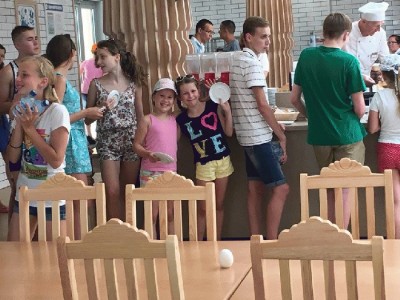
Russian kids attending a youth camp called Artek in Crimea.

(Russian kids attending a youth camp called Artek in Crimea.)


This was posted at the website of the Center for Citizen Initiatives, which sponsored the 20-person delegation of citizen diplomats to Russia last month.  If you are interested in attending the Center’s next delegation to Russia, scheduled for September, please contact me at natyliesb [at] gmail.com.


The following piece was written by CCI trip participant Ann Wright based on her experiences during the just-concluded CCI Russia trip.

OpEdNews.com
This article is a composite of the comments and questions that were asked to our 20-person delegation and to me as an individual. I do not attempt to defend the views but offer them as an insight into the thinking of many of the persons we came into contact with in meetings and on the streets.I’ve just ended two weeks visiting cities in four regions of Russia. The one question that was asked over and over was, “Why does America hate us? Why do you demonize us?” Most would add a caveat — “I like American people and I think YOU like us individually but why does the American government hate our government?”

None of the questions, comments or views tell the full story, but I hope they give a feel for the desire of the ordinary Russian that her country and its citizens are respected as a sovereign nation with a long history and that it is not demonized as an outlaw state or an “evil” nation. Russia has its flaws and room for improvement in many areas, just as every nation does, including for sure, the United States.

New Russia Looks Like You — Private Business, Elections, Mobile Phones, Cars, Traffic Jams

One middle-aged journalist in the city of Krasnodar commented, “The United States worked hard to make the Soviet Union collapse, and it did. You wanted to remake Russia like the United States — a democratic, capitalist country in which your companies could make money — and you have done that.

“After 25 years, we are a new nation much different from the Soviet Union. The Russian Federation has created laws that have allowed a large private business class to emerge. Our cities now look like your cities. We have Burger King, McDonalds, Subway, Starbucks and malls filled with a huge number of totally Russian business ventures for the middle class. We have chain stores with merchandise and food, similar to Wal-Mart and Target. We have exclusive stores with top-of-the-line clothing and cosmetics for the richer. We drive new (and older) cars now just like you do. We have massive rush hour traffic jams in our cities, just like you do. We have extensive, safe, inexpensive metros in all of our major cities, just like you have. When you fly across our country, it looks just like yours, with forests, farm fields, rivers and lakes — only bigger, many time zones bigger.

“Most people on buses and in the metro are looking at our mobile phones with internet, just like you do. We have a smart youth population that is computer literate and most of whom speak several languages.

“You sent your experts on privatization, international banking, stock exchanges. You urged us to sell off our huge state industries to the private sector at ridiculously low prices, creating the multi-billionaire oligarchs that in many ways mirror the oligarchs of the United States. And you made money in Russia from this privatization. Some of the oligarchs are in prison for violating our laws, just as are some of yours.

“You sent us experts on elections. For over 25 years we have held elections. And we have elected some politicians you don’t like and some that we as individuals may not like. We have political dynasties, just like you do. We don’t have a perfect government, nor perfect government officials — which is also what we observe in the U.S. government and its officials. We have graft and corruption in and outside of government, just as you do. Some of our politicians are in jail for violating our laws, just like some of your politicians are in jail for violating your laws.

“And we have the poor just like you do. We have villages, towns and small cities that are struggling with migration to the big cities with people moving in hopes of finding jobs, just like you do.

“Our middle class travels throughout the world, just like you do. In fact, as a Pacific nation just like the U.S., we bring so much tourism money with us on our trips that your Pacific island territories of Guam and the Commonwealth of the Northern Marianas have negotiated with the U.S. Federal government to allow Russian tourists to enter both of those U.S. territories for 45 days without the time-consuming and expensive U.S. visa.

“We have a strong science and space program and are a key partner in the International Space Station. We sent the first satellite into space and the first humans into space. Our rockets still take astronauts to the space station while your NASA program has been curtailed.”

Dangerous NATO Military Exercises Threatening our Borders

“You have your allies and we have our allies. You told us during the dissolution of the Soviet Union that you would not enlist countries from the Eastern block into NATO, yet you have done that. Now you are placing missile batteries along our border and you are conducting major military exercises with strange names such as Anaconda, the strangling snake, along our borders.

“You say that Russia could possibly invade neighboring countries and you have big dangerous military exercises in countries on our borders with these countries. We did not build up our Russian military forces along those borders until you continued to have ever increasingly large military ‘exercises’ there. You install missile ”defenses’ in countries on our borders, initially saying they are to protect against Iranian missiles and now you say Russia is the aggressor and your missiles are aimed at us.

“For our own national security, we must respond, yet you vilify us for a response that you would have if Russia would have military maneuvers along the Alaskan coast or the Hawaii islands or with Mexico on your southern border or with Canada on your northern border.”

Syria

“We have allies in the Middle East including Syria. For decades, we have had military ties to Syria and the only Soviet/Russian port in the Mediterranean is in Syria. Why is it unexpected that we help defend our ally, when the stated policy of your country is for ‘regime change’ of our ally — and you have spent hundreds of millions of dollars for Syrian regime change?

“With this said, we Russia saved the U.S. from an enormous political and military blunder in 2013 when the U.S. was determined to attack the Syrian government for “crossing the red line” when a horrific chemical attack that tragically killed hundreds was erroneously blamed on the Assad government. We provided you documentation that the chemical attack did not come from the Assad government and we brokered a deal with the Syrian government in which they turned over their chemical weapons arsenal to the international community for destruction.

“Ultimately, Russia arranged for the chemicals to be destroyed and you provided an especially designed U.S. ship that carried out the destruction. Without Russian intervention, a direct U.S. attack on the Syrian government for the mistaken allegation of use of chemical weapons would have resulted in even greater chaos, destruction and destabilization in Syria.

“Russia has offered to host talks with the Assad government about power sharing with opposition elements. We, like you, do not want to see the takeover of Syria by a radical group such as ISIS that will use the land of Syria to continue its mission to destabilize the region. Your policies and financing of regime change in Iraq, Afghanistan, Yemen, Libya and Syria have created instability and chaos that is reaching all over the world.”

Coup in Ukraine and Crimea Reuniting with Russia

“You say that Crimea was annexed by Russia and we say Crimea ‘reunited’ with Russia. We believe that the U.S. sponsored a coup of the elected Ukrainian government that had chosen to accept a loan from Russia rather than from the EU and IMF. We believe that coup and the resulting government was illegally brought to power through your multi-million dollar “regime change” program. We know that your Assistant Secretary of State for European Affairs Victoria Nuland described in a phone call that our intelligence services recorded the pro-West/NATO coup leader as ‘our guy-Yats.’

“In response to that US sponsored violent government take-over of the elected government of the Ukraine with a presidential election scheduled within a year, Russians in the Ukraine, particularly those in the eastern part of the Ukraine and those in Crimea were very afraid of the anti-Russian violence that had been unleashed by neo-fascist forces that were in the militia arm of the takeover.

“With the takeover of the Ukrainian government, ethnic Russians who composed a majority of the population of Crimea in a referendum participated by over 95 percent of the population of Crimea, 80 percent voted to unite with the Russian Federation instead of staying with Ukraine. Of course, some citizens of Crimea disagreed and left to live in Ukraine.

“We wonder whether citizens of the United States realize that the Southern Fleet of the military of the Russian Federation was located in the Black Sea ports in the Crimea and in light of the violent take over of Ukraine that our government felt it was vital to ensure access to those ports. On the basis of Russian national security, the Russian Duma (Parliament) voted to accept the results of the referendum and annexed Crimea as a republic of the Russian Federation and gave federal city status to the important seaport of Sevastopol.”

Sanctions on Crimea and Russia — Double Standards

“While the US and European governments accepted and cheered for the violent overthrow of the elected government of the Ukraine, both the US and European nations were very vengeful of the non-violent referendum of people of Crimea and have slammed Crimea with all sorts of sanctions that have reduced international tourism, the main industry of the Crimea, to almost nothing. In the past in Crimea we received over 260 cruise ships filled with international passengers from Turkey, Greece, Italy, France, Spain and other parts of Europe. Now, because of the sanctions we have virtually no European tourists. You are the first group of Americans we have seen in over a year. Now, our business is with other citizens from Russia.

“The U.S. and the European Union have put sanctions on Russia again. The Russian ruble has been devalued almost 50 percent, some from the downturn of worldwide price of oil, but some from the sanctions the international community has placed on Russia from the Crimea ‘reunification.’

“We believe you want the sanctions to hurt us so we will overthrow our elected government, just like you put sanctions on Iraq for the Iraqis to overthrow Saddam Hussein, or on North Korea, or on Iran for the people of those countries to overthrow their governments.

“Sanctions have the opposite effect than what you want. While we know sanctions do hurt the ordinary person and if left on a population for a long time can kill through malnutrition and lack of medicines, sanctions have made us stronger.

“Now, we may not get your cheeses and wines, but we are developing or redeveloping our own industries and have become more self-reliant. We now see how the globalization trade mantra of the United States can and will be used against countries that decide not to go along with the U.S. on its worldwide political and military agenda. If your country decides not to go along with the United States, you will be cut off from the global markets that the trade agreements have made you dependent upon.

“We wonder why the double standard? Why haven’t the member states of the United Nations put sanctions on the U.S. since you have invaded and occupied countries and killed hundreds of thousands in Iraq, Afghanistan, Libya, Yemen and Syria.

“Why is the U.S. not held accountable for kidnapping, extraordinary rendition, torture and imprisonment of almost 800 persons that have been held in the gulag called Guantanamo?”

Elimination of Nuclear Weapons

“We want the elimination of nuclear weapons. Unlike you, we have never used a nuclear weapon on people. Even though we consider nuclear weapons as a defensive weapon, they should be eliminated because one political or military mistake will have devastating consequences for the entire planet.”

We Know the Costs of War

“We know the terrible costs of war. Our great-grandparents remind us of the 27 million Soviet citizens killed during World War II, our grandparents tell us of the Soviet war in Afghanistan in the 1980s and the difficulties arising from the Cold War.

“We don’t understand why the West continues to vilify and demonize us when we are so much like you. We too are concerned about threats to our national security and our government responds in many ways like yours. We do not want another Cold War, a war in which everyone gets frost bitten, or worse, a war that will kill hundreds of thousands, if not millions of people.”

We Want A Peaceful Future

“We Russians are proud of our lengthy history and heritage.”

“We want a bright future for ourselves and our families…and for yours.”

“We want to live in a peaceful world.”

“We want to live in peace.”

Ann Wright is a 29-year US Army/Army Reserves veteran, a retired United States Army colonel and retired U.S. State Department official, known for her outspoken opposition to the Iraq War. She received the State Department Award for Heroism in 1997, after helping to evacuate several thousand people during the civil war in Sierra Leone. She is most noted for having been one of three State Department officials to publicly resign in direct protest of the 2003 Invasion of Iraq. Wright was also a passenger on the Challenger 1, which along with the Mavi Marmara, was part of the Gaza flotilla. She served in Nicaragua, Grenada, Somalia, Uzbekistan, Kyrgyzstan, Sierra Leone, Micronesia and Mongolia. In December, 2001 she was on the small team that reopened the US Embassy in Kabul, Afghanistan. She is the co-author of the book “Dissent: Voices of Conscience.” She has written frequently on rape in the military.


Analysis & Book Reviews on U.S. Foreign Policy and Russia