Ian Proud: Ukraine has consistently over-sold the number of children moved to Russia since war began

By Ian Proud, Strategic Culture Foundation, 6/11/25

At the latest round of peace talks in Istanbul, Ukraine submitted a list of 339 children that it demands Russia returns. That’s a fraction of the number that Kiev alleges have been kidnapped since the war began. This speaks to the over-politicisation of children in this terrible war. But it also offers scope for helpful progress towards an eventual peace.

As a parent of beautiful children who I love more than anything, I find little more heartbreaking than the thought of children who are forced, petrified and upset, from their homes because of war. There have been widespread reports from the Ukrainian side that Russian has forcibly deported almost 20,000 children since the war began. This contributed to International Criminal Court decision in March 2023 to issue an arrest warrant against President Putin for alleged war crimes.

The detailed legal provisions on the treatment of civilians including children at times of war are laid out in the Fourth Geneva Convention. It requires systems to identify and register separated children, the consent of parents or guardians for temporary separation and prohibits the changing of family status and nationality.

The reality for children in war torn Ukraine has been both heartbreaking and complex. When you dig into the available western reporting, it appears that many of the ‘missing’ 20,000 are children who have moved to Russia or to Russian occupied Ukraine with a parent or relative, rather than being forcibly deported.

Since the war began there have been several negotiated returns of Ukrainian children including, in some cases, with mediation of third countries like Qatar. Ukraine recovered 1223 children in 2024 through dialogue with Russia, for example. Many cases of children returned to Ukraine have involved families separated during the invasion. In December 2024, five Ukrainian children returned of whom three had been taken to Russia by their parents. Likewise at the start of May, six children returned to Ukraine, at least three of whom had been with their parents.

A second problem relates to gaining parental consent. There are around 100,000 orphans in Ukraine most with living parents who abandoned them out of a lack of resources, or for other reasons including alcoholism, abuse and poor mental health. Ukraine itself has faced accusations about the widespread abuse and mistreatment of orphans in care, including from the BBC, since the war began. Russia itself has a similar problem with so-called social orphans as a heart-wrenching 2013 BBC report showed. According to a U.S.-based Christian charity, there are an estimated 47,000 orphans in Russia.

It is absolutely clear that orphans have been moved to Russia, but the issue of parental consent is a grey area, in circumstances where the location of parents is often unknown. Around 4500 Ukrainian orphans were also moved to Europe, with 2100 living in Poland. Orphans have been relocated to other countries on a temporary basis including Israel and Scotland. Indeed, as the Ukrainian government has pressed for all children to be returned, foster families in Italy and Spain have raised legal disputes seeking to prevent the return of children in their care to a war zone.

Likewise, Ukrainian children have undoubtedly been given Russian citizenship, as investigations by the Financial Times and New York Times have uncovered. Without going into details, I have strong reason to believe that close Russian friends of mine adopted a child from Ukraine in 2022, not long after the war started. They now consider themselves to be the adoptive parents of the child and are raising them with the level of loving care that with my wife, I bestow on my own kids. I don’t condone adoption taking place in this way and my Russian friends present me with a troubling moral dilemma, given the circumstances that led to them taking the child in. But while I pray for them, I find it harder to judge.

For any child, in any country, life in an orphanage will never be as enriching as the loving care of parents. There is some misinformation in the reporting of the challenge of displaced children. Yale School of Medicine has reported on the ‘kidnapping and re-education of Ukraine’s children, talking of ‘fracturing their connection to Ukrainian language… and disconnecting children from their Ukrainian identities.’ However, the vast majority of children displaced from the war torn parts of Ukraine (rather than its major cities like Kiev) would have been Russian speaking, not Ukrainian speaking, and these claims appear deliberately misleading.

Ukraine undoubtedly wants to paint Russia in the image of the villainous child snatcher, in part to bolster its support from western allies and to press the case that Russia is guilty of war crimes. Yet I worry that the issue of forced deportations of children from Ukraine since the war started has become overly politicised. The reality appears much more complex and nuanced, evading easy generalisation. During my diplomatic posting to Russia, my most striking observation was of how loving Russian people are towards children, including my own.

Every child, first and foremost, should be with their parents, assuming they are able to care for them responsibly. In a country that has lost hundreds of thousands of young people to death or injury in the war, the status and protection of children in Ukraine is a totemic issue for entirely understandable reasons. Under the stewardship of Ukraine’s First Lady, there has been a campaign for Ukrainian families to adopt orphans, which led to a record figure of 1264 adoption in 2024, for example.

The problem of socially orphaned children remains deep seated and, long term, it will take real economic progress, coupled perhaps with benevolent social policy, to tackle the root causes. That process can only kick into gear when the guns fall silent allowing Ukraine to start the long delayed reconstruction and regeneration of its economy.

Amidst surprise that Ukraine has sought the return of a relatively small number of children, the conclusion I draw from Istanbul is that the list of 339 is comprised of those for whom there is at least one identified parent in Ukraine who seeks their return. And if that be so, then every effort should be made to facilitate their reunion. While the issue of displaced children didn’t grab the main headlines from the Istanbul talks, progress on bringing these children home may represent an important confidence building measure as both Ukraine and Russia take small, faltering steps towards eventual peace.
War, Censorship and a Spacebridge

Paula Day, Center for Citizen Initiatives, 7/3/25

A simultaneous event happened in Kingston, New York, and St. Petersburg, Russia on June 18, that must encourage all who favor peace between our countries:  a new Spacebridge was thrown out to two audiences of ‘ordinary’ citizens.  The purpose was to provide a live forum for Russians and Americans to speak to each other, face-to-face, to introduce themselves to one another, to ask questions, express concerns and otherwise engage in the halting, sometimes awkward business of getting to know one another.

This Citizens’ Summit was for the people – not academics nor professional analysts, not opinion promoters nor influencers or leaders, but members of the class of human beings who make up 99.9999% (rough guess) of our species who populate this planet.  I would suggest that they are the people CCI refers to as citizen diplomats and I am happy to report that there were three CCI travelers in attendance (including yours truly) and financial support from a fourth as a show of solidarity.

The original Spacebridges took place in the 1980’s, as some of you may remember, and there were clips from the 1985 program hosted by Vladimir Pozner and the late Phil Donohue inserted throughout this year’s event.  (A full video of the ‘80’s landmark is included in the link below.)  This year’s version was not a polished network production, and the hosts were not news media celebrities.  The New York host was Scott Ritter, United States Marine, weapons’ inspector, military analyst, while his counterpart in St. Petersburg was businessman Pavel Balobanov.  The audiences consisted of +/- 30 people in each location.

Asked after the event what I thought were the significant take aways, I came up with two:

  1.  Most significant – IT HAPPENED.  Scott and Pavel took the first step in recreating a format that originated in a period when US/USSR relations were at an all-time low and the fear of a nuclear war between the two nuclear superpowers at an all-time high.  Forty years later, both according to the experts and to what our eyes and senses tell us as we view the daily news, the real danger of nuclear war is higher than ever in history.  Fear of that pending catastrophe affected the participants in both audiences but so did a palpable feeling of relief at being able to share that fear.
     
  2. Next most significant – THERE ARE PEOPLE OUT THERE WHO DON’T WANT YOU TO KNOW IT HAPPENED.  A week before the event we posted to our listserv a video of an interview with Ritter and Balobanov in which they discussed the upcoming Spacebridge.  Some of our readers were able to view it but a few days before the event, Youtube censored and removed it on the pretext that it “violated community standards.” We then heard from other readers, including friends in Russia, that they were unable to view it.  Likewise, we have learned that the Youtube video of the June 18 event has been removed for the same “violation of community standards.”  Joe Lauria, editor of Consortium News, attended the event and stood up to express his most concerning fear in today’s world – censorship.  It is well to note that the threat of nuclear war is just that, a threat.  Censorship is real, it is happening to us, and it affects our ability to understand and function rationally in the world around us and that includes our ability to fight the threat of nuclear war.

It is every encouraging to be able to report that the censors are not winning, not yet, anyway.   Scott and Pavel are planning more such citizen-to-citizen meet-ups, Vladimir Pozner hopes to celebrate the December 15 date of the original Spacebridge with another similar production, plans are being discussed for student-to-student bridges in colleges, universities and even elementary schools.  A former CCI traveler hopes to have one such grade school Spacebridge ready this fall. 

Since the subject of ‘fear’ was a clearly animating motivation for the Spacebridges, of 1985 as well as 2015, we might as well face it squarely; in all of nature, fear is critically necessary for life.  When confronted by deadly danger fear motivates and when frightened we humans are motivated to save ourselves by either fleeing or fighting.  If our fear is of nuclear destruction, then we must acknowledge there is nowhere to flee to – fight is our only option. 

And if our fear is of censorship, of losing our right to speak, to assemble and to share our thoughts with others, then what do we do?  I would suggest that we take a good look at the so-called ‘community’ Youtube wants us to be a part of and shun it. And then we should speak louder and more often as we get together and share those words with others.  Nuclear war is neither acceptable nor inevitable, not if enough ‘ordinary’ people in our world say it isn’t. 

With lawlessness, mayhem, bombing, murder, genocide and every other previously ‘unimaginable’ atrocity under the sun seemingly becoming the expected order of the day, you may be left feeling just a little bit helpless or depressed – I know I do.  This state can lead to paralysis, another symptom of fear, which really is deadly.  Fortunately, there are wise people among us to throw out a lifeline when needed and I wish I knew the name of the person who said, “The antidote to hopelessness is not hope.  It’s a plan.” 

The engineers of Spacebridges have a plan.  Hats off to them and let us join them. 

Riley Waggaman: Russia to become world leader in convenience thanks to digital ruble

For our younger readers who may have a harder time picking up on such things in this day and age, this writer engages in lots of sarcasm. – Natylie

By Riley Waggaman, Substack, 6/11/25

In less than four months, the Russian government could begin disbursing funds using a CBDC issued and controlled by an IMF-obedient BIS member managed by a Yale World Fellow (colloquially known as the “Bank of Russia”).

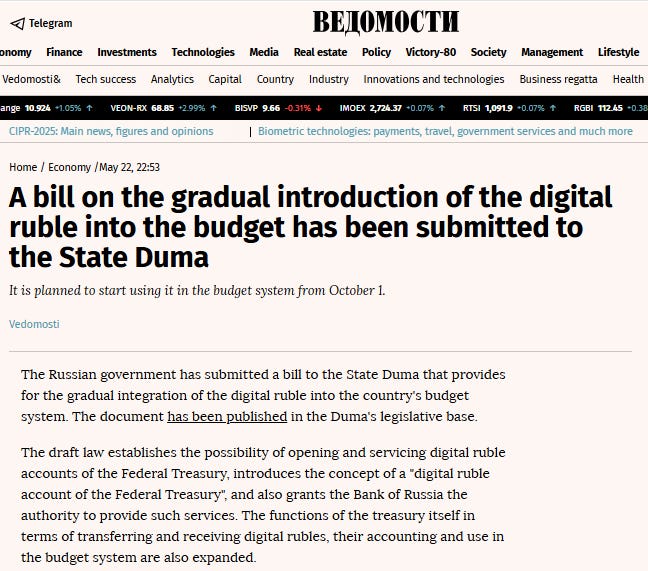
A draft law submitted to the State Duma at the end of May will permit the federal government to use the digital ruble to pay for a limited list of budget expenditures starting October 1. The full-scale use of the central bank-controlled digital currency for all types of budget payments will begin on January 1, 2026.

Russia adopted the digital ruble as its third form of legal currency, alongside the cash ruble and the electronic ruble, two years ago. While the “full-scale implementation” of the Bank of Russia’s CBDC (as publicly advocated for by Vladimir Putin last year) has been pushed back, the transition period for its introduction at the regional level is currently scheduled to begin on July 1, 2027. The draft law lists the same date as the deadline for credit institutions to offer clients access to the digital ruble platform.

source: vedomosti.ru

A week before the bill was submitted, the Bank of Russia launched an info-offensive against the conveniencephobes who spread malicious lies and innuendo about the safe, convenient, and forever-voluntary digital ruble.

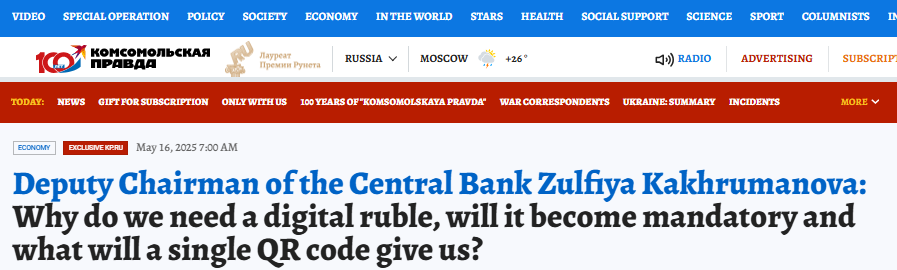
source: kp.ru

It wasn’t easy, though. Russia’s incredulous mainstream media had a lot of hard-hitting questions about the endless pitfalls of a programmable, centrally-controlled digital token issued by an entity that is not answerable to the Russian government.

Here’s how Komsomolskaya Pravda prefaced its interview with Bank of Russia Deputy Chairman Zulfiya Kakhrumanova:

[I]n the field of finance, we are ahead of the rest of the world! Well, or at least among the world leaders. The financial sector is one of the most technologically advanced in Russia, many countries would envy such a level of development of payment technologies. Large banks are actively introducing innovations that change and simplify our lives. And the rules of the game in this market are set by the Central Bank. And it also creates new entities. For example, the same digital ruble.

What changes await us in the coming years? And how will this affect our wallets? Zulfiya Kakhrumanova, Deputy Chairman of the Bank of Russia, spoke about this and much more in an exclusive interview with KP.RU

And they say journalism is dead. Shame on the people who say that. Shame!

With her feet to the fire, Kakhrumanova regurgitated the boilerplate talking points:

[What is the digital ruble?] It’s simple. The digital ruble is another form of Russian currency … And what’s important is that the choice of [what type of ruble to] use remains with the person. […]

It cannot be said that we are exactly following the Chinese path. But this is a global trend — to simplify life when making not only payments, but also any of our actions in any spheres. We have already gotten used to this convenience.

Rich and pungent word-dung, even for a Novgorod-based manure connoisseur such as myself. Unsurprisingly, the interview attracted the attention of numerous convenience-haters in Russia, including commentator Alexander Lezhava, who worked in the banking sector for many years before going rogue.

https://www.youtube-nocookie.com/embed/TAwN0fVCA-M?rel=0&autoplay=0&showinfo=0&enablejsapi=0

Responding to the KP interview, Lezhava wrote on his Telegram channel:

Another propaganda article from the Bank of Russia has appeared in Komsomolskaya Pravda. This time, the new deputy chairperson of the Central Bank of the Russian Federation, Zulfiya Kakhrumanova, sang hosannas to the digital ruble under the title “Why do we need a digital ruble, will it become mandatory, and what will a single QR code give us?”

There’s nothing new in what she said. It is a rehash of the same banalities from the Bank of Russia, criticisms of which they are unable to respond to intelligibly. There is no point in repeating the same thing, so it is much more interesting to look at this speech from the point of view of manipulation and logical errors.

The interview begins with an appeal to the readers’ feelings and an attempt to create some kind of positive emotional background:

“And yet, in the field of finance, we are ahead of the rest of the world! Or at least among the world leaders.”

This is necessary to evoke positive emotions in the reader and distract his attention from possible substantive criticism. In essence, this is an attempt to create a pseudo-reality, wherein the emotional background is used to shape public opinion in favor of the policy pursued by the central bank.

Then comes the manipulation, through a simplification:

“The digital ruble is another form of Russian currency… the choice of what to use is up to the individual.”

The complex system of the digital ruble is presented as a simple replacement for cash and non-cash funds – just a third type of currency, nothing interesting. At the same time, the potential risks and consequences with regard to maintaining the privacy of citizens and monitoring or managing them with this tool are ignored. This is a typical example of “manufacturing consent”, in which complex processes are simplified to the level of an inconsequential selection in order to reduce the level of critical thinking.

But that’s not all. She also has to underscore the divide between “us” and “them”:

“We are not following the Chinese path exactly. But this is a global trend…”

It is significant that the Chinese path and the introduction of the digital yuan are mentioned as a potentially negative thing, but at the same time she notes that the trend is global. Here, an external model is used to legitimize internal actions, but in such a way as not to associate it with one’s own policy, which is no different from the external one. (Surprisingly, the deputy chairperson did not bring up the Nigerian experience.)

Once again we see manipulation in her touting of the idea of freedom, or, rather, a false promise of freedom of choice:

“If a person does not want to use it [the digital ruble], he will continue to use the services he is accustomed to.”

The statement regarding the voluntary use of the digital ruble contradicts the possible creation of conditions and pressure from the Bank of Russia that can make it essentially mandatory. This is “managed democracy”, when freedom of choice is declared, but in practice it is limited by systemic factors.

At the same time, the Central Bank positions itself as an expert who “knows better”, although it provides no proof of this, and openly avoids open dialogue with the public. And when there was some interaction with the public on these matters, the Bank’s representatives came out on the losing side. This is called “elite management” — when officials of various kinds determine the direction of society’s development without taking into account the real needs of citizens. This is how it sounded this time:

“We predict what will be in demand in the coming years. We take into account the requests of market participants…”

The practical results of such forecasting are well known and have little correlation with real life, and it is practice that is the standard of truth.

Nevertheless, the Bank of Russia does not hesitate to openly manipulate hope, promising future well-being:

“The digital ruble platform is standardized… providing additional convenience for people.”

The idea of some future convenience and technological progress is used to justify current actions, without a detailed justification of their benefits. This approach is known as “technological determinism”. It presents the development of a technology as an end in itself, while the ethical and social consequences of its implementation and use are not taken into account. As our reader correctly noted, if you are unable to explain the usefulness of the digital ruble even to the former Minister of Finance, then what kind of convenience and usefulness are we even talking about?

There are also purely contradictory statements. They contain multidirectional ideas in order to satisfy different groups of readers but not give a clear position. For example, she asserts that there is a need to both unify and preserve the many payment systems, creating a logical contradiction:

“The QR code must be universal and recognized by any payment service…” but then “a universal QR will not eliminate all the different payment services.”

And need we even mention the concealment of information or the provision of incomplete information by the Bank of Russia:

“The digital ruble platform is a unified system… It is impossible to just steal them.”

This does not address the issues of who controls the platform, how data protection is ensured, or what risks there are for users. This is “information control”, when key issues are hushed up during the implementation of the project in order to avoid criticism and doubts. The Bank of Russia itself has previously admitted that digital ruble thefts will occur and that it will be difficult to get them back. The only thing that can be done is to follow them, where they go, but this will not help the victim, since they will already have been spent, and the Bank of Russia does not block channels for funneling stolen funds abroad.

At the moment, we have the following situation: The Bank of Russia forces banks, trade enterprises, and other market participants to invest billions of rubles into organizing the digital ruble infrastructure, with questionable benefit for society, instead of directing these resources to ensuring cyber security and preventing theft of funds from citizens.

How dare you, Mr. Lezhava. Don’t you read Simplicius the Thinker, the Internet’s #1 Thinker, who correctly observed that the digital ruble is a good CBDC that will remain eternally-voluntary as it karate-chops the globalists?

I mean, does Lezhava even read TASS?

source: tass.ru

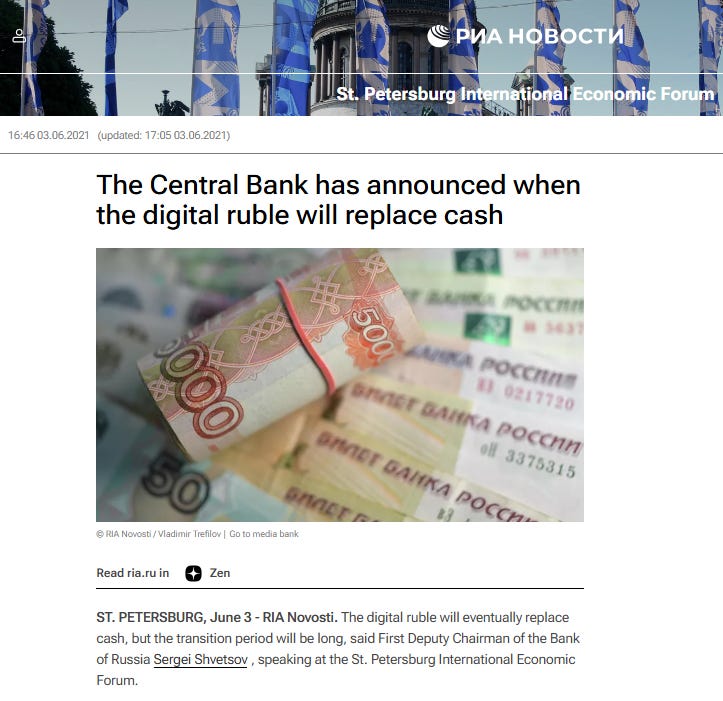
Here are some very inspirational words from First Deputy Chairman of the Bank of Russia Sergei Shvetsov, speaking at the St. Petersburg International Economic Forum in 2021, as quoted by Russian state media:

“Once again: we can thank the pandemic; paper spreads infection. You’ve heard of ‘dirty’ money, now we also have infectious money. This [cash] is probably a technology that’s on its way out, serving either ‘gray’ business or used when there is no alternative. Internet coverage is growing, gadgets are reaching the people. Russia is one of the leaders in this field, and thus we have a technology that allows us to replace cash with digital rubles,” he added.

[…]

“We have moved away from certain inconvenient forms of money. I think that cash will also be marginal at some point, in 10/20/30 years. The digital ruble will have to replace it. And the speed at which this product is created depends very much on our technological readiness,” [the First Deputy Chairman of the Bank of Russia] emphasized.

Yes. Good.

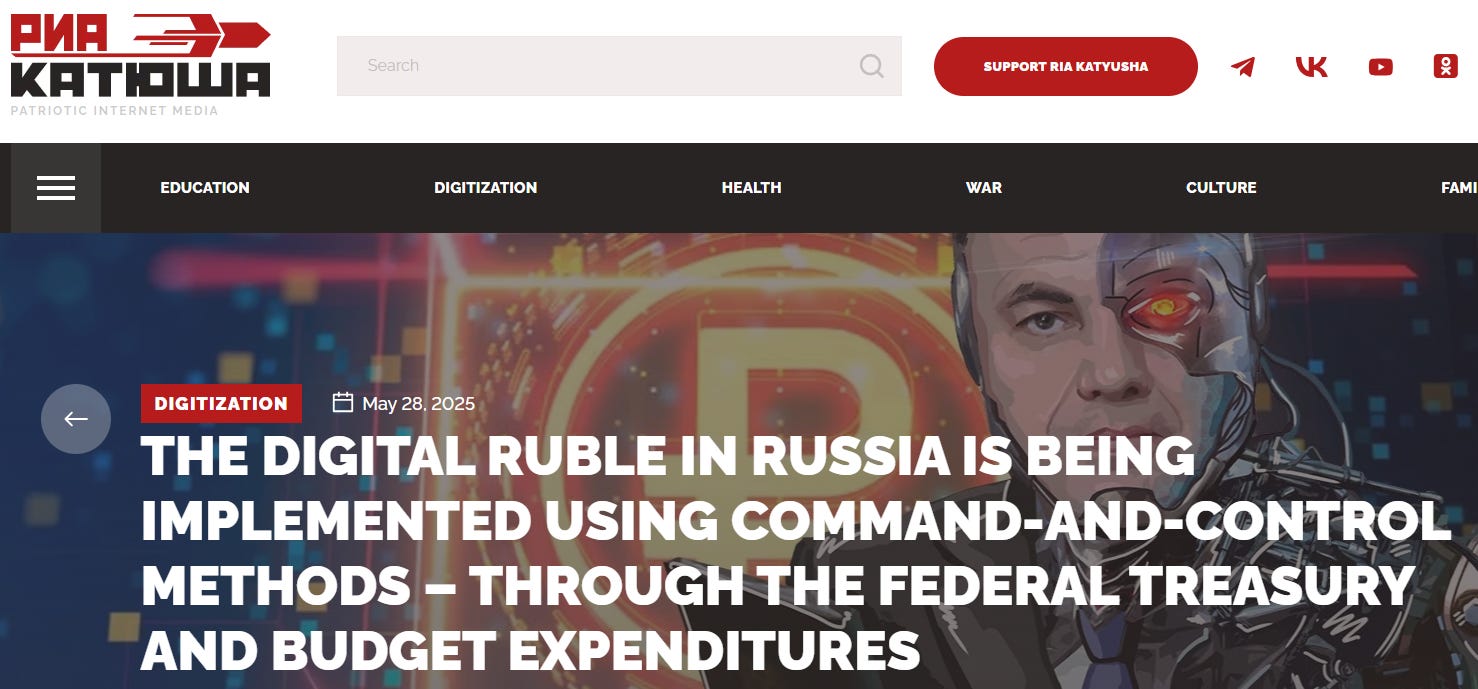
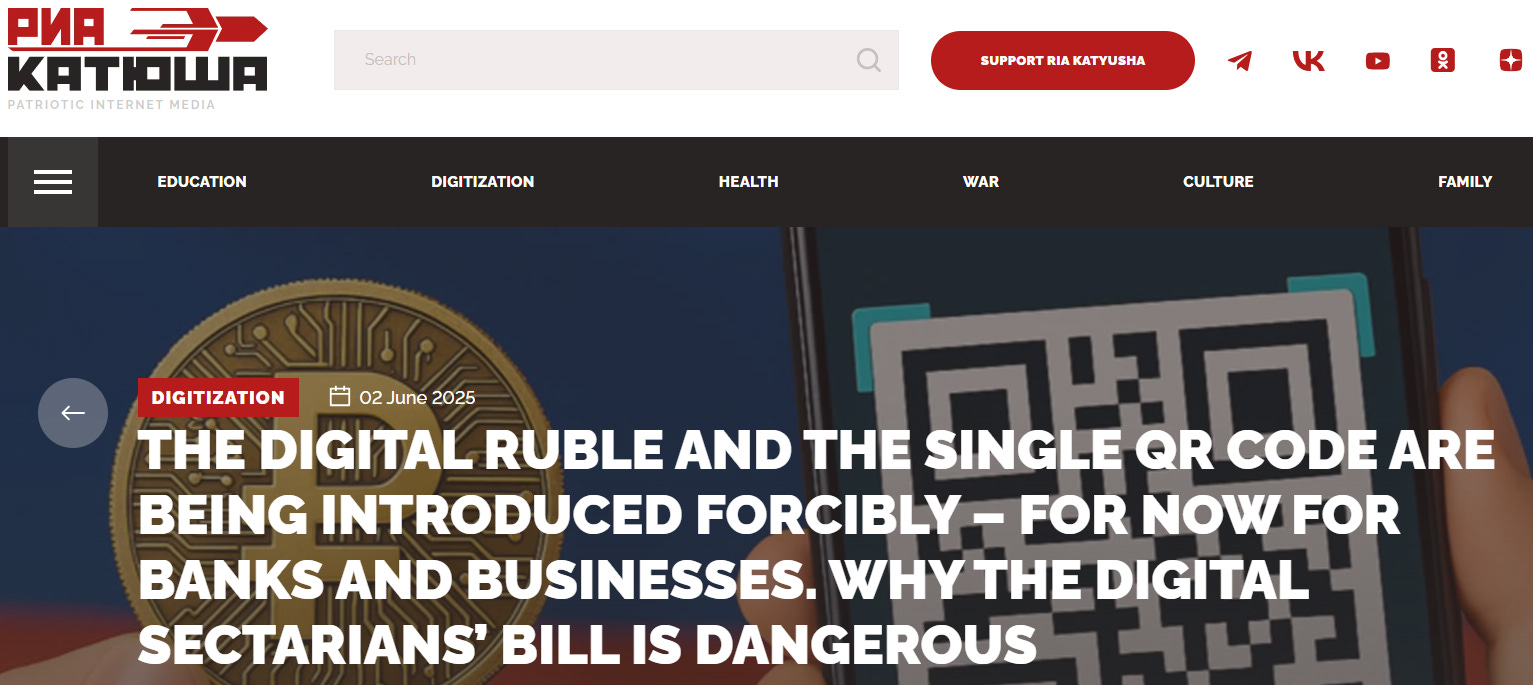
For more information on the World-Leading Convenience that awaits all Russians, read the latest offerings from Katyusha.org:

source: katyusha.org
source: Katyusha.org

James Carden: Democracy in Georgia Is Under Threat by the US Congress and the Helsinki Commission

By James Carden, Landmarks Magazine, 6/11/25

The following, by Simone Weil Center board member James Carden, first appeared in the Realist Review.

Tbilisi—It was Lincoln who once said “I would like to see someone proud of the place in which they live.” The 16th president never made it to the South Caucasus, but here reside a people quite justly proud of the place in which they live. Among the most striking differences between the vision offered to Georgian citizens by the ruling Georgian Dream (GD) party and by the Western-backed opposition parties is that the former is unabashedly so.

From the perspective of an American of rather longstanding, it seems the politics of the GD are not dissimilar to those of MAGA Republicans; Hungary’s Fidesz; France’s National Rally; Poland’s Law and Justice; or the UK’s Reform Party. The pro-NATO, pro-EU Georgian opposition coalition, having lost a democratic election by a convincing margin last October, continues to call for foreign powers (the US, the EU) to sanction members and funders of the GD. The bedraggled youth who sit in protest on the steps of the Georgian Parliament under the flags of a foreign powers are calling for those powers to sanction the legitimate winners of their country’s last national election: Do they not know what “democracy” means?

For some reason, the Georgian opposition thinks Washington and Brussels (a EU and NATO “Information Center” resides in a handsome building just off Tbilisi’s Freedom Square) have something to teach Georgia about democracy. Still worse, the illusion that Washington has both the right and duty to teach Georgia how to govern itself persists in the American media and in the halls of Congress.Pledge your support

***

The Helsinki Commission: A National Embarrassment

Last month Congress passed the MEGOBARI Act. Taking a page from Orwell (as Congress often inadvertently does) megobari is the Georgian word for ‘friend’—it is also, in the manner of these sorts of bills, an acronym for “Mobilizing and Enhancing Georgia’s Options for Building Accountability, Resilience, and Independence.

In reality it is a sanctions bill that seeks to cripple the financing behind the GD.

The bill is the hare-brained-child of the Helsinki Commission, a relic of the Cold War that now employs odd-ball-starved-for-social-media-attention staffers LARPing as freedom fighters for Ukraine.

Before we get to the specific problems with the MEGOBARI act, a few words about the Commission are perhaps in order. To be perfectly blunt, Congress should disband the Helsinki Commission, it is a national embarrassment. And has been for years. It is an unaccountable office that for the past decade and a half has prostituted itself to William Browder, a billionaire hedge fund manager who renounced his American citizenship.

Browder, the grandson of the Stalinist dupe Earl Browder, was tried and convicted in absentia by a Russian court on credible charges of tax evasion. To avoid being hauled back to Russia by Interpol, Browder spent untold sums in Washington, London, and many places besides, on an admittedly brilliant PR strategy that transformed him from a tax cheat into a human rights crusader, and, eventually (and unbelievably) into a Knight of the British Empire. One would have to be deeply stupid to have fallen for the act. But many have. For readers understandably unfamiliar with what kind of character Browder actually is, here is a video of him jumping out the backseat of a car and running down 51st St. in Manhattan to avoid being served a subpoena.

“Sir” William worked hand in glove with the Helsinki Commission’s adviser (now its Chief of Staff—they ‘fail up’ on Capitol Hill, you know), Kyle Parker, who last year found himself under investigation for acting as a foreign agent for Ukraine. Parker, deeply compromised by, among other things, his marriage to a Ukrainian woman, began to act as a freelance weapons dealer to further, you know, the real cause.

Congress, being what it is, promoted him.

In any event, Parker, and his financial patron Browder, crafted a fictional account of the death of Browder’s hapless accountant Sergei Magnitsky (Browder claims that Magnitsky was his attorney—another lie). Parker was later given a “Sergei Magnitsky Human Rights Award” by Browder for his efforts. An aside: Browder’s name never appears in the numerous accounts of foreign influence in Washington: Why would that be?

As a piece of fiction, the Magnitsky saga would have been trashed by critics as so far removed from reality that it could not be believed. For example: In his book Red Notice, Browder claims he got a late night call,

…That night, at 12:15 a.m., the voice mail alert on my BlackBerry vibrated. Nobody ever called my BlackBerry. No one even knew the number. I looked at Elena and dialed into voice mail.…I heard a man in the midst of a savage beating. He was screaming and pleading. The recording lasted about two minutes and cut mid-wail.” He writes, As soon as the sun came up, I called everyone I knew. They were all okay. The only person I couldn’t call was Sergei.”

As the award winning investigative journalist Lucy Komisar, the only American journalist to have exposed the Browder fraud, notes,

…Imagine Magnitsky, handcuffed based on what Browder claims and the bruises found on his wrists, being beaten by, Browder says, eight riot guards.

Magnitsky: “Hey guys, I have to make a phone call. Can we take a break?”

Even Magnitsky’s mother doesn’t believe the story Browder peddled. But then again, she’s clearly brighter than the staff of the Helsinki Commission which took Browder’s claims at face value (no investigation was ever done to validate any part of Browder’s tale) and duly drew up the 2012 Sergei Magnitsky Rule of Law Accountability Act, a sanctions bill against Russia and one that effectively stuck a dagger into the heart of President Obama’s “reset” policy and put the US squarely on track for a new and even more perilous Cold War.

But that was the goal all along. Browder’s tale, sold to a credulous media, was weaponized by the Helsinki Commission in the service of a policy favored by neoconservatives in Congress—a policy that, allow me to add, subverted the foreign policy of a duly elected President of the United States.

Democracy in action.

***

Old Habits Die Hard

The Helsinki Commission is at it again—this time it has Russia’s southern neighbor, Georgia in its sights. And naturally Russia is both the pretext and the ultimate target. Helsinki Commission chairman Joe Wilson (R-SC) and ranking member Steve Cohen (D-TN) praised the passage of their bipartisan effort to overturn the Georgian election. Cohen, a loud and unscrupulous peddler of the Russiagate conspiracy, said the act “sends a strong message to the Georgian people that the U.S. supports them as they fight for their democracy.”

In fact it does the opposite.

In reality, the act demands that Georgians relinquish their right to vote for whom they want to vote. Indeed, the MEGOBARI act is based on the faulty premise that the GD is riddled with Russian influence—in the manner it was alleged that Ukraine’s ill-fated Party of Regions was said to have been a proxy for Russian interests in that country. I suspect that all the GD wants are simply non-hostile relations with their restive northern neighbor. But that, in the eyes of the zealots on the Helsinki Commission, is a grave sin not to be countenanced.

The passage of the MEGOBARI act (which President Trump should veto if it ever makes it to his desk) only serves to alienate a small, friendly, Christian country in a very tough neighborhood. Bounded by Russia to the north, Islamist Turkey to the West, and another Islamist dictatorship to the East in Azerbaijan—Georgia would be far better off charting its own path—free of dictates emanating out of Washington or Moscow or, for that matter, Beijing.

Election interference is something we Americans deplore. We should practice what we preach.